
Between Parents and Screens: The Impact of Parental Support and
Gadget Use on EFL Learning in Early Childhood
Marsika Sepyanda
a
and Fenni Kurnia Mutiya
b
1
Department of Sport Science, Faculty of Sports Science, Universitas Negeri Padang, Indonesia
2
Department of Statistics, Faculty of Mathematics and Natural Sciences, Universitas Negeri Padang, Indonesia
Keywords: Parental Support, Gadget Use, EFL, Early Childhood, Screen Time.
Abstract: This study explores the impact of parental involvement and gadget use on early English as a Foreign Language
(EFL) acquisition among preschool-aged children. In the recent digital age, young learners are increasingly
exposed to screen-based media, while the role of parents remains critical in shaping children's language
development. This study was a quantitative correlational design which involved 65 parents of children aged
4 to 6 years. They were selected through volunteer random sampling. Data were collected using a structured
questionnaire including 26 Likert-scale items divided into three parts: parental involvement, gadget use, and
EFL acquisition. Statistical analysis discovered that both parental involvement and gadget use significantly
correlated with children’s language development, with a higher correlation for parental involvement (r =
0.6909) compared to gadget use (r = 0.5238). Multiple regression analysis showed that 65.36% of the variance
in EFL acquisition was explained by the two variables combined, with parental involvement (β = 0.53111)
employing a stronger influence than gadget use (β = 0.28867). These findings suggest that active parental
engagement through language-rich interaction and guided screen mediation plays a dominant role in
encouraging early EFL learning, while responsible gadget use helps as a supportive tool. The study
emphasizes the importance of involving parents in home-based language practices and promoting digital
literacy strategies to optimize early language development in young learners.
1 INTRODUCTION
In the rapid growth of the technology era, digital
media has become an inseparable part of early
childhood living experiences. The use of mobile
devices, smartphones, and other types of gadgets by
children has merged globally, often beginning as
early as the first year of life. As a result, young
learners are increasingly exposed to screen-based
content, including educational applications and
language learning tools. While this shift offers new
opportunities for enhancing English as a Foreign
Language (EFL) instruction in early childhood, it also
raises concerns about developmental and linguistic
risks, especially when screen time replaces
interactive, human-mediated learning (Al Hosani et
al.; Axelsson et al.).
Besides the development of technology, early
childhood education and parental involvement have
a
https://orcid.org/0000-0002-8149-2267
b
https://orcid.org/0009-0007-5449-6821
become increasingly significant, particularly in
contexts where English as a Foreign Language (EFL)
learning is introduced at a young age. As digital
devices such as smartphones and tablets become
increasingly accessible to children, their presence in
early learning environments, whether they are both
formal and informal, brings important questions
about their pedagogical potential and developmental
impact (Srinahyanti et al.; Rizki et al.; Maiziani and
Amilia). In early childhood, when linguistic,
cognitive, and social foundations are rapidly
developing, the role of digital media should be
carefully evaluated, especially when it relates to
second language acquisition.
Previous research recognized that screen exposure
can influence language development in both positive
and negative ways (Ghofururrohim et al.; Srinahyanti
et al.). On one hand, digital tools may facilitate early
language learning through interactive storytelling,
Sepyanda, M. and Mutiya, F. K.
Between Parents and Screens: The Impact of Parental Support and Gadget Use on EFL Learning in Early Childhood.
DOI: 10.5220/0014068200004935
Paper published under CC license (CC BY-NC-ND 4.0)
In Proceedings of the 7th International Conference on Early Childhood Education (ICECE 2025) - Meaningful, Mindful, and Joyful Learning in Early Childhood Education, pages 17-23
ISBN: 978-989-758-788-7; ISSN: 3051-7702
Proceedings Copyright © 2025 by SCITEPRESS – Science and Technology Publications, Lda.
17

phonics games, and visual vocabulary development
(Habibie; Damar et al.). On the other hand,
unregulated or excessive screen use in early
childhood has been associated with delays in speech,
limited expressive language, and reductions in
parent–child verbal interactions (Al Hosani et al.;
Hutton et al.; Liu et al.). As children’s screen time
increases, there is often a corresponding decrease in
the quality and quantity of caregiver–child
communication, which is essential for effective EFL
learning (Ewin et al.; Moon et al.).
The growing exposure of young children to digital
technologies has prompted educators and researchers
to investigate how gadgets influence EFL learning.
On one hand, educational applications, videos, and
interactive platforms can offer engaging,
multisensory experiences that support vocabulary
acquisition, phonological awareness, and
communicative competence (Najiha et al.). On the
other hand, concerns have been raised regarding the
passive consumption of content, overreliance on
screen-based input, and potential delays in expressive
language development due to excessive or
unsupervised screen time (Stiglic and Viner; Liu et
al.)
In this digital learning era, parental support
emerges as a critical factor. Parents act not only as
facilitators of digital access but also as mediators who
figure out children’s experiences with technology
through guidance, monitoring, and participation (Ho
et al.; Pek and Mee; Lanjekar et al.). Previous
research shows that co-viewing and active mediation
strategies can significantly improve children’s
comprehension and language outcomes during digital
interactions (Najiha et al.; Moorhouse and
Beaumont). This is especially crucial in EFL
contexts, where children's limited exposure to
English in their environment makes scaffolded
interaction essential.
Therefore, the effectiveness of EFL learning in
early childhood is not only determined by the
presence of digital tools, but by the quality of parental
involvement in those learning episodes. Parents’
digital literacy and beliefs about technology also play
a substantial role in shaping children's screen habits
and language learning outcome (Clinton and Hattie;
Rahayu et al.; Chasanah and Pranoto). For example,
a study highlights that when parents possess strong
digital capabilities, they are more likely to curate and
engage with appropriate language-learning content
for their children (Garim and Latief).
However, gaps in parental digital literacy, time
availability, and awareness of EFL pedagogical
practices present challenges in optimizing gadget use
for learning. Moreover, the shift toward screen-based
education during the COVID-19 pandemic has
further intensified the dependency on home support
systems, revealing both opportunities and limitations
of parental roles in early EFL instruction (Jong et al.;
Pek and Mee).
Related to the increasing relevance of screen-
based media in early education and the crucial role of
parents in mediating its use, this study aims to
investigate the relationship between parental support,
gadget use, and early EFL acquisition. Specifically, it
examines how parents’ engagement, control
strategies, and perceptions of technology affect their
children’s English language exposure and
development. By focusing on young learners in EFL
settings, the study aims to contribute to a deeper
understanding of how digital and familial
environments connection to support or hinder
language learning in early childhood.
2 METHOD
This study conducted a quantitative correlational
design to explore the relationship between parental
support, gadget use, and children’s English as a
Foreign Language (EFL) acquisition. A correlational
approach is appropriate when examining the degree
to which independent variables where in this case,
parental involvement and gadget use are related to a
dependent variable (language acquisition) without
manipulating any variables (Creswell and Creswell).
Participants were selected using non-probability
volunteer sampling because the total population was
unknown. A total of 65 parents of early childhood
learners participated in the study, representing
various educational and occupational backgrounds.
Data were collected using a structured questionnaire
consisting of three main sections: parental support,
gadget use, and EFL acquisition. Items were
measured using a 5-point Likert scale. The
questionnaire was adapted from previous validated
instruments and pilot-tested for clarity and relevance.
To ensure quality, the instrument underwent
validity and reliability testing. Content validity was
reviewed by experts, while construct validity was
checked through item-total correlations. Cronbach’s
alpha coefficients for all scales exceeded 0.70,
indicating strong internal consistency (Nunnally &
Bernstein, 1994). Data were also tested for normality,
and all assumptions were met. Statistical analysis
using multiple linear regression revealed that parental
support and gadget use accounted for 65.36% of the
variance in children's EFL development, suggesting a
ICECE 2025 - The International Conference on Early Childhood Education
18
strong combined influence on language learning
outcomes.
3 RESULT AND DISCUSSION
3.1 Result
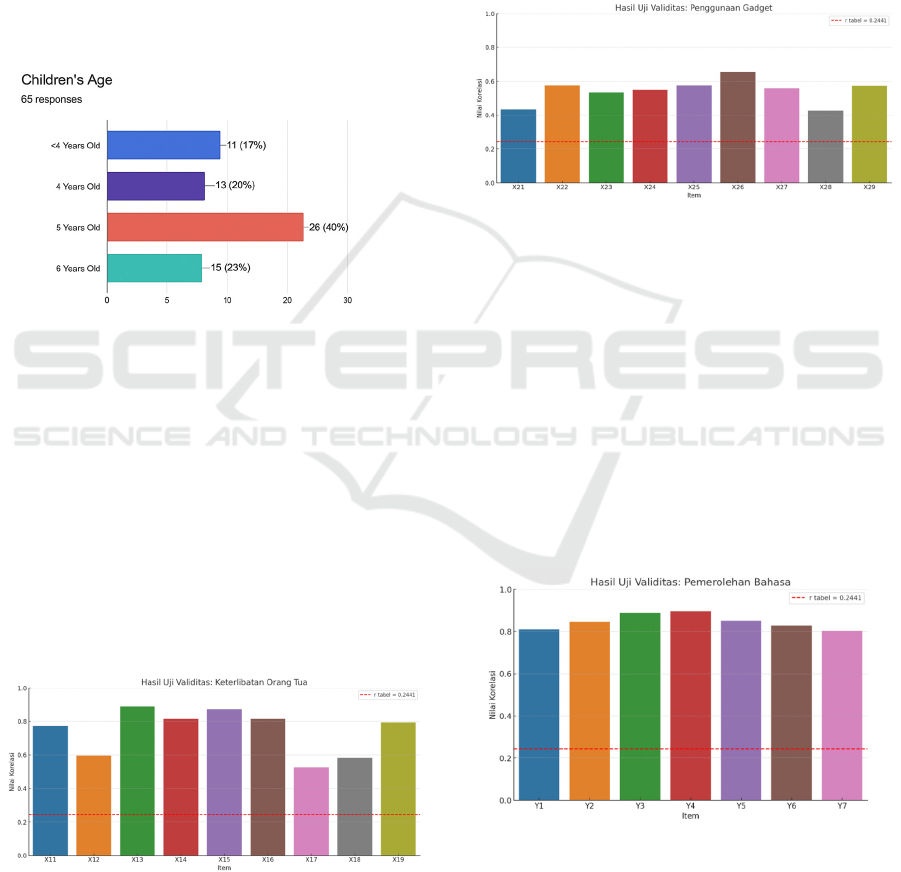
Based on the questionnaire distributed to the
respondents, there were 65 parents who give
information related to the parental support, gadget use
and early EFL acquisition. The data can be seen on
the following graph.
Figure 1: Classification of the Children based on the Age.
3.1.1 Validity Testing
The validity test ensures that each item in the
questionnaire accurately measures the intended
variable. Using Pearson Product Moment correlation
(α = 0.05, r-table = 0.2441), all questionnaire items
for the three variables (Parental Involvement, Gadget
Use, and Language Acquisition) showed correlation
coefficients higher than the threshold. It indicates that
all items are statistically valid.
The following bar charts show the correlation
coefficients of each item, clearly above the r-table
reference line (0.2441), reinforcing their validity:
Figure 2: Validity Results for Parental Involvement.
Figure 2 above presents the validity test results for
the questionnaire items measuring parental
involvement in early childhood EFL learning. Using
the Pearson Product Moment correlation technique
with a significance level of 0.05 and a critical r-table
value of 0.2441 (df = 63), all nine items (X11 to X19)
exceeded the threshold, with correlation coefficients
ranging from 0.5249 to 0.8892. This indicates that
each item strongly correlates with the overall
construct and is statistically valid. The high validity
confirms that the instrument effectively captures the
multidimensional aspects of parental involvement,
including monitoring, guidance, and language
support at home.
Figure 3: Validity Results for Gadget Use.
Figure 3 illustrates the validity test outcomes for
items assessing children's gadget usage. All nine
items (X21 to X29) demonstrated significant positive
correlations with the total score, with correlation
coefficients ranging from 0.4264 to 0.6557, well
above the minimum required r-value of 0.2441. These
results suggest that each item reliably measures
different dimensions of gadget use, such as duration,
purpose, parental control, and content exposure. The
overall statistical validity supports the inclusion of
these items in the final instrument, ensuring accurate
measurement of how digital device engagement
intersects with early language development.
Figure 4: Validity Results for Language Acquisition.
Figure 4 displays the validity analysis for
questionnaire items related to children's language
acquisition. The correlation coefficients for the seven
items (Y1 to Y7) range between 0.8033 and 0.8949,
Between Parents and Screens: The Impact of Parental Support and Gadget Use on EFL Learning in Early Childhood
19

all surpassing the critical r-value of 0.2441. These
high correlations signify that each item is a valid
measure of the children's language acquisition
abilities, including vocabulary range, sentence
formulation, comprehension, and verbal expression.
The strong item-total correlations confirm that the
instrument is statistically sound and capable of
capturing key indicators of EFL language
development in early childhood learners.
3.1.2 Reliability Testing
The reliability test in this study was conducted using
the Cronbach’s Alpha formula to evaluate the internal
consistency of the questionnaire items. Internal
consistency refers to the degree to which the items
within a scale are correlated, indicating they measure
the same underlying construct (Tavakol & Dennick,
2011). The higher the Cronbach’s Alpha value, the
greater the reliability of the instrument. According to
George and Mallery (2003), a Cronbach’s Alpha
value above 0.7 is generally considered acceptable,
with values above 0.8 indicating good reliability and
values above 0.9 considered excellent. The formula
used to calculate Cronbach’s Alpha is as follows:
𝛼
𝑘
𝑘1
1
Σvar𝑥
𝑣𝑎𝑟𝑥
This formula helps quantify the proportion of the
total score variance that is attributable to true score
variance rather than measurement error. In this study,
reliability testing showed that the instruments used to
measure parental involvement, gadget use, and
language acquisition demonstrated high internal
consistency, thereby confirming the reliability of the
questionnaire for further data analysis. The result can
be seen as follow.
𝛼
9
9 1
1
11,6712
58,5096
0,9006
It can be seen that, he reliability coefficient for the
parental involvement variable is 0.9006, which
indicates a very high level of internal consistency
among the questionnaire items. This suggests that the
items effectively and consistently measure the
construct of parental involvement in early childhood
EFL learning.
𝛼
9
9 1
1
10,6798
27,7091
0,6914
The Cronbach’s Alpha value for the gadget use
variable is 0.6914, which falls within the acceptable
range of reliability. Although slightly below the
commonly recommended threshold of 0.70, the
consistency is still considered adequate for early-
stage research or exploratory studies.
𝛼
7
7 1
1
7,3260
36,4197
0,9320
With an alpha value of 0.9320, the instrument
used to measure language acquisition demonstrates
excellent internal reliability. This very high score
confirms that the items reliably capture the construct
of EFL language development in early childhood.
These results indicate that the questionnaires are
reliable and consistent for data collection, as most
coefficients are above the recommended threshold of
0.70.
3.1.3 Normality Testing
The normality test was conducted to determine
whether the data distribution met the assumption of
normality, which is a key requirement for many
parametric statistical analyses. The Shapiro–Wilk test
was used in this study, as it is well-suited for small to
moderate sample sizes and provides a reliable
measure of distribution normality (Shapiro & Wilk,
1965). The criterion for normality is that the p-value
should be greater than the significance level (α =
0.05). The result of the test, conducted using R
software, yielded a p-value of 0.6731, which is well
above the threshold. Therefore, it can be concluded
that the residuals are normally distributed, fulfilling
the assumption necessary for further inferential
analysis.
Figure 5: Normality Results.
3.1.4 Correlation Analysis
To examine the strength of the relationship between
the independent variables (Parental Involvement and
Gadget Use) and the dependent variable (Language
Acquisition), a Pearson correlation analysis was
performed.
Table 1: Correlation results.
Variable Pair Pearson r Interpretation
Parental Involvement
& Language
Acquisition
0.680 Strong positive
correlation
Gadget Use &
Language Acquisition
0.497 Moderate
positive
correlation
ICECE 2025 - The International Conference on Early Childhood Education
20
Based on the table above, it can be seen that the
correlation coefficient of 0.680 between parental
involvement and language acquisition suggests a
strong and statistically meaningful positive
relationship. This means that greater parental
involvement tends to be associated with higher levels
of early childhood EFL acquisition. The correlation
between gadget use and language acquisition is
moderate (r = 0.497), indicating that gadget use also
plays a supportive role in language learning, though
not as strong as parental involvement.
Moreover, the results of the study show a
statistically significant relationship between parental
support, gadget use, and early childhood EFL
acquisition. Based on the multiple linear regression
analysis, the adjusted R² value was 0.6536,
suggesting that 65.36% of the variance in children’s
English language acquisition can be explained by the
combination of parental support and gadget use. This
represents a strong model fit, implying that both
factors jointly contribute substantially to language
learning outcomes.
The regression equation generated is:
Y = 0.72228 + 0.53111X₁ + 0.28867X₂ + ε,
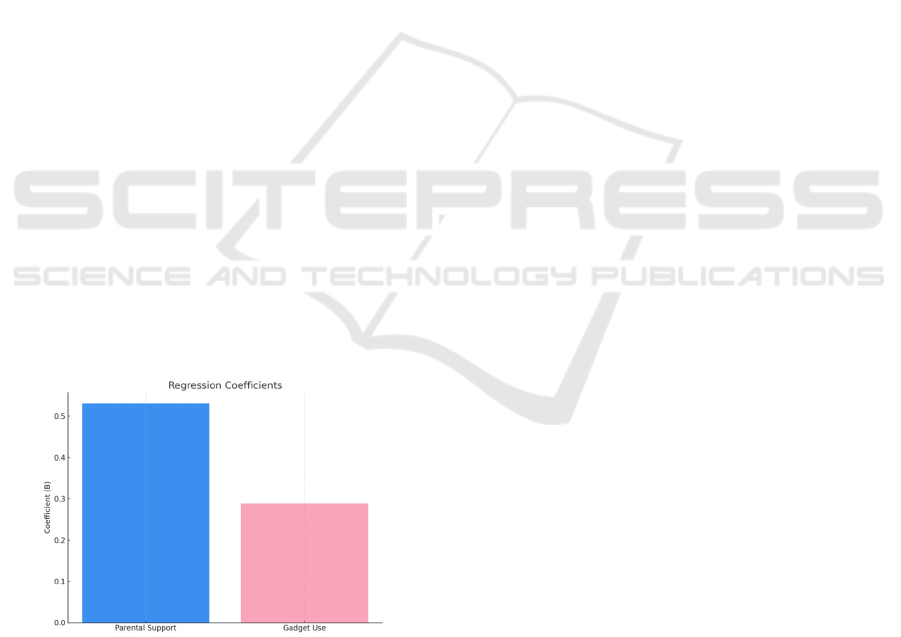
In this study, X₁ represents parental support and
X₂ represents gadget use. The coefficient for parental
support (B = 0.53111) was higher than that of gadget
use (B = 0.28867), indicating that parental
involvement had a stronger influence on children’s
EFL development compared to digital device usage.
These findings are visually presented in the
following bar chart, showing the magnitude of each
independent variable's contribution:
Figure 6: Regression Coefficient.
These results support the assumption that parental
support remains a dominant factor in facilitating early
EFL learning, while responsible gadget use can serve
as a meaningful supplement when guided effectively.
The significant regression coefficients and strong
correlation values reinforce the importance of
parental involvement as a consistent and powerful
influence on children's language acquisition. At the
same time, the moderate yet positive impact of gadget
use indicates that digital tools, when appropriately
monitored and integrated into children's routines, can
contribute constructively to their language
development. Therefore, these findings highlight the
necessity of a balanced approach, where traditional
parenting roles are complemented by the strategic use
of technology to optimize early English language
learning outcomes.
3.2 Discussion
The findings of this study emphasize the strong
influence of parental involvement in early EFL
learning. The regression results show that parental
involvement (X
1
) holds a higher coefficient (0.53111)
than gadget use, indicating that parents' active
participation has a more significant impact on
children's language acquisition. This supports
Vygotsky’s Sociocultural Theory, which argues that
social interaction and scaffolding provided by more
knowledgeable others such as parents which are
essential for cognitive and linguistic development.
When parents engage directly with their children
during learning activities, they create a zone of
proximal development that enables more effective
language acquisition.
While gadget use (X
2
) also demonstrated a
positive contribution to EFL learning (coefficient =
0.28867), its effect was notably smaller. This
suggests that while technology can serve as a
supportive tool, it should not be seen as a replacement
for human interaction. Previous research affirms this
view; for example, Plowman et al. (2012) and
Habibie (2021) highlight that digital tools can
enhance learning only when integrated thoughtfully
and when they complement rather than replace
interpersonal engagement. The key is not the
presence of gadgets, but the quality of interaction
surrounding their use.
This study also underlines the importance of
digital parenting and guided mediation. When parents
co-view, discuss, or guide their children’s screen
experiences, the linguistic benefits are significantly
enhanced. Estrada Chichón (2022) and Najiha et al.
(2023) found that such active mediation leads to
better vocabulary growth and comprehension in early
learners, compared to unmediated or passive screen
use. These findings align with the results of the
current study, emphasizing that digital learning
environments require parental scaffolding to be truly
effective.
Between Parents and Screens: The Impact of Parental Support and Gadget Use on EFL Learning in Early Childhood
21

Moreover, the results in line with previous studies
showing that interaction matters more than exposure.
According to Hirsh-Pasek et al. (2015), the duration
of screen time alone does not predict language gains.
Instead of that, it is the interactional quality, such as
talking about the content, asking questions, and
relating it to real-life experiences, that facilitates
learning. Therefore, meaningful engagement, rather
than mere access to digital content, is what enhances
early language development.
Finally, the remaining 34.64% of unexplained
variance points to the possibility of other influential
factors not captured in this study. Elements such as
socioeconomic status, the home literacy environment,
parental education, and language exposure at school
may also contribute to children’s EFL proficiency.
This indicates a need for future research to adopt a
more holistic perspective, incorporating both
environmental and individual variables to provide a
fuller understanding of the mechanisms underlying
early language learning.
In light of these findings, several implications for
parents and educators emerge. There is a growing
need to educate parents not only on limiting screen
time but also on how to optimize digital tools for
language enrichment. Schools and early childhood
educators may consider developing programs that
combine interpersonal strategies and digital learning,
while also encouraging more parental involvement in
the language development process. This integrative
approach could help bridge the gap between home
and school, technology and human connection,
ultimately supporting young learners in their journey
toward EFL proficiency.
4 CONCLUSIONS
It can be concluded that parental involvement has a
significantly stronger role than gadget use in
supporting early childhood English language
acquisition. The correlation analysis revealed a strong
positive relationship between parental involvement
and language acquisition (r = 0.6909), while gadget
use also showed a moderate positive correlation (r =
0.5238). These findings suggest that while both
variables are beneficial, consistent and engaged
parental support has a greater impact on children’s
EFL development. Moreover, the effectiveness of
gadget use depends on guided mediation and
meaningful interaction, underscoring the importance
of human engagement in digital learning contexts.
Therefore, digital tools should be used to create a
balance part, not to replace, active parental
involvement in early language learning.
REFERENCES
Al Hosani, Salwa Salem, et al. “Screen Time and Speech
and Language Delay in Children Aged 12–48 Months
in UAE: A Case–Control Study.” Middle East Current
Psychiatry, vol.30, no. 1, 2023, pp. 4–11,
https://doi.org/10.1186/s43045-023-00318-0.
Axelsson, Emma L., et al. “Preschoolers’ Engagement with
Screen Content and Associations with Sleep and
Cognitive Development.” Acta Psychologica, vol. 230,
no. August, 2022, p. 103762, https://doi.org/10.101
6/j.actpsy.2022.103762.
Chasanah, Naila, and Yuli Kurniawati Sugiyo Pranoto.
“Parental Guidance for Gadget Use during Early
Childhood.” Jurnal Pendidikan Dan Pengajaran, vol.
56, no. 3, 2023, pp. 501–08, https://doi.org/10.23887
/jpp.v56i3.66501.
Clinton, Janet, and John Hattie. “New Zealand Students’
Perceptions of Parental Involvement in Learning and
Schooling.” Asia Pacific Journal of Education, vol. 33,
no. 3, 2013, pp. 324–37, https://doi.org/10.1080/02
188791.2013.786679.
Creswell, John W., and J. David Creswell. “Mixed Methods
Procedures.” Research Defign: Qualitative,
Quantitative, and Mixed M Ethods Approaches, SAGE
Publications, 2018.
Damar, Ebru Atak, et al. “Teaching English to Young
Learners: Through the Eyes of EFL Teacher Trainers.”
ELT Research Journal, vol. 2, no. 3, 2013, pp. 95–110.
Ewin, Carrie A., et al. “Mobile Devices Compared to Non-
Digital Toy Play: The Impact of Activity Type on the
Quality and Quantity of Parent Language.” Computers
in Human Behavior, vol. 118, no. December 2020,
2021, p. 106669, https://doi.org/10.1016/j.chb.
2020.106669.
Garim, Idawati, and Nurlaela Latief. “Writing with Cultural
Insight: Elevating Analytical Exposition through Local
Culture and Project-Based Learning.” International
Journal of Language Education, vol. 7, no. 4, 2023, pp.
711–28.
Ghofururrohim, Noor Muhammad, et al. “Pengaruh
Smartphone Terhadap Anak Usia Dini.” Education :
Jurnal Sosial Humaniora Dan Pendidikan, vol. 3, no.
2, 2023, pp. 129–46, https://doi.org/10.51903/edu
cation.v3i2.340.
Habibie, Alvons. “Exploring the Use of Mobile Assisted
Language Learning in University Students Context.”
Scope : Journal of English Language Teaching, vol. 5,
no. 2, 2021, p. 51, https://doi.org/10.30998/scope
.v5i2.8537.
Ho, Hui Ru, et al. “SET-PAiREd: Designing for Parental
Involvement in Learning with an AI-Assisted
Educational Robot.” Conference on Human Factors in
Computing Systems, 2025, https://doi.org/10.1145
/3706598.3713330.
ICECE 2025 - The International Conference on Early Childhood Education
22

Hutton, John S., et al. “Associations between Screen-Based
Media Use and Brain White Matter Integrity in
Preschool-Aged Children.” JAMA Pediatrics, vol. 174,
no. 1, 2020, pp. 1–10, https://doi.org/10.1001/jam
apediatrics.2019.3869.
Jong, Peter F. de, et al. “Parent–Child Conflict during
Homeschooling in Times of the COVID-19 Pandemic:
A Key Role for Mothers’ Self-Efficacy in Teaching.”
Contemporary Educational Psychology, vol. 70, July
2022, pp. 1–4, https://doi.org/10.1016/J.CEDP
SYCH.2022.102083.
Lanjekar, Purva D, et al. “The Effect of Parenting and the
Parent-Child Relationship on a Child’s Cognitive
Development: A Literature Review.” Cureus, vol. 14,
no. 10, 2022, https://doi.org/10.7759/cureus.30574.
Liu, Wenwen, et al. “Early Childhood Screen Time as a
Predictor of Emotional and Behavioral Problems in
Children at 4 Years: A Birth Cohort Study in China.”
Environmental Health and Preventive Medicine, vol.
26, no. 1, 2021, pp. 1–9, https://doi.org/10.1186/s1219
9-020-00926-w.
Maiziani, Fitri, and Winanda Amilia. “Pemanfaatan Gadget
Oleh Anak Usia Dini Pada Era Digital Native Dalam
Rangka Pemerolehan Bahasa Inggris.” E-Tech Journal,
vol. 8, no. 2, 2020, pp. 1–4, https://doi.org/10.1007/
XXXXXX-XX-0000-00.
Moon, Jin Hwa, et al. “Smart Device Usage in Early
Childhood Is Differentially Associated with Fine Motor
and Language Development.” Acta Paediatrica,
International Journal of Paediatrics, vol. 108, no. 5,
2019, pp. 903–10, https://doi.org/10.1111/apa.14623.
Moorhouse, Benjamin L., and Andrew M. Beaumont.
“Involving Parents in Their Children’s School-Based
English Language Writing Using Digital Learning.”
RELC Journal, vol. 51, no. 2, 2020, pp. 259–67,
https://doi.org/10.1177/0033688219859937.
Najiha, Nasratun, et al. “The Role of Parents in Stimulating
Early Children’s Language Development Through
Smartphone Use.” JOYCED: Journal of Early
Childhood Education, vol. 3, no. 1, 2023, pp. 10–18,
https://doi.org/10.14421/joyced.2023.31-02.
Pek, Lim Seong, and Rita Wong Mee Mee. “Parental
Involvement on Child’S Education At Home During
School Lockdown.” JHSS (Journal of Humanities and
Social Studies), vol. 4, no. 2, 2020, pp. 192–96,
https://doi.org/10.33751/jhss.v4i2.2502.
Rahayu, Nur Sri, et al. “Penggunaan Gadget Pada Anak
Usia Dini.” Jurnal PAUD Agapedia, vol. 5, no. 2, 2022,
pp. 202–10, https://doi.org/10.36418/syntax-impera
tif.v1i5.159.
Rizki, Mohammad Tri, et al. “Parent Assistance in the Use
of Gadgets for Early Childhood Learning Process.”
Innovative Journal of Curriculum and Educational
Technology, vol. 10, no. 1, 2021, pp. 132–39.
Srinahyanti, Srinahyanti, et al. “Influence of Gadget: A
Positive and Negative Impact of Smartphone Usage for
Early Child.” ACEIVE, 2019, https://doi.org/10.4108
/eai.3-11-2018.2285692.
Stiglic, N., and R. M. Viner. “Effects of Screentime on the
Health and Well-Being of Children and Adolescents: A
Systematic Review of Reviews.” BMJ Open, vol. 9,
2019, p. 23191, https://doi.org/10.1136/bmjopen-2018-
023191.
Between Parents and Screens: The Impact of Parental Support and Gadget Use on EFL Learning in Early Childhood
23
