
Balanced Nutrition Education Strategy Through Local Culinary
for Early Childhood
Nerru Pranuta Murnaka
1a
and Marini
2b*
1
Postgraduate Department of Science Education, Faculty of Teacher Training and Education,
Parahyangan Catholic University Bandung, Indonesia
2
Department of Early Childhood Education, Faculty of Education IVET University, Semarang, Indonesia
Keywords: Balanced Nutrition, Eating Patterns, Nutritious Food, Early Childhood, Systematic Review.
Abstract: Early childhood is known as the golden age, a critical period for physical growth and brain development.
During this stage, the intake of nutritious food significantly influences a child's physical development and the
maturation of the brain's nervous system, which serves as the center of cognitive function. Conversely, a
deficiency in essential nutrients can negatively affect brain development and reduce a child's learning
potential. Early Childhood Education (ECE) serves as a strategic avenue for instilling an understanding of the
importance of balanced nutrition from an early age through engaging approaches that align with children's
developmental characteristics. This study explores various theories and strategies for nutrition education that
can be applied within the context of ECE in Central Java. A systematic review method was employed to
examine and synthesize relevant studies related to nutrition education for early childhood. The data sources
used in this study include nationally accredited journals, and reputable international journals. The literature
review reveals that learning-through-play approaches, the integration of nutrition themes into the curriculum,
and the active involvement of both parents and teachers are effective strategies for enhancing children's
understanding of healthy eating. The findings of this review are expected to serve as a foundation for
developing a balanced nutrition education model that optimally supports brain development and intelligence
in early childhood, particularly in the Central Java region.
1 INTRODUCTION
Early childhood is recognized as a crucial phase in
human development, as it is during this period that
physical, cognitive, social, and emotional growth
occurs and progresses rapidly. This stage is often
referred to as the "golden age." To support optimal
growth and development during this period, an
adequate and balanced nutritional intake including
both macronutrients and micronutrients is essential.
Good and balanced nutrition plays a vital role in
tissue formation, brain development, immune system
function, learning readiness, and long-term
behavioral outcomes (Black et al., 2017). Nutritional
deficiencies in early childhood can disrupt cognitive
development and increase the risk of long-term
learning impairments (Prado and Dewey, 2014).
a
https://orcid.org/0000-0002-6761-9559
b
https://orcid.org/0000-0002-2698-1586
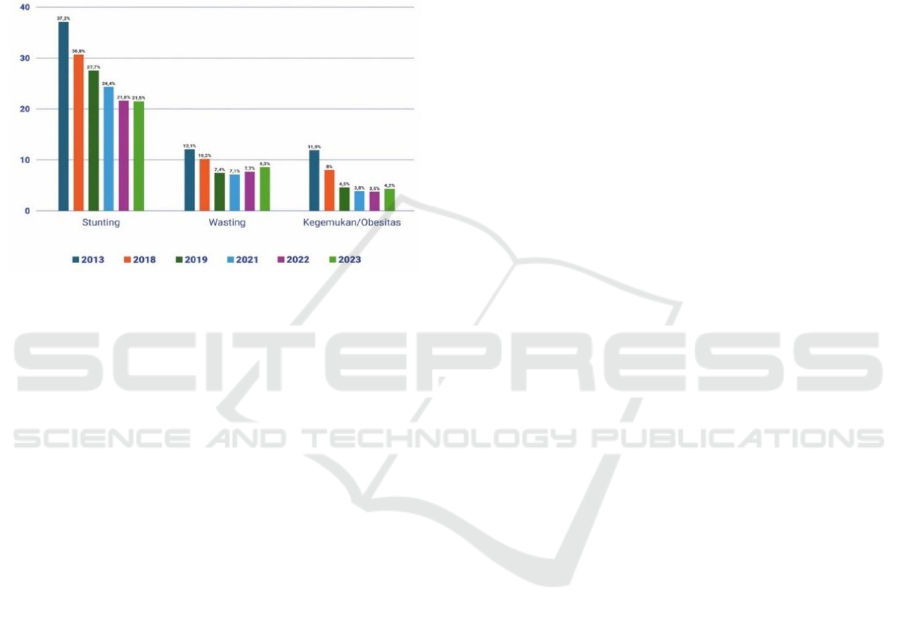
Unfortunately, real-world data show that
many Indonesian children still suffer from nutritional
deficiencies, including stunting, anemia, and
malnutrition. According to the 2022 Indonesian
Nutritional Status Survey (SSGI), there was a
decrease in the stunting rate from 24.4% in 2021 to
21.6% in 2022. This downward trend is expected to
continue so that the National Medium-Term
Development Plan (RPJMN) target of 14% can be
achieved by 2024.
These facts demonstrate that nutritional
problems in early childhood remain a critical issue
requiring serious attention and intervention. Research
suggests that the problem is not solely due to food
scarcity, but also to a lack of parental knowledge
regarding balanced nutrition. This is supported by the
findings of Jamalatun Nisa & Wahab, (2024);
Silitonga et al., (2023); Sulistyowati, (2021) who
emphasized that parental feeding behavior
Murnaka, N. P. and Marini,
Balanced Nutrition Education Strategy Through Local Culinary for Early Childhood.
DOI: 10.5220/0014068100004935
Paper published under CC license (CC BY-NC-ND 4.0)
In Proceedings of the 7th International Conference on Early Childhood Education (ICECE 2025) - Meaningful, Mindful, and Joyful Learning in Early Childhood Education, pages 221-228
ISBN: 978-989-758-788-7; ISSN: 3051-7702
Proceedings Copyright © 2025 by SCITEPRESS – Science and Technology Publications, Lda.
221
significantly influences a child’s nutritional status.
Parents with low nutritional knowledge are four times
more likely to have malnourished children than those
with adequate knowledge (de Buhr and Tannen,
2020). Furthermore, parents who actively involve
their children in meal planning and preparation tend
to have children with better nutritional outcomes
(Scaglioni et al., 2018). This suggests that a
combination of positive feeding behavior and
adequate knowledge is crucial for supporting optimal
child nutrition (Sukmawati et al., 2023).
Source : https://www.unicef.org/indonesia/id/gizi (UNICEF, 2024)
Figure 1: Child Malnutrition Trends in Indonesia.
This situation is further worsened by the
increasing consumption of fast food (Sumitro, 2025).
Fast food is typically low in nutrients but high in
sugar, salt, and saturated fat (Health Research and
Development Agency, 2019; Yulyanti et al., 2019).
Ironically, despite Indonesia’s rich culinary heritage,
the potential of nutritious local foods remains
underutilized in meeting children’s dietary needs.
Traditional foods are often regarded merely as snacks
rather than primary sources of nutrition. In fact, many
of these foods contain essential nutrients such as
complex carbohydrates, fiber, vitamins, protein, and
healthy fats critical for overall health and
development (Nurhasanah et al., 2023; Santoso et al.,
2023).
Global studies have shown that the use of local
foods not only contributes to food security and
environmental sustainability but can also enhance
nutritional security when regularly incorporated into
family meals (Lambers et al., 2021; Giyose et al.,
2020). Strengthening nutrition education rooted in
local culture is essential to increase public awareness
about the nutritional potential of traditional foods,
which are often overlooked. Prioritizing local foods
is also aligned with the principles of food sovereignty
and represents a more sustainable approach to
nutrition interventions within the broader framework
of human resource development.
However, traditional foods are often regarded as
complementary items or snacks, rather than primary
sources of nutrition. Therefore, nutrition education
based on local foods needs to be strengthened and
introduced early, so that communities and future
generations understand that these traditional foods
passed down through generations can play a crucial
role in building a healthy and intelligent generation
from an early age. Several studies have shown that
nutrition education rooted in local culture is more
effective in changing community dietary behavior
due to its cultural familiarity and social acceptance
(Bickenbach, 2011; Carpenter et al., 2017). When
utilized properly, these traditional foods can serve as
an effective alternative source of local nutrition to
help address childhood malnutrition.
This study aims to explore various theories and
strategies for nutrition education that can be applied
within the context of Early Childhood Education
(PAUD) in Semarang.
2 METHOD
This research is a qualitative descriptive study
employing a library research approach. Library
research refers to a data collection method that
involves reviewing books, literature, notes, and
various reports relevant to the problem being
investigated (Jalali and Wohlin, 2012). The data
sources used in this study include nationally
accredited journals, and reputable international
journals. These journals addressed the following
topics: (1) culinary food ; (2) children's eating
patterns; and (3) the nutritional content of traditional
foods.
The literature was analyzed using a descriptive
analytical method. The analysis process began with
literature collection, which involved searching two
databases Google Scholar and E-journal for research
articles and review papers published between 2018
and 2024. The literature search focused on the
following themes: (1) the urgency of balanced
nutrition in early childhood; (2) strategies for
balanced nutrition education in early childhood; and
(3) the potential of traditional culinary arts as a source
of balanced nutrition.
Keywords used in the literature search included:
traditional food, child nutrition, early childhood diet,
and traditional culinary. Journal articles were selected
based on the relevance of their titles and abstracts.
When the title or abstract was unclear, the full
manuscript was reviewed for suitability. After the
literature was collected, the data were synthesized to
ICECE 2025 - The International Conference on Early Childhood Education
222
deepen the understanding of the research problem and
to draw comparisons with relevant case studies. The
analysis was carried out in alignment with the specific
objectives of the study.
3 RESULT AND DISCUSSION
Food is a basic necessity for every human being. The
food consumed must fulfill the requirements of
balanced nutrition, as achieving such balance is a
crucial component of human growth and
development, aimed at supporting a healthy life. This
is also emphasized by Hasrul et al., (2020);
Nurchayati & Pusari, (2015) who state that
consuming healthy food is essential for optimal
human growth and development especially during
early childhood.
Children in early childhood require proper
nutritional intake to support their physical and
cognitive development into adolescence (Teixeira et
al., 2022). Children who receive adequate nutrition
tend to be healthier, more productive, and
demonstrate improved learning abilities. Conversely,
a deficiency in essential nutrients such as iron, iodine,
and vitamin A can lead to short-term declines in
cognitive performance and concentration (Black et
al., 2017, 2013; Gannika, 2023).
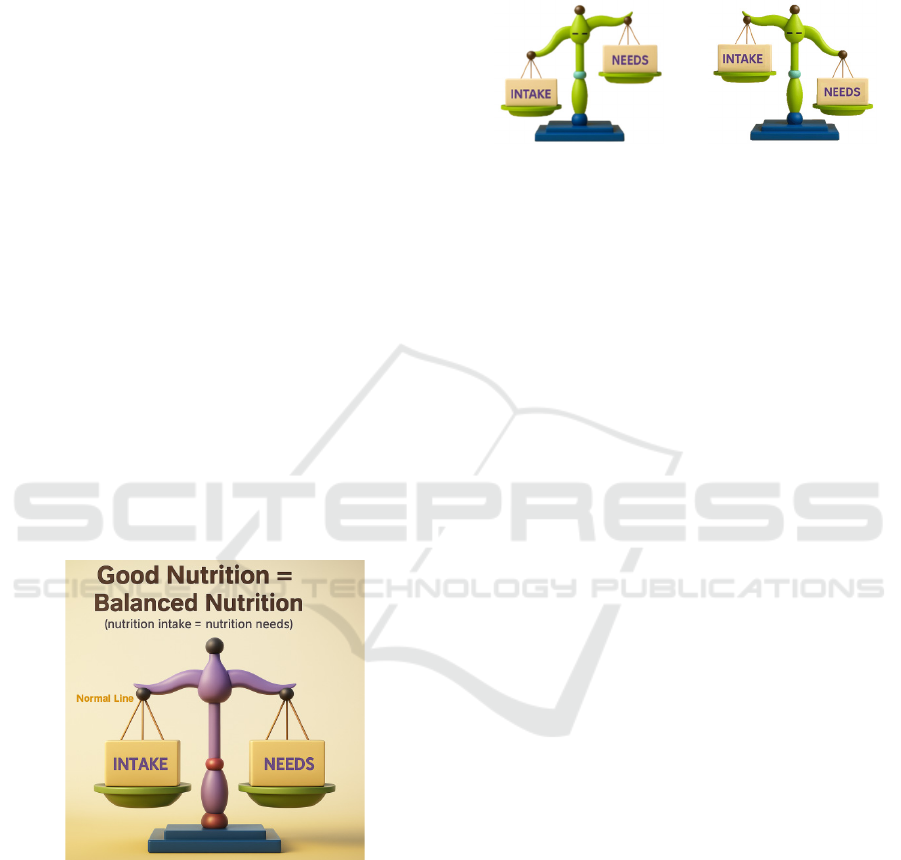
Figure 2: Balanced Food Intake and Nutritional Needs.
Good nutrition is achieved when nutrient intake
matches the body's physiological needs. As illustrated
in Figure 1, a balanced scale between "intake" and
"needs" reflects the ideal condition in which the
quantity and quality of food and nutrients are neither
excessive nor deficient. This nutritional equilibrium
is essential for supporting early childhood growth,
immune function, and cognitive development. This
concept is referred to as balanced nutrition, where the
intake of each nutrient such as carbohydrates,
proteins, fats, vitamins, and minerals is fulfilled
according to the body's requirements (UNICEF,
2021; World Health Organization (WHO), 2020).
(
a
)
(
b
)
Figure 3: Relationship Between Food Intake and Balanced
Nutritional Needs.
The two figures above illustrate an imbalance
between nutritional intake and bodily needs. Figure
2.a depicts a tilted scale, with the weight leaning
towards the "Intake" side indicating that food
consumption exceeds nutritional requirements. This
condition reflects overnutrition, which can lead to
various health problems such as obesity, early-onset
hypertension, and metabolic disorders, particularly
when children consume excessive amounts of foods
high in sugar, saturated fat, or calories without
sufficient physical activity (Lobstein et al., 2015;
Popkin et al., 2020). Figure 2.b, on the other hand,
represents a condition of undernutrition, in which
nutritional intake falls short of the body’s needs. The
scale appears heavier on the "Needs" side, signaling
that the body demands more nutrients than it receives.
This type of malnutrition can result in stunting,
wasting, anemia, and reduced immunity conditions
that are especially concerning during early childhood,
a critical period of growth and development(Black et
al., 2017, 2013; Mamun et al., 2023).
1) The Urgency of Balanced Nutrition in Early
Childhood
Every child undergoes rapid physical,
intellectual, emotional, and mental
development. This process requires adequate
and balanced nutritional intake. Early childhood
is a pivotal period for supporting physical
growth, immune system function, and brain
development. Therefore, ensuring balanced
nutrition during this stage is essential. Balanced
nutrition goes beyond simply consuming three
meals per day. It involves achieving a proper
balance between macronutrients
(carbohydrates, proteins, and healthy fats) and
micronutrients (vitamins and minerals), all of
which must be consumed in appropriate
quantities based on the body’s needs.
Balanced Nutrition Education Strategy Through Local Culinary for Early Childhood
223
Providing children with a balanced diet
positively influences brain development,
physical growth, immune function, and long-
term learning capacity. Conversely, nutritional
deficiencies during this stage can result in long-
term consequences, such as stunting, anemia,
and cognitive impairment conditions that may
hinder a child’s ability to reach their full
potential in the future (Black et al., 2017;
Hoddinott et al., 2013; Prado and Dewey, 2014).
Thus, ensuring balanced nutrition in early life is
not only a health initiative, but also an
investment in sustainable human capital
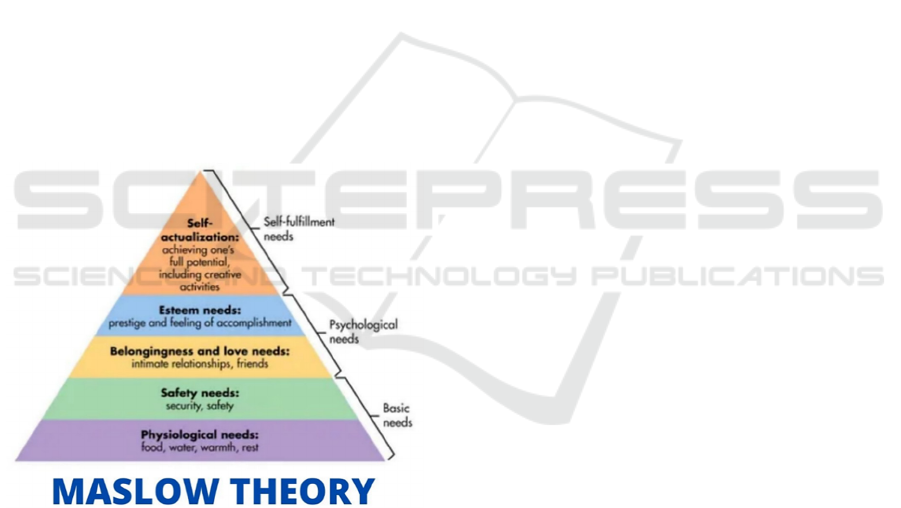
development. This aligns with Maslow’s
Hierarchy of Needs (Maslow, 1943), which
posits that physiological needs form the
foundational layer of human motivation.
Without meeting these basic needs, individuals
especially children cannot progress to higher
levels of development, including self-
actualization. As such, the role of families, early
childhood education institutions, and
government policies is crucial in fostering an
environment that supports access to healthy
food and early nutrition education.
Figure 4: Maslow Theory.
2) Balanced Nutrition Education Strategies for
Early Childhood
Balanced nutrition education can be
implemented through various approaches,
including integration into the Early Childhood
Education (PAUD) curriculum. One effective
approach is the use of educational media based
on local culinary traditions. This method not
only enhances children's nutritional knowledge
but also reinforces local cultural values. In
addition, strengthening family nutrition literacy
should be an essential component of the
educational strategy, as parents serve as primary
decision-makers regarding their children’s food
consumption at home. According to Faber &
Laurie, (2011) nutrition education that involves
parents particularly mothers can significantly
improve children’s dietary diversity and
micronutrient intake. Chatterjee & Nirgude,
(2024); Suciyanti et al., (2025) also emphasize
that nutrition education combining school-,
family-, and community-based strategies has a
greater impact on improving children's overall
eating behavior.
The following are strategies for balanced nutrition
education in early childhood:
a. Thematic Learning (Theme: “Healthy Food”
integrating local culinary traditions)
Through this thematic learning activity,
children are expected to recognize 3–4 food
groups (carbohydrates, protein,
fruits/vegetables, and healthy snacks) using
examples from Semarang’s local cuisine.
Children should also be able to give at least
one reason for choosing fruits or vegetables
every day (e.g., color, taste, or health benefits).
The theme is integrated across activities
language, art, sensory play, and practical
demonstrations so that nutritional concepts are
learned through repeated, meaningful
experiences.
b. Role Play: Market and Pretend Cooking
Activities
Role play enables children to learn about
traditional foods, basic portion concepts,
social skills, and the function of each food
group. In the “Semarang Market” activity,
children assume roles such as seller, buyer, or
cook, using replicas or pictures of local foods.
They practice simple transactions (counting
from 1–5), selecting balanced portions, and
engage in short discussions about why they
chose certain vegetables or foods. Evidence
suggests that role play and food-related play
can enhance children’s understanding of
nutrition (B and G.K., 2024; Willemsen et al.,
2023).
c. Storytelling: AI-Based Short Interactive
Animated Videos
Use AI-generated short animation videos
designed specifically for young children.
These videos combine engaging visual and
audio storytelling and when paired with
adaptive AI prompts can be lightly
personalized (for example, by including a
ICECE 2025 - The International Conference on Early Childhood Education
224

child’s name, local characters, or typical
dishes Local Culinary ). Pedagogically
designed digital media, used alongside hands-
on activities, can strengthen both parents’ and
children’s understanding and engagement
with nutrition concepts. Studies from BMC
Nutrition (2024) and BMC Health Services
Research (2024) indicate that well-designed
digital learning videos can increase parent and
child knowledge and participation.
Thus, nutrition education that is contextual,
engaging, and culturally rooted is vital to
developing a generation that is healthy,
intelligent, and resilient to global health
challenges.
3) Local Culinary Potential as a Source of
Balanced Nutrition
Indonesia’s rich traditional culinary heritage
offers a diverse and valuable resource for
supporting balanced nutrition in early
childhood. Local dishes such as tofu and
tempeh, pecel sayur (vegetable salad), corn rice,
lodeh (vegetables in coconut milk), sambal
anchovies with peanuts, and boiled mung beans
are examples of traditional foods that are rich in
plant-based proteins, fiber, vitamins, and
essential minerals. Moreover, local culinary
products benefit from the availability of raw
ingredients, affordability, and strong cultural
acceptance within communities. According to
(Sibhatu et al., 2015), the diversity of local food
consumption is strongly associated with both
micro- and macronutrient intake, which
contributes significantly to improving children's
overall nutritional status. (Johns et al., (2013)
further support this view, stating that culinary
practices based on local ingredients can promote
food security and enhance the sustainability of
food systems, particularly in developing
countries. In addition, the use of local culinary
practices helps preserve traditional eating habits
and cultural identity.
In early childhood education settings,
teachers and parents can utilize mealtime as an
educational opportunity to introduce children to
local ingredients, explain their origins, discuss
their nutritional benefits, and demonstrate
healthy preparation methods. This is consistent
with findings by (Gartaula et al., 2020;
Principato et al., 2025) who found that children
exposed to traditional foods from an early age
are more likely to accept healthy food options
later in life. Therefore, it is important for child
nutrition and education programs to revitalize
the use of local culinary resources as a source of
balanced nutrition that is contextual,
sustainable, and readily accessible. The city of
Semarang offers a variety of traditional foods
that are not only flavorful but also rich in
nutrients. Dishes such as lumpia, wingko babat,
mochi, and garang asem incorporate natural
ingredients like bamboo shoots, coconut, eggs,
and chicken providing essential proteins, fiber,
vitamins, and minerals beneficial for children’s
growth. Utilizing local culinary traditions can
serve as a sustainable strategy to meet children’s
nutritional needs while fostering an appreciation
and love for local food culture. Several
examples of local foods used in nutrition
education include:
Table 1: Several examples of local foods used in nutrition
education include.
Food Nutritional
Content
Educational
Value
Tahu
Gimbal
Plant-based
protein, carbo-
h
y
drates, fibe
r
Introducing
sources of protein
and fibe
r
Pecel Leafy vegetables,
carbohydrates,
vitamins A & C
Emphasizing the
importance of
vegetables and
colorful meals
Bubur
Tumpang
Legumes, coconut
milk, plant-
b
ased
p
rotein
Source of energy
and protein
Mochi
Semarang
Complex
carbohydrates,
peanuts (plant-
b
ased protein),
natural su
g
a
r
Educating about
healthy snacking
and sugar
moderation
Pempek
Palembang
Fish-based
protein,
carbohydrates,
low fat
Understanding
p
rotein from
aquatic sources
and traditional
preservation
methods
Gudeg Young jackfruit
(fiber, vitamin C),
coconut milk,
plant-based
p
rotein
Learning about
b
alanced meals
with plant-
b
ased
protein and fiber
Balanced Nutrition Education Strategy Through Local Culinary for Early Childhood
225
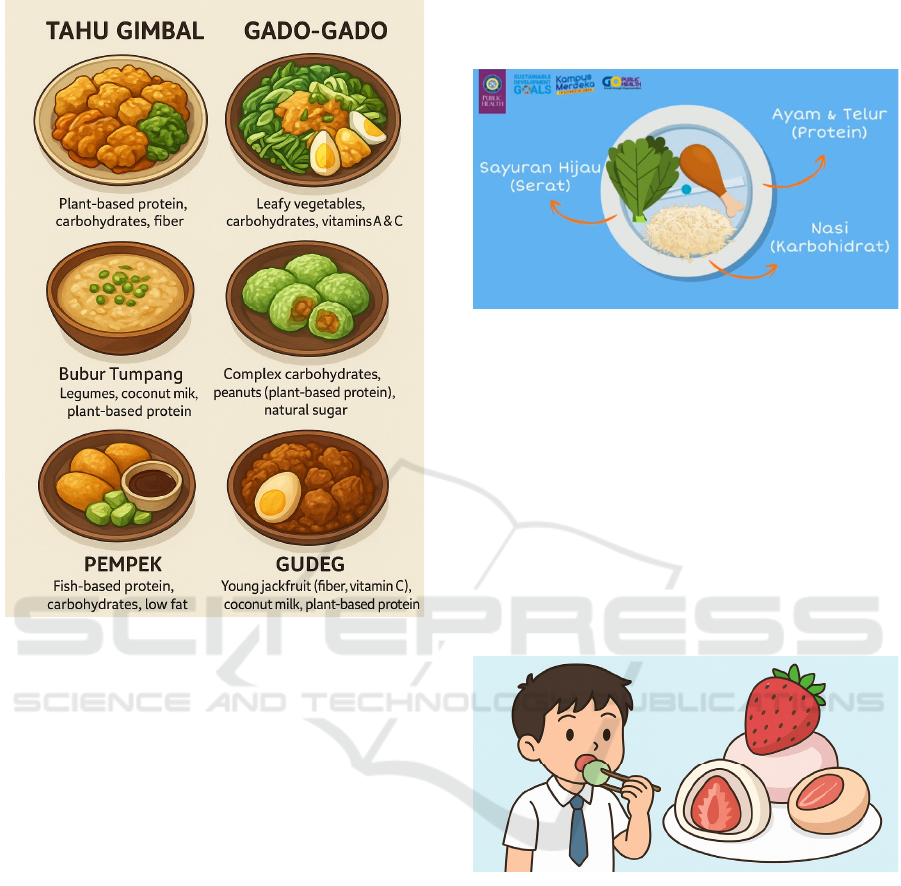
Figure 5: Local Culinary Foods.
The image above shows several types of
traditional Indonesian culinary dishes, namely Tahu
Gimbal, Gado-Gado, Bubur Tumpang, Mochi,
Pempek, and Gudeg. Each traditional food is
accompanied by information on its nutritional
content, such as plant-based protein, complex
carbohydrates, fiber, vitamins, healthy fats, and
natural sugars.
Through the presentation of this image, it is
expected that children will be able to understand the
nutritional value of everyday foods. Using a visual
approach, learners can easily recognize local food
sources, understand their nutritional content, and
relate them to a balanced diet.
The selection of these six dishes reflects the
diversity of food sources in Indonesia, ranging from
plant-based proteins (tofu, legumes, tempeh), animal
proteins (fish in pempek, eggs in gudeg), complex
carbohydrates (rice, sago, glutinous rice), to
vegetables and fruits rich in vitamins. This
introduction is expected to raise awareness of the
importance of food diversity and minimize the
consumption of ultra-processed foods..
Learning about balanced meals with plant based
protein and fiber
Source : https://www.youtube.com/watch?v=fwgtWPDX6cY
Figure 6: Learning Video Image.
4) The Potential of Local Culinary Delights as a
Source of Balanced Nutrition
In today’s digital era, information technology-
based media serve as powerful tools for
delivering educational messages including those
related to early childhood nutrition. One
effective medium is digital content such as
interactive videos. These videos can be used to
introduce the concept of balanced nutrition
based on local foods to both children and their
parents.
Figure 7: Traditional culinary food mochi.
According to Hikmatullah, (2023); Raut et al., (2024)
digital media specifically designed for child nutrition
education has been shown to improve nutritional
literacy and promote healthy eating behaviors,
particularly when developed contextually and
grounded in local culture. Digital media enables the
presentation of educational content in an engaging,
interactive, and age-appropriate manner. For
example, a short animated video about mochi can
help children understand not only the ingredients and
preparation process, but also its nutritional value and
the cultural significance behind the dish.
ICECE 2025 - The International Conference on Early Childhood Education
226

4 CONCLUSIONS
Balanced nutrition during early childhood lays a
critical foundation for physical growth, cognitive
development, and long-term health. During this
golden age, children require adequate nutritional
intake in both quality and quantity, including
sufficient macronutrients and micronutrients.
Malnutrition at this stage may result in serious
consequences such as stunting, anemia, and cognitive
impairments. Therefore, an effective nutrition
education strategy is essential. Such education should
not remain theoretical but should be fully integrated
into the early childhood education curriculum. It
should also involve active participation from families
and utilize local foods as both learning tools and daily
consumption options.
Parental involvement particularly by mothers has
been shown to enhance dietary diversity and improve
the overall quality of children’s diets. This is further
supported by the implementation of contextual
learning approaches, such as the use of local culinary
delights as educational media. These local foods not
only offer nutritional value comparable to modern
food products but also carry cultural meaning and are
more accessible within communities.
The integration of digital technology in education
provides new opportunities for delivering local food–
based nutrition education in a fun and interactive way.
Animated videos, for example, can effectively
convey nutrition messages in a manner that is both
participatory and culturally grounded. By combining
cultural values, family involvement, formal
education, and digital innovation, balanced nutrition
education based on local foods can become a
comprehensive and impactful strategy for fostering a
generation that is healthy, intelligent, and competitive
in the global context.
REFERENCES
B, A., G.K., B., 2024. Story Book and Role Plays:
Promising Garden-Based Nutrition Education Tools for
Preschoolers. Indian J Nutr Diet 141–151.
https://doi.org/10.21048/IJND.2024.61.2.35945
Badan Penelitian dan Pengembangan Kesehatan, 2019.
Riset Kesehatan Dasar (Riskesdas) 2018. Jakarta,
Indonesia.
Bickenbach, J.E., 2011. Monitoring the United Nation’s
Convention on the Rights of Persons with Disabilities:
data and the International Classification of Functioning,
Disability and Health. BMC Public Health 11, S8.
https://doi.org/10.1186/1471-2458-11-S4-S8
Black, M.M., Walker, S.P., Fernald, L.C.H., Andersen,
C.T., DiGirolamo, A.M., Lu, C., McCoy, D.C., Fink,
G., Shawar, Y.R., Shiffman, J., Devercelli, A.E.,
Wodon, Q.T., Vargas-Barón, E., Grantham-McGregor,
S., 2017. Early childhood development coming of age:
science through the life course. The Lancet 389, 77–90.
https://doi.org/10.1016/S0140-6736(16)31389-7
Black, R.E., Victora, C.G., Walker, S.P., Bhutta, Z.A.,
Christian, P., de Onis, M., Ezzati, M., Grantham-
McGregor, S., Katz, J., Martorell, R., Uauy, R., 2013.
Maternal and child undernutrition and overweight in
low-income and middle-income countries. The Lancet
382, 427–451. https://doi.org/10.1016/S0140-6736(13
)60937-X
Carpenter, D.M., Estrada, R.D., Roberts, C.A., Elio, A.,
Prendergast, M., Durbin, K., Jones, G.C., North, S.,
2017. Urban-Rural Differences in School Nurses’
Asthma Training Needs and Access to Asthma
Resources. J Pediatr Nurs 36, 157–162. https://doi.org/
10.1016/j.pedn.2017.06.013
Chatterjee, P., Nirgude, A., 2024. A Systematic Review of
School-Based Nutrition Interventions for Promoting
Healthy Dietary Practices and Lifestyle Among School
Children and Adolescents. Cureus. https://doi.org/1
0.7759/cureus.53127
de Buhr, E., Tannen, A., 2020. Parental health literacy and
health knowledge, behaviours and outcomes in
children: a cross-sectional survey. BMC Public Health
20, 1096. https://doi.org/10.1186/s12889-020-08881-5
Faber, M., Laurie, S., 2011. A home gardening approach
developed in South Africa to address vitamin A
deficiency., in: Combating Micronutrient Deficiencies:
Food-Based Approaches. CABI, UK, pp. 163–182.
https://doi.org/10.1079/9781845937140.0163
Gannika, L., 2023. Hubungan Status Gizi dengan Tumbuh
Kembang Pada Anak Usia 1-5 Tahun : Literature
Review. Jurnal Ners 7, 668–674. https://doi.org/
10.31004/jn.v7i1.14198
Gartaula, H., Patel, K., Shukla, S., Devkota, R., 2020.
Indigenous knowledge of traditional foods and food
literacy among youth: Insights from rural Nepal. J Rural
Stud 73, 77–86. https://doi.org/10.1016/j.jrurstud.
2019.12.001
Hasrul, H., Hamzah, H., Hafid, A., 2020. Pengaruh Pola
Makan Terhadap Status Gizi Anak Sekolah Dasar.
Jurnal Keperawatan Muhammadiyah 5.
https://doi.org/10.30651/jkm.v5i2.4621
Hikmatullah, 2023. Pendidikan Keluarga dan Peran
Teknologi di Era Millennial 15, 172–183.
Hoddinott, J., Alderman, H., Behrman, J.R., Haddad, L.,
Horton, S., 2013. The economic rationale for investing
in stunting reduction. Matern Child Nutr 9, 69–82.
https://doi.org/10.1111/mcn.12080
Jalali, S., Wohlin, C., 2012. Systematic literature studies,
in: Proceedings of the ACM-IEEE International
Symposium on Empirical Software Engineering and
Measurement. ACM, New York, NY, USA, pp. 29–38.
https://doi.org/10.1145/2372251.2372257
Jamalatun Nisa, N., Wahab, R., 2024. The Relationship
Between Maternal Knowledge and Attitudes Regarding
Balanced Nutrition Education Strategy Through Local Culinary for Early Childhood
227

Balanced Nutrition with The Nutritional Status of
Toddlers 1, 421-433,. /https://doi.org/10.25105/akta
trimedika.v1i4.19586
Johns, T., Powell, B., Maundu, P., Eyzaguirre, P.B., 2013.
Agricultural biodiversity as a link between traditional
food systems and contemporary development, social
integrity and ecological health. J Sci Food Agric 93,
3433–3442. https://doi.org/10.1002/jsfa.6351
Lobstein, T., Jackson-Leach, R., Moodie, M.L., Hall, K.D.,
Gortmaker, S.L., Swinburn, B.A., James, W.P.T.,
Wang, Y., McPherson, K., 2015. Child and adolescent
obesity: part of a bigger picture. The Lancet 385, 2510–
2520. https://doi.org/10.1016/S0140-6736(14)61746-3
Mamun, A. Al, Mahmudiono, T., Yudhastuti, R., Triatmaja,
N.T., Chen, H.-L., 2023. Effectiveness of Food-Based
Intervention to Improve the Linear Growth of Children
under Five: A Systematic Review and Meta-Analysis.
Nutrients 15, 2430. https://doi.org/10.3390/nu1511
2430
Maslow, A.H., 1943. A theory of human motivation.
Psychol Rev 50, 370–396. https://doi.org/10.1037/h0
054346
Nurchayati, D., Pusari, R.W., 2015. Upaya Meningkatkan
Pengetahuan Makanan Sehat Melalui Penerapan Sentra
Cooking Pada. Jurnal Penelitian PAUDIA 5.
Popkin, B.M., Corvalan, C., Grummer-Strawn, L.M., 2020.
Dynamics of the double burden of malnutrition and the
changing nutrition reality. The Lancet 395, 65–74.
https://doi.org/10.1016/S0140-6736(19)32497-3
Prado, E.L., Dewey, K.G., 2014. Nutrition and brain
development in early life. Nutr Rev 72, 267–284.
https://doi.org/10.1111/nure.12102
Principato, L., Pice, G., Pezzi, A., 2025. Understanding
food choices in sustainable healthy diets – A systematic
literature review on behavioral drivers and barriers.
Environ Sci Policy 163, 103975. https://doi.org/10
.1016/j.envsci.2024.103975
Raut, S., KC, D., Singh, D.R., Dhungana, R.R., Pradhan,
P.M.S., Sunuwar, D.R., 2024. Effect of nutrition
education intervention on nutrition knowledge, attitude,
and diet quality among school-going adolescents: a
quasi-experimental study. BMC Nutr 10, 35.
https://doi.org/10.1186/s40795-024-00850-0
Scaglioni, S., De Cosmi, V., Ciappolino, V., Parazzini, F.,
Brambilla, P., Agostoni, C., 2018. Factors Influencing
Children’s Eating Behaviours. Nutrients 10, 706.
https://doi.org/10.3390/nu10060706
Sibhatu, K.T., Krishna, V. V., Qaim, M., 2015. Production
diversity and dietary diversity in smallholder farm
households. Proceedings of the National Academy of
Sciences 112, 10657–10662. https://doi.org/10.1073/
pnas.1510982112
Silitonga, J.M., Anugrahwati, R., Hartati, S., 2023.
Hubungan Pengetahuan Ibu dengan Status Gizi pada
Anak Balita di wilayah Kerja Puskesmas Rawabunga
Jakarta Timur. Malahayati Nursing Journal 5, 2738–
2745. https://doi.org/10.33024/mnj.v5i8.10940
Suciyanti, D., Kolopaking, R., Mustafa, A., Iwan, S.,
Witjaksono, F., Fahmida, U., 2025. Effect of optimized
food-based recommendations on nutrient intakes,
hemoglobin levels, and memory performance of
adolescent girls in East Java, Indonesia. Nutr J 24.
https://doi.org/10.1186/s12937-024-01061-w
Sukmawati, E., Marzuki, K., Batubara, A., Harahap, N.A.,
Efendi, E., Weraman, P., 2023. The Effectiveness of
Early Childhood Nutrition Health Education on
Reducing the Incidence of Stunting. Jurnal Obsesi :
Jurnal Pendidikan Anak Usia Dini 7, 4002–4012.
https://doi.org/10.31004/obsesi.v7i4.4846
Sulistyowati, R., 2021. Pengaruh Pengetahuan Zizi Ibu
Terhadap Status Gizi Anak Balita di Puskesmas
Sukorame. Jurnal Gizi Madani 4, 34–41.
Teixeira, B., Afonso, C., Rodrigues, S., Oliveira, A., 2022.
Healthy and Sustainable Dietary Patterns in Children
and Adolescents: A Systematic Review. Advances in
Nutrition. https://doi.org/10.1093/advances/nmab148
UNICEF, 2024. Gizi “Mengatasi tiga beban malnutrisi di
Indonesia” [WWW Document]. https://www.unicef.
org/indonesia/id/gizi.
UNICEF, 2021. The State of the World’s Children 2021:
On My Mind – Promoting, protecting and caring for
children’s mental health, 1st ed. UNICEF, New York
City, Amerika Serikat.
Willemsen, A., Wiggins, S., Cromdal, J., 2023. Young
Children’s mealtimes and eating practices in early
childhood education and care: A scoping review of
30 years of research from 1990 to 2020. Educ Res Rev
38, 100503. https://doi.org/10.1016/j.edurev.2022.100
503
World Health Organization (WHO), 2020. Guiding
principles for complementary feeding of the breastfed
child. American Health Organization.
Yulyanti, D., Rachmawati, L., Hidayati, T., 2019.
Hubungan Konsumsi Junk Food dengan Kejadian
Overweight Dan Obesitas Pada Remaja. Jurnal Gizi
Indonesia (The Indonesian Journal of Nutrition) 7, 100–
107.
ICECE 2025 - The International Conference on Early Childhood Education
228
