
Analysis Causative Factors of Self-Harm Behavior in Early
Childhood: A Systematic Literature Review
Puji Gusri Handayani
1a
, Hafiz Hidayat
2b
, Frischa Meivilona Yendi
1c
, Lisa Putriani
1d
,
Rahmi Dwi Febriani
1e
and Triave Nuzila Zahri
1f
1
Department of Guidance and Counselling, Universitas Negeri Padang, Padang, Indonesia
2
Department Master of Elementary, Universitas Adzkia, Padang, Indonesia
Keywords: Self-Harm, Early Childhood, Counselling, Mental Health, Intervention Counselling.
Abstract: The phenomenon of self-harm at this time is also detected in early children, including early childhood. Given
the long-term impact on children's emotional and social development, this raises serious concerns. The most
significant risk is felt from family factors, especially mental disorders in parents. This study explores self-
harm behaviors that occur in children, their impacts, and influencing factors from various aspects. The study
aims to achieve three main objectives: first, to identify examples of self-harm behavior in children; second,
to detect factors as a precursor to self-harm behavior; and third, to assess the effectiveness of current
prevention strategies. The study involved a comprehensive review of articles from three major databases—
Scopus, ScienceDirect, and Google Scholar—resulting in an initial selection of 160 articles. After applying
specific inclusion and exclusion criteria, 18 articles were considered relevant for the analysis. These findings
suggest that the factors that cause children aged 3-6 to commit self-harm are not just an individual problem,
but also reflect the wider environment and experiences that can affect their wellbeing. Implications highlight
the importance of monitoring and support for at-risk children, as well as the need for intervention approaches
to address these mental health issues at an early age.
1 INTRODUCTION
Self-harming behavior has been on the rise for
decades, not only among adolescents and young
adults, but also begins to be identified early, including
in childhood (Jung et al., 2018). Given its long-term
impact on a child's emotional and social development,
this development raises significant concerns among
educators and mental health professionals. Childhood
traumatic events, including physical abuse, sexual
abuse, neglect, and disharmonious domestic
situations, are closely related to self-harm behaviors
in young children (Stewart et al., 2020). Furthermore,
self-harm behavior is closely associated with
childhood trauma. The fact that 75% of self-harming
a
https://orcid.org/0000-0001-7343-8896
b
https://orcid.org/0009-0006-4491-4420
c
https://orcid.org/0000-0003-4157-1865
d
https://orcid.org/0009-0009-1647-4618
e
https://orcid.org/0009-0009-0308-1436
f
https://orcid.org/0000-0001-6163-0362
teens have a history of sexual disclosure as a child
supports this (Naeem, 2024).
Furthermore, long-term research shows that
children who experience trauma or injury from
violence before the age of 15 are significantly more
likely to commit acts of self-harm during their
adolescence and early adulthood (Griffin, 2018).
According to Chinese research, psychological
resilience may act as a mediator in the relationship
between behavioral tendencies to have self-harm
behaviors in early adolescence and violence during
childhood, offering a possible avenue for preventive
measures (Li et al., 2024). Furthermore, it was found
that psychological traits such as impulsivity,
dissociative tendencies, and low self-esteem served as
Handayani, P. G., Hidayat, H., Yendi, F. M., Putriani, L., Febriani, R. D. and Zahri, T. N.
Analysis Causative Factors of Self-Harm Behavior in Early Childhood: A Systematic Literature Review.
DOI: 10.5220/0014054900004935
Paper published under CC license (CC BY-NC-ND 4.0)
In Proceedings of the 7th International Conference on Early Childhood Education (ICECE 2025) - Meaningful, Mindful, and Joyful Learning in Early Childhood Education, pages 145-154
ISBN: 978-989-758-788-7; ISSN: 3051-7702
Proceedings Copyright © 2025 by SCITEPRESS – Science and Technology Publications, Lda.
145

mediating factors, reinforcing the link between self-
harm behaviors and childhood trauma (Cheng et al.,
2023).
According to a longitudinal study of child abuse
and neglect, children who have self-harming
behaviors by the age of four, such as suicidal thoughts
and self-harm, are more likely to continue these
behaviors by the time they are six years old
(Marcheselli et al., 2018). Data from 387 children
between the ages of 5 and 12 who were hospitalized
for self-harm examined in a study in the UK found
that 39% of cases occurred in children aged 5 to 11,
with a greater percentage in boys under the age of 11
(Geulayov, 2022). In addition, the youngest of the 30
children sent to mental health facilities for self-harm
was less than 6 years old, and the majority of them
had a history of learning problems, parental conflict,
or severe family stress (Krishnakumar, 2011).
Self-harm behaviors and bad childhood
experiences are also mediated by psychological
characteristics, including problems with emotional
control, low resilience, and low self-esteem (Chen et
al., 2022). Children who are victims of bullying,
neglect, or poor parenting also tend to do self-harm,
either directly or indirectly through aggressive
behavior towards others (Handayani et al., 2023;
Myklestad & Straiton, 2021). In populations with
developmental disorders such as ADHD or bipolar
disorder, where self-harm behaviors are more
common and influenced by traumatic childhood
experiences, these problems become more severe.
Self-harm behaviors in early childhood have serious
long-term impacts, such as a higher risk of
psychopathological diseases, social isolation, and
risky behavior tendencies in adulthood (Handayani et
al., 2024; Islam et al., 2020; Müller-Vahl et al., 2023;
Suryana & Latifa, 2023). To stop self-harm behaviors
and more serious psychosocial problems in the future,
children exposed to risk factors must receive early
detection and treatment (Kirkbride, 2020).
Based on these considerations, it is essential to
conduct a systematic review of the existing literature
to gain a deeper understanding of risk factors,
psychological mechanisms, and relevant preventive
and intervention measures for self-harm behaviors in
children. Emphasizing the importance of taking
action to prevent self-harm behavior in children, this
study aims to systematically identify the factors that
contribute to self-harm behavior in children and
analyze planned or carried out interventions related to
this phenomenon. In addition, as far as we know,
research on various forms of self-harm behavior in
children is still minimal.
Research on self-harm behaviors in early
childhood is urgently needed to identify risk factors,
mechanisms, and practical preventive measures that
will protect children from long-term negative
impacts. Researchers believe that self-harm behavior
can be reduced if the factors that trigger it can be
avoided. As self-harm behaviors become more
common and interfere with children's development
later in life, this research is critical to address as soon
as possible. This research aims to find ways to reduce
incidents and their impact.
2 METHODOLOGY
The Preferred Reporting Items for Systematic
Reviews and Meta-Analyses (PRISMA) tool was
utilized in this SLR investigation. A series of
recommendations created by the PRISMA approach
is intended to raise the caliber and openness of
systematic reviews and meta-analyses (Page et al.,
2021). SLR is an exacting research methodology that
entails a thorough and systematic search for relevant
studies, followed by a critical evaluation and
synthesis of the results (Azarian et al., 2023).
PRISMA provides an organized approach to SLR,
including guidelines for choosing research, creating a
search strategy, gathering data, and synthesizing the
findings (Shaffril et al., 2021). The following
Systematic Searching Strategies are used when
conducting SLR research:
2.1 Identification
This part involved looking through the current
internet research databases on Scopus, Google
Scholar, and Scopus for relevant scientific papers.
Many criteria, such as accessibility, time coverage,
subject relevance, and content quality, affect the
choice of these platforms (Wesz et al., 2023). To find
articles about self-harm, the article search included
many keywords, including "Self-harm" OR "Self-
Injury" AND "Self-harm for Child".
2.2 Screening
We found 160 articles total—147 on the Scopus
database, four on the Sciencedirect database, and nine
on the Google Scholar database—by conducting
keyword searches across three databases. Only
English articles from the last 10 years, 2015–2025,
have been found.
ICECE 2025 - The International Conference on Early Childhood Education
146
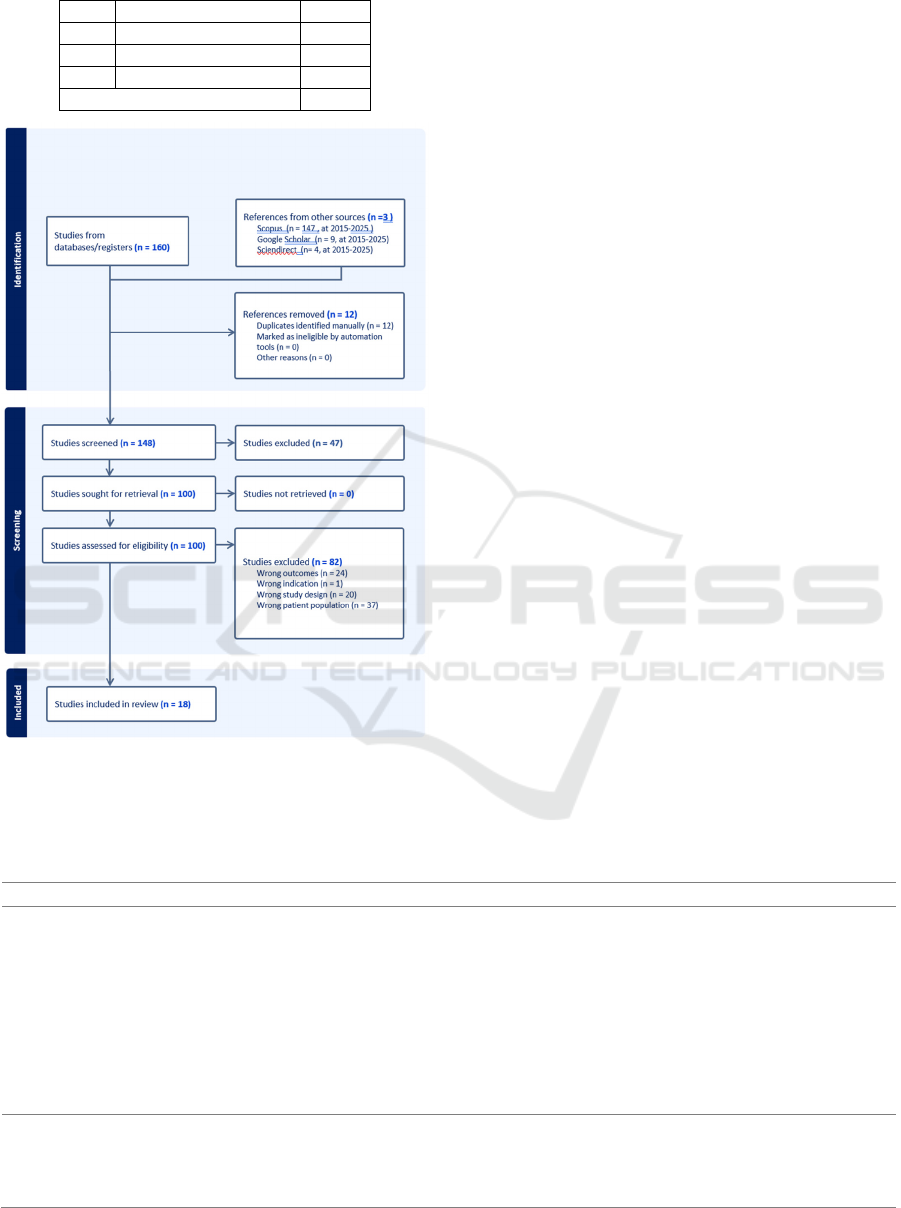
Table 1. Data Base.
No. Data Base Total
1 Sco
p
us 147
2 Sciendirec
t
4
3 Goo
g
le Schola
r
9
Total 160
Figure 1: PRISMA Flow Chart.
Duplication is possible; out of 160 articles, 12 are
identified as duplicates, making the total number of
articles 148. After that, we chose publications
pertinent to the research issue by going through the
148 titles and abstracts. We eliminated 47 items out
of 148, leaving 100 articles. The researchers next
identified the population: children aged three to six.
Of the 100 articles not categorized as children, 37
were classified as individuals, and 63 were left. We
eliminated forty-five articles after rereading the entire
manuscript on the results, indication, intervention,
and research design. Ultimately, the researchers
identified the details by excluding any references to
juvenile self-harm; 18 articles remained from the 45
that had nothing to do with the circumstances at hand.
2.3 Eligibility
Articles that now meet the first set of requirements
still need to be thoroughly validated by reading and
analyzing the entire text. Making sure all required
portions are included is the primary goal. A thorough
examination of the abstract, introduction, methods,
results, discussion, and conclusion is part of this
evaluation process. The researcher must guarantee
coherence and seamless integration between all
segments. To lessen potential bias, the researcher
should openly explain the rationale for exclusion of
any publication that is judged inappropriate (Tawfik
et al., 2019).
3 RESULT
All eighteen of the papers that are pertinent to this
study topic are quantitative studies. The 18 research
environments differed.
Table 2: Article Details Studies Included in Review.
N
o Autho
r
Findin
g
s Causal Factors Intervention
1 (Paul, 2019) It has been found that children between
the ages of 4 and 6 engage in self-harm
behavior. This behavior affects about
3.9% of 4-year-olds and 3.2% of 6-year-
olds. Overall, self-harm behavior in
children is not just a personal problem;
These behaviors also reflect the broader
environment and events that can affect
their wellbein
g
.
● Experiencing abuse,
especially physical
neglect, indicates a link
between harmful
behavior and an
unsupportive
environment.
● supervision and
support for
children
2 (Paul &
Peralta, 2016)
Children who are victims of violence—
physical, emotional, or neglect—are
more likely to have suicidal thoughts
and self-harm.
● Children who
experience physical,
emotional, or neglect are
more likely to have
● Trauma care
interventions
Analysis Causative Factors of Self-Harm Behavior in Early Childhood: A Systematic Literature Review
147

suicidal thoughts and
self-harm.
● In the context of
preventing harmful
behaviour in children,
attention to physical and
sexual education is just
as significant as dealing
with forms of violence,
including emotional
ne
g
lect.
3
(Aitken,
2016)
Thoughts of suicide and self-harm
were found to be more common in
children referred to gender dysphoria,
and the impulses for self-harm and
suicide increased with age.
● One example of
behavioral problems is
the refusal to accept
gender norms.
● The social problems
arise from the feeling
that their current gender
has re
j
ected them.
● Clinical
Medicine
4 (Zubrick,
2016)
Self-harm behavio
r
occurs in 11% of
children aged 4 to 17 years. Suggests
that this behavior occurs in early
childhood.
● Having a mental illness ● Clinical
treatment
5 (Mitchell,
2018)
Children who feel imperfect are more
likely to self-harm or end their lives.
● Physical violence
● Economically
disadvantaged.
● Psychosocial
care
● Providing
education to
p
arents.
6 (Borschmann,
2020)
Self-harm behavior in early childhood
is quite prevalent and can be
anticipated from an early age based on
many risk factors.
● These include ongoing
anxiety issues, experien-
ces of social oppression
and rejection, as well as
emotional disorders and
behaviors such as
emotional dysregulation
and antisocial behavior.
● School
environment
collaboration,
including peers.
7 (MacMullin,
2020)
Suicidal thoughts and actions in a
community sample of children who
exhibit
g
ender nonconformit
y
(GNC).
● Gender today does not
match the wishes of
parents.
● Marriage
education
● Parent education
8 (Geulayov,
2022)
Men are more likely to commit acts of
self-harm than women, especially at the
ages of 5 and 10.
● Gender
● Marriage
education
● Parent Education
9 (Predescu,
2023)
Girls with depressive symptoms were
more likely to attempt suicide than boys,
and girls with depressive symptoms and
behavioral problems showed more self-
harm behaviors.
● Depression
● occurs in an unstable
family and social
environment.
● Counseling
● Clinical
treatment
10 (McCluskey,
2022)
Children between the ages of 5 and 18
who are treated for diagnoses involving
intentional self-harm or suicide attempts.
Women are the cause of the most
hospitalizations, while men are the cause
of the most deaths in hospitals.
Intentional drug consumption is the most
common mode of self-harm.
● Deliberate excessive
consumption of drugs.
● Clinical
treatment
● Counseling
ICECE 2025 - The International Conference on Early Childhood Education
148

11 (Jiang, 2019) Self-harm behavior arises triggered by
stress because it was born to
HIV/AIDS-positive parents.
● The experience of
verbal victimization
● Depression
● Taking
preventive
measures
12 (Sekmen,
2023)
1,098 children treated at (37%) were
diagnosed with a self-harm event. We
identified four different profiles with
varying risks for the diagnosis of self-
harm behavior, mainly consisting of
children ages 5 to 9 years without a
p
revious
p
s
y
chiatric dia
g
nosis.
● Health conditions
● Social environment
● Medical care
● Family education
13 (Townsend,
2022)
Understanding of how widespread the
problem of self-harm is among
younger school students is still
limited. Further, support is needed to
help children who engage in self-
in
j
urious behaviour.
● Anxious
● Stress
● Bullying
● Improving the
skills of teachers
and parents
14 John, J.R.
(John, 2024)
Children with disabilities show
significantly higher incidents of self-
harm than children without
disabilities.
● Disability
● Sleep problems
● Medical care
● Therapeutic
Treatment
15 (Avanci,
2021)
The results showed 58 deaths of
Brazilian children with intentional
self-harm, mainly male, white ones.
● Related risk factors
include social,
cultural, and family
conditions and stigma
that inhibit early
reporting and
treatment.
● Improve early
identification,
prevention, and
strengthening of
health and edu-
cation systems to
protect children
from the risk of
suicidal
behaviour from
an earl
y
a
g
e.
16 (Townsend,
2024)
Self-harm and suicidal thoughts occur
as a result of poor parenting.
● Bad use of language
from parent to child.
● Collaboration
with parents is
mainly essential
in the use of
lan
g
ua
g
e.
17 (Zhu, 2019)
Children with one or several
disabilities have a statistically higher
tendency to self-harm than children
without disabilities.
● Disability ● Carry out
preventive
efforts together
with a disability
therapist.
18 (He, 2025)
The increase in self-harm behavior is
caused by academic pressure and
relationships with parents that result
in stress and depression.
● Study pressure
● Depression
● Parent-child
relationship
● Carry out
preventive
intervention
efforts before it
happens.
There is a substantial correlation between the
experience of self-harm behavior and its causative
factors, based on data on self-harm behavior, causal
variables, and interventions in Table 1. These results
suggest that many complex elements, such as social
context, mental health, and experiences of violence,
influence self-harm behavior in children. According
to research, children who are abandoned, physically
abused, or emotionally abused are more likely to self-
harm or consider suicide. The increase in self-harm
behaviors is also caused by a variety of factors,
including gender identity challenges and scholastic
pressures. Supporting at-risk children requires
effective interventions. Collaboration between
schools and families, teaching mindful of children's
needs, and parental supervision can help reduce the
likelihood of these negative behaviors. By
understanding the factors that contribute to self-harm
Analysis Causative Factors of Self-Harm Behavior in Early Childhood: A Systematic Literature Review
149

behaviors, we can create more effective prevention
strategies to maintain the mental health of children
and adolescents.
Further, it is essential to remember that
children in need may be reluctant to seek help due to
social stigma and a lack of knowledge about mental
health issues. To reduce this stigma and make it easier
for children and families to receive requests for help,
communities must be strengthened through education
and awareness initiatives. Peer support is also
essential to provide a safe space for children to
express their emotions and experiences.
Finally, further investigation is needed to
explore the relationship between risk variables and
self-harm behaviors fully. Interventions can be more
appropriately tailored to meet the needs of each
individual by recognizing a more specific risk profile
and understanding the underlying mechanisms.
Researchers, medical experts, and the general public
must work together to create conditions that improve
children's mental health and prevent negative
behaviors in the future.
4 DISCUSSION
4.1 Factors that Cause Early
Childhood Self-Harm
Although rare, self-harm among young children is on
the rise (Cybulski, 2021). The main risk factors found
were a history of mental disorders or criminal
behavior in the elderly (Nisar et al., 2015). Parents of
nearly 75% of self-harmed children have a history of
mental illness and/or criminal activity (Hare et al.,
2022). After family characteristics were considered,
community environmental factors such as low
socioeconomic status, location, and ecological crime
rates were not shown to be significantly related
(Favril et al., 2020; B. P. Liu et al., 2022; J. Liu &
Accid, 2006).
Adverse childhood experiences (ACEs),
including neglect, emotional, physical, and sexual
abuse, are also closely associated with a higher risk
of self-harm, including suicidal thoughts and non-
suicidal self-harm (NSSI) (Laporte et al., 2023).
Exposure to ACEs in long-term or mid-term
childhood to adolescence increases the likelihood of
depression and self-harm in adolescence (Chen et al.,
2022).
The development of symptoms of anxiety,
sadness, emotional control problems, and aggressive
behavior is one of the mechanisms that links negative
childhood experiences to acts of self-harm (Huang et
al., 2022). Children who are abandoned or victims of
violence tend to show signs of aggression and
depression/anxiety, which increases their risk for self-
harm (Paul & Ortin, 2019). Furthermore, sleep
problems and low self-esteem are significant
predictors of self-harm behavior later in life (Uh et
al., 2021).
4.2 Intervention Plan
Psychological resilience has been proven to reduce
the risk of self-harm in children who experience
violence or neglect (Tian et al., 2020). Interventions
that increase resilience and strengthen family and
peer relationships can be effective prevention
strategies (Pollak et al., 2023). Early detection of a
history of mental disorders in parents, bad childhood
experiences, and psychological symptoms in children
is essential to prevent self-harm (Bunting et al.,
2023). Interventions should involve families, schools,
and communities, and focus on increasing resilience,
emotion regulation, and social support (Bethell et al.,
2022). Prevention efforts should begin early and
continue throughout childhood to adolescence.
To stop the formation of self-harm behaviors in
young children, preventive care is critical (Morken,
2020). One practical approach is school-based
programs focusing on improving emotion
management skills, strengthening self-esteem, and
developing problem-solving skills (Lee et al., 2020).
The program can be broadcast to young people who
show increased risk or is widely used in school
settings (Bıdık & Sisman, 2021). Research shows that
school-based interventions can prevent suicide
attempts in the long term and can reduce suicidal
thoughts and attempts in the short term (Ebrahem et
al., 2019; Gaspar et al., 2018).
From a curative standpoint, parents and
counselors can collaborate to offer evidence-
supported therapeutic and psychosocial help, such as
dialectical behavioral therapy (DBT) (Stallard et al.,
2024), cognitive behavioral therapy (CBT)
(Handayani et al., 2022), and Mentalization Therapy
(MBT) (Yoon et al., 2017). These therapies are
successful in reducing repetitive self-harm behaviors
in children and adolescents. To ensure prompt and
effective treatment, it is also important to identify
signs of depression, anxiety, or other behavioral
problems that can lead to self-injuring behaviors early
on. In addition, in both types of therapy, parental
participation is essential. Parents should be taught
how to recognize the warning signs of self-harm
behavior in their children and how to help them
emotionally (Townsend et al., 2021). In addition,
ICECE 2025 - The International Conference on Early Childhood Education
150

fostering open and loving communication between
parents and children can help children develop
resilience and prevent self-harm (Curtis et al., 2018).
Cooperation between families, schools, and
counselors is essential for early childhood education
to be safe and supportive.
5 CONCLUSIONS
In early infancy (3–6 years), self-harm behaviors can
occur, especially in children who have developmental
disorders, trauma, or an unsupportive environment.
Although its prevalence is lower than during puberty,
health and education providers should be aware of its
dangers from an early age. Although research on self-
harm behavior in early childhood (ages 3–6) is
limited, there is growing concern about the increasing
prevalence of self-harm behavior in children. The
identification and treatment process relies heavily on
age-appropriate language use and parental
involvement, which has educational consequences. In
addition, it is highly recommended that schools,
parents, and mental health specialists work together;
However, teachers and parents still need special
training.
REFERENCES
Aitken, M. (2016). Self-Harm and Suicidality in Children
Referred for Gender Dysphoria. Journal of the
American Academy of Child and Adolescent
Psychiatry, 55(6), 513–520. https://doi.org/10.1016/j
.jaac.2016.04.001
Avanci, J. Q. (2021). Notifications, hospitalizations and
deaths from self-harm in children in Brazil’s national
health systems. Ciencia E Saude Coletiva, 26, 4895–
4908. https://doi.org/10.1590/1413-812320212611.
3.35202019
Azarian, M., Yu, H., Shiferaw, A. T., & Stevik, T. K.
(2023). Do We Perform Systematic Literature Review
Right? A Scientific Mapping and Methodological
Assessment. Logistics, 7(4). https://doi.org/10.33
90/logistics7040089
Bethell, C. D., Garner, A. S., Gombojav, N., Blackwell, C.,
Heller, L., & Mendelson, T. (2022). Social and
Relational Health Risks and Common Mental Health
Problems Among US Children: The Mitigating Role of
Family Resilience and Connection to Promote Positive
Socioemotional and School-Related Outcomes. Child
and Adolescent Psychiatric Clinics of North America,
31(1), 45–70. https://doi.org/10.1016/j.chc.2021.08.001
Bıdık, G., & Sisman, F. N. (2021). School-based mental
health programs for improving psychosocial well-being
in children and adolescents: Systematic review. Journal
of Psychiatric Nursing, 12(4), 350–361. https://doi.
org/10.14744/phd.2021.14471
Borschmann, R. (2020). Self-harm in primary school-aged
children: Prospective cohort study. Plos One, 15(11).
https://doi.org/10.1371/journal.pone.0242802
Bunting, L., Mccartan, C., Davidson, G., Grant, A.,
Mulholland, C., Schubotz, D., Hamill, R., Mcbride, O.,
Murphy, J., Nolan, E., & Shevlin, M. (2023). Child
Abuse & Neglect The influence of adverse and positive
childhood experiences on young people ’ s mental
health and experiences of self-harm and suicidal
ideation. Child Abuse & Neglect, 140(June 2022),
106159. https://doi.org/10.1016/j.chiabu.2023.106159
Chen, Z., Li, J. W., Liu, J. M., & Liu, X. (2022). Adverse
childhood experiences, recent negative life events, and
non-suicidal self-injury among Chinese college
students: the protective role of self-efficacy. Child and
Adolescent Psychiatry and Mental Health, 16(1), 1–9.
https://doi.org/10.1186/s13034-022-00535-1
Cheng, F., Shi, L., Wang, S., Jin, Q., Xie, H., Wang, B., &
Zhang, W. (2023). The relationship between childhood
traumatic experience and suicidal tendency in non-
suicidal self-injury behavior patients. BMC Psychiatry,
23
(1), 1–11. https://doi.org/10.1186/s12888-023-
04863-0
Curtis, S., Thorn, P., McRoberts, A., Hetrick, S., Rice, S.,
& Robinson, J. (2018). Caring for young people who
self-harm: A review of perspectives from families and
young people. International Journal of Environmental
Research and Public Health, 15(5). https://doi.org/
10.3390/ijerph15050950
Cybulski, L. (2021). Temporal trends in annual incidence
rates for psychiatric disorders and self-harm among
children and adolescents in the UK, 2003–2018. BMC
Psychiatry, 21(1). https://doi.org/10.1186/s12888-021-
03235-w
Ebrahem, S., Shattla, S., Ebrahem, S. M., & Shattla, S. I.
(2019). The Effectiveness of Psycho-educational
Program on Emotional Regulation and Problem-
Solving among Preparatory School Students. American
Journal of Nursing Research, 7(6), 922–931.
https://doi.org/10.12691/ajnr-7-6-3
Favril, L., Yu, R., Keith, P., Fmedsci, H., & Fazel, P. S.
(2020). Risk factors for self-harm in prison : a
systematic review and. The Lancet Psychiatry, 7(8),
682–691. https://doi.org/10.1016/S2215-0366(20)301
90-5
Gaspar, T., Cerqueira, A., Branquinho, C., & Matos, M. G.
(2018). The Effect of a Social-Emotional School-Based
Intervention upon Social and Personal Skills in
Children and Adolescents. Journal of Education and
Learning, 7(6), 57. https://doi.org/10.5539/jel.v7n6p57
Geulayov, G. (2022). Self-harm in children 12 years and
younger: characteristics and outcomes based on the
Multicentre Study of Self-harm in England. Social
Psychiatry and Psychiatric Epidemiology, 57(1), 139–
148. https://doi.org/10.1007/s00127-021-02133-6
Griffin, E. (2018). Increasing rates of self-harm among
children, adolescents and young adults: a 10-year
national registry study 2007–2016. Social Psychiatry
Analysis Causative Factors of Self-Harm Behavior in Early Childhood: A Systematic Literature Review
151

and Psychiatric Epidemiology, 53(7), 663–671.
https://doi.org/10.1007/s00127-018-1522-1
Handayani, P. G., Hidayat, H., Putriani, L., Yendi, F. M.,
Febriani, R. D., Sari, A. K., Adlya, S. I., & Gusinia, A.
H. (2024). Gender Differences in Self-Harm Behavior
Among University Students Victimized by Bullying.
Bisma The Journal of Counseling Volume, 8(3), 124–
134. https://doi.org/10.23887/bisma.v8i3.87862
Handayani, P. G., Wiyono, B. B., & Hambali, I. (2022).
Cognitive Behavior Therapy in Improving the Adversity
Quotient of Young Prisoners. 20(15), 3271–3279.
https://doi.org/10.14704/NQ.2022.20.15.NQ88320
Handayani, P. G., Wiyono, B. B., Mulihati, & Hambali, I.
(2023). A Synthesis of Adversity Quotient in Student
Victims of Bullying. Pegem Journal of Education and
Instruction, 13(3), 168–175. https://doi.org/10.47
750/pegegog.1
Hare, O., Kristin, R., Vaughan, J., & Melissa, J. (2022).
Parental and Community Risk Factors for Childhood
Self-Harm Thoughts and Behaviours. Journal of
Affective Disorders, 310(pp), 279–283.
https://doi.org/10.1016/j.jad.2022.05.050
He, J. L. (2025). Study pressure and self harm in Chinese
primary school students: the effect of depression and
parent-child relationships. Frontiers in Psychiatry, 16.
https://doi.org/10.3389/fpsyt.2025.1580527
Huang, Y., Zhang, S., Zhong, S., Gou, N., Sun, Q., Guo, H.,
Lin, R., Guo, W., Chen, H., Wang, J., Zhou, J., &
Wang, X. (2022). The association of childhood
adversities and mental health problems with dual-harm
in individuals with serious aggressive behaviors. BMC
Psychiatry, 22(1), 1–11. https://doi.org/10.1186/s12
888-022-04027-6
Islam, I., Khanam, R., & Kabir, E. (2020). Bullying
victimization , mental disorders , suicidality and self-
harm among Australian high schoolchildren : Evidence
from nationwide data. Psychiatry Research,
292(February), 113364. https://doi.org/10.1016/j
.psychres.2020.113364
Jiang, Y. (2019). Subtypes of Peer Victimization,
Depressive Symptoms, and Self-harm Behaviors
Among Children Affected by Parental HIV. Journal of
Child and Family Studies, 28(9), 2522–2530.
https://doi.org/10.1007/s10826-019-01352-5
John, J. R. (2024). Self-harm-related mental health
presentations to emergency departments by children
and young people from culturally and linguistically
diverse groups in South Western Sydney. Bjpsych
Open, 10(6). https://doi.org/10.1192/bjo.2024.763
Jung, K. Y., Kim, T., Hwang, S. Y., Lee, T. R., Yoon, H.,
Shin, T. G., Sim, M. S., Cha, W. C., & Jeon, H. J.
(2018). Deliberate self-harm among young people
begins to increase at the very early age: A nationwide
study. Journal of Korean Medical Science, 33(30), 1–
12. https://doi.org/10.3346/jkms.2018.33.e191
Kirkbride, J. (2020). Beginning to hope: Aligning
psychiatric care provision to needs of vulnerable
children and young people. https://doi.org/10.1111
/apa.15583
Krishnakumar, P. (2011). Deliberate self harm in children.
Indian Pediatrics, 48(5), 367–371.
https://doi.org/10.1007/s13312-011-0084-z
Laporte, N., Ozolins, A., Westling, S., Westrin, Å., &
Wallinius, M. (2023). Adverse childhood experiences
as a risk factor for non-suicidal self-injury and suicide
attempts in forensic psychiatric patients.
https://doi.org/10.1186/s12888-023-04724-w
Lee, M. J., Wu, W. C., Chang, H. C., Chen, H. J., Lin, W.
S., Feng, J. Y., & Lee, T. S. H. (2020). Effectiveness of
a school-based life skills program on emotional
regulation and depression among elementary school
students: A randomized study. Children and Youth
Services Review, 118(September), 105464.
https://doi.org/10.1016/j.childyouth.2020.105464
Li, Y., Li, Y. H., He, Y., Chen, S. S., Chang, J. J., Yuan, M.
Y., Cao, L. L., Wang, S. J., Wang, G. F., & Su, P. Y.
(2024). Psychological Resilience Mediates the
Association Between Childhood Maltreatment and
Self-Harm Phenotype in Chinese Early Adolescents.
Child Psychiatry and Human Development, 55(4), 1073–
1082. https://doi.org/10.1007/s10578-022-01471-z
Liu, B. P., Jia, C. X., Qin, P., Zhang, Y. Y., Yu, Y. K., Luo,
X., & Li, S. X. (2022). Associating factors of suicide and
repetition following self-harm: A systematic review and
meta-analysis of longitudinal studies.
EClinicalMedicine, 49, 101461.
https://doi.org/10.1016/j.eclinm.2022.101461
Liu, J., & Accid, M.-L. M. (2006). SafetyLit is a free service
of the Center for Injury Prevention Policy and Practice
at San Diego State University in collaboration with the
World Health Organization. WHO.
MacMullin, L. N. (2020). Self-harm and suicidality in
gender-nonconforming children: A Canadian
community-based parent-report study. Psychology of
Sexual Orientation and Gender Diversity, 7(1), 76–90.
https://doi.org/10.1037/sgd0000353
Marcheselli, F., Brodie, E., Yeoh, S. N., Pearce, N.,
McManus, S., Sadler, K., Vizard, T., Ford, T.,
Goodman, A., & Goodman, R. (2018). Mental Health
of Children and Young People in England, 2017:
Behaviours, lifestyles and identities. NHS Digital,
November 2018, 1–48. https://files.digital.nhs.uk/81
/542548/MHCYP 2017 Behaviours Lifestyles
Identities.pdf (Accessed: 25 October 2024).
McCluskey, C. K. (2022). Suicide and Self-Harm in
Children and Adolescents Admitted to PICUs in the
United States. Pediatric Critical Care Medicine, 23(1).
https://doi.org/10.1097/PCC.0000000000002836
Mitchell, R. J. (2018). Intentional self-harm and assault
hospitalisations and treatment cost of children in
Australia over a 10-year period. Australian and New
Zealand Journal of Public Health, 42(3), 240–246.
https://doi.org/10.1111/1753-6405.12782
Morken, I. S. (2020). The effects of interventions
preventing self-harm and suicide in children and
adolescents: An overview of systematic reviews. In
F1000research (vol.8). https://doi.org/10.12688/f10
00research.19506.1
ICECE 2025 - The International Conference on Early Childhood Education
152

Müller-Vahl, K. R., Pisarenko, A., Szejko, N., Haas, M.,
Fremer, C., Jakubovski, E., Musil, R., Münchau, A.,
Neuner, I., Huys, D., van Elst, L. T., Schröder, C.,
Ringlstetter, R., Koch, A., Jenz, E. B., & Großhennig,
A. (2023). CANNA-TICS: Efficacy and safety of oral
treatment with nabiximols in adults with chronic tic
disorders – Results of a prospective, multicenter,
randomized, double-blind, placebo controlled, phase IIIb
superiority study. Psychiatry Research, 323, 115135.
https://doi.org/10.1016/j.psychres.2023.115135
Myklestad, I., & Straiton, M. (2021). The relationship
between self-harm and bullying behaviour: results from
a population based study of adolescents. BMC Public
Health, 21 (1 PG-524), 524. https://doi.org/10.1186
/s1288 9-021-10555-9
Naeem, F. (2024). “Understanding The Impact Of
Childhood Sexual Abuse And Child Maltreatment On
Non-Suicidal Self-Harm: The Mediating Role Of Self-
Blame In Young Adults Of Pakistan.” Kurdish Studies,
October, 1463–1473.
https://doi.org/10.53555/ks.v12i5.3497
Nisar, M., Ullah, S., Ali, M., & Alam, S. (2015). Juvenile
Delinquency: The Influence of Family, Peer and
Economic Factors on Juvenile Delinquents. Scientia
Agriculture, 9(1). https://doi.org/10.15192/pscp.asr.
2015.9.1.3748
Page, M. J., McKenzie, J. E., Bossuyt, P. M., Boutron, I.,
Hoffmann, T. C., Mulrow, C. D., Shamseer, L.,
Tetzlaff, J. M., & Moher, D. (2021). Updating guidance
for reporting systematic reviews: development of the
PRISMA 2020 statement. Journal of Clinical
Epidemiology, 134, 103–112. https://doi.org/10.1016/j.
jclinepi.2021.02.003
Paul, E. (2019). Correlates of Suicidal Ideation and Self-
harm in Early Childhood in a Cohort at Risk for Child
Abuse and Neglect. Archives of Suicide Research,
23(1), 134–150. https://doi.org/10.1080/138111
18.2017.1413468
Paul, E., & Ortin, A. (2019). Correlates of Suicidal Ideation
and Self-harm in Early Childhood in a Cohort at Risk
for Child Abuse and Neglect. Archives of Suicide
Research, 23(1), 134–150. https://doi.org/10.1080/
13811118.2017.1413468
Paul, E., & Peralta, A. O. (2016). Mental Health and Child
Maltreatment Risk Factors For Suicidal Ideation and
Self-Harm and in Preschool Aged Children. In Journal
of the American Academy of Child & … (pp. 55–10).
researchgate.net. /http://dx.doi.org/10.1016/j.jaac.
2016.09.454
Pollak, I., Mitic, M., Birchwood, J., Dörfler, S., Krammer,
I., Rogers, J. C., Schek, E. J., Schrank, B., Stiehl, K. A.
M., & Woodcock, K. A. (2023). A Systematic Review
of Intervention Programs Promoting Peer Relationships
Among Children and Adolescents: Methods and
Targets Used in Effective Programs. Adolescent
Research Review, 8(3), 297–321. https://doi.org/10.1
007/s40894-022-00195-4
Predescu, E. (2023). Self-Harm Behaviors, Suicide
Attempts, and Suicidal Ideation in a Clinical Sample of
Children and Adolescents with Psychiatric Disorders.
Children, 10(4). https://doi.org/10.3390/children100
40725
Sekmen, M. (2023). Characteristics Associated With
Serious Self-Harm Events in Children and Adolescents.
Pediatrics, 151(6). https://doi.org/10.1542/peds.2022-
059817
Shaffril, M., Azril, H., Samsuddin, Farid, S., Samah, A., &
Asnarulkhadi. (2021). The ABC of systematic literature
review: the basic methodological guidance for
beginners. Quality and Quantity, 55(4), 1319–1346.
https://doi.org/10.1007/s11135-020-01059-6
Stallard, P., Whittle, K., Moore, E., Medina-Lara, A.,
Morrish, N., Cliffe, B., Rhodes, S., & Taylor, G. (2024).
Clinical effectiveness and safety of adding a self-harm
prevention app (BlueIce) to specialist mental health
care for adolescents who repeatedly self-harm: A single
blind randomised controlled trial (the BASH study).
Psychiatry Research, 339, 116017. https://doi.
org/10.1016/j.psychres.2024.116017
Stewart, S., Toohey, A., & Lapshina, N. (2020). Childhood
Maltreatment and Risk of Harm to Self and Others: The
Role of Sex and Polyvictimization. International
Journal of Child and Adolescent Resilience, 7(1), 108–
122. https://doi.org/10.7202/1072592ar
Suryana, D., & Latifa, B. (2023). Inner Child Influence on
Early Childhood Emotions. Educational
Administration: Theory and Practice, 29(3), 289–299.
https://doi.org/10.52152/kuey.v29i3.693
Tawfik, G. M., Dila, K. A. S., Mohamed, M. Y. F., Tam, D.
N. H., Kien, N. D., Ahmed, A. M., & Huy, N. T. (2019).
A step by step guide for conducting a systematic review
and meta-analysis with simulation data. Tropical
Medicine and Health, 47(1), 1–9. https://doi.org/
10.1186/s41182-019-0165-6
Tian, X., Yang, G., Jiang, L., Yang, R., Ran, H., Xie, F.,
Xu, X., Lu, J., & Xiao, Y. (2020). Resilience is
inversely associated with self-harm behaviors among
Chinese adolescents with childhood maltreatment.
PeerJ, 8. https://doi.org/10.7717/peerj.9800
Townsend, M. L. (2022). Prevalence, Response and
Management of Self-harm in School Children Under 13
Years of Age: A Qualitative Study. School Mental
Health, 14(3), 685–694. https://doi.org/10.1007/
s12310-021-09494-y
Townsend, M. L. (2024). Self-harm and suicidal behaviors
in children: perspectives of mental health clinicians.
Journal of Pediatric Psychology, 49(8), 571–579.
https://doi.org/10.1093/jpepsy/jsae044
Townsend, M. L., Miller, C. E., Matthews, E. L., &
Grenyer, B. F. S. (2021). Parental Response Style to
Adolescent Self-Harm : Psychological , Social and
Functional Impacts
.
Uh, S., Dalmaijer, E. S., Siugzdaite, R., Ford, T. J., & Astle,
D. E. (2021). Two Pathways to Self-Harm in
Adolescence. Journal of the American Academy of
Child and Adolescent Psychiatry, 60 (12 PG-1491–
1500), 1491–1500. https://doi.org/10.1016/j.jaac.2
021.03.010
Wesz, J. G. B., Miron, L. I. G., Delsante, I., &
Tzortzopoulos, P. (2023). Urban Quality of Life: A
Analysis Causative Factors of Self-Harm Behavior in Early Childhood: A Systematic Literature Review
153

Systematic Literature Review. Urban Science, 7(2), 1–
20. https://doi.org/10.3390/urbansci7020056
Yoon, I. A., Slade, K., & Fazel, S. (2017). Outcomes of
psychological therapies for prisoners with mental
health problems: A systematic review and meta-
analysis. Journal of Consulting and Clinical
Psychology, 85(8), 783–802. https://doi.org/10.1037/
ccp0000214.
Zhu, H. (2019). Deliberate self-harm among chinese
children with different types and severity of disabilities.
International Journal of Environmental Research and
Public Health, 16(17). https://doi.org/10.33
90/ijerph16173149
Zubrick, S. R. (2016). Self-harm: Prevalence estimates
from the second Australian Child and Adolescent
Survey of Mental Health and Wellbeing. Australian
and New Zealand Journal of Psychiatry, 50(9), 911–
921. https://doi.org/10.1177/0004867415617837
ICECE 2025 - The International Conference on Early Childhood Education
154
