
A Preliminary Study on Teacher Interaction, Teaching Methods, and
the Development of Creativity in Early Childhood Within
the Framework of SDG 4
Mutia Afnida
1a
, Gracia Mandira
2b
, Harlina Ramelan
1c
, Yosa Yulia Nasri
3d
, Tisna Syafnita
1e
and Ade Herdian Putra
4
f
1
Department of Early Childhood Education Universitas Negeri Padang, Indonesia
2
Department of Early Childhood Education Universitas Syiah Kuala, Indonesia
3
Department of Special Education, Universitas Negeri Padang, Indonesia
4
Department of Guidance and Counselling, Universitas Negeri Padang, Padang, Indonesia
*
Keywords: Teaching Method, Teacher Instruction, Creativity, Sustainable Development, SDG 4.
Abstract: Education in the twenty-first century faces a dual imperative: enhancing teacher–student interaction and
fostering children’s creativity as a foundation for achieving Sustainable Development Goal 4 (SDG 4). While
active teaching practices are widely promoted, many studies suggest they remain largely knowledge-oriented
and insufficiently aligned with creativity development or sustainability objectives. The novelty of this
research lies in the development of a structural model that positions children’s creative abilities not only as
an outcome, but also as a mediator linking teaching method, teacher instruction, and SDG achievement. Using
a quantitative design, the study applied Structural Equation Modeling–Partial Least Square (SEM-PLS) with
elementary school teachers in Padang, Indonesia. Five constructs were measured: teaching method, teacher
instruction, stimulation of children’s creativity, children’s creative abilities, and SDG 4 achievement. revealed
that teaching method significantly influences teacher instruction, but has no direct effect on creativity or
SDGs. Negative associations emerged between teacher instruction and children’s creative abilities and
between creativity stimulation and SDGs. Importantly, teaching method indirectly supports SDG 4 through
children’s creative abilities. These findings underscore creativity as a vital bridge between pedagogy and
sustainable development, while highlighting the need for less rigid instruction and stronger integration of
sustainability in teaching practices.
1 INTRODUCTION
Education in the twenty-first century faces a dual
challenge: strengthening teacher–student interaction
while simultaneously fostering children’s creativity
as a foundation for achieving Sustainable
Development Goal 4 (SDG 4). Although active
teaching methods have been shown to enhance
classroom interaction, their direct impact on
creativity and sustainability outcomes remains
a
https://orcid.org/0000-0002-0578-2035
b
https://orcid.org/0000-0003-0361-5361
c
https://orcid.org/0009-0001-8121-9957
d
https://orcid.org/0009-0000-5436-1846
e
https://orcid.org/0009-0008-6033-9360
f
https://orcid.org/0000-0002-6646-2457
inconclusive. For example, Bullard & Bahar (2023)
highlights structural constraints in teaching practices
that tend to suppress creativity when instruction is
overly rigid. Similarly, at the global level, UNESCO
(2021) emphasizes the urgent need for a holistic
transformation of education, including creativity and
critical thinking as essential competencies for
advancing SDG 4.
Educational theories such as constructivism and
critical pedagogy support the idea that teacher
Afnida, M., Mandira, G., Ramelan, H., Nasri, Y. Y., Syafnita, T. and Putra, A. H.
A Preliminary Study on Teacher Interaction, Teaching Methods, and the Development of Creativity in Early Childhood Within the Framework of SDG 4.
DOI: 10.5220/0014047300004935
Paper published under CC license (CC BY-NC-ND 4.0)
In Proceedings of the 7th International Conference on Early Childhood Education (ICECE 2025) - Meaningful, Mindful, and Joyful Learning in Early Childhood Education, pages 5-16
ISBN: 978-989-758-788-7; ISSN: 3051-7702
Proceedings Copyright © 2025 by SCITEPRESS – Science and Technology Publications, Lda.
5
instruction should not be limited to knowledge
transmission but should instead cultivate creativity
and reflective thinking. However, there is still a
limited body of empirical research that explicitly
links teaching methods, teacher instruction,
children’s creativity, and sustainable development
outcomes. In the Indonesian context, the integration
of sustainability values into teaching practices is still
at an early stage. A systematic literature review by
Druker-Ibáñez & Cáceres-Jensen (2022)found that
sustainability perspectives are rarely embedded into
local educational research, particularly in language
learning and pedagogy. This reveals a knowledge gap
between the urgent need for creativity-driven
education and its practical implementation in
classrooms.
The novelty of this study lies in the development
of a structural model connecting teaching method,
teacher instruction, stimulation of children’s
creativity, children’s creative abilities, and SDG 4
achievement. Unlike previous studies, this research
positions children’s creative abilities not merely as an
outcome but as a mediating mechanism that links
pedagogical practices with sustainable education
goals. This perspective offers a more systematic
understanding of how creativity can serve as a bridge
between everyday teaching and global sustainability
objectives.
The urgency of this research is underscored by the
approaching 2030 deadline for the SDGs, which calls
for more concrete contributions from education
systems. Strengthening teaching practices that
enhance creativity and critical skills is crucial for
preparing children to act as agents of sustainable
change. This study therefore seeks to provide
empirical evidence and practical insights for
educators, policymakers, and researchers in
designing teaching approaches that are not only
effective in instructional terms but also meaningful in
supporting global development goals.
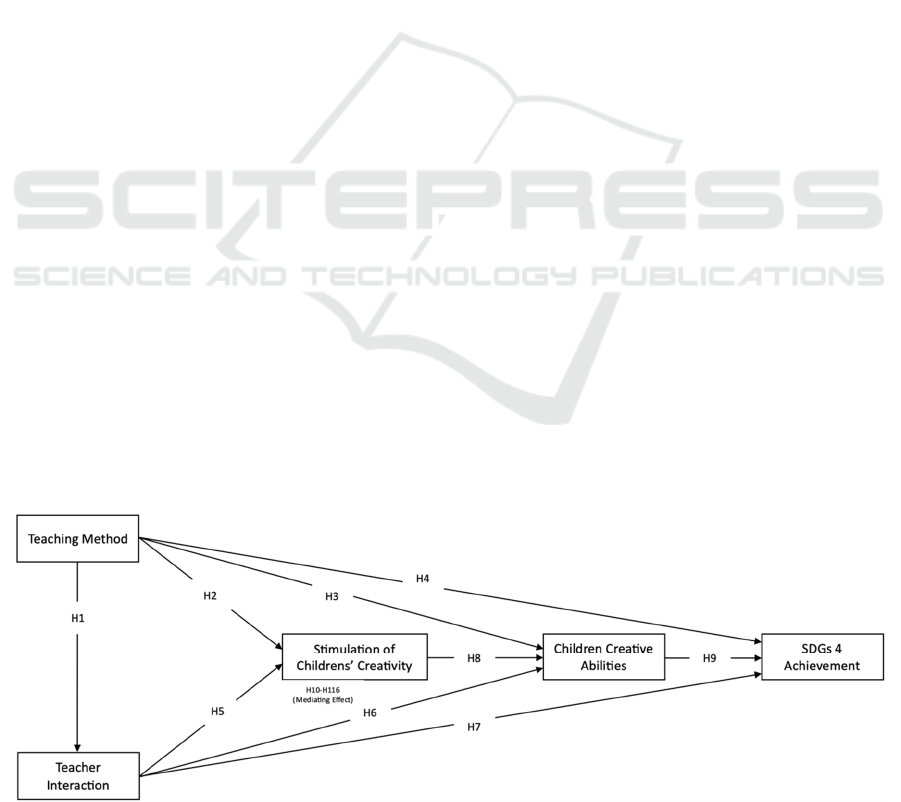
The following are the 8 hypotheses proposed in this
study:
H1: There is a positive and significant correlation
between Teaching Method and Teacher
Instruction.
H2: There is a positive and significant correlation
between Teaching Method and Stimulation
Children Creativity.
H3: There is a positive and significant correlation
between Teaching Method and Childrens’
Creative Abilities.
H4: There is a positive and significant correlation
between Teaching Method and SDGs 4
Achievement.
H5: There is a positive and significant correlation
between Teacher Instruction and Stimulation
Children Creativity.
H6: There is a positive and significant correlation
between Teacher Instruction and Childrens’
Creative Abilities.
H7: There is a positive and significant correlation
between Teacher Instruction and SDGs 4
Achievement.
H8: There is a positive and significant correlation
between Stimulation Children Creativity and
Childrens’ Creative Abilities.
H9: There is a positive and significant correlation
between Stimulation Children Creativity and
SDGs 4 Achievement.
H10:Stimulation Children Creativity mediates the
correlation between Teaching Method and
Childrens’ Creative Abilities.
H11:Stimulation Children Creativity mediates the
correlation between Teacher Instruction and
Childrens’ Creative Abilities.
H12: Stimulation Children Creativity mediates the
correlation between Teaching Method and
SDGs 4 Achievement.
Figure 1: Conceptual Model.
ICECE 2025 - The International Conference on Early Childhood Education
6

H13: Stimulation Children Creativity mediates the
correlation between Teacher Instruction and
SDGs 4 Achievement.
H14: Childrens’ Creative Abilities mediates the
correlation between Teaching Method and
SDGs 4 Achievement.
H15:Childrens’ Creative Abilities mediates the
correlation between Teacher Instruction and
SDGs 4 Achievement.
H16:Childrens’ Creative Abilities mediates the
correlation between Stimulation Children
Creativity and SDGs 4 Achievement.
2 METHOD
This study employed a quantitative approach using
Partial Least Squares Structural Equation Modeling
(PLS-SEM) to analyze the structural relationships
among Teaching Method, Teacher Interaction,
Variety of Teaching Methods, Stimulation of
Children’s Creativity, SDG 4 Achievement, and
Children’s Creative Abilities. Data were collected
through questionnaires administered to teachers and
classroom observations of children’s behavior to
assess their creative abilities.
A quantitative approach was chosen because it is
particularly suitable for confirmatory research, which
aims to test theoretical models using empirical data
and to evaluate hypotheses that have been explicitly
formulated (Hair et al., 2019). Accordingly, the
research design adopted was PLS-SEM.
PLS-SEM is a multivariate analysis technique
widely applied in social science and educational
research because it is capable of examining complex
causal relationships among latent constructs, even in
large models or when the data do not meet the
assumption of normal distribution (Hair et al., 2021).
In this study, PLS-SEM was used to validate the
conceptual model linking Teaching Method, Teacher
Interaction, Variety of Teaching Methods,
Stimulation of Children’s Creativity, SDG 4
Achievement, and Children’s Creative Abilities. This
design provides a robust analytical framework to
empirically test the hypothesized relationships and to
confirm the theoretical model supported by previous
literature.
2.1 Population and Sample
The population of this study consisted of all
kindergartens in Padang City, totaling 335
institutions, comprising 5 public and 330 private
kindergartens, based on official data from the
Ministry of Education, Culture, Research, and
Technology of the Republic of Indonesia
(https://referensi.data.kemendikdasmen.go.id/pendid
ikan/paud/086100/2/jf/1/s2).
The sampling technique employed was stratified
sampling to ensure proportional representation from
each district in Padang City. From this population, a
total of 200 teachers and 200 children. The teachers
represented both public and private kindergartens
across all districts of Padang, while the children were
randomly chosen from selected classes and were
within the age range of 5–6 years.
Based on the demographic analysis of
respondents, this study involved teachers from
various types of schools and administrative regions.
The majority of respondents were teachers from
private schools (90%), while only a small proportion
came from public schools (10%). This indicates that
the sample was dominated by private school
educators, reflecting the prevalence of private
institutions in the study area.
In terms of teaching experience, most respondents
had worked for more than ten years (64.5%),
suggesting that the sample largely consisted of senior
teachers with substantial professional experience.
Teachers with shorter experience were less
represented, with 14% having 1–3 years, 12% having
7–9 years, 6.5% with 3–5 years, and only 3% with 5–
7 years of service. This distribution highlights that the
majority of participants were highly experienced,
while novice teachers formed a relatively small
segment of the sample.
The distribution of school locations also shows
considerable diversity. The largest groups of teachers
were concentrated in Padang Utara (20.5%), Koto
Tangah (19.5%), and Lubuk Begalung (16.5%).
Several other districts, such as Padang Timur
(12.5%), Padang Barat (5.5%), Padang Selatan (7%),
Nanggalo (5%), Bungus Teluk Kabung (3.5%),
Lubuk Kilangan (3.5%), and Pauh (2.5%),
contributed smaller proportions. Kuraji accounted for
4%. This spread indicates that the research covered a
wide geographic area, though the concentration of
respondents was higher in certain regions compared
to others.
In sum, the demographic profile shows that the
sample was largely composed of experienced
teachers from private schools, distributed across a
wide range of geographical areas in Padang. This
composition offers a comprehensive overview of the
respondents’ background and provides a solid basis
for interpreting the subsequent findings within the
specific educational context of the study.
A Preliminary Study on Teacher Interaction, Teaching Methods, and the Development of Creativity in Early Childhood Within the
Framework of SDG 4
7
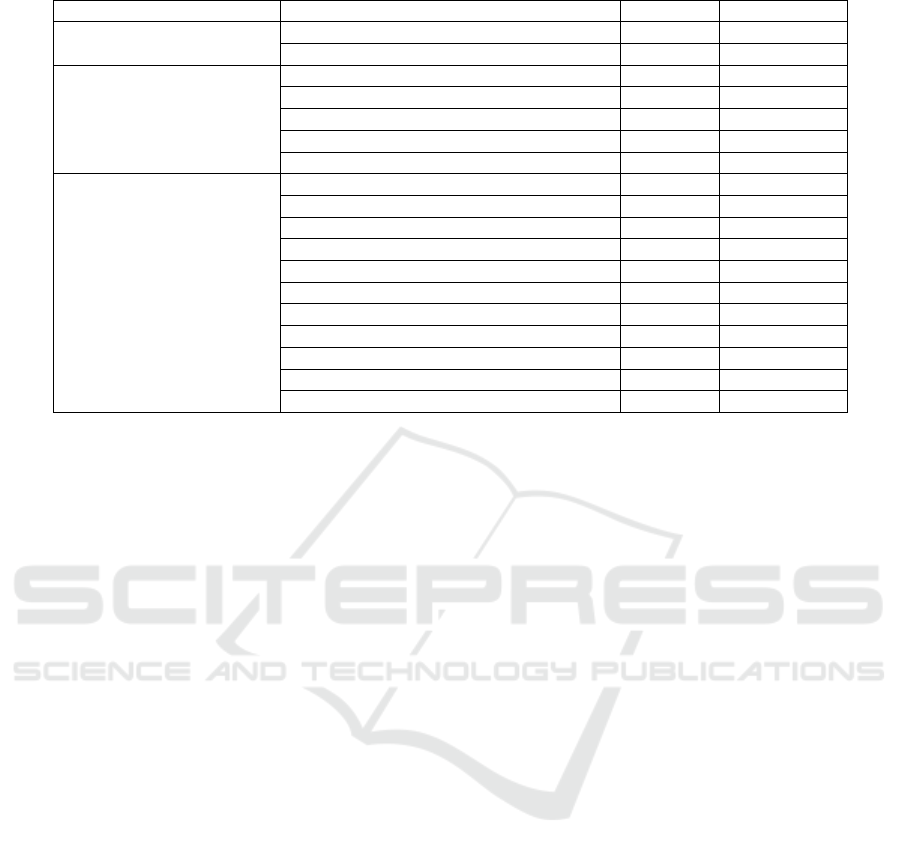
Table 1: Demographics of Research Respondents.
Demographic Categories Sub-Categor
y
Total Percentage
Teachers Public School 20 10%
Private School 180 90%
Teaching experience 1-3
y
ears 28 14%
3-5
y
ears 13 6.5%
5-7 years 6 3%
7-9 years 24 12%
>10 years 129 64.5%
School Location Bun
g
us Teluk Kabun
g
7 3.5%
Koto Tan
g
ah 39 19.5%
Kuran
j
i 8 4.0%
Lubuk Begalung 33 16.5%
Lubuk Kilangan 7 3.5%
Nan
gg
alo 10 5.0%
Padan
g
Barat 11 5.5%
Padan
g
Selatan 4 7%
Padang Timu
r
25 12.5%
Padang Utara 41 20.5%
Pauh 5 2.5%
Source: Field Data (2025)
2.2 Research Instrument
The instruments used in this study consisted of five
measurement scales designed to assess the variables
of Teaching Method, Teacher Interaction, Variety of
Teaching Methods, Stimulation of Children’s
Creativity, Creative Abilities, and SDG 4
Achievement. The selection of instruments was based
on their relevance to the research constructs and on
previous studies that had demonstrated their validity
and reliability.
The adaptation process was adjusted to the
context of early childhood education in Padang City,
following recent international guidelines on the
translation and cross-cultural adaptation of
measurement instruments, as recommended by
Cruchinho et al. (2024). These guidelines emphasize
the importance of a structured procedure, including
forward–backward translation, expert panel review,
and pilot testing, in order to ensure conceptual,
linguistic, and cultural equivalence across all
constructs measured.
2.2.1 Teacher Questionnaire
In the teacher questionnaire, two latent variables were
measured, namely Teaching Method (TM) and
Teacher Interaction (TI), using a five-point Likert
scale (1 = strongly disagree to 5 = strongly agree).
The items were developed based on a review of the
literature and validated by six experts in the field.
2.2.2 Observation of Children’s Creative
Abilities
In this study, children’s creative abilities were
assessed through systematic observation of their
behaviors during classroom learning activities. The
dimensions of creativity evaluated encompassed
novelty, flexibility, elaboration, and persistence.
Observations were carried out within the natural
classroom setting to preserve ecological validity and
to minimize potential sources of bias.
To ensure the validity and reliability of the
constructs prior to the main analysis, the study
assessed convergent validity and internal consistency
reliability for all constructs in the model. The results
indicated that all constructs met the required criteria.
The average loading factor values for all
constructs were above 0.7, demonstrating that the
indicators used were valid in measuring their
respective constructs. Both Cronbach’s Alpha and
Composite Reliability (CR) values exceeded the
minimum threshold of 0.7, indicating that the
research instrument was reliable and consistent in
measuring the variables under study. In addition, the
Average Variance Extracted (AVE) values for each
construct were greater than 0.5, showing that more
than 50% of the variance in the indicators was
explained by the construct they represented.
Accordingly, all constructs—including Children’s
Creative Abilities, SDG 4 Achievement, Stimulation
of Children’s Creativity, Teacher Instruction, and
Teaching Method—were confirmed to be valid and
reliable, and thus appropriate for use in the
ICECE 2025 - The International Conference on Early Childhood Education
8

subsequent structural model analysis using PLS-
SEM. The detailed results of the construct validity
and reliability tests are presented in Table 3.
All questionnaire items were assessed using a
five-point Likert scale. For the constructs of Teaching
Method, Teacher Interaction, Stimulation of
Children’s Creativity, Variety of Teaching Methods,
and Creative Abilities, participants evaluated the
frequency of the observed behaviors on a scale
ranging from 1 (never) to 5 (always).
In contrast, the SDGs 4 Achievement construct
was measured using a scale from 1 (strongly disagree)
to 5 (strongly agree). In this measurement framework,
higher scores across these constructs reflect a greater
intensity or prevalence of the respective attributes as
perceived by the respondents.
2.3 Data Collection Procedure
Data were collected between June and August 2025.
The teacher questionnaires were distributed directly
to schools using a Google Form, while children’s
creativity was observed by trained enumerators who
monitored classroom learning activities.
2.4 Data Analysis
Data were analyzed using Partial Least Squares
Structural Equation Modeling (PLS-SEM) with the
latest version of SmartPLS. This method was chosen
because it is well suited for confirmatory research that
examines complex causal relationships among latent
constructs, can handle non-normal data, and is
Table 2: Research Instruments.
Instruments Indicators N of items Sam
p
le
Teaching Method Learnin
g
A
pp
roach 18 Teacher
Teaching Strategies and Techniques
Active Involvement of Children
Utilization of Learning Resources
Providin
g
Freedom and Ex
p
loration
Consistenc
y
and Clarit
y
of Ste
p
s
Teacher Interaction Reciprocal communication 18
Teacher
Feedback provision
Emotional scaffolding / Affective support
Fre
q
uenc
y
and intensit
y
of
p
ositive en
g
a
g
ement
E
q
uitable role distribution
Instructional res
p
onsiveness
Stimulation of Children
Creativity
Originality Stimulation 12 Teacher
Flexibility Stimulation
Exploration Stimulation
Elaboration Stimulation
Creative Abilities Ori
g
inalit
y
12 Children
Flexibilit
y
Elaboration
Persistence
SDGs 4 Achievement Availabilit
y
of facilities and infrastructure 10 School
Non-discriminator
y
acce
p
tance
Source: Field Data (2025)
Table 3: Construct Reliability and Validity Results.
Construct
Average
Loadin
g
Facto
r
Decision
Cronbach's
Al
p
ha
Decision
Composite
Reliabilit
y
(
CR
)
Outer
T-statistic
Decision
Children Creative
Abilities
0.781 Valid 0.790 Reliable 0.862 AVE (0.610) Valid
SDGs 4
Achievement
0.867 Valid 0.715 Reliable 0.862 AVE (0.759) Valid
Stimulation of
Children’s Creativit
y
0.812 Valid 0.832 Reliable 0.886 AVE (0.661) Valid
Teacher Interaction 0.825 Vali
d
0.895 Reliable 0.919 AVE (0.656) Vali
d
Teaching Metho
d
0.834 Vali
d
0.912 Reliable 0.932 AVE (0.696) Vali
d
Source: Field Data (2025)
A Preliminary Study on Teacher Interaction, Teaching Methods, and the Development of Creativity in Early Childhood Within the
Framework of SDG 4
9
appropriate for large samples (Ali et al., 2018). The
analysis involved two main stages: evaluation of the
outer model (convergent validity, discriminant
validity, and reliability) and the inner model
(hypothesis testing, path coefficients, t-statistics, p-
values, and R-square), in order to assess theoretical
validity, the strength of relationships, and the
predictive power of the model.
The evaluation of model fit indicated that the
research model showed an adequate level of
alignment with the empirical data. The SRMR value
was 0.054 for the saturated model and 0.055 for the
estimated model, both below the threshold of 0.08,
which indicates a good fit. The NFI index also
demonstrated satisfactory results, with values of
0.862 for the saturated model and 0.861 for the
estimated model, exceeding the minimum standard of
0.80 and confirming that the model achieved an
acceptable level of fit. Furthermore, the d_G and
d_ULS values were relatively consistent between the
saturated and estimated models, suggesting that the
model possessed good stability in its estimations.
The comparison of Chi-square values (487.318
for the saturated model and 488.750 for the estimated
model) also showed only a very small difference,
reinforcing that the model used was consistent with
the structure of the data analyzed. Taken together,
these results indicate that the structural model
developed in this study can be considered appropriate
and feasible for use in testing the research hypotheses.
Table 4: Model Fit.
Model Fit Criteria Saturated Model Estimated Model
SRMR 0.054 0.055
NFI 0.862 0.861
d_G 0.275 0.276
d_ULS 0.735 0.755
Chi-square 487.318 488.750
Source: Field Data (2025)
3 RESULT
3.1 Outer Model
The evaluation of the outer model aimed to assess the
quality of the measurement model by examining the
reliability and validity of the indicators for each
construct. This evaluation included tests of
convergent validity, discriminant validity, and
internal consistency reliability.
The results of the PLS-SEM analysis showed that
all indicator loadings exceeded the threshold of 0.70,
indicating that each item strongly represented its
corresponding latent construct. The Average
Variance Extracted (AVE) values for all constructs
were also above 0.50, confirming adequate
convergent validity.
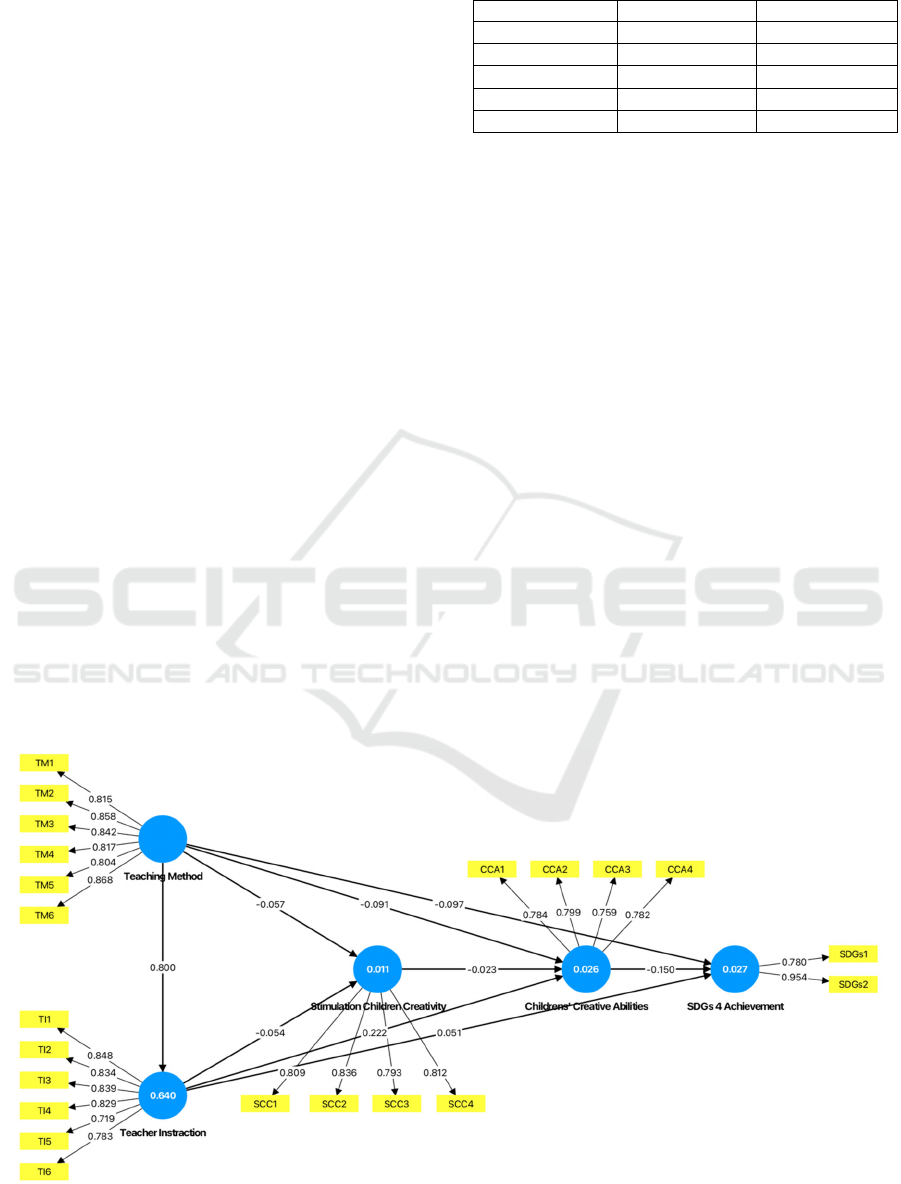
The structural model presented revealed that only
a subset of the hypothesized paths between constructs
was statistically significant. In particular, the
relationships between Teaching Method and Teacher
Instruction, Teacher Instruction and Children’s
Figure 2: Measurement Model Evaluation.
ICECE 2025 - The International Conference on Early Childhood Education
10

Table 5: Loading Factor Value.
Teaching
Method (TM)
Teacher
Interaction (TI)
Stimulation Childrens’
Creativity (SCC)
Children Creative
Abilities (CCA)
SDGs 4 Achievement
(SDGs)
TM1
0
815
TM2 0.858
TM3 0.842
TM4 0.817
TM5 0.804
TM6 0.868
TI1 0.848
TI2 0.834
TI3 0.839
TI4 0.829
TI5 0.719
TI6 0.783
SCC1 0.809
SCC2 0.836
SCC3 0.793
SCC4 0.812
CCA1 0.784
CCA2 0.799
CCA3 0.759
CCA4 0.782
SDGs1 0.780
SDGs2 0.954
Source: Field Data (2025)
Creative Abilities, and Children’s Creative Abilities
and SDG 4 Achievement were found to be significant,
suggesting that these variables play a crucial role in
explaining the overall research model.
The path coefficients presented in the model
indicate both the direction and strength of the
relationships. Teaching Method exerted a strong
influence on Teacher Instruction, Teacher Instruction
contributed positively to Children’s Creative
Abilities, while Children’s Creative Abilities, in
contrast, showed a negative effect on SDG 4
Achievement. These findings provide an important
basis for further interpretation, suggesting that
although teaching methods and teacher instruction
can enhance children’s creativity, translating that
creativity into outcomes aligned with the SDGs
requires the presence of additional supporting factors
3.1.1 Convergent Validity
The convergent validity test was conducted to
evaluate the extent to which indicators of a construct
measure the same concept and are highly correlated.
According to (Hair et al., 2020) and Sarstedt et al.
(2020), convergent validity is established when: 1)All
outer loadings are ≥ 0.70; 2)The Average Variance
Extracted (AVE) is ≥ 0.50. The results of the
convergent validity assessment are presented in table
5.
Based on the results of the convergent validity test
presented in Table 5, all indicators had loading factor
values above 0.70, indicating that each item was able
to represent its respective construct effectively. These
high loading factor values suggest that the indicators
in this model met the criteria for convergent validity.
Therefore, all constructs can be considered
convergently valid and are appropriate to proceed to
the next stage of testing, namely discriminant validity
and construct reliability.
3.1.2 Discriminant Validity
The convergent validity test was conducted to
evaluate the extent to which indicators of a construct
measure the same concept and are highly correlated.
Table 6 shows that the diagonal values (in bold),
representing the square roots of the AVE for each
construct, are higher than the correlations between
constructs in the corresponding rows and columns.
This indicates that each construct in the model
possesses an adequate level of distinctiveness and
does not measure the same concept as the other
constructs. Therefore, the discriminant validity of the
model can be considered empirically established and
consistent with the criteria recommended by Sarstedt
et al. (2020).
A Preliminary Study on Teacher Interaction, Teaching Methods, and the Development of Creativity in Early Childhood Within the
Framework of SDG 4
11

Table 6: Discriminant Validity Evaluation (Fornell–Larcker Criterion).
Teaching
Method
(
TM
)
Teacher
Interaction
(
TI
)
Stimulation Childrens’
Creativit
y
(
SCC
)
Children Creative
Abilities
(
CCA
)
SDGs 4 Achie-
vement
(
SDGs
)
Teaching Method (TM) 0.834
Teacher Interaction
(
TI
)
0.800 0.810
Stimulation Childrens’
Creativit
y
(
SCC
)
-0.100 -0.099 0.813
SDGs 4 Achievement
(SDGs)
-0.070 -0.049 0.088 0.871
Children Creative
Abilities
(
CCA
)
0.089 0.151 -0.036 -0.151 0.781
Source: Field Data (2025)
3.1.3 Reliability
After establishing construct validity, the next step
was to evaluate the internal reliability of each
construct. Reliability was used to assess the
consistency of the indicators in representing their
intended constructs.
Referring to Sarstedt et al. (2020), internal
reliability can be evaluated using three main
indicators: Cronbach’s Alpha, composite reliability
(rho_a and rho_c), and average variance extracted
(AVE). Cronbach’s Alpha and composite reliability
are considered adequate when their values exceed
0.70, while AVE is deemed acceptable for validity
when it is greater than 0.50.
The discriminant validity test using the Fornell–
Larcker criterion shows that the AVE square root
(diagonal) for each construct is consistently higher
than its correlations with other constructs. For
instance, Teaching Method (0.834) and Teacher
Interaction (0.810) both exceed their inter-construct
correlations, as do SCC (0.813), CCA (0.781), and
SDGs (0.871).
These findings confirm that the constructs in the
model are distinct and valid, meaning each construct
captures its own indicators more effectively than it
overlaps with others. In short, the discriminant
validity requirement is fulfilled, and the model is
considered reliable for further analysis (Benitez et al.,
2020).
Based on Table 7, all constructs in this study
demonstrated excellent values for Cronbach’s Alpha
and Composite Reliability, both exceeding the
minimum threshold of 0.70 (Ali et al., 2018; Hair et
al., 2019). This indicates that each construct
possesses a high level of internal consistency in
measuring the intended concept.
In addition, the Average Variance Extracted
(AVE) values for all constructs were above the cut-
off point of 0.50, meaning that a substantial
proportion of the variance in the indicators was
explained by their respective latent constructs. These
findings confirm that each indicator was able to
meaningfully reflect its corresponding construct.
Therefore, it can be concluded that all constructs
in the research model met the criteria for strong
reliability and convergent validity, ensuring that the
model results are credible, stable, and suitable for
further testing in the structural analysis stage.
3.2 Inner Model
After the outer model evaluation produced
satisfactory results, the next stage was to assess the
inner model, or structural model, in order to evaluate
the strength of the relationships among latent
constructs and to test the research hypotheses. This
analysis involved examining path coefficients,
statistical significance (t-values and p-values)
through bootstrapping, and the coefficient of
determination (R²) for each endogenous construct to
assess the predictive accuracy of the model.
The purpose of the inner model assessment was to
determine the extent to which the independent
variables could explain the dependent variables in the
model and to verify the theoretically proposed causal
relationships (Hair et al., 2020). In addition, the
analysis also considered potential mediation and
moderation effects to identify intermediary or
reinforcing roles among variables within the complex
model structure. Furthermore, the adequacy of model
fit was evaluated using global fit indices such as the
Standardized Root Mean Square Residual (SRMR)
and the Normed Fit Index (NFI) (Benitez et al., 2020).
3.2.1 Hypothesis Testing
Hypothesis testing in this study was conducted by
examining the path coefficients, t-statistics, and p-
values for each hypothesized relationship between the
latent constructs. A hypothesis was considered
statistically significant if the t-statistic was ≥ 1.96 and
ICECE 2025 - The International Conference on Early Childhood Education
12

the p-value ≤ 0.05 at the 95% confidence level (Hair
et al., 2020). The path coefficients indicate the
magnitude and direction of the relationships, while
the t-statistics and p-values were used to determine
statistical significance and the generalizability of the
findings. The results of the hypothesis testing are
summarized in Table 8.
Table 7: Construct Reliability.
Cronbach’s
alpha
Composite reliability
(rho_a)
Composite reliability
(rho_c)
Average variance
extracted (AVE)
Teachin
g
Method
(
TM
)
0.912 0.915 0.932 0.696
Teacher Interaction
(
TI
)
0.895 0.900 0.919 0.656
Stimulation Childrens’ Creativity
(
SCC
)
0.832 0.846 0.886 0.661
Children Creative Abilities
(CCA)
0.790 0.802 0.862 0.610
SDGs 4 Achievement
(
SDGs
)
0.715 0.998 0.862 0.759
Source: Field Data (2025)
Table 8: Results of Hypothesis Testing and Structural Relationships.
Hypo-
thesis
Path
Original
Sample (O)
Sample
Mean (M)
Standard
Error
t-Statistic p-Value Decision
Direct Effect
H1
Teaching Method → Teacher
Interaction
0.800 0.802 0.022 36.639 0.000 Accepted
H2
Teaching Method → Stimulation
Children Creativit
y
-0.057 -0.053 0.120 0.473 0.636
Rejected
H3
Teaching Method → Children’s
Creative Abilities
-0.091 -0.093 0.102 0.891 0.373
Rejected
H4
Teaching Method → SDGs 4
Achievement
-0.097 -0.097 0.108 0.895 0.371
Rejected
H5
Teacher Interaction →
Stimulation of Children’s
Creativit
y
-0.054 -0.064 0.117 0.462 0.644
Rejected
H6
Teacher Instruction → Children’s
Creative Abilities
-0.190 0.227 0.097 2.288 0.022 Accepted
H7
Teacher Instruction → SDGs 4
Achievement
0.051 0.053 0.120 0.421 0.673
Rejected
H8
Stimulation Children Creativity
→ Children’s Creative Abilities
-0.023 -0.020 0.089 0.261 0.794
Rejected
H9
Stimulation Children Creativity →
SDGs 4 Achievement
-0.150 -0.153 0.070 2.133 0.033 Accepted
Modiatin
g
Effect
H10
TM → SCC → CCA (Mediating)
0.001 0.001 0.011 0.121 0.904 Re
j
ecte
d
H11
TI → SCC → CCA (Mediating)
0.001 0.002 0.011 0.110 0.912 Rejecte
d
H12
TM → SCC → SDGs (Mediating)
-0.043 -0.051 0.094 0.460 0.645 Rejecte
d
H13
TI → SCC → SDGs (Mediating)
-0.033 -0.035 0.023 1.465 0.143 Rejecte
d
H14
TM → CCA → SDGs
(
Mediatin
g)
0.178 0.182 0.078 2.277 0.023 Accepted
H15
TI → CCA → SDGs (Mediating)
0.014 0.014 0.018 0.757 0.449 Re
j
ecte
d
H16
SCC → CCA → SDGs
(
Mediatin
g)
-0.000 -0.000 0.001 0.105 0.916 Rejected
Notes:
● p < 0.10 (), p < 0.05 (), p < 0.01 ().
● Hypothesis is supported if t-statistic ≥ 1.96 at 5% significance level.
Source: Field Data (2025)
A Preliminary Study on Teacher Interaction, Teaching Methods, and the Development of Creativity in Early Childhood Within the
Framework of SDG 4
13

Table 8 shows that most of the proposed hypotheses
were not supported, with only a few significant paths
identified. The significant relationships include
Teaching Method → Teacher Instruction (H1), Teacher
Instruction → Children’s Creative Abilities (H6),
Stimulation Children Creativity → SDGs 4
Achievement (H9), as well as the mediating pathway
Teaching Method → Children’s Creative Abilities →
SDGs 4 Achievement (H14).
Meanwhile, the majority of both direct and
indirect paths were rejected as they did not meet the
required significance level. These findings provide
empirical evidence that Teacher Instruction plays a
crucial role in enhancing Children’s Creative
Abilities, which in turn influences the achievement of
SDGs 4, albeit in a negative direction. Furthermore,
the results demonstrate that Teaching Method exerts
a strong indirect influence on SDGs through the
mediating role of children’s creativity.
3.2.2 R-Square
In addition to examining the significance of the
relationships among constructs, the PLS-SEM
analysis also assessed the model’s predictive power
for the endogenous variables through the R-Square
(R²) values. R² reflects the proportion of variance in a
dependent construct that can be explained by the
independent constructs within the model. An R² value
of 0.75 is considered substantial, 0.50 is viewed as
moderate, and 0.25 is regarded as weak, depending on
the context of the research discipline (Ali et al., 2018;
Hair et al., 2019).
Table 9: R-square Value.
Konstruk Endogen R-Square
Adjusted
R-S
q
uare
Children Creative
Abilities
0.026 0.017
SDGs 4 Achievement 0.027 0.017
Stimulation Children
Creativit
y
0.011 0.004
Teacher INteraction 0.640 0.639
Source: Field Data (2025)
Table 9 indicates that the explanatory power of the
model varies considerably across constructs. The
highest R² value is found in Teacher Interaction (R² =
0.640; Adjusted R² = 0.639), suggesting that more
than 60% of the variance in teacher–student
interaction can be explained by the predictors
included in the model. This result reflects strong
predictive power and highlights Teacher Interaction
as a central construct within the framework.
In contrast, the R² values for Children Creative
Abilities (0.026), SDGs 4 Achievement (0.027), and
Stimulation of Children’s Creativity (0.011) are
notably low, indicating that the predictors account for
only a very small proportion of the variance in these
constructs. These findings imply that additional
factors, not captured in the current model, may play a
more substantial role in explaining creativity-related
outcomes and SDG achievements.
Overall, the results demonstrate that while the
model explains Teacher Interaction effectively, its
predictive ability for creativity and achievement-
related constructs remains limited. This suggests the
need for model refinement, possibly through the
inclusion of other mediating or moderating variables,
to better capture the dynamics underlying children’s
creativity and educational outcomes.
4 DISCUSSION
The results of this study revealed that teaching
method has a strong and significant effect on teacher
instruction (H1). This finding underscores the
importance of pedagogical strategies in shaping the
quality of classroom interaction. When teachers
employ active and student-centered methods, they
tend to be more engaged in reciprocal
communication, feedback provision, and
instructional responsiveness. Active methodologies
significantly enhance both teacher-student
engagement and the integration of sustainability
values in learning (Crisol-Moya et al., 2020; Tang,
2023; L. Zhang et al., 2021). This suggests that
teaching approaches do not merely transfer
knowledge but also determine how effectively
teachers can interact with learners.
Interestingly, the direct effects of teaching method
on the stimulation of children’s creativity, children’s
creative abilities, and SDGs achievement (H2–H4)
were not supported. This indicates that teaching
methods alone are insufficient to directly foster
creativity or sustainable development competencies.
Rather, their influence is more indirect, requiring
mediating mechanisms. This aligns with the
argument of Beghetto & Kaufman (2014), who
emphasized that creativity development is contingent
not only on teaching practices but also on the broader
classroom climate, emotional support, and
opportunities for exploration. Hence, the lack of
direct influence found in this study may reflect the
limited focus of teaching practices that still prioritize
knowledge transmission over creativity-oriented
learning.
ICECE 2025 - The International Conference on Early Childhood Education
14

Another surprising finding lies in the relationship
between teacher instruction and children’s creative
abilities (H6), which was found to be significant but
negative. In other words, the more intensive the
instruction, the lower the creative abilities of children.
This resonates with Hennessey, (2019) classic theory
of creativity, which suggests that controlling or
overly directive environments undermine intrinsic
motivation and creative performance. Recent studies
reinforce this perspective; for example, Zhang et al.
(2023) reported that children’s creativity flourishes
when they experience supportive peer relationships
and a sense of belonging in the classroom, rather than
strict instructional control. Thus, the negative effect
observed in this study highlights the potential risks of
rigid teacher instruction that limits children’s
autonomy.
Furthermore, the effect of stimulation of
children’s creativity on SDGs achievement (H9) was
also significant but negative. This unexpected
outcome suggests that excessive or poorly targeted
stimulation may distract from broader sustainable
development goals. As López et al., (2024) argue in
their systematic review, creativity in education
contributes positively to sustainability only when it is
contextually integrated and aligned with ecosocial
perspectives. Without such alignment, creative
activities may remain isolated and fail to translate into
meaningful contributions toward sustainability
outcomes.
Regarding the mediation hypotheses, most
pathways through stimulation of creativity (H10–
H13) and children’s creative abilities (H15–H16)
were not significant. However, one important
mediating effect was confirmed: teaching method
influences SDGs achievement through children’s
creative abilities (H14). This finding positions of
creativity as a crucial bridge between pedagogy and
sustainability. It also supports UNESCO’s (2021)
framework, which highlights creativity and
innovation as central competencies for sustainable
development. Recent studies echo this, showing that
problem-solving pedagogies and creative risk-taking
in classrooms foster both individual growth and
collective contributions to global goals (Creely et al.,
2021; Fischer et al., 2022; Henriksen et al., 2021).
Taken together, the findings suggest that while
teaching methods play a pivotal role in shaping
teacher instruction, their contribution to creativity
and sustainability is indirect and contingent upon how
creativity is cultivated within the classroom. Overly
rigid instruction can stifle creativity, while
unstructured stimulation may fail to support
sustainability. The most promising pathway, as
demonstrated in this study, lies in empowering
children’s creative abilities as mediators linking
teaching practices to sustainable educational
outcomes. This insight resonates with a growing body
of literature emphasizing the need for integrative
pedagogies that balance structure with autonomy and
align creative development with the broader aims of
sustainable development.
5 CONCLUSIONS
This study examined the complex relationships
between teaching method, teacher instruction,
children’s creativity, and the achievement of SDG 4,
and the findings offer several important insights. The
results confirm that teaching method plays a decisive
role in strengthening teacher instruction, yet its direct
impact on creativity and sustainability outcomes was
limited, suggesting that pedagogy influences these
aspects mainly through indirect pathways.
Notably, the study revealed that intensive teacher
instruction can negatively affect children’s creative
abilities, while excessive or unfocused stimulation of
creativity may even reduce progress toward SDG 4,
highlighting the need for more balanced and
contextually integrated approaches. At the same time,
the mediation analysis demonstrated that teaching
methods can contribute positively to SDGs 4
achievement when they enhance children’s creative
abilities, positioning creativity as a vital bridge
between classroom practice and sustainable
development.
These findings imply that educational strategies
should move beyond rigid instruction and prioritize
learning environments that cultivate autonomy,
exploration, and problem-solving skills, as these
elements are central to preparing students for future
challenges.
For future research, it is essential to broaden the
model by including variables such as school climate,
peer collaboration, digital pedagogy, and socio-
emotional support, as well as adopting longitudinal or
qualitative approaches to capture how creativity and
sustainability evolve over time, thereby generating a
deeper and more comprehensive understanding of
how pedagogy can effectively support sustainable
education.
ACKNOWLEDGEMENTS
The authors would like to thank Lembaga Penelitian
dan Pengabdian Masyarakat Universitas Negeri
A Preliminary Study on Teacher Interaction, Teaching Methods, and the Development of Creativity in Early Childhood Within the
Framework of SDG 4
15

Padang for funding this work with a contract number:
1789/UN35.15/LT/2025.
REFERENCES
Ali, F., Rasoolimanesh, S. M., Sarstedt, M., Ringle, C., &
Ryu, K. (2018). An Assessment of The Use of Partial
Least Squares Structural Equation Modeling.
International Journal of Contemporary Hospitality
Management, 34(1), 1–5. https://doi.org/10.1108/IJC
HM-10-2016-0568
Beghetto, R. A., & Kaufman, J. C. (2014). Classroom
contexts for creativity. High Ability Studies, 25(1), 53–
69. https://doi.org/10.1080/13598139.2014.905247
Benitez, J., Henseler, J., Castillo, A., & Schuberth, F.
(2020). How to perform and report an impactful
analysis using partial least squares: Guidelines for
confirmatory and explanatory IS research. Information
and Management, 57(2), 103168. https://doi.org/10.
1016/j.im.2019.05.003
Bullard, A. J., & Bahar, A. K. (2023). Common barriers in
teaching for creativity in K-12 classrooms: A literature
review. Journal of Creativity, 33(1), 100045.
https://doi.org/https://doi.org/10.1016/j.yjoc.2023.100
045
Creely, E., Henriksen, D., Crawford, R., & Henderson, M.
(2021). Exploring creative risk-taking and productive
failure in classroom practice. A case study of the
perceived self-efficacy and agency of teachers at one
school. Thinking Skills and Creativity, 42, 100951.
https://doi.org/10.1016/j.tsc.2021.100951
Crisol-Moya, E., Romero-López, M. A., & Caurcel-Cara,
M. J. (2020). Active Methodologies in Higher
Education: Perception and Opinion as Evaluated by
Professors and Their Students in the Teaching-Learning
Process. Frontiers in Psychology, 11(August), 1–10.
https://doi.org/10.3389/fpsyg.2020.01703
Cruchinho, P., López-Franco, M. D., Capelas, M. L.,
Almeida, S., Bennett, P. M., da Silva, M. M., Teixeira,
G., Nunes, E., Lucas, P., & Gaspar, F. (2024).
Translation, Cross-Cultural Adaptation, and Validation
of Measurement Instruments: A Practical Guideline for
Novice Researchers. Journal of Multidisciplinary
Healthcare, 17, 2701–2728. https://doi.org/10.21
47/JMDH.S419714
Druker-Ibáñez, S., & Cáceres-Jensen, L. (2022). Integration
of indigenous and local knowledge into sustainability
education: a systematic literature review. Environ-
mental Education Research, 28(8), 1209–1236.
https://doi.org/10.1080/13504622.2022.2083081
Fischer, D., King, J., Rieckmann, M., Barth, M., Büssing,
A., Hemmer, I., & Lindau-Bank, D. (2022). Teacher
Education for Sustainable Development: A Review of
an Emerging Research Field. Journal of Teacher
Education, 73(5), 509–524. https://doi.org/10.1177/002
24871221105784
Hair, J. F., Howard, M. C., & Nitzl, C. (2020). Assessing
measurement model quality in PLS-SEM using
confirmatory composite analysis. Journal of Business
Research, 109(August 2019), 101–110.
https://doi.org/10.1016/j.jbusres.2019.11.069
Hair, J. F., Hult, G. T. M., Ringle, C. M., Sarstedt, M.,
Danks, N. P., & Ray, S. (2021). Evaluation of the
Structural Model. In: Partial Least Squares Structural
Equation Modeling (PLS-SEM). In Structural Equation
Modeling: A Multidisciplinary Journal (vol.30, Issue 1)
Hair, J. F., Risher, J. J., Sarstedt, M., & Ringle, C. M.
(2019). When to use and how to report the results of
PLS-SEM. European Business Review, 31(1), 2–24.
https://doi.org/10.1108/EBR-11-2018-0203
Hennessey, B. A. (2019). Motivation and creativity. The
Cambridge.
Henriksen, D., Henderson, M., Creely, E., Carvalho, A. A.,
Cernochova, M., Dash, D., Davis, T., & Mishra, P.
(2021). Creativity and risk-taking in teaching and
learning settings: Insights from six international
narratives. International Journal of Educational
Research Open, 2, 100024. https://doi.org/10.101
6/j.ijedro.2020.100024
López, U. H., Vázquez-Vílchez, M., & Salmerón-Vílchez, P.
(2024). The Contributions of Creativity to the Learning
Process within Educational Approaches for Sustainable
Development and/or Ecosocial Perspectives: A
Systematic Review. Education Sciences, 14(8). https://
doi.org/10.3390/educsci14080824
Sarstedt, M., Ringle, C. M., & Hair, J. F. (2020). Handbook
of Market Research. In Handbook of Market Research
(Issue July). https://doi.org/10.1007/978-3-319-05542-8
Tang, K. H. D. (2023). Student-centered Approach in
Teaching and Learning: What Does It Really Mean? Acta
Pedagogia Asiana, 2(2), 72–83. https://doi.org/10.53
623/apga.v2i2.218
UNESCO. (2021). Reimagining our futures together: a new
social contract for education. In Reimagining our futures
together: a new social contract for education.
https://doi.org/10.54675/asrb4722
Zhang, J., Yang, Y., Ge, J., Liang, X., & An, Z. (2023).
Stimulating creativity in the classroom: examining the
impact of sense of place on students’ creativity and the
mediating effect of classmate relationships. BMC
Psychology, 11(1), 1–12. https://doi.org/10.1186/s4
0359-023-01479-7
Zhang, L., Basham, J. D., Carter, R. A., & Zhang, J. (2021).
Exploring Factors associated with the implementation
of student-centered instructional practices in U.S.
classroomss. Teaching and Teacher Education, 99,
103273. https://doi.org/10.1016/j.tate.2020.103273.
ICECE 2025 - The International Conference on Early Childhood Education
16
