
A Comparative Study on The Performance of ChatGPT-4 and
Claude 3 in Translating Engineering Specialized Course Textbooks
Yiqin Jiang
Institute of International and Comparative Education, East China Normal University, Shanghai, 200062, China
Keywords: AIGC, Machine Learning, Translation Applications.
Abstract: This study examines the advantages and disadvantages of Claude 3 and ChatGPT-4 for translating engineering
texts. Both AI technologies analyze scientific texts from four engineering textbooks for accuracy, fluency,
audience appropriateness and logicality using the CO-STAR framework. The translation outcomes of AI tools
were contrasted and examined with those of rule-based machine translation and human translation of the four
paragraphs. Overall, Claude 3 performs better than ChatGPT-4, according to the results, and ChatGPT-4 has
to be enhanced in terms of audience adaption and fluency. Nevertheless, the overall quality of the translations
is inferior to that of human translators, and both AI systems have representational flaws. This study
emphasizes the need for improvement in the distribution of educational resources across languages, as well
as the potential of AI technologies for translating engineering textbooks.
1 INTRODUCTION
The sharing of educational resources across
languages has become a significant force to promote
education and has drawn the attention of many
nations as a result of the internationalization of
education and the ongoing advancement of
communication technologies (Ahmadova, 2024). The
process of teaching knowledge and concepts for the
practice of engineering professions is known as
engineering education (Kadhim & Hussein, 2024).
One of the key issues facing engineering education is
globalization, which requires engineers to possess a
variety of cultural and communication abilities
(Ahrenberg, 2017). Thus, there is an urgent need for
learning materials for engineering education to be
shared and distributed throughout the world.
Nonetheless, there are numerous issues with the way
specialized engineering course textbooks are now
translated, and when translating scientific literature,
it's critical to consider linguistic and cultural
variations (Balas et al,2024). Engineering textbooks'
precise terminology and theoretical explanations
make it possible for manual translation or rule-based
machine translation to highlight its shortcomings,
such as inefficiency and low accuracy (Simpson &
Weiner,1989; Duderstadt, 2007). This makes it
difficult for engineering education learning resources
to be disseminated internationally. As generative
artificial intelligence advances, it opens up new
avenues for translating engineering textbooks and
offers a revolutionary solution to the aforementioned
issues.
It has been discovered that Artificial Intelligence
Generated Content (AIGC) technology is extensively
utilized in the translation industry in addition to being
utilized in the domains of cross-linguistic
communication and cultural exchange (Ferrag &
Bentounsi, 2024). In addition to having higher
translation quality and efficiency than human
translation, Artificial Intelligence (AI) translation is
superior to machine translation (Haq et al, 2024; Li et
al, 2024). To encourage global scientific and
technical communication, AIGC technology can raise
the translation quality in the interim (Li, 2024). AI
translators do have some limitations, though: first,
they are not as good at handling logical expressions
and textual connotations (Li, 2024); second, they are
not as good at adapting to different fields of
specialization (Li,2022), and third, while the quality
of translations is on par with intermediate human
translators, they still fall short of advanced translators
(Lommel et al, 2024). Numerous research have also
been conducted on the efficacy of AI translation
applications in several specialized domains. Artificial
intelligence (AI) does well in the literary domain
when it comes to word choice and narrative, but it
struggles to handle cultural and subtle emotional
distinctions (Mohsen, 2024). AI translations are
454
Jiang, Y.
A Comparative Study on the Performance of ChatGPT-4 and Claude 3 in Translating Engineering Specialized Course Textbooks.
DOI: 10.5220/0013999300004912
Paper published under CC license (CC BY-NC-ND 4.0)
In Proceedings of the 1st International Conference on Innovative Education and Social Development (IESD 2025), pages 454-460
ISBN: 978-989-758-779-5
Proceedings Copyright © 2025 by SCITEPRESS – Science and Technology Publications, Lda.

typically less accurate than human translators in the
legal domain (Quigley et al,2011). Studies in the
medical field have also assessed and contrasted the
performance of various AI tools in translating
educational materials for neurological patients and
ophthalmic terminology, with ChatGPT performing
better in the latter case and Claude performing better
in the former (Shokoohifar, 2024; Wang, 2023).
Thus, it is yet unclear and worthwhile to investigate
if these two AI techniques can translate engineering
texts. It is evident that the majority of current research
is concentrated on AI translation in the fields of law,
medical, and literature, whereas engineering research
is at a lower level. Although the scientific text is
primarily based on objective facts, it is still influenced
by cultural differences in terms of expression,
according to the author, who believes that the use of
AI tools to translate engineering textbooks will face
many challenges. First, the text is extremely
specialized, and arbitrary additions and omissions
could cause it to lose its original meaning; second,
even though the scientific text is primarily grounded
in objective facts, cultural differences in expression
still have an impact on it (Wang,2023). In order to
provide a higher-quality, more accurate translation,
this research will investigate the benefits and
drawbacks of AI technologies in engineering
textbook translation.
Among the various AI tools used in this study,
ChatGPT-4 and Claude 3 were selected for two
reasons: first, they are the most popular in the
translation field when compared to other AI tools like
Kimi; second, ChatGPT-4 does well when translating
scientific texts (Yan et al, 2024), and Claude does
better than ChatGPT when translating into English
(Yan & Zhao, 2023). As a result, both are equally
capable of translating technical texts. In this study,
the translation skills and outcomes of these two AI
systems for specialized engineering course texts will
be evaluated and compared for similarities and
differences. This study is innovative in two ways:
first, it closes the knowledge gap regarding the
potential and constraints of AI tools for translating
specialized engineering science texts; second, it
optimizes the research methodology by using the
Multidimensional Quality Metrics (MQM) evaluation
framework as a foundation for screening relevant
evaluation indicators. The significance of this study
is threefold: 1. To encourage the exchange of
educational resources across languages and to
compare the strengths and shortcomings of Claude 3
and ChatGPT-4 in translating engineering textbooks
in order to enhance their quality. 2. Research findings
have the potential to foster creativity and
collaboration in international education. 3. This study
can also offer fresh perspectives on the investigation
of engineering talent development in Science,
Technology, Engineering, Mathematics (STEM)
education within an interdisciplinary setting.
2 RESEARCH METHOD
This study compares the translation capabilities of
Claude 3 and ChatGPT-4 for engineering texts. For
this study, two textbooks that are fairly representative
of the Chinese-US Mechanical Design and
Manufacturing and Automation joint engineering
curriculum at Shanghai Normal University were
selected. These two texts are Fluid Mechanics
Fundamentals and Applications (2nd edition) and
Thermodynamics: An Engineering Approach (7th
edition). The author chose two scientific texts from
each engineering textbook that addressed specialized
terminology and the background of specialized
domain knowledge for additional AI translations in
order to assess whether these two AI tools could
successfully negotiate the numerous challenges
associated with translating engineering textbooks. To
assess the quality of the AI translations, the author
included the translation results in a questionnaire that
was given to Shanghai Normal University
engineering majors, ranging from freshmen to
seniors, along with their professors. The author then
contrasted and examined the rule-based machine
translation, artificial intelligence translation, and
human-translated materials after using the DeepL
program and hiring a qualified English translator to
translate the textbook simultaneously.
2.1 Textbooks Chosen for the Analysis
Thermodynamics: An Engineering Approach (7th
edition), written by Yunus A. Cengel and Michael A.
Boles, is the first textbook. Important topics like
energy, the second law of thermodynamics, entropy,
the gas power cycle, chemistry, and phase
equilibrium are covered in this book, which presents
the fundamental ideas and laws of engineering
thermodynamics and their applications. The book
also includes numerous instances that are explored
together with technical applications. Undergraduate
and graduate students studying energy and power
engineering, architecture, machinery, and other
relevant fields at universities can use this book as a
textbook.
Fluid Mechanics Fundamentals and Applications
(2nd edition), written by Yunus A. Cengel and John
A Comparative Study on the Performance of ChatGPT-4 and Claude 3 in Translating Engineering Specialized Course Textbooks
455

M. Cimbala, is the second book. This book provides
many examples of engineering while introducing the
fundamental ideas and formulas of fluid mechanics.
It discusses crucial topics such fluid kinematics,
pressure and hydrostatics, Bernoulli equations, and
energy equations. Undergraduate and graduate
students studying physical engineering, chemical
engineering, aerospace, and other relevant fields can
use this book as a university textbook.
These two volumes, which are standard textbooks
for Chinese-foreign cooperative education in
engineering, cover a lot of information in several
engineering disciplines and are appropriate for use in
this study.
2.2 Procedures
The author intends to start by providing ChatGPT-4
with the same CO-STAR command framework as
Claude 3 (with “C” for Context, “O” for Objective,
“S” for Style, “T” for Tone, “A” for Audience, and
“R” for Response). These two AI systems ought to be
able to more precisely and expertly translate technical
materials from English into Chinese with the help of
this framework. Two factors led to the selection of the
CO-STAR education framework: 1. It is thorough,
producing translated text that is accurate and
readable. 2. It is focused, making translations in
specialized fields easier.
Second, upon the completion of the translation,
the writers will ask professionals in the field who
have undergone these specialized courses to assess
the outcomes. A framework for assessing the quality
of translations produced by humans, machines, and
artificial intelligence is called MQM (Multi-
dimensional Quality Metrics) (Zhang & Li, 2009).
Although there are seven assessment indicators in the
MQM system, not all of them can be used when
translating scientific materials in engineering
textbooks. Therefore, three variables from the MQM
framework — accuracy, fluency, and audience
adaptability—were selected for this study in order to
reduce redundancy and increase evaluation
efficiency. In addition, the inclusion of the indication
and logic makes it easier to assess how well the
scientific text's reasoning and argumentation process
is supported in the translation. Table 1 displays the
four indicators' definitions and evaluation goals. As
indicated in Table 2, a Likert scale was used to assess
each indicator from 1 to 5. In this study, a five-level
scale questionnaire with four assessment indicators
was designed using a quantitative-qualitative and
qualitative-mixed research methodology. This allowed
for both a qualitative analysis of the differences
Table 1: Explanation of indicators.
Indicator Definition Objectives
Accuracy The translation faithfully captures the original
text's content, message, and intent.
Evaluate whether the translation faithfully captures the
original text's meaning and make sure that terminology
is not mistranslated when translatin
g
scientific texts.
Fluency The translation is adequately fluid, exhibiting
natural expression, a range of language and
phrase structures, and cohesion between
sentences.
Evaluate the translation's vocabulary, syntax, and
grammar to see if it is readable, fluid, and natural.
Audience
Appropriateness
The translation is suitable for the intended
audience's reading level, comprehension, and
interests.
Evaluate whether the translation has taken into
consideration the target audience's expected level of
knowledge, which in this case was undergraduate
students.
Logicality The translation's procedures for reasoning and
arguments are sound, understandable, and
consistent.
Evaluate whether the translation adheres to the scientific
text's rigor and steers clear of ambiguous or nonsensical
reasoning.
Table 2: Likert scale for all assessments.
Metric 1 2 3 4 5
Accuracy Very inaccurate Inaccurate Moderately accurate Accurate Very accurate
Fluency Not fluent Not very fluent Moderately fluent Fluent Very fluent
Audience
Appropriateness
Very inappropriate Inappropriate Moderately appropriate Appropriate
Very
appropriate
Logicality Very illogical Illogical Moderately logical Logical Very logical
IESD 2025 - International Conference on Innovative Education and Social Development
456
between the AI translation results and those of the
human and rule-based machine translations, as well as
a quantitative analysis and interpretation of the
research data. In order to provide a higher-quality,
more accurate translation of engineering textbooks,
this study ultimately analyzes the benefits and
drawbacks of ChatGPT-4 and Claude 3.
2.3 Data Collection
In all, 71 questionnaires were gathered for this study,
with 32 male and 39 female participants. The samples
comprised professors and freshman to senior
engineering students at Shanghai Normal University,
including 13 teachers, with almost 60% of the
samples being “fourth-year university students”.
3 RESULTS & DISCUSSION
3.1 Quantitative Research Results
The scale sample in the questionnaire is dependable
and trustworthy since the Cronbach alpha coefficient,
which is larger than 0.9, was 0.972 when the gathered
questionnaire was examined for validity and
reliability in this study. The study data is very
acceptable for information extraction since the KMO
value was 0.858, which is more than 0.8. The research
sample has strong validity and reliability.
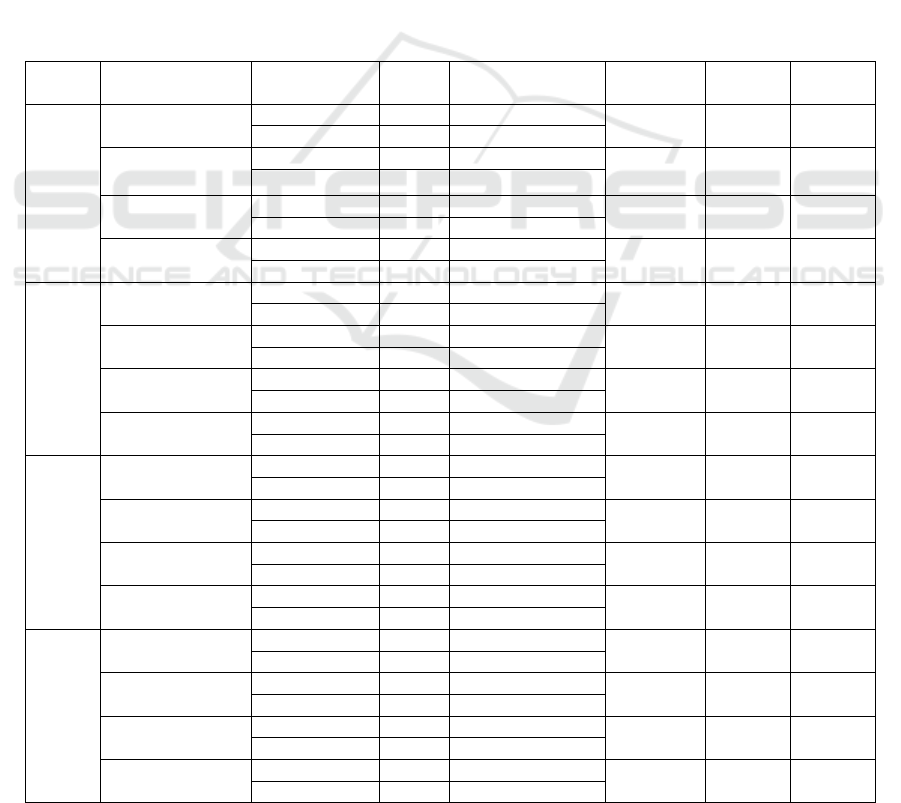
Since the discrete degree of evaluation of Claude
3 and ChatGPT-4 is essentially the same, students and
teachers of different engineering majors are in the
same divergence of evaluation of these two AI tools,
and there is never a situation in which the evaluation
of one AI tool is more controversial. According to the
Table 3: A table comparing the advertising language ability of ChatGPT-4o and Kimi in the translation beauty industry.
* p<0.05 ** p<0.01
Passage Metric AI Mean Standard Deviation
Mean
Difference
t p
1 Accuracy ChatGPT-4 3.92 0.65 -0.07 -0.672 0.504
Claude 3 3.99 0.80
Fluency ChatGPT-4 3.90 0.74 -0.21 -2.200 0.031*
Claude 3 4.11 0.67
Audience
Appropriateness
ChatGPT-4 3.92 0.71 -0.18 -2.333 0.023*
Claude 3 4.10 0.70
Logicality ChatGPT-4 3.97 0.68 -0.04 -0.445 0.658
Claude 3 4.01 0.80
2 Accuracy ChatGPT-4 3.94 0.81 -0.07 -0.698 0.488
Claude 3 4.01 0.80
Fluency ChatGPT-4 3.89 0.73 -0.15 -1.742 0.086
Claude 3 4.04 0.78
Audience
Appropriateness
ChatGPT-4 3.90 0.74 -0.14 -1.598 0.114
Claude 3 4.04 0.76
Logicality ChatGPT-4 3.96 0.73 -0.11 -1.526 0.132
Claude 3 4.07 0.76
3 Accuracy ChatGPT-4 4.00 0.74 0.00 0.000 1.000
Claude 3 4.00 0.72
Fluency ChatGPT-4 3.90 0.78 -0.17 -2.044 0.045*
Claude 3 4.07 0.72
Audience
Appropriateness
ChatGPT-4 3.93 0.74 -0.08 -0.973 0.334
Claude 3 4.01 0.73
Logicality ChatGPT-4 3.96 0.75 -0.14 -1.926 0.058
Claude 3 4.10 0.68
4 Accuracy ChatGPT-4 3.97 0.76 0.00 0.000 1.000
Claude 3 3.97 0.77
Fluency ChatGPT-4 3.99 0.80 0.04 0.445 0.658
Claude 3 3.94 0.75
Audience
Appropriateness
ChatGPT-4 3.87 0.77 -0.21 -2.154 0.035*
Claude 3 4.08 0.71
Logicality ChatGPT-4 4.03 0.74 -0.10 -1.355 0.180
Claude 3 4.13 0.65
A Comparative Study on the Performance of ChatGPT-4 and Claude 3 in Translating Engineering Specialized Course Textbooks
457

results of the questionnaire data survey, Claude 3 has
a slightly higher average value of each index than
ChatGPT-4, which is more advantageous in user
evaluation. In contrast, the assessments of the four
indicators do not change (p>0.05) when ChatGPT-4
translates four sets of distinct engineering textbook
sections, and the translation capability remains
constant. The stability of Claude 3's translation of the
engineering textbook can still be improved, though,
as one of the four groups of distinct passages in the
textbook exhibits a significance at the 0.05 level of
fluency with the other two passages (p is 0.038 vs.
0.022, respectively).
Furthermore, Table 3 displays the survey results
of the comparison analysis of the translations of
Claude 3 and ChatGPT-4. The table shows that the
first translated passage, Claude 3, has better audience
adaptation and fluency than ChatGPT-4; the second
translated passage's results show no difference
(p>0.05); the third translated passage, Claude 3, has
better fluency than ChatGPT-4; and the fourth
translated passage, Claude 3, has better audience
adaptation than ChatGPT-4.
In summary, the research indicates that both
ChatGPT-4 and Claude 3 perform well when
translating engineering textbooks; both exhibit good
accuracy and logic, but ChatGPT-4 performs worse
than Claude 3 in terms of fluency and audience
adaptability. Claude 3's translation stability still
requires work.
3.2 Comparative Result Analysis of
Four Translation Methods
After comparing and evaluating four selections
translated with rule-based machine translation,
human translation, ChatGPT-4 translation and Claude
3, the author came to the following conclusions.
1. Rule-based machine translation is able to
recognize and translate most specialized vocabulary,
but omissions and mistranslations are more
problematic. For instance, “Fluid statics is used to
determine the forces acting on floating or submerged
bodies and the forces developed by devices like
hydraulic presses and car jacks.” Rule-based machine
translation can identify and translate the majority of
specialized vocabulary. The forces generated by
machinery such as vehicle jacks and hydraulic
presses, as well as the forces acting on submerged or
floating things, are determined using fluid statics.
While “floating or submerged bodies” was accurately
translated but just a portion of the text was translated,
leaving out important details. because the sentence's
use of “floating or submerged bodies” is incorrectly
translated, leaving out important details. In addition,
it suffers from certain translation accents, such as
slightly unnatural expressions like “the so-called” and
“become very important”, which make it less fluent
to read.
2. Certain specialist terms, such “isentropic” and
“isentropic efficiencies,” are appropriately translated
using ChatGPT-4. The translation is consistent with
the Chinese expression pattern, yet the sentences are
also fluid, natural, and logical, such as the sentence
“Electrons at outer orbits have larger kinetic
energies.” The phrase “the force relations developed
naturally involve the gravitational acceleration” is
one example of a term that has to be better improved
since it is a little stiff. The phrase “the force relations”
is too simple to translate.
3. Since there is no relative motion between the
fluid and the solid surface, there are no shear forces
acting parallel to the surface. Claude 3's translation
guarantees accuracy, fluency, and logicalness while
also excelling at handling lengthy and challenging
sentences. Shear forces operating parallel to the
surface are absent as there is no relative motion
between the fluid and the solid surface. The sentence's
translation is clear and faithfully captures the original
text's logical flow. However, there are also some
cases where the translation is too colloquial and the
meaning is vague, such as in the sentence “the
variation of pressure is due only to the weight of the
fluid. For example, in the sentence “the variation of
pressure is due only to the weight of the fluid.”, the
translation of “is due to” lacks professionalism.
4. Compared to the other three translation
processes, human translations are the slowest and
least effective, but they are of the greatest quality and
have almost evident errors.
The aforementioned investigation results indicate
that the public is aware of ChatGPT-4 and Claude 3's
capacity to translate engineering texts. Although both
ChatGPT-4 and Claude 3 have presentation issues,
Claude 3 is superior in this area in terms of
translation. In the meanwhile, ChatGPT-4 and Claude
3 continue to struggle with difficult, informal, and
ambiguous language, and their overall translation
quality falls short of that of human translators. Thus,
according to the author, when translating engineering
textbooks, translators can use the AI tool to finish the
first translation and then combine it with the benefits
of human translation quality to add embellishments or
rewrites to further improve the translation's wording
and elaboration.
IESD 2025 - International Conference on Innovative Education and Social Development
458

4 CONCLUSION
With advancements in science and technology,
translation technology also brings about innovation as
times change. According to the author, textbooks
from all disciplines should aim to use the most
advanced translation technology, such as AI
translation, when they are translated, as the academic
community is now placing a strong emphasis on the
sharing of global educational materials across
languages. This study employed a mixed research
approach to identify the advantages and
disadvantages of ChatGPT-4 and Claude 3 in the
translation of engineering textbooks. The advantages
of these two AI tools include their ability to
effectively translate scientific texts in engineering
textbooks in a way that is accurate, fluent, acceptable,
and logical, as an alternative to rule-based machine
translation. Furthermore, in this subject, Claude 3 is
better suited for translation. The drawback is that,
although scientific texts are objective, engineering
textbooks must be presented carefully to be
appropriate for this age range in order to serve as
instructional resources for students. The presentation
of these two AI tools is still difficult, informal, and
unclear; translators who are knowledgeable about the
variations in languages, cultures, and modes of
expression among nations must manually alter and
add to them. In order to produce more accurate and
expert translations of top-notch engineering
textbooks, the author suggests that the AI tool should
be able to learn the languages and cultures of other
nations and continually enhance its algorithm.
However, this study has many drawbacks, such as a
too limited selection of engineering textbooks; more
engineering textbooks in other domains may be
included. In future research, more in-depth studies
can be conducted to continue exploring the
complementary aspects of AI translation and human
translation in textbooks for different specialties in
engineering. Through this project, it is envisaged that
translators would become proficient in integrating AI
and manual touch-ups while translating engineering
textbooks, fostering collaboration and innovation in
international education while also fostering cross-
linguistic communication.
REFERENCES
Ahmadova, S. 2024. A comparative quality assessment of
ChatGPT - 4 and human translation of scientific texts
(Master's thesis, Khazar University (Azerbaijan)).
Ahrenberg, L. 2017. Comparing machine translation and
human translation: A case study. In RANLP 2017: The
First Workshop on Human - Informed Translation and
Interpreting Technology (HiT - IT) (pp. 21 - 28). Asso-
ciation for Computational Linguistics.
Al - Romany, T. A. H., Kadhim, & M. J. 2024. Artificial
Intelligence Impact on Human Translation: Legal Texts
as a Case Study. International Journal of Linguistics,
Literature and Translation 7.5:89 - 95.
Balas, M., Kaplan, A. J., Esmail, K., Saleh, S., Sharma, R.
A., Yan, P., & Arjmand, P. 2024. Translating ophthal-
mic medical jargon with artificial intelligence: a com-
parative comprehension study. Canadian Journal of
Ophthalmology.
Dictionary, O. E. 1989. Oxford English dictionary.
Simpson, Ja & Weiner, Esc, 3.
Duderstadt, J. J. 2007. Engineering for a changing road, a
roadmap to the future of engineering practice, research,
and education.
Ferrag, F., & Bentounsi, I. 2024. A. The Use of Artificial
Intelligence in Academic Translation Tasks Case Study
of Chat GPT, Claude and Gemini.
Haq, M., Mushhood Ur Rehman, M., Derhab, M., Saeed,
R., & Kalia, J. 2024. Bridging Language Gaps in
Neurology Patient Education Through Large Language
Models: a Comparative Analysis of ChatGPT, Gemini,
and Claude. medRxiv 2024 - 09.
Li, B., Yang, P., Sun, Y., Hu, Z., & Yi, M. 2024. Advances
and challenges in artificial intelligence text generation.
Frontiers of Information Technology & Electronic
Engineering 25(1): 64 - 83.
Li, Q. 2024. Bridging Languages: The Potential and
Limitations of AI in Literary Translation: A Case Study
of the English Translation of A Pair of Peacocks
Southeast Fly. Advances in Humanities Research 8.1: 1
- 7.
Li, S. Q., 2024. The Role and Challenges of Generative
Artificial Intelligence (AIGC) for Science and
Technology Communication. China Science and
Technology Industry (05):50-52.
Lommel, A., Gladkoff, S., Melby, A., Wright, S. E.,
Strandvik, I., Gasova, K. & Nenadic, G. 2024. The
multi-range theory of translation quality measurement:
Mqm scoring models and statistical quality control.
arXiv preprint arXiv 2405.16969.
Mohsen, M. 2024. Artificial Intelligence in Academic
Translation: A Comparative Study of Large Language
Models and Google Translate. PSYCHOLINGUISTICS
35(2): 134 - 156.
Quigley, C., Oliviera, A. W., Curry, A., & Buck, G. 2011.
Issues and techniques in translating scientific terms
from English to Khmer for a university-level text in
Cambodia. Language, Culture and Curriculum 24(2):
159 - 177.
Shokoohifar, M. 2024. Artificial Intelligence-Assisted
Translation: A Study of Cognitive Load and Time
Through EEG (Doctoral dissertation, Allameh
Tabataba’i University).
A Comparative Study on the Performance of ChatGPT-4 and Claude 3 in Translating Engineering Specialized Course Textbooks
459

Wang, L. 2023. The Impacts and Challenges of Artificial
Intelligence Translation Tool on Translation
Professionals. SHS Web of Conferences 163.
Wang, Y. 2023. Artificial Intelligence Technologies in
College English Translation Teaching. Journal of
Psycholinguistic Research.
Yan, J., Yan, P., Chen, Y., Li, J., Zhu, X., & Zhang, Y.
2024. Benchmarking GPT - 4 against Human
Translators: A Comprehensive Evaluation Across
Languages, Domains, and Expertise Levels. arXiv
preprint arXiv:2411.13775.
Yan Y. Q., & Zhao Y., 2023. Research on the Application
of AIGC in Traditional Artificial Intelligence Systems.
Guangdong Communication Technology (12):14 -
17+68.
Zhang, H. B., & Li, Y. S., 2009. A study on the
development status of educational resource sharing
environment and sharing mechanism. China Electronic
Education (11):68-73.
Zhao, L. H., 2022. The Relationship between Machine
Translation and Human Translation under the Influence
of Artificial Intelligence Machine Translation. Mobile
Information Systems (1): 9121636.
IESD 2025 - International Conference on Innovative Education and Social Development
460
