
Comparative Study of Western and Chinese Landscape Painting
Tianyi Lyu
Vanke Meisha Academic, Shenzhen, Guangdong, China
Keywords: Paint Realistically, Artistic Conception, Spatial Level.
Abstract: Landscape painting, as the name suggests, is an art form that primarily depicts natural scenery. However,
there are significant differences between landscape painting in different regions, particularly between China
and the Western traditions. This article analyzes the reasons for the differences between Chinese and Western
landscape painting in audience's perspectives and emotional responses, focusing on the impacts of religion,
science and cultural influences on Western landscape painting. By comparing famous Chinese and western
landscape painting works, this paper explores differences in content, brushstrokes, color usage, structure and
social context. The findings reveal that Chinese landscape painting emphasizes composition hierarchy, and
the conveyance of audience atmosphere and artistic conception, reflecting Taoist principles. Western land-
scape painting, on the other hand, is deeply influenced by science, religion, and cultural development, focus-
ing on detailed depictions of light, shadow, and color.
1 INTRODUCTION
This study focuses on the differences and similarities
between Chinese and Western landscape paintings,
particularly in painting techniques, cultural
influences, and societal backgrounds. Painting has
evolved as a primary means of human expression,
documenting life and emotions over centuries (Deng,
2008). Landscape painting, as an important branch of
this art, not only captures the beauty of nature but also
reflects profound cultural connotation and aesthetics
(Ding, 2024). With globalization facilitating cultural
exchanges, comparing these two traditions has
become increasingly significant.
This study is significant for deepening the
understanding of Chinese and Western
paintingtraditions and promoting cultural exchange
and integration. First, by examining the similarities
and differences between these two traditions, it
highlights the unique charm of landscape painting in
completely different cultural settings. Second, this
research supports cultural exchange and integration
by enhancing understanding and respect for different
artistic and societal contexts.
The analysis focuses on four key areas: painting
techniques, emotional expression, social background,
and aesthetic concepts. In terms of techniques,
traditional Chinese landscape painting emphasizes
the use of ink and the creation of artistic conception
(Fu, 2024). It reveals a unique Oriental charm through
the smooth lines, dark and dry ink, and balanced
compositions. By contrast, Western landscape
painting prioritized the use of light and shadow, and
colors, achieving three-dimensional and realistic
effects through careful light and shade contrast and
rich color layers. Emotional expression also varies
between the two traditions, each having its own
distinctive characteristics (Guo, 2014). Traditional
Chinese landscape painting often expresses emotion
through natural scenes, reflecting the painter's inner
world and life philosophy (Monet et al., 2011). This
introspective approach conveys a harmonious
connection between humans and nature, where
emotions flow through the depicted landscapes.
Western landscape painting, on the other hand, pays
more attention to the magnificence and harmony of
nature iteself, using delicate light, shadow processing,
and color matching to emphasize an external sense of
beauty. The social background and aesthetic concept
of these traditions further distinguish them. Chinese
landscape painting is deeply rooted in traditional
philosophies, particularly Taoist ideas about the unity
between humans and nature. This philosophical
foundation imbues the art with a meditative and
spiritual quality. In contrast, Western landscape
painting reflects the influence of scientific
advancements and cultural developments. The
discovery of optics, perspective, and color theory
contributed to its realistic depictions and a fascination
with the natural world
Lyu, T.
Comparative Study of Western and Chinese Landscape Painting.
DOI: 10.5220/0013998700004912
Paper published under CC license (CC BY-NC-ND 4.0)
In Proceedings of the 1st International Conference on Innovative Education and Social Development (IESD 2025), pages 425-430
ISBN: 978-989-758-779-5
Proceedings Copyright © 2025 by SCITEPRESS – Science and Technology Publications, Lda.
425

To further explore the similarities and differences,
this study uses the literature analysis method to search
for and review relevant materials and scholar works.
This method provides a foundation for examining the
historical origin, development context, and
representative works of Chinese and Western
landscape painting, offering rich resources and
theoretical support for the comparative study. In the
research process, this study first organizes and
compares the historical evolution of Chinese and
Western landscape painting traditions. This includes
a detailed examination of their painting techniques,
emotional expression, social background, and
aesthetic concepts. By identifying patterns and
changes over time, the study highlights the defining
features of each tradition (Tang, 2005). Furthermore,
specific representative works are analyzed as case
studies to provide a direct and intuitive comparison of
the similarities and differences in Chinese and
Western landscape paintings. These examples help to
illustrate the unique charm and artistic value of each
tradition, offering deeper insights into their cultural
and artistic identities.
The ultimate goal of this study is to uncover the
cultural and social roots behind the similarities and
differences between Chinese and Western landscape
paintings, thereby providing theoretical support and
practical guidance for promoting cultural exchange
and integration. The findings demonstrate that the
similarities and differences between Chinese and
Western landscape paintings are not confined to
artistic techniques or emotional expression but also
reflect the aesthetic concepts and values of their
respective cultural backgrounds. By understanding
these differences, we can better appreciate the
diversity of artistic traditions and develop new
perspectives to foster cross-cultural integration and
innovation in art.
2 BACKGROUND
Landscape painting, as the name suggests, is a form
of art where natural landscapes such as mountains,
rivers, and streams as the primary subject. It records
the spectacular and beautiful natural scenes that the
artist observes (Rafting, 2024). However, landscape
painting is not solely focused on observation; it also
carries rich connotations shaped by various regions,
periods, and social backgrounds, highlighting the
harmonious coexistence between humans and nature
as a central theme.
Whether in terms of surface-level painting
techniques or deeper emotional expressions,
landscape paintings show both noticeable differences
and commonalities across regions (Wan, 2021). The
contrast between Western and Chinese landscape
paintings serves as a classic example of how
geographical and cultural differences shape artistic
expression. The long-standing separation of the
Western and Eastern worlds has resulted in entirely
different societies, histories, religions, cultural
values, and traditional customs, which directly
influence their respective approaches to landscape
paintings.
Although there are clear differences between
Chinese and Western landscape paintings, both
traditions have produced exceptional works with
distinct artistic value (Wang, 2024). By comparing
famous and widely recognized landscape paintings
from the two regions, one can better understand these
differences and how they influence the audience’s
reception and perspectives. For instance, Chinese
landscapes often focus on composition and layers to
create magnificent landscapes using exquisite
brushwork and ink colors on silk or paper. In contrast,
Western landscape artists emphasize the interplay of
light and shadow, using oil paints on canvas or wood
to achieve vivid and realistic depictions of nature and
making the contrast more obvious.
3 ANALYSIS OF CHINESE
LANDSCAPE PAINTING
In ancient China, landscape paintings held a noble
status and became a primary art form within society.
Its development reached its peak during the Song
Dynasty, producing many renowned artists and
masterpieces. Among these, Fan Kuan's "Traveling in
the Mountains and Rivers" stands out as a
representative work of Chinese panoramic landscape
painting (Figure 1).
Fan Kuan, a prominent artist of the Northern Song
Dynasty, created this masterpiece with an ink brush
on silk. Spanning 206.3 cm in height and 103.3 cm in
width, this magnificent painting depicts the scenery
of the Zhongnan Mountain area in the ancient
Qinlong area, now part of Shanxi and Gansu
provinces. Through vigorous brushwork, the painting
conveys the magnificence of the northern landscape
(Wang, 2023). At the center of the composition, a
towering mountain peak occupies most of the space,
IESD 2025 - International Conference on Innovative Education and Social Development
426
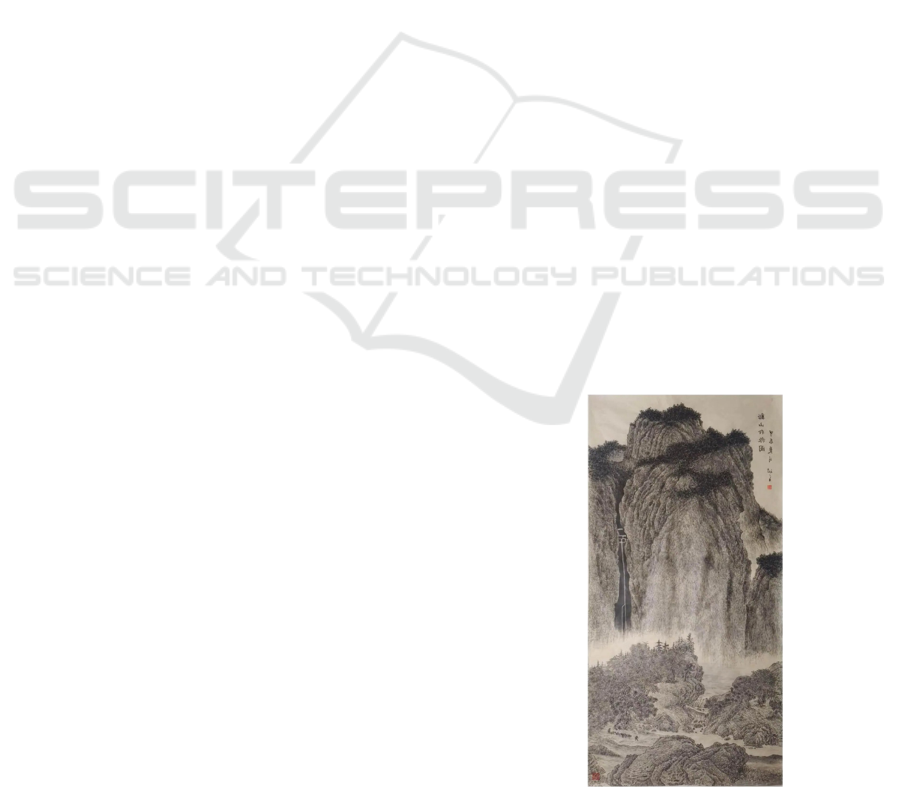
drawing the viewer’s attention and establishing it as
the painting’s protagonist. Dense forests and clouds
surround its summit, while evenly distributed trees
and shrubs enhance the sense of depth and vitality.
Further details, such as the weathered texture of the
rocks and the cascading waterfall in the valley, add
dynamism to the composition. At the foot of the
mountain, a broad but looming stream winds through
the terrain, where a group of merchants and their
donkeys traverse a narrow mountain path. This
imagery vividly reflects the painting’s theme of
"traveling in the mountains and rivers."
When observing Fan Kuan’s "Traveling in the
Mountains and Rivers," the viewer’s gaze is guided
and influenced by the thoughtful composition of the
painting. In this context, the composition plays a
critical role (Xu, 2007). The arrangement within the
painting helps the artist direct the viewer’s focus,
establish layers, and enhance the overall visual effect.
Fan Kuan utilized multiple compositional techniques
to achieve these effects in "Traveling in the
Mountains and Rivers,". First of all, the use of a “high
and far” perspective offers the viewer an ascending
view of the scenery (Yu, 2008). This technique
emphasized the mountain’s grandeur, beginning from
its base, leading the eye upward to its majestic peak,
ultimately creating a powerful visual impact. In
addition, Fan Kuan did not limit the painting to a
single mountain but also included a smaller one in the
foreground. This deliberate choice of overlapping
elements creates a sense of depth and spatial
arrangement, with a clear primary and secondary
relationship,
Secondly, Fan Kuan employed a three-stage
composition, diving the scenery into close-up,
middle, and distant views. In the close-up view, the
painting features large rocks, dense forests, mountain
roads, and merchants traveling along the path. The
middle view includes a stream flowing from the
mountain’s base and the clouds gathering at its foot.
The distant view is dominated by the towering central
mountain, its rugged stone texture complemented by
cascading waterfalls and peaks covered with
vegetation. This layered composition not only
enhances spatial depth but also creates a harmonious
layout.
Regarding brushwork, "Traveling in the
Mountains and Rivers" exemplifies the majestic and
intricate style typical of Northern Song Dynasty
landscape painting. Fan Kuan’s use of heavy
brushstrokes conveys the mountain’s solid weight
and texture. With techniques such as iron-wire-like
outlines and raindrop textures, the rocks appear vivid
and lifelike. The brushstrokes in the foreground are
bold and precise, while the lines in the middle view
suggest movement and continuity. the distant peaks
are rendered with lighter, more concise brushwork,
ensuring the painting retains balance and a sense of
progression. Another notable feature of Fan Kuan's
brushwork is his combination of points, lines, and
surfaces, which gives the painting structural stability
while maintaining dynamic variation. This mastery
allows him to demonstrate both the rugged strength
of the rocks and the smooth, flowing essence of
natural elements like clouds and water. His
brushwork shapes the complicated details of the
painting and reinforces its overall sense of power and
unity.
In addition to brushwork, Fan Kuan excelled in the
use of ink to add depth and atmosphere to the
painting. By varying ink intensity- from thick and bod
in the foreground to light and delicate in the
foreground- he creates a layered and immersive
effect. The trees and rocks in the foreground are
depicted with darker tones, while the distant
mountains and mist are rendered with softer, diluted
ink to evoke a hazy beauty. This interplay between
light and dark not only enhances the painting’s three-
dimensional quality but also creates a harmonious
balance between elements. Fu Kuan also utilized
layering techniques to achieve coherence with the
painting. He meticulously adjusted the shading of ink
to blend the mountains, rocks, and clouds seamlessly,
giving the landscape a unified and dynamic feel. The
clouds and mist extend the natural elements of the
scene, adding motion and vitality to the otherwise still
composition. Through these techniques, Fan Kuan
vividly captures the majestic and poetic natural
scenery in "Traveling in the Mountains and Rivers".
Figure 1: Traveling in the Mountains and Rivers.
Comparative Study of Western and Chinese Landscape Painting
427

4 ANALYSIS OF WESTERN
LANDSCAPE PAINTING
Landscape painting also occupies an important
position in Western art. Its origins in the East and
West often stem from its initial role as a backdrop in
portraiture, rather than as a standalone subject. For
example, in portraits such as Joséphine de
Beauharnais, Queen of Napoleon, landscapes were
secondary elements designed to emphasize the central
figures. However, with the rise of Romanticism,
landscapes gained prominence as independent
subjects. Artists began to use them as a means of
conveying mood, atmosphere, and emotion, shifting
the focus toward the authenticity and emotional
resonance of natural scenes.
With the tradition of Western landscape oil
painting, the contributions of three preeminent artists-
John Constable, Vincent van Gogh, and Claude
Monet- stand out as particularly transformative.
These artists, through their innovative approaches to
light, color, and composition, significantly shaped the
development of the genre and altered viewers'
interpretations of the natural world.
John Constable, a leading figure of the Romantic
movement, gained acclaim for his realistic depiction
of rural life in 19th-century Britain. One of his most
famous works, “The Hay Wain,” epitomizes his
dedication to capturing the serene beauty of pastoral
landscapes (Figure 2). The painting features a hay-
filled carriage crossing shallow, surrounded by lush
greenery and an expansive, cloud-filled sky.
Constable’s meticulous brushwork and vibrant use of
greens and blues create a fresh, tranquil atmosphere
that departs from the warmer tones typical of earlier
landscapes. He skillfully portrays the reflections in
water, the rippling waves caused by the cart’s motion,
and the changing patterns of sunlight on the clouds,
offering viewers an authentic and immersive
experience of rural England.
Figure 2: The Hay Wain.
Conversely, two renowned Impressionist artists,
Vincent van Gogh and Claude Monet, each
approached landscape painting with unique yet
compelling styles. Despite their differing artistic
choices, both used oil paints masterfully, harnessing
the interplay of color, light, and shadow to create
deeply evocative works. These innovative approaches
transformed the viewer's experience, offering a
nuanced perspective on nature through their unique
artistic lenses.
Van Goh’s The Starry Night, perhaps one of the
world’s most famous paintings, presents a mysterious
and dynamic depiction of the night sky (Figure 3).
The scene appears as if viewed from halfway up a hill,
with the swirling sky dominating the composition.
The dramatic movement of the stars and clouds,
seemingly caught in the whirlpool of wind, creates a
sense of cosmic energy and turbulence. Below, the
grass and trees appear similarly affected, yet the town
remains calm and undisturbed, its illuminated
windows symbolizing tranquility amidst the chaos.
Unlike John Constable’s meticulous realism, Van
Gogh employed bold and rough brushstrokes to
convey his emotional response to the scene. The
exaggerated forms and vivid contrasts between the
glowing stars and the darkened sky evoke a sense of
wonder, drawing the viewer into Van Gogh’s inner
world. Despite its departure from literal accuracy, the
painting resonates deeply, reflecting his profound
respect for the universe and his introspective thoughts
on life and existence.
Figure 3: The Starry Night.
As a groundbreaking impressionist artist, Claude
Monet excelled in capturing specific moments and
details of natural landscapes, transforming them into
evocative visual experiences. His famous “The Water
Lilies” exemplifies this approach, where he focused
on a serene pond rather than a complete landscape
(Figure 4). The viewer’s perspective is directed to the
water lilies of different colors, lotus leaves, and their
reflections on the calm surface of the lake. Monet’s
IESD 2025 - International Conference on Innovative Education and Social Development
428

emphasis on subtle changes in natural light and
shadow is masterfully conveyed through his sensitive
use of color and delicate brushstrokes. Over the
course of his career, he created approximately 250
paintings in this series, each capturing the tranquil
beauty and meditative atmosphere of the scene.
Through his unique vision, Monet invites viewers
into a peaceful, introspective encounter with nature,
presenting an alternative perspective to the grand,
panoramic landscape of traditional paintings.
Figure 4: The Water Lilies.
5 COMPARATIVE INSIGHTS
A comparative analysis of notable landscape
paintings from both Western and Eastern traditions
reveals distinct approaches to the portraying and
interpreting nature. Chinese landscape painting,
exemplified by Fan Kuan’s "Traveling in the
Mountains and Rivers," prioritized harmony between
humans and nature through its layered compositions
intricate brushwork, and refined use of ink tones. In
contrast, Western landscape painting, such as
Monet’s “The Water Lilies” and John Constable’s
“The Hay Wain”, uses a distinctive oil-based color
palette and a focus on light and shadow to evoke
emotional resonance and sensory realism. Despite
these differences, both traditions achieve profound
artistic value, offering audiences complementary
ways to experience and appreciate the natural world.
In "Traveling in the Mountains and Rivers," Fan
Kuan depicts the majestic scenery of northern China,
with towering peaks occupying the viewer’s focus.
The mountain forms layered visual structures, while
streams and merchants traveling on winding
mountain roads provide a narrative dimension. This
high-angle composition is combined with three-stage
layering (foreground, middle ground, and
background). enhances the painting’s depth and
spatial hierarchy, creating a sense of grandeur. By
contrast, Western landscape oil painting often
emphasizes the immediate, observable realism of
natural scenes. For example, John Constable's
“Licorice Cart” presents a vivid depictions of rural
life, capturing details such as streams, forests, and
lawns. The fresh and natural color palette conveys an
immersive and tranquil atmosphere, demonstrating
Western painting’s focus on realistic detail and
sensory engagement.
The brushwork in "Traveling in the Mountains and
Rivers" embodies the Northern Song Dynasty’s grand
and profound style. Fan Kuan uses heavy, precise
strokes to outline the lines and rocks, emphasizing the
natural weight and texture of the landscape. His “iron-
like” outlines and fine “raindrop” textures imbue the
painting with an intricate sense of detail and structure.
This combination of points, lines and surfaces creates
both stability and variation in composition. By
comparison, Western landscape artists, such as
Vincent Van Gogh, use bold and expressive
brushstrokes to emphasize mood and emotional
depth. For example, in “The Starry Night”, Van Gogh
employs swirling, exaggerated strokes to depict the
sky’s dramatic energy, contrasting sharply with the
calm town below. This expressive technique reflects
an emotional and subjective interpretation of the
natural world, prioritizing artistic vision over realism.
In "Traveling in the Mountains and Rivers," Fan
Kuan relies on ink tones to achieve depth and
atmosphere. By layering dry and wet ink, he creates a
dynamic interplay of light and shadow, bringing a
three-dimensional quality to the painting. The darker
ink highlights foreground details, such as trees and
rocks, while the lighter ink softens the distant peaks,
adding a sense of vastness. This subtle use of ink
reflects the Chinese tradition of pursuing an artistic
conception rather than strict realism. In contrast,
Western landscape oil paintings, such as Claude
Monet's "The Water Lilies" focus on capturing the
natural interplay of light and color. Monet’s
meticulous attention to changing light conditions is
evident in his vibrant and shifting color palette, which
conveys a sense of fluidity and tranquility. Both
conditions excel in their use of color to evoke distinct
emotional and visual experiences, rooted in their
respective cultural contexts.
The development of Chinese landscape painting is
Comparative Study of Western and Chinese Landscape Painting
429

deeply tied to traditional culture and philosophical
ideas. For example, Chinese art often emphasizes
harmony between humans and nature, reflecting
societal values of balance and coexistence. This stems
from the Taoist ideology which promotes the idea of
"the unity of heaven and man", meaning that man and
nature are in harmony, rely on each other, and
develop and promote each other. This makes Chinese
landscape painting convey the theme of man and
nature while expressing the natural scene, just like the
commercial journey slowly moving forward at the
foot of the mountain in "Traveling in the Mountains
and Rivers". In contrast, Western landscape painting
has been shaped by scientific advancements and
cultural developments, such as the discovery of
perspective, optics, and color theory. These
innovations enabled artists to depict nature with
unprecedented realism and detail, mirroring the West
’ s growing fascination with exploring and
documenting the natural world. This divergence in
social and cultural influences highlights the distinct
techniques and themes of Chinese and Western
landscape traditions, offering audiences diverse and
enriching artistic experiences.
6 CONCLUSION
In conclusion, through an in-depth comparison of
Chinese and Western landscape painting, this
research highlights the significant differences in
techniques, emotional expression, and social contexts
between the two traditions. The findings reveal that
Chinese landscape painting emphasizes structured
composition and layered hierarchies, focusing on the
nuanced interplay of ink tones and the overall design
to evoke a sense of atmosphere and artistic
conception. This approach reflects cultural
influences, particularly the philosophical values of
balance and harmony promoted by Taoist beliefs.
Western landscape painting, on the other hand,
prioritizes the interplay of light, shadow, and color,
delivering detailed descriptions of natural scenes.
These elements reflect the integration of religious
themes, scientific advancements, and cultural
developments in Western art.
This study not only deepens our understanding of
the foundational differences between Chinese and
Western painting traditions but also provides a new
perspective for fostering cross-cultural artistic
exchange and integration. Both traditions carry
distinct cultural identities and aesthetic values,
contributing to the rich diversity of human artistic
expression. In addition, this research underscores
the importance of mutual learning and innovation,
encouraging a dialogue between Chinese and
Western painting traditions that can further enrich
and, diversify global art culture.
Looking ahead, the ongoing acceleration of
globalization is expected to facilitate more frequent
and meaningful exchanges and integration between
China and the West. This study serves as a valuable
reference for future artists and cultural practitioners,
inspiring them to boldly innovate while respecting
their own artistic heritage.
By building on these shared insights, artists from
different traditions can collaborate to create a new
chapter in the evolution of art, one that reflects both
individual traditions and a shared global vision.
REFERENCES
Deng, T. 2008. On the Characteristics of Chinese Literati
Painting and Western Impressionist Painting. Popular
Technology 1: 2.
Ding, J. 2024. How to Represent Light in Oil Painting --
Taking Monet's Works as an Example. Tiangong 23:
62–64.
Fu, S. 2024. Analysis on the Integration of Taoist Aesthetic
Thoughts into Chinese Landscape Painting Creation.
With the Time 11: 9–11.
Guo, C. 2014. On the Structure Division and Golden Ratio
of "Xi Shan Travel Map." Doctoral dissertation, Xi'an
Academy of Fine Arts.
Monet, V., Van Gogh, V., Pissarro, C., & Sisley, A. 2011.
Learn Color from Impressionist Masters. Anhui Educa-
tion Press.
Rafting. 2024. Monet's Water Lilies: A Garden of Colors.
Reading 66: 46–49.
Tang, J. 2005. Comparative Study of Chinese Landscape
Painting and Western Landscape Oil Painting. Journal of
Chongqing University: Social Science Edition 11(2): 5.
Wan, Y. 2021. Constable's Inspiration to the Series of "Quiet
Mountain Villa." Master's Thesis, Liaocheng University.
Wang, P. 2023. To Explore the Evolution of Texturing
Method in Landscape Painting in Song and Yuan Dyn-
asties. Doctoral dissertation, Qufu Normal University.
Wang, S. 2024. On the Beauty of "Sublimity" in Art Works
-- Starting from Van Gogh's Starry Night. Comedy
World (Second Half) 12: 70–72.
Xu, H. 2007. Aesthetic Implication of Chinese Landscape
Painting. Journal of Literature and Art 000(010): 146–
148.
Yu, N. 2008. The Power of Form and the Purity of Color:
On the Artistic Characteristics of Vincent Van Gogh,
the Pioneer of Expressionism. Social Science 5: 2.
IESD 2025 - International Conference on Innovative Education and Social Development
430
