
Persian Miniatures as a Lens for Understanding Historical, Social,
and Artistic Perspectives in 15th-Century Persia
Ziqian Ding
Sheng Hua Zizhu Academy, Shanghai, China
Keywords: Persia Miniature Trade Culture, Paint, Transportation.
Abstract: The background of the study is based on the history, society and art of Persia based on a way of painting in
Persia during the 15th century after the multicultural influences such as the Silk Road and the conquests of
the Mongol Empire. For this study, the main focus is to analyze a painting based on various aspects and
compare it with paintings of the same subject matter from different periods to explain why Persian Miniatures
are different from other local paintings and to explore the factors that influenced them from other countries.
The result of this study is that Persian Miniatures are influenced by the local culture in the overall composition
and some details, and in the overall framework they are painted according to the local culture.
1 INTRODUCTION
This study sets out to examine how Persia, having
been influenced by different cultures, brings out the
influences in images. This study is of great
significance for how to further analyze the historical
information embedded in the images themselves, and
to use the historical materials themselves as a definite
evidence of cultural exchange. This study focuses on
the specific aspects of the study in terms of the
information fed back from the images of the selected
Persian miniatures themselves. Literature analysis
method is used to find and read relevant information
and literature, the advantage of this method is that it
can well analyze the original source of the
information contained in the images of this Persian
Miniaturist painting and determine the influence of
the Persian native culture given to this Persian
Miniaturist painting by the Persian Miniaturist
painting itself, and at the same time, by comparing
paintings with the same theme in different periods,
the characteristics of this Persian Miniaturist painting
can be visualized, which is conducive to the study.
The ultimate goal of this study is to make the
researcher more aware of how the Persian civilization
was influenced by other civilizations in the 15th
century as reflected in the paintings of Persian
Miniatures in the 15th century, and then to cover
more comprehensive information when analyzing
other paintings, in order to achieve the goal, a variety
of materials were examined and compared to support
the reliability of thesis.
2 IMAGE ANALYSIS IN PERSIAN
MINIATURE
First, the information contained in the Persian
miniatures is analyzed. As shown in Figure 1, the
painting titled “John and the Whale (a Jami al-
Tavarikh, 1400) 1” depicts, from left to right, a pear
tree on land, a man with a beard, a large fish, and a
winged man holding clothes. The objects themselves
have religious references.
Figure 1: John and the whale. Jonah and the Whale, Folio
from a Jami al-Tavarikh (Compendium of Chroni-
cles).Jstor. ca. 1400. https://www.jstor.org/stable/commu-
nity.18324224.
380
Ding, Z.
Persian Miniatures as a Lens for Understanding Historical, Social, and Artistic Perspectives in 15th-Century Persia.
DOI: 10.5220/0013993400004912
Paper published under CC license (CC BY-NC-ND 4.0)
In Proceedings of the 1st International Conference on Innovative Education and Social Development (IESD 2025), pages 380-383
ISBN: 978-989-758-779-5
Proceedings Copyright © 2025 by SCITEPRESS – Science and Technology Publications, Lda.
Therefore, if one wants to analyze the images of
this painting, it is first necessary to understand the
source of inspiration for the creation of this painting,
which comes from a book called Chronicle
Compendium, and since the first edition of this book
was written in the 13th century, it is possible that this
15th century Persian miniaturized painting appeared
inside the copy. The name of the painting is derived
from the Biblical phrase “John and the Whale,” which
reads, “And the LORD commanded the fish, and the
fish vomited up Jonah into the dry land. 2” And in
reflecting on this one, the characters can be matched.
John is the one on top of the fish's mouth, and Jehovah
is the one on top of the fish, and from these pre-
existing sources, a further comparative study can be
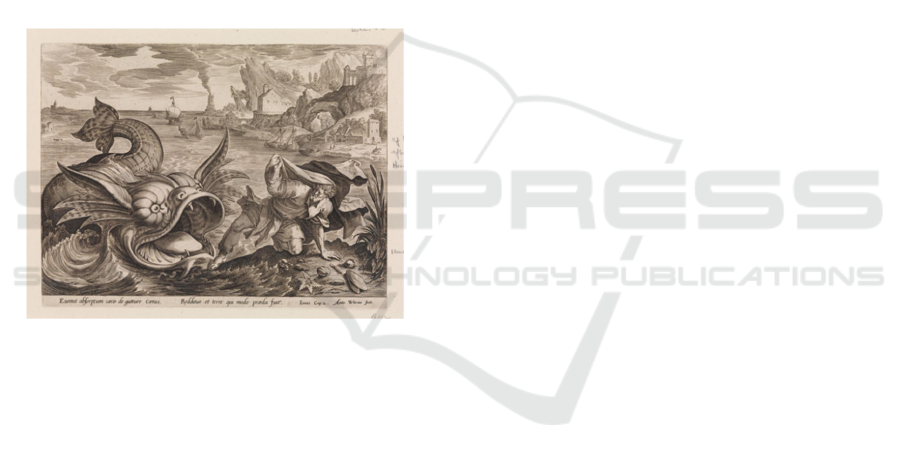
made of this pair of sources. Compare this painting
with a painting of the same subject, such as the Dutch
“John and the Whale” from the sixteenth century,
shown in Figure 2.
Figure 2: Jonah Cast on Shore by the Fish. Artist: Antonius
Wierix, II (Netherlandish, Antwerp 1555/59-1604 Ant-
werp), Artist: Hieronymus (Jerome) Wierix (Netherlandish,
ca. 1553-1619 Antwerp), and Artist: After Maerten de Vos
(Netherlandish, Antwerp 1532-1603 Antwerp). Jonah Cast
on Shore by the Fish. Jstor. ca. 1585. https://www.jstor.
org/stable/community.18575686.
In the Dutch painting, there is no Jehovah, but the
scene and the depiction of the figures show the
differences between the Persian miniatures and the
European painting(Antonius Wierix, Hieronymus
(Jerome) Wierix and After Maerten de Vos, 1585).
First of all, from a perspective point of view, Persian
miniatures do not have a very clear perspective, while
this Dutch painting has a two-point perspective
(Keshmiri, 2000). Analyzing the backgrounds of the
paintings, the Persian miniatures show more of the
natural world, while the Dutch paintings show the
ships and houses of the time, and combined with the
humanism of the post-Renaissance period, the
religious connotations of the paintings are diluted by
the absence of Jehovah and the man-made objects.
The presence of Jehovah in the Persian miniatures
reinforces the religious atmosphere of the paintings.
Religion played an important role in the history of
Persia, so religious translations and exchanges also
occurred in Persia, and the Bible was one of them
(Yamauchi, 1991). The background of this painting
and the figures shown in this painting use images to
show the different ideas that the Persians had about
the figures and objects and the objects that appeared
in them, in this Persian miniatures painting, the image
of John and the image of the big fish are quite
different from the Dutch painting. The image of John
in the Persian miniatures is more oriented to a middle-
aged man in terms of perception, whereas the image
of Holland is more oriented to a middle-aged or old
man, because the muscles and facial texture of John
in the Persian miniatures are not clearly defined, and
also, in the Persian miniatures, John has black hair
and beard. In the Dutch painting, John is depicted
with clear muscle lines and a pale beard and hair. The
two paintings also diverge in their drawings of fish.
In Persian Miniatures, the depiction of fish is more
like the fish that can be seen in reality, although in the
treatment of details, Persian Miniatures fish will be
abbreviated, but from the overall appearance, Persian
Miniatures fish is more like the real fish. The Dutch
paintings, in contrast to the fine drawings, tend to be
more of a fantastical image of a fish, rather than a
realistic one, in terms of the fish. So, although the
fineness of this miniaturization is slightly less than
that of the paintings made more than a hundred years
later, this miniaturization is based on the things
observed in reality, and even the image of Jehovah is
expressed by using the image of a human being.
3 REASONS FOR THE
FORMATION OF PERSIAN
MINIATURIZATION STYLE
3.1 Impact of Culture
Based on the content of Persian miniatures, it was
found that Persian miniatures were influenced by
Christianity. This is because most of the stories
depicted in the paintings are derived from classic
Christian books. According to the Byzantines who
had a basic understanding of the Persians, it can be
concluded that both indirectly and directly, the
Christian world and Persia also had a certain way of
communication and exchange (Todt, 2013). And it is
this kind of exchange and communication will lead to
Persian Miniatures as a Lens for Understanding Historical, Social, and Artistic Perspectives in 15th-Century Persia
381

people's concepts and can be exposed to things
differently, take the exchange between China and
Persia as an example, China used to trade with Persia,
to distinguish between the different fabrics, derived
from the Persian silk, and this can be used as a way to
distinguish between different things for the different
things exposed to the different ways of things
(Hansen, Valerie, and Xinjiang Rong, 2013). This
difference is also reflected in this Persian painting,
which is due to the role of the native culture.
However, in addition to the influence of foreign
cultures on Persia, foreign crops also influenced the
Persians. In this painting, pears appear, and according
to the research, pears, as an exotic crop, after being
cultivated in Persia for many years, appeared more
frequently in the Persian paintings (Abdollahi, 2021).
What this shows is that a painting itself reflects what
is objectively available in a society, and that Persia
reflects on the level of what is objectively available
the variation and universality of crops that are
available in other countries in its own.
The context of the painting also reflects its
cultural impact. As mentioned earlier, the painting
was presented in a book related to history, so it proves
that Persian miniatures could be used as an
illustration or a note in an official document, giving
the text a function to be viewed. The style of the
painting itself has also had an impact on history. First,
because of the Silk Road, Chinese culture had the
opportunity to exchange with Persian culture, and the
objects created by Persian civilization were also
exchanged with other civilizations, such as India
(Rostovtzeff, 1927). When Persian culture interacted
with other cultures, the influence on other cultures
also led to the emergence of something new, such as
the Mughal miniatures, which in the timeline were
created in the 16th century after the heyday of Persian
miniatures, and can be viewed as a source of
information on the cultural influence of Persia on
other countries. In Mughal Miniatures, the style of
painting is not too different from that of Persian
Miniatures, but in the treatment of details, Mughal
Miniatures and Persian Miniatures are not the same.
So, if Persian fine painting was influenced by other
painting styles, then the painting styles that
influenced Persian fine painting must also possess a
certain number of characteristics with Persian fine
painting, but it is difficult to speculate the exact
number of characteristics that are the same. Persian
painting itself, as a foreign form of culture for India,
must have been introduced in the exchange with other
cultures, and this introduction should be a long-term
influence, because in the case of only a single copy of
the situation, it is difficult for human beings to go to
make for other things need to be presented in the
image of, so, in this regard, the spread of this art form
can be illustrated by the two civilizations Therefore,
in this respect, the spread of this art form can illustrate
the long-term communication between the two
civilizations in history. Through the similarities with
other civilizations, as reflected by the influence of
other civilizations' art forms, combined with the
probability of occurrence in geographic locations and
documentary records, it is possible to speculate on the
civilization that influenced the evolution of a culture.
Among the objects in the creation of art, foreign
things can also be presented in the picture as a visual
representation, as in the case of the silk in the hands
of Jehovah. In the Persian miniatures, the material of
the clothing worn by Jehovah is more like silk, while
in the Dutch paintings, the fabric worn by John is
more like linen. Silk, as a thing of Chinese origin, was
accepted by the Persians after entering Persia, which
led to the emergence of foreign things in the Persian
miniatures, and this can be recorded in history as a
thing that can be touched in reality.
3.2 The Role of Indigenous Culture
In Persian Miniatures, native culture also plays an
important role. As mentioned in the previous section,
the appearance of pears in Persian Miniatures is not a
completely foreign species, but a product of local
cultivation and breeding. This, in turn, illustrates the
ability of the Persian homeland to localize non-native
products. As a result, the things that appear in this
painting are localized to a certain extent, or the
author's understanding of the characters and the
objects appearing in the painting are mixed in to make
the effect of this painting different from that of other
regions. For example, fish, Persia used the Persian
Gulf for trade in the third century, so the Persians had
direct access to fish (Cobb, Matthew, 2015). So, the
fish in Persian paintings possess a more reasonable
appearance. However, this can only be taken as a
rough speculation. It does not serve as a role of
indigenous culture that can be identified. What can
truly be identified as an indigenous cultural role in
this painting is the portrait of Jehovah. In this Persian
painting, Jehovah is depicted as a young man without
a beard, whereas in most Western paintings, Jehovah
is often depicted as an older man with a beard. The
reason for this kind of thing has a source. Because a
religious story undergoes changes over time as it
spreads, and because in the old days, it was difficult
to preserve and spread visual material, it led to
differences in the illustrations that appeared in
different religious stories. The image of Jehovah
IESD 2025 - International Conference on Innovative Education and Social Development
382

reflected in the Persian miniatures can be visualized
as being influenced by the Persian artist's ideas,
resulting in a very different image of Jehovah than the
Western understanding of Jehovah. What is reflected
in the Persian miniatures is the Persian idea of the
image of Jehovah. In this picture, then, it may be
observed that Jehovah here is in the likeness of a
young man clothed in silk, and possessed of wings on
his back. As to the conditions, then, under which such
a thing would take place it is as before set forth, and
therefore will not be repeated. Another figure, John,
was also localized by the Persians, as can be seen in
the comparison between the Persian miniatures and
the Dutch paintings, the Persians' portrayal of the
figure is flatter because of their more local way of
dealing with the space, and so, based on this aspect,
the local culture of Persia has given Persia a
characteristic that separates it from the rest of the
cultures. This separation of characteristics can be
used as a historically researchable goal, so that the
unique characteristics of the Persian art form given by
the native culture of Persia, and this unique
characteristic, in turn, the Persian culture itself more
complete. Because of the special characteristics of
Persia's geographic location, it led to a trade in which
Persia could not only passively accept the cultures of
other countries, but also spread the local culture, as
described in the Mughal Miniatures, in which the
overall framework of Mughal Miniatures was based
on Persian Miniatures, and this is the other side of
Persian Miniatures, the spread of the local culture.
4 CONCLUSION
The findings of this study are that what is shown from
Persian fine paintings is the presentation of a fusion
in the picture after a long period of multicultural
influence. The study further concludes that Chinese
and Christian cultures and objects reflected in Persian
miniatures had an impact on the creation of Persian
miniatures. This study provides a lot of valuable
references for future research in this direction, which
mainly affects how to conduct further research on
some places or civilizations that have played a
important role in cultural exchanges in the context of
multiculturalism, and how to conduct further research
on the areas where cultural exchanges have taken
place or how the civilizations that have been
exchanged have been fed back on the screen can be
show in the In-depth research.
REFERENCES
Abdollahi, H. 2021. An illustrated review on manifestation
of pome fruit germplasm in the historic miniatures of
ancient Persia. Genet Resour Crop Evol, 68: 2775–
2791.
Artist: Antonius Wierix, II (Netherlandish, Antwerp
1555/59-1604 Antwerp), Artist: Hieronymus (Jerome)
Wierix (Netherlandish, ca. 1553-1619 Antwerp), and
Artist: After Maerten de Vos (Netherlandish, Antwerp
1532-1603 Antwerp). Jonah Cast on Shore by the Fish.
ca. 1585. Engraving, Sheet: 7 1/2 × 9 13/16 in. (19.1 ×
25 cm). The Metropolitan Museum of Art.
Cobb, M. 2015. The chronology of Roman trade in the In-
dian Ocean from Augustus to early third century CE.
Journal of the Economic and Social History of the Ori-
ent, 58(3): 362–418.
Hansen, V., & Rong, X. 2013. How the residents of Turfan
used textiles as money, 273-796 CE. Journal of the
Royal Asiatic Society, 23(2): 281–305.
Keshmiri, M. 2000. Why did al-Manāẓir not lead the linear
perspective in Persian paintings of the 13th to 15th cen-
tury? Journal for the History of Science, 20(1): 43–91.
Rostovtzeff, M. 1927. Persia, India, China. Artibus Asiae,
2(4): 294–297.
Todt, K. P. 2013. Islam and Muslims in Byzantine histori-
ography of the 10th-15th centuries. In Christian-Mus-
lim Relations. A Bibliographical History. Volume 5
(1350-1500): 35-46.
Yamauchi, E. 1991. Persia and the Bible. Theological Stud-
ies, 52(1): 176.
Jonah and the Whale, Folio from a Jami al-Tavarikh (Com-
pendium of Chronicles). ca. 1400. Ink, opaque water-
color, gold, and silver on paper, H. 13 1/4 in. (33.7 cm)
W. 19 1/2 in. (49.5 cm).
Jonah 2010. U.S. Standard Edition. Jonah and the Whale,
Folio from a Jami al-Tavarikh (Compendium of Chron-
icles). The Metropolitan Museum of Art.
Persian Miniatures as a Lens for Understanding Historical, Social, and Artistic Perspectives in 15th-Century Persia
383
