
Exploring ChatGPT-4O’s Performance and Practical Application in
Criminal Law: Insights from China’s Bar Exam
Yuqin Peng
College of Education for the Future, Beijing Normal University, Zhuhai, Guangdong, 519000, China
Keywords: ChatGPT-4O, Criminal Law, China’s Bar Exam, AI Performance Evaluation.
Abstract: This study explores ChatGPT-4O’s performance in the field of Chinese criminal law and explores its practical
application through the development of a learning intelligent agent. By analyzing ChatGPT-4O’s capabilities
in handling multiple-choice and case-based questions, the study identifies strengths in legal text comprehen-
sion and simple task processing, alongside limitations in logical reasoning and knowledge adaptation. A sup-
plementary intelligent agent was designed to address these shortcomings, providing efficient knowledge re-
trieval and learning support. The study invited law students, PhD students in criminal law and students
preparing for the China’s Bar Exam to use the intelligent agent and collect feedback. Some of them believe
that the use of intelligence can support learning in some ways, though areas such as personalized learning
paths and complex reasoning require further enhancement. The findings underline ChatGPT-4O’s potential in
legal education and suggest future directions for optimizing AI applications in the legal domain.
1 INTRODUCTION
Large Language Models (LLMs) of Artificial
Intelligence represented by ChatGPT demonstrate
promising potential in the fields of education, legal
field and so on. Regarding the application of GPT in
law, GPT is now providing intelligent support to the
legal profession in the areas of paperwork,
communication with clients and legal advice (Surden,
2019; Iu & Wong, 2023; Lorek, 2024). Meanwhile,
one judge in Columbia used ChatGPT to help him
make a legal decision (Parikh, Shah, & Parikh, 2023).
Some researchers have looked at how the GPT
performs in bar exams in different countries
(Martínez, 2024; Shope, 2023; Freitas & Gomes,
2023; Katz, Bommarito, Gao, & Arredondo, 2024;
Wyłuda, 2024; Chalkidis, 2024). The potential of AI
as an aid in legal filed has already been explored in
existing research.
The ‘China National Unified Legal Profession
Qualification Examination’, the bar exam in China, is
the core assessment tool for access to the legal
profession filed. In 2018, in order to further improve
the overall quality of legal professionals, China’s
judicial exam underwent a major reform. It was
officially renamed the ‘National Unified Legal
Vocational Qualification Examination’. The exam
tests candidates’ theoretical knowledge, practical
legal skills and professional ethics, covering a wide
range of areas including civil and criminal law, etc.
China’s Criminal Law has undergone several
revisions and improvements, continuously adapting
to social development and legal needs in practice. Its
current structure and the rigour of its legal provisions
make it one of the most comprehensive laws in the
Chinese legal system, which is also one of the key
components of China’s Bar Exam.GPT-4O is a more
advanced large-scale language model developed by
OpenAI, which has more powerful natural language
understanding and generation capabilities than GPT-
4. Criminal law is a field involving complex logical
reasoning and understanding of legal texts. Whether
GPT-4 can effectively understand Chinese criminal
law and generate legally compliant reasoning is an
innovative research topic.
Meanwhile, students use traditional learning
methods (e.g. reading textbooks) for criminal law
study, with dispersed learning materials and a lack of
timely feedback. Therefore building a smart agent for
criminal law learning is of great practical significance
in enhancing students’ learning efficiency and
assisting candidates to prepare exams.
Based on this, this study proposes to focus on the
following questions:
1. How did GPT-4O perform in the criminal law
module of China’s Bar Exam?
368
Peng, Y.
Exploring ChatGPT-4O’s Performance and Practical Application in Criminal Law: Insights from China’s Bar Exam.
DOI: 10.5220/0013990100004912
Paper published under CC license (CC BY-NC-ND 4.0)
In Proceedings of the 1st International Conference on Innovative Education and Social Development (IESD 2025), pages 368-374
ISBN: 978-989-758-779-5
Proceedings Copyright © 2025 by SCITEPRESS – Science and Technology Publications, Lda.
2. How to develop a more suitable intelligent tool
for Chinese criminal law learning based on the
performance of GPT-4O?
Therefore, this study focuses on ChatGPT4O’s
performance in the criminal law module of China’s
Bar Exam, exploring its abilities and limitations. This
study innovatively demonstrates how AI adapts to
cross-cultural legal systems and provides a new
perspective on intelligent tutoring for law exams by
building an intelligent agent, promoting the
application of artificial intelligence in the legal field.
2 LITERATURE REVIEW
The bar exam is a key tool for assessing legal
practitioners’ core competencies. Recent studies have
examined ChatGPT’s performance on the bar exam:
The UBE is a standardised test developed by the
National Conference of Bar Examiners (NCBE).
GPT-4’s overall performance on the UBE was below
the 69th percentile, with poor essay
results(Martínez,2024). In the Taiwan Bar Exam,
GPT-4 outperformed 50.86% of human test-takers in
the multiple-choice section but failed to meet the
criteria for the writing section (Shope, Mark,2023).
Freitas found GPT-4 performed poorly in criminal
law on the Brazilian Bar Association Exam,
particularly lacking contextual relevance and legal
judgment in open-ended questions. (Freitas, 2023).
The researchers concluded that GPT lacks
contextual understanding (Katz, Bommarito, Gao, &
Arredondo, 2024). In the Zero-Shot setting, GPT-4
has less depth of inference than human experts
(Biswas, 2023). GPT inevitably inherits social biases
hidden in training data, which will affect the fairness
of legal advice (Surden, 2019).
In summary, artificial intelligence shows great
potential in law. However, most research on ChatGPT
in law focuses on GPT-3.5 and GPT-4, with less
exploration of its iterative version, GPT-4O.
ChatGPT’s legal training data likely lacks Chinese
sources, leading to potential knowledge bias on
China-specific legal issues. While some studies focus
on Taiwan’s bar exam, research on the mainland
China bar exam is limited.
3 EXPERIMENT DESIGN
3.1 Research Framework
This study focuses on OpenAI’s GPT-4O, access to
which is available through a paid plan. As of 2018,
the content of the bar exam is no longer published by
the Chinese Ministry of Justice, since the test context
published by the Chinese Ministry of Justice in 2017
and 2016 were selected as the materials. The exam is
divided into objective and subjective questions, and
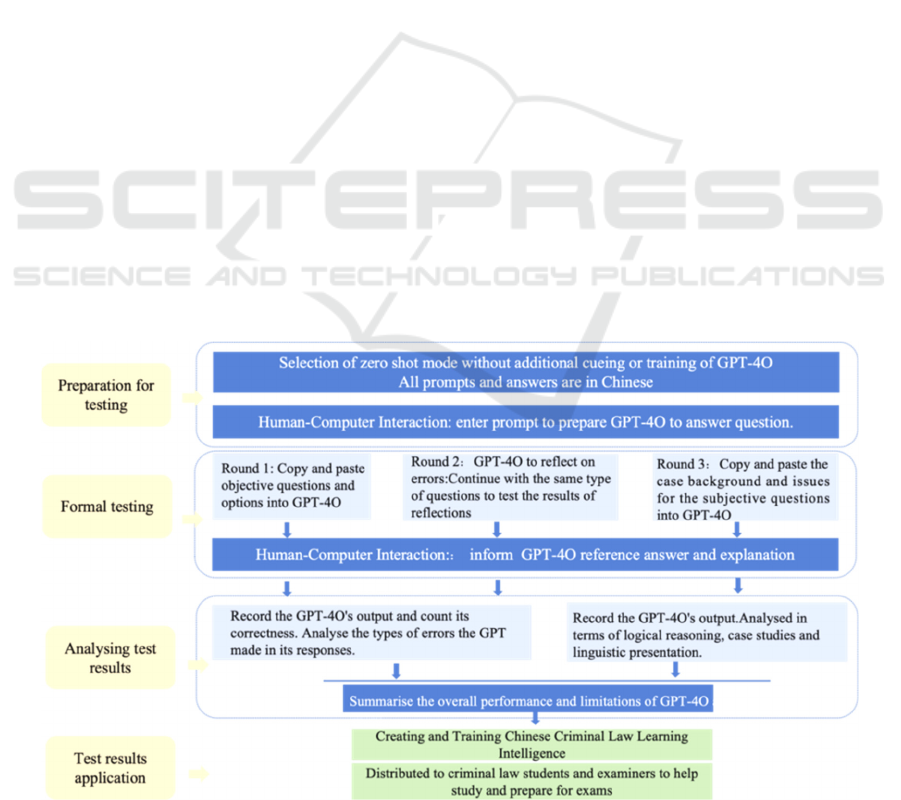
The study examines GPT-4O’s performance, focusing
on its answers in criminal law. Then, on the basis of
GPT’s performance, specialist criminal law
intelligent agent is trained (See Figure 1).
Figure 1: Research Roadmap.
Exploring ChatGPT-4O’s Performance and Practical Application in Criminal Law: Insights from China’s Bar Exam
369
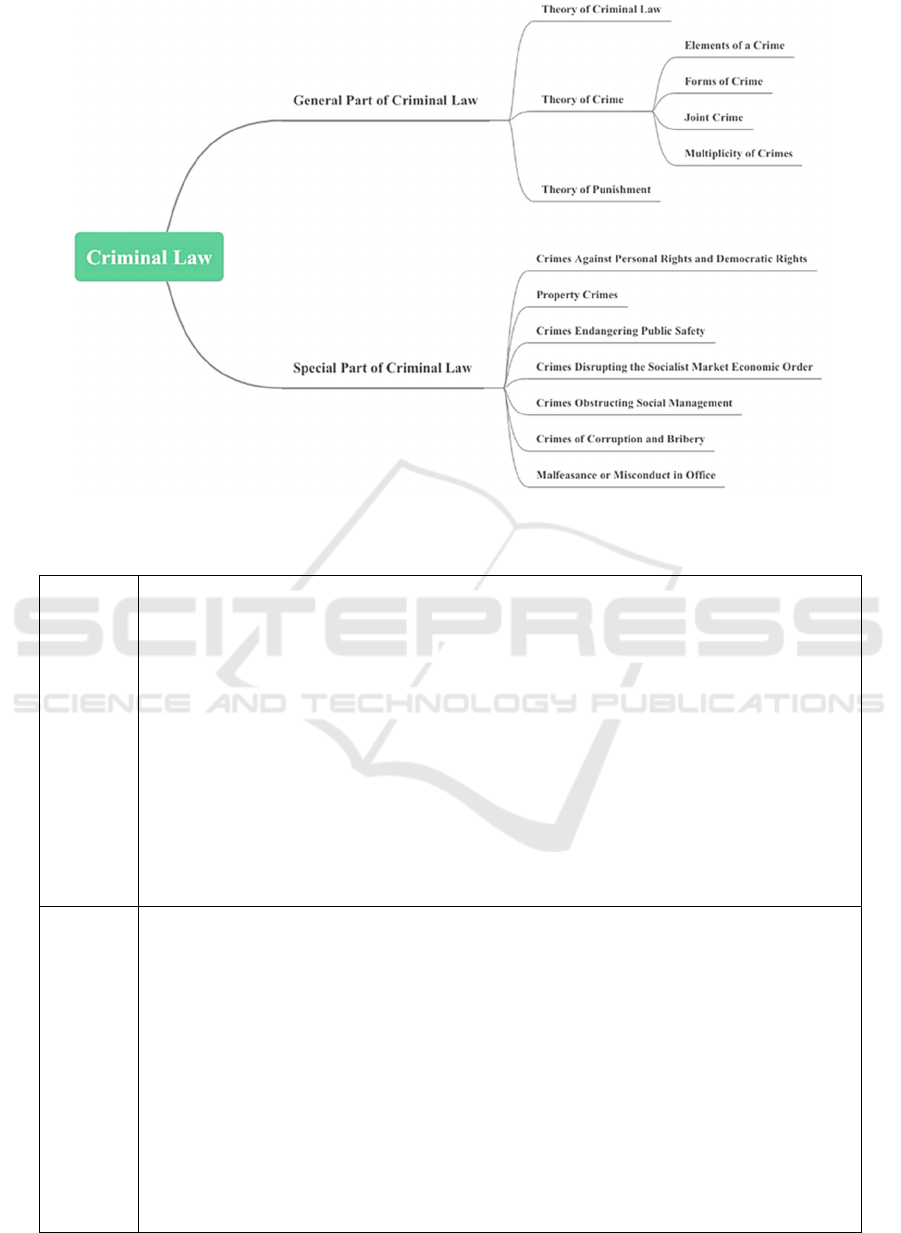
Figure 2: Referenced Chinese criminal knowledge framework.
Table 1: GPT Interaction Multiple-Choice Example.
Question 1.Regarding crimes infringing on the personal rights of citizens, which of the following statements
is correct?
A. Person A has an obligation to support a family member but refuses to do so, intentionally
causing the family member’s death. Person A does not constitute the crime of abandonment but
rather commits intentional homicide through omission.
B. Person B enters a bank’s business hall and takes customer Mr. Wang hostage, threatening to kill
him unless bank employees hand over 200,000 yuan. Person B does not constitute robbery, but
only constitutes the crime of kidnapping.
C. Person C, in retaliation against Mr. Zhou, spends 5,000 yuan on transportation to take Mr.
Zhou’s 12-year-old child to another city and sells the child for 2,000 yuan. Although Person C has
no profit motive, he is still guilty of the crime of child trafficking.
D. Person D, knowing that factory owner Mr. Xiong is forcing workers to labor, recruits
individuals such as Mr. Su to work at Mr. Xiong’s factory. Since Person D did not personally force
Mr. Su and others to work, he does not constitute the crime of forced labor.”
GPT-4O
Answer
Correct answers: A, C.
Analysis and Basis:
A. Under Article 232 (Intentional Homicide) and Article 261 (Abandonment) of the Criminal Law,
intentionally causing the death of a family member by neglecting the duty of support infringes on
the right to life, not the duty of support. This constitutes intentional homicide by omission, not
abandonment.
B. Person B takes Mr. Wang hostage, threatening to kill him unless property is surrendered,
constituting violent extortion (robbery) under Article 263, with elements of kidnapping under
Article 239. Robbery absorbs kidnapping, so Person B should be charged with robbery.
C. Article 240 (Child Trafficking) of the Criminal Law does not require a profit motive. Person C
trafficks a child by taking them to another city and selling them, regardless of the intent to profit.
D. Article 244 (Forced Labor) covers both direct coercion and assistance. Person D, aware of Mr.
Xiong’s forced labor and recruiting workers, aids the crime and is an accomplice.
IESD 2025 - International Conference on Innovative Education and Social Development
370

3.1.1 Objective Question Tests
The multiple-choice section consisted of questions
selected based on key areas of criminal law (see
Figure 2). Two questions from each section were
chosen, totaling 26 questions. The test was conducted
in zero-shot mode, with two rounds of testing
performed.
In order to explain more clearly the approach
taken, an example is provided below (See Table 1).
(1) Test Round 1
Prompt: “You’re a candidate for China’s bar exam. I
will ask you multiple-choice questions on criminal
law. Choose the correct answer and explain your
reasoning.”
GPT Answer: “Understood! Feel free to ask your
multiple choice questions about criminal law, and I’ll
help you analyze and choose the correct answer with
reasoning.”
(2) Test Round 2
In this round, the GPT interacted over several rounds
to help it organize its thoughts following an incorrect
answer. The author then asked a new question of the
same type to assess whether the analysis improved
.
3.1.2 Subjective Question Test
The subjective part selected case study questions
from the 2017 Chinese Legal Qualification
Vocational Examination. The author copies the
questions into GPT-4O as prompts and compares its
answers with those given in the exam (see Table 2).
Prompt: “Next, please complete the subjective
test, in which you are asked to carefully analyse the
case and respond to the questions.”
GPT Answer: “Certainly! Please provide the case
details, and I will carefully analyze it and respond to
the questions accordingly.”
At the end of the GPT-4O responses, a current
Chinese PhD student (specialising in criminal law)
was selected to be interviewed. The author asks him
to comment on GPT4O’s response and also to give his
opinion on the AI issue.
Table 2: GPT Interaction Case Analysis Example.
Legal Cases & Issues
(1) Case
Facts
Person A is facing financial losses in business, and Person B has accumulated gambling debts. The
two conspired to carry out a “reliable” scheme to resolve their financial problems. Following their
division of labor, Person A approached Person C and deceived him into believing that Mr. Qian
owed money and refused to repay it. Person C agreed to detain Mr. Qian’s child to pressure him into
repaying the debt, threatening not to release the child unless the money was paid. Based on the
information provided by Person A, Person C lured Mr. Qian’s child to his residence, where he kept
the child under control. Person C then called Person A to inform him that the child was in his
custody, and Person A notified Person B to proceed with the extortion.
Person B called Mr. Qian and said, “Your son is in our hands. Pay 500,000 yuan to ransom him, or
we will kill him!” Mr. Qian glanced at his son beside him, replied “Scammer!” and hung up,
refusing to respond further. Person B sensed something was wrong and informed Person A. Person A
then went to Person C’s place and discovered that the child was not Mr. Qian’s son, but rather Mr.
Zhao’s child. However, Person A did not inform Person C but instead advised him to continue
monitoring the child and forced the child to reveal Mr. Zhao’s phone number. Person A and Person B
then decided to switch targets and extort money from Mr. Zhao.
The next day, the child began crying incessantly and demanded to be released. Fearing exposure,
Person C covered the child’s mouth and nose with his hands, then bound the child’s hands with tape
and sealed the child’s mouth with tape, causing suffocation and death. Upon learning of the child’s
death, Person A and Person B decided to abandon the extortion of Mr. Zhao’s money. Person B and
Person C then disposed of the body, transporting it outside the city and burying it. The next day,
Person B called Mr. Zhao, threatening him to immediately transfer 300,000 yuan to a specified
account, warning him not to report to the police, or the child would be killed. Mr. Zhao immediately
reported the case to the authorities, and Persons A, B, and C were arrested shortly thereafter.
(2) Questions
Please analyze the criminal liability of Persons A, B, and C, including the criminal charges they
face, the forms of the crimes, whether they constitute joint criminal enterprise or conspiracy, and
whether consecutive sentences should apply for multiple offenses. Provide a brief rationale for each.
Exploring ChatGPT-4O’s Performance and Practical Application in Criminal Law: Insights from China’s Bar Exam
371

3.2 Intelligent Agent Development
3.2.1 Conceptual Design
This study designs the intelligent agent based on the
first phase of analyzing common errors in GPT-4O’s
criminal law responses, using Chinese criminal law,
judicial examination questions, and their analysis as
core learning resources, aiming to create an effective
tool for students in Chinese criminal law.
3.2.2 Implementation Details
In this study, the Poe platform is used as the main tool
for the development of intelligent agents. The
development framework involves command
prompting, building a basic knowledge base, and
training GPT-4O on common legal errors while
optimizing its understanding of criminal law.
Three types of users were invited to test the
functions: university students majoring in law (9),
PhD student in criminal law(1), and students
preparing for the bar exam(20). As Table 3 shows,
they were invited to evaluate the intelligence in three
aspects.
Table 3: Indicators and content of intelligence performance
evaluation.
Evaluation
indicators
Evaluation content
Response
accuracy
Based on your experience, how accurate do
you think the agent will be in answering
questions about criminal law?
very accurate
fairly accurate
less accurate
very inaccurate
Learning
efficiency
Do you think that the use of the intelligent
agent has helped you to save time in your
studies? Please select one of the following
options:
Very frugal (more than 40%)
More frugal (30-40%)
Somewhat helpful (20-30%)
Not at all helpful (less than 20%)
No help
Overall
assessment
1.You rate the functional performance of
out of 5. (1 being the lowest and 5 being
the highest)
2. Please briefly explain the reason for
your rating (e.g. answer accuracy, learning
efficienc
y
, interactive ex
p
erience, etc.
)
4 RESULTS AND DISCUSSION
4.1 Preliminary Study
4.1.1 Objective Test
The results of the criminal law are presented and
discussed in this section.
GPT-4O has a low rate of correct answers in the
multiple-choice questions on criminal law in the bar
exam of China, with an accuracy rate of 38.46%.
Continued practice with the same type of questions
helped increase accuracy, leading to better
performance, but not to the level of 50%. As Table 4
shows, on the basis of GPT4O’s responses, it was
found that there were a number of limitations in the
legal analysis.
Firstly, there is a lack of depth and precision in the
understanding of the law. Secondly, in the application
of the law, there is no exact correspondence between
the legal text and the case and some key points were
ignored. Thirdly, the logic of reasoning favours
homogeneity and lacks the necessary problem solving
and multidimensional thinking.
Table 4: Types of Errors Made by GPT-4O on Multiple
Choice Tests.
Types of Errors Examples of Errors
Knowledge Blind
Spot
Unable to distinguish between
criminal attempt vs. voluntary
abandonment vs. consummated
crime
Errors in the
application of legal
texts
Unable to distinguish the
conditions for determining whether
voluntary surrender constitutes a
valid admission of guilt
Poor reasoning and
analytical skills
Uncertainty regarding the factors
that break the causal link, and an
unreasonable inference of causality.
Poor understanding
of case details
It is not considered as constituting
damage to transportation
infrastructure when railway tracks
are ‘in active use’ and stolen.
Errors in Fact
Determination
Misapplication of intentional
homicide and negligent
manslaughter.
Emotional bias Overemphasizing the emotional
motive of anger assumes that the
severity of violence warrants a
more serious offense.
First impressions
count
Automatically classifying a
retaliatory act as self-defense,
ignoring the legal concept of
‘excessive self-defense’.
IESD 2025 - International Conference on Innovative Education and Social Development
372

4.1.2 Subjective Test
The results of the subjective test shown in Table 5.
Table 5: Different responses to GPT4O on subjective tests.
A case
participant
Bibliographic
answer
GPT-4O’s
answer
A and B Attempted
kidnapping
Completed
kidnapping
C Intentional
homicide
Involuntary
manslaughter
In response to the GPT’s reply, a PhD student in
criminal law was invited to further comment. He
argued that GPT’s assessment of criminal offenses
and crime classifications is flawed. The divergence
between GPT’s analysis and its conclusions stems
from the differing legal approach it adopts. In his
view, the legal students must be cautious about AI and
need to be discerning about content generated by AI.
Table 6 provides an assessment of the GPT’s
responses to the subjective test.
Table 6: Evaluation of response limitations of the GPT-4O
in subjective testing.
Evaluation
dimensions
Specific
standards
Limitations
Logical
reasoning
Logical
consistency of
answers and legal
organisation
Insufficient analysis
of complex situations
and incomplete
understanding of
behavioral causality.
Textual
applicability
Criminal laws
understood and
applied in cases
Lack of proper
contextualisation of
the specific
p
rovisions and lack of
precise
characterisation of the
offence and the
pattern of the offence.
Linguistic
expression
Clarity,
professionalism
and structural
coherence of the
text produced
Lack of clarity:
Content is lengthy yet
unclear.
Lack of
specialization: Some
legal concepts are
imprecise and
ambiguous.
Lack of structural
coherence: The
discussion is
confused , lacking a
clear reasoning
process.
4.1.3 Summary
In summary, GPT-4O has the following limitations in
completing the bar exam of China: First, GPT-4O
lacks the necessary robustness in relevant knowledge
and may not respond with the rigor needed in legal
practice. Second, GPT-4O lacks depth in legal
reasoning and cannot analyze the case-law match in
relation to legal, ethical, and social contexts. Third,
GPT-4O’s analyses may exhibit bias, impacting the
fairness of conclusions. Fourth, GPT-4O lacks real-
life legal experience. It cannot replace a human judge
in ethical or human-centered legal issues.
In the criminal law section of the Brazilian bar
exam, a study found that the GPT-4 performed poorly
(Freitas & Gomes ,2023). The results of the present
study confirm this conclusion. The following factors
may be considered as the reasons. At first, GPT-4O
lacks a clear understanding of the specific
background of Chinese society, history, culture, and
has an inadequate system of legal expertise in relation
to China. Second, as an AI model, the randomness in
GPT-4O’s algorithm may lead to varying outcomes.
These findings offer valuable insights for designing
intelligent agents.
4.2 Intelligent Agent Test
4.2.1 Results
The evaluation results of the intelligent agent’s
performance by the three types of users are as
follows:
Factor 1: Accuracy of the Answer
Most law students found the intelligent agent more
accurate, particularly in memorizing knowledge
points. However, feedback from the PhD student in
criminal law suggested the agent needed
improvement in deep logical reasoning, and students
preparing for the exam noted room for improvement
in accuracy, especially in complex case reasoning.
Factor 2: Learning Efficiency
Most students majoring in law thought that they could
save a certain amount of time searching for
information (20%-30%). The PhD student and exam
preparation students perceived savings as less
efficient (less than 20%), because they focused more
on in-depth parsing.
Factor 3: Overall Rating
Regarding the overall rating, the average user rating
Exploring ChatGPT-4O’s Performance and Practical Application in Criminal Law: Insights from China’s Bar Exam
373

was 4.1, showing that the intelligence performs well
on features such as text analysis and question
practice. The PhD student suggests that the
intelligence still need to be optimised on academic
issues. Exam preparation students found their
personalised learning advice insufficient.
4.2.2 Discussion
Although intelligent agent excels in several
functional modules, its limitations should not be
overlooked as well. Firstly, the knowledge base of the
intelligent agent still needs to be expanded to
accommodate higher levels of specialisatiton.
Secondly, the depth of logical reasoning and
coherence of reasoning needs to be enhanced. In
addition, the ability to personalise learning advice
needs to be improved. In the future, it will need to
better adapt to the different learning habits of users,
ensuring individualized access to the learning
experience.
5 CONCLUSIONS
This section makes some recommendations for the
use of GPT40 in the legal field and looks to the future,
taking into account the results of the study.
Firstly, GPT should be used as a supplement to the
expertise and judgement of professionals. Secondly,
model training can be optimised by introducing more
specialised data, case studies and legal reasoning
training in the legal domain. In addition, beginners
learning law should be cautious about using the GPT
as an exam aid. GPT-generated results can result in
misleading human judgements.
In terms of applications, legal learning intelligent
agents need to be optimised in a number of ways: to
expand the knowledge base to cover more local laws
and regulations and high-quality case studies; to learn
advanced reasoning mechanisms to enhance the
ability to analyse complex cases; to add a
personalised learning path recommendation function.
This study relied on automatically generated text
and user feedback from GPT for analysis, lacking
sufficient quantitative support. Future research
should incorporate systematic quantitative indicators
and a standardized assessment framework.
Additionally, the study’s limited sample size restricts
the applicability of its conclusions and fails to fully
validate GPT-4O’s ability in complex legal issues.
Future research should aim to expand the sample size
and include a more diverse range of user groups.
REFERENCES
Biswas, S. 2023. Role of chatGPT in Law: According to
chatGPT. SSRN. Available at: https://ssrn.com/ab-
stract=4405398
Freitas, P. M., & Gomes, L. M. 2023. Does ChatGPT Pass
the Brazilian Bar Exam? In EPIA Conference on Artifi-
cial Intelligence 131-141.
Katz, D. M., Bommarito, M. J., Gao, S., & Arredondo, P.
2024. GPT-4 passes the bar exam. Philosophical Trans-
actions of the Royal Society A: Mathematical, Physical
and Engineering Sciences 382: 2273.
Kwan Yuen Iu, Vanessa Man-Yi Wong. 2023.ChatGPT by
OpenAI: The End of Litigation Lawyers? SSRN. Avail-
able at: https://ssrn.com/abstract=4339839
Lorek, L. A. 2024. AI legal innovations: The benefits and
drawbacks of Chat-GPT and generative AI in the legal
industry. Ohio Northern University Law Review 50(3):4.
Martínez, E. 2024. Re‑evaluating GPT‑4’s bar exam perfor-
mance. Artificial Intelligence and Law.
Parikh, P., Shah, D. M., & Parikh, K. P. 2023. Judge Juan
Manuel Padilla Garcia, ChatGPT, and a controversial
medicolegal milestone. Indian Journal of Medical Sci-
ences 75(1).
Shope, M. 2023. GPT Performance on the Bar Exam in Tai-
wan. SSRN. Available at: https://ssrn.com/abstract=
4394826
Surden, H. 2019. Artificial intelligence and law: An over-
view. Georgia State University Law Review 35(4).
Wyłuda, T. 2024. Can GPT-4 Chat Pass a Polish Stock-
broker Exam? Scientific Journal of Bielsko-Biala
School of Finance and Law 28(1):75–80.
IESD 2025 - International Conference on Innovative Education and Social Development
374
