
Through the Perspective of Post-Colonialism: Re-Evaluating Hinduist
Iconoclasm in the British Museum
Hanying Li
English Faculty, Guangdong University of Foreign Studies, Guangdong, China
Keywords: Post-Colonialism, Iconoclasm, Hinduist Exhibits.
Abstract: Iconoclasm, from the Greek for “icon smashing,” originally pertained to an 8th-century Orthodox Christian
dispute. Today, it extends beyond physical destruction. Any act diminishing an icon’s religious function qual-
ifies, like removing a religious item from a museum. This study, through a post-colonial perspective, examines
the British Museum’s representation of two Indian icons: Nataraja Bronze and Harihara sculpture. Their
meanings are recontextualized within colonialism, with the colonizer’s power altering their original religious
significance. In the museum, the colonizer’s power syntax eclipses, or even redefines their original religious
meanings. The essay will explore the ongoing colonizer-colonized struggle, especially regarding the removal
and representation of religious icons, highlighting the structural inequality between them.
1 INTRODUCTION
This study focuses on the transformation and
underlying socio-cultural motivations of iconoclasm
since modern times. With the development of
capitalism and the great geographical discoveries, the
connotation of iconoclasm has shifted from the direct
destruction of religious icons to their
commodification and removal from their original
cultural contexts. This alteration is not only motivated
by economic interests but also closely linked to the
Western mystification aesthetic towards Eastern
cultures and the power structure of colonialism. The
lax regulations of governments and museums also
promote cultural plunder and colonialism. By
analyzing the aforementioned four aspects and
combining the findings of modern scholars on
iconoclasm, this research delves into how these
factors play in constructing the underlying colonial
discourse and provides a multi-dimensional
analytical framework to evaluate this phenomenon.
The ultimate goal is to reveal the colonial
connotations in modern iconoclastic behavior and
provide a theoretical basis and practical guidance for
future studies on cultural plunder and heritage
repatriation. A comparative analysis of two pairs of
Indian icons displayed in the British Museum has
been conducted to further support this argumentation.
2 BACKGROUND
INFORMATION
Looking back to history, the connotation of
iconoclasm has gone through many changes through
different periods. Hence, the extension from its
Orthodox Christianity origin is predictable when
entering the capitalism stage. The very primitive form
of ’Iconoclasm’ refers to direct physical damage or
destruction done to the religious icons. At the
beginning of the iconoclasm movement in the 8th
century, the iconoclasts took supportive evidence
from the holy scripture to defend the orthodox
doctrine of Christianity faith, characterized by
persecuting heretics and intentionally shattering their
spiritual medium-icons. Later in the Protestant
Reformation in the 16th century, the movement of
iconoclasm started again. Emphasizing the
significance of the Bible itself, this movement still
aimed at altering or violently converting one’s
religious belief by physically destroying icons.
However, with the rise of the bourgeois class and the
development of capitalism, the great discoveries of
geography allow European merchants to export
various goods and raw materials from colonies to
further provide capitalism with the primitive
accumulation of capital. Subsequently, the focus, or
to say, the orientation of iconoclasm activities shifts
from damaging the icon’s religious function
immediately to commercializing it as a tradable
Li, H.
Through the Perspective of Post-Colonialism: Re-Evaluating Hinduist Iconoclasm in the British Museum.
DOI: 10.5220/0013985800004912
Paper published under CC license (CC BY-NC-ND 4.0)
In Proceedings of the 1st International Conference on Innovative Education and Social Development (IESD 2025), pages 347-351
ISBN: 978-989-758-779-5
Proceedings Copyright © 2025 by SCITEPRESS – Science and Technology Publications, Lda.
347
commodity and removing it from temples (Méndez,
2022). The capitalist commodification grants
religious icons, which were initially secluded from
commercial trading, with certain economic value to
enter the exchange market (Harwich, 2022). At that
time, European capitalists indiscriminately exploited
and extracted potential values from any item in its
period of aggressive expansion, let alone icons from
different cultures.
Hence, many illegal stolen or smuggled crimes
were committed against artworks and icons in that
period. Without government direct intervention and
systematic laws on artwork smuggling crime, many
traders secretly imported many icons overseas.
Ironically, in terms of the responsibility of museums
in the art trade, Bator describes that many museums
would not apply stricter rules on the illegal export of
artworks because of the high cost of assuring
individual’s means of import. On the other hand,
bringing about new regulations on the acquisition of
artworks “will fatally stunt the growth of the
collection.” (Bator, 1982) This implies that museums
have played a negative role in the art trade.
But exactly in what way do these icons catch the
eyes of Western traders? Bernard Faure has
introduced a certain complex the Westerners hold
towards non-Western icons. In the eyes of
Westerners, non-Western icons displayed in the
temple are more of an enchanted and nebulous
novelty than an actual material medium performing
its religious functions. When they encounter an
unfathomable and ineffable ‘oriental’ icon, among
these veiled mysterious objects, some meet their
orient fantasy will be taken for aesthetic tastes or
personal interests, others that seem less intriguing to
them may be cast as useless or simply be destroyed.
In Faure’s description of the Westerner’s mysticism
aesthetics and peculiar obsession towards Buddhist
icons, the very presence of the icon is eclipsed by a
mysterious aura, which sublimates it as a
representative of a whole mysterious Eastern belief
system. Faure later comments on the profanation of
these non-Western icons, “…a violence so deeply
embedded that it infected even the best minds.”
Sometimes the superstition over the ‘power’ of icons
will lead iconophilia to iconoclasm, as concluded by
Faure (Faure, 1998).
To sum up, the meaning and the purpose of
iconoclasm has been through several changes after
entering the modern times. If applying new
categorizing standards on iconoclasm, the action of
removing one religious icon into a supposed ‘neutral’
space – a museum – also has colonial connotations.
The reasons behind this shift could be ascribed to the
development of capitalism, the great discoveries of
geography, the rise of Orientalist aesthetics, and the
government and museum’s loose regulations on theft
or smuggling of art. These three factors have
contributed to the removal of icons, the
indiscriminate commercialization of icons, and the
enchantment of Orient icons.
3 VISUAL ANALYSIS
In the following section, A detailed introduction and
analysis will be conducted of these two religious
icons, Nataraja Bronze and Harihara sculpture.
3.1 Nataraja Bronze
Figure 1: Nataraja Bronze in the Thiru Vishwanath Swamy
Temple; https://indianculture.gov.in/retrieved-artefacts-of-
india/artefact.
Figure 2: Nataraja Bronze in the British Museum; https://
www.britishmuseum.org/collection/object/A_1987-0314-1.
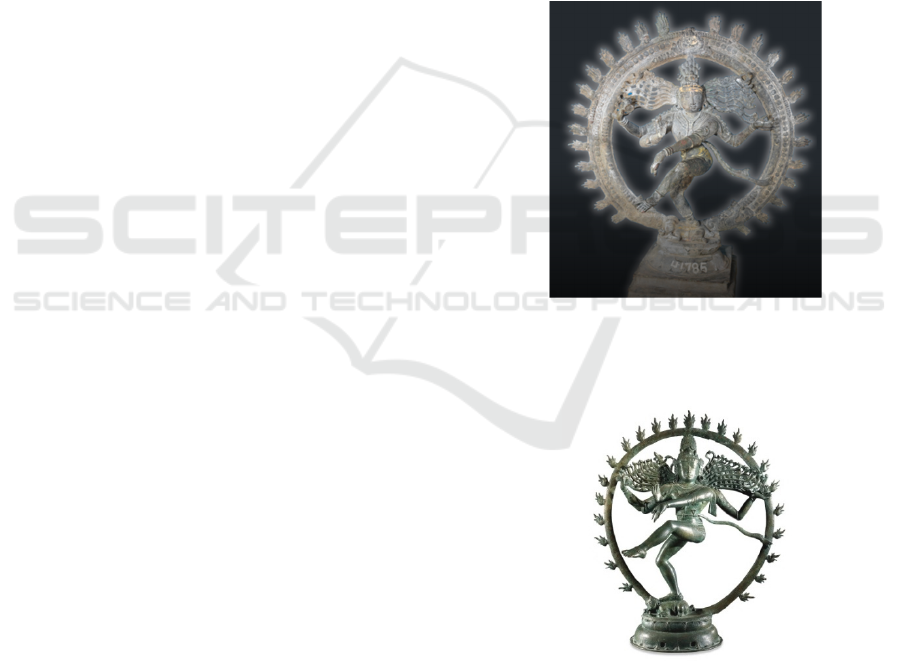
These two icons are Nataraja Bronze mostly
originated from Tamil Nadu, depicting the deity
Shiva’s dancing movement atibhanga. Shiva as
Nataraja’s appearance marks the end of a cosmic
cycle, revealing its philosophical significance in
IESD 2025 - International Conference on Innovative Education and Social Development
348
illustrating Hinduist wisdom. Both of them have been
exhibited in Western museums. Still, Figure 1 was
retrieved by the Indian government in 1991 and
restored its religious functions in the original temple
while Figure 1 is still on display in the British
Museum.
According to the British Museum website
account, Figure 2 has been exhibited by several
Western museums like the Philadelphia Museum of
Art and the Seattle Art Museum from 1981 to 1982.
The Acquisition notes show that this idol was initially
bought from C T Loo in Paris by the Honolulu
Academy of Arts in 1946 and later purchased by the
British Museum in 1987, while the history behind
Figure 1 reflects the dark side of the idol trade. After
being unearthed in 1967, this idol was stolen and then
transferred to the hands of artwork dealers.
Eventually, it was shipped out of India to the city of
London. Unfortunately, this retrieval has also gone
through difficulties and obstacles. According to the
description of this Nataraja Bronze on the official
website, “This idol was repatriated after the
Government of India won a court case in the UK
against the Bumper Development Corporation Ltd.”
It can be inferred that the high cost and the difficulties
in judicial practices to icon repatriation are some of
the main causes why these icons acquired in illegal
ways cannot be retrieved easily and quickly.
Nevertheless, the repatriation of this icon still
marks a turning point in restoring this icon’s original
meaning. Fig. 1 now is presented in Thiru Vishwanath
Swamy temple as a venerated sacred article.
3.2 Harihara Sculpture
Another case study would focus on the following two
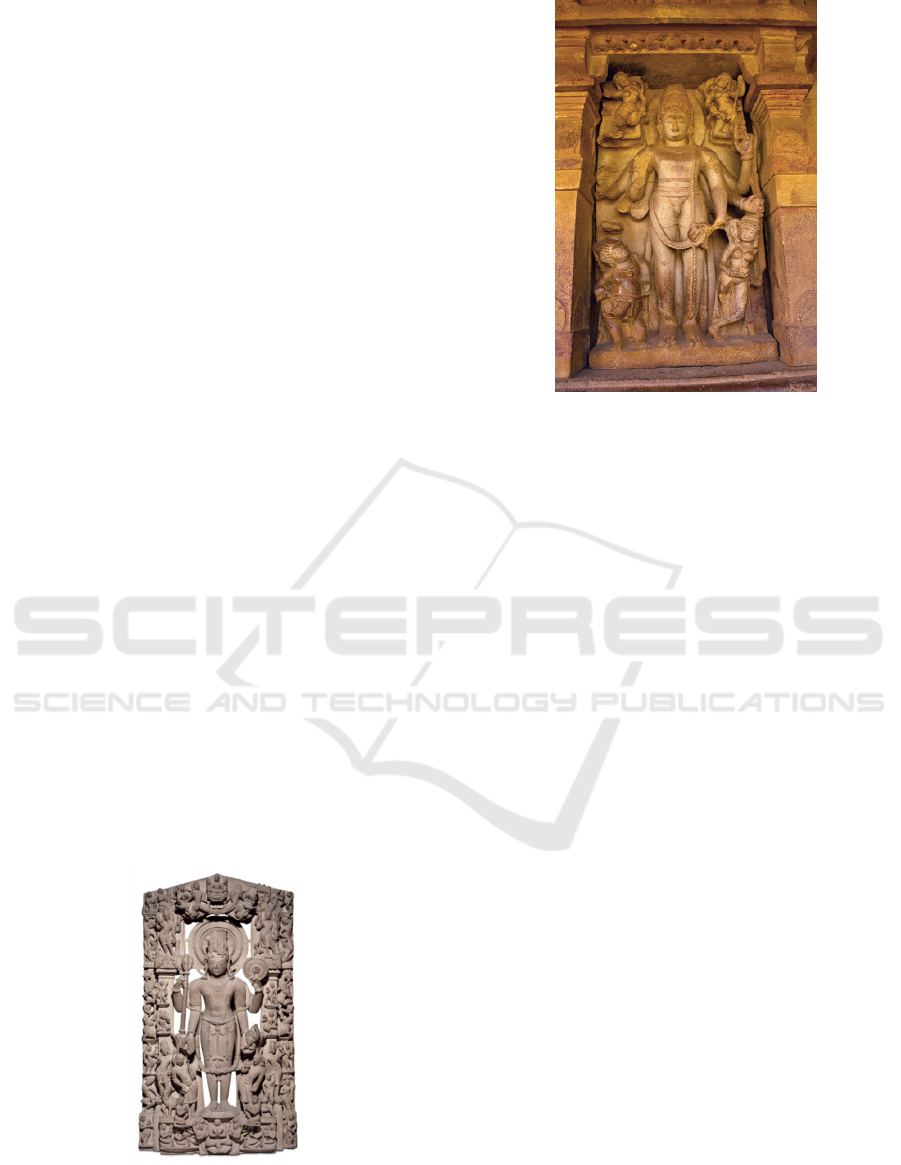
icons, Harihara sculpture, which depicts a standing fig.
Figure 3: The standing figure of Harihara in the British Mu-
seum;https://www.britishmuseum.org/collection/object/A_
1872-0701-75.
Figure 4: The Harihara panel in Durga temple, Aihole;
Hariharan Form of Lord Vishnu, Durga Temple , Aihole ,
Karnataka Stock Photo - Image of building, campus:
111900236.
of Indian deity Harihara, the combined incarnation of
Lord Shiva and Lord Vishnu. Both Figure 3 and
Figure 4 represent the image of Harihara, but we can
detect the differences between these two. Referring to
the description of Figure 3 on the British Museum
website, “Standing figure of Harihara carved from a
single slab of buff-colored sandstone.” However, if
compared with Figure 4, the possible origin form of
Figure 3 would be an attachment to the temple’s wall,
which means that it is probably a penal sculpture
rather than an isolated standing sculpture.
This loss of background elements reflects the
poignant fact that art traders have removed the major
part from the wall for portable reasons, suggesting the
colonial overtones behind this action. These
iconoclasts would put their interest in respecting other
culture’s religious relics and overlook the potential
damage that could have been done to the icon.
4 DISCUSSION
It can be inferred that the removal of religious icons
would cause inevitable damage and loss of meaning
in this process from the aforementioned two cases.
From the perspective of semiotics and Benjamin’s
theories on the aura, the temple is an aura-sacred
building with its coherent logic, and the icon’s
presence constitutes the temple’s “spatial syntax”.
The theory of semiotics, firstly influenced by
Saussurean structural linguistics at the awakening of
the 20th century, has innovatively applied
Through the Perspective of Post-Colonialism: Re-Evaluating Hinduist Iconoclasm in the British Museum
349

structuralism theories to architecture analysis. In
Edmund Leach’s dissertation, he continually explores
the semiotics architecture and affirms the significance
of context especially for religious icons. He argues
that icons are an indispensable constitute of the
“space syntax” of the temple (Leach, 1983), which
further testifies that once icons are removed from its
sacred context, the meaning would be altered or even
defined by the new context. In Andre Loeckx and
Hilde Heynen’s combined work in introducing
semiotics, they address that in semiotics architecture
is seen as “a kind of language,” within which
underlies “a system of rules (Loeckex & Heyden,
2020)” The displacement of icons also causes the loss
of aura if seen through the perspective of Walter
Benjamin’s theory. These non-Western icons were
purchased, stolen, removed from where they
belonged, fell in the hands of antique collectors,
bought by art colleges, and eventually ‘preserved’ in
museums. Nevertheless, the museum is a distinctive
space compared to the temple. The original
atmosphere in the temple cannot be replicated and
reconstructed in a new context like a museum.
On the other hand, a museum is a special space
called heterotopias, within which time and space are
distorted and intertwined, and sacred items from
different ages or different cultures are exhibited
together. The distinctive features of the museum
make it different from other common places with its
historical traces remaining. The physical and spatial
arrangement of these artifacts is based on Westerners’
comprehension of history and culture, which suggests
the higher possibility of disorder or recreating the
colonial authority discourse.
Historically speaking, western museums have
played a negative role in the illegal trade of artworks
and contain colonial remnants. Birgit Mersmann in
her essay points out that “the museum as an exhibited
space … and site of cultural representation has
increasingly come under attack since the 1990s
(Mersmann, 2024)”, which, ironically, is true.
Therefore, in reaction to the colonial discourse in
museums, a New York-based movement ‘Decolonize
This Place’(DTP) targeted many museums in New
York City. This social movement propels the
repatriation of artworks and reconstruction of the
former museum layout. As Mersmann highlights in
the significance of DTP, “…to give voice to those
who feel not included and represented in the history.”
Ironically, chargers in Western museums would claim
that their preservation of these icons benefits various
generations but intentionally omit the unethical
acquisition histories behind these exhibitions. This
could remind us of the violence done to these icons is
another testimony to Westerner’s Eurocentrism and
Colonialist mindset.
Furthermore, non-Western icons displayed in
Western museums have lost their activeness and
become passive objects, represented and exposed to
the European gaze. This phenomenon could be
interpreted through the theory of post-colonialism,
especially the concept brought out by Edward Said,
one of the founding fathers of the school of post-
colonialism, the Self and the Other (Said, 2003). In
the process of comprehending and identifying the
East, Westerners will take the active cognitive role
and spontaneously identify themselves as the center,
or the Self; while the East, normally considered as
passive and inferior, is alienated as the Other. When
Europeans inevitably bump into different ethnic
groups or exotic cultures, the cognition of the Self is
constructed at the expanse of belittling and
marginalizing the Other. Namely, the museum is not
just an exhibition place, but also a site for Westerners
to construct the Self when representing the image of
the Other. Through the representation of these icons,
the hierarchical structure behind them is also
exposed.
However, is there any possibility for the colonized
party to reverse the authority discourse imposed by
the colonizer, to which the answer is yes. Said’s
theory on the Self and the Other later was developed
by Indian researcher Homi Bhabha. He proposes two
concepts named Hybridity and the third space,
referring to the mutual dependence between the
colonized and the colonizer (Bhabha, 1994). In other
words, through mimicry in political forms or
economic structure after the colonizer, the colonized
nation could construct its self-identity. At the same
time, the colonizer has also been influenced by the
presence of its colony, which leads to cultural
integration and mutual ambivalence between this
binary opposition. The clear-cut line has been blurred
through interactions between these two parties,
suggesting that their relations are more flowing and
dynamic than static and rigid. Another concept “the
third space” has been proposed by Homi Bhabha to
address a space where the colonized culture and the
colonizer’s culture get integrated. In the British
Museum, the exotic cultures have negotiated with the
British ideologies. Bhabha suggests that in this ‘in-
between space’, the mutual impact exerted on each
party would shake the hegemonic colonial discourse
and give opportunities for the colonized culture to
establish its narration. Under the colonial discourse,
by representing icons from exotic cultures, the
colonizer could construct its own identity by
distinguishing from the other. However, these exotic
IESD 2025 - International Conference on Innovative Education and Social Development
350

icons disturb the dominant colonizer’s power
construction in this “third space” museum, which also
testifies that the ambivalence with mixed elements
could only disturb this discourse.
Last but not least, the national significance of
these religious icons has also been emphasized
nowadays. These religious icons not only have their
cultural significance but also signify the national
image of a country – especially for a post-colonized
country, which means that the colonized country
should construct its own narration to defend against
the colonial representation imposed by former
colonizers (Pease, 1997). The repatriation of icons
could contribute to reconstructing the national
narrations of the colonized country against the
Western colonial discourse.
5 CONCLUSION
To conclude, after entering modern times, the aims
and meaning of iconoclasm have extended beyond its
original definition. The action of removing icons
from museums could be deemed as a kind of
iconoclasm. And once the icon is removed from the
temple, it loses its full meaning and is represented
within the colonizer’s power structure. Temple and
Western museums are constructed using different
spatial syntax and for different purposes. Most
Western museums have played a rather negative role
in regulating illegal worldwide art trade and somehow
contributed to the construction of colonial discourse.
However, the hierarchical structure can still be
reversed with the repatriation of icons. The national
narration of the colonized country could still be
voiced in this way. However, this paper has several
limitations. One significant challenge is that the study
could benefit from a more nuanced exploration of the
diverse cultural contexts and the varying degrees of
iconoclasm across different regions. Future research
on relevant topics could focus on developing a more
comprehensive framework for understanding the
economic and cultural implications of repatriation.
This could involve interdisciplinary approaches,
combining insights from anthropology, economics,
and cultural studies to evaluate the long-term effects
of repatriation on both the source and holding
countries. By addressing these gaps, future
exploration can deepen our understanding of
iconoclasm and its role in contemporary cultural
dynamics.
REFERENCES
Berger, J. (2008) Ways of seeing. Penguin Classics.
Bhabha, H.K. (1994) The location of culture. London and
New York: Routledge..
British Museum (n.d.) 'Harihara sculpture'. Available at:
https://www.britishmuseum.org/collection/ob-
ject/A_1872-0701-75 (Accessed: 7 January 2025).
British Museum (n.d.) 'Nataraja Bronze'. Available at:
https://www.britishmuseum.org/collection/ob-
ject/A_1987-0314-1 (Accessed: 7 January 2025).
Faure, B. (1998) 'The Buddhist icon and the modern gaze',
Critical Inquiry, 24(3), pages 768-813. Available at:
http://www.jstor.org/stable/1344089 (Accessed: 7 Janu-
ary 2025).
Harwich, 2022, Iconoclasm: Past and Present Issues. Cam-
bridge University Press on behalf of Academia Europaea.
Indian Culture (n.d.) 'Bronze Idol of Nataraj (Late Chola Pe-
riod)'. Available at: https://indianculture.gov.in/retrie-
ved-artefacts-of-india/artefact-
Leach, E.R. (1983) 'The gatekeeper of heaven: anthropo-
logical aspects of grandiose architecture', Journal of
Anthropological Research, 39(Fall), page 244.
Loeckx, A. and Heynen, H. (2020) 'Meaning and effect: re-
visiting semiotics in architecture', in Heynen, H.,
Loosen, S. and Heynickx, R. (eds.) The figure of
knowledge: conditioning architectural theory, 1960s -
1990s. Leuven University Press, pp. 31-62. Available
at: https://doi.org/10.2307/j.ctv16x2c28.4 (Accessed: 7
January 2025).Bator, P.M. (1982) 'An essay on the in-
ternational trade in art', Stanford Law Review, 34(2),
pages 275-384. Available at: https://doi.org/10.2307
/1228349 (Accessed: 7 January 2025).
Manishjaishree (n.d.) 'The Harihara panel in Durga temple,
Aihole'. Available at: https://manishjaishree.com/hari-
hara-aihole/ (Accessed: 7 January 2025).
Méndez, GL 2022, The Bonfires of Money: Capitalism,
Memory and Iconoclasm. in Cultures of Currencies:
Literature and the Symbolic Foundation of Money.
Taylor and Francis, pp. 98-118. https://doi.org/1
0.4324/9781003265733-7
Mersmann, B. (2024) 'Decolonial insurgency for art-sys-
temic change: dissenting art museums in New York', in
Bublatzky, C., Dogramaci, B., Pinther, K. and Schieren,
M. (eds.) Entangled histories of art and migration: the-
ories, sites and research methods. Intellect, pp. 304-
319. Available at: http://www.jstor.org/stable/jj.207
53033.26 (Accessed: 7 January 2025).
Pease, D. E. (1997) 'National narratives, post-colonial nar-
ration', Modern Fiction Studies, 43(1), pages 1-23.
Available at: http://www.jstor.org/stable/26285462
(Accessed: 7 January 2025).
Said, Edward. (2003). Orientalism, Penguin Classics.
Through the Perspective of Post-Colonialism: Re-Evaluating Hinduist Iconoclasm in the British Museum
351
