
A Brief Analysis of the Composition and Connotation of the
Skeletons' Illusory Performance
Haoyu Wu
Culture, Creativity and Management, Beijing Normal University &
Hong Kong Baptist University United International College, Guangdong, China
Keywords: South Song Dynasty, Traditional Chinese Painting, The Skeletons' Illusory, Performance, Genre Painting.
Abstract: The Skeletons' Illusory Performance, is a genre painting by court painter Li Song of Southern Song Dynasty.
Since this painting contains the image of skull, which is not a common figure in traditional Chinese paintings,
scholars have studied this painting for hundreds of years since its creation, but there is no consensus on why
Li Song painted such a image in this painting. This study will utilize interdisciplinary research approaches of
Historical-contextual Analysis, Formal Analysis Method and Iconographic Analysis Method to analyze
multiple areas of history, art history and religions, including the painting's inscriptions, the background of the
creation period, Buddhist and Taoist thoughts, etc., to explores the composition and connotation of the
Skeletons' Illusory Performance. The painting of Skeletons' Illusory Performance is not a simple satire of
reality, but a reflection of painter Li Song's view of life and death influenced by Buddhism and Taoism.
1 INTRODUCTION
This study focuses on the image of skeletons in the
Skeletons' Illusory Performance, which is not
common in traditional Chinese paintings. This study
is very meaningful to the historical culture and the
concept of life and death in the Southern Song
Dynasty. First, this paper uses the literature analysis
method to search and read relevant materials and
documents. The advantage of this method is that it
can well analyze the creation background of the
Skeletons' Illusory Performance and the research
results of scholars of all generations, which is
conducive to the research. In addition, to achieve the
goal, this study utilizes interdisciplinary research
approaches, including Historical-Contextual Analysis
(He, 2023) to analyze whether the Skeletons' Illusory
Performance is related to historical events or social
change like Kaixi Northern Expedition or whether the
painter Li Song was influenced by a particular school
of thought; Formal Analysis Method (Sar, 2023) to
analyze how Li Song used color and composition to
express his views on life and death in the Skeletons'
Illusory Performance; Iconographic Analysis Method
(Jaskot, 2020) to analyze the meaning of the skull
images in the Skeletons' Illusory Performance.
Ultimately, the research goal is to analyze the
composition and connotation of the Skeletons'
Illusory Performance to find out what the painter Li
Song wanted to express through this painting.
2 LITERATURE REVIEW
As the painting contains the image, which is rare in
traditional Chinese paintings, scholars have studied it
for hundreds of years since Skeletons' Illusory
Performance was created. Wu Qizhen, a scholar of
the Qing Dynasty, mentioned in his book that: "Li
Song's "Skull Picture"...don't know what the meaning
is." (Li, n.d.). Nowadays, many studies believe that
the Skeletons' Illusory Performance reflects the hard
life of the people in the Southern Song Dynasty. Xiao
(2019) listed some historical materials about war and
famine in the Song Dynasty (960AD - 1279AD) to
prove that war and famine occurred frequently at that
time. The death and famine caused by war made
people were difficult to pay for the high-price food,
the death rate was high and cannibalism often
occurred and the people were familiar with the image
of skulls. The paper finally concluded that Li Song
sympathized with and worried about the living
conditions of the people, he used the Skeletons'
Wu, H.
A Brief Analysis of the Composition and Connotation of the Skeletons’ Illusory Performance.
DOI: 10.5220/0013982300004912
Paper published under CC license (CC BY-NC-ND 4.0)
In Proceedings of the 1st International Conference on Innovative Education and Social Development (IESD 2025), pages 259-265
ISBN: 978-989-758-779-5
Proceedings Copyright © 2025 by SCITEPRESS – Science and Technology Publications, Lda.
259

Illusory Performance to expose the miserable life of
the people in the Southern Song Dynasty.
Although previous studies have analyzed the social
context and the meaning that Li Song wanted to
express through this painting in detail, there still has
research gap that didn’t analyze the composition of
the painting and the connotation of the skull image,
which will be the focus of this paper.
3 CREATION BACKGROUND
With the further prosperity of the urban commodity
economy in the Song Dynasty (960AD - 1279AD) in
China, the new citizen class emerged and continued
to grow. In order to meet the aesthetic needs of the
growing citizen class, the range of painting themes
became wider and wider, then the genre paintings
with the theme of the lives of ordinary urban and rural
people also appeared (Song, 2022). The creation of
genre paintings in the Northern Song Dynasty
(960AD - 1127AD) had gradually become
systematized and had basically matured by the
Southern Song Dynasty (1127AD - 1279AD),
reaching a deeper level in creative conception and
connotation (Zhang, 2024).
The court painter Li Song (1166AD -1243AD) is a
painter born in Qiantang (today’s Hangzhou,
Zhejiang), Southern Song Dynasty. He worked as a
carpenter when he was young and later followed his
stepfather, Li Congxun, a royal painter, into the Royal
Painting Institution of South Song Dynasty. Born in
poverty, Li Song had a deep understanding of the
daily life of ordinary people, he also became a royal
painter later and created many genre paintings
depicting the lives of ordinary people (Han, 2019). As
a representative of genre painting painters in the
South Song Dynasty, Li has more than 50 works
handed down, most of which are genre paintings
depicting the life of the lower-class citizens and the
labor life of farmers, including the painting of
Skeletons' Illusory Performance (Can be seen in
Figure 1), which was created by Li Song during the
Jiading period (1208AD - 1224AD). The main
content of the painting is a skeleton puppeteer
manipulating a small skeleton puppet to tease a
curious infant.
Figure 1: The painting of Skeletons' Illusory Performance.
Source: Palace Museum. https://digicol.dpm.org.cn/ cul-
tural/details?id=187317.
4 HISTORICAL ANALYSIS
The Skeletons' Illusory Performance was created
during the Jiading period (1208AD - 1224AD), South
Song Dynasty. More specifically, it was created
before the tenth year of Jiading (1208AD - 1218AD).
During the Kaixi Period (1205AD - 1207AD)
before the Jiading period, the Prime Minister Han
Tuozhou (1152AD - 1207AD), who was eager to
make a name for himself in history, advocating
resistance against the Jin Dynasty. In the second year
of Kaixi (1206AD), Han rashly launched the Kaixi
Northern Expedition without making adequate
preparations (Zou, 2019). Finally, the expedition
failed due to the army of Southern Song Dynasty
failed in most of the attacks and the obstruction by the
peace faction in the court. The peace faction then
murdered Han and sent his head to the Jin Dynasty
(1115AD - 1234AD) (Zou, 2019) as a sign of
sincerity, then the Southern Song Dynasty and Jin
Dynasty signed a ceasefire agreement ---- Jiading
Peace Agreement in the first year of Jiading
(1208AD), marking the failure of the Kaixi Northern
Expedition. With this agreement, the Southern Song
Dynasty and Jin Dynasty maintained a brief peace for
ten years, which was exactly the period when the
Skeletons' Illusory Performance was created, until a
new war broke out in the tenth year of Jiading
(1218AD).
Although the people of the Southern Song Dynasty
in this period still had some sufferings, their lives
were much better than during the war. It is illogical
for Li Song to deliberately paint a picture that simply
reflects the miserable lives of the people during
peacetime rather than wartime.
IESD 2025 - International Conference on Innovative Education and Social Development
260
5 ANALYSIS OF THE
INSCRIPTION
The viewpoint that the Skeleton Illusory Performance
reflects the miserable life of the people in the
Southern Song Dynasty is originated from the
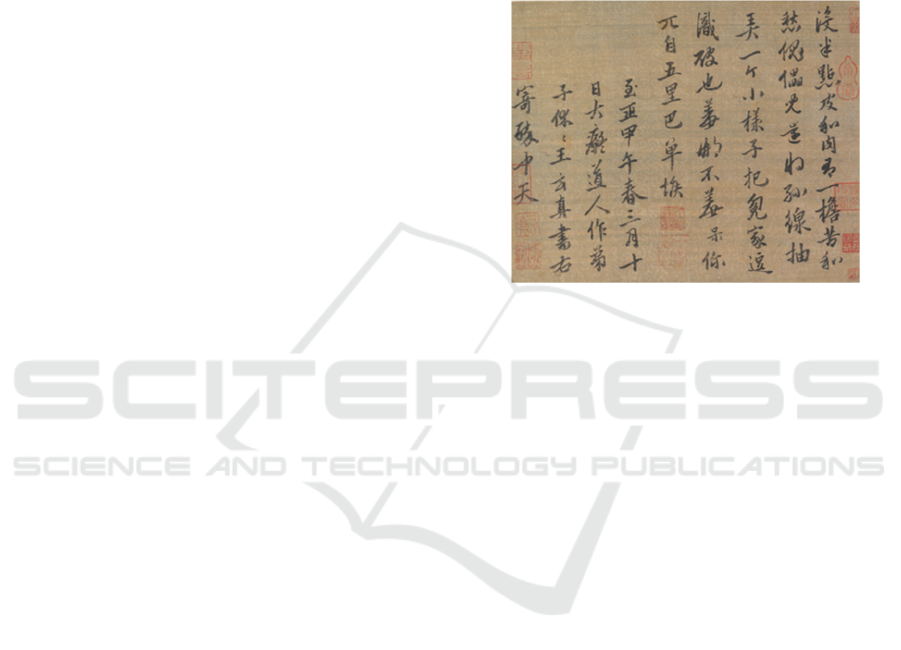
inscription of Zui Zhong Tian (Can be seen in Figure
2) attached to the painting by Huang Gongwang
(1269AD - 1354AD) in Yuan Dynasty (1271AD -
1368AD).
Huang Gongwang is a painter who was born in the
late Southern Song Dynasty, his family was poor and
he lost both his parents when he was young (Lu,
2024). Besides, the Yuan Dynasty Huang lived in set
up a four-class system. The social status from high to
low is: Mongolians; Semites: minorities groups in the
Western Regions; Han People: people under the rule
of the former Jin Dynasty and people in the Southern
Song Dynasty areas occupied by Mongolia in the
early stage, such as Sichuan; Southerners: other
people under the rule of the former Southern Song
Dynasty (Ma, 2024). As the lowest class, Southerners
like Huang Gongwang had almost no political rights
and it was difficult for them to become government
officials, while most of the Han intellectuals in
ancient China had the ideal of governing the country
and bringing peace to the world. Becoming an
government official is the best way to realize their
ambitions, Huang was no exception. Huang served as
an official twice, however, he was imprisoned
unfortunately during his hard-won official career and
ruined his political future. After being released from
prison, Huang gave up the secular world and turned
to the Taoism (lu, 2024).
The inscription, which is the closest analysis to the
time when the Skeleton Illusory Performance was
painted, writes: “Without any skin or flesh, there is
only a burden of pain and sorrow. The puppet also
pulled out the silk thread, trying to find a small shape
to amuse its enemy...”. Huang Gongwang's use of
negative words of "bitter", "sorrow" and "enemy"
(Can be seen in Figure 2) shows his pessimistic view
of the connotation of the Skeleton Illusory
Performance.
Huang Gongwang's negative view on the
connotation of the Skeleton Illusory Performance is
more due to the oppression of his own living
environment oppressing Han intellectuals like him,
he's own difficult life experience made him a more
pessimistic person. It wass inevitable for him to have
a negative view on the connotation of a painting
contains skull images representing death and took the
opportunity of writing the inscription for the Skeleton
Illusory Performance and used the past (Southern
Song Dynasty) to satirize the present (Yuan Dynasty).
As a Han intellectual born in the Southern Song
Dynasty, Huang Gongwang was more likely to be
longing for life in the Southern Song Dynasty rather
than considering the people in the Southern Song
Dynasty lived a miserable life.
Figure 2: The inscription of Zui Zhong Tian attached to the
Skeleton Illusory Performance. Source: Palace Museum.
https://digicol.dpm.org.cn/cultural/details?id=187317
6 ANALYSIS OF THE
COMPOSITION
6.1 Method of Chiaroscuro
Starting from the Tang Dynasty, the use of
Chiaroscuro in Chinese painting became increasingly
common, paintings of the Song Dynasty were
increasingly focused on the expression of chiaroscuro
as well as vividness (Lin & Zhang, 2024). Li Song
also utilized the Chiaroscuro to show the superficial
relationship between life and death in the Skeletons'
Illusory Performance. He divided the painting into
two parts, on the left, Li used plenty of lines and dark
ink to draw the brick milestone and the shoulder pole
loaded with living utensils, making them as mediums
to set off the death atmosphere of the skeleton peddler
fiddling with the skeleton puppet; while on the right
side, a large area of blank background as well as
empty ground is used to set off the curious infant,
which represents the life (Can be seen in Figure 3).
The contrastion of the dark left half and the bright
right half contrasted by Chiaroscuro reflects the clear
divided and distinct relationship between life and
death.
A Brief Analysis of the Composition and Connotation of the Skeletons’ Illusory Performance
261
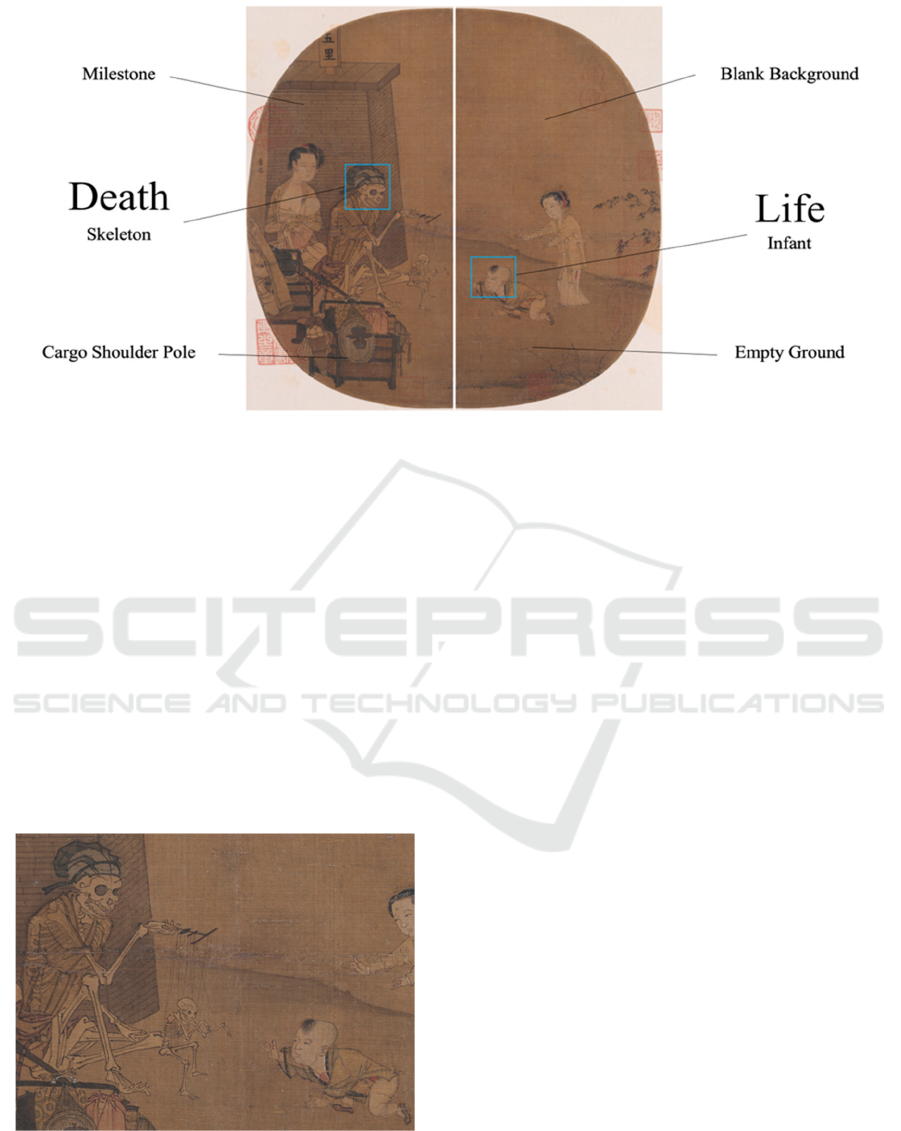
Figure 3: Composition Analysis Diagrm of the Skeletons' Illusory Performance. (Picture credit: Original).
6.2 Picture in Picture
The Skeletons' Illusory Performance contents a
picture in picture that the skeleton puppeteer using the
skull puppet to tease the infant, which is the core part
of the painting (Can be seen in Figure 4). The skeleton
symbolizing death teases the child symbolizing new-
born life to crawl to the left and reach out to grab the
skeleton puppet. This is Li Song's mockery of the
impermanence of life, although the relationship
between life and death is distinct and clearly divided,
they are also mutually attractive. Death is always
accompanied by life, even if it is just a newborn
infant.
Figure 4: The picture in picture of the Skeletons' Illusory
Performance. Source: Palace Museum. https://digicol.dpm.
org.cn/cultural/details?id=187317
6.3 Triple Illusion Structure
The composition of the Skeletons' Illusory
Performance also contains a triple illusion structure.
The first illusion is the picture in picture of the
skeleton puppeteer manipulates the small skull
puppet to tease the infant, which "offers a chilling
contrast between the toddler's innocent facial
expression and the enticing posture of the skeleton
marionette" (Hong, 2011). Then, as a skeleton
representing death, the puppeteer cannot move on his
own, but is manipulated by an invisible hand, the
painter Li Song, to manipulate the small skeleton
puppet, which is the second illusion. Finally, although
the audience can see the first two illusions from the
perspective of a bystander when watching the
Skeletons' Illusory Performance, the illusion structure
that arises from each other makes the viewer
unconsciously fall into it. While watching and
thinking about this painting, the audience also
constitutes the third illusion together with the
Skeletons' Illusory Performance. Through the nested
triple illusion structure, the Skeletons' Illusory
Performance not only reveals Li Song's view of life
and death, but also forms a relationship of mutual
interweaving and reflection with the audience. In the
interaction with this painting, the audience is no
longer just an external observer, but gradually
becomes a part of the illusion, and together with the
skeleton and the manipulator behind it, they fall into
the puzzle of death and life, reality and illusion.
IESD 2025 - International Conference on Innovative Education and Social Development
262

7 RELIGIOUS INFLUENCES
7.1 Overview
Traditionally, the dominant thought in ancient
Chinese society ---- Confucianism's attitude towards
ghosts and gods is to keep a distance from them
(Tang, 2022), this can explain why it is not normal to
see skull images in traditional Chinese painting.
However, just a short period before the creating of the
Skeleton Illusory Performance, the Neo-
Confucianism was accused of hypocrisy and being
denounced as a pseudo-doctrine (Kong, 2010). In
order to suppress the peace faction in the court and
launch the Kaixi Northern Expedition, the Prime
Minister Han Tuozhou accused Neo-Confucianism, a
branch of Confucianism popular during the Song
dynasties, of being hypocritical and listed it as a
pseudo-doctrine, as almost all the officials who
advocated peace were disciples of Neo-Confucianism
(He, 2008). This crackdown not only strengthened the
power of the emperor and made political preparations
for the Kaixi Northern Expedition, but also provided
space for the development and spread of Taoist and
Buddhist thoughts. In addition, the Taoism and
Buddhism also gently became secularized during the
Song Dynasty (Dong, 2024). As the skull image is
quiet common in Taoism and Buddhism, Li Song's
depiction of skull elements in the Skeleton Illusory
Performance is probably influenced by Buddhist and
Taoist thoughts.
7.2 Skeletons in Buddhism
There are many spells and images related to skulls in
Buddhism, the meaning of which is positive,
symbolizing the wisdom and breaking away from
worldly obsessions.
7.2.1 The Skeleton Meditation
The Skeleton Meditation is one of the five Buddhist
meditation methods. It allows ascetics to abandon
their greed for the body and lust through meditation
(Han, 2019), curing the greed and attachment to
worldly things through the contemplation of human
bones. People who practice the Skeleton Meditation
successfully will eventually see through the manday
world, losing their muscles and turn into a pure white
skeleton. When they look at other people, they will
also put aside distracting thoughts and see others as
white bones.
7.2.2 Chitipati
The Tantric Buddhism, which is a branch of
Buddhism developed rapidly in the Song Dynasty,
has a image of the crematory guard ---- Chitipati. It
arises from the Secret Essence Wheel Tantra and
primarily employed as a wealth practice. With
emphasis on protecting from thieves, Chitipati also
serves as the special protector for the Vajrayogini
'Naro Khechari' practice. It is common in all the
Sarma (New) Schools of Himalayan and Tibetan
influenced Buddhism, including the Tantric
Buddhism, whose image is a pair of skeletons of a
couple (Han, 2019).
7.3 Skeletons in Taoism
Taoism also has a deep relationship with the skull
image. The skull image in Taoism actually represents
happy life and carefree rather than simply death.
7.3.1 Zhuangzi Sighed Over the Skull
Before Taoism was formed, there was already an
allusion to the Taoist representative Zhuangzi
(369BCE - 286BCE) Sighed Over The Skull, an
ancient Taoist story from Zhuangzi
·
Zhile that,
Zhuangzi saw a skull on his journey and asked it
whether it died because it lost the truth in pursuit of
life, or died of shame for bad behavior, or died of cold
and hunger, etc. He used the skull as a pillow and fell
asleep, then the skull told Zhuangzi in the dream that
what he said was all the burdens of the living. After
death, there is no monarch to rule, no officials to
govern and no toil in the four seasons. Even the
happiness of being a king cannot exceed that. The
story conveyed the idea of “Life is labor, death is rest”
(Dong, 2024).
7.3.2 Quanzhen Sect
Quanzhen Sect is a Taoist sect founded by Wang
Chongyang (1112AD - 1170AD) in the Jin Dynasty,
which was the same period as the Southern Song
Dynasty, preaching that "only after death can people
realize the meaning of life". Wang created many
painting about skeletons and Quanzhen Sect also
frequently used skull images to persuade its disciples
to get rid of their obsessions, not be greedy for lust,
fame and wealth, so as to achieve true open-
mindedness and freedom (Han, 2019). Besides, the
Taoist sect that Huang Gongwang joined after he was
released from prison was exactly the Quanzhen Sect.
A Brief Analysis of the Composition and Connotation of the Skeletons’ Illusory Performance
263

7.4 Influence of Buddhism and Taoism
The period when Li Song painted the Skeleton
Illusory Performance happened to be a period of
rapid development of Buddhism and Taoism, while
the skull image in them is more a positive image
rather than just simply represents death. It conveys
the idea that human beings are constantly facing the
threat of death and born to die, only by eliminating
inner desires can one free from the sufferings of life,
which is consistent with the composition of the
painting. In the Skeleton Illusory Performance, the
skeleton puppeteer who controls the skeleton puppet,
is also a symbol of purity and nobility as well as
detaching from the secular world. Under the influence
of Buddhist and Taoist thoughts, Li Song created such
a complex and contradictory image to tease the infant
who represent the livings or real-life people, with the
skeleton puppet to persuade audiences to abandon
worldly distractions and achieve true freedom and
happiness.
8 DISCUSSION
This study mainly focuses on analyzing the picture in
picture of the skeleton puppeteer teasing the infant
with a small skeleton puppet, which is the core part of
the painting of Skeleton Illusory Performance, the
history background of creation and the inscription
attached to the painting. In addition, this research also
analyzes the figure of milestone, carrying pole and the
large blank background in shaping the composition
and connotation of the painting. However, this study
does not analyze the secondary characters in the
picture, to be specific, the woman behind the skeleton
puppeteer who is breastfeeding and watching what is
happening as well as the woman on the left side of the
picture who is stretching out her hands to stop the
infant from approaching the skeleton puppet.
Likewise, the scholars also have not reached a
consensus on their identities and why Li Song paint
these two figures that seem unrelated to the theme of
the painting. This means that future research can
focus on the identities and connotations of the
secondary characters in this painting, which may
further contribute to the connotation of the entire
painting of Skeleton Illusory Performance.
9 CONCLUSION
The result of this study is that, the Skeleton Illusory
Performance was created under the influence of
Buddhism and Taoism thoughts to showcase Li
Song’s point of view on life and death. Further
concluded that, it is not simply a genre painting
reflects the difficult life of the people in the Southern
Song Dynasty, but more importantly, a reflection of
painter Li Song's point of view on life and death.
Through the method of Chiaroscuro and the illusory
composition, Li Song showed the contradictory and
absurd relationships between life and death. Although
life and death looks distinct, they are also mutually
attractive. By using the skull images of skeleton
puppeteer to tease the infant represents life, he
exhorted people to let go of the worldly obsessions,
then they can get free from the secular life as well as
gain true freedom, detachment and happiness. To sum
up, this study provides a lot of valuable references for
future research on the history of the Southern Song
Dynasty, genre painting, and the concept of life and
death. Although this research utilized the method of
interdisciplinary analysis to analyze the chiaroscuro
method used by Li Song and the triple illusion he
constructed in constructing the composition of the
painting, it did not involve the analysis of other art-
related aspects like Li Song's painting brush and ink
techniques, and whether these have any connection
with or influences on the connotation of the painting
of Skeletons' Illusory Performance. This means that
more in-depth researches need to be done in the
future.
REFERENCES
Dong, Y. 2024. 21 shiji yilai lisong "Kulouhuanxitu"
guonei yanjiu songshu. A review of the domestic re-
search on Li Song's "Skeleton Fantasy Performance"
since the 21st century. Art Evaluation 10: 43-50.
Han, Y. 2023. Gudai kulou xingxiang yanjiu. Research on
the Image of Ancient Skeletons. Shanxi Normal Uni-
versity 6.
He, C. Reflections on Metacritical Analysis. Interdiscipli-
nary Studies of Literature 7(1).
He, K. 2008. Luelun lixue yu nansong ‘qingyuandangjin’
de xingcheng. A Brief Discussion on Neo-Confucian-
ism and the Formation of the "Qingyuan Party Ban" in
the Southern Song Dynasty. Anhu Wenxue (Anhui Lit-
erature) 12: 232-234.
Hong, J. 2011. Theatricalizing Death and Society in The
Skeletons' Illusory Performance by Li Song. The Art
Bulletin 93(1): 60-78.
IESD 2025 - International Conference on Innovative Education and Social Development
264

Jaskot, P. B. 2020. Digital methods and the historiography
of art. In The Routledge Companion to Digital Human-
ities and Art History 9-17.
Li, E. n.d. Nansong yuanhua lu. Records of Court Paintings
in the Southern Song Dynasty, Shang-hai People's Fine
Arts Publishing House 5: 99.
Li, S. The Skeletons' Illusory Performance, fan-shaped al-
bum leaf, ink and colors on silk, (27 X 26.3 cm),
1208AD - 1224AD. Palace Museum, Beijing. Palace
Museum. https://digicol.dpm.org.cn/cultural/de-
tails?id=187317
Lin, Y., & Zhang, D. 2024. Historical Inheritance and Folk-
lore Memory—Development and Innovation of Im-
agery Expression in Chinese Painting. Cultura: Interna-
tional Journal of Philosophy of Culture and Axiology
21(1).
Lu, J. 2024. Huanggongwang de fuchunshan. The Fuchun
Mountain of Huang Gongwang. Hangzhou, 11, 68-69.
Ma, X. 2024. The Application of Ancient Chinese Drama
in the Field of Saxophone—Taking Yuan Zaju as an
Example. The University of North Carolina at Greens-
boro.
Sar, A. M. K. 2023. Formal Analysis of the Mystical Lan-
guage: Types, Objects, and Solutions. Research on
Mystical Literature 17(1): 155-171.
Song, A. 2022. Liangsong huihua yishu tanjiu. A Study on
the Painting Art of the Northern and Southern Song
Dynasties. Art Education Research 18: 19-21.
Tang, C. 2022. Lisong "Kulouhuanxitu" tanxi. An Analysis
of Li Song's "Skeleton Fantasy Performance". Art Edu-
cation Research 23: 13-16.
Xiao, W. 2019. "Kulouhuanxitu" yu nansong baixing
shengcun zhuangtai. “Skeleton Illusory Performance”
and the Living Conditions of the People in the Southern
Song Dynasty. Popular Literature and Art 21: 67-68.
Zhang, X. 2024. Cong tuxiangxue jiaodu fenxi "kulou-
huanxitu". Analysis of ‘Skeleton Illusory Performance’
from the perspective of iconography. Dahe Art Weekly.
Zou, H. 2019. Kaixi mingjiang bizaiyu shiji buju. The Com-
plementary Research on Captain Commando Bi Zaiyu.
Wuling Xuekan (Wuling Academic Journal) 4: 69-76.
A Brief Analysis of the Composition and Connotation of the Skeletons’ Illusory Performance
265
