
Real-Time Leaf Disease Detection and Fertilizer Recommendation
System
A. V. Nageswara Rao, Pranathi Avutu, Sai Preethi Bijjala
and Peddi Lakshmi Aishwarya
Department of ACSE, Vignan University, Guntur, Andra Pradesh, India
Keywords: Leaf Disease Detection, Hybrid Model, Feature Extraction, Image-Based Disease Detection.
Abstract: This project highlights the importance of leaf disease detection in precision agriculture, enabling early
identification and timely intervention to protect crops from various diseases. This project presents a novel
approach to detecting leaf diseases using deep learning (DL) and machine learning (ML) techniques. The
study employs four powerful convolutional neural network (CNN) architectures: VGG16, VGG19,
Inception v3, and Inception v6 to train a comprehensive leaf image data set, enabling robust disease
classification. VGG-based models are used to extract features, which are then input into a support vector
machine (SVM) classifier for disease classification. This hybrid DL-ML framework improves both the
accuracy and efficiency of the system in distinguishing between healthy and diseased leaves. An interactive
interface was developed, allowing users to upload leaf images for real-time disease detection, while an IoT
camera system was integrated for automated leaf disease analysis in the field. The proposed solution
demonstrates significant potential
to improve crop management practices and advance automated
agricultural systems, offering an innovative tool for early-stage disease diagnosis and management.
1 INTRODUCTION
In recent years, global demand for food has
increased significantly due to rapid population
growth, placing greater pressure on agricultural
systems to ensure optimal crop pro- duction. One of
the primary challenges faced by farmers is the timely
detection of leaf diseases, which can severely impact
crop health and yield. The timely and precise
detection of these diseases is essential for efficient
pest management, reducing crop loss, and
minimizing the use of pesticides, this ultimately
results in more sustainable farming practices.
Traditional leaf disease detection methods often
depend on manual inspection, which is time
consuming, labor intensive, and susceptible to
human error. With rapid progress in machine learning
(ML) and deep learning (DL), there is great potential
to automate and enhance the accuracy of disease
detection processes. In this context, computer vision
techniques powered by convolutional neural
networks (CNN) have shown great promise in
analyzing plant leaf images to identify disease
patterns.
This study uses advanced CNN architectures,
specifically VGG16, VGG19, Inception v3, and
Inception v6., to train
and evaluate a
comprehensive data set of leaf images for
disease detection. These deep learning models are
used for feature extraction, where the VGG models
play a pivotal role in identifying relevant features
from leaf images. The extracted features are then fed
into a support vector machine (SVM) classifier for
further processing, a traditional machine learning
algorithm, to classify whether the leaf is healthy or
diseased. By combining the strengths of CNN for
feature learning and SVM for classification, the
proposed method seeks to improve both the accuracy
and efficiency of disease detection.
In addition, an interactive user interface was
developed that allows users to upload images of
plant leaves and receive real-time feedback on
whether the leaf is healthy or infected. To further
extend the practical application, the system was
integrated with an IoT camera device, allowing
automated image capture and analysis directly in
agricultural fields. This IoT-enabled camera
provides real-time monitoring and disease detection,
creating a seamless and efficient solution for
farmers.
Integrating deep learning with IoT technology
represents a significant step toward modernizing
862
Rao, A. V. N., Avutu, P., Bijjala, S. P. and Aishwarya, P. L.
Real-Time Leaf Disease Detection and Fertilizer Recommendation System.
DOI: 10.5220/0013982100004919
Paper published under CC license (CC BY-NC-ND 4.0)
In Proceedings of the 1st International Conference on Research and Development in Information, Communication, and Computing Technologies (ICRDICCT‘25 2025) - Volume 5, pages
862-874
ISBN: 978-989-758-777-1
Proceedings Copyright © 2026 by SCITEPRESS – Science and Technology Publications, Lda.

agricultural practices. By automating the leaf disease
detection process, the proposed system can help
farmers make informed decisions faster, improve
crop management, and contribute to increased
agricultural productivity.
2 LITERATURE SURVEY
The detection of leaf diseases using machine
learning and deep learning models has been a key
focus in modern agricultural research. The goal is to
automate the process and enhance crop management.
This section examines various studies on leaf disease
detection and emphasizes the key distinctions in our
approach.
2.1 Deep Learning Approaches for
Leaf Disease Detection
Mohanty et al. (2016) developed a convolutional
neural network (CNN) model to classify images of
various crops, such as tomatoes, cucumbers, and
peppers, achieving re- markable results in leaf
disease detection. Their approach leverages CNNs to
automatically extract features from images,
significantly reducing the need for manual feature
engineering. However, their model was trained on
a small dataset, which reduced its ability to
generalize between different plant species and
environments.
2.2 Convolutional Neural Networks
Diagnose Plant Disease
Toda and Okura (2019) developed a convolutional
neural network (CNN) model to diagnose plant
diseases by analyzing leaf images. Their approach
aimed to improve the interpretability of CNN-based
predictions by extracting learned features in an
understandable way, enhancing the model re-
liability. Using deep learning, their method reduced
the dependence on manual feature extraction,
making the diagnosis plant disease more efficient.
However, their study focused mainly on
interpretability rather than improving classification
precision, and the ability of the model to generalize
between different plant species and environmental
conditions remained a challenge.
2.3 Deep Neural Networks-based
Recognition of Plant Diseases
Sladojevic et al. (2016) developed a deep
convolutional neural network (CNN) model to
recognize plant disease using leaf image
classification. Their model was developed to
differentiate between healthy and diseased leaves,
covering 13 different plant diseases. Using CNNs,
their approach automates feature extraction,
reducing the need for manual preprocessing. The
study also utilized the Caffe deep learning
framework to train the model on an extensive
dataset, achieving an accuracy of 96.3%. However,
the model’s performance was influenced by dataset
limitations, particularly in generalizing across
diverse environmental conditions and plant species.
2.4 Convolutional Neural Networks for
the Automatic Identification of
Plant Diseases
Boulent et al. (2019) carried out an extensive
review on the use of convolutional neural networks
(CNNs) for the automatic identification of plant
diseases. Their study analyzed 19 research papers
that implemented CNNs for crop disease detection,
highlighting key aspects such as dataset
characteristics, model architectures, training
strategies, and performance metrics. The review
emphasized the potential of CNNs in precision
agriculture, improving food security through
automated disease diagnosis. However, challenges
such as dataset limitations, model generalization,
and interpretability were identified as critical areas
for improvement. The authors also offered
recommendations to improve the reliability of CNN-
based plant disease identification systems for
practical agricultural applications.
2.5 Fast and Accurate Detection and
Classification of Plant Diseases.
International Journal of Computer
Applications
Al-Hiary et al. (2011) developed a machine
learning-based approach for the rapid and accurate
detection of plant diseases using image processing
techniques. Their model used K- means clustering
for segmentation and artificial neural net- works
(ANNs) for classification, greatly enhancing
efficiency compared to traditional expert-based
disease identification methods. The proposed
Real-Time Leaf Disease Detection and Fertilizer Recommendation System
863

method successfully classified various plant diseases
with a precision ranging between 83% and 94%,
achieving a 20% speedup compared to previous
approaches. However, the model’s performance was
affected by factors like dataset variability and
environmental conditions, which presented
challenges for its implementation in real-world
applications.
2.6 Detection of Unhealthy Region of
Plant Leaves and Classification of
Plant Leaf Diseases Using Texture
Features
Arivazhagan et al. (2013) developed a machine
learning- based method for detecting and classifying
plant leaf diseases by utilizing texture features. Their
method involved transforming input images into the
HSI color space, masking and removing green
pixels, segmenting infected regions, and extracting
texture statistics for classification. The study
employed a SVM classifier, achieving an accuracy
of 94% on a dataset of 500 plant leaves. The
proposed approach improved efficiency in plant
disease detection, reducing dependency on expert
analysis. However, its performance was influenced
by variations in leaf conditions and environmental
factors.
2.7 Detection of Unhealthy Region of
Plant Leaves and Classification of
Plant Leaf Diseases Using Texture
Features Using ANN
Kanjalkar and Lokhande (2013) developed an
approach using artificial neural networks (ANN) to
detect and classify plant leaf diseases through image
processing techniques. Their method involved
converting RGB images to the HSI color space,
removing noise, segmenting infected regions using
connected component labeling, and extracting key
features such as size, color, proximity, and centroid
distance. The ANN classifier was trained on four
different plant diseases, achieving reliable
classification results. However, the model’s
performance was affected by dataset limitations and
variations in leaf appearance due to environmental
factors.
2.8 Diseases Detection of Various Plant
Leaf Using Image Processing
Techniques: A Review
The paper” Diseases Detection of Various Plant Leaf
Using Image Processing Techniques: A Review”
explores the importance of detecting plant diseases
to improve agricultural productivity. Given that over
70% of India’s population depends on agriculture,
early disease detection is crucial to prevent
economic losses. The study reviews various plant
diseases affecting crops like maize, are can’t,
coconut, papaya, cotton, chili, tomato, and brinjal. It
discusses key challenges, such as image quality,
background noise, and the need for large datasets.
The paper highlights different image processing
techniques, including K-Means clustering, Support
Vector Machine (SVM), Artificial Neural Networks
(ANN), and Deep Learning for disease
classification. Various studies are reviewed, the use
of color space transformations, wavelet transforms,
and machine learning models for effective disease
detection. The research emphasizes the
importance of automation in agriculture to reduce
manual monitoring and pesticide usage. Future
improvements include enhancing classification
accuracy and expanding the dataset for better
detection of plant diseases. [8]
2.9 Recent Technologies of Leaf
Disease Detection Using Image
Processing Approach – A Review
The paper” Recent Technologies of Leaf Disease
Detection using Image Processing Approach – A
Review” presents a comprehensive study of
advancements in image processing techniques for
plant leaf disease detection. Given the critical role of
agriculture in economic growth, early disease
detection is essential to prevent yield loss. The paper
reviews various methodologies, such as
segmentation, feature extraction, and classification,
and organizes them according to the technologies
used and their applications. Techniques such as
histogram equalization, median filtering, and
machine learning classifiers like Support Vector
Machine (SVM) and K-Nearest Neighbor (KNN) are
analyzed. The study also discusses challenges such
as varying lighting conditions, image noise, and
dataset limitations. Future research should aim at
integrating hybrid algorithms, deep learning models,
and mobile-based solutions to enable real-time
disease detection and enhance precision agriculture.
ICRDICCT‘25 2025 - INTERNATIONAL CONFERENCE ON RESEARCH AND DEVELOPMENT IN INFORMATION,
COMMUNICATION, AND COMPUTING TECHNOLOGIES
864
2.10 A Review of Machine Learning
Approaches in Plant Leaf Disease
Detection and Classification
The paper” A Review of Machine Learning
Approaches in Plant Leaf Disease Detection and
Classification” offers a thorough analysis of recent
advancements in the identification and classification
of plant diseases using Machine Learning (ML) and
Deep Learning (DL) models. The study reviews over
45 research papers from 2017 to 2020, highlighting
techniques such as Support Vector Machine (SVM),
Neural Networks, K- Nearest Neighbor (KNN), and
advanced DL architectures like AlexNet,
GoogLeNet, and VGGNet. Various image
processing techniques, including segmentation and
feature extraction, are employed, and classification,
are discussed along with their accuracy and dataset
details. The paper emphasizes the importance of
mobile-based applications for real-time plant disease
detection, improving agricultural productivity. It
also addresses key challenges like dataset quality,
segmentation precision, and the need for hybrid ML-
DL models to enhance accuracy. Future research
should focus on real-time image datasets, mixed
lighting conditions, and automated severity
estimation to improve detection performance.
2.11 Comparison with Our Work
While existing studies have contributed significantly
to the field of leaf disease detection, they primarily
focus on training deep learning models for
classification or rely on traditional machine learning
methods for disease identification. Our approach
differentiates itself in the following key areas:
• Integration of Advanced Deep Learning Models
– Unlike previous works, our study utilizes a
combination of VGG16, VGG19, Inception v3, and
Inception v6 models for feature extraction. These
architectures are designed to handle complex
patterns in image data, improving the accuracy of
leaf disease detection across various plant species
and environments.
• Hybrid Deep Learning and Machine Learning
Approach –By combining VGG-based deep learning
models with an SVM classifier, our approach
leverages the strengths of both deep learning (for
feature extraction) and machine learning (for
classification). This hybrid framework improves the
system’s robustness and ac- curacy. compared to
traditional deep learning models, which may
struggle in some real-world conditions due to
overfitting or lack of generalization.
• User Interface for Practical Application – We
have developed an easy-to-use interface that allows
farmers and users to upload leaf images for instant
disease diagnosis. This interactive feature makes our
system more practical and accessible to non-expert
users, differentiating it from previous works that
often do not focus on user-friendly implementations.
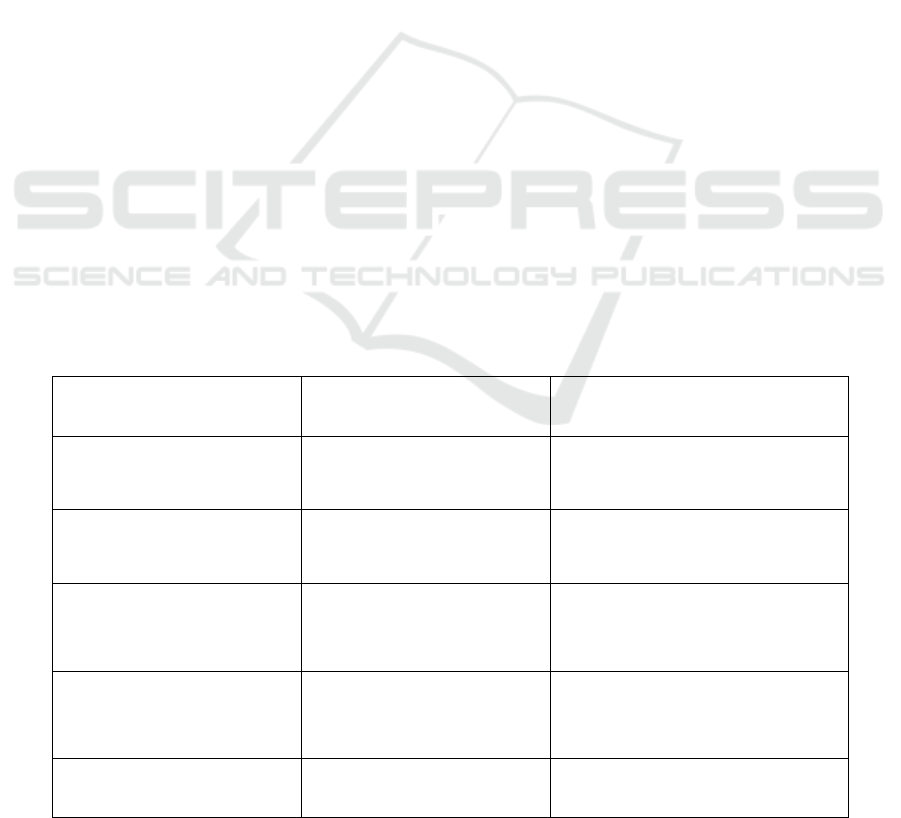
Table 1 gives the overall literature survey.
•
Table 1: Literature survey.
Study Focus Area Key Findings
Shrada P.Mohanty(2016)
Deep learning for plant disease
detection
High accuracy but real- world
challenges.
Toda T.Okura(2019)
Deep learning for plant disease
recognition.
Achieved 96.3% accuracy in classifying
13 plant diseases.
Boulent,J.; Foucher(2019)
CNN-based automatic plant
disease identification.
CNNs achieve high accuracy but require
diverse datasets for real-world ap-
plication.
M.V.V.R.S.Varma and
P.P.V.S.Reddy,(2019)
Advanced
convolutional neural
networks
Improved accuracy and efficiency in
disease classification
Arivazhagan S.,Newlin Shebia
R.(2019)
Texture-based plant dis- ease
classification.
Achieved 94.74% accuracy using
SVM classifier.
Real-Time Leaf Disease Detection and Fertilizer Recommendation System
865

3 METHODOLODY
3.1 Existing Model
• Visual Inspection - Visual inspection is the most
traditional and commonly used method to detect
plant leaf diseases, farmers and agronomists rely
on their expertise to identify symptoms such as
discoloration, necrotic spots, wilting, or
abnormal growth patterns. This method is cost-
effective and does not require specialized
equipment, making it accessible to small-scale
farmers. However, it is highly subjective, as
accuracy depends on the observer’s experience
and knowledge. In addition, visual inspection is
often limited to detecting diseases in advanced
stages when symptoms become evident, reducing
the chances of early intervention. Factors such as
lighting conditions, environmental stress, and
plant variety can also lead to misdiagnosis.
Furthermore, the presence of multiple diseases
with overlapping symptoms complicates the
identification. Although visual inspection
remains a valuable initial screening method, it is
increasingly being supplemented by technology-
driven solutions to improve accuracy and early
detection capabilities.
• Feature Extraction and Machine Learning:
Traditional methods involve segmenting leaf
images to isolate dis- eased areas, followed by
extracting characteristics such as color, texture,
and shape. These features are then used to train
classifiers like Support Vector Machines (SVM)
for disease identification. For example, a study
applied K-means clustering for segmentation
and extracted color features to train an SVM,
achieving significant accuracy in classifying
different plant diseases.
• Deep Learning Approaches: The integration of
Convolutional Neural Networks (CNNs) has
revolutionized feature extraction by allowing
models to learn directly from raw pixel data, thus
improving classification accuracy. A notable
study developed a CNN-based model capable of
diagnosing 26 unique plant diseases in 14 plant
species, achieving an accuracy of 98.14%. This
model was also integrated into a mobile
application, facilitating real-time on-field disease
diagnosis for farmers.
• Sensor based Technologies: Innovations in
sensor-based technologies have led to the
development of wearable devices for plants,
allowing early detection of stress signals such as
elevated levels of hydrogen peroxide H
2
O
2
.
These sensors, often designed as microneedle
patches, attach to plant leaves and monitor
H2 O, a signaling scaling the pixel values in the
range of 0 and 1, thus improving training
efficiency.
• Feature Extraction Using Pretrained Deep
Learning Models
• VGG16 and VGG19: The Deep convolutional
neural networks intended for image
classification. These models include an
increasing number of convolutional, pooled, and
fully connected layers. They were fine-tuned
with pre-trained weights using a data set of
leaf diseases. The last few layers will be
modified to support the binary classification, in
which two classes (healthy versus diseased) will
be treated.
• Inception v3 and v6: These models are more
complicated and perform better at obtaining
characteristics and generalizing models.
Inception networks have applied different sizes
of the convolutional kernel on all layers, thereby
enabling the model to capture features at different
ranges like VGG models, Inception v3 and
Inception v6 are also fine-tuned on the leaf
disease dataset to detect disease.
• Feature Extraction and SVM Classification
With the help of the VGG-16 and 19
models, these molecule indicatives of
environmental stressors such as dehydration,
excessive heat, infections, or pest attacks. By
detecting these biochemical changes before
visible symp- toms manifest, such as wilting or
discoloration, these devices provide real-time
alerts to growers, facilitating timely intervention
to mitigate potential crop damage. For example,
researchers have developed a wearable patch that
can detect stress signals in plants before visible
symptoms appear, allowing early intervention.
Furthermore, advances in Nano sensor
technology have allowed the real-time
monitoring of plant health by detecting H
2
O
2
signaling waves, providing deeper insights into
plant stress responses. These innovations
represent a significant leap toward precision
agriculture, improving crop management
practices, and potentially improving agricultural
productivity.
ICRDICCT‘25 2025 - INTERNATIONAL CONFERENCE ON RESEARCH AND DEVELOPMENT IN INFORMATION,
COMMUNICATION, AND COMPUTING TECHNOLOGIES
866

3.2 Proposed Model
• Dataset Collection and Processing:
A dataset is gathered consisting of images of healthy
and diseased leaves of various species. Open
datasets- like the Plant Village dataset- can be used
for this purpose; they contain labeled images for the
model to train on.
Data Augmentation: Data augmentation
techniques such as rotation, flipping, cropping, and
color changes increase the diversity of training
data and diminish the chance of overfitting. This
helps mimicking the actual world variance in leaf
appearance.
Image preprocessing: The collected image
data would first undergo resizing to account for
model input requirements from a ground-truth
perspective, for example, to 224x224 pixels.
Normalization allows general patterns are extracted
from images related to disease detection in leaves.
These models primarily help to capture hierarchical
patterns in the images, such as edges, textures, and
shapes. The output of the last few aforementioned
Conv-n layers is flattened and then used as input
features for the SVA learning model.
After features are extracted from the VGG-16
and VGG- 19 models, these features are given to the
Support Vector Machine SVM) classifier. SVM is a
supervised learning method that works by
identifying the hyperplane in the feature space that
best separates healthy and diseased leaf images.
The SVM model is fitted on the extracted features to
classify the leaf images as either” healthy” or”
diseased.”
Training the SVM: The SVM is trained with the
feature vectors extracted from the dataset.
Hyperparameters such as the kernel function (linear,
radial basis function, etc.), regularization
parameters, and so on will be optimized to maximize
the classification accuracy.
• IoT Camera Integration for Real-Time Image
Capture VGG Model for Feature Extraction
The VGG16 and VGG19 models will be utilized
to extract advanced features from the images. These
models are built to detect different levels of
features in the images, such as edges, textures,
and shapes, that are crucial for the identification
of diseases in leaves. The output of the last
convolutional layers is flattened and used as input
features for the machine learning model. Support
Vector Machine (SVM): This extracted feature is fed
into the SVM classifier. The SVM algorithm
functions by identifying the optimal hyperplane that
separates the two classes of healthy and diseased
images in the feature space. The trained SVM is
being trained on the extracted features to classify the
two classes of the leaf image as healthy or diseased.
Training the SVM: The extracted feature vector is
used to train the SVM, along with hyperparameters
such as the kernel function (for example, linear,
radial basis function, etc.) and also the regularization
parameters.
IoT Camera Hardware: IoT-enabled cameras are
developed to capture real-time leaf images in the
agricultural field. The images are processed by
connecting the IoT camera to a local server or a
cloud platform.
• User Interface for Image Upload and
Diagnosis Web interface design
To enable users (farmers, re- searchers, etc.) to
upload leaf images for disease diagnosis, a user-
friendly Web interface is created. The interface is
made using web technologies (HTML, CSS,
JavaScript) linked with a back-end server where
the disease detection model is hosted.
Image upload: Users can upload leaf images in a
variety of formats (JPEG, PNG, etc.) through the
interface. The uploaded image will be passed
through trained models to determine whether the leaf
is healthy or diseased.
Real-time diagnosis feedback: After image
processing is complete, the system will provide
feedback about the condition of the leaf indicating
that it is healthy or diseased along with possible
disease names, and will be given in real time by the
system. The system may also suggest actions or
treatments to be performed based on the detected
disease.
• Deployment and Testing
Model Evaluation: Standard performance metrics,
such as accuracy, precision, recall, and F1 score,
are used to evaluate the trained models (VGG16,
VGG19, In- ception v3, and Inception v6). Through
cross-validation, the trained models are proven to be
robust enough to withstand validation on various
datasets.
By enabling federation, users can join external
com- munities, share resources, and maintain open
lines of communication while still benefiting from
end-to-end encryption and administrative control.
This makes it an ideal choice for organizations with
distributed teams or multiple branches that require
secure internal and external collaboration.
System Testing: The whole system, including the
user interface and the IoT camera, is operated in
Real-Time Leaf Disease Detection and Fertilizer Recommendation System
867
real-time conditions so that the hardware interacts
with the users as required. These tests will include
uploading images to the Web interface, retrieving
feedback in real time, and examining the IoT camera
for disease detection accuracy.
Using Arduino and IoT Hardware Camera
Device to Capture Images for Leaf Disease
Detection: Integrating an IoT camera system with
an Arduino plat- form is a powerful way to capture
images for leaf disease detection in real time. This
setup allows for easy deployment in agricultural
fields or greenhouses. An Arduino- based device can
capture images of leaves and upload them to a server
or cloud for processing. Below is an overview of the
methodology for using Arduino with an IoT camera
for leaf disease detection:
IoT Camera Module Camera Module: The
camera module attached to Arduino is responsible
for capturing images of leaves. Popular camera
modules include
OV7670 Camera Module: A low-cost, simple-to-
use camera that can be interfaced with Arduino to
capture small images.
ESP32-CAM: An all-in-one solution with a built-
in camera, Wi-Fi capabilities, and low power
consumption, ideal for IoT applications.
Arducam Mini Module Camera: A high-
resolution camera that can be used for more detailed
image capture. The ESP32-CAM is an ideal choice
for IoT applications due to its built-in camera and
Wi-Fi capabilities, offering a compact and energy-
efficient solution. Alternatively, the OV7670 and
Arducam Mini provide options for different levels of
image quality and complexity, depending on the
application’s needs. So, we choose ESP32-CAM.
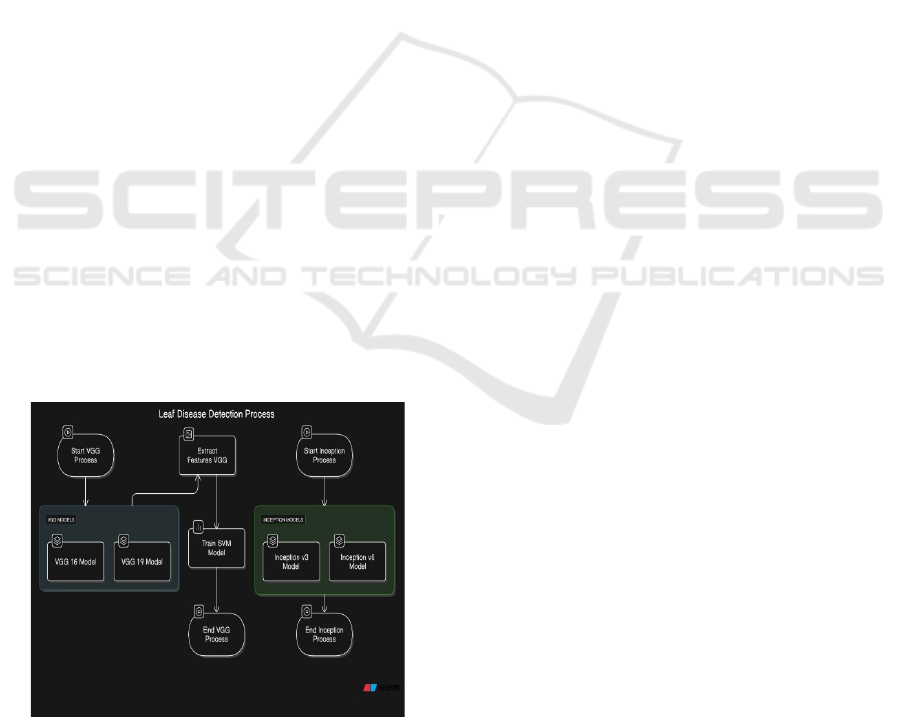
Figure 1: Block-Diagram.
Figure 1 illustrates a leaf disease detection
process that uses deep learning models for the
extraction and classification of characteristics. The
process begins with two parallel approaches: VGG-
based models VGG-16 and VGG-19 and
Inception-based models Inception V3 and Inception
V6. In the VGG pipeline, feature extraction is
performed using VGG models, followed by
training a Support Vector Machine (SVM) for
classification. Inception models process images
separately, but do not involve SVM training. Both
approaches operate independently and terminate
after their respective processes. This methodology
leverages deep learning for feature extraction while
integrating machine learning for classification,
enhancing the accuracy of plant disease detection.
Image Capture and Processing Flow Capturing
Images: The camera module captures images of the
leaves by triggering the Arduino to capture the
image using the camera. A button or sensor (such as
a light or motion sensor) can be used to trigger
image capture when a leaf enters the camera’s field
of view.
Sending Images to a Server:
Once an image is
captured,
it needs to be sent to a server or database
for analysis. The ESP32 can use its built-in Wi-Fi
capabilities to upload the image to a server, or it can
send the image via HTTP POST requests.
Image Processing and Leaf Disease Detection:
After the image is uploaded to the server, it is
processed using machine learning models like
VGG16, VGG19, or InceptionV3 to classify
whether the leaf is healthy or diseased. This can be
achieved by integrating a pre- trained model with a
Flask API to receive images and return predictions.
Secure Transmission via HTTPS: To ensure
privacy and prevent tampering, we implemented
HTTPS using a self- signed SSL certificate. The
Flask Web server was con- figured to encrypt image
uploads and model predictions, securing
communication between users and the server.
ESP32-CAM with Arduino: To integrate an
ESP32-CAM with an Arduino to capture images via
a web interface (providing an IP address and
allowing image capture directly through the
browser), you will need to set up the ESP32-CAM as
a web server.
In this way, users can access the camera’s web page
from a browser, where they can trigger image
captures and send them to a server or save them
locally.
Hardware
Software Requirements:
-
ESP32-CAM Module
ICRDICCT‘25 2025 - INTERNATIONAL CONFERENCE ON RESEARCH AND DEVELOPMENT IN INFORMATION,
COMMUNICATION, AND COMPUTING TECHNOLOGIES
868
-
Arduino IDE
-
ESP32 Camera Library
3.3 Install ESP32 Board in Arduino
IDE
Open Arduino IDE.
Go to Tools > Boards > Boards Manager, search for
ESP32, and install it.
3.4 Configure the Web Server Code
code to configure the ESP32-CAM as a web server
that will give you an IP address and allow you to
capture an image through a web interface.
3.5 Upload the Code to ESP32-CAM
On the ESP32-CAM while uploading the code (to
enter programming mode).
-
After uploading, restart the ESP32-CAM.
3.6 Monitor Output
Open the Serial Monitor (at 115200 baud) in the
Arduino IDE. Once connected to Wi-Fi, the ESP32-
CAM will print its IP address.
{
css
Connecting to WiFi... Connected to
WiFi
IP Address: 192.168.1.100
}
3.7 Accessing the Web Interface
Open a web browser and enter the IP address
displayed on the Serial Monitor. For example,
http://192.168.1.100/. The ESP32-CAM will capture
and serve a JPEG image of what the camera sees.
3.8 Capture Image
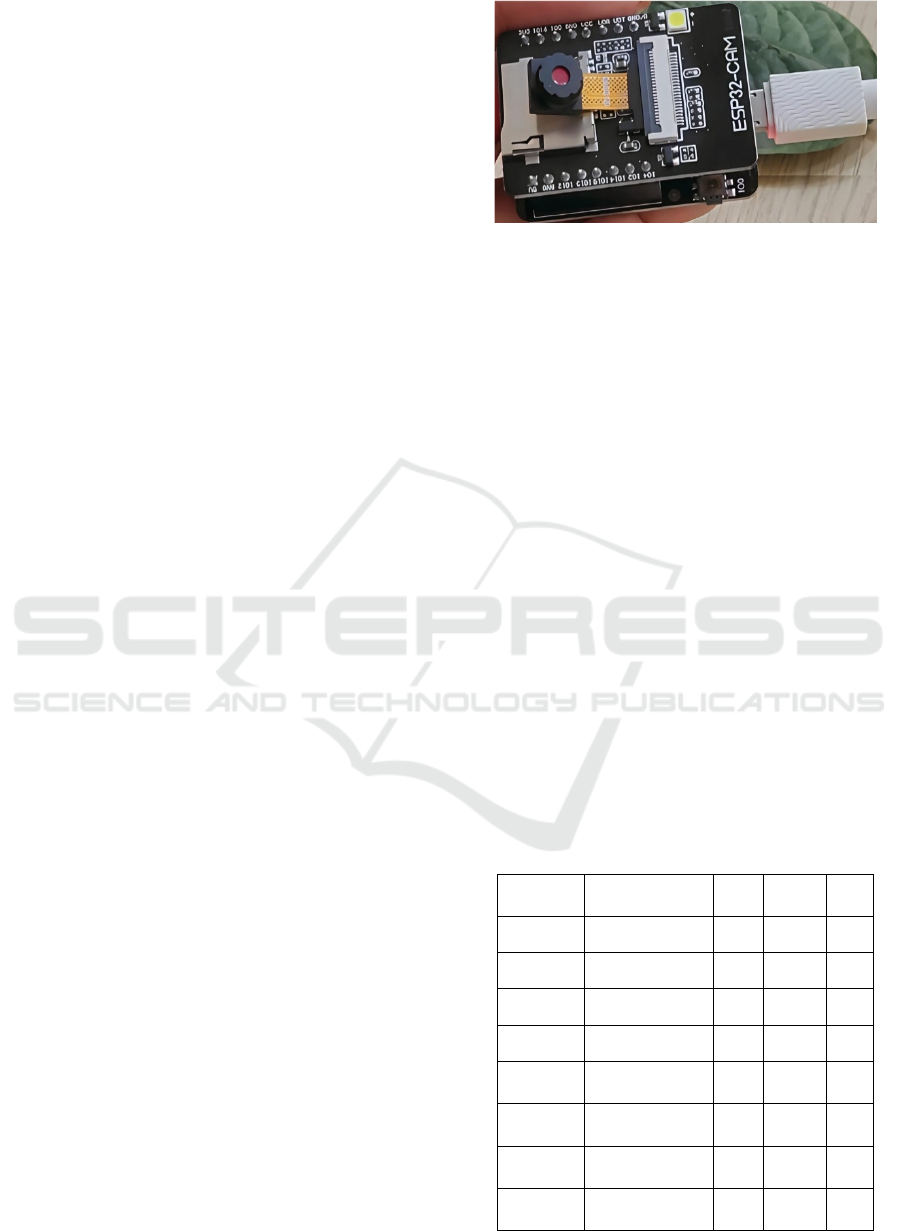
ESP32-CAM will capture images automatically and
from different angles. Figure 2 shows the camera
module.
Figure 2: IOT based ESP-32 CAMERA MODULE.
4 RESULTS AND DISCUSSION
The table compares the performance of deep
learning models (VGG-16, VGG-19, Inception V3,
and Inception V6) for plant disease classification
using different activation functions (ReLU, Sigmoid,
and Tanh). The accuracy and loss values were
obtained by training these models on various
datasets, such as the Fruit Dataset, Vegetable
Dataset, Healthy Dataset, and Diseased Dataset,
while fine-tuning the activation functions to assess
their impact.
In Table 2, VGG-16 and Inception V3
demonstrated superior performance, achieving peak
accuracy of 96% with Tanh, while VGG-19 and
Inception V6 showed relatively lower accuracy,
ranging from 68% to 73%, with higher loss values.
ReLU suffered from slightly higher loss, likely due
to the” dying ReLU” issue, while Sigmoid and Tanh
exhibited better gradient propagation, leading to
lower loss values, particularly in VGG-16 and
Inception V3.
Table 2: Fruit dataset- existing model.
Model
Activation
Function
ReLu Sigmoid Tanh
VGG 16 Accuracy 93 95 96
VGG 16 Loss 18 4 4
VGG 19 Accuracy 73 71 70
VGG 19 Loss 57 58 62
Inception
V3
Accuracy 92 94 96
Inception
V3
Loss 17 4 4
Inception
V6
Accuracy 68 73 72
Inception
V6
Loss 55 57 56
Real-Time Leaf Disease Detection and Fertilizer Recommendation System
869
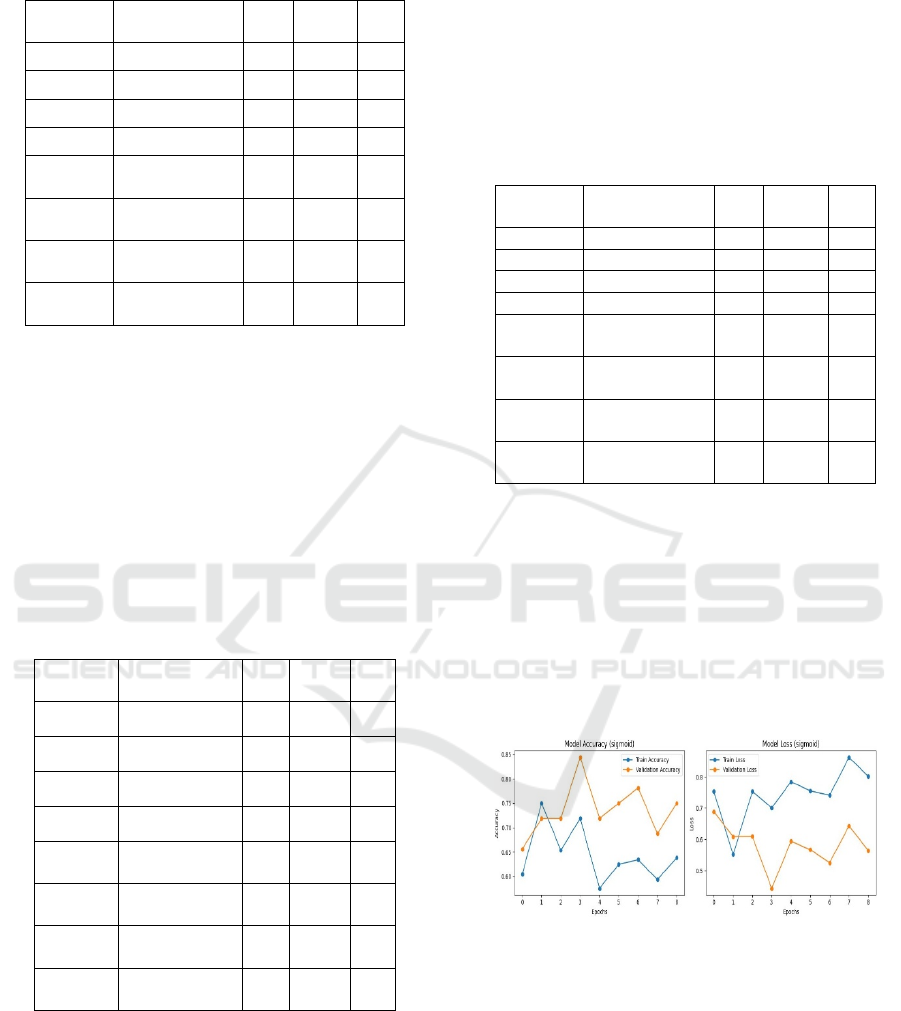
Table 3: Vegetable dataset- existing model.
Model
Activation
Function
ReLu Sigmoid Tanh
VGG 16 Accuracy 80 100 91
VGG 16 Loss 54 23 22
VGG 19 Accuracy 94 87 100
VGG 19 Loss 20 35 21
Inception
V3
Accuracy 93 93 93
Inception
V3
Loss 18 18 20
Inception
V6
Accuracy 93 92 92
Inception
V6
Loss 19 20 21
In Table 3, VGG-16 achieved a maximum
accuracy of 100% with Sigmoid, although its loss
remained slightly higher at 23 compared to Tanh’s
22. VGG-19 performed best with Tanh, reaching
100% accuracy while maintaining a lower
loss of
21. Inception V3 demonstrated consistent
performance across all activation functions, with
an accuracy of 93% and a minimal variation in loss
values between 18 and 20. Similarly, Inception V6
exhibited stable accuracy, hovering around 92–93%,
with slight fluctuations in loss values.
Table 4: Healthy dataset- proposed model.
Model
Activation
Function
ReLu Sigmoid Tanh
VGG 16 Accuracy 90 91 60
VGG 16 Loss 34 21 29
VGG 19 Accuracy 50 65 52
VGG 19 Loss 70 78 82
Inception
V3
Accuracy 70 69 64
Inception
V3
Loss 60 67 83
Inception
V6
Accuracy 72 65 66
Inception
V6
Loss 59 64 74
In Table 4, VGG-16 demonstrated the highest
accuracy with Sigmoid (91%) while maintaining a
lower loss (21), whereas its performance dropped
significantly with Tanh (60% accuracy and 29 loss).
VGG-19 showed moderate accuracy, peaking at
65% with Sigmoid, but suffered from high loss
values across all activation functions, with the
highest loss (82) recorded for Tanh. Inception V3
exhibited balanced performance, with ReLU
providing the highest accuracy (70%) and the lowest
loss (60), while Tanh resulted in lower accuracy
(64%) and the highest loss (83). Similarly, Inception
V6 performed best with ReLU, achieving 72%
accuracy with the lowest loss (59), whereas its
performance declined with Sigmoid and Tanh.
Table 5: Diseased dataset- proposed model.
Model
Activation
Function
ReLu Sigmoid Tanh
VGG 16 Accurac
y
93 70 95
VGG 16 Loss 25 25 17
VGG 19 Accurac
y
68 75 71
VGG 19 Loss 62 56 58
Inception
V3
Accuracy 69 61 68
Inception
V3
Loss 62 71 69
Inception
V6
Accuracy 64 72 64
Inception
V6
Loss 64 64 76
In Table 5, VGG-16 showed the highest accuracy
with Tanh (95%), while ReLU also performed well
(93%), while Sigmoid showed a significant drop
(70%). The loss values for VGG-16 remained low
across all activation functions, with Tanh achieving
the lowest loss (17). VGG-19 exhibited moderate
accuracy, peaking at 75% with Sigmoid, but
struggled with higher loss values, particularly with
ReLU (62).
Figure 3: VGG-19 Healthy.
Inception V3 showed relatively lower
accuracy, ranging from 61% (Sigmoid) to 69%
(ReLU), and had consistently high loss values, with
Sigmoid performing the worst (71). Inception V6
achieved its best accuracy with Sigmoid (72%) but
showed similar accuracy with ReLU and Tanh (both
64%), while its loss values were higher, reaching 76
with Tanh. Figure 3 shows the healthy statics.
The performance analysis of VGG-16, VGG-19,
Inception V3, and Inception V6 models across four
ICRDICCT‘25 2025 - INTERNATIONAL CONFERENCE ON RESEARCH AND DEVELOPMENT IN INFORMATION,
COMMUNICATION, AND COMPUTING TECHNOLOGIES
870
datasets—fruit, veg- etable, healthy, and diseased—
demonstrates variations in accu- racy and loss based
on activation functions. In the fruit dataset, VGG-16
and Inception V3 achieved the highest accuracy with
Tanh (96%), while VGG-19 and Inception V6
showed lower performance, with their best accuracy
reaching 73%. The vegetable dataset exhibited
strong performance, particularly with VGG-19 using
Tanh (100%) and VGG-16 using Sigmoid (100%),
indicating robust classification abilities. Loss values
in this dataset were also relatively low, signifying
stable training.
In contrast, the healthy dataset showed decreased
accuracy, with VGG-19 performing the worst (50%
with ReLU), and high loss values were observed,
particularly for VGG-19 and Inception models,
suggesting challenges in detecting healthy samples
accurately.
Figure 4: SVM Model for Healthy and Diseased Dataset.
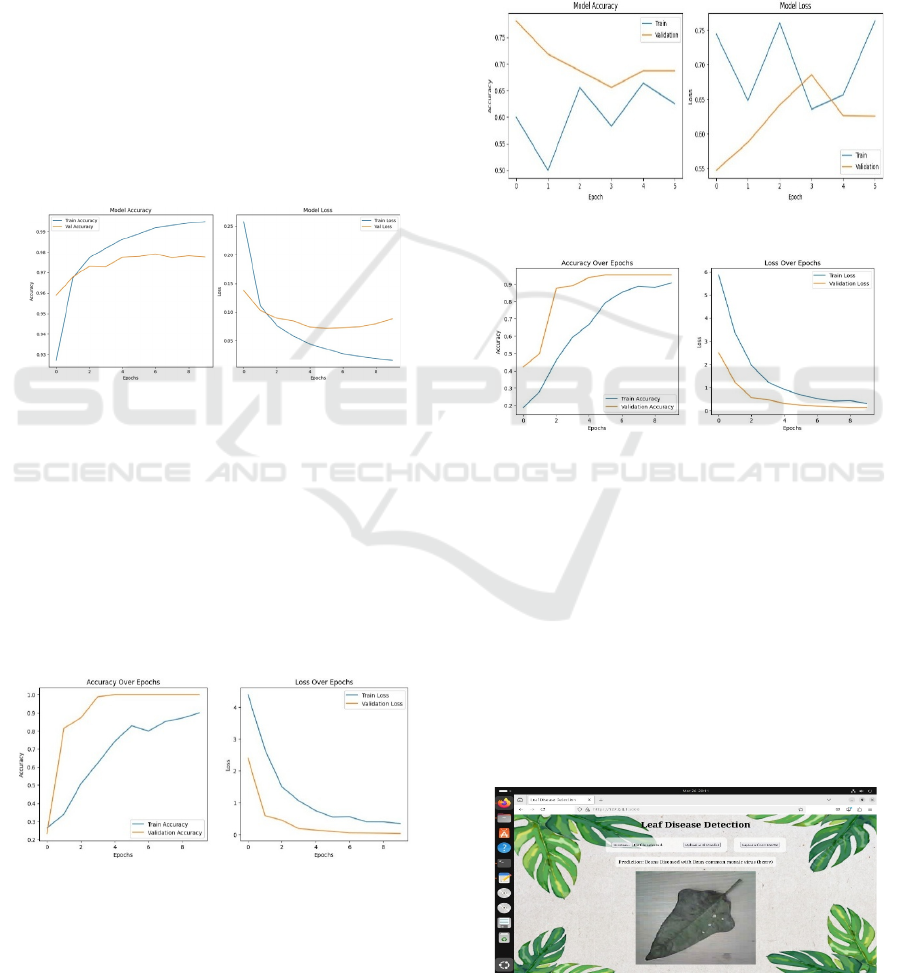
The accuracy and loss curves in Figure 4
illustrate the training performance of the proposed
model. The left plot shows a steady increase in
training and validation accuracy, reaching above
98%, indicating effective learning. The right plot
demonstrates a consistent decrease in training and
validation loss, with a minor gap suggesting minimal
overfitting. These results confirm the model’s high
generalization capability in plant disease
classification.
Figure 5: VGG 16 Healthy.
In Figure 5, the diseased dataset exhibited moderate
performance, with VGG-16 achieving the highest
accuracy of 95% using Tanh, while Inception
models struggled to exceed 72%.
Figure 6 illustrates the accuracy and loss trends
of the model across the training epochs. The left
graph shows training and validation accuracy
improving steadily, with validation accuracy
reaching near-perfect levels early on.
The graph on the right shows a steady decrease
in both training and validation loss, indicating
effective learning and highlighting the accuracy and
loss trends of the model across multiple epochs.
Figure 6: VGG 19 Diseased.
Figure 7: VGG 16 Diseased.
The accuracy graph in Figure 7, indicates
fluctuating training accuracy, while validation
accuracy declines, suggesting poor generalization.
The loss graph shows instability in training loss.
The implementation of HTTPS using a self-
signed certificate effectively encrypts
communication, preventing interception. HTTPS
conversion successfully encrypted data transmission,
preventing snipping and MITM attacks. Self-signed
SSL reduced costs, making it feasible for small-
scale applications and internal tools. Figure 8 shows
the user interface.
Figure 8: Secured Web interface detecting real-time leaves
through ESP-32 camera module.
Real-Time Leaf Disease Detection and Fertilizer Recommendation System
871
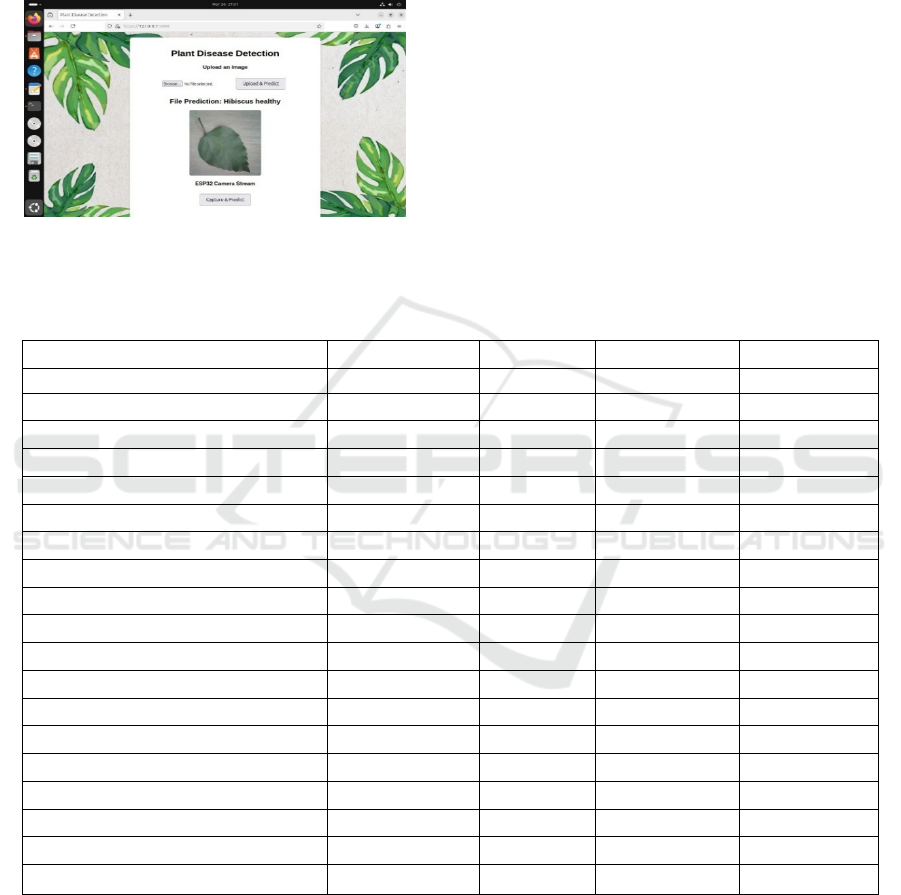
Once an image is uploaded or captured, it is
processed and classified as” Healthy” if no disease
symptoms are detected. The result is displayed on a
user-friendly web interface, with an option for
further analysis or expert consultation as shown in
figure 9.
Figure 9: Secured Web interface detecting leaf images
through Real-time Database.
In Table 6, it presents the classification
performance of the Support Vector Machine (SVM)
model on various plant dis- ease categories. The
model achieves an overall accuracy of 91%, with
macro and weighted F1-scores of 0.92, indicating
strong classification capabilities. While most classes
exhibit high precision and recall values, some, such
as Bottleguard Diseased (F1-score: 0.73) and
Tomato Diseased (F1-score: 0.75), show relatively
lower performance, suggesting potential
misclassification. The perfect scores (1.00 F1-score)
in several classes indicate effective feature
extraction and differentiation by the model.
Table 6: Classification Report on SVM.
Precision Recall F1-score Support
Beans Diseased 0.77 0.91 0.83 22
Beans Healthy 1.00 0.88 0.94 17
Blackgram Diseased 1.00 1.00 1.00 10
Blackgram Healthy 1.00 0.90 0.95 21
Bottleguard Diseased 0.57 1.00 0.73 16
Bottleguard Healthy 1.00 1.00 1.00 15
Brinjal Healthy 1.00 0.78 0.88 9
Brinjal Diseased 1.00 0.78 0.88 9
Greengram Diseased 1.00 1.00 1.00 12
Guava Healthy 1.00 1.00 1.00 15
Guava Diseased 1.00 1.00 1.00 8
Hibiscus Healthy 1.00 0.82 0.90 11
Jungle flower Healthy 1.00 1.00 1.00 17
Jungle flower Diseased 1.00 1.00 1.00 4
Rose Healthy 1.00 0.75 0.86 8
Tomato Diseased 1.00 0.60 0.75 10
Accuracy 0.91 204
Macro avg 0.96 0.90 0.92 204
Weighted avg 0.94 0.91 0.92 204
5 CONCLUSION AND
FUTURESCOPE
In this project, an integrated and comprehensive
system is developed for leaf disease detection using
advanced deep learning models such as VGG16,
VGG19, and Inception V3. This system aims to
achieve very efficient and accurate diagnosis or
detection of leaf disease based on the developed
ground of pre-trained Convolutional Neural
Networks (CNNs); this is done to classify healthy
ICRDICCT‘25 2025 - INTERNATIONAL CONFERENCE ON RESEARCH AND DEVELOPMENT IN INFORMATION,
COMMUNICATION, AND COMPUTING TECHNOLOGIES
872

plant images against those with diseases. Through
the integration IoT hardware (like the ESP32
camera), farmers and agricultural experts can shoot
leaf images and upload them for instant observation.
The model was trained with healthy and diseased
leaves across various datasets so that it could
generalize over several plant species. Transfer
Learning was applied, where we harvested the
power of the pre-trained layers from VGG and
Inception models, significantly reducing training
time and computation costs while ensuring desirable
accuracy. Additionally, optimization was done based
on performance, with machine learning classifiers
like SVM being used for better prediction
performance.
Additionally, the project considered the possible
deployment of the system on the cloud, so as to
leverage the platform’s scalability and global
accessibility, such that users from different parts of
the world can ultimately take advantage of the
leaf disease detection system available. An easy
interface design was done for seamless interaction
that would allow an easy image upload and feedback
on prediction. Also, steps to make the model
scalable are catered for with performance
optimizations in place, and this would further enable
the system to easily handle a large volume of
concurrent users with no significant performance
degradation at all.
Thus, this project has shown the possibility of
using deep learning, IoT, and cloud technologies to
radically change the methods of farm management
practices. Systems have now been developed that
provide automatic, accurate, organic, and efficient
leaf disease detection systems that would allow for
timely interventions and particular attention to crops
growing. Future work may include creating
comprehensive models encompassing multiple plant
species, improving real-time detection/dynamic
detection, and interfacing mobile platforms for more
wide accessibility.
REFERENCES
Mohanty, S. P., Hughes, D. P., Salathe´, M. (2016).”
Using Deep Learning for Image-Based Plant Disease
Detection.” Frontiers in Plant Science, 7, 1419. [DOI:
10.3389/fpls.2016.01419]
Toda, Y.; Okura, F. How Convolutional neural networks
diagnose plant disease. Plant Phenomics 2019, 2019,
9237136. [CrossRef] [PubMed]
Sladojevic, S.; Arsenovic, M.; Anderla, A.; Culibrk, D.;
Stefanovic, D. Deep neural networksbased recognition
of plant diseases by leaf image classification. Comput.
Intell. Neurosci. 2016, 2016, 3289801. [CrossRef]
Boulent, J.; Foucher, S.; The´au, J.; St-Charles, P.-L.
Convolutional neural networks for the automatic
identification of plant diseases. Front. Plant Sci. 2019,
10, 941. [CrossRef]
Al-Hiary H., S. Bani-Ahmad., M. Reyalat., M. Braik. And
Z. AlRahamneh. 2011. Fast and accurate detection and
classification of plant diseases. International Journal
of Computer Applications. Vol 17, No 1, pp 31-38.
Arivazhagan S., Newlin Shebia R. “Detection of un-
healthy region of plant leaves and classification of
plant leaf diseases using texture features”. Agricultural
Engi- neering Institute: CIGR journal, 2013. Volume
15, No.1
Hrishikesh Kanjalkar P. and Prof. Lokhande S. “Detection
and Classification of Plant Leaf Diseases using ANN”.
International Journal of Scientific Engineering
Research. 2013, ISSN: 2229 5518
Diseases Detection of Various Plant Leaf Using
Image Processing Techniques: A Review
https://ieeexplore.ieee.org/stamp/stamp.jsp?tp=arnumbe
r= 8728325
A Review of Machine Learning Approaches in
Plant Leaf Disease Detection and Classification
https://ieeexplore.ieee.org/stamp/stamp.jsp?tp=arnumbe
r= 9388488
Recent Technologies of Leaf Disease Detection
using Image Processing Approach A Review
https://ieeexplore.ieee.org/stamp/stamp.jsp?tp=arnumb
er=8275901
Simonyan, K., Zisserman, A. (2014). ” Very Deep Con-
volutional Networks for Large Scale Image
Recognition.” International Conference on Learning
Representations (ICLR), 1–14.
Szegedy, C., Liu, W., Jia, Y., Sermanet, P., Reed,
S., Anguelov, D., Erhan, D., Vanhoucke, V., Rabi-
novich, A. (2015). ” Going Deeper with
Convolutions.” Proceedings of the IEEE Conference
on Computer Vision and Pattern Recognition (CVPR),
1-9. [DOI: 10.1109/CVPR.2015.7298594]
Jayaraman, P. P., Poonkodi, P. (2019). ”IoT Based Plant
Disease Detection and Diagnosis System.”
International Journal of Innovative Technology and
Exploring Engi- neering (IJITEE), 8(7), 2422-2427.
Perez, L., Wang, J. (2017). ”The Effectiveness of Data
Augmentation in Image Classification using Deep
Learning.” Convolutional Neural Networks for Visual
Recognition, Stanford University.
Chollet, F. (2015). ”Keras: The Python Deep Learning
Library.” Journal of Machine Learning Research,
18(1), 1-6.
P. M. Gajendran, T. V. S. N. Chaitanya, and S. B. Ananya,
”Application of Deep Learning for Plant Disease
Classification,” IEEE Access, vol. 8, pp. 103984-
103993, 2020. doi: 10.1109/ACCESS.2020.2995856.
K. R. Shetty, S. A. R. Shariff, and A. M. Patil, ”IoT- based
Plant Disease Detection System Using Machine
Learning,” IEEE International Conference on
Computing, Communication, and Intelligent Systems
Real-Time Leaf Disease Detection and Fertilizer Recommendation System
873

(ICCCIS), pp. 16, 2020. doi:
10.1109/ICCCIS49118.2020.9194353.
A. T. K. Sahu, B. R. R. Roy, and S. Ghosal, ”A Deep
Learning Approach for Plant Disease Detection Using
Convolutional Neural Networks,” IEEE Transactions
on Industrial Informatics, vol. 17, no. 4, pp. 2741-
2748,2021. doi: 10.1109/TII.2020.3037629.
M. V. V. R. S. Varma and P. P. V. S. Reddy, ”Web-Based
Plant Disease Detection Using Convolutional Neural
Networks,” IEEE International Conference on
Advanced Networks and Telecommunications Systems
(ANTS), pp. 16, 2019. doi:
10.1109/ANTS46884.2019.8966549.
ICRDICCT‘25 2025 - INTERNATIONAL CONFERENCE ON RESEARCH AND DEVELOPMENT IN INFORMATION,
COMMUNICATION, AND COMPUTING TECHNOLOGIES
874
