
Constructing Identities Through Multimodal Design on Social
Platforms: A Case Study of WeChat Moments
Dongyan Chen
1
, Tongsihan Wang
2
and Shizhen Xu
3
1
College of Foreign Language, Guizhou University, Guiyang, Guizhou, 550000, China
2
College of Foreign Language, Hebei Normal University, Shijiazhuang, Hebei, 050024, China
3
School of Foreign Languages, Zhengzhou University, Zhengzhou, Henan, 450001, China
Keywords: Multimodality, Social Platforms, Visual Design, Identity Construction, Digital Identity.
Abstract: In the context of the rapid development of digital media, the application of multimodal discourse is increas-
ingly extensive and life-oriented, and social platforms are also becoming an important space for people to
showcase their self-image, where visual design plays a crucial role in user identity construction. This study
aims to combine dynamic multimodal discourse analysis with the perspective of identity construction to ob-
serve and analyze WeChat Moments, a dynamic social space, to reveal the dynamic process of users’ identity
construction. The research found that users often utilize multimodal discourse to construct a multidimensional
self. For instance, they evoke emotional resonance through images and text, establish a sense of group be-
longing, and gain recognition by performatively displaying their ideal self. This enriches applying applied
linguistics theory to daily life and offers feasible references to the construction of modern citizens’ identities.
1 INTRODUCTION
1.1 Background
In the realm of human existence, as Max Weber’s
concept implies, “Man is an animal suspended in
webs of significance he has spun” (Weber, M., 2002).
This suggests that individuals are constantly
endowing their actions and the information they
handle with meaning in engaging with the world. This
phenomenon has become even more pronounced
along with the rapid advancement of digital media.
People are no longer content with mere recording or
recollection; instead, the desire to use photographs for
self-expression has grown significantly (Berger, J.,
1972). Especially for college students who have
grown up with technology, maintaining an authentic
and engaging online persona is a continual and time-
consuming process (Stokes & Price, 2017). In terms
of the development of media, Günther Kress captures
precisely the essence by mentioning that digital
screens, with their unique interactivity and
immediacy, have changed the way people
communicate and interact. Traditional print media
have been forced to give way to their digital
counterparts. The evolution of media forms towards
multimodality not only means the superposition of the
visual logic when information is organized but also
heralds the innovation and optimization of
communication effects when resources are
intertwined. The application of multimodal discourse
offers people the opportunity to conduct abundant
visual design, thereby dynamically satisfying various
psychological needs behind self-identity
construction, interest-driven motivation, public
culture, or other factors. From a multimodal vantage
point, the visual designs of different user groups on
social platforms exhibit other functions,
characteristics, and patterns in identity construction.
1.2 Literature Review
O'Halloran pointed out that in different sociocultural
contexts, there are notable disparities in the visual
designs of different user groups (O'Halloran, 2006).
For the adolescent group, Tong Xin et al. analyzed the
construction of their digital identity model through
questionnaires. They concluded that there are four
influencing factors: “friendship-driven”, “new media
literacy”, “online public culture”, and “interest-
driven” (Tong, et al., 2020). For the college student
group, scholars have respectively conducted multi-
dimensional explorations and reflections from
different perspectives (Gan et al., 2022; Stokes &
Price, 2017; Yan & Han, 2024). There are adverse
aspects to the Social Networking Sites (SNS)
94
Chen, D., Wang, T. and Xu, S.
Constructing Identities Through Multimodal Design on Social Platforms: A Case Study of WeChat Moments.
DOI: 10.5220/0013965500004912
Paper published under CC license (CC BY-NC-ND 4.0)
In Proceedings of the 1st International Conference on Innovative Education and Social Development (IESD 2025), pages 94-99
ISBN: 978-989-758-779-5
Proceedings Copyright © 2025 by SCITEPRESS – Science and Technology Publications, Lda.

presentation of the self-online which can be mitigated
through meticulous guidance and judicious
approaches (Stokes & Price, 2017).
Ravelli and Van Leeuwen pointed out that in the
digital media era, there are three main research
directions in multimodal discourse analysis: first, re-
examining the multimodality of digital tools (Ravelli
&Van Leeuwen, 2018). Second, guiding frameworks
for new encoding methods; and third, critically
analyzing power and identity issues in multimodal
discourse, known as Multimodal Critical Discourse
Analysis (MCDA) (Wu & Zhao, 2022). The research
by Machin and Mayr laid the foundation for this field
by analyzing the choice of symbols in multimodal
discourse in advertisements and media publicity to
reveal the underlying values and identity
constructions (Machin & Mayr, 2012). Additionally,
Professor Li also conducted an in-depth exploration
of Kress and Leeuwen's contributions to visual
grammar and functional grammar, analyzing the three
major meanings, representation, interaction, and
composition, in multimodal discourse (Li, 2003).
This especially provided methodological guidelines
for this paper, such as image content analysis and
social semiotics analysis.
1.3 Research Topic
Based on the above significance exploration and
literature review, this section points out the research
gaps and challenges discovered during the study.
First, current multimodal perspective analyses have a
propensity to concentrate on static discourse and
social semiotic models, while research combining
dynamic discourse and identity construction remains
scant. The identities of users on social platforms are
dynamically changing and multi-constructed, making
it challenging for existing studies to fully capture and
explain this complex process. Second, research in this
field tends to zero in on isolated instances of
communication, with relatively few longitudinal
studies tracking identity construction across multiple
positions or over extended periods. Most studies
focus on multimodal discourse at specific moments or
single events, without sufficiently considering the
evolution of user identities across different social
contexts and periods. Furthermore, data analysis of
dynamic multimodal discourse becomes complicated
due to factors such as contextual diversity and
individual user differences, making corpus
processing more challenging. In qualitative analysis,
researchers need to accurately interpret the implicit
meanings of users from different cultural
backgrounds and social strata in dynamic multimodal
discourse, requiring multidisciplinary knowledge
such as intercultural communication and sociology.
In quantitative research, the unstructured and
complex nature of dynamic multimodal data makes it
difficult to establish effective quantitative indicators
to measure the relationships between modes and their
impact on identity construction.
In this regard, this study focuses on the identity
construction of visual design in social platforms
under the multi-modal perspective, taking WeChat
Moment as an example to conduct in-depth
exploration. In China, WeChat Moment provides rich
materials for the study of user identity construction,
owing to its easy operation, strong popularity, and
high authenticity and naturalness. In-depth research
on the identity construction of users in a more private
social platform not only helps to reveal how
individuals show themselves, interact with others,
and build social relations through video design in the
digital age but also provides an empirical basis for
understanding the mechanism of multi-modal action
in a social context. Through the analysis of user
behavior patterns, content presentation, interaction
mode, and other aspects in the circle of friends, this
paper will gain insight into how users use multi-
modal resources to build multidimensional identity
images, as well as the social and psychological
motivations behind such identity construction. The
final research results can provide valuable references
for the design and optimization of social platforms,
users’ self-presentation strategies, and theoretical
development in related fields, and promote the further
application and expansion of multimodal discourse
analysis.
1.4 Research Objectives
This paper aims to apprehend the manifested behavior
patterns of WeChat users in the Moments and analyze
their personalized identity construction. By
integrating the findings of others regarding related
psychological needs, we endeavor to probe into users’
social interaction mechanism and internal motivation
in the social network from a micro perspective. From
a macro level, this research also commits to capturing
the extrinsic manifestations of users’ behavior
patterns and identity construction in a naturalistic
context. Through the whole process, we hope that
certain empirical data and corpus support can be
provided. Ultimately, the relationship between digital
identity and real identity will be combined and
summarized to obtain more universal laws and
explore practical significance.
Constructing Identities Through Multimodal Design on Social Platforms: A Case Study of WeChat Moments
95

2 RESEARCH DESIGN
2.1 Sample Selection
In the highly information-oriented era where
meanings abound, how do people weave their identity
nets? Based on the view that communication is the
transmission and understanding of meaning, this
article regards the use of media as a bridge for
communication (Robbins, S. P., & Coulter, 2017).
The reason for choosing WeChat Moments as this
bridge is based on the comprehensive consideration
of the following factors.
Firstly, the simplicity of the operation of WeChat
Moments makes it stronger applicability across areas
of interest and age groups in China. WeChat and its
Moments have become essential communication
tools for people of all ages in China, so the selection
of this research object has a broader coverage and
relatively stronger representativeness. Next, the
relative authenticity and naturalness of Moments.
Different from international social platforms like
Facebook and Sina microblog, such a small circle of
participants (the presenter and the viewer) is limited
to people who have added each other as “friends” or
contacts, making users' behaviors and expressions
closer to real-life scenarios. The data generated in this
natural state can more accurately reflect users' states,
giving the research results higher credibility and
practical application value. This also points to the
third point, the high update frequency of Moments.
Due to its relative privacy, those pieces of Moments
content tend to be more spontaneous, natural, and
close to life. The reveal of people’s everyday lives
also can be seen at different time points, which
facilitates longitudinal research and allows for
tracking of the dynamic change process of users’
identity construction. Moreover, from the perspective
of research itself, Chinese researchers can relatively
easily obtain a large amount of original data without
the need for additional equipment support.
2.2 Research Methodology
This study opts to thoroughly examine the objective
data by applying literature research methods,
observational methods, and case study methods to test
the applicability of the theories.
Focusing on visual design in WeChat Moments,
relevant literature and documents were sought
through channels such as China National Knowledge
Infrastructure (CNKI) and the Wanfang Database.
These materials then were analyzed selecting theories
related to the topic to explain the viewpoints, thereby
providing a sufficient theoretical foundation for this
study. After determining the topic, the author
conducted observations on the collected WeChat
Moments and classified the data over the past three
months. The posts were divided into seven types: pure
text, pure image, video, pure link, text plus image,
text plus video, and text plus link. These were then
tabulated to provide reliable data sources for the
research.
Simultaneously, the author imported their
WeChat address book into an Excel spreadsheet via
the “WeChat Extraction Tool” program and utilized
the “Index” and “Randbetween” functions inherent in
Excel to identify the college student users within the
address book. Subsequently, five college students
were randomly selected as specific cases, and their
Moments content over three months was observed
and analyzed to explore the specific ways in which
they construct certain identities.
Additionally, the researchers consulted relevant
interview cases from the database, with the interview
content concentrating on the manners in which users
present themselves and the motivations for
concealing in Moments. Thereby, all the above
facilitated a better understanding of the psychological
processes of users when using Moments.
3 RESULTS AND DISCUSSIONS
3.1 Content Analysis
Analyzing the Moments of five college students, we
found that the components are mainly divided into the
following 5 types: content, form, interaction mode,
language style, and update frequency (Table 1). In the
book The Presentation of Self in Everyday Life,
Goffman argues that speech and behavior in everyday
life are a kind of performance, a specific performance
in one particular situation (Goffman, 1959).
Similarly, taking the Moments of five college
students randomly into consideration, it can be found
that users will act toward their ideal selves when
making social interactions on this platform. The
concrete ways of identity construction are depicted in
Table 1, which demonstrates how users selectively
share diverse content. Getting beyond such surfaces
as travel experiences, trending news, campus life, and
hobbies, it can be revealed that users shape various
identities such as travelers who enjoy life, thinkers
who care about society, and students who actively
participate in activities. By publicly presenting
IESD 2025 - International Conference on Innovative Education and Social Development
96
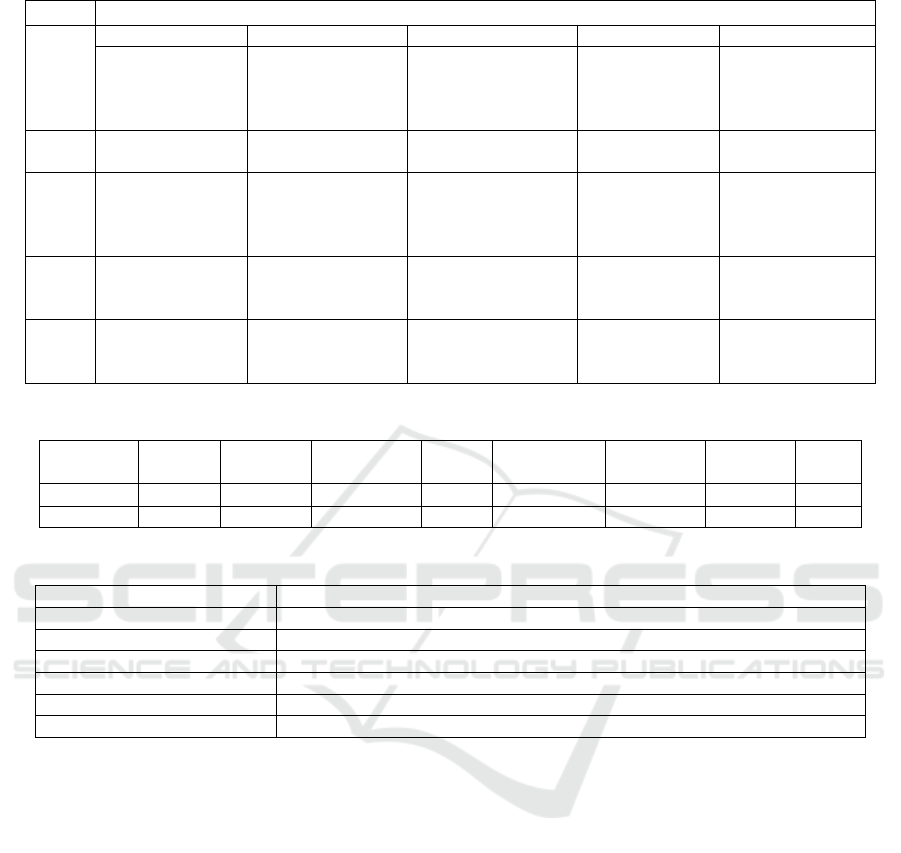
Table 1: Composition of the Moments of five college students in three months.
Users
Elements of the Moments
User A Content Format Interaction Language style Update frequency
Mainly campus life
and tourism
Landscape or selfie
plus text, text plus
emoji, video plus
text
Mainly by
replying
to comments
lively, humorous Two to three
updates per week
User B Mainly on love
to
p
ics and hobbies
Selfie plus text with
emo
j
is
Directly
@
someone
lively and relaxed One or two updates
p
er wee
k
User C Mainly to share
campus activities.
Send a hyperlink or
event poster with the
appropriate text and
emoji.
Encourage others to
leave comments in
the comment section.
Passionate Irregular updates
User D Mainly sharing
travel experiences
and books.
Scenery plus text,
pure text
Mainly by replying to
comments
Literary and
Artistic
One or two updates
per week
User E Mainly to share
subject knowledge
and news
Send hyperlinks, a
few with text, rarely
use emo
j
is
Take the initiative to
express your views in
the comment section
Rigorous Irregular updates
Table 2: Self-presentation content of WeChat users.
Type Text-only
Image-
onl
y
Small video
t
yp
e
Pure
lin
k
Text -image
t
yp
e
Text-video Text -link total
Quantity 223 120 21 136 808 84 116 1508
Proportion 14.79% 7.96% 1.39% 9.02% 53.58% 5.57% 7.69% 100%
Table 3: WeChat users’ discursive practices to construct interactional identity.
Discursive Practice Characteristics
Self Autonomous,
p
ersonalized, diversified, contextualization
Text Immediate, expressive, emotional
Rhetoric Antithesis or parallelis
m
, comparison, exaggeration
Cite the practice Interactive feedback, emotional resonance, and seeking responses
Comment Behavio
r
Praise, have fun, critical evaluation.
Exchan
g
e of information Timeliness, interactivit
y
, d
y
namics
photographs, videos, or hyperlinks (User C and User
E), with humorous, enthusiastic, or encouraging
words, users display their personalities and ideal
qualities intentionally or unconsciously. Furthermore,
the degree of social activeness and interpersonal
network-building skills also are exhibited via several
interactive ways, like comment sections. The control
of the frequency of posting also reflects their strategy
of striking a balance between their ideal self and their
real self which is constructed in cyberspace, to create
a credible self-image on social media to gain respect
and recognition in social networks.
According to Table 2, the survey users are more
inclined to use the conjunction of text-image
(53.58%), text-only (14.79%), and pure link (9.02%)
to construct their self-identity. This shows that
multimodal discourse can help users maintain their
self-image from multiple dimensions such as story
description, opinion statement, and emotional appeal.
It can be seen that under the interaction of multiple
visual resources, users can construct a three-
dimensional and multi-faceted identity for
themselves, and its dynamic nature can also promote
interaction between individuals.
According to Tables 2 and 3, this study analyzed
content and form to ascertain that the synchronic
logic of images can assist users in eliciting the
audience’s emotional resonance and interactive
participation. At the empirical level, images that tell
a story are called Narrative Representation because
they represent the world in the form of actions and
events (Kress. & Leeuwen, 2020). The characteristics
of its different discourse practices can be seen in
Table 3, and on digital platforms such as Moments,
narrative presentation exhibits greater autonomy,
dynamism, and interactivity due to its multimodal
form. The red-dotted head portrait in the interface,
when any added friend posts a new piece of Moment,
and the number of messages in the comment section,
are both updates in real-time, giving users an
Constructing Identities Through Multimodal Design on Social Platforms: A Case Study of WeChat Moments
97

omniscient perspective on the real-time status of their
friends. At the level of interpersonal meaning, users
can promptly respond to others’ information through
instant transmission of information, and interact with
the changes of identity in different scenarios to
construct a clearer identity and group category.
3.2 Case Analysis
Based on the combing and analysis of the above
relevant literature and data results, the following will
carry out specific analysis ideas from an empirical
perspective, and we choose the WeChat Moment of a
Chinese female graduate as an example. This is the
text content:
“I felt like I have lived an ideal life, and after a
busy week, I ate hot pot with my pretty sis [tearful
emoji]! There are cute pets, and every day after
coming to Beijing is very felicitous [tearful emoji].
From time to time, I am shocked and often secretly
rejoiced that such a beautiful, gentle, and intelligent
girl is willing to like me so much [tearful emoji]!”
The accompanied picture content (a total of 9
photos) comprises 3 female photos, 4 photos of hot
pot and gifts, and 2 screenshots of chat history. The
analysis is as follows: Firstly, interpersonal meaning
can be achieved by constructing a sense of
participation, power relations, and a particular modal
tone. While the user’s text expresses her appreciation
and esteem for a female friend, two of the pictures
then show their chatting history and their group
photo. This combination especially gives this female
friend a strong sense of participation and interactive
experience, and the two modalities also confirm each
other's authenticity. In addition, the user exhibited the
first-person food photos through the live feed, which
presented the theme of “eating hot pot together” (also
“ideal life” and “very felicitous”) to the audience.
From another perspective, according to the
experiential function of language, which refers to the
expression of language to people's various
experiences in the real world (including the inner
world), it can be found in the empirical sense that the
user not only uses images of various scenes (diet and
working performance) to conduct the narration but
also uses words to express her reflection of life:
“busyness and concentration are hallucinogens with
curative effects” (from the user’s next WeChat
Moment content) (Hu et al., 2005).
Judging from the data, users tend to use
multimodal forms such as the combination of images
and texts to construct identities, and different
presentation methods correspond to different
pragmatic identity expressions, so it is no wonder that
Mirtsov lamented that images are not just a part of
life, but life itself (Tan, 2015). From the case study,
the behavior of users in the WeChat Moments can be
found consistent with Goffman's self-presentation
theory (Goffman, 1959). To a certain extent, it is
performed in the orientation of the ideal self to obtain
the recognition of others and self.
4 CONCLUSIONS
From a multimodal perspective, this study concludes
that the identity construction of users in WeChat
Moments is multidimensional and dynamic. It
analyzed how users use visual design to construct a
multidimensional self and ideal self, clarifying the
underlying behavioral motivations and influences.
However, compared to the initial research objectives,
this study has not entirely reached the ideal state. The
following outlines several limitations for future
researchers to continue improving upon.
Initially, one limitation lies in the sample
selection. This study only selected five university
students as specific case study subjects, of which the
small quantity made it limited to young people. Thus,
it cannot fully represent users of different ages and
social backgrounds, nor reflect the overall identity
construction of social platform users.
Additionally, in terms of research depth, although
this study mentions that sociocultural and
interpersonal contextual factors influence identity
construction, how these complex factors (like cultural
and psychological factors) specifically affect the
identity-construction process remains superficial and
insufficient. If a broader theoretical study could be
expanded, the conclusions of this study would be
clearer and more accurate.
Furthermore, the implementation of research
methods is also partially restricted by technical levels
and periods. The effect of observational methods may
be influenced by the inevitable subjective
comprehension of the researchers, as different
researchers might have different interpretations and
judgment standards of WeChat Moments content,
which will affect data objectivity and accuracy. A
three-month observation period may not
comprehensively encompass the long-term changes
and stability of user identity construction.
Given all these above, this study sees a rich
potential for combining multimodal fields with
identity theory. Therefore, we encourage and expect
the academic community to conduct broader and
deeper discussions on this topic. Related scholars
may consider expanding the sample range, including
IESD 2025 - International Conference on Innovative Education and Social Development
98

users of different ages, professions, regions, and
cultural backgrounds, to jointly build a widely
representative sample library. Furthermore, an
interdisciplinary research method is recommended to
be employed. Integrating sociological, cultural
anthropological, and psychological research
outcomes, helps to deeply analyze the mechanisms of
identity construction. Certainly, more precise
analysis of related corpora requires more advanced
data analysis technologies, to better handle the
complexity of multimodal data and deeply reveal the
intrinsic relationship between digital identity
construction and multimodal visual design. In
summary, we hope this study can inspire the
academic community to generate novel insights and
embark on new explorations on the limitless potential
of digital media and functional linguistics in everyday
life.
AUTHORS CONTRIBUTION
All the authors contributed equally and their names
were listed in alphabetical order.
REFERENCES
Berger, J., 1972. Ways of Seeing. London: BBC and Pen-
guin Books.
Gan, Q., Liu, K., & Gan, L., 2022. Construction of College
Students' Digital Identity. Comparative Study of Cul-
tural Innovation, (16), 60-64.
Goffman, E., 1959. The Presentation of Self in Everyday
Life. Garden City, N.Y.: Doubleday.34-51.
Hu, Z. L., Zhu, Y. S., & Zhang, D. L., 2005. Systemic Func-
tional Linguistics. Perking University Press.
Kress, G., & Leeuwen, T.V., 2020. Reading Images: The
Grammar of Visual Design (3rd ed.). Routledge.
Li, H., Wu, Y, X., 2023. Research on Visual Patterns of
WeChat Moment Posters Based on Scene Interaction
Theory. Art Science and Technology, 36(3):188-191.
Li, Z. Z., 2003. Social Semiotic Approach to Multimodal
Discourse. Foreign Language Studies, 20(5):1-8.
Liu, X., 2020. Research on the Pragmatic Identity Construc-
tion of College Students in WeChat Moments. Hunan
University of Technology, (02).
Lv, X., & Wang, J. C., 2019. Research on the Mechanism
of Visual Addiction in Social Networks: An Example
Based on WeChat Moments. Modern Communication
(Journal of Communication University of China) (12):
97-100.
Machin, D., & Mayr, A., 2012. How to Do Critical Dis-
course Analysis: A Multimodal Introduction. London:
SAGE Publication.
O'Halloran. & K. L., (Ed.). 2006. Multimodal Discourse
Analysis: Systemic-functional Perspectives. Blooms-
bury Publishing.
Ravelli, L., & Van, L. T., 2018. Modality in the Digital Age.
Visual Communication, 17(3): 277-297.
Ren, X. Y., 2019. A Study on the Identity Construction of
WeChat Users’ Discursive Practices, Shanxi University.
Robbins, S. P., & Coulter, M. 2017. Management. China
Renmin University Press.
Stokes, J., & Price, B., 2017. Social Media, Visual Culture,
and Contemporary Identity. International Multi-conf.
on Society, Cybernetics and Informatics (11
th
). IMSCI:
https://www. Is. org/CDs2017/CD2017Summer/pa-
pers/EA876TF. pdf.
Tan, S. M., 2015. On the Graphic Landscape in Self-Editing
Messages in WeChat Moments. Media Observer
(10),41-42.
Tong, X., Hui, L. H., Hui, X. M., Du, F., Wang, Y. W., 2020.
Digital Identity Modeling for Adolescents in the New
Media Environment. Press Outpost, (02):65-67.
Weber, M., 2002. The Protestant Ethic and the “Spirit” of
Capitalism: and Other Writings. Penguin.
Wu, Y. X., & Zhao, X. F., 2022. Multimodal Discourse
Analysis in China: An Annual Review of the 2021 Re-
searches. Discourse Studies Forum (02),151-164.
Yan, G. H., & Han, S., 2024. Digital Identity: Constructing
and Rethinking the Symbols of Virtual Survival of
Youth Groups. China Youth Study (06),44-51.
Zhou, T., 2018. Research on the Self-Presentation in
WeChat Moments. Chongqing University.
Zhou, Y. N., Liu, D. Q., & Sun, L. N., 2024. Presentation
and Invisibility of the Self: A Study of the Phenomenon
of Burnout in the Use of the WeChat Moments. West
China Broadcasting TV (11),71-75.
Constructing Identities Through Multimodal Design on Social Platforms: A Case Study of WeChat Moments
99
