
Multimodal Reading and Writing Design Analysis of English
Audiovisual Learning in The Context of The Digital Age and Its
Utilization and Impact Research: Take the Little Red Book
Platform as an Example
Hanyu Ma
Department of Language Engineering, Kunming University of Science and Technology, Kunming, Yunnan, 605500, China
Keywords: Multimodal Reading, Red Book Platform, Digital Age.
Abstract: With the rapid development of electronic science and technology, the learning of English visual and visual is
gradually integrated into multimodal resources. This article takes the Little Red Book platform as an example
to analyze its multimodal resource design, utilization and influence in English visual and learning. Through
qualitative research methods, combined with case analysis and interview methods, the influence and utiliza-
tion of multimodal learning resources on the learning effect of learners in Little Red Book are discussed. The
study found that although multimodal resources bring rich learning, there are also problems such as infor-
mation overload and insufficient depth of learning resources. Finally, the article puts forward suggestions to
optimize the multimodal learning resources of the Little Red Book platform to help learners better use digital
media to improve learning results.
1 INTRODUCTION
With the advent of the information age, digital media
is more and more widely used in English visual
learning. The new media environment uses digital
means to integrate various media forms such as
sound, data and images. With the help of
communication, radio, telephone, television,
computer, mobile or terminal server and other
equipment means, it realizes the communication
forms of two-way and multi-way reception,
broadcasting and dialogue. New media is closely
related to information transmission, thought
formation, literary expression, and the development
of language communication ability. Without the
existence of new media, there would be no exchange
of modern culture (including thought, literature and
language) (Li, 2020). Modal is the matching
resources used in communication, such as text,
images, charts, written language, body language, etc.
Media is the material medium used by people to
communicate, such as books, cards, multimedia
blackboards in the classroom, etc. There is an
intrinsic connection between the modal and the
media. Multimodal is the way people use more than
two symbolic resources to communicate (Yuan,
2012). The inner volume brought by the tide of the
times makes people tend to invest in short-term
learning to get exponential learning results. In today's
society, teachers are encouraged to implement
multimodal teaching methods in the classroom;
students also like multimodal learning methods and
like to use multimodal resources (video, audio) to
promote the learning of course content. Digital
multimodal tools are inseparable from students'
language learning experience (Li, 2020). In Little Red
Book, there is usually an English listening "daily
practice", in which pictures, text and audio are
grouped into a video, which can only be continued
after punching in every day, forming a level-style
learning mode. Rich reading and writing design
patterns and color matching make the learning
content easier to understand. Multi-modal resources
bring a lot of convenience and a lot of interest. The
effect of multimodal resources has brought many
impacts to learners. Visually, it can enhance the
understanding of the content, reasonable typesetting,
and color layout are more conducive to learners'
reading; in terms of language, good language use can
improve the accuracy of understanding and affect the
learning progress; emotionally, the multi-modal
design style is unique and novel, which can enhance
the emotional interaction with learners, and also
evoke Enthusiasm and curiosity about learning
Ma, H.
Multimodal Reading and Writing Design Analysis of English Audiovisual Learning in The Context of The Digital Age and Its Utilization and Impact Research: Take the Little Red Book Platform
as an Example.
DOI: 10.5220/0013965300004912
Paper published under CC license (CC BY-NC-ND 4.0)
In Proceedings of the 1st International Conference on Innovative Education and Social Development (IESD 2025), pages 83-87
ISBN: 978-989-758-779-5
Proceedings Copyright © 2025 by SCITEPRESS – Science and Technology Publications, Lda.
83

(Zhong et al., 2024). However, there is also a very
important problem in the multi-modal resource
teaching mode. The multi-modal teaching resources
of Little Red Book are redundant. This digital
medium has bait-type point method, "title party" and
other information. Although there are community
conventions that restrict certain titles on the Little
Red Book platform, it also guides users to abide by
and persist. However, it also ignores the "title party"
notes of users who do not comply with the convention
and call themselves "title party" in the comment
section. Little Red Book still needs to strictly manage
such events (Liu & Mao, 2024). Secondly, most of the
learning resources are simple content. There is no
professional word book, no in-depth academic
research, and it cannot cover all the content of English
visual learning. In the face of many existing
problems, some learners can transform the new media
into their learning and entertainment tools in a "tame"
way to avoid the negative impact of the new media
(Li & Gou, 2023).
Based on the information age, this article aims to
study the utilization and impact of the design of
multimodal resources on English visual and visual
learning in the digital media "Little Red Book". This
article will be based on the advantages, disadvantages
and effects of reading and writing design analysis of
multimodal learning resources, so as to distinguish
what kind of multimodal learning resources are
available and referenced by more learners. So that
multi-modal teaching resources can better become a
resource utilization platform for visual learning and
better serve learners.
This article first analyzes the learning trend in the
current information age and how students use digital
media to learn. Secondly, I wrote about the
application of multi-modal resources in learning,
which is a very important point. Multi-modal
resources have a wide range of applications in
learning, which can provide video, pictures, text,
audio and other resources. Page layout and reading
and writing design are also very convenient for
students to learn. Finally, the impact of learning in the
digital age on learners is studied, which is the closest
point to reality.
2 RESEARCH METHODS
This paper selects the method of qualitative research,
and uses case analysis and interview methods to
analyze the multi-modal reading and writing design
of multi-modal English visual and speaking learning
in the context of the information age and its utilization
and impact research - taking Little Red Book as an
example for analysis and research.
2.1 Sample Selection
Little Red Book APP is a digital medium covering
many resources. It is a lifestyle platform and
consumption decision-making entrance for young
people. It is also the birthplace of an important life
trend for young people, attracting a wide range of
users. At present, Little Red Book has more than 200
million users and continues to grow. Little Red Book
is chosen because of information sharing. Information
publicity has achieved the effect of pure green in the
APP. Both the exporter and the input of information
resources can conveniently obtain the information
they need.
2.2 Interview Method
A total of 6 students were interviewed for about an
hour. In order to protect the personal information of
the respondents, the real name will be changed to
letters. The gender, study experience, school and
grade of the selected students are all different, (see
Table 1 for the student's background).
Before starting the interview, the author made an
interview outline, which roughly includes the
following 7 questions. (See Table 2)
Table 1: Interviewee Information Table.
Student Sex Grade School Major
A Girl Senior Two Kunming No.1 Middle School Physical and chemical life
B Bo
y
Junio
r
Kunmin
g
Universit
y
of Science and Technolo
gy
En
g
lish
C Girl Junio
r
Kunmin
g
Universit
y
of Science and Technolo
gy
Thai
D Girl Junio
r
Kunming University of Science and Technolog
y
English
E Girl Sophomore Kunming University of Science and Technolog
y
International Trade
F Boy Senior Kunming University of Science and Technolog
y
English
IESD 2025 - International Conference on Innovative Education and Social Development
84
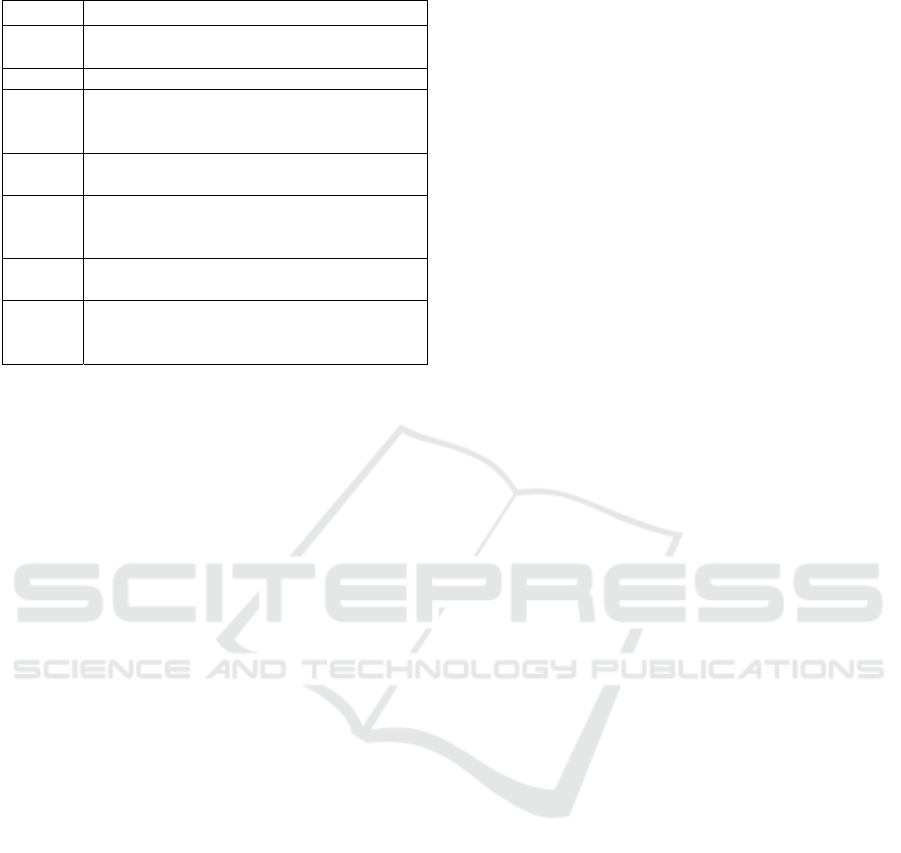
Table 2: Interview Outline Table.
Number Questions
1 Do you think you use Little Red Book
fre
q
uentl
y
in the learnin
g
p
rocess? Wh
y
?
2 How do you use the Little Red Book APP?
3 What kind of English visual and visual
learning knowledge do you often use Little
Red Book to search for?
4 How do the multimodal learning resources in
Xiaohon
g
Book affect
y
our current learnin
g
?
5 Do you think the multimodal English visual
and visual learning resources in Xiaohong's
b
ook are highly available? Why?
6 Do you think we can fully absorb the learning
resources in the Little Red Book?
7 What do you think are the advantages and
disadvantages of using digital media to assist
learning?
3 INTERVIEW RESULTS
3.1 Features of Little Red Book APP
3.1.1 Little Red Book APP Has a Variety of
Multimodal Learning Resources
E-learning has become an increasingly important
learning and teaching mode, and is also an efficient
and effective way of learning. The development of e-
learning emphasizes the necessity of communication
and interaction (Gros & García, 2023). Multimodal
learning can bring learners a better learning
experience and gain a sense of immersion; it also
enables learners to participate in learning with a
positive attitude and improve their learning attitude;
learners can carry out multimodal input and output in
it, generating positive emotional feedback (Hu &
Feng, 2024). Little Red Book helps students majoring
in English to find suitable practice methods and
resources for themselves, clearly practice the correct
steps of listening and speaking, and use multi-modal
design to improve learning efficiency. When learners
can't find the resources to practice English listening
and speaking, they can search for "English Speaking
Practice" and "English Listening Practice" in the
search bar of Little Red Book APP. Its search results
are as follows: categories include comprehensive,
material, app, dialogue, follow-up reading, italic,
American, fun dubbing, short Articles, topics, videos.
These are comprehensive categories, and learners can
choose according to their personal needs; there are
also videos covering the original text, dubbing and
video animation; daily shadow reading, shadowing;
ten minutes of practicing into authentic spoken
English videos every day; there are also oral
resources of line books + video + audio; there are also
all-English and American Vlog; there are also audio-
visual courses for foreign teachers (video format);
adhere to morning reading (graphic and text format).
These resources all exist in the Little Red Book APP.
The above-mentioned types of multi-modal learning
resources show in detail the greatness of digital
media, and even fill in the missing learning flexibility
in the learning textbooks. The integration of learners
and multimodal learning resources can better predict
learning outcomes and help learners explain complex
learning processes (Cukurova, Giannakos, &
Martinez, 2020)
3.1.2 Little Red Book Has a Strong and
Convenient Fast Retrieval Ability
The Little Red Book APP can help solve the detailed
knowledge that is not easy to understand in English
textbooks and official learning websites. At the same
time, it also solves the problem that learners who
learn English according to different purposes can
quickly understand the direction of knowledge
search. When learners encounter knowledge they
don't understand, they can search for keyword bars on
the Little Red Book APP. For example, if they don't
understand English and American accents, there will
be bloggers of American accents and English accents
to help learners distinguish the search results; there
will also be different types of videos, pictures and
texts to assist in explanation, and can help quickly
Understand. When learners prepare for IELTS and
TOEFL, they enter the Little Red Book APP to search
for "English IELTS Listening" and "English IELTS
Speaking Practice", and the following results will
appear: Himalayan English Listening Materials,
China Daily English News, 8,000 English Speaking
Sentences, BBC Wear English, World Celebrity
English Literature speech, TED, IELTS listening
APP, IELTS speaking APP; TOEFL listening 10 sets
(audio + questions + listening text), TOEFL must
listen · blog, TOEFL home test, etc. In terms of search
engines, Little Red Book presents the characteristics
of content richness and content depth; secondly, it
also strengthens the emotional resonance with users
and improves the interest; search engineization is a
new media phenomenon, which provides
convenience for users of the Little Red Book platform
(Yan, 2024). The Little Red Book APP can provide
learners with a wide range of learning resources and
learning points. Using the multi-modal resources in
the Little Red Book APP, it can solve learners'
Multimodal Reading and Writing Design Analysis of English Audiovisual Learning in The Context of The Digital Age and Its Utilization
and Impact Research: Take the Little Red Book Platform as an Example
85

learning problems or help learners get out of learning
difficulties.
3.2 Interview Results
3.2.1 Use in The Scene
Through the interview, it was found that learners
generally use the Little Red Book APP when they
don't know English sentence patterns and words,
because there are incisive answers in the Little Red
Book platform, as student E said:
"I think it makes my English learning more
convenient. There are sentence patterns that I don't
understand, the sentence composition is not clear, and
the words will be searched by the Little Red Book
APP. The content given is very useful. As the main
subject of English in high school, Little Red Book
APP has built a good platform for our English
learning, given us learning methods, and even helped
students with a very simple teaching method to
facilitate memory, which not only relaxes the body
and mind, but also gains knowledge." (Student E)
Through the interview, it was found that college
students usually use the Little Red Book APP in the
scenario of writing speeches and making PPTs.
Because there are many ready-made resources on the
Little Red Book platform, as student D said:
"There are too many multi-modal learning
resources in the Little Red Book APP. As a college
student, I think it is very convenient. When writing a
speech, the Little Red Book APP has a lot of phrases
and examples for us to make convenient use. When
the teacher asks for a PPT presentation, the Little Red
Book will provide a lot of templates, themes, and
even Some classmates will buy ready-made books in
Little Red Book. Whether it is the multi-modal
learning resources or commercial learning materials
covered by the Little Red Book APP, they all make it
convenient for college students to learn, but also
make people lazy." (Student D)
3.2.2 Impact
Through the interview, it was found that some people
think that using the Little Red Book APP for learning
also has limitations and negative effects. As student
C said:
"I heard that the Little Red Book APP is very
popular before. After trying it myself, I think that
although the Little Red Book covers a wide range of
content, it does not cover a lot of advanced
knowledge taught by the professor, and some of it can
only be learned well. Therefore, the Little Red Book
APP only has an auxiliary role in some of my
superficial learning content, and it does not have a
comprehensive positive impact. (Student C)
Through the interview, it was found that some
people feel that using the Little Red Book APP to
learn can have a beneficial impact. As student F said:
"I have been using Little Red Book since my
sophomore year. Personally, I think Little Red Book
is a very good resource sharing platform. In terms of
learning, it is also enough for a college student in
humanities and social sciences. Two years of use have
taught me a lot of knowledge, and also made me
depend on it, which has a very good impact on my
study, even Review materials and examples of past
papers make my study very convenient. (Student F)
3.2.3 Frequency of Use
Through interviews, it was found that some people
only sometimes use the Little Red Book APP to learn,
and they use it less frequently. As student A said:
"After I go home after a day's class, I sometimes
use the Little Red Book APP to search for the types
of questions I don't understand. There are posts in
Little Red Book that will teach me how to do
questions. There are also different problem-solving
methods in the comment area, so that I can have a
reference when doing questions. But I found that part
of it was right and part of it was wrong, which was
the opposite of the order taught by the teacher. I
adopted the method taught by the teacher." (Student
A)
Through interviews, it is found that some people
always use the Little Red Book APP to learn, and the
frequency of using it is very high. As student B said:
"I will enter Little Red Book from time to time
during class, because I feel that my study is
inseparable from Little Red Book. Many learning
resources, listening audio, and word induction are
ready-made. Not only that, but when doing
homework, I will also use the little red boo
k to
collect some necessary content. (Student B)
4 DISCUSSION
The survey shows that the Little Red Book APP is
very popular when students study, and students at all
stages are using it. However, the multimodal learning
resources in the Little Red Book APP have not been
applied to the extreme. The main reason is that the
mechanism of the Little Red Book itself sends 3,000
yuan, and any learning content will be pushed wildly
when it hits the same search content, among which
IESD 2025 - International Conference on Innovative Education and Social Development
86

there is no book basis and no official verification;
secondly, the students have different levels and
narrow knowledge. In the face of the Little Red Book
APP, there are many colors and interesting Learning
resources will inevitably be untenable, which
eventually leads students to blindly use the useless
knowledge points and mistakenly pointing students to
the wrong side. In fact, more feedback is a good
review of the Little Red Book APP. Students all
understand and love to use this software. On the
contrary, there are also many shortcomings. This
article believes that both the exporter and the input
side should take necessary measures, and should be
refined according to the actual situation.
5 CONCLUSION
This research aims to analyze how students who use
the Little Red Book APP for academic improvement
can effectively extract multi-modal learning
resources that are beneficial to themselves, and
analyze the reading and writing mode and impact of
multi-modal English visual learning resources on
students. Multimodal learning resources are an
important topic in the information age. However, at
present, there are few studies on multimodal learning
resources, and the impact of multimodal learning
resources on the visual and visual of learning English
at various stages has not been fully explained. In view
of this, this article focuses on the research of multi-
modal English visual-visual learning resources,
provides a new perspective and a new framework for
multi-modal resource research, and investigates the
feelings and usage patterns of some students. Looking
to the future, we can conduct in-depth research on
multi-modal resources targeted by multiple types and
disciplines, supplement the shortcomings of the
current research on multimodal learning resources,
and also compare the similarities and differences
between the views of users and non-users learned by
Little Red Book APP.
For the extraction of multi-modal English visual
and visual learning, this article solves some of the
problems that can correctly extract learning
resources; but at the same time, there are also certain
limitations in this study, such as the fact that the
number of interviewees in this article is too small,
only six people, and the identity of the interviewee is
limited, which cannot represent all people; in the
future The study will expand the sample size and the
scope of the sample to solve this problem.
REFERENCES
Cukurova, M., Giannakos, M., & Martinez-Maldonado, R.
2020. The promise and challenges of multimodal learn-
ing analytics. British Journal of Educational Technol-
ogy, 51(5): 1441-1449.
Gros, B., & García-Peñalvo, F. J. 2023. Future trends in the
design strategies and technological affordances of e-
learning. In Learning, design, and technology: An inter-
national compendium of theory, research, practice, and
Policy (pp. 345 to 367). Cham: Springer International
Publishing.
Hu, H.L., & Feng, R., 2024. Research progress and trend of
multimodal learning: interdisciplinary perspective. Hei-
longjiang Higher Education Research, (06): 148-154.
Li, M., 2020. Multimodal pedagogy in TESOL teacher ed-
ucation: Students' perspectives. System, 94, 102337.
Li, W. Y., & Guo. Y. F., 2023. Will the new media affect
the learning participation of college students? - Analy-
sis of "domemed media" college students. Modern Dis-
tance Education (06): 84-94.
Li, X. H., 2020. The effective application of new media in
foreign language learning. Educational Theory and
Practice (27), 53-55.
Liu, Y., & Mao, C., 2024. Analysis of the phenomenon of
"title party" on the Little Red Book platform. New Me-
dia Research, (02):96-100.
Yan, W. Y., 2024. Research on the phenomenon of "search
engineization" of Little Red Book from the perspective
of media availability theory. New Media Research (16):
76-78+97.
Yuan, Q. X.,2012. Research on Multimodal Discourse
Analysis and English Writing Teaching (Master's The-
sis, Zhangzhou Normal University). Master.
Zhong, J. H., Wang, B., & Wang, G. L., 2024. Research on
the English reading effect based on the theory of multi-
modal discourse analysis. Journal of Social Sciences of
Jiamusi University (04): 191-194.
Multimodal Reading and Writing Design Analysis of English Audiovisual Learning in The Context of The Digital Age and Its Utilization
and Impact Research: Take the Little Red Book Platform as an Example
87
