
Exploration and Analysis of the Contemporary Chinese Art Activism
as an Intervention in Urbanization
Rui Zhou
Humanities, Arts and Social Sciences, The University of Queensland, Brisbane, Australia
Keywords: Urban Intervention, Public Art, Contemporary Art, Urbanization, Chinese Art.
Abstract: China’s rapid urbanization and market-oriented reforms resulted in localized socio-political issues while
redefining the image of world power. The ideological shift during the social transformation creates an
experimental era for art interventions and cultural practices. This article maintains that artistic production
serves as a means to understand, interact, and critique the transformation of urban spaces, contributing to
responding and addressing the challenges suffered by citizens and the nation. Focusing on the perspectives of
common people, socio-economic and physical geographies inequality, and nation branding during the urban
revolution, this article examines the expressions of artistic activism in China reflect on the issues arising from
urban space development. Adopting phenomenological approach and action research methods, it considers
artworks as manifestations and mediums for the narratives of residents and social discourse identities, thereby
interpreting the potential of cultural strategies as form of deconstructing contemporary urban issues in China
amidst social and environmental change.
1 INTRODUCTION
The implementation of reform and opening-up in
China coincided with the influx of international
capital driven by neo-liberalism and economic
globalization in the 1980s, which accelerated the
rapidity of urbanization (Tam, 2020). These top-
down social transformations reshaped the living
environment of citizens and emerged as subject of
public political or cultural imagination,
reconstructing ethnography within the national
context (Wang, 2015).
Nevertheless, national socioeconomic
transformation imposes the popular masses to surfer
throes and confusion (Mirra, 2020). Urban
development has shaped a volatile environment of
mobility, where citizens confront anxieties of
dislocation and alienation in the shifting time and
narratives, which interact with trans-local and social
texts, ultimately influencing nation-building
(Valjakka & Wang, 2018).
In response, local artists who concern for new
urban aesthetics concentrate on socially
underprivileged people, disappearing historical land
spaces, as well as the marginalization of national
image identity resulting from an atomized society,
utilizing artistic creative expressions as a means to
perceive, interpret, and address the dilemmas of
urbanization (Jiang, 2020).
This article focuses on contemporary Chinese
artists who have background shaped by the impacts
of urbanization and possess an urban consciousness,
exploring how their creation of locality to
deconstructs and applies the concept of urbanization
through diverse materials, forms, and multimedia
installations to construct narrative discourse that
supports underprivileged social groups negotiate
visibility and address structural issues (Zhang, 2020).
Furthermore, the article discusses the significant role
of artistic practices in reshaping and promoting
Chinese cultural identity and nation branding along
an unprecedented path of development.
2 METHODOLOGY
This article adopts phenomenological approach and
action research methodology, exploring how Chinese
artists are voicing diverse groups and issues while
dealing with the juxtaposition relationship between
contemporary urbanization and artistic production.
The phenomenological approach emphasizes that
abandons the preconceived theoretical frameworks,
aiming to objectively employs participatory attitude
Zhou, R.
Exploration and Analysis of the Contemporary Chinese Art Activism as an Intervention in Urbanization.
DOI: 10.5220/0013962400004912
Paper published under CC license (CC BY-NC-ND 4.0)
In Proceedings of the 1st International Conference on Innovative Education and Social Development (IESD 2025), pages 35-40
ISBN: 978-989-758-779-5
Proceedings Copyright © 2025 by SCITEPRESS – Science and Technology Publications, Lda.
35

to describe the phenomena and experiences generated
by the research subjects (Cissé & Rasmussen, 2022).
Moreover, the action research involves investigating
strategies and effectiveness of problem-solving
practices within real social situations (Wright, 2015).
Thus, this article is based on cultural activism and
combines the quantifiable and intangible contexts
within urban revolution, analyzing phenomena
generated by aesthetic production as a method of
urban intervention and the subjective experiences of
social groups. Consequently, this study examines the
cultural phenomena and interventions generated
through artistic works in individual, land, and
national image. It aims to demonstrate the possibility
of art as a vehicle for addressing public issues and
engaging with utopian dreams, reimagining the
symbiotic interdependence between humans and city.
3 THE ARTISTIC EXPRESSION
ABOUT MIGRANT WORKER
IN THE CHINESE
URBANIZATION
The restructuring and expansion of industries during
urbanization attracted large-scale flow of rural-urban
migration, resulting in the conflicted spatial
concentration of population and production (Lu,
2011). Confronting with the unfamiliar exploitative
and elitist value systems in cities, migrant workers
with limited cultural and economic resources endure
discrimination, and marginalizing as ‘superfluous
people’ (Grube, 2020). In response to the polarized
laboring environment of this transitional period, local
artists employ art interventions, including
photography, installation, and performance art, to
create spaces for dialogue and resolution, thereby
concerning with and revealing the destruction and
disruption experienced with the migrant population in
their lives of excluded from the right to the city (Qi,
2023).
As the economic focal point of urbanization
policies, the growing demand for industrial
transformation in the Pearl River Delta facilitates an
influx of rural populations into the development
zones to serve as cheap labour and rendering them to
objectified individual (Tam, 2020). The consumerist
environment which detached from individual lived
experiences exacerbates tensions between
marginalized citizens and the modernized imagery of
urban clusters (Yu, 2020).
Liang Juhui, who is a member of the Big Tail
Elephant Working Group from Guangzhou, created
the experimental performance artwork One-Hour
Game (1996) within a moving construction lift at the
Sinopec Towers (figure 1), to highlight the exclusion
and alienation suffered by migrant laborers as the
objects of urbanization (Lin, 2018). In the
photographic documentation, Liang dresses the blue
uniform and safety helmet, which symbolize worker
image, and crouches within the narrow confines of the
elevator grille while playing the video game Battle
City (1985). Over the hour-long performance, the
workers’ elevator, which represented the prison
imprisoning the identity of rural migrant laborers
embodied by Liang, moved up and down the
expansive urban construction landscape following the
predetermined rhythms of the building process (Wu,
2010).
Liang Juhui’s artistic practice integrates the
artist’s body with urbanism materials as medium for
expression. This approach appropriates the repetitive
work scenes associated with urban construction to
reveal and examine the monotony of laborers lived
conditions. By employing sharp contrasts, Liang
metaphorically represents the impoverished lives of
migrant laborers trapped within the urbanized context
through his own powerless portrayal in the elevator
(Tan, 2015). The video game symbolizes the nipple
entertainment culture in lower tier market, which is
utilized by marginalized individuals for distraction
and escapism from the harsh realities of life.
Furthermore, this work offers a illustration of
human alienation in the context of industrial
urbanization (Merlin, 2018). The elevator operation
is confined to two-dimensional vertical motion,
lacking the capacity transport in other directions. The
juxtaposition of the wide-angle city skyline with the
restrictive and mechanical operations of the elevator
emphasizes the sense of powerlessness and absurdity
encountered by rural migrants, who find themselves
with nowhere to turn under the dominant narrative of
urbanization.
The identity issues faced by migrant workers and
other margins of the cities and invisible residents
linked to the processes of urbanization, which led to
the dismantling of neighborhoods and the rural
landscape. Thus, Chinese artists who engage with
rural predicaments connect their bodies with the land
and environment, adopting performance art to
articulate the loss of emotion associated with land.
IESD 2025 - International Conference on Innovative Education and Social Development
36
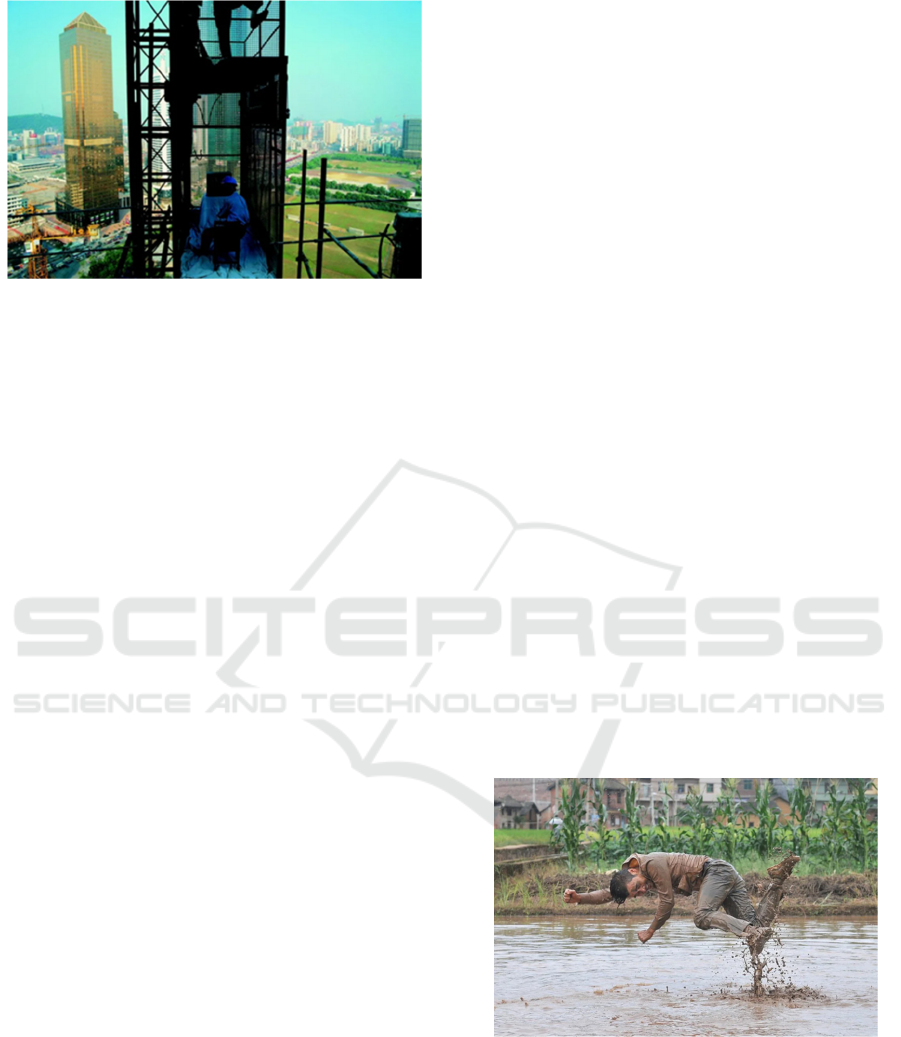
Figure 1: Liang, J. H. One Hour Game.
4 THE GEOGRAPHICAL
ARTISTIC EXPRESSION IN
THE CHINESE URBANIZA-
TION
The crucial topic in urbanization is the appropriation
of rural land. The uncontrolled expansion of urban
property industries misappropriated the rural lands
and traditional buildings, resulting in the deprive of
collective memory and the hollowing out of
community culture (Wang, 2015). As a result of
construction development by real estate companies or
local authorities, the dwellings of villagers are
squeezed and destroyed (Mirra, 2023). They are
compelled to migrate to the cities while living space
and collective memories are deprived. The art
professionals who concentrate on sacrificed
geographical spaces connect the avant-gardism of art
with the social issues surrounding encroached rural
land, forming a manifestation of social intervention
and engagement (Wang, 2018).
The joint exhibition, Land, created by Li Binyuan
and Zhang Huan, transcends the limitation of single
geographical area. The artists adopt physical and
performative art form to represent the intrusion of
rampant urbanization into rural environments,
thereby interpreting the emotional connection
between people and land. In Chinese culture,
farmland is regarded as the root, representing the
foundation of traditional civilization relations and life
primal agency (Yu, 2020). Nonetheless, the
dichotomy between city and countryside engendered
by urbanization resulted in farmland being regarded
as a sacrifice to industrialization. This condition
dissolves collective memories for root and
disintegrates the traditional attachment to the
countryside.
In the Freedom Farming, Li Binyuan integrates
phenomenology and activism, manifesting his own
body as a farming tool. This innovative form with the
farmland to creates a venue of emotional resonance
and connection for the audience. The two-hour film
initiates with a shot of the Certificate of Land issued
by Dahankou Village in Hunan, symbolizing the
encroachment and reshaping of rural land belief under
urbanization policies. In the observation of his family
and the neighborhoods of the village, Li repetitively
jumps up and down on the moist soil on his deceased
father’s farmland (figure 2). The video end in him
collapsing into the muddy water, vomiting from
exhaustion and becoming a part of the paddy field
(Oredsson, 2019). Li Binyuan’s artistic languages,
characterized by suffering and stressful, incorporates
affective expediences and responds from audiences
into the performance, creating an interactive
phenomenological expression. His Sisyphean
mechanical jumps allegorically represent fragile
plight of farmer forced to leave their familiar rural
context due to the enduring long-standing
implications of urbanization, continuously oscillating
within the urban environments (Shi, 2022). However,
Li Binyuan’s ultimate action of submerging himself
in the muddy field metaphor aspiration of villager
long for return pastoral textures in traditional Chinese
agricultural structure. The Free Farming employs
sensible representation to visualizes the emotional
relationship and identity of farmers marginalized by
economic reform, reposing localized feelings of
displacement and offering dialogue site for citizens to
reconceptualize traditional life in villagescape.
Figure 2: Li, B.Y. Freedom Farming.
Furthermore, Zhang Huan utilizes a dark humor
performance to reveal the relationship between the
individual needs and the collective narratives in land
reform. In the phonographic work To Raise the Water
Level in a Fish Pond, Zhang Huan, who carry a child
on his shoulders, stands naked with forty temporary
migrant workers in a pond located in Beijing Park.
Exploration and Analysis of the Contemporary Chinese Art Activism as an Intervention in Urbanization
37
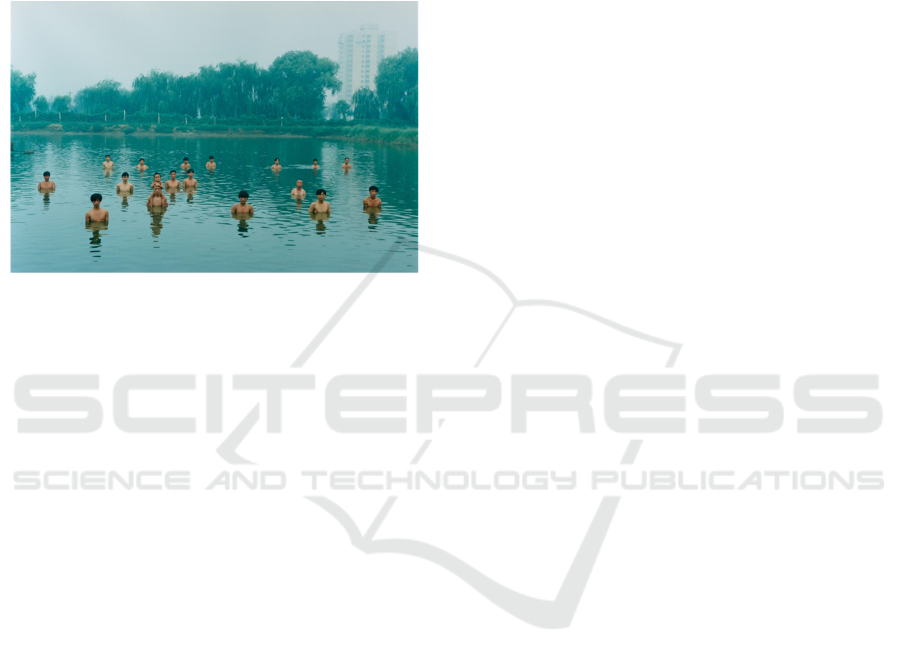
They gaze impassively beyond the viewfinder frame
of the camera in the scene of portrayed in a cold and
lime green palette (figure 3). Through this
orchestrated collective performance in the water,
Zhang transforms the pond into a space for
experiencing the natural landscape, metaphorically
reflecting the pollution and destruction of aquatic
environments resulting from urbanization (Lin,
2020).
Figure 3: Zhang, H. To Raise the water Level in a fish pond.
Additionally, Zhang Huan attempts to raise the
water level of the pond by one centimeter through the
collective effort of strangers. This activism of
intervention emphasizes the potential for microscopic
individual freedom and power for resistance within
the macroscopic ideological transformations and
influence. Nevertheless, the tragedy of the ethical
concern image stems from the futility of the action, as
the water level remains unchanged despite the
individual efforts. Instead, the participants, who are
depicted as powerless citizens, experience the
exploitation of societal transformation’s relentless
waves within the icy waters of the pond (NASHER,
n.d.). With urbanization accelerates, the self-
awareness and subjective meaning of individuals
appear insignificant. Zhang’s performance art
critiques and reflects on the inevitable harms of
urbanization, aspiring to establish an alternative
aesthetic imaginary for migrant workers and general
public.
The individual contexts that emerged during
China’s sociopolitical transformations evolved into
structural issues on societal scale, accompanying
challenges impact on the construction and recognition
of the national overall image. Artists who are aware
of the diminish of national imagination within highly
industrialized urban spaces seek to incorporate the
visual vocabulary of traditional art history into the
process of urbanization. They aspire to create
channels for cultural dialogue and perception
between citizens and the nation through balancing
modernity with a traditional aesthetic narrative.
5 THE ARTISTIC EXPRESSION
ABOUT THE NATIONAL IDEN-
TITY IN THE CHINESE UR-
BANIZATION
Top-down industrial development disrupts urban
cultural landscapes and public spiritual space,
resulting in the national identity crisis (Marinelli,
2015). In comparison with the Chinese flourishing
international stature in framework of public
diplomacy, the cultural identity of the citizens
presents signs of fatigue (Hu, 2023). The property
planning and infrastructure constructing, service to
dream of social transformation, led to supersized
sprawl to compresses the presence of historical
texture with urban spaces, disrupting sentimental
geographical connections. A significant number of
ancient architectures which embody cultural memory
have been leveled and destroyed, conceding to
spiritless building binge of modernity. This process
deprives citizens of the physical spaces necessary to
entrust and experience localized cultural affective
(Campanella, 2008).
Moreover, the economic stimulus of urbanization
exacerbates competitive life patterns and consumerist
ideology. Overcrowded residential environment and
intense commuting pressures enforce citizens to
devote their limited time to endless involution labor,
to exchange for opportunities that sustain life in the
city. Meanwhile, urban classes, constrained by stress
of capital accumulation, incapable to form habits of
life associated with subjectivity. Instead, they have to
embrace and obsess logic of capital, serve as a savior
for material and spiritual dilemmas within the
commercialization of the urban fabric (Lu & Zhang,
2020). Thus, the gentrified society creates a vicious
cycle of production and consumption, reinforcing the
atomization and fragmentation of the cultural climate
(Mirra, 2019). In the context of the prevailing trend
of ‘de-Europeanisation’, the international perspective
is increasingly oriented towards China’s cultural soft
power. The tensions of robust internal cultural pride
is a matter of significant concern (Salemink et al.,
2023). For this reason, Chinese artists integrated
localized narrative structures into the urbanization,
creating new local art practice, to address disjunctive
and antagonistic situation between the economic
reforms and traditional culture.
IESD 2025 - International Conference on Innovative Education and Social Development
38
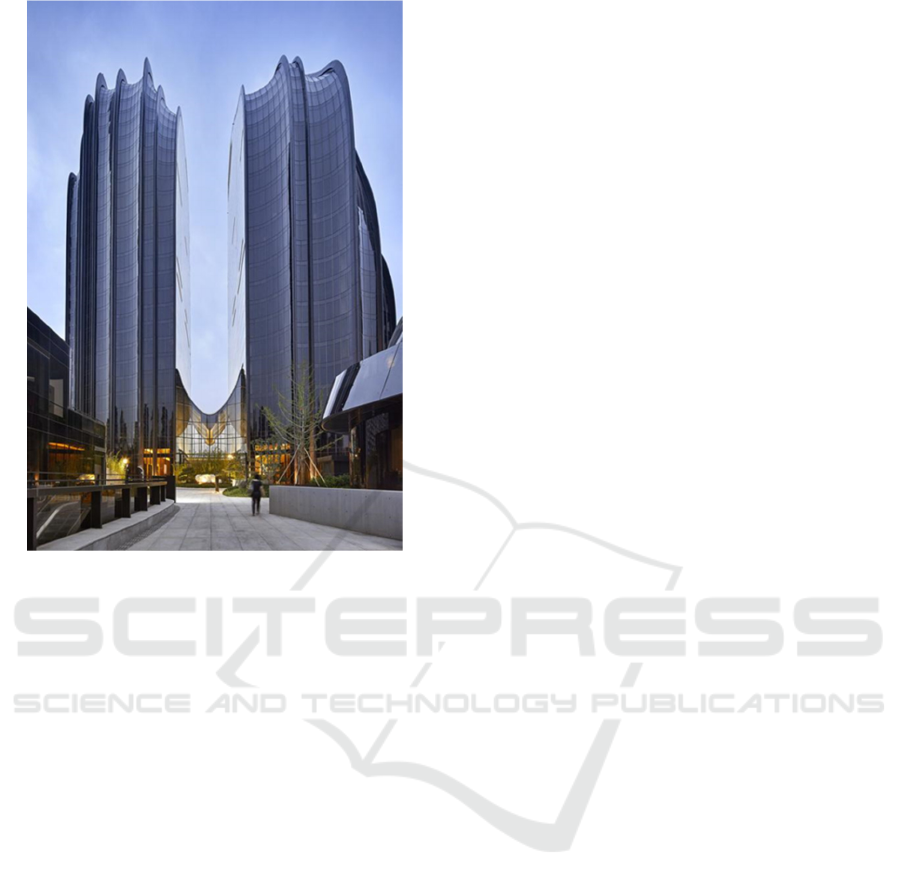
Figure 4: Ma, Y. S. Chaoyang Park Plaza.
The optimal solution is to search for cultural
symbols of subjectivity, integrate them with the
current pattern of change, and construct local
narratives to reduce the vulnerability of cultural
identity. The shanshui city designed by Ma Yansong
applies the artistic characteristics of traditional
Chinese Shan shui painting to architectural design
(figure 4), representing dissatisfaction and resistance
with the dehumanizing urban configurations resulted
from predatory architecture (Mirra, 2019). Through
his imitation of landscapes, the skyscrapers present
the soft streamlines, accompanied with luxuriant
vegetation, which enrich the weak fabric of urban
space. For instance, the Chaoyang Park Plaza
conforms to traditional concepts of Chinese
landscape painting and classical garden design. The
fluid and streamlined forms of the architectural
complex emulate the poetic imagery of layered
mountain ranges, creating sinuous and organic natural
contours. The extensive utilizing of glass curtain
walls adopts the classical garden technique of ‘scene
borrowing’, reflecting and showcasing the urban
texture and landscapes. This sustainable architectural
landscape which imbued with distinctive Chinese
aesthetic traditions and identity evokes a sense of
cultural belonging and inspires conceptualization of
the national future among citizens. It provides
residents of impersonal and machine-made cities with
a solution to connect with humanized environment on
a spiritual or philosophical level (Yang & Hu, 2017).
Moreover, the incorporation of traditional
philosophical concept of Chinese art present the
architect’s affective identification with Chinese
cultural discourse and ideology. This approach
contributes to capture and shape cultural values and
strengths characterized by coherence and continuity
during a period of social transformation (De Nigris,
2019).
Confronting the ambiguity of cultural identity,
artists experienced the influence of highly urbanized
environments are dedicated to translate and
refrigerate philosophies of traditional Chinese art into
modern narratives, addressing the anxiety of seeking
the cultural root and offering a creative expression of
national self-identity (Jiang, 2019). They aim to
promote Chinese citizens to reengage with their
cultural gene and establish enduring emotional
connections within a context of high mobility,
fostering a sense of national pride. From the
perspective of national identity, the past undoubtedly
informs the future (Li, 2019).
6 CONCLUSION
This research highlights the three dimensions
involved in China’s urbanized revolution, including
migrant workers, geo-cultural dynamics and national
image. It examines the social issues arising from
uncertainty while presenting the perspectives and
expression from artists. The essence of the dilemma
of social transformation in China is that the rush for
economic and political achievements has defused the
inherent narrative patterns of traditional society.
Regardless of the original context, it is essential for
individuals to recognize and adapt to the new social
structure and to make the changes. In this progress of
constant movement, citizen suffer the alienation in
daily lives and sense of cultural estrangement.
In the social transformation, artists assume the
responsibility to utilize artistic and cultural
productions as medium to reflect critically on social
problems and articulate the concerns for public and
themselves. Art activism, as a form of urban
intervention, captures, interprets, and conceives the
distinctiveness and critical aspects of contemporary
urbanization in China, aiming to create sustainable
and inclusive spaces within overcrowded urban
environments. This approach offers citizens a
localized connection to reimagine and experience
ancient traditional values and cultural specificity
while cultivating the potential for new forms of civic
Exploration and Analysis of the Contemporary Chinese Art Activism as an Intervention in Urbanization
39

engagement. Ultimately, through a narrative structure
creates by locational aesthetics and participatory art,
China would establish a strong foundation for the
people’s livelihoods and social harmony, while
manifesting a multifaceted and great national
branding image.
REFERENCES
Campanella, T. J. 2008. The concrete dragon: China’s
urban
revolution and what it means for the world.
Princeton Architectural Press.
Cissé, A., & Rasmussen, A. 2022. Qualitative Methods. In
Comprehensive Clinical Psychology. Second Edition 3:
91–103.
De Nigris, O. 2019. Continuum generation by generation:
The representation of Chinese traditions at the China
pavilion of the 57th Venice Biennale. Journal of Con-
temporary Chinese Art 6(2–3):343–366.
Grube, K. 2020. Labouring bodies: Big Tail Elephants in
1990s Guangzhou. Journal of Contemporary Chinese
Art 7(2–3):201–219.
Hu, Y. 2023. Identity and Preservation of Traditional Cul-
ture in the Context of Urbanization in China. Studies in
Art and Architecture 2(3):86–89.
Jiang, J. H. 2019. Everyday Legend: Reinventing tradition
in Chinese contemporary art. Journal of Contemporary
Chinese Art 6(2):159–165.
Jiang, J. H. 2020. Urban transformations and contemporary
art in China. Journal of Contemporary Chinese Art 7(2–
3):171–176.
Li, B. Y. 2014. Freedom Farming. M+. https://www.m
plus.org.hk/en/collection/objects/freedo.
Li, P. 2019. Past as future: The discourse of Chuantong in
twentieth-century China. Journal of Contemporary
Chinese Art 6(2):167–186.
Liang, J. H. 1996. One Hour Game. M+. https://www.mplus
.org.hk/en/collection/objects/one-hour-game-2012576/.
Lin, N. P. 2018. Urban Insertion as Artistic Strategy: The Big
Tail Elephant Working Group in 1990s Guangzhou. In
Visual Arts, Representations and Interventions in Con-
temporary China. Amsterdam University Press 181–208.
Lin, N. P. 2020. Keepers of the Waters: Experiments in
xianchang art practice in 1990s China. Journal of Con-
temporary Chinese Art 7(2–3):325–343.
Lu, D. 2011. The great urbanization of China. World Scien-
tific Publishing Co. Pte. Ltd. 30.
Lu, S. H., & Zhang, Z. 2020. Tear down the City: Recon-
structing Urban Space in Contemporary Chinese Popu-
lar Cinema and Avant-Garde Art. In The Urban Gener-
ation, Duke University Press 137–160.
MAD Architects. 2017. Chaoyang Park Plaza.
https://www.archdaily.com/884841/chaoyang-park-
plaza-mad-architects?ad_medium=office_land-
ing&ad_name=article.
Marinelli, M. 2015. Urban revolution and Chinese contem-
porary art: A total revolution of the senses. China In-
formation 29(2):154–175.
Merlin, M. 2018. Cao Fei: Rethinking the global/local dis-
course.Journal of Contemporary Chinese Art 5(1):41–60
Mirra, F. 2019. Reverie through Ma Yansong’s Shanshui
City to evoke and re-appropriate China’s urban space.
Journal of Contemporary Chinese Art 6(2–3):393–413.
Mirra, F. 2020. The art of billboards in urbanized China.
Journal of Contemporary Chinese Art 7(2–3):281–306.
Mirra, F. 2023. Erasure: China’s Migrant Workers in Con-
temporary Visual Arts. Third Text 37(4):487–507.
NASHER. n. d. Zhang Huan, To Raise the Water Level in
a Fishpond (Water Child). https://nasher.duke.edu/sto-
ries/zhang-huan-to-raise-the-water-level-in-a-fishpond
-water-child/.
Oredsson, E. 2019. From earth to ink: How performance
artists use their bodies in their work. M+.
https://www.mplus.org.hk/en/magazine/from-earth-to-
ink-how-performance-artists-use-their-bodies/.
Qi, J. 2023. Against authority: Performance art in 1980s
China. Journal of Contemporary Chinese Art 10(1–
2):19–38.
Salemink, O., Corrêa, A. S., Sejrup, J., & Nielsen, V. 2023.
Global Art in Local Art Worlds: Changing Hierarchies
of Value. Taylor & Francis. https://doi.org/1
0.4324/9781003128908.
Shi, Y. K. 2022. Li Binyuan’s art is violent, futile labor.
Sixth Tone.
Tam, I. 2020. Canton Express: Urbanization and contempo-
rary Chinese art. Journal of Contemporary Chinese Art
7(2–3):241–260.
Tan, J. 2015. Toward a spatiotemporal consciousness in
media studies: Locational aesthetics and digital
filmmaking in China’s Special Zones. Journal of Chi-
nese Cinemas 9(3):187–203.
Wang, M. 2015. Urbanization and Contemporary Chinese
Art. Routledge 13: 1–264.
Wang, M. 2018. Place-making for the people: Socially en-
gaged art in rural China. China Information 32(2):244–
269.
Wright, J. D. 2015. International Encyclopedia of the Social
and Behavioral Sciences. Elsevier (Second edition).
Wu, H. (Ed.). 2010. Contemporary Chinese Art: Primary
Documents. Museum of Modern Art; Distributed by
Duke University Press.
Valjakka, M., & Wang, M. 2018. Visual Arts, Representa-
tions and Interventions in Contemporary China: Urban-
ized Interfaces. Amsterdam University Press.
Yang, Y., & Hu, J. 2017. Sustainable Urban Design with
Chinese Characteristics: Inspiration from the Shan-Shui
City Idea. Articulo 14.
Yu, S. L. 2020. Guangzhou airport biennale: Competition
and confrontation in villagers-led participation. Journal
of Contemporary Chinese Art 7(1–2):103–130.
Zhang, H. 1997. To Raise the Water Level in a Fish Pond.
The Philadelphia Museum.
Zhang, Z. 2020. Introduction: Bearing Witness: Chinese
Urban Cinema in the Era of “Transformation.” In The
Urban Generation, Duke University Press 1–46.
IESD 2025 - International Conference on Innovative Education and Social Development
40
