
Enhanced Deepfake Detection Using ResNet50 and Facial Landmark
Analysis
P. S. Prakash Kumar
1
, G. Mohesh Kumar
1
, K. Shanmuga Priya
1
, V. Dharun Kumar
2
,
P. Nanda Krishnan
2
and S. A. Barathraj
2
1
Department of Information Technology, K S R College of Engineering, Tiruchengode 637215, Tamil Nadu, India
2
Department of Information Technology, K S R Institute for Engineering and Technology, Tiruchengode‑637215, Tamil
Nadu, India
Keywords: Deepfake Detection, ResNet50, Deep Learning, MobileNetV2, Detection Accuracy, Fake Image, Dataset,
Face.
Abstract: This research focuses on accuracy enhancement in the detection of deepfakes using the ResNet50 algorithm
designed through deep learning. It analyzes anomalies in artificial facial images. Materials and Methods: The
two implemented deep learning models include MobileNetV2 (Group 1) and ResNet50 (Group 2), each
trained and tested with 40 image samples, comprising 20 real images and 20 deepfake images. Here, a facial
irregularity detector based on ResNet50 was trained against one whose model was created through
MobileNetV2. Result: ResNet50 was shown to have a detection accuracy of 91.81 % to 97.87 % for
distinguishing between real and fake photographs. Its effectiveness for real-time applications is demonstrated.
Statistical study revealed a significant improvement in detection accuracy than the MobileNetV2 Model (p-
value < 0.05). Conclusion: According to the study's results, the ResNet50 algorithm is very good at identifying
deepfake photos and real photos with a low mistake rate and high accuracy. Due to its efficiency in processing
synthetic and genuine images, it can be a dependable tool for handling the problems created by deepfake
media.
1 INTRODUCTION
This research focuses on identifying deepfakes using
Residual Neural Networks (ResNet50), leveraging
their proven success in image recognition (D. Zhu,
2025) The study examines the detection performance
of ResNet50 in distinguishing deepfake images by
extracting subtle irregularities and inconsistencies
introduced during their generation (C. Yang, 2025)
Deep learning advancements have improved methods
of detecting deepfakes, and the project here is to
improve this method using the robust and reliable
architecture of ResNet50. Training ResNet50 on a
large dataset of real and manipulated images/videos
would enable the recognition of anomalies that
distinguish deepfakes from authentic content (S.
Xue,2025) The objective of this research is to use a
deep learning-based ResNet50 architecture to develop
a trustworthy deepfake detection system. The
ResNet50 model will be trained on a large dataset of
actual and changed images or videos, allowing the
system to identify subtle irregularities and
inconsistencies introduced throughout the deepfake
manufacturing process. This research is important
since deepfakes seriously jeopardize the legitimacy of
digital information and affect journalism, media, and
law enforcement (S. Song, 2025) The strategy will
increase public trust in digital media and assist stop
the spread of false information (A. Qadir, et.al,2024),
(R. Yang, et.al, 2024), (S. M. Hassan, et.al,2025), (M.
Saratha et al,2025).
2 RELATED WORKS
The total number of articles published on this topic in
the last five years, there have been more than 1954
publications on the topic in IEEE Xplore and 836 in
Google Scholar. In contrast to conventional
techniques, the combination of preprocessing steps,
feature-based, residual connection, and batch
normalization improves the detection accuracy of
deepfake videos in the presence of facemasks.
848
Prakash Kumar, P. S., MoheshKumar, G., Shanmuga Priya, K., Dharun Kumar, V., Nanda Krishnan, P. and Barathraj, S. A.
Enhanced Deepfake Detection Using ResNet50 and Facial Landmark Analysis.
DOI: 10.5220/0013948000004919
Paper published under CC license (CC BY-NC-ND 4.0)
In Proceedings of the 1st International Conference on Research and Development in Information, Communication, and Computing Technologies (ICRDICCT‘25 2025) - Volume 5, pages
848-855
ISBN: 978-989-758-777-1
Proceedings Copyright © 2026 by SCITEPRESS – Science and Technology Publications, Lda.

According to the study's findings, face-mask-
deepfakes can be detected with 94.81 % accuracy
when compared to the conventional
InceptionResNet50V2 and VGG19, which have
accuracy rates of 77.48 % respectively. Future
research should assess the precision of creating a
follow-up experimental study for improved deepfake
detection using facemasks.
The user interface further displays a confidence
score for each prediction to provide users an idea of
the model's dependability. With training and testing
accuracy rates over 95 %, this study provides a
comprehensive technique to differentiate between real
and fake faces (C. Wang, 2025) The ability of deep
learning to produce and identify deepfakes is still
developing. deepfake detection models are created
using older datasets, may become obsolete over time,
and constantly need new detection methods. With an
accuracy rate of over 90 %, the research findings are
encouraging, but there is still room for improvement
(N. M. Alnaim, et.al 2025) (S. Karthikeyan et
al,2020)The CT outperforms the state-of-the-art in the
deepfake detection task, demonstrating its better
discriminative capacity and resilience to various forms
of attacks. With an overall classification accuracy of
over 97 % despite accounting for deepfakes from 10
different GAN architectures that are not only involved
in face photos, the CT demonstrates its dependability
and independence from image semantics. Finally, tests
employing deepfakes created by FACEAPP
demonstrated the effectiveness of the proposed
strategy in a real-world scenario, achieving 93 %
accuracy in the fake detection task (Y. Xu, 2025)
Additionally, in order to assess the resilience of
Arabic-AD, Arabic recordings from non-Arabic
speakers were gathered, taking into account the accent.
To evaluate the suggested approach and contrast it
with established standards in the literature, three
comprehensive experiments were carried out. With
the lowest EER rate (0.027 %) and the highest
detection accuracy (97 %) while avoiding the
requirement for lengthy training, Arabic-AD thereby
surpassed other state-of-the-art techniques (L. Zhou,
2025) The study's YOLO models all exhibited almost
flawless accuracy in recognizing X-ray images that
revealed osteoarthritis in the knee. Despite the
generally excellent performance of the YoloV8
models, the YoloV5 models yielded the best and
poorest results in lung CT scan images.The YoloV5su
model had the highest recall (0.997), while the
YoloV5nu model had the lowest (0.91). Additionally,
YoloV5su, the best model, performs 60 % better than
YoloV8x, the second-best model. The results
demonstrate YoloV5su's speed and accuracy in
detecting medical deepfakes (T. Qiao, 2025) (P.
Jahnavi et al, 2025) The neural network will be trained
extensively using these photos and their labels in order
to accurately predict an image's legitimacy. The model
has been trained on precisely 7104 photos, and based
on the outcomes, the model's predictions are
reasonably accurate. The accuracy and precision of the
results are 88.81 % and 87.93 %, respectively. The
suggested technique classifies the input video frames
into genuine and deepfake by extracting features using
a CNN-MLP model that is based on deep learning.
The suggested approach detected deepfake movies
with a high accuracy of 81.25 % using Celeb-df, a
publicly available deepfake dataset. Comparative tests
using a different algorithm show how accurate our
model is, confirming its effectiveness in identifying
modified content (N. Saravanan et al, 2025) The
feature extraction stage, which is the next and most
important step, is when particular features relating to
face orientation are taken out of every frame. A
histogram of oriented gradients, scale-invariant
feature transforms, and local binary patterns are the
features that are extracted (N. K. Wardana, 2022).
Normalization of features takes place in other neural
network pipelines later in the design. The following
neural network will then categorize the videos as
either deepfake or not after combining the features.
This architecture has a validation accuracy of 95.89 %
(M. Venkatesan et al,2025)
Previous studies have shown that using
MobileNetV2 methods to detect deepfake content
might be challenging. An important factor in the
rapidly changing realm of cybersecurity is effective
deepfake detection. In contrast to traditional detection
methods, the goal of this study is to improve detection
accuracy by employing a unique deep learning-based
ResNet50 algorithm.
3 MATERIALS AND METHODS
The study measures the performance of the ResNet50
model compared with that of MobileNetV2 in
deepfake image detection based on predictive
accuracy. The models are built and tested on a
prepared dataset to verify real vs fake image
classification (L. Pham, 2025) The experiments were
conducted in the IT Lab at KSR Institute for
Engineering and Technology, where high-
performance computing systems and necessary
computational support are available for deep learning-
based research. The dataset used for training and
testing was obtained from Kaggle.com, specifically
the Deepfake Detection Dataset. Statistical methods
Enhanced Deepfake Detection Using ResNet50 and Facial Landmark Analysis
849
such as a 95 % confidence interval and a 0.05 % level
of significance at a G-power value of 80 % were used
to validate the results.
In this study, Group 1 is the MobileNetV2 model,
which was trained and tested on 2178 deepfake and
real images. The model, however, failed to predict
images well, resulting in inconsistent performance in
detection and obtained an accuracy level of 89 % (E.
Şafak, 2017) Group 2 refers to the ResNet50 deep
learning model, trained and tested on 2193 deepfake
and real images. The aim is to improve detection
accuracy through deeper feature extraction and
enhanced classification capabilities. The ResNet50
model was found to have improved the detection of
deepfake images by about 5 % to 7 % when compared
to MobileNetV2.
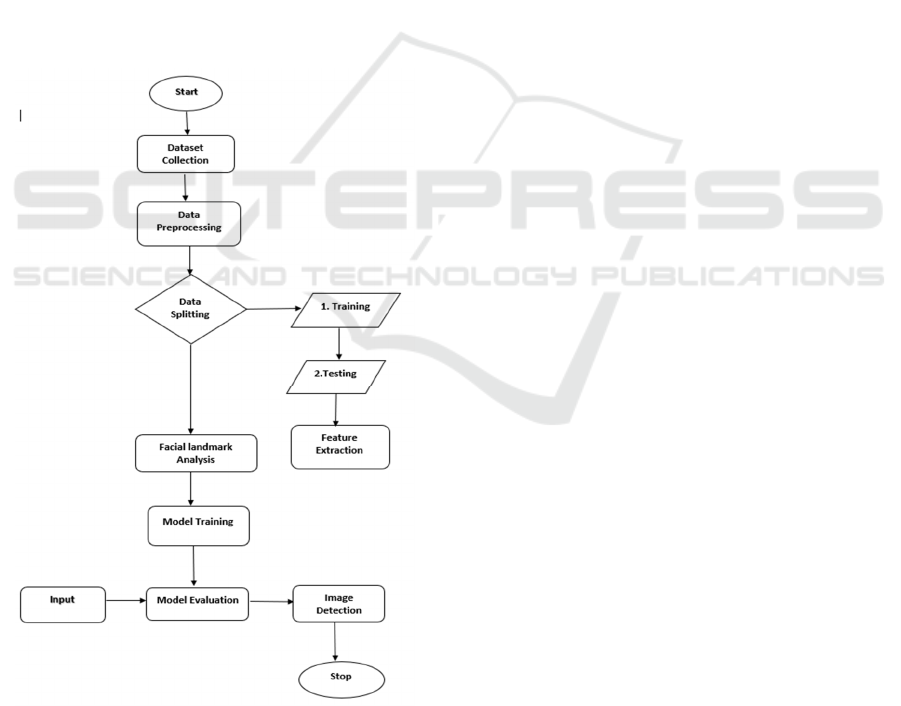
The Deepfake detection system begins with the
collection of the dataset from sources such as Kaggle,
and preprocessing steps like resizing, normalization,
and augmentation are performed on it. Then, the data
is split into training and testing.
Figure 1: The workflow of the deepfake detection process
using images.
The ResNet50 model learns deepfake-specific
patterns during the training phase. Feature extraction
and facial landmark analysis using dlib enhance
classification accuracy. The figure 1 shows the
workflow of the deepfake detection process using
images Metrics like accuracy, precision, recall, and
F1-score are used to evaluate the trained model.
During detection, the final phase, this model classifies
images as being real or fake based on some
confidence scores which ensure an efficient
deepfake-detecting model.
4 STATISTICAL ANALYSIS
The presentation of the deepfake recognition
framework is analyzed by using SPSS adaptation 26
for a quantitative study. The review centers on two
essential measurements: discovery precision and
levels of certainty (K. Stehlik-Barry, 2017) A one-tail
free t-test was conducted to analyze the results. The
ResNet model showed high dependability,
accomplishing more than 97 % exactness for ensured
pictures and 94 % accuracy for counterfeit ones. These
outcomes highlight the design's capacity to see
genuine and controlled pictures with surprising
accuracy, making it a strong reaction for combating
deepfakes.
5 RESULT
The results show that ResNet50 is more accurate,
with accuracy ranging from 91.81 % to 97.87 %,
while for the MobileNetV2 variants it was between
83.64 % and 89.56 %. It follows that the error for
ResNet50 lies in the range of 2.13 % to 8.19 %
compared to a much higher range for MobileNetV2,
which is from 10.44 % to 13.71 %. Further statistical
measures such as standard deviation, variance, and t-
tests emphasize the significance of the differences.
Graphical analysis further emphasizes the better
nature of ResNet50 about its always good
performance.
The T-test comparison between the ResNet50
and MobilseNetV2 models shows a high difference in
the accuracy, with p < 0.05. ResNet50 has higher
mean accuracy as 95.155 with low standard deviation
0.86375, and MobileNetV2 has mean accuracy as
87.557 with a high standard deviation of 1.01267.
This indicates that although ResNet50 is more
accurate, its consistency is slightly higher due to
lower standard deviation. The graph of accuracy
distribution also shows the comparative advantage of
ResNet50: multiple iterations indicate higher
ICRDICCT‘25 2025 - INTERNATIONAL CONFERENCE ON RESEARCH AND DEVELOPMENT IN INFORMATION,
COMMUNICATION, AND COMPUTING TECHNOLOGIES
850
accuracy in the case of the ResNet50 model. This
again shows that the model proposed here is better
and more consistent than MobileNetV2 in terms of
deepfake detection.
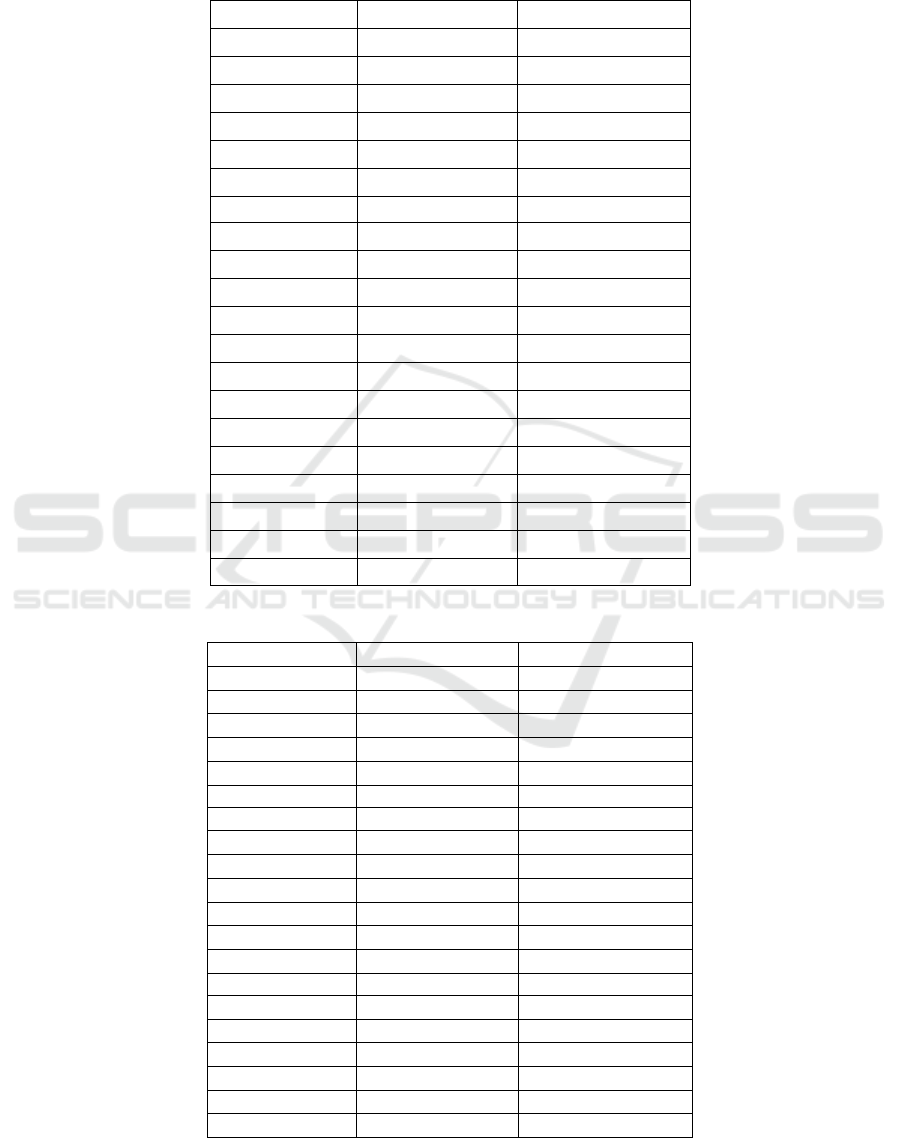
Table 1: The model of MobileNetV2 realizes an accuracy of 86.37 % to 89.56 %, an error rate of 10.87 to 13.63.
Iteration Accuracy Error Rate
1 86.37 13.63
2 87.29 12.71
3 86.72 13.28
4 88.02 11.98
5 88.64 11.36
6 89.56 10.44
7 86.42 13.58
8 89.13 10.87
9 87.81 12.19
10 86.38 13.62
11 86.44 13.56
12 87.31 12.69
13 88.14 11.86
14 86.69 13.31
15 87.55 12.45
16 86.71 13.29
17 89.05 10.95
18 87.86 12.14
19 86.74 13.26
20 88.32 12.14
Table 2: The model of ResNet50 realizes an accuracy of 91.81% to 97.87% an error rate of 2.13 to 7.65.
Iteration Accuracy Error Rate
1 94.24 5.76
2 95.41 4.59
3 96.05 3.95
4 97.12 2.88
5 96.80 3.20
6 97.35 2.65
7 95.85 4.15
8 97.87 2.13
9 96.30 3.70
10 94.75 5.25
11 96.51 3.49
12 91.81 8.19
13 92.48 7.52
14 94.03 5.97
15 92.35 7.65
16 94.92 5.08
17 93.49 6.51
18 94.95 5.05
19 94.63 5.37
20 95.46 6.54
Enhanced Deepfake Detection Using ResNet50 and Facial Landmark Analysis
851
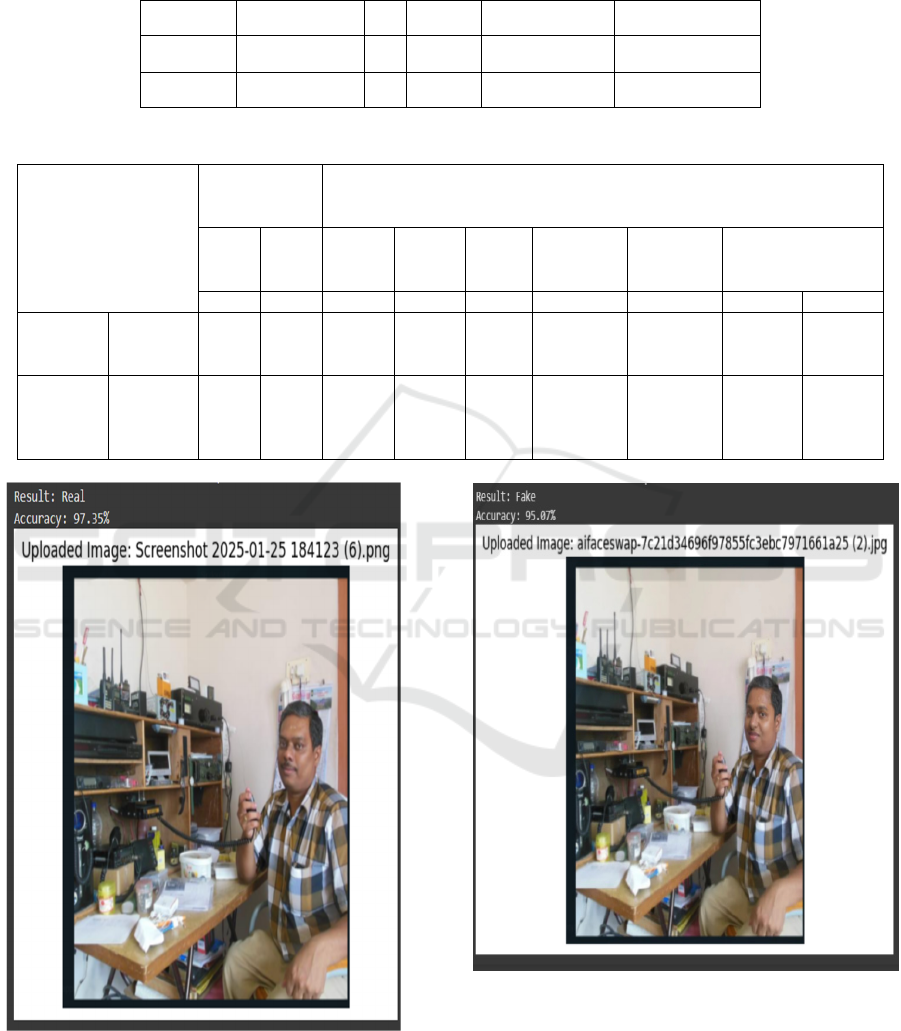
Table 3: The mean Accuracy of ResNet 50 is 95.155 and MobileNetV2 has 87.557. Even though ResNet50 has a significantly
lower variability or std. Deviation of 0.86375 while MobileNet v2 has Std. Deviation of 1.01267, means only slightly high
stability.
Metric Method N Mean Std. Deviation Std. Error Mean
Accuracy MobileNetV2 20 87.557 1.01267 0.22644
Accuracy ResNet50 20 95.155 0.86375 0.15378
Table 4: Form SPSS Independent Samples Test t-test Comparison of gain in MobileNet v2 and ResNet 50 (p<0.05).
Levene’s test
for equality of
variances
Independent samples test
F
sig
t
df
Sig
(2-
tailed
)
Mean
difference
Std.
error
difference
95% confidence
interval of the
difference
lowe
r
U
pp
e
r
Accuracy
equal
variance
assume
d
4.381 0.043
-
16.761
38 0.000 -7.59800 0.45332
-
8.51570
-
6.68030
Accuracy
equal
variances
not
assume
d
-
16.761
30.377 0.000 -7.59800 0.45332
-
8.52332
-
6.67268
Figure 2: Accuracy comparison between MobileNetV2 and
ResNet50.
Figure 3: Accuracy in the classification.
Figure 2, the outcome with the Accuracy is
displayed along with the result of the uploaded image,
and it determines that the image is real with high
Accuracy as illustrated in 2 and identifies the image
as fake with strong Accuracy in the classification as
shown in figure 3. The interface clearly displays the
ICRDICCT‘25 2025 - INTERNATIONAL CONFERENCE ON RESEARCH AND DEVELOPMENT IN INFORMATION,
COMMUNICATION, AND COMPUTING TECHNOLOGIES
852
outcome of the classification to ensure an efficient
process of deep fake detection.
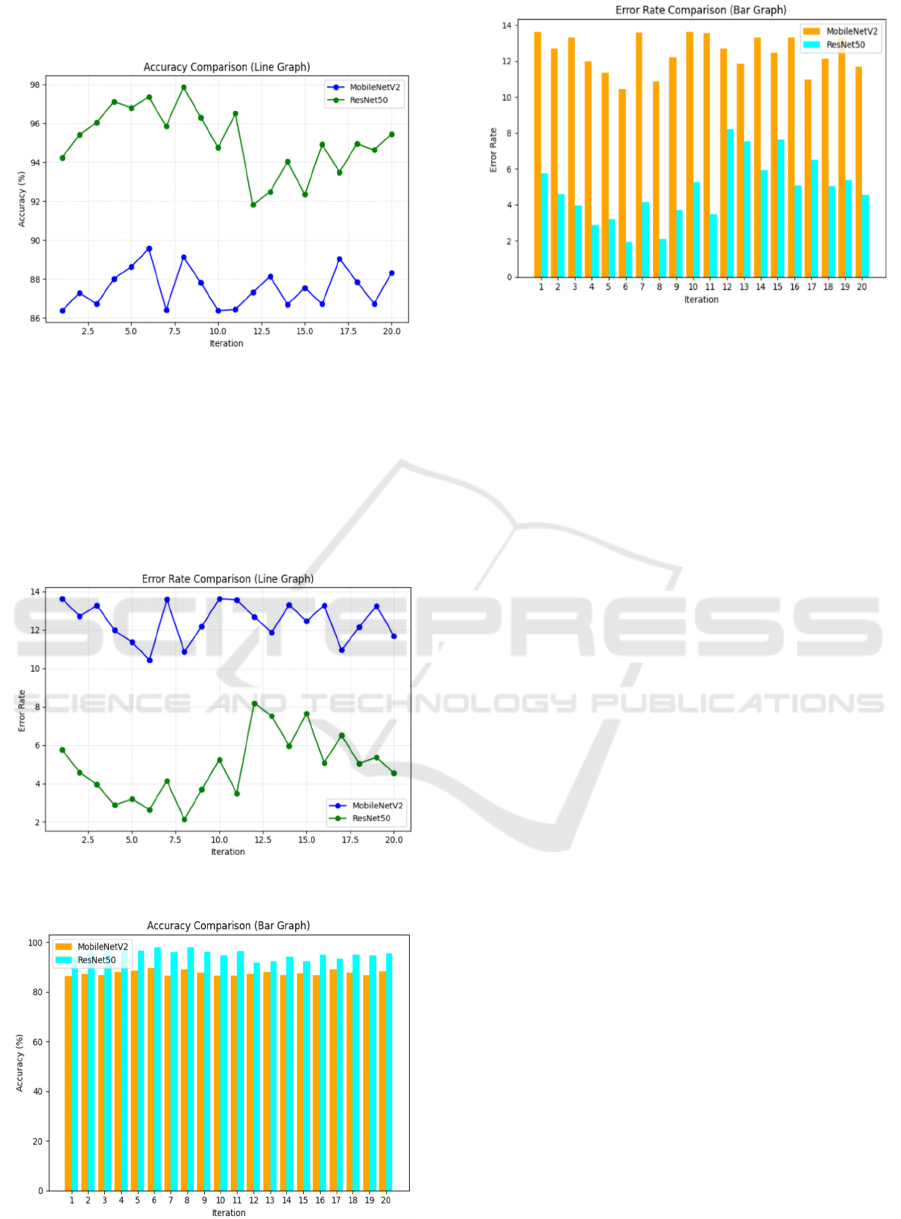
Figure 4: Accuracy comparison.
The accuracy comparison between MobileNetV2
and ResNet50 is shown in Figure 4 and while the error
rate is depicted in Figure5. The performance of
ResNet50 was better compared to both the metrics,
that is, with greater accuracy and maintaining a lesser
error rate compared to MobileNetV2 throughout all
iterations.
Figure 5: Error rate comparison.
Figure 6: Accuracy comparison.
Figure 7: Error rate comparison.
Figure 6 contrasts the accuracy of MobileNetV2
and ResNet50 with a bar graph, and Figure 7 uses
another bar graph to depict their error rates. In all
iterations, ResNet50 outperforms MobileNetV2 by
having greater accuracy and lower error rates, which
makes them highly effective in detecting DeepFakes.
6 DISCUSSION
The present study showed how the ResNet50
algorithm provides a remarkable degree of
improvement in detecting deepfake images compared
to the MobileNetV2 model (L. Si et al, 2025) With
accuracies between 91.81 and 97.87 % achieved with
ResNet50, the model took precedence over
MobileNetV2, showing a significance in difference
with statistical confidence (p-value < 0.05) (S.
Khairnar,2025) (P. Raghavendra Reddy et al, 2025)
This emphasizes the potential of ResNet50 for
accurately distinguishing between real and deepfake
images, especially in real-time applications where
accuracy becomes critical. With skip connections
incorporated into a deep architecture, ResNet50 is
capable of extracting rather complex features from
facial images that sensitively detect small anomalies
which might become possible red flags in deepfakes
but invisible to standard detection methods (Y.
Mao,205) The model can also learn hierarchical
representations of features across many layers that
further augment its power to identify variations in
textures and contours and minor details that remain
undetectable for standard economic functions. For
example, slight differences in skin texture, eye
movements, or maybe facial expressions are
manipulations that happen in deep-fake content (M.
C. Gursesli, 2025) (A. V. Santhosh Babu et al, 2019)
Slightest differences are what make ResNet50 best
Enhanced Deepfake Detection Using ResNet50 and Facial Landmark Analysis
853

capable of doing deep-fake detection and, therefore,
good at unveiling minute manipulations
(M.Venkateswarlu, 2025) (N.Saravanan et al,2025)
Deepfake generation methods, including facial
swapping, expression manipulation, or synthesis-
based facial animation, are all variable methods that
will require a contrasting range of capabilities for
accurate identification and distinguishable traits
incorporated within them. ResNet50 scores high in
feature extraction, which allows it to withstand
variation in the described attributes (H. Chen, 2025)
Due to its great generalizability across varied
datasets, it can distinguish deepfakes coming from
different sources and formats, which is an exciting
feature for real-world deployment. The extremely
high accuracy shows that deep learning-based
methods have prospects like ResNet50. Future work
will extend to increase diversity of the dataset,
enhance pre-processing, and boost the accuracy with
ensemble learning. Attention mechanisms and
adversarial training will improve robustness.
Optimizations will minimize further computational
overhead. Extracting both image and audio features
for generating the model for detection shall increase
this performance.
7 CONCLUSIONS
The deepfake detection system was designed to train,
and test for the performance in the differentiating
between real and deepfake images utilizing the
ResNet50 algorithm. The results showed that the
ResNet50 model displayed significantly better than
the performance of the MobileNetV2 model and
demonstrated between 91.81 % to 97.87 % detection
accuracy, while MobileNetV2 achieved 86.37 % to
89.56 % accuracy. This signifies the wide margin for
the improvement of the determines ResNet50 model's
capability of detecting minute anomalies and
manipulations in facial images and essential for high-
accuracy applications and considering stability with
the MobileNetV2 showing a standard deviation of
1.01267, indicating some variability in the
performance across the different datasets. On the
other hand, the lower standard deviation of 0.86375
for the ResNet50 model indicates the model had
consistently good performance across varying
datasets.
REFERENCES
A. V. Santhosh Babu et al, “Performance analysis on
cluster-based intrusion detection techniques for energy
efficient and secured data communication in MANET,”
International Journal of Information Systems and
Change Management, Aug. 2019, Accessed: Feb. 03,
2025. [Online]. Available: https://www.inderscienceo
nline.com/doi/10.1504/IJISCM.2019.101649
A. Qadir, R. Mahum, M. A. El-Meligy, A. E. Ragab, A.
AlSalman, and M. Awais, “An efficient deepfake video
detection using robust deep learning,” Heliyon, vol. 10,
no. 5, p. e25757, Mar. 2024.
C. Yang, S. Ding, and G. Zhou, “Wind turbine blade
damage detection based on acoustic signals,” Sci Rep,
vol. 15, no. 1, p. 3930, Jan. 2025.
C. Wang, C. Shi, S. Wang, Z. Xia, and B. Ma, “Dual-Task
Mutual Learning with QPHFM Watermarking for
Deepfake Detection.” Accessed: Feb. 03, 2025.
[Online]. Available:
https://doi.org/10.1109/LSP.2024.3438101
D. Zhu, C. Li, Y. Ao, Y. Zhang, and J. Xu, “Position
detection of elements in off-axis three-mirror space
optical system based on ResNet50 and LSTM,” Opt
Express, vol. 33, no. 1, pp. 592–603, Jan. 2025.
E. Şafak and N. Barışçı, “Detection of fake face images
using lightweight convolutional neural networks with
stacking ensemble learning method,” PeerJ Comput
Sci, vol. 10, p. e2103, Jun. 2024.
H. Chen, G. Hu, Z. Lei, Y. Chen, N. M. Robertson, and S.
Z. Li, “Attention-Based Two-Stream Convolutional
Networks for Face Spoofing Detection.” Accessed:
Feb. 03, 2025. [Online]. Available: https://doi.org/10.
1109/TIFS.2019.2922241
I. N. K. Wardana, “Design of mobile robot navigation
controller using neuro-fuzzy logic system,” Computers
and Electrical Engineering, vol. 101, p. 108044, Jul.
2022.
K. Stehlik-Barry and A. J. Babinec, Data Analysis with
IBM SPSS Statistics. Packt Publishing Ltd, 2017.
L. Pham, P. Lam, T. Nguyen, H. Nguyen, and A. Schindler,
“Deepfake Audio Detection Using Spectrogram-based
Feature and Ensemble of Deep Learning Models.”
Accessed: Feb. 03, 2025. [Online]. Available:
https://doi.org/10.1109/IS262782.2024.10704095
L. Si et al., “A Novel Coal-Gangue Recognition Method for
Top Coal Caving Face Based on IALO-VMD and
Improved MobileNetV2 Network.” Accessed: Feb. 03,
2025. [Online]. Available: https://doi.org/10.1109/TI
M.2023.3316250
L. Zhou, C. Ma, Z. Wang, Y. Zhang, X. Shi, and L. Wu,
“Robust Frame-Level Detection for Deepfake Videos
with Lightweight Bayesian Inference Weighting.”
Accessed: Feb. 03,2025.
[Online].Available:https://doi.org/10.1109/JIOT.2023.
3337128
M. C. Gursesli, S. Lombardi, M. Duradoni, L. Bocchi, A.
Guazzini, and A. Lanata, “Facial Emotion Recognition
(FER) Through Custom Lightweight CNN Model:
Performance Evaluation in Public Datasets.” Accessed:
ICRDICCT‘25 2025 - INTERNATIONAL CONFERENCE ON RESEARCH AND DEVELOPMENT IN INFORMATION,
COMMUNICATION, AND COMPUTING TECHNOLOGIES
854

Feb. 03, 2025. [Online].Available:https://doi.org/10.1
109/ACCESS.2024.3380847
M. Venkatesan et al, “A New Data Hiding Scheme with
Quality Control for Binary Images Using Block Parity.”
Accessed: Feb.03,2025. [Online]. Available: https://d
oi.org/10.1109/IAS.2007.26
M. Saratha et al, “Research and Application of Boundary
Optimization Algorithm of Forest Resource Vector
Data Based on Convolutional Neural Network.”
Accessed: Feb. 03, 2025. [Online]. Available:
https://doi.org/10.1109/SmartTechCon57526.2023.103
91589
M.Venkateswarlu and V. R. R. Ch, “DrowsyDetectNet:
Driver Drowsiness Detection Using Lightweight CNN
With Limited Training Data.” Accessed: Feb. 03, 2025.
[Online]. Available: https://doi.org/10.1109/ACCESS.
2024.3440585
N. Saravanan et al, “Revolutionizing Air Quality
Prognostication: Fusion of Deep Learning and Density-
Based Spatial Clustering of Applications with Noise for
Enhanced Pollution Prediction.” Accessed: Feb. 03,
2025. [Online]. Available: https://doi.org/10.1109/ICP
CSN62568.2024.00029
N. M. Alnaim, Z. M. Almutairi, M. S. Alsuwat, H. H.
Alalawi, A. Alshobaili, and F. S. Alenezi, “DFFMD: A
Deepfake Face Mask Dataset for Infectious Disease Era
with Deepfake Detection Algorithms.” Accessed: Feb.
03, 2025. [Online]. Available: https://doi.org/10.1109/
ACCESS.2023.3246661
N. Saravanan et al, “Accurate Prediction and Detection of
Suicidal Risk using Random Forest Algorithm.”
Accessed: Feb. 03, 2025. [Online]. Available:
https://doi.org/10.1109/ICPCSN62568.2024.00053
P. Raghavendra Reddy et al, “Novel Detection of Forest
Fire using Temperature and Carbon Dioxide Sensors
with Improved Accuracy in Comparison between two
Different Zones.” Accessed: Feb. 03, 2025. [Online].
Available: https://doi.org/10.1109/ICIEM54221.2022.
9853107
P. Jahnavi et al, “IOT based Innovative Irrigation using
Adaptive Cuckoo Search Algorithm comparison with
the State of Art Drip Irrigation to attain Efficient
Irrigation.” Accessed: Feb.03,2025. [Online].
Available: https://doi.org/10.1109/ICTACS56270.202
2.9987981
R. Yang, K. You, C. Pang, X. Luo, and R. Lan, “CSTAN:
A Deepfake Detection Network with CST Attention for
Superior Generalization,” Sensors (Basel), vol. 24, no.
22, Nov. 2024, doi: 10.3390/s24227101.
S. Karthikeyan et al, “An attempt to enhance the time of
reply for web service composition with QoS,”
International Journal of Enterprise Network
Management, Dec. 2020, Accessed: Feb.03,2025.
[Online]. Available: https://www.inderscienceonline.c
om/doi/10.1504/IJENM.2020.111750
S. M. Hassan and A. K. Maji, “Pest Identification Based on
Fusion of Self-Attention with ResNet.” Accessed: Feb.
03, 2025. [Online].Available:https://doi.org/10.1109/
ACCESS.2024.3351003
S. Song, J. C. K. Lam, Y. Han, and V. O. K. Li, “ResNet-
LSTM for Real-Time PM2.5 and PM₁₀ Estimation
Using Sequential Smartphone Images.” Accessed: Feb.
03, 2025. [Online]. Available:
https://doi.org/10.1109/ACCESS.2020.3042278
S. Khairnar, S. Gite, K. Mahajan, B. Pradhan, A. Alamri,
and S. D. Thepade, “Advanced Techniques for
Biometric Authentication: Leveraging Deep Learning
and Explainable AI.” Accessed: Feb. 03, 2025.
[Online]. Available: https://doi.org/10.1109/ACCESS.
2024.3474690
S. Xue and C. Abhayaratne, “Region-of-Interest Aware 3D
ResNet for Classification of COVID-19 Chest
Computerised Tomography Scans.” Accessed: Feb. 03,
2025. [Online]. Available: https://doi.org/10.1109/AC
CESS.2023.3260632
T. Qiao, S. Xie, Y. Chen, F. Retraint, and X. Luo, “Fully
Unsupervised Deepfake Video Detection Via Enhanced
Contrastive Learning.” Accessed: Feb.03,2025.
[Online].Available:https://doi.org/10.1109/TPAMI.20
24.3356814
Y. Xu, P. Terhörst, M. Pedersen, and K. Raja, “Analyzing
Fairness in Deepfake Detection with Massively
Annotated Databases.” Accessed: Feb. 03, 2025.
[Online]. Available: https://doi.org/10.1109/TTS.2024
.3365421
Y. Mao, Y. Lv, G. Zhang, and X. Gui, “Exploring
Transformer for Face Mask Detection.” Accessed: Feb.
03, 2025. [Online]. Available: https://doi.org/10.1109/
ACCESS.2024.3449802
Enhanced Deepfake Detection Using ResNet50 and Facial Landmark Analysis
855
