
Kite Connect, Uplink and Smart API: A Comprehensive Study of
Python API Libraries
Somnath Hase
1
and Vikas T. Humbe
2
1
Department of Computer Science, Smt. S. K. Gandhi Arts, Amolak Science and P. H. Gandhi Commerce College, Kada
414202, Maharashtra, India
2
School of Technology, SRTM University, Sub Center Latur, Maharashtra, India
Keywords: WebSocket, SmartAPI, Uplink, Kite Connect, API.
Abstract: The ability of machines to efficiently execute complicated and high-frequency trading strategies has made
algorithmic trading, or "algo trading," an essential part of the financial markets. With a focus on three well-
known platforms like SmartAPI, Uplink, and Kite Connect this research paper offers an in-depth study of
Python APIs in the context of the Indian financial markets. The basics of algorithm trading are covered in the
first section of the study, along with the value of Python as a programming language for creating algorithmic
techniques. The selection of Kite Connect, Uplink, and SmartAPI was driven by their notable positions in the
Indian financial scene, each providing traders and developers with special features and functionalities. Factors
including order execution speed, accuracy of market data, and the variety of supported financial instruments
are considered in this study. Case studies and real-world examples show how each API is used in algorithmic
trading scenarios. The study additionally looks at each API's WebSocket streaming capabilities, which are
essential for real-time data updates in the market.
1 INTRODUCTION
The financial system has shifted its paradigm in
recent years due to the use of technology into trading
activities. Algorithmic trading, or "algo trading," has
become an effective tool that is changing the way the
financial market function. This study explores the
complex world of algorithmic trading, with a
particular emphasis on its application utilizing Python
API inside the framework. Algo trading is the process
of automatically executing high-frequency trades
using mathematical models and pre-established
methods. Its ability to quickly assess market
conditions, identify trading opportunities, and carry
out orders at speeds faster than humans makes it
attractive. As the Indian share market keeps
developing and embracing new technology, algo
trading strategies especially those that use Python
APIs are becoming more and more popular. After
approving the Direct-Market-Access (DMA)
technology, the Securities Exchange Board of India
(SEBI) approved Algo Trading in 2008 (S. Acharya
and Dr. A. Ps 2022).
Artificial intelligence is a technology that can
think and act for itself. As such, it is ideal for
complicated trading applications where efficiency
and speed are critical. Its use can alter trading in a
variety of ways (Vignesh CK 2020), as is already
clear. Many factors are responsible for the daily
changes in the market, which makes it challenging for
businesses and stockbrokers to choose where to trade
(Bali 2021). Python's versatility, user-friendliness,
and availability of libraries and frameworks make it a
popular choice for algo trading. For traders and
engineers looking to build advanced algorithms in the
dynamic and complex environment of the Indian
stock market, Python is a great option due to its
readability and strong community involvement. With
a focus on Python API integration complexities, this
research study attempts to offer a thorough grasp of
API libraries. It looks at the main benefits and
characteristics of using Python for algorithmic
trading, as well as the difficulties encountered and
how they affect in trading procedures Algorithmic
trading is a method of order execution. Using
automated, pre-modified trading rules that represent
variables like volume, cost, and time (M. Mathur et
al., 2021). When compared to human brokers, this
type of trading aims to take advantage of the speed
and computational power of PCs.
814
Hase, S. and Humbe, V. T.
Kite Connect, Uplink and Smart API: A Comprehensive Study of Python API Libraries.
DOI: 10.5220/0013944200004919
Paper published under CC license (CC BY-NC-ND 4.0)
In Proceedings of the 1st International Conference on Research and Development in Information, Communication, and Computing Technologies (ICRDICCT‘25 2025) - Volume 5, pages
814-819
ISBN: 978-989-758-777-1
Proceedings Copyright © 2026 by SCITEPRESS – Science and Technology Publications, Lda.
This study explores the complex world of Python
API libraries, concentrating on the Python APIs
offered by three major platforms: Kite Connect,
Uplink, and SmartAPI. These APIs, which are
provided by top Indian financial institutions, are
essential in enabling algorithmic trading methods
because they give developers the resources and
connection they need to communicate
programmatically with financial markets.
2 PYTHON API
2.1 Kite Connect from Zerodha
One of the top stockbrokers in India, Zerodha, offers
Kite Connect, a well-liked trading API. Using Python
and other computer languages, it enables developers
to include stock trading capabilities into their own
apps. An interface for easy interaction with the Kite
Connects API is provided by the Kite Connect Python
library.
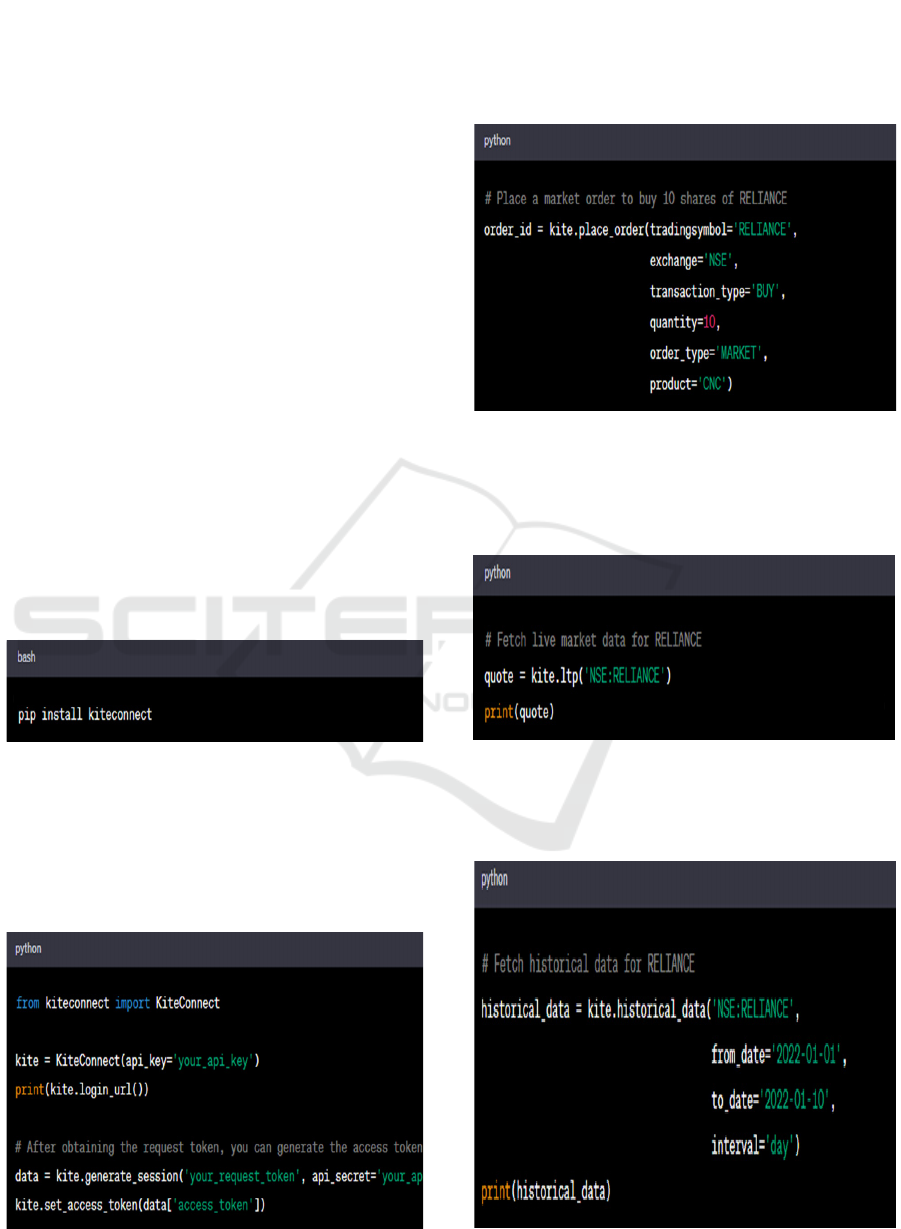
2.1.1 Installation
You can install the Kite Connect Python library using
pip:
2.1.2 Authentication
Your Zerodha API credentials are required in order to
utilize the Kite Connect API. An access token can be
generated to authenticate your API queries once you
have the API key and secret. Methods for managing
authentication are provided by the library.
2.1.3 Place Orders
You can place a variety of orders with the Kite
Connect Python library, such as market, limit, and
stop-loss orders.
2.1.4 Fetch Market Data
You can retrieve market data, including live market
quotes, historical data, and more, using the Kite
Connect API.
2.1.5 Historical Data
Access historical market data for a certain financial
instrument.
Kite Connect, Uplink and Smart API: A Comprehensive Study of Python API Libraries
815
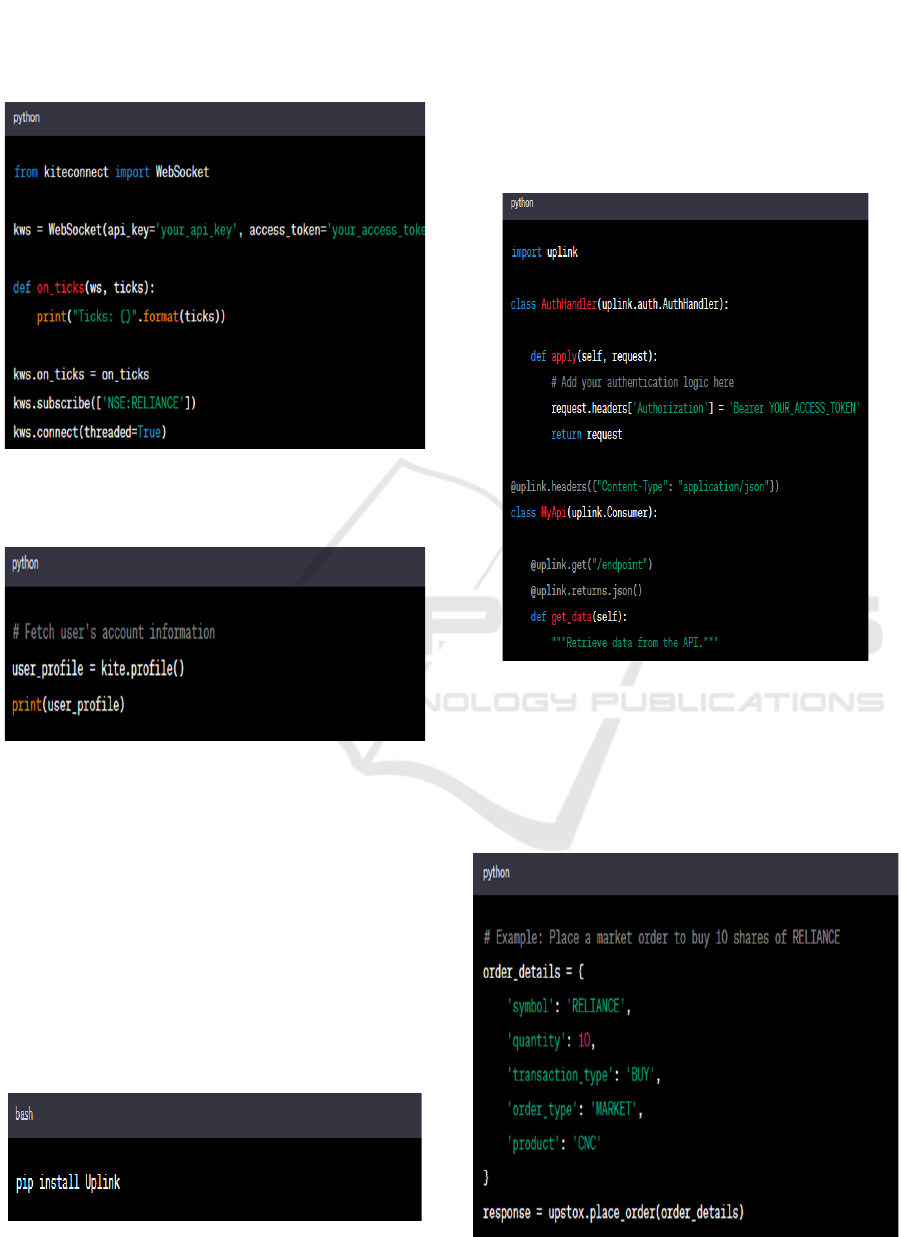
2.1.6 WebSocket Streaming
WebSocket streaming is supported by Kite Connect
to provide real-time data updates.
2.1.7 Account Information
Retrieve details on the user's trading account.
2.2 Uplink from Upstox
Leading Indian stock brokerage Upstox has an
official API called Uplink. With the help of the
Uplink API, developers can incorporate Upstox
trading features into their apps, allowing users place
orders, get market data, and carry out a number of
other programmatic tasks. The basics of the Upstox
Uplink API is shown below:
2.2.1 Installation
Upstox uplink API can be installed by using
following command.
2.2.2 Authentication
To use the Uplink API, developers need to obtain API
credentials (API key and secret) from Upstox. These
credentials are used to authenticate and authorize API
requests. Once authenticated, developers can access
various endpoints to interact with the Upstox
platform.
2.2.3 Order Placement
The Uplink API allows developers to make a variety
of orders, such as limit orders, stop-loss orders,
market orders, and more. Users may change attributes
including instrument, quantity, order type, and
validity details of order.
ICRDICCT‘25 2025 - INTERNATIONAL CONFERENCE ON RESEARCH AND DEVELOPMENT IN INFORMATION,
COMMUNICATION, AND COMPUTING TECHNOLOGIES
816
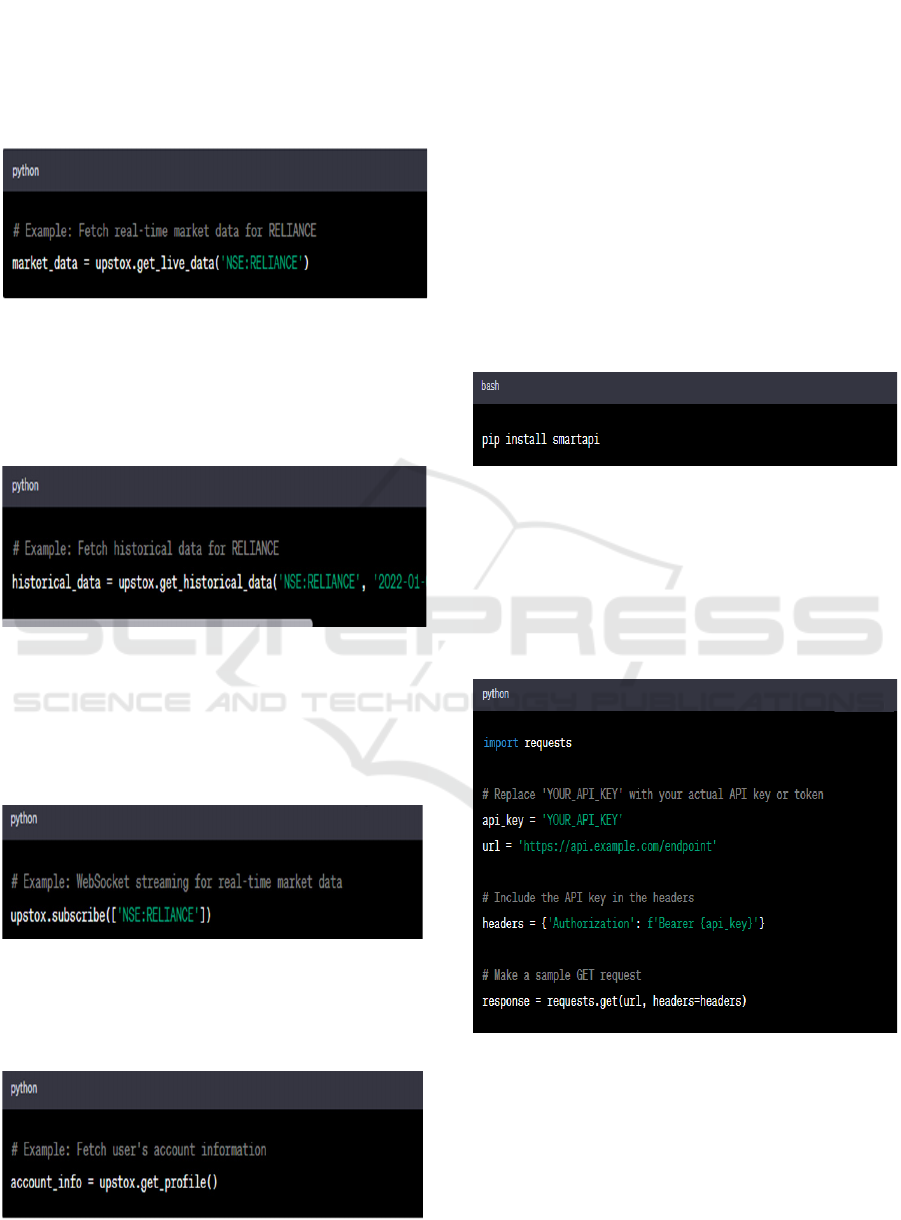
2.2.4 Market Data
Developers can access historical data, live quotes, and
market depth in real-time via the Uplink API. Making
customized charts, examining patterns, and deciding
on trades with knowledge can all benefit from this.
2.2.5 Historical Data
Developers can use the API to fetch historical market
data for backtesting and analysis purposes. Historical
data can be retrieved in different time intervals, such
as daily, hourly, or minute-wise.
2.2.6 WebSocket Streaming
WebSocket streaming is enabled by Uplink API so
that real-time updates can be received. Through the
WebSocket connection, developers can subscribe to
specific tools and get real-time market data, order
updates, and more.
2.2.7 Account Information
Developers may obtain account-related data via the
API, such as positions, margin details, and user
profile details.
2.3 SmartAPI
One of the well-known stockbrokers in India, Angel
One (previously known as Angel Broking), offers an
official API (Application Programming Interface)
called SmartAPI. With the help of SmartAPI,
developers can integrate stock trading features into
their apps, allowing users place orders, get market
data, and carry out a number of other programmed
activities. The basics of Angel One's SmartAPI is
shown below.
2.3.1 Installation
The following command can be used to install
AngelOne's SmartAPI.
2.3.2 Authentication
Angel One provides developers with API credentials
(API key and secret) in order for them to use the
SmartAPI. These login credentials are required for
API request authorization and authentication. Once
developers have registered for API access, they can
generate API keys via the Angel One developer site.
2.3.3 Order Placement
Developers can place various orders using SmartAPI,
such as limit orders, stop-loss orders, market orders,
and more. Order attributes including symbol, amount,
order type, validity, and product type are configurable
by developers.
Kite Connect, Uplink and Smart API: A Comprehensive Study of Python API Libraries
817
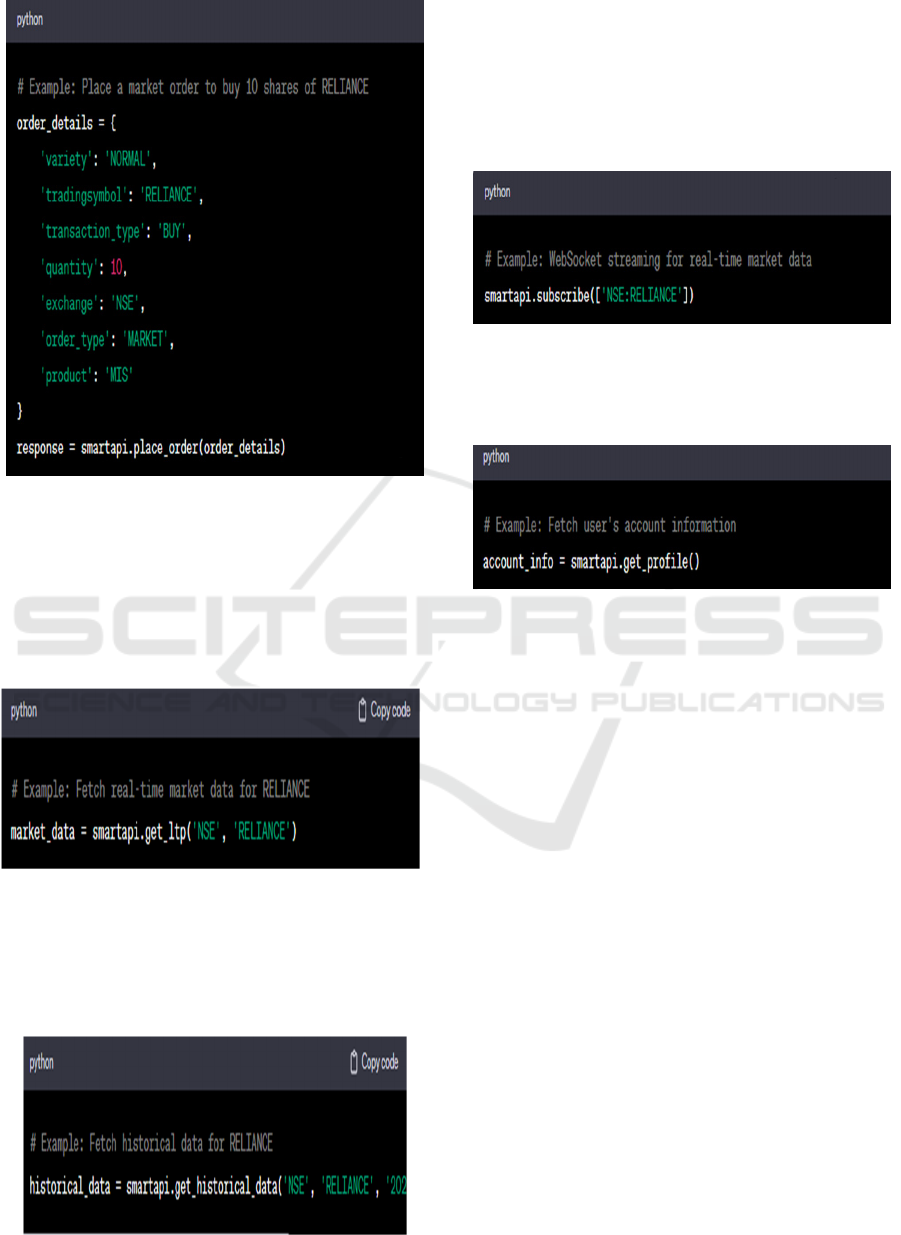
2.3.4 Market Data
With SmartAPI, developers may obtain up-to-date
market data. This covers historical data, market
depth, and real-time quotes. For the purpose of
building personalized charts, identifying trends, and
making wise trading decisions, access to market data
is essential.
2.3.5 Historical Data
Developers can retrieve historical market data for
analysis and backtesting using SmartAPI. One can
obtain historical data at several time periods,
including hourly, minute, and daily.
2.3.6 WebSocket Streaming
For real-time updates, WebSocket streaming is
supported by SmartAPI. Through the WebSocket
connection, developers can subscribe to particular
instruments and get real-time market data, order
updates, and more.
2.3.7 Account Information
Developers can get details about accounts, such as
positions, margins, and user profiles, through the API.
3 CONCLUSIONS
The analysis presented in this research has shed light
on the distinctive features and functionalities offered
by each API, enabling a nuanced understanding of
their strengths and limitations.
SmartAPI, Uplink, and Kite Connect represent
key players in shaping the future of algorithmic
trading in the Indian financial markets. Their
distinctive attributes cater to a spectrum of trading
needs, providing traders and developers with the tools
necessary to navigate the complexities of algorithmic
strategies. As we stand at the intersection of
technology and finance, these APIs serve as catalysts
for innovation, empowering market participants to
unlock new possibilities and chart the course for a
future where algorithmic trading seamlessly
integrates with the heartbeat of Indian financial
markets.
REFERENCES
“Kite Connect 3 / API documentation.”
https://kite.trade/docs/connect/v3/
“SmartAPI.” https://smartapi.angelbroking.com/docs
ICRDICCT‘25 2025 - INTERNATIONAL CONFERENCE ON RESEARCH AND DEVELOPMENT IN INFORMATION,
COMMUNICATION, AND COMPUTING TECHNOLOGIES
818

“Trader API - Free Stock Market Trading API with
Documentation @Upstox,” Upstox - Online Stock and
Share Trading, Jul. 25, 2023.
https://upstox.com/uplink/trader-api/
A. Bali, “Development of Trading Bot for Stock Prediction
Using Evolution Strategy,” Sep. 30, 2021.
https://easychair.org/publications/preprint/Xrlc
E. P. Chan, Quantitative Trading. 2009. [Online].
Available:
http://books.google.ie/books?id=4kJ8tAEACAAJ&dq
=Quantitative+Trading&hl=&cd=1&source=gbs_api
M. Mathur, S. Mhadalekar, S. Mhatre, and V. Mane,
“Algorithmic Trading Bot,” ITM Web of Conferences,
vol. 40, p. 03041, 2021, doi:
10.1051/itmconf/20214003041.
S. Acharya and Dr. A. Ps, “Algorithmic Trading-Changing
The Paradigm of Stock Trading in The Indian Capital
Market,” ResearchGate, Nov. 26, 2022.
S. Hase and V. Humbe, “Python-Powered ETF Trading:
Unleashing Algorithmic Trading Strategies,” in 2024
3rd Edition of IEEE Delhi Section Flagship Conference
(DELCON), 2024, pp. 1–4. doi:
10.1109/DELCON64804.2024.10866662.
Vignesh CK, “APPLYING MACHINE LEARNING
MODELS IN STOCK MARKET PREDICTION,”
EPRA International Journal of Research &
Development (IJRD), pp. 395–398, Apr. 2020, doi:
10.36713/epra4361.
Y. Hilpisch, Python for Algorithmic Trading. O’Reilly
Media, 2020. [Online]. Available:
http://books.google.ie/books?id=g5IIEAAAQBAJ&pri
ntsec=frontcover&dq=trading+using+python&hl=&cd
=1&source=gbs_api MichaelL. Halls_Moore, Successf
ul Algorithmic Trading.
Kite Connect, Uplink and Smart API: A Comprehensive Study of Python API Libraries
819
