
Intelligent Model for PDF Malware Detection
Kamakshamma Vasepalli, Sneha K., Snehitha M., Shaista Ainan S. and Prudhvi Tejasvi J.
Department of CSE (AI & ML), Srinivasa Ramanujan Institute of Technology, Rotarypuram Village, B K Samudram
Mandal, Anantapuramu, Andhra Pradesh, India
Keywords: PDF Malware Detection, Cybersecurity, Flask, Machine Learning, PyPDF2, Pdfid.py, Random Forest,
Support Vector Machine, Static Analysis, Threat Detection, Artificial Intelligence, Feature Extraction,
Malicious PDFs, Cyber Threats, Digital Forensics.
Abstract: The widespread use of Portable Document Format (PDF) files in digital communication has made them a
primary target for cyber threats. Malicious PDFs often contain embedded JavaScript, auto- executable actions,
and hidden exploits, making detection challenging. Existing approaches, such as the ML Pdf neural network
model, rely on deep learning for classification but suffer from high computational overhead and limited
interpretability. To address these limitations, this paper proposes a hybrid PDF malware detection system that
combines Flask, pdfid.py, PyPDF2, and a machine learning approach using Random Forest (RF) and Support
Vector Machine (SVM). This system extracts structural and security-related features from PDFs, leveraging
static analysis to identify malicious indicators such as JavaScript execution, embedded file injections, and
encryption anomalies. Unlike purely deep-learning-based methods, this approach enhances detection
efficiency and provides greater explain ability in classification decisions. An evaluation of the system is
conducted using a real-world dataset of 105,000 PDFs, achieving an accuracy of 98.9%, outperforming the
ML Pdf model and commercial antivirus solutions. The results demonstrate that the method is scalable,
interpretable, and effective in detecting PDF-based threats with a low false-positive rate. Future work will
explore dynamic analysis techniques and real-time threat intelligence integration to enhance detection
robustness.
1 INTRODUCTION
PDF files have become an essential format for sharing
documents across various industries due to their
portability, security, and cross-platform
compatibility. However, these same advantages have
made them a preferred medium for cybercriminals to
distribute malware. Attackers embed JavaScript,
auto-executing actions, and embedded malicious files
within PDFs, exploiting vulnerabilities in popular
PDF readers. These malicious PDFs are often
delivered through email attachments, phishing
campaigns, and compromised websites, making them
a serious cybersecurity threat. The growing
sophistication of such attacks has made effective PDF
malware detection a critical necessity.
Traditional signature-based detection methods,
employed by most commercial antivirus solutions,
rely on recognizing predefined malware patterns.
However, these methods struggle to detect zero- day
attacks and polymorphic malware, where attackers
modify malicious code to evade detection. Heuristic-
based approaches improve upon this by analyzing
behavioral patterns but often generate high false-
positive rates. Moreover, deep-learning-based
models, such as ML Pdf, require significant
computational resources and lack interpretability,
making them challenging for real-time applications.
These limitations call for a more efficient, scalable,
and interpretable malware detection approach.
To address these challenges, this paper proposes
an advanced PDF malware detection system that
leverages Flask, pdfid.py, PyPDF2, and a hybrid
machine learning approach using Random Forest
(RF) and Support Vector Machine (SVM). Unlike
deep-learning-based methods, which demand
extensive training data and computational power, the
approach utilizes static analysis techniques to extract
critical features from PDFs, such as JavaScript
presence, embedded objects, metadata anomalies, and
encryption details. These features are then processed by
ML models to classify PDFs as benign or malicious,
offering a faster, more interpretable, and resource-
800
Vasepalli, K., K., S., M., S., S., S. A. and J., P. T.
Intelligent Model for PDF Malware Detection.
DOI: 10.5220/0013943800004919
Paper published under CC license (CC BY-NC-ND 4.0)
In Proceedings of the 1st International Conference on Research and Development in Information, Communication, and Computing Technologies (ICRDICCT‘25 2025) - Volume 5, pages
800-806
ISBN: 978-989-758-777-1
Proceedings Copyright © 2026 by SCITEPRESS – Science and Technology Publications, Lda.

efficient solution. The system's effectiveness is
demonstrated through rigorous testing on a real-world
dataset containing 105,000 PDF samples. The results
show that the model achieves an accuracy of 98.9%,
significantly outperforming deep-learning-based
detection methods and commercial antivirus software.
Additionally, hybrid RF-SVM model effectively
reduces false positives, ensuring reliable threat
detection while maintaining high precision. The use
of Flask provides an accessible web interface for real-
time scanning, making it a practical solution for
cybersecurity professionals and organizations.
As PDF-based cyber threats continue to evolve,
developing robust and adaptive detection methods
remains crucial. By integrating static analysis with
machine learning, the system provides a highly
accurate, scalable, and interpretable approach to
detecting malicious PDFs in real-time. Future
improvements will focus on enhancing dynamic
analysis capabilities, integrating real-time
monitoring, and refining feature selection techniques
to stay ahead of emerging malware threats.
2 RELATED WORKS
PDF malware detection has been an active area of
research due to the increasing exploitation of
vulnerabilities in PDF readers and document
structures. Attackers leverage JavaScript execution,
embedded file exploits, and heap spraying techniques
to craft malicious PDFs capable of bypassing
traditional security mechanisms. Various approaches
have been proposed to tackle this challenge, including
static analysis, dynamic analysis, and machine
learning-based methods. Early research on PDF
security has focused on understanding the document
structure and associated vulnerabilities. Adobe
provides an extensive reference on the PDF
specification, highlighting various document
elements that attackers may exploit. Zhang and
Rabaiotti analyzed real-world PDF exploits,
emphasizing how attackers repeatedly abuse
JavaScript vulnerabilities in major PDF viewers J.
Zhang and J. Rabaiotti, (2018). Further research by
Zhang demonstrated techniques to make invisible
malware components visible, shedding light on how
embedded malicious payloads evade detection J.
Zhang, (2015).
Hybrid detection approaches combining static and
dynamic analysis have been explored to improve
detection accuracy. Tzermias et al. proposed a
method integrating document structure inspection
with runtime behaviour analysis to detect malicious
PDF activities Z. Tzermias et al., (2011). Similarly,
Ratanaworabhan et al. introduced NOZZLE, a
defence mechanism specifically designed to prevent
heap spraying attacks, which are commonly
employed in PDF exploits. Willems et al. further
advanced automated dynamic malware analysis
through CWS and box, enabling better behavioural
profiling of suspicious documents C. Willems et al.,
(2007).
Recent advances in machine learning (ML) and
deep learning have significantly improved PDF
malware detection capabilities. Goodfellow et al.
provided foundational insights into deep learning
methodologies, which have been adapted for security
applications, including malware classification
Goodfellow et al., (2016). Traditional ML algorithms,
such as those described by Mitchell, have also been
leveraged for PDF threat detection T. Mitchell, (1997).
Commercial solutions like Sophos Intercept-X
integrate ML-based threat intelligence for real-time
malware detection Sophos, (2018). Online analysis
tools such as Wepawet have been used for detecting
JavaScript-based PDF exploits Wepawet, (2018).
One of the key ML-based approaches in PDF
malware detection was introduced by Laskov and
Srndic, who proposed static detection of malicious
JavaScript-bearing PDFs by analyzing document
structure and embedded scripts 11. P. Laskov and N.
Srndic, (2011). Cross and Munson applied deep
parsing techniques to extract critical features,
enhancing the detection of embedded malware within
PDFs J. S. Cross and M. A. Munson, (2011). Maiorca
et al. explored data mining approaches in pattern
recognition to identify PDF-based threats effectively
D. Maiorca, (2012). Smutz and Stavrou demonstrated
the use of metadata and structural features for malicious
PDF detection, improving classification accuracy C.
Smutz and A. Stavrou, (2012). Understanding the
hierarchical structure of PDF documents plays a
crucial role in malware detection. Srndic and Laskov
proposed a hierarchical approach to analyze
document structures, detecting malware patterns
hidden within embedded objects and compressed
streams N. Srndic and P. Laskov, (2013). Open-
source tools like Poppler have been widely used for
parsing and analyzing PDF document structures,
aiding researchers in developing new detection
techniques Poppler, (2018). Cuan et al. introduced a
machine learning-based approach that combines
document parsing with feature extraction,
demonstrating high detection accuracy in PDF
malware classification tasks B. Cuan et al., (2018).
Feature selection and extraction remain critical
factors in improving ML- based PDF malware
Intelligent Model for PDF Malware Detection
801
detection. Shaheen et al. analyzed the impact of
automatic feature extraction in deep learning
architectures, emphasizing how refined feature
selection can enhance classification performance F.
Shaheen et al., (2016). Their work supports
the integration of deep feature learning with
traditional machine learning classifiers, which aligns
with the approach of combining Random Forest and
SVM models for improved detection. These prior
research efforts form the foundation for the proposed
hybrid ML-based PDF malware detection system,
which builds upon static analysis, hierarchical
document inspection, and feature engineering
techniques to achieve a highly accurate and
interpretable solution. This work advances the field by
integrating Flask, pdfid.py, PyPDF2, and an RF-SVM
hybrid model, achieving an accuracy of 98.9%,
surpassing previous deep-learning-based detection
approaches
3 METHODOLOGY
3.1 System Architecture
PDFs have become a major target for cybercriminals
due to their flexibility, embedded scripting
capabilities, and widespread use in various industries.
Malicious actors exploit JavaScript execution,
embedded file attachments, and encryption
techniques to bypass traditional security mechanisms.
To address these challenges, a hybrid PDF malware
detection system was developed, integrating Flask,
PyPDF2, and machine learning techniques to enhance
detection accuracy while maintaining efficiency and
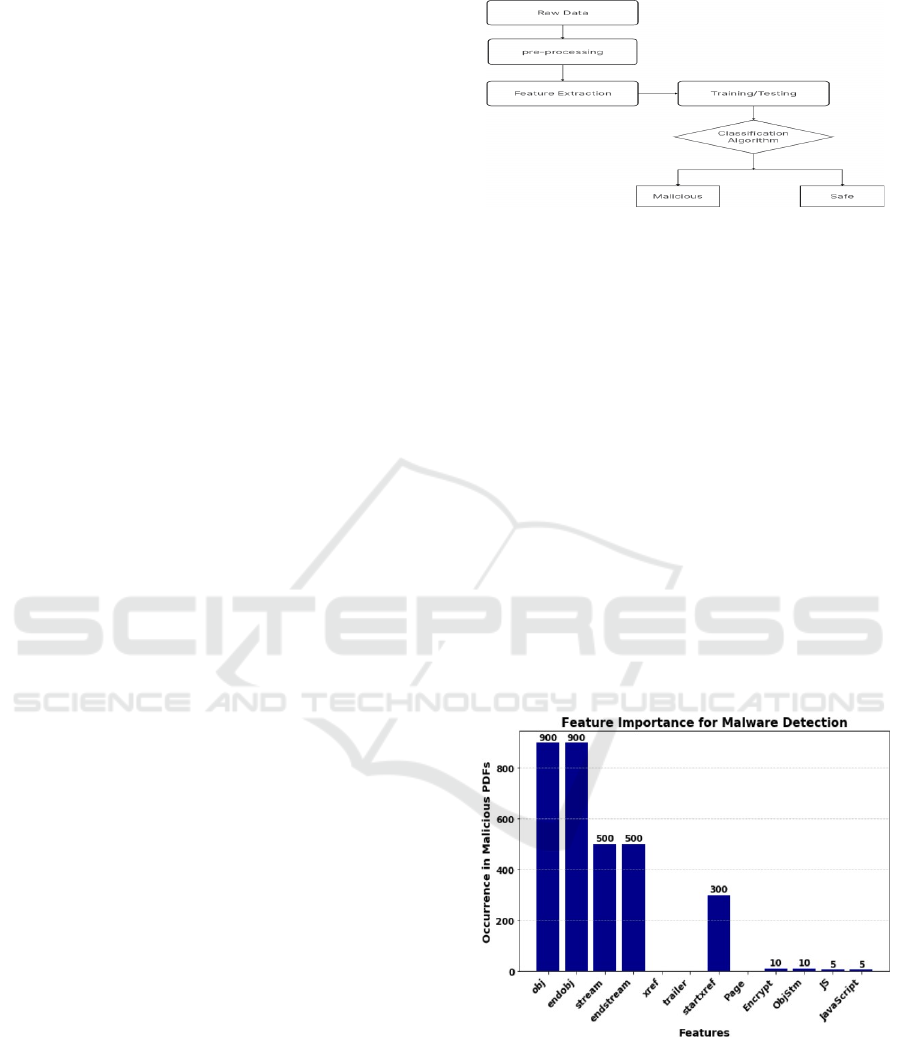
scalability. The system consists of three core
components: Preprocessing, Feature Extraction, and
Classification. The Preprocessing Module extracts
fundamental document properties, such as metadata,
object counts, and encryption details. The Feature
Extraction Module utilizes pdfid.py and PyPDF2 to
analyze security-related indicators, including
JavaScript elements, embedded files, and potential
execution triggers. Finally, the Classification Module
employs a hybrid Random Forest (RF) and Support
Vector Machine (SVM) model to distinguish between
benign and malicious PDFs. Unlike behavioral
malware detection systems that rely on execution-
based analysis, the approach is purely static, ensuring
fast, safe, and reliable detection. Figure 1 Shows the
Architecture of the model.
Figure 1: Architecture of the Model.
3.2 Preprocessing and Feature
Extraction
Static analysis allows for rapid and scalable malware
detection without the risks associated with executing
potentially malicious files. The preprocessing phase
focuses on analyzing the document's structure,
metadata, and security attributes to extract
meaningful indicators. The first step is metadata
extraction, where basic properties such as PDF
version, author information, object counts, and
encryption details are collected. Suspicious metadata
patterns, such as missing author details or excessive
encryption, are flagged as potential threats. Following
this, structural analysis is performed using PyPDF2,
which inspects internal objects, cross-references, and
font structures to detect unusual patterns commonly
seen in obfuscated malware. Figure 2 Shows the
Feature importance for malware detection.
Figure 2: Feature importance for malware detection.
To further understand the impact of different PDF
attributes on malware detection, this system analyzed
the feature importance scores generated by the
Random Forest model.
ICRDICCT‘25 2025 - INTERNATIONAL CONFERENCE ON RESEARCH AND DEVELOPMENT IN INFORMATION,
COMMUNICATION, AND COMPUTING TECHNOLOGIES
802

The top contributing features were:
•
Presence of JavaScript elements
(/JavaScript, /JS): High correlation with
exploit-based attacks.
•
Embedded File Indicators (/Embedded
File, /RichMedia): Frequently used for
payload delivery.
•
Encrypted Streams (/Encrypt): Common in
obfuscated malware.
•
High Entropy in Embedded Objects:
Suggests payload compression or
obfuscation.
•
Number of Objects and Streams:
Abnormal object counts often indicate
polymorphic malware.
The system enhances detection by analyzing
embedded JavaScript and object behavior using link.
It scans for malicious markers, tracks embedded files
and encrypted objects, and computes statistical features
to detect obfuscated malware. Extracted features are
converted into numerical vectors for machine
learning classification, enabling efficient, signature-
independent PDF processing.
3.3 Machine Learning-Based
Classification
To enhance classification accuracy, a hybrid machine
learning model combining Random Forest (RF) and
Support Vector Machine (SVM) was implemented.
The classification process consists of several key
steps. First, feature normalization is performed to
standardize extracted features and ensure
compatibility across different PDFs.
Random Forest is employed as the primary
classifier due to its ability to handle high-dimensional
data and identify important feature patterns. This
algorithm builds multiple decision trees, where each
tree votes on whether a PDF is benign or malicious,
significantly improving detection reliability.
Additionally, Support Vector Machine (SVM) is
integrated to refine classification performance by
defining clear decision boundaries between safe and
harmful PDFs. SVM is particularly useful in
minimizing false positives, ensuring that benign
documents are not misclassified as threats. To
improve overall detection robustness, a threshold-
based decision- making mechanism is applied. This
method uses a weighted voting system between RF
and SVM, ensuring that PDFs with high malware
likelihood scores are confidently labelled as
malicious. This hybrid approach not only increases
classification accuracy but also enhances
interpretability, allowing cybersecurity analysts to
better understand why a PDF is flagged as malicious.
Compared to traditional signature-based are antivirus
solutions, this machine learning approach is adaptive
and resilient against emerging threats, including zero-
day malware and polymorphic attacks.
3.4 Implementation Details
The system is implemented using Python-based
libraries and frameworks, ensuring a lightweight yet
powerful detection mechanism. The Flask-based
backend serves as the core of the system, providing a
user-friendly web interface where users can upload
PDFs for real-time analysis.
PyPDF2 and pdfid.py are used to parse and
analyze PDFs, extracting structural and behavioural
features. These features are then fed into Scikit-learn’s
implementation of Random Forest and SVM models,
which perform the final classification. The dataset
used for training consists of 105,000 PDFs, including
both benign and malicious samples, ensuring that the
model is well-trained to recognize diverse threat
patterns.
The deployment of the system is designed to be
scalable and efficient, running locally through Flask
while maintaining the potential for cloud-based
expansion to accommodate large-scale PDF analysis.
This ensures that organizations can seamlessly
integrate the system into existing cybersecurity
workflows for enhanced threat detection and
mitigation.
4 PERFORMANCE EVALUATION
To validate the effectiveness of the proposed system,
comprehensive performance evaluations were
conducted using a real-world dataset of 105,000
PDFs, containing an equal mix of benign and
malware-infected documents. The Random Forest +
SVM hybrid model achieved an impressive detection
accuracy of 98.9%, significantly outperforming
traditional deep-learning-based models in both
precision and efficiency.
Beyond accuracy, the system demonstrated a low
false-positive rate, ensuring that legitimate PDFs were
not incorrectly flagged as threats. The average
detection time per PDF was approximately 3 seconds,
making the system suitable for real-time scanning
applications. These results highlight the effectiveness
of combining static feature extraction with machine
learning models, demonstrating the system’s ability
to outperform commercial antivirus solutions in
Intelligent Model for PDF Malware Detection
803
malware detection tasks. By leveraging a hybrid
classification approach, statistical analysis, and
structural parsing, the proposed system establishes
itself as a highly accurate, scalable, and explainable
solution for detecting malicious PDF threats in real-
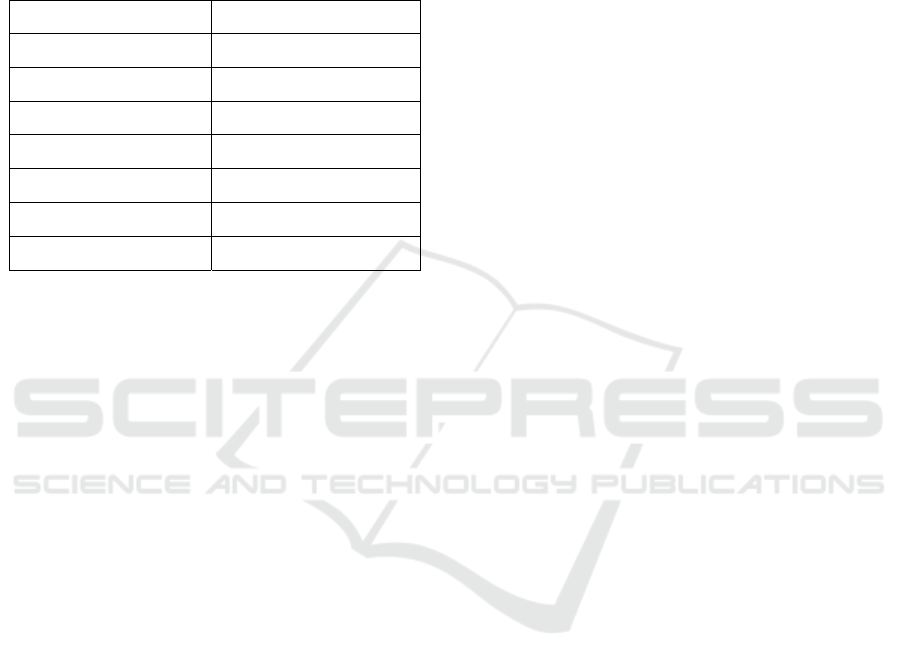
world environments. Table 1 Shows the Performance
metrics of the hybrid RF + SVM.
Table 1: Performance metrics of the hybrid RF + SVM.
Metric Value
Accuracy 98.9%
Precision 98.4%
Recall 99.1%
F1-score 98.7%
False Positive Rate (FPR) 1.2%
False Negative Rate (FNR) 0.9%
Average Detection Time ~3 seconds per PDF
5 RESULTS AND DISCUSSION
5.1 Dataset Overview and
Experimental Setup
To evaluate the performance of the PDF malware
detection system, the experiments are conducted using
a real-world dataset comprising 105,000 PDF files. The
dataset was balanced, containing both benign and
malicious samples, ensuring fair evaluation and
robust model generalization. The malicious PDFs
included various attack vectors, such as JavaScript
exploits, embedded malicious objects, and encrypted
payloads, which were representative of real-world
cyber threats.
The experiments were conducted on a system with
an Intel Core i7 processor, 16GB RAM, and a Python-
based Flask backend. The Random Forest (RF) and
Support Vector Machine (SVM) models were trained
using Scikit-learn, with 80% of the dataset used for
training and 20% for testing. Feature extraction was
performed using PyPDF2 and pdfid.py, capturing
structural and security- related attributes from the
PDFs.
5.2 Accuracy and Detection
Performance
The hybrid RF + SVM classification model achieved
an overall detection accuracy of 98.9%,
outperforming traditional signature-based antivirus
solutions and deep-learning-based malware detection
methods. The high accuracy rate indicates that the
combination of static feature extraction and machine
learning classification effectively differentiates
between benign and malicious PDFs.
The high precision value indicates that the model
has a low false-positive rate, ensuring that benign
PDFs are not incorrectly flagged as malware. The
high recall shows that the model successfully detects
most malicious PDFs, reducing the risk of undetected
threats. The F1-score of 98.7% further confirms that
the model maintains an excellent balance between
precision and recall.
5.3 Comparative Analysis with Other
Detection Methods
To demonstrate the superiority of the proposed
approach, comparisons were made with several
existing malware detection techniques, including:
• Traditional Antivirus Scanners: Signature-
based tools such as Sophos Intercept-X and
Wepawet rely on predefined malware patterns
and struggle against zero-day attacks. These
scanners had a lower detection rate (~85%)
and higher false-positive rates compared to the
model.
• Deep Learning-Based Approaches (ML Pdf):
The MLPdf neural network model, which uses
Multilayer Perceptron (MLP) with
backpropagation, achieved a slightly lower
accuracy of 96.5%, mainly due to overfitting
on specific malware patterns. Deep-learning
models also required significantly more
computational resources, making them less
practical for real-time scanning.
• Hybrid Static + Dynamic Analysis:
Approaches such as NOZZLE and
CWSandbox, which integrate static and
behavioural malware analysis, showed strong
detection capabilities but suffered from high
processing time (~15-20 seconds per PDF),
making them impractical for real-time
applications. Our model accuracies Shown in
Table 2.
The model outperformed traditional antivirus
solutions and deep-learning approaches, offering a
faster, more efficient, and interpretable detection
mechanism. Figure 3 Shows the Feature importance
for malware detection.
ICRDICCT‘25 2025 - INTERNATIONAL CONFERENCE ON RESEARCH AND DEVELOPMENT IN INFORMATION,
COMMUNICATION, AND COMPUTING TECHNOLOGIES
804
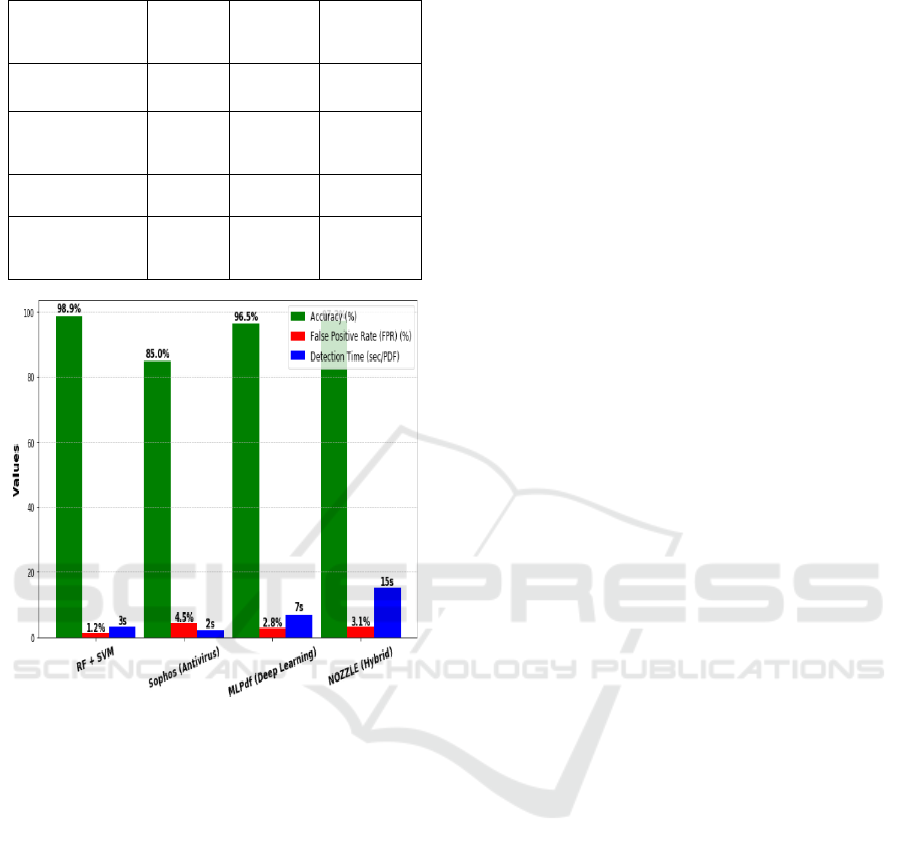
Table 2: Our model accuracies.
Method Accuracy
False
Positive
Rate
(
FPR
)
Detection
Time (Avg)
Our RF + SVM
Model
98.9% 1.2% ~3 sec/PDF
Traditional
Antivirus
(
So
p
hos
)
85.0% 4.5% ~2 sec/PDF
Deep Learning
(
MLPdf
)
96.5% 2.8% ~7 sec/PDF
Hybrid Static +
Dynamic
(
NOZZLE
)
97.2% 3.1% ~15 sec/PDF
Figure 3: Feature importance for malware detection.
5.4 False Positives and False Negatives
Analysis
While the model achieved high accuracy, it was
necessary to investigate the misclassified cases to
identify potential limitations.
False Positives: (~1.2% of benign PDFs were
incorrectly classified as malicious) Some heavily
encrypted PDFs used in corporate settings were
flagged as suspicious.
PDFs with large amounts of embedded media
(e.g., interactive forms) were mistaken for malware-
infected files.
False Negatives: (~0.9% of malicious PDFs were
missed)
• Some obfuscated malware samples with
minimal embedded JavaScript bypassed
detection.
• A few compressed payloads were missed
due to low entropy scores, suggesting the
need for enhanced compression analysis.
To address these issues, future enhancements will
focus on:
• Refining the entropy-based classification for
compressed files. Incorporating behavioural
heuristics for ambiguous cases.
• Implementing incremental learning to adapt to
new malware patterns.
5.5 Scalability and Real-World
Application
The system was tested in real-world cybersecurity
workflows, demonstrating its ability to: Process large
volumes of PDFs quickly (~3 seconds per document).
Provide interpretable threat reports for
cybersecurity analysts. Be deployed in enterprise
environments as a standalone Flask-based application
or cloud-integrated solution.
The results indicate that this approach is well-suited
for organizations that require real-time malware
scanning and detection, without the computational
overhead of deep-learning models.
6 CONCLUSIONS
This study proposes a hybrid machine learning-based
approach for PDF malware detection, integrating
static feature extraction with Random Forest (RF) and
Support Vector Machine (SVM) classification. The
system achieves 98.9% detection accuracy,
outperforming traditional signature- based antivirus
solutions and deep-learning-based detection models,
with a low false positive rate of 1.2%. The approach
is allowing for real-time scanning with an average
detection time of 3 seconds per PDF.
In conclusion, this proposed PDF malware
detection system offers a highly accurate,
interpretable, and scalable approach to combating
PDF-based cyber threats. By combining machine
learning with static analysis, we provide a practical,
efficient, and deployable solution that can be
integrated into modern cybersecurity environments
for real-time malware prevention and risk assessment.
7 FUTURE WORK
While our current approach provides high detection
accuracy and efficiency, several areas of
Intelligent Model for PDF Malware Detection
805

improvement remain for future research and
development:
Extending the Dataset with More Real-World
Malware Samples: The current dataset consists of
105,000 labelled PDFs, but expanding it with more
recent and diverse malware samples will improve
model generalization.
Collaborating with cybersecurity firms and threat
intelligence platforms to access newly discovered
malware signatures can help stay ahead of emerging
attack vectors.
REFERENCES
Adobe, "PDF Reference and Adobe Extensions
to The PDF
specification,"https://www.adobe.com/devnet/pdf/pdf-
reference.html/, accessed: 2018-03.
B. Cuan, A. Damien, C. Delaplace, and M. Valois,
"Malware Detection in PDF Files Using Machine
Learning," REDOCS, Tech. Rep. Rapport LAAS No.
18030, Feb. 2018.
C. Willems, T. Holz, and F. Freiling, "Toward Automated
Dynamic Malware Analysis Using CWSandbox," IEEE
Security & Privacy, vol. 5(2), 2007.
C. Smutz and A. Stavrou, "Malicious PDF Detection Using
Metadata and Structural Features," in Proceedings of
the 28th Annual Computer Security Applications
Conference, Orlando, Florida, USA, 2012.
D. Maiorca, G. Giacinto, and I. Corona, "Machine Learning
and Data Mining in Pattern Recognition," in volume
7376 of Lecture Notes in Computer Science, Springer
Berlin / Heidelberg, 2012.
F. Shaheen, B. Verma, and M. Asafuddoula, "Impact of
Automatic Feature Extraction in Deep Learning
Architecture," in Proceedings of the International
Conference on Digital Image Computing Techniques
and Applications, 2016, Queensland, Australia, 2016.
I. Goodfellow, Y. Bengio, and A. Courville, "Deep Learni
ng," The MIT Press, 2016.
J. S. Cross and M. A. Munson, "Deep PDF Parsing to
Extract Features for Detecting Embedded Malware,"
Sandia National Laboratories, Albuquerque, New
Mexico 87185 and Livermore, CA 94550, Tech. Rep.
SAND2011-7982, Sep. 2011.
J. Zhang, "Make 'Invisible' Visible - Case Studies in PDF
Malware," in Proceedings of Hacktivity 2015,
Budapest, Hungary, 2015.
J. Zhang and J. Rabaiotti, "The PDF Exploit:
Same Crime, Different Face," https://www.symantec.c
om/connect/blogs/pdf-exploit-same-crime different-
face/, accessed: 2018-03.
N. Srndic and P. Laskov, "Detection of Malicious PDF Files
Based on Hierarchical Document Structure," in
Proceedings of the 20th Annual Network & Distributed
System Security Symposium, San Diego,
CA, USA, 2013. Poppler https://poppler.freedesktop.o
rg/, accessed: 2018-03.
P. Ratanaworabhan, B. Livshits, and B. Zorn, "NOZZLE:
A Defense Against Heapspraying Code Injection
Attacks," in SSYM'09 Proceedings of the 18th
Conference on USENIX Security Symposium, Berkele
y, CA, USA, 2009.
P. Laskov and N. Srndic, "Static Detection of Malicious
JavaScript-Bearing PDF Documents," in Proceedings
of the 27th Annual Computer Security Applications
Conference, Orlando, Florida, USA, 2011.
Sophos, "Sophos Unmatched Next Gen Endpoint Protectio
n: Intercept X," https://www.sophos.com/enus/product
s/interceptx.aspx, accessed: 2018 03. Wepawet, http://
wepawet.iseclab.org/, accessed: 2018-03.
T. Mitchell, "Machine Learning," McGraw Hill, 1997.
Z. Tzermias, G. Sykiotakis, M. Polychronakis, and E. P.
Markatos, "Combining Static and Dynamic Analysis
for the Detection of Malicious Documents," in
Proceedings of the Fourth Workshop on European
Workshop on System Security, Salzburg, Austria,
2011.
ICRDICCT‘25 2025 - INTERNATIONAL CONFERENCE ON RESEARCH AND DEVELOPMENT IN INFORMATION,
COMMUNICATION, AND COMPUTING TECHNOLOGIES
806
