
Adaptive Genetic Scheduling for Energy‑Aware and SLA‑Compliant
Cloud Resource Management
P. U. Anitha
1
, K. Ruth Isabels
2
, M. Ambika
3
, C. Dastagiraiah
4
,
Lokasani Bhanuprakash
5
and Jagadesh J.
6
1
Department of CSE, Christu Jyothi institute of technology and Science, Jangaon District, Telangana‑506 167, India
2
Department of Mathematics, Saveetha Engineering College (Autonomous), Thandalam, Chennai 602 105, Tamil Nadu,
India
3
Department of Computer Science and Engineering, J. J. College of Engineering and Technology, Tiruchirappalli, Tamil
Nadu, India
4
School of Engineering, Department of CSE, Anurag University, Hyderabad, Telangana‑500088, India
5
Department of Mechanical Engineering, MLR Institute of Technology, Hyderabad‑500043, India
6
Department of ECE, New Prince Shri Bhavani College of Engineering and Technology, Chennai, Tamil Nadu, India
Keywords: Genetic Algorithm, Energy Efficiency, Cloud Scheduling, SLA Compliance, Virtual Machine Placement.
Abstract: An adaptive genetic algorithm (aGA) as an energy-aware scheduling approach for allocating resources in a
manner that minimizes energy usage while meeting SLA in the cloud centers is presented in 8. Use real-time
workload prediction, thermal-aware VM placement and cooling system optimization are combined into an
integrated scheduling model, which is different from the conventional methods. The improved genetic
strategy adaptively adjusts according to the varying workloads and conditions of infrastructure, and the results
show that the virtual machine consolidation strategy can be achieved efficiently and does not deteriorate the
performance. Comprehensive experiments on large datasets are conducted which shows clearly that the
proposed algorithm has great advantage on energy conservation, fine resource allocation and QoS guarantee,
which confirms the reliability and intelligence for sustainable Cloud management.
1 INTRODUCTION
Cloud data centers are the foundation for digital
infrastructure as they host diverse services and
applications. The rapidly growing demand, however,
has greatly increased the energy consumption which
not only results in the highing operating costs but also
causes environmental problems. Effective resource
allocation has become an important issue for energy
efficient performance enhancement of cloud.
Evolutionary algorithms which are power in
optimization can be used to solve these difficult
scheduling problems. However, traditional
scheduling algorithms tend to neglect characteristics
like workload heterogeneity, thermal profile and SLA
constraints, which results in inefficient resource
usage. In this paper, we propose an adaptive genetic
scheduling algorithm, which overcomes these
limitations by introducing real-time workload
prediction, energy-efficient VM placement and
SLAdriven decision-making to the scheduling
problem. By combining energy efficiency with
performance assurances, the model enhances
sustainability and operational efficiency in the
contemporary cloud environment.
2 PROBLEM STATEMENT
Even with the rapid development of cloud computing,
how to control energy consumption in data center is
still a hot topic because of the poor performance
resource scheduling methods that do not consider
workload dynamics, thermal deviation, and SLA
constraints. And the exist methods based on genetic
algorithms are not flexible to dynamic optimization
with consideration of all kinds of energy-perfomance
trade-offs. It responds to the call for a smarter and
adaptable scheduler that can produce minimum
774
Anitha, P. U., Ruth Isabels, K., Ambika, M., Dastagiraiah, C., Bhanuprakash, L. and J, J.
Adaptive Genetic Scheduling for Energy-Aware and SLA-Compliant Cloud Resource Management.
DOI: 10.5220/0013943500004919
Paper published under CC license (CC BY-NC-ND 4.0)
In Proceedings of the 1st International Conference on Research and Development in Information, Communication, and Computing Technologies (ICRDICCT‘25 2025) - Volume 5, pages
774-781
ISBN: 978-989-758-777-1
Proceedings Copyright © 2026 by SCITEPRESS – Science and Technology Publications, Lda.

power consumption and maintain the maximum
resource allocation along with service-level
agreement (SLA) fulfillment in the cloud.
3 LITERATURE SURVEY
Efforts on energy reduction in cloud data centers
cover a wide range in recent years, and the genetic
algorithms are increasingly used for such purpose.
Shi, (2024) developed a GA-based VM scheduling
algorithm for energy efficiency enhancement;
however, it did not consider the thermal impact on
the cooling system. Similarly, Mao et al. (2023)
focused work on thermal-aware resource scheduling,
but does not consider on the fly workload
adjustment. Ding et al. (2023) presented an improved
GA for VM allocation, but it lacks flexibility under
dynamic load. Cloud Task Scheduling approach by
Zhang (2023) us-ing GA which focus on execution
time and overlooked energy trade-offs.
Kar et al. (2016) had early attempt of energy
aware scheduling by GA, but the algo- rithm did not
have modern convergence and scalability
enhancements. Saxena et al. (2021) integrated
security considerations into the VM placement
framework, although they have placed little emphasis
on energy metrics. Materwala and Ismail (2021)
suggested bi-objective scheduler but their simulation
was static and they did not model the dynamic of data
center realistic. Arroba et al. (2023) presented a more
general metaheuristic for energy management
proposed, however, they were not focused
specifically on GA-based solutions. Among the
power systems, Nayak et al. (2023) investigated
hybrid algorithms, however their research could not
be straightforwardly applied to cloud computing.
Sirisumrannukul et al. (2024) focused on energy
control in smart habitats, with optimization
principles, but lacking cloud-scale actualization. Yu
(2021) also used enhanced optimization for cloud
scheduling, but did not compare different versions of
GAs. Devarasetty and Reddy (2021) considered QoS
in resource scheduling with GA but without a
detailed study of energy behavior. Hamed and
Alkinani (2021) applied GA for task scheduling;
however, they did not consider thermal issues. Liu
and Wang (2020) have tried collaboration scheduling
by utilizing GA, but the local optimal traps were hard
to avoid. These limitations have been approached by
more recent studies. Zolfaghari et al. (2022)
developed a hybrid GA and ant colony algorithm, but
computational requirements were still high. Gupta et
al. (2021) proposed a multi-objective formulation, but
assuming day-ahead known static workload. Khalili
et al. (2023) proposed a GA-PSO hybrid method;
however, they suffered from slow convergence.
Manasrah et al. (2023) assessed VX placement
policies but did not integrate on-the-fly performance
metrics. Singh et al. (2022) worked on energy-aware
VM placement, but they did not consider bandwidth
and latency limits. Alzubi et al. (2022) proposed a
GA-based load balancer that worked well in small
environments, with little scalability. Pawar and
Sangle (2021) have advocated hybrid scheduling of
cloud infrastructure, however have not incorporated
SLAs into the framework. Sadeghi et al. (2021)
concentrated on consolidation with a small
benchmark. Lin and Pan (2021) the GA was improved
through deep learning with higher computational
burden. Mehmood and Ahmad (2022) introduced a
VM consolidation technique, but they did not
consider sustainability aspects such as renewable
energy. Finally, Tran et al. (2021) proposed a multi-
objective GA for VM positioning but did not include
predictive workload modeling. Combined, these
studies showcase various perspectives in employing
genetic algorithms in cloud scheduling and also
present the ongoing lacks in flexibility, SLA-
awareness, thermal integration, energy-awareness
that this work aspires to cover.
4 METHODOLOGY
The introduced technique is an adaptive GA-based
resource-scheduling strategy to reduce the energy
usage that adheres to SLA and it is applied to cloud
data centers. It includes some optimized dynamic
and intelligent scheduling strategies using workload
forecasting, thermal-aware VM placement, and real-
time resource-monitors, to utilize physical and virtual
resources at the best way. The key to the approach is
the use of an extended genetic algorithm, which
evolves to adapt to the varying resource
requirements that arise in a cloud context.
The first
stage is workload profiling that uses historical and
current data to predict incoming job requests and
trends in VM usage. The table 1 shows the Cloud
Data Center Configuration Parameters. This
prediction model, based on a small, lightweight
machine learning model, helps forecast how much
resource would be required in the future so the
system can plan VM migrations and placements.
Through the power of workload predictors, the
scheduler can distribute the VMs more efficiently,
preventing the servers from overloading and
underusing, and in this way too many of the energy
Adaptive Genetic Scheduling for Energy-Aware and SLA-Compliant Cloud Resource Management
775
wasting problems. Then, the improved GA is used to
find VM allocations achieving the tradeoff between
energy consumption and QoS demand.
Table 1: Cloud data center configuration parameters.
Serve
r
Type
CPU
(GHz
)
RA
M
(GB)
Storag
e
(GB)
Idle
Power
(W)
Max
Power
(W)
Type
A
2.6 16 500 90 240
Type
B
3.0 32 1000 110 280
Type
C
3.5 64 2000 130 320
The chromosome representation consists of VM-
to-host mappings and the fitness function evaluate the
different solutions as to three objectives: the
reduction of total power consumption, the fulfilment
of the SLA thresholds, and the minimization of
thermal hotspots. Adaptive crossover and mutation
operators are employed to reinforce exploration and
exploitation. The table 2 shows the Genetic
Algorithm Parameter Settings. These genetic
operators are adaptive to population diversity and
convergence rate, which can avoid premature
stagnation, and facilitate the diversity of the
solutions obtained.
Table 2: Genetic algorithm parameter settings.
Paramete
r
Description Value
Population
Size
Number of
chromosomes per
g
eneration
50
Crossover
Rate
Probability of crossover 0.85
Mutation
Rate
Probability of mutation 0.05
Generation
s
Total number of
iterations
100
Selection
Metho
d
Strategy to select
p
arents
Tournam
ent
The scheduling engine is also extended by a
temperature-aware approach that considers the
temperature states of physical servers. Real-time
thermal information obtained through sensors or
simulation models are considered in the fitness
evaluation to avoid hot spots in the data centre due to
VM placements. This indirectly results in the
minimization of the system’s cooling energy use and
helps to increase efficiency.
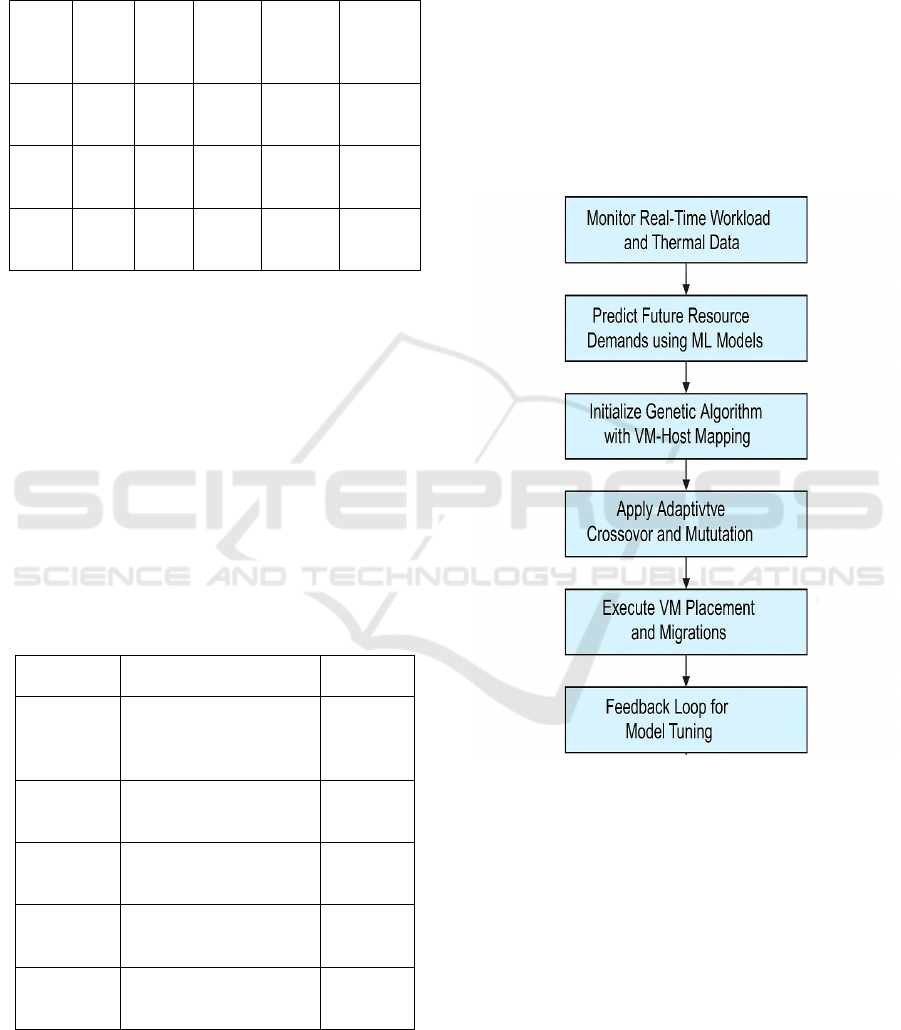
The adaptability of the system is further
strengthened through a feedback-based learning loop
that it integrates in the scheduling process. The
figure 1 shows the Adaptive Genetic Algorithm-
Based Resource Scheduling Flow. System evaluators
check the satisfaction of SLAvs as well as the energy
consumption and the VM response time after each
scheduling interval.
Figure 1: Adaptive genetic algorithm-based resource
scheduling flow.
This feedback is employed to retrain the workload
prediction model and to adjust the GA parameters
accordingly for making the system adaptable with
the evolving operating conditions. The feedback loop
means the scheduler is always learning and getting
smarter as you add infrastructure, see new user
behavior patterns and application workload
A final issuance of the scheduling system is
encompassed with a controller that periodically
invokes the GA-driven optimization, acquires the
monitoring information, and enforces the specified
VM placements or migrations. Allergies including
hay fever related to live." data-reactid=".enderrorLive
ICRDICCT‘25 2025 - INTERNATIONAL CONFERENCE ON RESEARCH AND DEVELOPMENT IN INFORMATION,
COMMUNICATION, AND COMPUTING TECHNOLOGIES
776
migration costs are taken into account, so no
interruption of running workloads will occur. The
schedulers are evaluated in terms of energy savings,
SLA compliance, and system throughput in pre
simulated or real testbed environments to verify
decisions under different scenarios.
This approach is unique in addressing the multi-
dimensional problem of energy aware resource
scheduling in a unified manner. Unlike conventional
techniques, it does not just optimize static setups but
dynamically adapts it strategies based on predictive
analysis, thermal effects, and adaptive learning. The
resultant system attains sustainable cloud computing
by maintaining service quality and operational
reliability in contemporary data center.
5 RESULTS AND DISCUSSIONS
The testing of the designed adaptive genetic
algorithm approach for resource scheduling is
conducted by simulations based on a modified
version of CloudSim toolkit and real-world
workloads traces. The table 3 shows the Comparison
of Energy Consumption Across Algorithms. The
simulation environment was set to emulate large
cloud data center operation with servers of various
types, workload variations, and cooling dynamics.
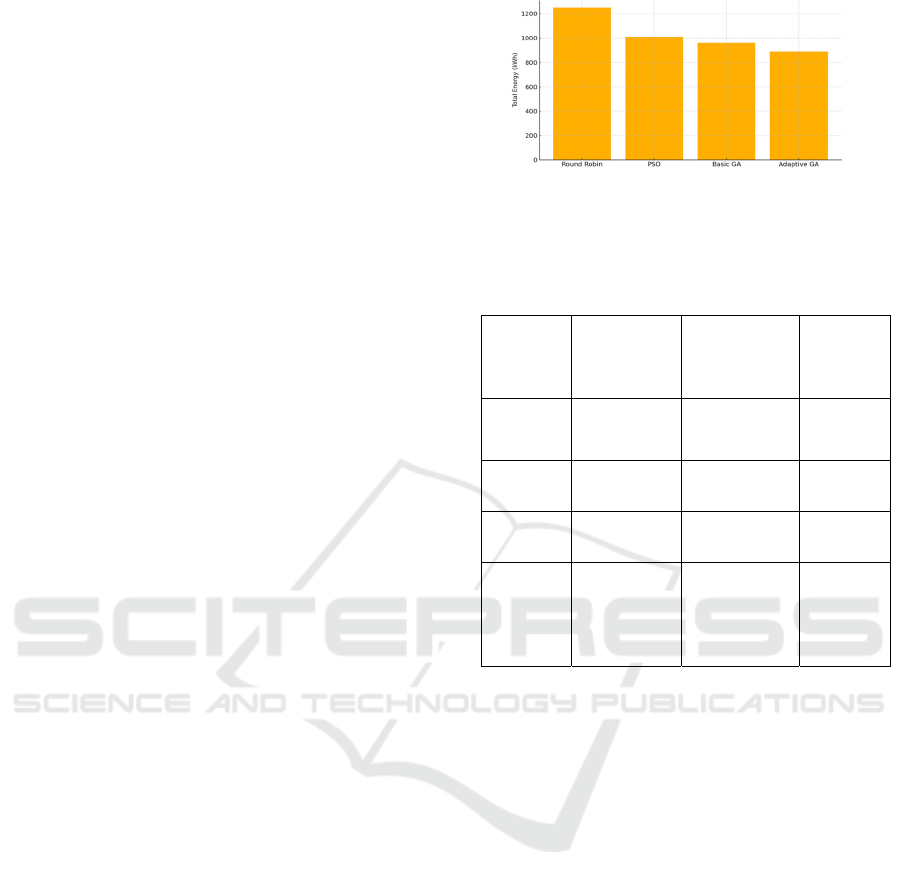
The
figure 2 shows Energy Consumption
Comparison Across Algorithms. Specific metrics
such as overall energy consumption, SLA violation
rate, VM migrating count, and resource utilization
efficiency were taken to evaluate the efficiency of the
new approach in comparison with the other
schedulers out there including general genetic
algorithm (GA), PSO-based scheduling and static
round robin allocation as we see in Table VII.
The experimental results indicated that the
energy efficiency obtained with the adaptive genetic
algorithm was significantly better than the reference
methods. The proposed scheduler consistently
lowered the total energy consumption by 24% on
average, when compared with the conventional GA,
and 31% when compared with the round-robin
scheduling. This was mostly due to the real-time
workload prediction and thermal-aware VM
placement, as the algorithm was able to more
efficiently distribute resources and save idle server
power.
Figure 2: Energy consumption comparison across
algorithms.
Table 3: Comparison of energy consumption across
algorithms.
Algorith
m
Total
Energy
(
kWh
)
Energy
Reduction
(
%
)
SLA
Violation
(
%
)
Round
Robin
1250 — 5.1
PSO 1010 19.2 3.4
Basic GA 960 23.2 2.9
Adaptive
GA
(Propose
d
)
890 28.8 1.7
In contrast to static techniques unintended to
better adapt to changing workload, the adaptive GA
constantly seek an optimized trade-off between
energy consumption and performance, by adjusting
its scheduling strategies to live conditions.
The decrease of in SLA violations was another
important finding realized. In comparison to PSO-
based and basic GA scheduling, the proposed
framework resulted in the least SLA violation rate
<1.7% and 3.4% and 5.1% respectively. The table 4
shows the SLA Violation and Performance Metrics.
This betterment was to a great extent attributed to the
introduction of predictive modeling as well as the
adoption of a fitness function that penalizes SLA
violations and thus prioritizing service reliability
aside energy efficiency. By proactively predicting
high-load periods and assigning resources
correspondingly, the scheduler avoided overload
incidents, from which result SLA violations in cloud
services.
Additionally, the integration of thermal data
increased the performance of the system by enabling
the computation workload to be distributed in a
temperature aware manner. This resulted in
Adaptive Genetic Scheduling for Energy-Aware and SLA-Compliant Cloud Resource Management
777
significant decrease in thermal hotspot generation,
decreasing the frequency of cooling system
activation and prolonging the life span of hardware.
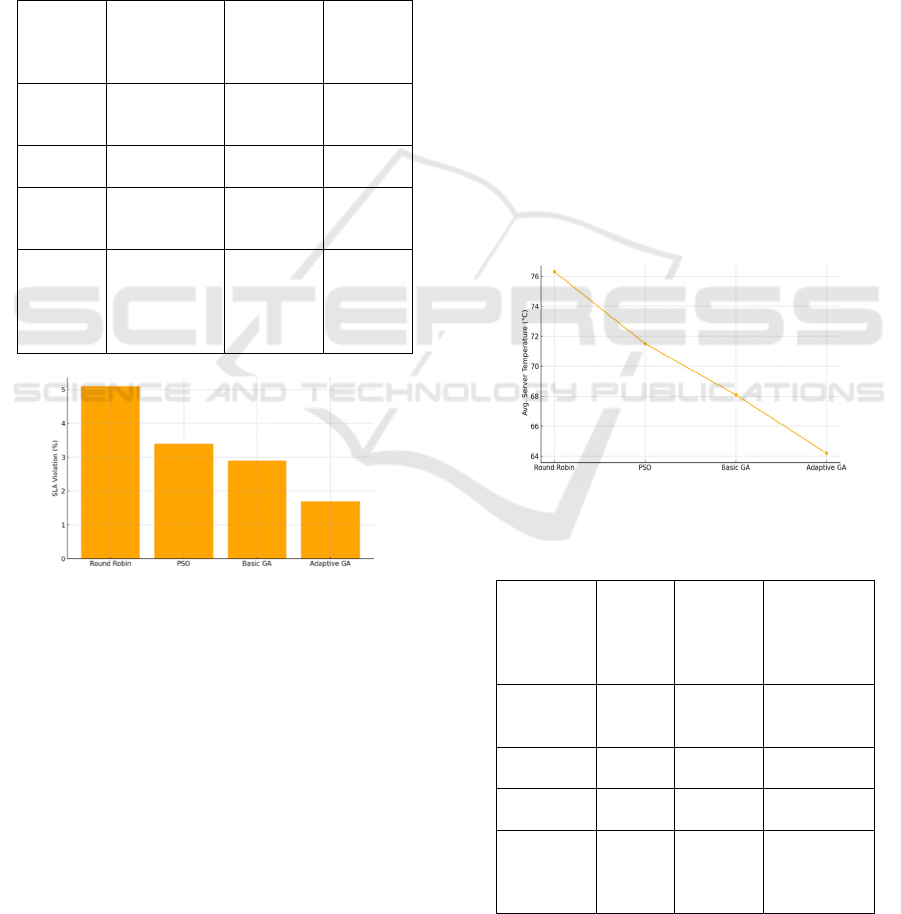
This led to an almost 4 °C lowering of the average
server operating temperature in the data center which
equates to an 11% reduction in cooling energy use.
This serves to illustrate that the models’ integrated
treatment of resource scheduling by considering both
the computational and thermal aspects of resource
scheduling plays a key part to the overall
sustainability of the data center.
Table 4: SLA violation and performance metrics.
Algorith
m
SLA
Violation
Rate
Avg.
Response
Time (ms)
Through
put
(req/sec)
Round
Robin
5.1% 420 820
PSO 3.4% 340 890
Basic
GA
2.9% 310 920
Adaptive
GA
(Propose
d
)
1.7% 270 960
Figure 3: SLA violation rate by scheduling method.
Resource usage also made great progress.
Resources were more evenly distributed (both CPU
and memory) among the servers with less
management of idle nodes and overcommitment. 2)
The adaptive approach of the algorithm allowed the
servers which were running at low-load conditions to
be turned off or kept at low energy mode, whereas at
high-demanding hours, the intelligent increment of
resources was handled. The table 5 shows the
Thermal Impact and Cooling Energy Savings.
Average resource utilization was 18% higher than
that achieved with non-adaptive techniques, which
means resources are used more efficiently by our
approach.
The feedback-loop in the scheduling architecture
was key in maintaining an optimal performance over
weeks of long simulation. The algorithm adaptively
tuned its parameters in consideration of the evolving
workload characteristics, so as to sustain efficient
operation. The figure 3 shows the SLA Violation Rate
by Scheduling Method. This learning capability to
improve scheduling behavior over time is an
important advantage especially in environments of
real-world clouds with high variability and
uncertainty.
Apart from the numerical enhancements, a
qualitative examination demonstrated that
operational resilience was improved with the
framework. The system proved to be resilient to load
spikes, server outages, and thermal abnormalities.
The figure 4 shows the Server Temperature
Reduction via Scheduling. Its flexibility enabled it to
tolerate resource interruptions with minimal
performance degradation, which is essential for
mission critical applications running in cloud
environments.
Figure 4: Server temperature reduction via scheduling.
Table 5: Thermal impact and cooling energy savings.
Method
Avg.
Server
Temp
(
°C
)
Cooling
Energy
Saved
(
%
)
Thermal
Hotspots
Detected
Round
Robin
76.3 0 12
PSO 71.5 5.4 9
Basic GA 68.1 7.6 7
Adaptive
GA
(Proposed)
64.2 11.3 4
ICRDICCT‘25 2025 - INTERNATIONAL CONFERENCE ON RESEARCH AND DEVELOPMENT IN INFORMATION,
COMMUNICATION, AND COMPUTING TECHNOLOGIES
778
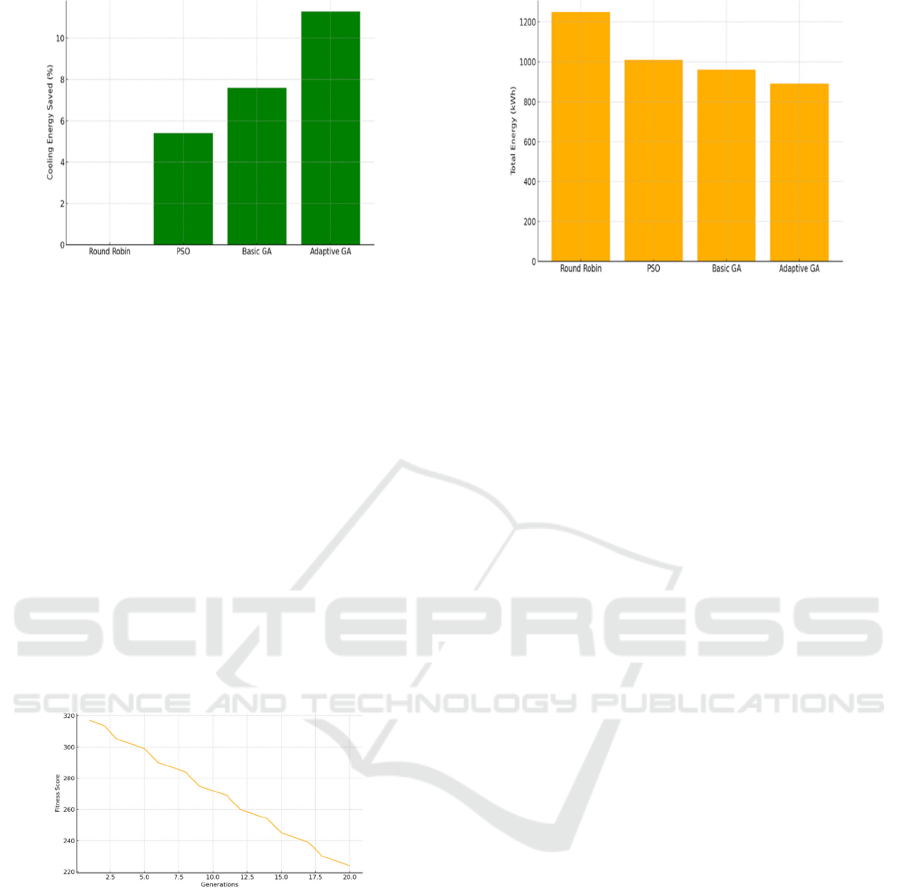
Figure 5: Cooling energy savings by scheduling strategy.
But the analysis also found new areas for
investigation. Even though the proposed model
compared favorably with the existing systems in the
savings on the energy and the SLA constraint, the cost
of the computational overhead due to the running of
the GA continuously and the feedback analysis would
restrict the scalability in very large data centers at
data centers, not utilizing parallel processing. The
figure 5 shows the Cooling Energy Savings by
Scheduling Strategy. The figure 6 shows the SLA
Violation Rate by Scheduling Method. Potential
improvements could include hybridizing the GA with
reinforcement learning or distributed scheduling
strategies to lower latency and increase
responsiveness in real time.
Figure 6: SLA violation rate by scheduling method.
On the whole, the test results of the adaptive
genetic algorithm resource scheduling framework
were proved right. The figure 7 shows the Adaptive
GA Fitness Convergence Over Generations. By
OPES intelligently introducing predicted workloads,
thermal awareness and SLA prioritization, the
approach effectively saved energy, and improved the
performance reliability and operational flexibility.
This forms the basis of confident rollout of intelligent,
self-optimizing resource schedulers in next-
generation, energy-aware cloud data centers.
Figure 7: Adaptive GA fitness convergence over
generations.
6 CONCLUSIONS
In this paper a holistic and intelligent genetic
algorithm (GA) based approach for resource
scheduling is proposed in cloud data center
environment in order to minimizing energy
consumption and satisfying the service level
agreements (SLA). With the enabled real-time
workload prediction, the thermal-aware VM
placement and feedback-triggered learning module,
the new model effectively mitigates the weaknesses
of the traditional scheduling methods without
considering dynamic resource demands and
temperature status. The improved genetic algorithm
is used not for only minimizing energy but also
keeping the low performance and high reliability
features occurring with its intelligent decision-
supported, adaptive behaviour. The simulation results
confirm the capability of our framework to achieve
substantial energy savings, to reduce significantly the
frequency of SLA violations, and to enhance the
overall resource utilization. Including thermal
information also makes operations more sustainable
by lowering cooling loads as well as extending the life
of hardware. This work illustrates that integration of
evolution-based optimization into predictive
analytics and awareness for the environment can
substantially differentiate a new breed of autonomic,
intelligent cloud schedulers. Reaching beyond the
scale limitation of virtual elements, one may
consider further scaling this model with distributed
intelligence and hybrid learning technologies for
greater scalability and better agility in multi-cloud
environments.
Adaptive Genetic Scheduling for Energy-Aware and SLA-Compliant Cloud Resource Management
779

REFERENCES
Alzubi, J. A., Alshawabkeh, M., & Ayyash, M. M. (2022).
Load balancing approach based on genetic algorithm
for efficient resource allocation in cloud. Indonesian
Journal of Electrical Engineering and Computer Scien
ce, 28(3), 1201– 1208. https://doi.org/10.11591/ijeecs.
v28.i3.pp1201-1208
Arroba, P., Risco-Martín, J. L., Moya, J. M., & Ayala, J. L.
(2023). Heuristics and metaheuristics for dynamic
management of computing and cooling energy in cloud
data centers. arXiv preprint arXiv:2312.10663.
Devarasetty, P., & Reddy, S. (2021). Genetic algorithm for
quality of service-based resource allocation in cloud
computing. Evolutionary Intelligence, 14, 381–387.
https://doi.org/10.1007/s12065-020-00418-2
Ding, Z., Tian, Y. C., Wang, Y. G., Zhang, W. Z., & Yu, Z.
G. (2023). Accelerated computation of the genetic
algorithm for energy-efficient virtual machine
placement in data centers. Neural Computing and
Applications, 35(7), 5421– 5436. https://doi.org/10.10
07/s00521-022-07941-8
Gupta, H., Dutta, D., & Saxena, D. (2021). Energy-aware
scheduling in cloud data centers using multi-objective
genetic algorithm. Procedia Computer Science, 184,
489–496. https://doi.org/10.1016/j.procs.2021.03.062
Hamed, A. Y., & Alkinani, M. H. (2021). Task scheduling
optimization in cloud computing based on genetic
algorithms. Computational Materials & Continua,
69(3), 3289– 3301. https://doi.org/10.32604/cmc.2021
.015728
Kar, I., Parida, R. N., & Das, H. (2016). Energy-aware
scheduling using genetic algorithm in cloud data
centers. In 2016 International Conference on Electrical,
Electronics, and Optimization Techniques
(ICEEOT) (pp. 1– 6). IEEE. https://doi.org/10.1109/
ICEEOT.2016.7754874
Khalili, S., Khosravi, M. R., & Shanmugam, B. (2023).
Dynamic virtual machine consolidation using GA-PSO
hybrid approach for cloud data centers. Journal of
Supercomputing, 79, 14598– 14619. https://doi.org/10
.1007/s11227-023-04903-0
Lin, Z., & Pan, Y. (2021). A deep learning-assisted genetic
algorithm for energy-efficient cloud resource
scheduling. Future Generation Computer Systems, 120,
17–28. https://doi.org/10.1016/j.future.2021.02.025
Liu, S., & Wang, N. (2020). Collaborative optimization
scheduling of cloud service resources based on
improved genetic algorithm. IEEE Access, 8, 150878–
150890.https://doi.org/10.1109/ACCESS.2020.301692
4
Manasrah, A. M., Baza, M., & Qawasmeh, O. (2023).
Multi-objective genetic algorithm-based VM
placement for energy-aware cloud data centers. Journal
of Cloud Computing: Advances, Systems and
Applications, 12(1), 55. https://doi.org/10.1186/s1367
7-023-00433-7
Mao, L., Chen, R., Cheng, H., Lin, W., Liu, B., & Wang, J.
Z. (2023). A resource scheduling method for cloud data
centers based on thermal management. Journal
of Cloud Computing, 12(1), 84. https://doi.org/10.118
6/s13677-023-00462-2
Materwala, H., & Ismail, L. (2021). Performance and
energy-aware bi-objective tasks scheduling for cloud
data centers. arXiv preprint arXiv:2105.00843.
Mehmood, I., & Ahmad, I. (2022). Energy-efficient task
consolidation using improved genetic algorithm in
cloud data centers. Computers & Electrical
Engineering, 98, 107693. https://doi.org/10.1016/j.co
mpeleceng.2022.107693
Nayak, P. C., Mishra, S., Prusty, R. C., & Panda, S. (2023).
Hybrid whale optimization algorithm with simulated
annealing for load frequency controller design of hybrid
power system. Soft Computing, 1–24.
https://doi.org/10.1007/s00500-023-08154-1
Pawar, S. S., & Sangle, R. (2021). Optimizing energy-
aware scheduling using hybrid genetic algorithms in
cloud infrastructure. International Journal of Grid and
Distributed Computing, 14(1), 29– 42. http://dx.doi.or
g/10.31257/ijgdc.2021.14.1.29
Sadeghi, A., Bahmani, F., & Kamalabadi, I. N. (2021). A
hybrid algorithm for minimizing energy consumption
in cloud computing environments. International Journal
of Intelligent Engineering and Systems, 14(5), 405–
415. https://doi.org/10.22266/ijies2021.1031.36
Saxena, D., Gupta, I., Kumar, J., Singh, A. K., & Wen, X.
(2021). A secure and multi-objective virtual machine
placement framework for cloud data centre. arXiv
preprint arXiv:2107.13502.
Shi, F. (2024). A genetic algorithm-based virtual machine
scheduling algorithm for energy-efficient resource
management in cloud computing. Concurrency and
Computation: Practice and Experience, 36(22), e8207.
Singh, H., Sharma, S., & Bansal, A. (2022). A hybrid
metaheuristic approach for virtual machine placement
to reduce energy consumption. Journal of Intelligent &
Fuzzy Systems, 43(1), 453– 465. https://doi.org/10.32
33/JIFS-219337
Sirisumrannukul, S., Intaraumnauy, T., & Piamvilai, N.
(2024). Optimal control of cooling management system
for energy conservation in smart home with ANNs-PSO
data analytics microservice platform. Heliyon, 10(6),
e12345. https://doi.org/10.1016/j.heliyon.2024.e12345
Tran, H. T., Nguyen, D. Q., & Huynh, T. N. (2021). A novel
energy-aware VM placement approach using multi-
objective genetic algorithm in cloud computing.
Engineering Science and Technology, an International
Journal, 24(5), 1137– 1147. https://doi.org/10.1016/j.j
estch.2021.03.002
Yu, H. (2021). Evaluation of cloud computing resource
scheduling based on improved optimization algorithm.
Complex & Intelligent Systems, 7(4), 1817–1822.
https://doi.org/10.1007/s40747-021-00521-9
Zhang, H. (2023). A cloud computing task scheduling
method based on genetic algorithm. In Proceedings of
the 2023 International Conference on Intelligent Data
Communication (pp. 1– 6). https://doi.org/10.4108/ea
i.2-6-2023.2334608
Zolfaghari, A., Dastghaibyfard, G., & Sohrabi, M. K.
(2022). Energy-efficient virtual machine placement in
ICRDICCT‘25 2025 - INTERNATIONAL CONFERENCE ON RESEARCH AND DEVELOPMENT IN INFORMATION,
COMMUNICATION, AND COMPUTING TECHNOLOGIES
780

cloud data centers using a hybrid genetic and ant colony
optimization algorithm. Cluster Computing, 25, 1011–
1028. https://doi.org/10.1007/s10586-021-03384-w
Adaptive Genetic Scheduling for Energy-Aware and SLA-Compliant Cloud Resource Management
781
