
GroQ SQL Travel Planner: Book Flights, Hotels, Tours,
Weather‑Based Recommendations and Chatbot Support with
Firebase Login and SuperBase Captcha
Gayathri Ramasamy, Gurupriya M., Gamidi Rohan, Vinitha Chowdary A.,
Tejaswi Muppala and M. Hemasri
Department of Computer Science and Engineering, Amrita School of Computing, Bengaluru, Karnataka, India
Keywords: Chatbot Support, Firebase Authentication, Flight Booking, Google Sign‑In, GroQ API, Guided Tours, Hotel
Reservations, MySQL Database, Node.js Backend, OpenWeatherMap API, React.js Frontend, RESTful API,
Superbase CAPTCHA, Travel Planner, Weather Recommendations.
Abstract: GroQ SQL travel planner is an online portal encompassing all the important features to make and manage a
scheduled trip such as flight booking, hotel reservation, guided tours, with weather-based recommendations
and a chatbot support. For a seamless user experience, this application employs a React.js frontend, a MySQL
database, and Node.js and Express for the backend. For authentication, Firebase provides Authentication and
Google Sign-in and to avoid bot access Superbase provides CAPTCHA. The system has the ability to make
use of RESTful APIs to dynamically connect the frontend with that backend and database and filter the options
in real-time improving the way in which the frontend is linked to the backend and database. Weather data
from Open Weather Map API and a GroQ-based chatbot further enrich users’ experience to provide an AI
driven approach. This application can further filter users’ needs matching, searching for certain places,
services, and personalizing the trip, and thus, making this a robust application which provides travel solutions.
1 INTRODUCTION
Tour planning can be seen as dealing with a disparate
set of services for scheduling flights, accommodation,
and excursions as well as such issues as weather
conditions, security and individual customers. This
makes the process rather a lengthy and tedious
exercise and at the same time fraught with several
errors most especially if the end user does not have
prior experience with the tools and/or the resources at
his disposal. Having no single platform just amplifies
the issue, and as a result, there is inconvenience and
compromised satisfaction with travel.
This poses on society disadvantage in that it
denies society the best travel itineraries, leads to
overcharge and has negative effects on the
environment because of wrong travel paths and
overbooking of the accommodation facilities. It also
presents difficulties for the travel operators who are
already under pressure to satisfy user requirements
appropriately. The demand of more simplified and
easier to approach solution is highly essential to
improve the UX and business performances.
These challenges are responded to by the ‘GroQ
SQL Travel Planner’ that provides a single package
for flight procurement, as well as hotel bookings,
guiding services, and even climate-dependent
suggestions. Through Firebase Authentication,
Google Sign-In, and superbase CAPTCHA feature it
allows secure and efficient user login. Weather
Application by OpenWeatherMap API integrated
with AI along with GroQ empowered weather
Chatbot gives real time weather details \&
personalized travel recommendations. Besides, users
can sort places according to personal choice, for
example, the cost or the weather or other interests
they have thus providing results which will meet the
customers’ needs most.
This work is unique, as it proposes a true
integration of AI, safe authentication, and on-demand
dynamic data offering to create a customized travel
experience. The platform is accountable to UN
Sustainable Development Goals (UN SDGs) 9 and 12
758
Ramasamy, G., M., G., Rohan, G., A., V. C., Muppala, T. and Hemasri, M.
GroQ SQL Travel Planner: Book Flights, Hotels, Tours, Weather-Based Recommendations and Chatbot Support with Firebase Login and SuperBase Captcha.
DOI: 10.5220/0013943300004919
Paper published under CC license (CC BY-NC-ND 4.0)
In Proceedings of the 1st International Conference on Research and Development in Information, Communication, and Computing Technologies (ICRDICCT‘25 2025) - Volume 5, pages
758-766
ISBN: 978-989-758-777-1
Proceedings Copyright © 2026 by SCITEPRESS – Science and Technology Publications, Lda.

on Industry; Innovation \& Infrastructure and
Responsible Consumption \& Production
respectively because it helps in reducing unending
wastage of resources while planning for travel.
The rest of this paper is organized as follows:
Section II contains the literature review followed by
Section III will give an overview of how the system
is implemented and the methodology and what major
features are. Section IV will provide details on
results. Section V will give information regarding
future work and conclusion and possible expansions
of this system.
2 RELATED WORKS
Ramasamy et al. developed a brain tumor
segmentation model based on Link-Net, using
ResNet152 as the backbone architecture and four
MRI modalities as the input. The proposed model
obtains a very promising performance in the BraTS
2020 dataset with a Dice coefficient of 0.7773 and a
Jaccard index of 0.7169. Future work will focus on
improving efficiency and performance at the pixel
level.
Tuba et al. present the porting of FreeRTOS to a
RISC-V architecture on the SPIKE simulator, with
improvements in documentation and maintenance.
They have made an assessment of its real-time
features-inter-process communication and mutex-
which guarantees that task creation, deletion, and
context switching are very efficient for time-critical
embedded systems.
Traykov et al., propose a testing framework that
could be used for LLPs to test their security
concerning known vulnerabilities, such as prompt
injection and denial of service. It was tested on three
models-Llama3-70b, Mixtral-8x7b, and Gemma-7b-
out of which one had flaws, proving the efficiency of
the framework. Future work includes increasing the
coverage done by tests and integrating it with
blockchain for transparent reporting.
Ramasamy et al., present an XGBoost framework
with hyperparameter tuning for the prediction of
Type-2 Diabetes Mellitus in the context of the PIMA
Indian Diabetes dataset. For this purpose, the model
is aggressively trained by using pre-processing,
feature extraction, and then 10-fold cross-validation.
L Bianchi et al. fine-tuned it with Grid Search; it
attained an accuracy of 94.5\%, outperforming SVM,
K-NN, and QDA.Reddy et al., present an AI-enabled
stress analysis system using GPT-3.5, designed to be
highly scalable by using NoSQL databases. A Flask
web application collects user input, analyzes the text
using AI, and provides specific suggestions regarding
stress management; MongoDB processes real-time
data in a secure manner.
Neszlényi et al., present AssistantGPT, a platform
that utilizes OpenAI's GPT API for both voice and
text-based tasks. Using a React interface and FastAPI
backend, it simplifies tasks like file management and
script execution. Evaluation results demonstrate a
62.5\% reduction in task times and increased user
satisfaction, highlighting its potential to boost
productivity, despite challenges such as internet
reliance and customization complexity.
Dong et al., examine cloud-native databases,
emphasizing their benefits such as elasticity and cost-
efficiency. It covers OLTP/OLAP architectures,
innovations such as compute-storage disaggregation,
and scalability methods. Case studies from
Snowflake, Redshift, and Aurora showcase improved
performance, with future research aimed at serverless
architectures, multi-cloud services, and security.
Zhou et al., examine the role of AI in improving
database functions and how databases support AI
deployment. It highlights innovations like deep
learning for cardinality estimation, reinforcement
learning for query optimization, and AI-powered data
cleaning. The study also explores challenges such as
hybrid data models and AI-DB co-optimization, with
future research focused on integrating AI with
databases to solve complex data challenges.
Pramono et al. present a secure authentication
framework for an employee presence system,
utilizing Firebase Authentication, RESTful APIs, and
JWTs. It ensures secure data exchange and optimal
performance, with future work focused on integrating
multi-factor authentication with biometrics for
enhanced security.
Rajappa et al., discuss the implementation of the
PingER project on Android devices, utilizing
Firebase to monitor global internet performance. The
Android app gathers real-time data on metrics like
latency, jitter, and packet loss, expanding the
coverage of the PingER network. The results
highlight successful performance monitoring, with
future plans to integrate advanced analytics and
visualization tools.
Nitu et al., improve a personalized travel
recommendation system (PTRS) by incorporating
recency effects using Twitter data. The system
employs machine learning for tweet classification,
sentiment analysis, and recency weighting, achieving
75.23\% accuracy and outperforming previous
models. Future efforts will aim to refine the models,
expand the dataset, and integrate additional social
media platforms.
GroQ SQL Travel Planner: Book Flights, Hotels, Tours, Weather-Based Recommendations and Chatbot Support with Firebase Login and
SuperBase Captcha
759
Singh et al., present a MERN stack-based web
streaming application leveraging WebRTC and
RTMP for real-time, cross-platform video streaming.
The system provides low-latency, scalability, and
security, featuring adaptive bitrate and error recovery
capabilities. Plans for further development include
adding VR support, integrating social media, and
enhancing user analytics.
Kulkarni et al., present the development of an
online food ordering system with a recommendation
module, utilizing ASP.NET, SQL Server, and the K-
Nearest Neighbors algorithm. The system improves
user experience and restaurant operations by
suggesting items based on previous orders. The
results indicate enhanced customer satisfaction and
efficiency. Future developments will focus on
refining recommendations and enabling real-time
adaptation.
Manish et al., utilizess LLMs and NLP to optimize
resume parsing, processing resumes in 2.0 seconds
with high precision. Although format variability
poses a challenge, it enhances ATS by providing
structured and actionable insights.
Yeong et al., presents a telematics system that
utilizes IoT, cloud computing, and analytics for real-
time alerts and data-driven decisions, facilitating
machinery monitoring and optimization with the
potential for predictive analytics.
3 METHODOLOGY
The GroQ SQL Travel Planner is a web-based tool
implemented with a highly customizable and flexible
structure to support travel planning with a dynamic
and modular architecture. The architecture adopted in
the system development entails frontend, backend
and the database levels. Furthermore, other external
APIs and AI capabilities are incorporated to improve
the user interface of the application.
3.1 Frontend
• Built using React.js to provide an interactive
and responsive user interface.
• Includes pages for login, sign-up, and forgot
password, home, Navigation Bar, Hotel cards
along with main features like flight booking,
hotel reservation, guided tours, and weather
based travel recommendation chatbot.
• User authentication is handled through
Firebase, enabling secure login via
email/password or Google Sign-In.
• CAPTCHA verification is implemented using
hCaptcha to prevent bot access.
Figure 1: Entity-relationship diagram of GroQ-SQL travel
booking.
3.2 Backend
• Developed using Node.js and Express.js, the backend
serves as the intermediary between the frontend and
the database. Implements RESTful APIs for handling
user actions such as booking flights and hotels,
retrieving weather recommendations, and interacting
with guided tours. Includes custom endpoints to
dynamically fetch and filter user preferences in real-
time.
3.3 Database
• Uses MySQL to store and manage data such as user
information, hotels, flights, places, and booking
records. Structured with normalized tables for
optimized data retrieval and storage. User-related
data (e.g., name, email, and phone) is securely stored
and accessed through structured queries.
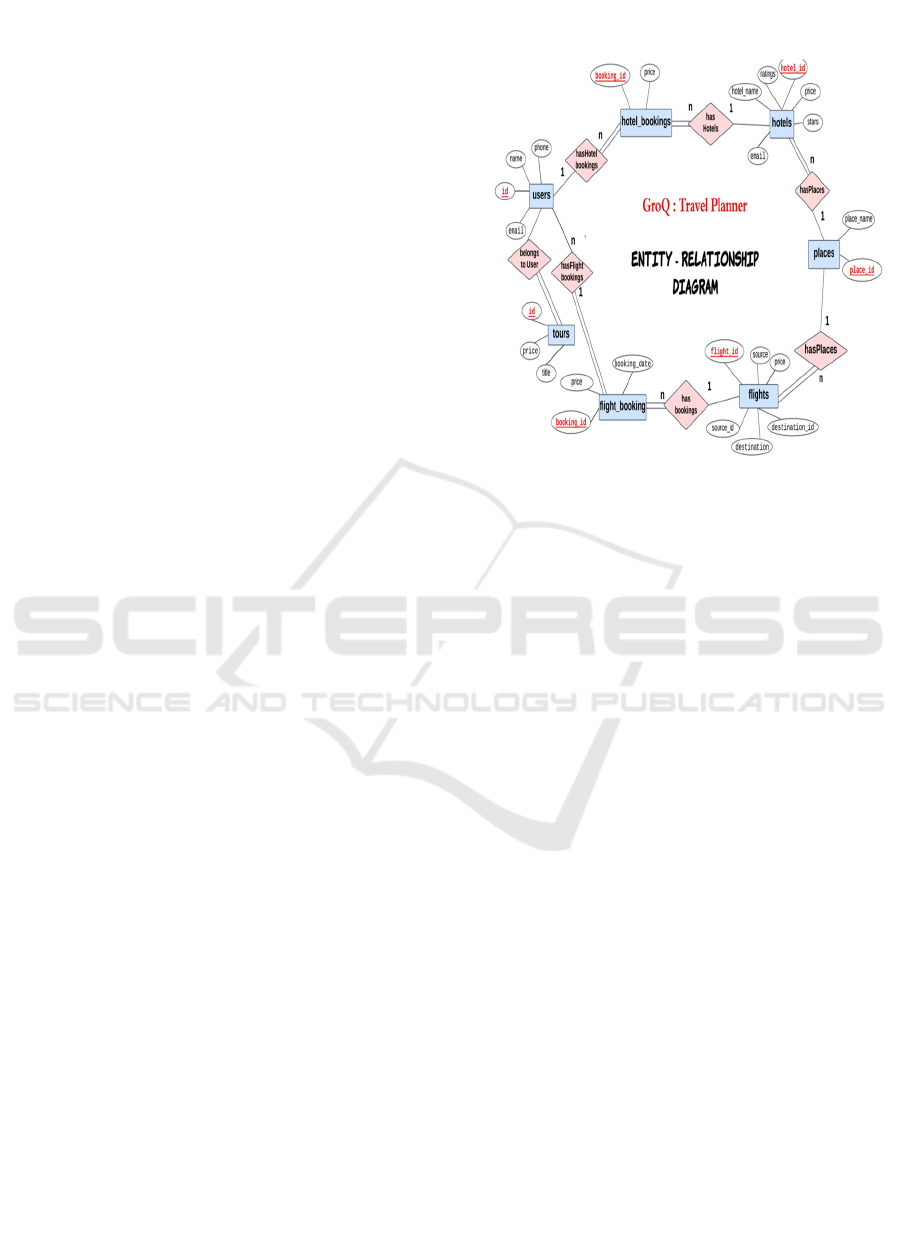
The Entity-Relationship (ER) diagram for the
GroQ: Shown in the context of the Travel Planner
Figure.1., proposed is a logical and well thought
through concept of the database schema which will
take the role in the system and allow the application
to readily support the process of travel management.
Fundamentally, there is the database relates many to
many relationship Users who make many Hotel
bookings Flights bookings and can be part of many
tours. They are linked with entities as Hotels which
have fields of hotel name, price and ratings, Flights
ICRDICCT‘25 2025 - INTERNATIONAL CONFERENCE ON RESEARCH AND DEVELOPMENT IN INFORMATION,
COMMUNICATION, AND COMPUTING TECHNOLOGIES
760
containing fields such as source, destination and price
etc. It also include Places, in which hotels and flights
are directly connected to destinations, and Tours
which enables users to travel through various guided
tours. With relationships clearly defined through
cardinalities like 1: n and n: n, the schema has no
problem accommodating these transformational
scenarios and provides a solid foundation for
functionalities such as dynamic filters, real-time
updates and recommendation. Front-end is based on
React.js Framework, Back-end is Node.js, Database
is MySQL, and the system incorporates RESTful API
features such as an Open Weather Map for integrating
weather-based recommendations and a GroQ-based
AI Chat bot. For security guarantees, there is Firebase
Authentication to eliminate bot access while
Superbase CAPTCHA also helps to safe the system
from bot activity. Combined, this design enables the
user to have an easy way to plan and organize their
trip from one interface to another seamlessly.
3.4 External APIs and AI
OpenWeatherMap API: Provides weather data to
recommend travel destinations and activities based on
real- time conditions.
GroQ-based Chatbot: AI-driven chatbot assists users
with queries related to travel planning and
personalized recommendations.
Firebase Authentication: Ensures secure user login
with support for email/password authentication and
Google Sign-In.
Superbase Authentication: Superbase for Captcha
authentication and API using hCaptcha integration.
4 FUNCTIONAL MODULES
4.1 User Authentication and
Management
The module for User Authentication and
Management enforces proper access control when
users login into the application. Both the email &
password registration and Google sign-in are
supported for the application using Firebase
Authentication. The user enters their name, email,
phone number, validates the email format and
password and the application safely signs them up on
Firebase. Also, the collected user data is transferred
to the backend and saved into MySQL including
personal user data. The login process includes
Firebase authentication, and, to stop bots, we use
HCaptcha. Google Sign-In is also fortified with
CAPTCHA validation to make user verification
extremely effective. Users are offered two options to
regain access to their account if they forgot the
password: through email or phone number. If the reset
type is email, a password reset e-mail is forwarded to
the user, and they are given instructions on how to
safely alter a password. For phone-based resets,
Firebase’s RecaptchaVerifier is used to perform the
verification by sending the code to the user’s phone
then the password updates upon confirming the code.
Checks such as data format check, mismatch on
passwords, and reCAPTCHA add the security aspect
and improve the authenticity of the system to deliver
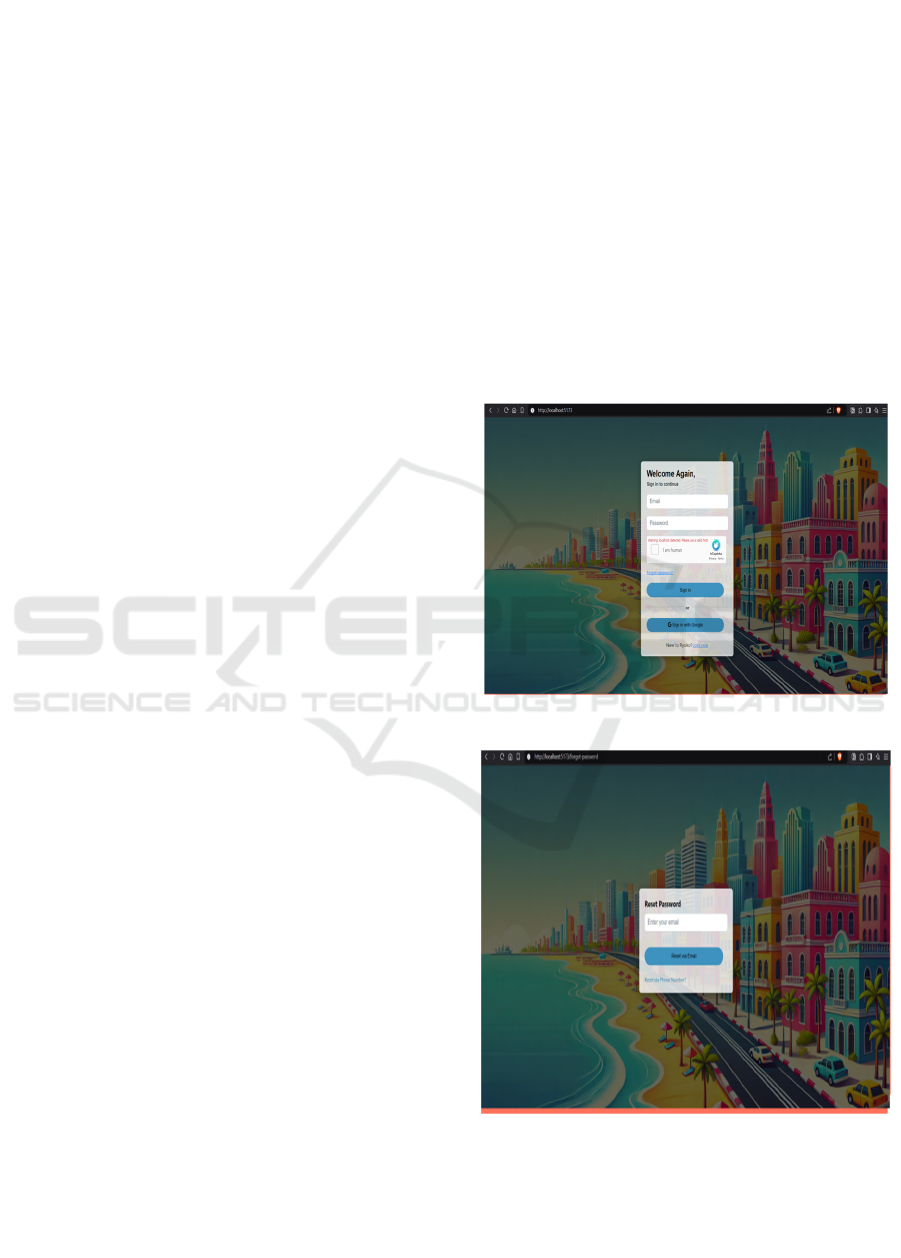
a safe authentication method. Figure. 2. Shows the
login page, followed by Figure. 3. Which shows the
forgot password page while Figure. 4. Shows the
sign-up page.
Figure 2: Login page.
Figure 3: Forgot password page.
GroQ SQL Travel Planner: Book Flights, Hotels, Tours, Weather-Based Recommendations and Chatbot Support with Firebase Login and
SuperBase Captcha
761
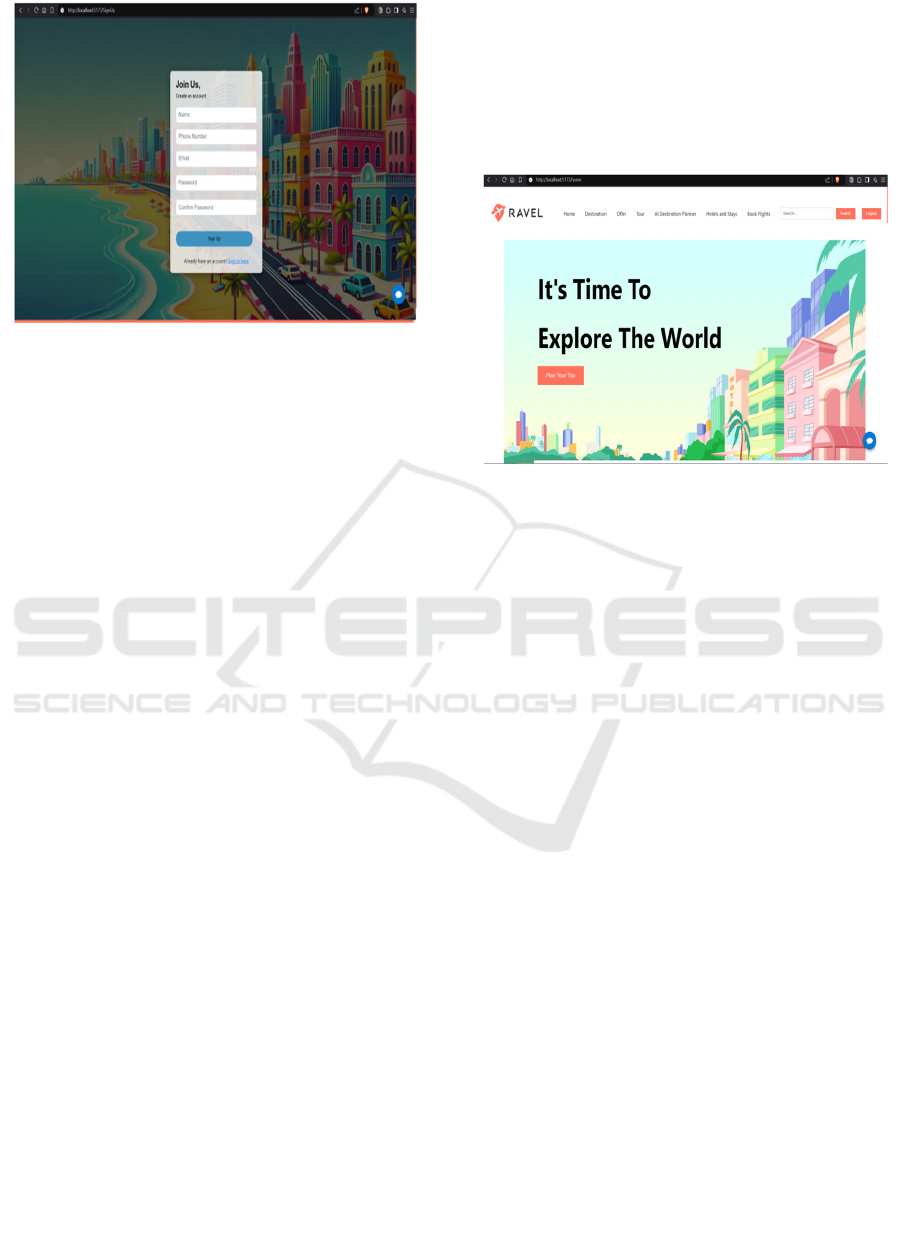
Figure 4: Signup page.
4.2 Home and Navbar
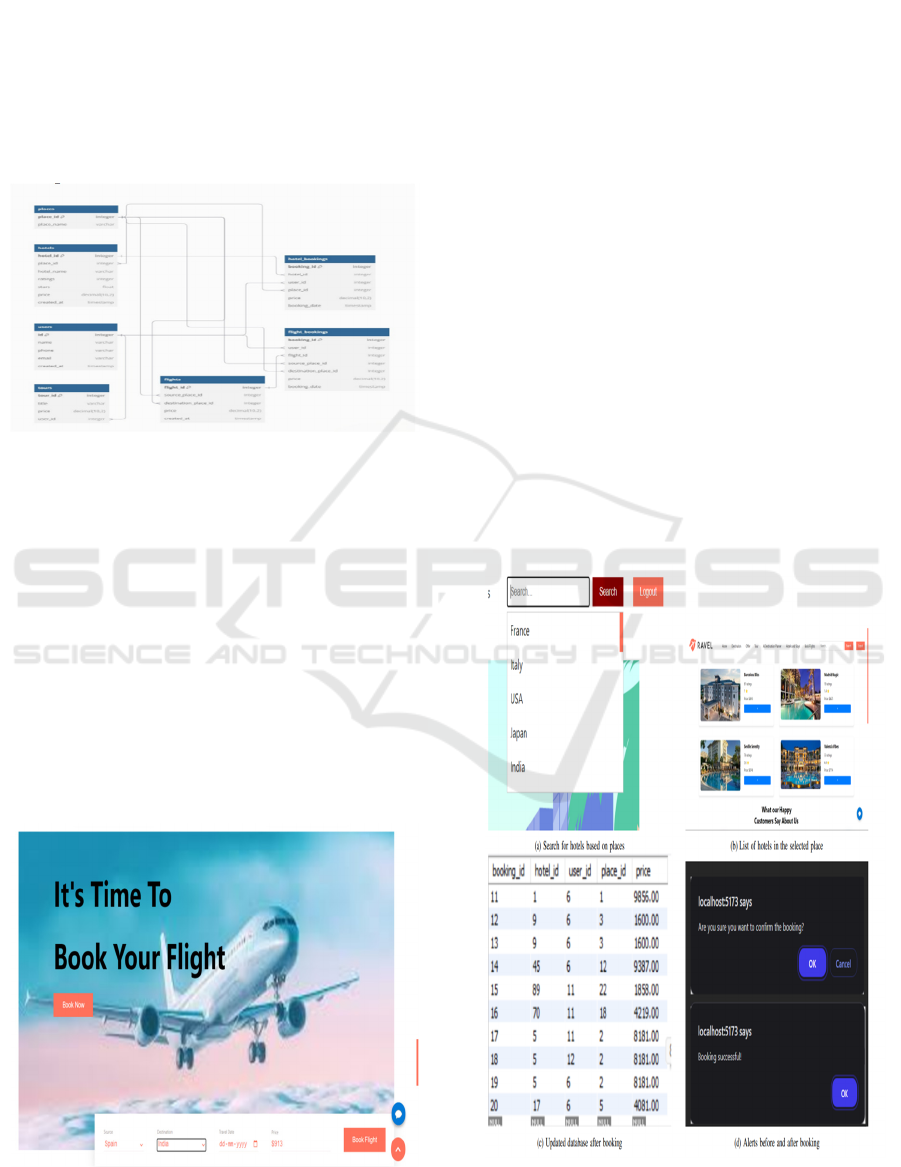
The Home Page is the primary system interface that
allows users to make a direct connection to primary
travel planning facilities such as flight schedules and
booking, hotel reservations, etc., weather and other
updates. As for it, the Navbar contains clear
navigation icons for such main areas as user
identification, history of orders, and travel
preferences. Figure.5. below shows the navigation
bar.
4.3 Chatbot
Chatbot GroQ Chatbot: Offers AI-driven assistance
to address user queries and provide personalized
travel recommendations. The ChatBotPopUp
component is integrated here as a button pop - up
which hovers over the screen on the bottom - right
corner. It moves up and down based on the visibility
of the” backToTop” button which has similar looks
and behavior. This window/ pop - up that hovers, has
two tabs where one is a chatbot that recommends the
user based on his location and holiday preference. It
can take everything into consideration from budget,
location, likes and dislikes. The GroQ based Chatbot
works with the ”llama3-8b-8192” model with an API
key that’s assigned to new users. Once a client object
is created in the code, it is programmed to take two
inputs: One is where we initialize a message to tell the
model how to perform. This gives the model context
of how it is supposed to behave, and what it’s
supposed to know before beginning a chat. This is
where we describe the bot that it is a travel
recommendation bot focused on India, and that its
goal is to provide specific travel recommendations
based on user input. The bot begins by greeting the
user and asking for their preferences, then provides a
destination suggestion. Since the bot has issues with
maintaining token length, and it looks odd in the chat
window, we ask it to maintain short and crisp
answers, and questions. And to address another issue
where it asks questions again and again, we ask the
model to not ask more than 3 questions whatever the
case is.
Figure 5: Home and navbar page.
After the initial message, we route the user
messages to the chat area, to which the model starts
to respond. These responses are then put into the chat
window which in turn makes it look interactive.
Weather Integration: Integrates
OpenWeatherMap API to offer real-time weather-
based suggestions. The weather integration is
implemented as a new tab since it gets complicated to
not get deeply involved with a model yourselves and
only depend on the API. This is because, to have a
model that does both recommendation based on user
preferences and recommend based on weather
conditions on the next few days. The major problem
is the one we arrive to over here, world standard, and
widely accepted models like LLaMa or GPT are not
given internet access to access weather APIs or
monitor weather conditions, or get regular updates on
news or whatever. So what we do here is, we update
the database once in every 24hrs of the latest data of
major cities in India, put it onto superbase’s
PostgreSQL database, it’s about 1160 reading (1
reading every 3 hours for over 5 days) monitoring
conditions like date - time, temperature, humidity,
weather description, and city name. Now this
PostgreSQL database can be read by a RAG model to
make decisions with the help of a base backbone
model like GPT or oLLaMa or Anthropic, with
combination of user preferences and season to make
a very sophisticated and specific combination and
concoction which works beautifully. Figure 6 shows
the Database UML Diagram.
ICRDICCT‘25 2025 - INTERNATIONAL CONFERENCE ON RESEARCH AND DEVELOPMENT IN INFORMATION,
COMMUNICATION, AND COMPUTING TECHNOLOGIES
762
4.4 Database
• MySQL Database:
– Stores user details, flight and hotel data,
booking records, and guided tours.
– Ensures efficient data retrieval and secure
management of sensitive user information.
– Table Relationships: Designed to maintain data
integrity and optimize search and filter
operations.
Figure 6: Database UML diagram.
4.5 Airplane Booking
The flight booking system consists of three input
parameters that include source, destination, and travel
date to generate flight fares in real-time. Users can
choose flight options and a record is made in a
MySQL database which contains details of the
booking and the user is notified through a
confirmation pop up. It also guarantees easy linking
with a backend API to get place options and their
prices and update the price field in real time. The
locations are in dropdowns and dates in a calendar to
make the booking as easy as possible for the clients.
Figure 7. shows the flight bookings component.
Figure 7: Flights booking.
4.6 Tour Booking
The booking of the tours involves choosing from
available tour destinations provided, the cost for the
tour, image, and the reviews of the tour. With just a
click, users can secure the tours they want and will
only need a click to confirm the choice with the pop
up box; the tours are saved in a database associated
with the user account. A backend API is integrated to
save the bookings while the system was designed
with an attractive graphical design and dynamic
features to enhance the users’ interest. Figure. 10.
Shows the tour booking page.
4.7 Hotel Booking
The hotels page comprises a list of Hotels filtered by
locations and prices to help the users in selecting the
required hotels. Booking of the hotels can be done
very easily with all the bookings recorded in the
database and optional recommendations from the site
being included for greater usability. The system is
also dynamic especially with regards to input such as
destination and price range to ensure that a user gets
a friendly interface for efficient hotel bookings.
Figure. 11. Shows the Hotel bookings.
Figure 8: Hotel booking.
GroQ SQL Travel Planner: Book Flights, Hotels, Tours, Weather-Based Recommendations and Chatbot Support with Firebase Login and
SuperBase Captcha
763
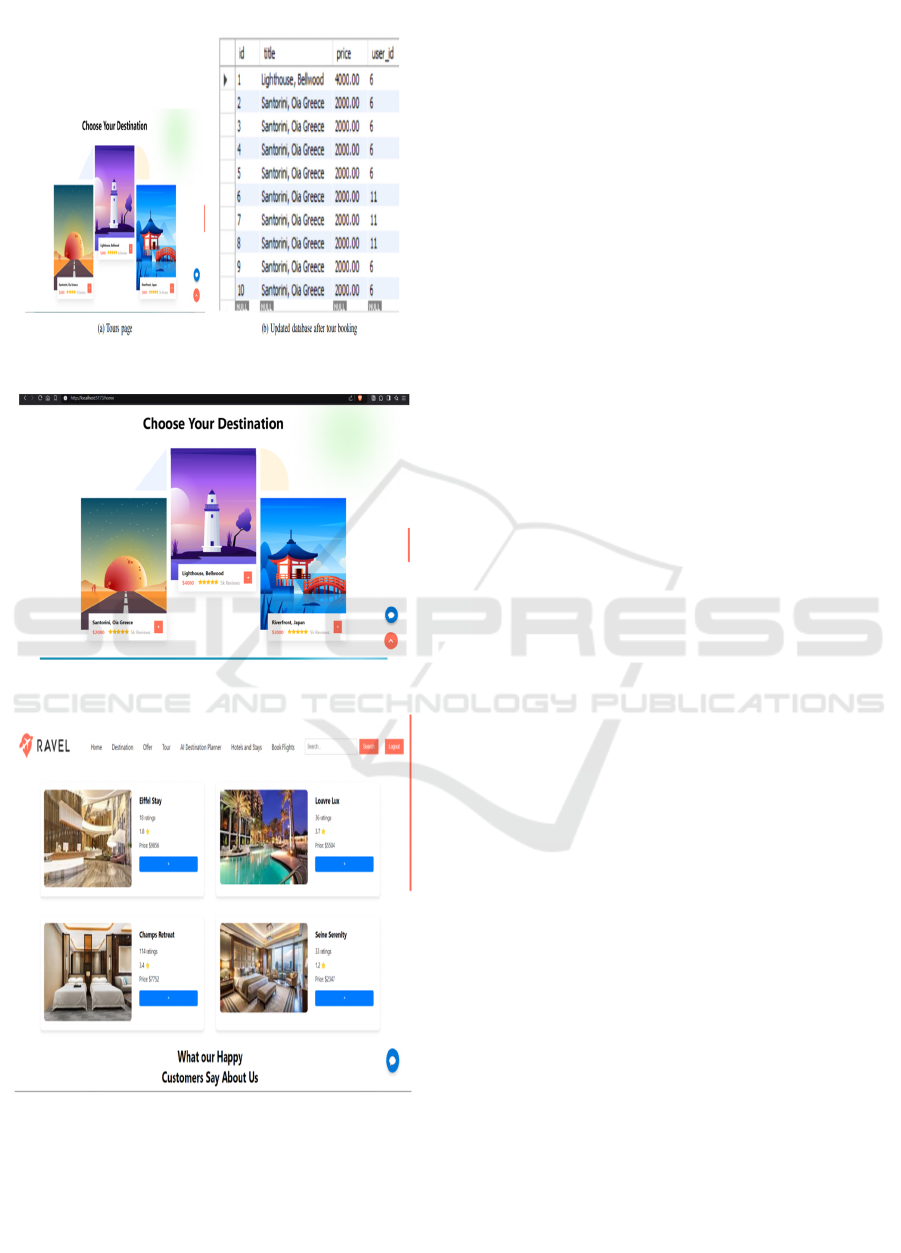
Figure 9: Tour booking.
Figure 10: Tour booking.
Figure 11: Hotel booking.
4.8 Backend
Express.js was used to create the backend which
interacts with a MySQL database to offer a variety of
travel-related services among them are the services of
user management, flight and accommodations, and
tour booking services. The endpoints include signing
up the user, getting flight prices, getting hotels by
location and price, and processing bookings; all
mysql database information is encrypted. Improper
backend also has capability to manage the last active
user which is quite useful for bespoke operations. The
high level of constants’ check, dynamic SQL
statement execution, and data validation are
considered as the crisp factors for the application and
its steady growth.
5 RESULTS
5.1 Hotel Booking
In the hotel booking part we have two ways, one is
through the search bar and one is through the home
page. when i click on the search bar in the navbar, a
list of places in the dropdown list will appear, when
you select a place it will redirect you to a new page
where all the hotels corresponding to that place will
be fetched from the database and displayed. when you
click on the ”+” button, an alert will appear if you
want to confirm the booking, if you click on okay then
the, the hotel bookings table in the database will be
undated. another way is to set the price range and
based on the price range and the selected place, the
filtered hotels based on the price range will be fetched
and displayed. The images related to Hotel Bookings
are displayed in Figure. 8.
5.2 Tour Bookings
In tour bookings the user can book multiple tours, and
once the + button is clicked an alert will be displayed
to confirm booking and the tour will be booked and
updated in the database. Figure. 9. shows all the
related images for Tour Bookings.
5.3 Airplane Booking
In the Airplane Bookings, the user has to choose the
source, destination and dates for travelling and the
price changes according to the source and destination
selected. If any one of the fields is not selected and
the ‘Book Flight’ button is clicked then a message
box will be shown. If all the details are filled it will
result in successful booking in the database. The alert
is shown in Figure. 12. while the database after a
booking is shown in Figure. 13.
ICRDICCT‘25 2025 - INTERNATIONAL CONFERENCE ON RESEARCH AND DEVELOPMENT IN INFORMATION,
COMMUNICATION, AND COMPUTING TECHNOLOGIES
764

Figure 12: Alert for empty field before booking.
Figure 13: Updated database after airplane booking.
5.4 ChatBot Integration
Implementing a chatbot within the platform provided
a highly individualized travel planning due to the
GroQ-based model run by LLaMa3-8b. It was very
smart in anticipating the kind of inputs that you would
want to input like location, budget and preferred
locale to offer relevant travel advice. The AI
Integrated chatbot successfully provided contextual
recommendations with the integration of weather
details opted from the Open Weather Map API as
shown in Figure. 14. Metered logical data being used
was updated every one day to ensure that it was
sufficient and timely. For improved efficiency, the
use of follow-ups was moderate at most three in order
to avoid long strings of conversations that may bore
the user.
The user interface of the chatbot was designed to
appear as a pop up so as not to intrude with the rest of
the other modules of the platform. Its AI-based logic
focused on providing fluent and low delay
interactions that will enhance users’ perceived
satisfaction. The combination of the dynamic
visualizations of the weather updates as well as the
smart suggestion systems made the chatbot a very
useful tool that folds into the design of the interactive
travel planning well and effectively.
Figure 14: GroQ ChatBot integration.
6 CONCLUSIONS
Enter the GroQ SQL Travel Planner A Complete
Intelligent Solution to Modern Travel Planning
Problems It streamlines user convenience by
combining flight booking, hotel reservation, and
guided tours into one service. Utilizing current
technologies such as React. js, Node. js, and
MySQL, the system enables efficient and seamless
interactions. Adding Firebase Authentication and
Superbase CAPTCHA, protects your application
from unwanted interference. The user experience is
more personalized with real-time weather-based
recommendations and a GroQ-based chatbot that
makes travel more flexible and informative. The
modularity of the architecture allows for scalability
and future improvements/expansions. A well-
structured ER model enables dynamic filtering and
fast decisions, ensuring efficient data handling. This
example demonstrates the power of AI fetch-focused
help through its integration of the LLaMa and
OpenWeatherMap APIs. In conclusion, the project
takes a well-rounded approach by providing
optimized travel suggestions that account for both
user needs and environmental considerations. A solid
potential for application in the real world and allow
its evolvement in this travel tech space.
GroQ SQL Travel Planner: Book Flights, Hotels, Tours, Weather-Based Recommendations and Chatbot Support with Firebase Login and
SuperBase Captcha
765

REFERENCES
A. Rajappa, A. Upadhyay, A. S. Sabitha, A. Bansal, B.
White, and L. Cottrell, “Implementation of pinger on
android mobile devices using firebase,” in 2020 10th
International Conference on Cloud Computing, Data
Science Engineering (Confluence), 2020, pp. 698–703.
B. A. Reddy, G. Someswara Reddy, K. Lokesh, S. B, and
R. M, “Aidriven stress analysis and management: A
novel approach leveraging openai and nosql databases
to empower students in stress management and promote
overall student well-being and academic progression,”
in 2024 International Conference on Computational
Intelligence and Computing Applications (ICCICA),
vol. 1, 2024, pp. 210–215.
D. J. Yeong, K. Panduru, and J. Walsh, “Smart agriculture:
Software platform for telematics monitoring in farm
machinery,” in 2024 35th Irish Signals and Systems
Conference (ISSC), 2024, pp. 1–6.
H. Dong, C. Zhang, G. Li, and H. Zhang, “Cloud-native
databases: A survey,” IEEE Transactions on
Knowledge and Data Engineering, vol. 36, no. 12, pp.
7772–7791, 2024.
K. Traykov, “A framework for security testing of large
language models,” in 2024 IEEE 12th International
Conference on Intelligent Systems (IS), 2024, pp. 1–7.
K. Balazs Neszl ´ enyi, A. Milos, and A. Kiss,
“Assistantgpt: Enhancing ´ user interaction with llm
integration,” in 2024 IEEE 22nd Jubilee International
Symposium on Intelligent Systems and Informatics
(SISY), 2024, pp. 000 619–000 624.
L. H. Pramono and Y. K. Yana Javista, “Firebase
authentication cloud service for restful api security on
employee presence system,” in 2021 4th International
Seminar on Research of Information Technology and
Intelligent Systems (ISRITI), 2021, pp. 1–6.
Ojas, Ojas, Aarav Vashishtha, Sumit Kumar Jha, Vivek
Kumar Shah, Rohit Kumar, and Gayathri Ramasamy.
"James: Enhancing Judicial Efficiency with Smart
Administration." Available at SSRN 5091509 (2024).
P. Nitu, J. Coelho, and P. Madiraju, “Improvising
personalized travel recommendation system with
recency effects,” Big Data Mining and Analytics, vol.
4, no. 3, pp. 139–154, 2021.
SR, M., & Ramasamy, G. (2024). Heartbeat Scream
Detection System.
V. Sevagen, H. Pabbati, P. Chanda, and A. Kumar,
“Intelligent chatbot for student monitoring and
mentoring,” in ICT Systems and Sustainability, M.
Tuba, S. Akashe, and A. Joshi, Eds. Singapore:
Springer Nature Singapore, 2023, pp. 393–399.
V. K. Singh, P. Awasthi, L. Tripathi, S. Thakur, and P.
Singh, “Mern (mongodb, express-js, react-js, node-js)
stack web-based streaming and broadcasting
application,” in 2024 International Conference on
Electrical Electronics and Computing Technologies
(ICEECT), vol. 1, 2024, pp. 1–6.
V. Manish, Y. Manchala, Y. Vijayalata, S. B. Chopra, and
K. Y. Reddy, “Optimizing resume parsing processes by
leveraging large language models,” in 2024 IEEE
Region 10 Symposium (TENSYMP), 2024, pp. 1–5.
Vashishtha, A., Kumar Jha, S., Kumar Shah, V., Prasad
Chauhan, J., Bhagat, K., & Ramasamy, G. (2024).
Empowering Student Success: A Comprehensive Task
Management and Notification System. Available at
SSRN 5091489.
X. Zhou, C. Chai, G. Li, and J. Sun, “Database meets
artificial intelligence: A survey,” IEEE Transactions on
Knowledge and Data Engineering, vol. 34, no. 3, pp.
1096–1116, 2022.
ICRDICCT‘25 2025 - INTERNATIONAL CONFERENCE ON RESEARCH AND DEVELOPMENT IN INFORMATION,
COMMUNICATION, AND COMPUTING TECHNOLOGIES
766
