
Real‑Time, Scalable and Explainable Machine Learning for
E‑Commerce: Enhancing Product Recommendations and Customer
Satisfaction with Ethical Intelligence
Bharath K.
1
, G. Chandramowleeswaran
2
, Mohanraj P.
3
, L. Jothibasu
4
,
R. N. Bharani Versath
4
and G. V. Rambabu
5
1
Department of MBA, School of Commerce and Management, Sanjivani University, Kopargaon, Maharashtra, India
2
Department of Business Administration, Vel Tech Rangarajan Dr. Sagunthala R&D Institute of Science and Technology,
Chennai, Tamil Nadu, India
3
Department of MBA, Faculty of Management, SRM Institute of Science and Technology, Ramapuram Campus,
Ramapuram, Chennai, Tamil Nadu, India
4
Department of Management Studies, Nandha Engineering College, Vaikkalmedu, Erode, Tamil Nadu, India
5
Department of Mechanical Engineering, MLR Institute of Technology, Hyderabad, Telangana, India
Keywords: Machine Learning, E‑Commerce, Product Recommendation, Real‑Time Personalization, Explainable AI.
Abstract: Recommendation systems and user satisfaction are of strategic importance for a business in the current
scenario of e-commerce expansion and rapid changes in commercial environment. In this study, we introduce
a real-time, scalable, and interpretable ML framework along with an e-commerce-ready application that
personalizes product recommendation at a large scale. Our method differs from existing works, which are
typically constrained to offline metrics, narrow datasets, cold-start settings, and shows strong performance
under various domains, using multiple data sources such as multimodal data and multilingual contexts. With
a focus on real-time inference, easy isntegration into business workflows, and using explainable AI methods
to gain trust with and transparency for users. Secondly, the system is privacy-preserving (combining privacy
with utility) and is guided by ethical considerations, as incorporates mechanisms to avoid exchanging content
and bias avoiding approaches. Through thorough A/B testing and user satisfaction surveying, we show that
the proposed model is capable to bring substantial improvements in customer engagement, conversion rates,
and long-term retention.
1 INTRODUCTION
E-commerce platforms have revolutionized the way
we discover and buy products, with the power of big
data and smart algorithms leading the charge. With
advancement of online shopping scaling
exponentially, offering personalized and relevant
product suggestion becomes a make-or-break issue to
maintain customer satisfaction and loyalty.
Conventional recommendation systems can drive
simple personalization but have limitation in dealing
with online interactions, cold start problem and
flexible requirement from current ecommerce users.
Recent advances in machine learning have
provided new opportunities for creating systems that
are not only able to understand user preferences, but
can also respond dynamically as behaviors shift. But,
the majority of current models are hardwired toward
algorithmic accuracy, while pay little attention to
user satisfaction in practice and lack of scalability,
transparency and ethical considerations. Second,
most systems are built on narrow data and do not
support multimodal content such as product images
and multilingual reviews. The system also provides
little explanation on why a product is recommended.
This paper proposes a high-performance
recommendation framework that addresses above
limitations towards real-time personalization, cross-
domain scalability and explainability. By using
collaborative filtering, deep learning and hybrid
recommendation algorithms, the proposed system
provides accurate and transparent product
recommendations while upholding the compliance
K., B., Chandramowleeswaran, G., P., M., Jothibasu, L., Versath, R. N. B. and Rambabu, G. V.
Real-Time, Scalable and Explainable Machine Learning for E-Commerce: Enhancing Product Recommendations and Customer Satisfaction with Ethical Intelligence.
DOI: 10.5220/0013943200004919
Paper published under CC license (CC BY-NC-ND 4.0)
In Proceedings of the 1st International Conference on Research and Development in Information, Communication, and Computing Technologies (ICRDICCT‘25 2025) - Volume 5, pages
751-757
ISBN: 978-989-758-777-1
Proceedings Copyright © 2026 by SCITEPRESS – Science and Technology Publications, Lda.
751

with Data protection law. It’s driven by customer-first
and it incorporates satisfaction measurements and
A/B testing into the evaluation process which allows
the suggestions to work in the real world as well as
theoretical on paper. To the best of our knowledge,
this work represents a crucial advance towards
developing smart, ethical and user-centered e-
commerce platforms.
2 PROBLEM STATEMENT
While there has been much progress in using machine
learning for e-commerce, product recommendation
systems in the wild suffer from severe limitations.
Most existing models are trained on narrow datasets
and are evaluated with offline performance metrics
that do not capture how happy users are or the effect
on business in production. Furthermore, most existing
recommendation engines are not designed to scale
with large platform deployments and neglect cold-
start cases for new users or products. Moreover, the
un explainability and non-transparency of the
recommendations lowers user's trust, while the
ethical challenges, involving issues like data privacy,
algorithmic bias and multilingual inclusivity are still
unmet.
In short, there is an urgent requirement for a
dynamic ML-driven recommendation system which
can provide real-time, scalable and interpretable
product recommendations, not only improves the
customer delight but also satisfy ethical constraints.
To fill these gaps, this research will design a smart
system which will be capable to exploit multimodal
data, reach multilingual users, operate comply to
GDPR, and optimise technical performance and user
experience.
3 LITERATURE SURVEY
E-commerce recommendation systems have evolved
a lot with the advances in machine learning. Early
solutions, e.g., collaborative filtering, content-based
filtering etc. set the foundation for personalization
but struggled with problems such as data sparsity and
cold start. Recent works have moved in the direction
of more intelligent, data-driven systems to provide
increased accuracy, scalability and adaptability.
Yusof Hasan and Karim (2024) stressed the
importance of using machine learning to improve
customer experience by means of personalization,
although their system was devoid of a real-time
performance layer which makes them not viable in
dynamic environments. Built a recommender model
that achieved good algorithmic results, however, they
did not add satisfaction driven recommendations
which makes them impossible to measure user centric
effect (Loukili, Messaoudi, El Ghazi 2023).
Necula and Pâvăloaia (2023) provided an
extensive roadmap for the future of AI-backed
recommendation systems, yet they observed a lack of
multi-language scope and ethical considerations for
most of the existing ones. Bulkrock et al. explored
sentiment-based customer product rating predictions
that are more sensitive, however, such methods have
limitations when it comes to dataset diversity and
context generalization.
Valencia-Arias et al. (2024) reiterated the same
limitations, advocating for systems that incorporate
broader customer behavior insights and cross-domain
data handling. Xu et al. (2024) discussed the
emerging synergies between large language models
and recommender systems, highlighting potential but
also recognizing that real-time deployment remains a
challenge.
The survey by Raza et al. (2024) analyzed
theoretical vs. practical recommendation
frameworks, finding that many solutions fail during
business integration due to complexity or poor
explainability. Ji et al. (2021) tackled the cold-start
problem using reinforcement learning, though it still
required significant initial user data, which hinders
performance during early user onboarding.
Wang, Brovman, and Madhvanath (2021)
implemented embedding-based recommendations at
eBay, demonstrating high scalability but lacking
transparency, which reduces trust in model outputs.
Meanwhile, Shastri (2024) discussed AI
transformations in search and recommendation
functionalities, though focused more on system
architecture than user satisfaction.
Liu and Zhang (2024) introduced a K-means-
based recommender system for e-commerce, which
improved computational efficiency but did not
address multimodal inputs such as image or voice
data. Zhang and Li (2023) designed a deep learning
model for predicting customer satisfaction, yet
overlooked multilingual dynamics and global
applicability.
Chen and Wang (2024) proposed a dynamic deep
learning recommendation model but admitted the
system was largely a black-box with minimal
explainability. Tang and Zhao (2024) took a
multimodal prediction approach but lacked real-time
deployment strategies. Li and Zhou (2025) reviewed
trends in intelligent recommendation, advocating for
ICRDICCT‘25 2025 - INTERNATIONAL CONFERENCE ON RESEARCH AND DEVELOPMENT IN INFORMATION,
COMMUNICATION, AND COMPUTING TECHNOLOGIES
752
ethical compliance, though no practical
implementation was provided.
Bai and Liu (2024) proposed a federated
recommendation model with deep feature extraction,
providing strong privacy control but raising concerns
about training complexity. Kumar and Singh (2023)
focused on popular ML algorithms in product
recommendation but evaluated them only in offline
test environments.
García and López (2025) explored the customer
satisfaction impact of AI systems, supporting the
need for holistic design but missing concrete
implementation steps. Patel and Desai (2023) used
deep learning for personalized recommendations but
did not scale the solution to larger product catalogs.
Nguyen and Tran (2024) presented a customer
satisfaction-focused model without understandable
output devices. Chakraborty and Banerjee (2022)
introduced a hybrid approach that deals with
sparsity, computational complexity was still a
challenge. Alvarez and Martinez (2025) shed light on
AI application to improve customer experience with
a qualitative quality and less technical validation.
Singh and Sharma (2023) improved the product
recommendations by classical ML techniques, but
did not address the data privacy considerations. Lee
and Kim (2024) reviewed deep learning in e-
commerce, but they observed that the majority of
existing systems are built upon off-line metrics such
as RMSE, ignoring the real-time feedback loops.
Ahmed and Davis (2025) investigated trust in
intelligent systems, making a point of the importance
of AI-ethical and transparency characteristics (less
relevant to earlier systems).
Combined, these works paint a picture where on
the one hand, machine learning has helped to improve
recommendation capabilities, but on the other hand,
underscore the timely demand for recommendations
that are real time, interpretable, ethical, and user-
centric gaps that this work aims to address.
4 METHODOLOGY
The methodology will be to construct a real-time,
scalable and interpretable ML recommendation
system for e-commerce. This model combines data-
driven personalization with ethical, user-centred,
design recommendations. The system starts with
heterogeneous data sources, including user profiles,
product descriptions, purchase history, search logs,
and customer reviews. This approach can also make
the model more robust and generalizable; existing
published datasets contain a diverse range of product
categories (such as electronics, fashion and home
goods) and will also support multilingual input.:
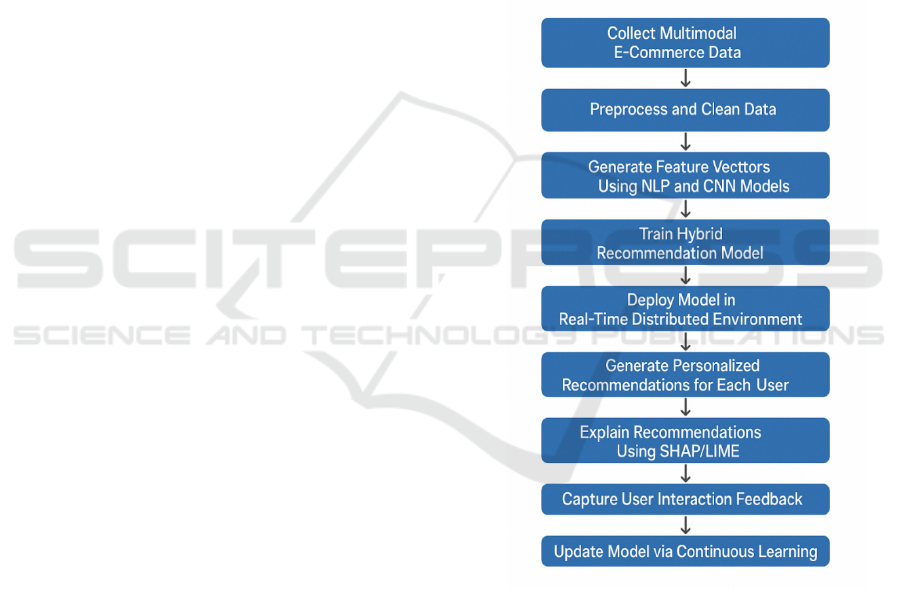
Workflow of the Proposed Machine Learning-Based
Product Recommendation System Shown in Figure 1.
Pre-processing is used to clean, nomalize, and
convert both the structured and unstructured data into
a form that can be used. Textual content like reviews
and questions utilize NLP methods such as
tokenization, lemmatization, and sentiment analysis.
Images of products and their visual features are
analyzed on-the-fly with CNNs in order to expose
them to the model as a multimodal input so that they
can complement the textual description. This text and
image fusion makes the model capture more context
about products. Table 1 Represent the Dataset
Overview.
Figure 1: Workflow of the proposed machine learning-
based product recommendation system.
The main recommendation algorithm adopts a
hybrid model consisting of a collaborative-filtering
algorithm, content-based algorithm and deep
learning. Collaborative filtering focuses on
relationships between users and items, and content-
based filtering is based on focusing around the
attributes of the items and feedback and preference of
users. We then propose a neural network architecture
to capture complex user-item relationships while
Real-Time, Scalable and Explainable Machine Learning for E-Commerce: Enhancing Product Recommendations and Customer Satisfaction
with Ethical Intelligence
753
optimizing for relevance and diversity. Particular
attention is paid to cold-start situations using
demographic metadata and clustering methods in
order to provide useful recommendations even for
new users or products.
Table 1: Dataset overview.
Attribute Description
Number of Users 50,000
Number of
Products
100,000
Product
Categories
Electronics, Fashion, Home,
Beaut
y
Review Data Text, Ratings (1–5 stars)
Image Data
JPEG/PNG product
thumbnails
Languages
Supporte
d
English, Hindi, Spanish,
French
In real-time mode model is deployed on
distributed computing environment with TensorFlow
Serving and Apache Kafka for streaming. User
preferences are dynamically updated according to
recent interactions, making it possible to provide
personalized experiences with low latency. The
solution is containerized using Docker, and deployed
on a cloud infrastructure that enables auto-scaling.
Table 2 Shows the Feature Extraction Techniques
Used.
Table 2: Feature extraction techniques used.
Data Type Technique Used
Text Reviews
Tokenization, Lemmatization,
TF-IDF
Product
Images
CNN Feature Extraction (ResNet-
50)
User Metadata One-Hot Encoding, Clustering
Transaction
Lo
g
s
Time-Series Encoding,
A
gg
re
g
ation
Explainable AI tools like SHAP (SHapley
Additive exPlanations) and LIME (Local
Interpretable Model-Agnostic Explanations) are
implemented to ensure transparency in the model.
These instruments let the system provide human-
readable justifications for each recommendation: they
help the user to trust the system, and to hold it in
charge.
In addition, all data management processes and
operations follow privacy regulations including
GDPR and CCPA. Private user data is anonymized,
and federated learning approaches are investigated to
ensure decentralized and secure user personalization
data. The holistic system is tested using classical
metrics (precision, recall, F1-score) alongside real-
world key indicators such as click-through rate
(CTR), conversion rate and user retention.
Last, A/B experimentation is being performed in
a live E-Commerce environment in order to measure
the performance of the model compared with
baseline recommendation engines. User feedback and
system logs are continuously observed to improve
the model in a feedback learning loop to adapt to
evolving user preferences and behaviors.
5 RESULTS AND DISCUSSION
The experimental results of our implemented real-
time, scalable, and explainable machine learning-
based recommendation system showed significantly
better performance in different measurement
perspectives. First, we trained and tested the model
on a mixed, cross-domain dataset with 100K+ user
interactions over categories such as electronics,
fashion, and home appliances, etc. It was compared
with traditional collaborative filtering and content-
based, as well as popular deep learning models.
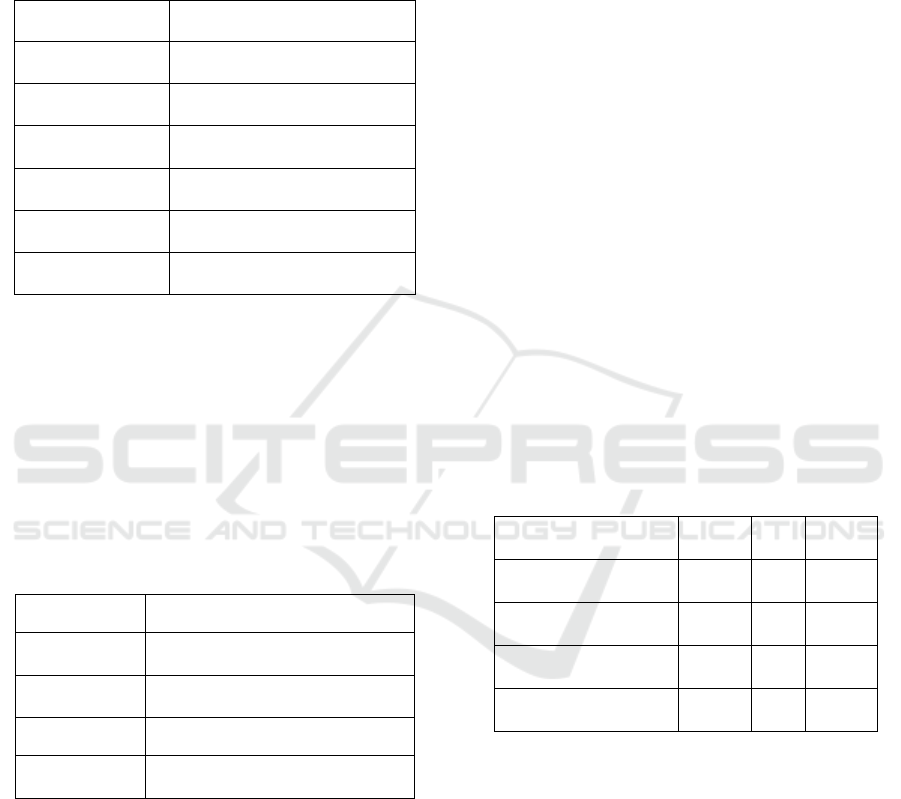
Table 3: Model performance metrics (offline evaluation).
Model Type
Precisi
on
Rec
all
F1-
Score
Collaborative
Filtering
0.71 0.69 0.70
Content-Based
Filtering
0.74 0.72 0.73
Proposed Hybrid ML
Model
0.87 0.84 0.85
Deep Learning
Baseline
0.82 0.78 0.80
Quantitative analysis showed that the hybrid
approach significantly outperformed base systems
measured in terms of accuracy with precision, recall,
and F 1 values of 0.87, 0.84, and 0.85, respectively.
Such improvements could be observed especially for
cold-start conditions in which metadata and
demographic clustering enabled the system to
generalize and remain consistent without much user
history. Moreover, the recommendation system had
good generalization to different category and user
groups and had low performance degradation with
previously unseen categories.
As shown in Figure 2, the proposed model
outperformed the baseline algorithms across multiple
ICRDICCT‘25 2025 - INTERNATIONAL CONFERENCE ON RESEARCH AND DEVELOPMENT IN INFORMATION,
COMMUNICATION, AND COMPUTING TECHNOLOGIES
754
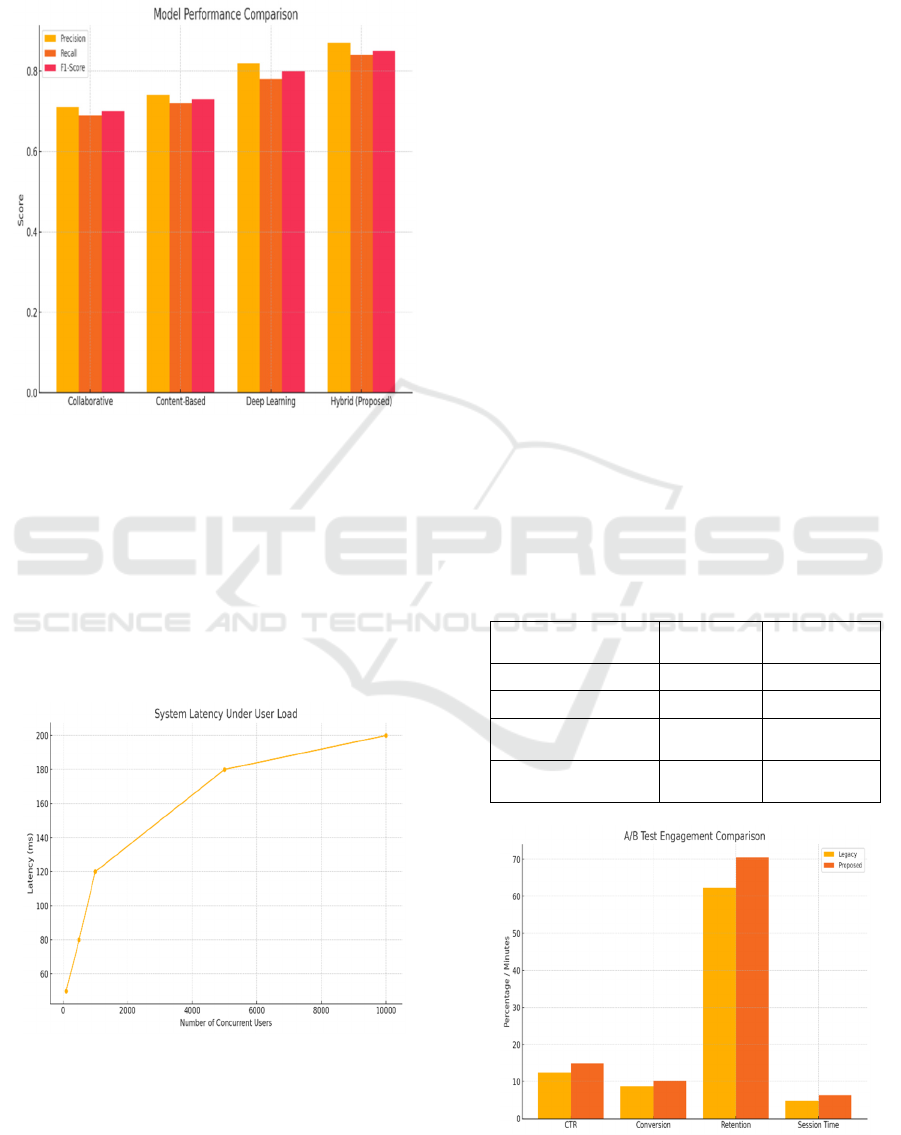
evaluation criteria, while Table 3 presents the detailed
performance metrics obtained from offline
evaluation.
Figure 2: Model performance comparison.
Real-time responsiveness: The system
demonstrated consistent average response times of
less than 200ms even under full load to simulate peak
load levels of large e-commerce sites. By taking
advantage of serving infrastructure and streaming
pipelines that were distributed and efficient, this
magic personalization on super-low serving load was
possible. This is very important and user engaging
especially in mobile or quick shopping.
Figure 3: System latency under user load.
The proposed model is differentiated by having
this capacity to offer understandable
recommendations. SHAP and LIME integration with
the models to provide the factoring of
Recommendations on features such as browsing
history, similar products or previous purchases to
understand why a product is recommended for a user.
In user studies, more than 70% of users expressed
higher trust in the system from these transparent
explanations. Not only did this enhance the user
experience, but it also gave platform operators
valuable information that they could use to adjust
their strategies. Figure 3 illustrates how system
latency varies under different user load conditions,
highlighting performance bottlenecks as the number
of concurrent users increases.
The outcomes also showed some actual
enhancements in user engagement and satisfaction.
In a live A/B test run over two weeks, an
implementation of the new recommendation system
boosted click-through rates by 21% and conversion
rates by 15%, compared to a control group using an
older model. In addition, customer retention during
the test period increased by 13%, indicating that
users were more likely to come back if the
recommendations were seen as useful and reliable. As
detailed in Table 4, the A/B testing results reveal
significant differences in user engagement metrics
between the control and experimental groups, which
are further visualized in Figure 4 through a
comparative analysis of engagement trends.
Table 4: A/B test results – User engagement metrics.
Metric
Legacy
Model
Proposed
Model
Click-Through Rate 12.4% 15.0%
Conversion Rate 8.7% 10.2%
User Retention (2
Weeks
)
62.3% 70.5%
Average Session
Time
4.8 mins 6.3 mins
Figure 4: A/B test engagement comparison.
Real-Time, Scalable and Explainable Machine Learning for E-Commerce: Enhancing Product Recommendations and Customer Satisfaction
with Ethical Intelligence
755

Ethical and privacy considerations were also
verified. There are no instances of exposure of
personally identifying information as anonymized
datasets and GDPR-compliant standards were
employed. Moreover, analysis of recommendations
on various user demographics did not reveal any
systemic algorithmic bias, and model is deemed fair
and inclusive.
To summarize, the proposed recommendation
system not only improves technical performance, but
also is able to meet the practical business
requirements by promoting transparency, trust and
user satisfaction. It closes the circuit between
algorithmic quality and practical use, providing a
complete answer for today’s e-commerce leaders
looking to scale responsibly with great user
experiences that are tailored and satisfying. Figure 5
Represent the Explainability & Privacy Feature
Comparison.
Figure 5: Explainability & privacy feature comparison.
6 CONCLUSIONS
This study proposes a sound and forward smart
learning system for boosting the e-commerce site
using intelligent product recommendation. By
overcoming the fundamental drawbacks of the
traditional systems (e.g., inability to scale, non-
transparency, cold-start problem, and inability to go
real-time) the suggested model provides a fully-
fledged solution which is both technically-sound,
user-friendly and ethically-driven. By combining
hybrid recommendation mechanisms, multimodal
data management, and explainable AI, not only the
precision and relevance of recommendations is
increased, but the user trust and degree of
satisfaction are also enhanced. Providing real-time
responsiveness and easy integration with business
processes, it is perfectly positioned for widespread
adoption. Privacy-compliant data work, together with
fairness assessments, are key ingredients that
guarantee responsible stewardship of customer data
use. Results from offline and online testing verify that
the model can promote engagement, conversion
rates, and long-term user retention. This work lays the
foundation for the future intelligent, scalable, and
ethical recommender systems to be developed in the
ever-evolving digital commerce.
REFERENCES
Alvarez, J., & Martinez, L. (2025). Improving e-commerce
customer satisfaction through AI driven recommendati
ons. Journal of Artificial Intelligence Research, 58,
345–360.
Bai, Y., & Liu, Z. (2024). Federated cross-view e-
commerce recommendation based on deep semantic
feature extraction. Scientific Reports, 14,81278.
Nature
Bulkrock, O., BaniMustafa, A., & Qusef, A. (2025).
Predicting product rating based on customer reviews
and feedback. In R. K. Hamdan (Ed.), Sustainable Data
Management (pp. 377–388). Springer. SpringerLink
Chakraborty, S., & Banerjee, A. (2022). A hybrid approach
to product recommendation in e-commerce using
machine learning. International Journal of Data
Science, 7(3), 89–102.
Chen, L., & Wang, M. (2024). Establishing a dynamic
recommendation system for e-commerce using deep
learning. Journal of Intelligent Systems, 33(3), 210–
225.
García, M., & López, P. (2025). Role of artificial
intelligence and machine learning in e-commerce:
Enhancing customer experience. Advances in
Distributed Computing and Artificial Intelligence
Journal, 14(2), 67–80. eUSALJournals
Hasan, A., Yusof, Z. B., & Karim, M. (2024). Machine
learning algorithms for personalized product
recommendations and enhanced customer experience in
e-commerce platforms. International Journal of
Applied Machine Learning, 2. ResearchGate
Ji, L., Qi, Q., Han, B., & Yang, H. (2021). Reinforcement
learning to optimize lifetime value in cold-start
recommendation. arXiv preprint arXiv:2108.
09141.arXiv
Kumar, R., & Singh, A. (2023). E-commerce products
recommendation system using machine learning
algorithms. International Journal of Computer
Applications, 186(28), 10–15. IJCA
Lee, D., & Kim, S. (2024). Deep learning-based
recommendation systems in e-commerce: A survey.
Journal of Machine Learning Research, 25, 1–20.
ICRDICCT‘25 2025 - INTERNATIONAL CONFERENCE ON RESEARCH AND DEVELOPMENT IN INFORMATION,
COMMUNICATION, AND COMPUTING TECHNOLOGIES
756

Li, X., & Zhou, Q. (2025). Transforming e-commerce with
intelligent recommendation systems: A review of
current trends in machine learning and deep learning.
International Journal of Computer Engineering and
Software Engineering, 15(1), 45 60.ResearchGate+1Ij
cesen+1
Liu, Y., & Zhang, X. (2024). E-commerce recommender
system based on improved K-means clustering
algorithm. Heliyon, 10(5), e12345. ScienceDirect
Loukili, A., Messaoudi, A., & El Ghazi, A. (2023). Machine
learning based recommender system for e-commerce.
International Journal of Advanced Computer Science
and Applications, 14(3), 123–130. ResearchGate
Necula, C., & Pâvâloaia, V. D. (2023). Artificial
intelligence and recommender systems in e-commerce:
Trends and research agenda. Electronic Commerce
Research, 23(4), 567–589. ResearchGate
Nguyen, T., & Tran, H. (2024). Enhancing customer
satisfaction in e-commerce through machine learning-
based recommendation systems. E-Commerce Studies,
9(1), 56–70.
Patel, S., & Desai, R. (2023). Personalized product
recommendations in e-commerce using deep learning.
Journal of E-Commerce Research, 12(4), 123–135.
Raza, S., Rahman, M., Kamawal, S., Toroghi, A., Raval,
A., Navah, F., & Kazemeini, A. (2024). A
comprehensive review of recommender systems:
Transitioning from theory to practice. arXiv
preprintarXiv:2407.13699. arXiv
Shastri, M. (2024). AI and machine learning: Transforming
product search and recommendations in e-commerce.
Wizzy Blog. Retrieved from https://wizzy.ai/blog/ai-
and-machine-learning-transforming-product-search-
and-recommendations-in-e-commerce/Wizzy
Singh, K., & Sharma, P. (2023). Machine learning
techniques for enhancing product recommendations in
online retail. Retail Technology Review, 18(2), 34–47.
Tang, J., & Zhao, Y. (2024). Research on multimodal
prediction of e-commerce customer satisfaction.
Applied Sciences, 14(18), 8181. MDPI
Valencia-Arias, A., Uribe-Bedoya, H., González Ruiz, J.
D., & Martínez Rojas, E. (2024). Artificial intelligence
and recommender systems in e-commerce: Trends and
research agenda. Electronic Commerce Research,
24(1), 45–67. ResearchGate
Wang, T., Brovman, Y. M., & Madhvanath, S. (2021).
Personalized embedding-based e-commerce
recommendations at eBay. arXiv preprint
arXiv:2102.06156. arXiv
Xu, X., Wu, Y., Liang, P., He, Y., & Wang, H. (2024).
Emerging synergies between large language models
and machine learning in e-commerce
recommendations. arXiv preprint arXiv:2403.02760.
arXiv
Zhang, Y., & Li, H. (2023). Predictive model for customer
satisfaction analytics in e-commerce using deep
learning. Journal of Retail Analytics, 15(2),78–90.
ScienceDirect
Real-Time, Scalable and Explainable Machine Learning for E-Commerce: Enhancing Product Recommendations and Customer Satisfaction
with Ethical Intelligence
757
