
Investigating Drug Trafficking Using Encrypted Messengers: NLP
and Data Analysis Approaches in Cybersecurity
Rushil Gautam, Kartik, Shravan Singh, Sarthak Srivastava and Dhanshri Parihar
Department of Computer Science and Engineering, Ajay Kumar Garg Engineering College, Ghaziabad, Uttar Pradesh,
India
Keywords: Cybersecurity, Drug Trafficking, Encrypted Messaging, NLP, Dark Web, Digital Forensics.
Abstract: The rise of encrypted messaging platforms has given the dealers of illegal drugs a new channel for their
transactions, making it difficult for law enforcement authorities to deal with them. The paper studies usage of
Natural Language Processing (NLP)and data analysis tech to find and analyze drug trafficking activities from
imposts on encrypted messaging platforms like WhatsApp and Telegram. By an analysis of digital forensic
operations together with sophisticated machine learning models, this research is directed at finding crime
patterns, retrieving temporal digital traces that have been erased and even building proposals for
countermeasures in order to mitigate the cybersecurity risks connected with online drug selling.
1 INTRODUCTION
The rise of the encrypted messaging services has
brought a revolution to the way of communication,
and it has provided users with privacy and security.
Nevertheless, this network has also become a center
for criminal acts among them drug trafficking.
However, the TB-Drug Test-Plus® was not
successful in finding a creating value-added
diagnostics-based TB pharm Dx which was later
licensed by DiaSorin. It’s a versatile test that gives
results for the common types of TB and at the same
time there’s also to people at risk of TB who do not
use this test correctly. Untraditionally, more cases of
TB have been ending up at hospitals where aches are
commonprecursorofdiagnosticsfollowedbybriefhospi
tal’sIdentifyapplicablefundingagencyhere.Ifnone,
delete this. stay instead of going to IHC because IHC
specialists were not skilled in linking the two. Unlike
traditional drug markets, online transactions on
platforms like WhatsApp, Telegram, and Signal
leverage encryption to evade detection, making it
increasingly difficult for law enforcement to track and
intercept these activities. This work is being aim edat
contributing with theoretical frameworks
(providing a comprehend), tending and cowitch(dete
ction) and other(identification) of them drug trafficki
ng issues on encrypted messaging platforms.
2 USECASES
2.1 Law Enforcement
Citizens have been alerted to hidden drug deals by
chatting and talking in code in the digital sphere! In
real time, the system can identify and interrupt
trafficking networks faster, if used properly.
2.2 Academic Research
With this platform, scientists can research the trends
of traffickers, follow the development of the slang,
and learn about the traffic network without end
angering the private lives of individuals.
2.3 Public Policy Formulation
Utilizing insights from this application method assists
the government in perceiving and drawing data-
driven actions and policies to fight drug trafficking.
the figure 1 shows the: Most Used Drugs.
Gautam, R., Kartik, , Singh, S., Srivastava, S. and Parihar, D.
Investigating Drug Trafficking Using Encrypted Messengers: NLP and Data Analysis Approaches in Cybersecurity.
DOI: 10.5220/0013943100004919
Paper published under CC license (CC BY-NC-ND 4.0)
In Proceedings of the 1st International Conference on Research and Development in Information, Communication, and Computing Technologies (ICRDICCT‘25 2025) - Volume 5, pages
743-750
ISBN: 978-989-758-777-1
Proceedings Copyright © 2026 by SCITEPRESS – Science and Technology Publications, Lda.
743
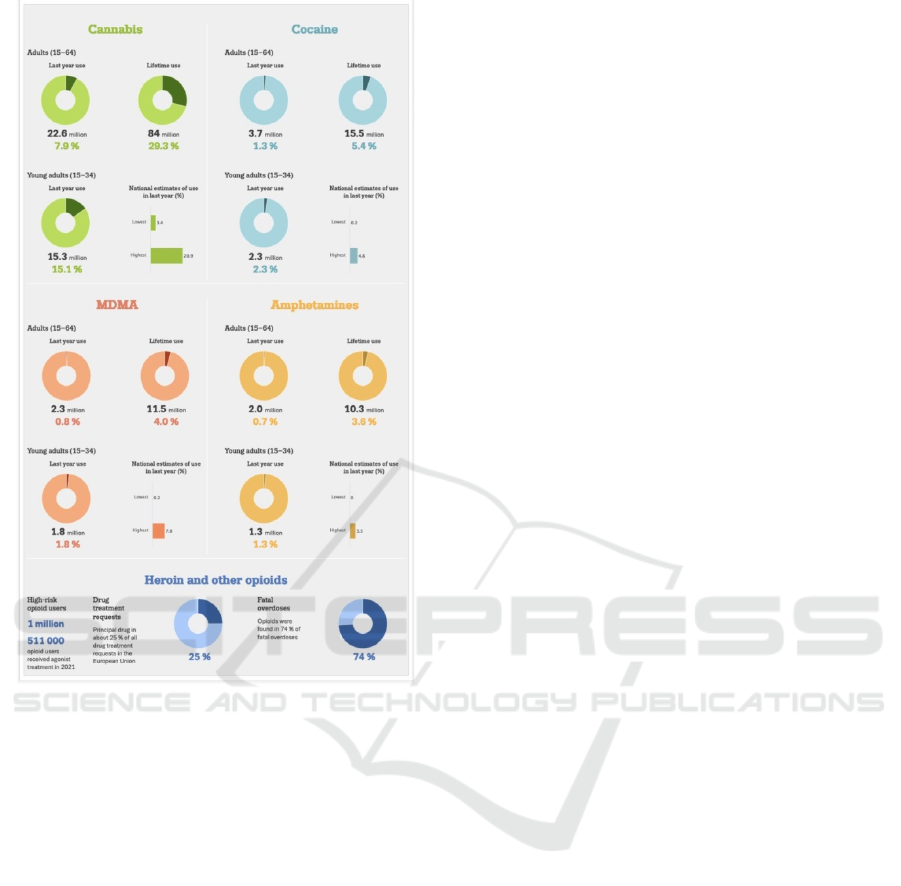
Figure 1: Most Used Drugs.
3 DIFFERENT NLP MODELS
FOR DRUG TRAFFIC KING
DETECTION
Some NLP approaches have been employed to
effectively identify drug trafficking activity. This
section presents some important models and their
descriptions, applications, and potential future
directions.
3.1 BERT – Based Models
Description: BERT (Bidirectional Encoder
Representations from Transformers) is a pre-trained
transformer-based model widely known for its
context-aware understanding of the con- textual
meaning of words in a sentence.
Application: BERT is applied in the analysis of
encrypted chat logs, social media posts and online
conversations to detect drug trafficking and
especially the detection of slang, euphemisms,
contextually relevant and so-called contextual words
that are commonly used by traffickers.
Advantages: BERT is highly accurate when
classified as text, and able to learn from and adapt to
changing language patterns. That makes BERT an
ideal tool in the fight against drug-related activity
online.
3.2 Graph Neural Networks (GNNs)
Description: GNNer is used to represent
relationships between different” devices” such as
hashtags, users and posts such as nodes and
Edges in a graph structure.
Application: Such networks can help identify human
trafficking by extracting correlations between users,
given keywords and content shared on social
networking sites such as Twitter and Instagram.
Advantages: GNNS has excellent ability to find
hidden correlations and intricate conditions in a large
-scale data set, making them very suitable for network
analysis.
3.3 Large Language Models (LLMs)
Description: Large Language Models (LLMs)such
as Chat- GPT and GPT-4 use knowledge-informed
prompts to analyze text data efficiently. Application:
These models are employed for detecting drug
trafficking activities by understanding and analyzing
deceptive language and evolving terminologies.
Advantages: LLMs excel in handling class-
imbalanced datasets and discovering new patterns
with limited labeled data, making them highly
adaptive.
3.4 Heterogeneous Graph Prompt
Learning (LLM-Het GDT)
Description: LLM-Het GDT combines Large
Language Models (LLMs) with Heterogeneous
Graph Neural Networks (HGNNs)to improve
detection accuracy, particularly in class imbalanced
scenarios.
Application: The system analyzes interactions
between users, posts, and keywords to detect drug
trafficking activities on platforms like Twitter.
Advantages: This approach is efficient, scalable, and
capable of addressing issues related to label scarcity
and data imbalance.
ICRDICCT‘25 2025 - INTERNATIONAL CONFERENCE ON RESEARCH AND DEVELOPMENT IN INFORMATION,
COMMUNICATION, AND COMPUTING TECHNOLOGIES
744
3.5 Deep Learning Models for Image
and Text Analysis
Description: They use a combination of image
processing and NLP approaches to analyze
multimodal data from social media.
Application: They detect drugs in images while also
matching captions and hashtags to see where they ’re
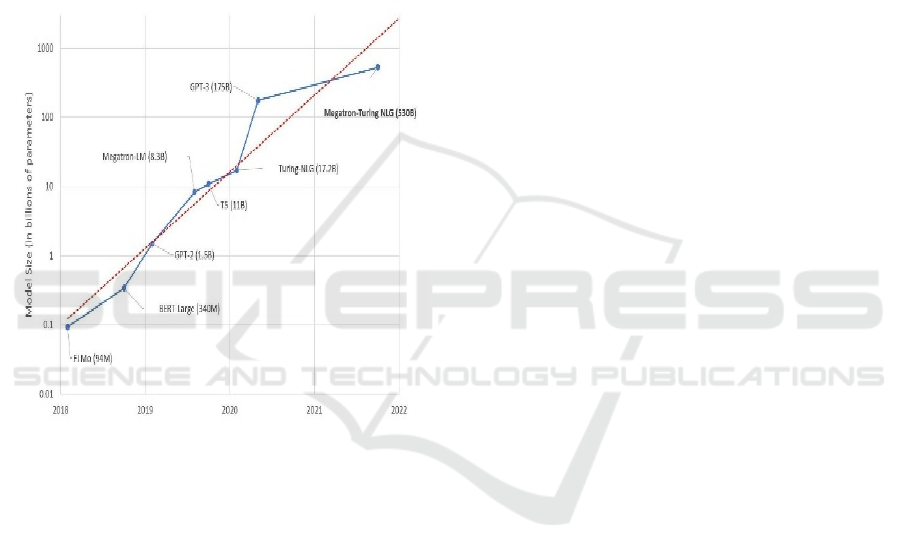
being used. The figure 2 shows the NLP Models
Comparison.
Advantages: By applying is approach to multiple
data sources it can be said that they provide a broad
and comprehensive solution for identifying patterns
in drug trafficking in relation to various content.
Figure 2: NLP Models Comparison.
3.5.1 Summary
The above we can see different way sin which models
of NLP and Deep Learning are used to effectively
fight drug trafficking; Based on the more complex
strategy, these models not only recognize suspicious
activities, but also consider the constantly changing
language and the behavior of smugglers. This section
presents the basic concepts needed to understand this
research: Monitoring illegal drug trade and observing
the analysis of social media monitoring and social
media platforms from a point of view. Illegal drug
sales are illegal distribution of drug sin electronic
form (usually by coded speech or private electronic
messages). Natural Language Processing (NLP) is a
subclass of artificial intelligence (AI) that uses human
language to detect drug related rupes and lack.
Use Cases Identify Objects Burgets (EG drugs)
in multimedia using image and video
recognition machine learning approaches
Geographical Location Tracking: Using
location information from social media posts to
do track where drugs are being sold.
Moral AI and Data Privacy: Regardless of the
moral guidelines and privacy requirements
when creating monitoring systems (such as
GDPR).
4 LITERATURE REVIEW
4.1 Key Concepts and Definitions
This section outlines fundamental concepts essential
to understanding the research:
Social Media Monitoring: Tracking and
analyzing con- tent on social platforms for
illegal drug sales.
Illicit Drug Sales: The illegal distribution of
narcotics through digital platforms, often
using coded language and direct messages.
•
Natural Language Processing (NLP): An AI
branch that analyzes human language, helping
detect suspicious conversations using drug-
related keywords and slang.
•
Image and Video Recognition: Machine
learning techniques for identifying objects, such
as drugs, in media posts.
•
Geolocation Tracking: Utilizing location data in
social media posts to identify drug sales hotspots.
•
Ethical AI and Data Privacy: Compliance with
ethical guidelines and privacy regulations, like
GDPR, in monitoring systems.
4.2 Historical Perspective
The role of social media in drug sales has evolved:
Early 2000s: Platforms like My Space and
Facebooks aw minimal illegal activity.
2010-2015: The rise of Instagram, Twitter, and
Snapchat led to increased drug trafficking due to
limited monitoring.
2015-Present: Billions of users have made
social media lucrative marketplace for drugs,
complicating law enforcement efforts.
4.3 Theoretical Framework
Key frame works guiding this research include:
Social Network Theory: Analyzes
communication pat- terns to detect criminal
behavior.
Investigating Drug Trafficking Using Encrypted Messengers: NLP and Data Analysis Approaches in Cybersecurity
745

Routine Activity Theory: Suggests crime
occurs when a motivated offender, suitable
target, and lack of guardian- ship converge.
Machine Learning and Big Data Analytics:
Essential technologies for processing large
datasets to detect suspicious behavior.
4.4 Previous Research
Studies on social media monitoring, AI, and drug-
related crime detection include:
These studies emphasize the need for integrated
systems combining text analysis, image recognition,
and network analysis.
4.5 Reputation of the Area now
The topic of the subject is shifting rapidly, and here
are some key developments to keep an eye on:
•
Improvements in NLP: Pre-trained models
such as BERT and GPT are paving the way for
a better comprehension of illegal code.
Advanced drug recognition algorithms based in deep
learning algorithms, are achieving consistently
greater accuracy in detecting drugs on images from
social networks such as Instagram.
4.6 Identified Gaps
However, there are still critical gaps within the
monitoring systems:
Changing Language, decoding: Since drug dealers
often adapt their means of communication, they need
flexible systems to track it.
•
Infections: Most modern systems don’t offer
insight until after data has been processed post-
infection. We must establish systems that are
capable of collecting and processing
information in real time, which will make it
possible for police to react faster.
•
Multichannel Integration: There is a remarkable
lack of systems capable of pulling records from
different systems within minutes, hindering full
drug trafficking detection.
•
Ethics, Privacy and Security Concerns:
Developing ethical monitoring protocols would
involve balancing law enforcement needs with
individual rights.
Quickly addressing these gaps may help create better
tools for combatting drug sales through social media
and protecting the privacy rights of users. The table
shows the table 1: summary of authors, objectives,
and findings Filling these gaps will help build better
tools to combat drug sales on social media platforms,
while ensuring that ethical and privacy concerns are
not overlooked.
Table1: Summary of authors, objectives, and findings.
Authors Objective Findings
Huang et
al.
(2018)
Detects lang in
drug-related
conversations on
Twitter.
Defined and
identified
drugs lang in
tracking
illegal
transactions.
Smith et
al.(
2020)
Identification of
drug paraphernalia
in social media
images.
Develope
d
an
Accurate
system for
identifying
drug-related
items.
Garcia and
Flores(201
9)
Use AI bots to
ascertain trends in
drug sales by
pretending to be a
buyer.
Successfully
gathered
insights into
drugs ales
trends using
b
ots.
Bakken
&Demant
(2019)
Study risk
perception by drug
vendors in social
media drug markets.
Public
platform
sellsers
perceived
higher risks
compared to
p
rivate ones.
Rhumor
barbeetal.
(2016)
Investigate Darknet
drug markets using
digital, physical,
and chemical data.
Found Dark
net markets
often offer
higher-quality
drugsat better
p
rices.
5 METHODOLOGY
5.1 Data Collection
The methodology was to expose the forensic data of
the experiment in encrypted chat logs and the dark
web market place. The algorithm is as follows:
•
Encrypted Chat Logs: Records of
experimental drug dealings were a hurdle in the
development of the data leakage.
•
Forensic Evidence: Cases of evidence were
identified from the impounded phones that were
legally seized from phones.
•
Dark Web Discussions: Chats on drug
trafficking were the topic of investigation.
ICRDICCT‘25 2025 - INTERNATIONAL CONFERENCE ON RESEARCH AND DEVELOPMENT IN INFORMATION,
COMMUNICATION, AND COMPUTING TECHNOLOGIES
746
5.2 Digital Forensic Investigation
The inquiry followed the NIST methodology and was
bro- ken down into four major parts:
Collection: The most popular methods that
investigators use to collect evidence include the
MOBIL and Magnet Axiom forensic tools. These
tools are used to image WhatsApp messages and
other material, as well as analyze the files on SD cards
and SIM cards.
Examination: Each file is hashed and its integrity
measured. This ensures that the file cannot be
modified or tampered with, as any change in the hash
would alter the block, leading to loss of file integrity.
Analysis: Crime prevention models were used to
locate drug-related terms and collections of words
indicating a crime spree in favor of narcotics.
Reporting: The police crime labs and the scene
investigator must complete the remaining affidavit so
that the prosecution has the necessary evidence.
5.3 NTP Based Detection Model
The authors suggested a BERT based NLP model to
classify drug conversations from drug related
encrypted chat history. The model went like this:
Preprocessing: Stop word and special character
removal from the messages, leading to
segmentation and noise elimination.
Feature Extraction: The word embeddings
were used to understand the nuances and
meanings associated with the messages.
Data Annotation and Reliability: If we want
the machine to have reliable data to learn from
then we also had to be careful with training data
so the model was trained on data obtained from
articles, TV Shows and Movies, etc, that had
relatable illegal activities
Evaluation: The performance of the model was
evaluated using metrics like accuracy, precision
and recall.
5.4 Figures and Tables
Terms and groups of words suggesting a streak of
crimes favoring narcotics.
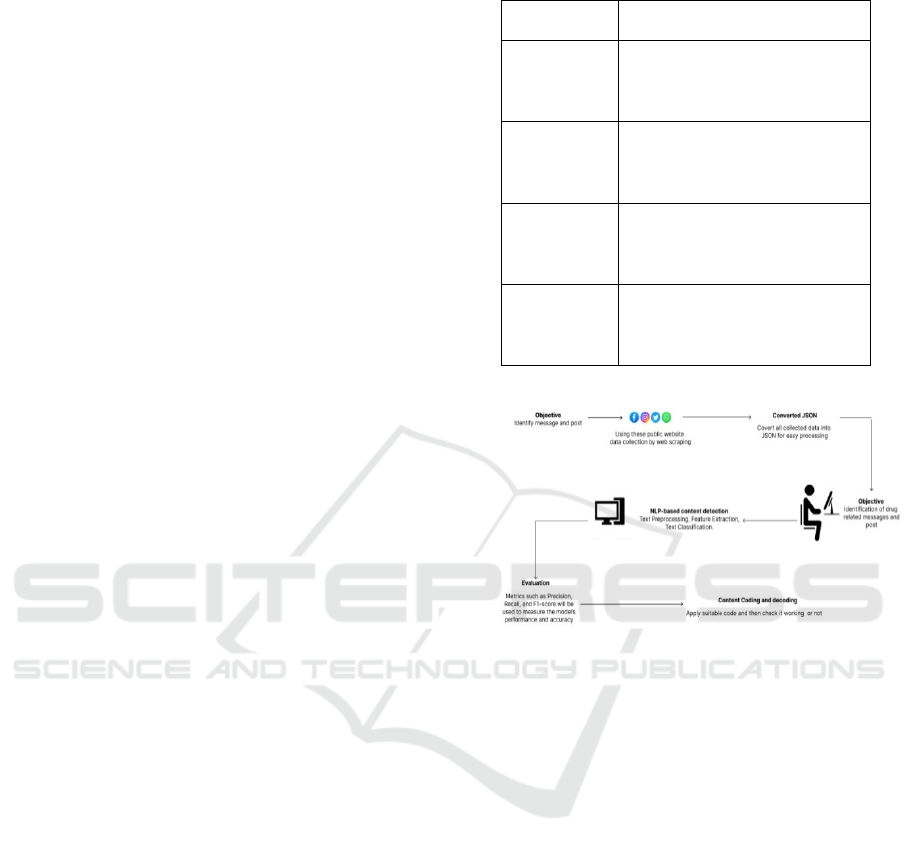
The figure 3 shows the Steps of NLP. And the
table 2 shows the Table 2 NLP based Detection
Model Stages. Finally, reporting: The police crime
labs and the scene investigator must fill out the
remaining affidavit so that the prosecution has what
they need.
Table 2: NLP based Detection Model Stages.
Stage Details
Preprocessing
Noise removal by deletings top
words and
Special characters.
Feature
Extraction
Word embeddings used to
capture relation
Ships and meanings of messages.
Model Training
Training on data from TV
shows, movies,
And articles featuring illegal
activities.
Evaluation
Performance measured through
accuracy,
precision, and recall.
Figure 3: Steps of NLP.
6 RESULTSANDDISCUSSION
6.1 Forensic Analysis of Encrypted
Message
Digital evidence such as deleted messages,
timestamps, and images was successfully extracted
from WhatsApp conversations using forensic tools.
The following key findings were observed:
A total of 67% of deleted messages were recovered,
demonstrating the effectiveness of forensic tools in
retrieving crucial evidence from suspects attempting
to erase their tracks.
100% of smartphone contacts were successfully
extracted, providing critical investigative leads for
law enforcement authorities.
Drug-related keywords were identified in 75% of
conversations, indicating that NLP-based analysis is
highly beneficial for detecting drugs muggling
activities through encrypted chats.
Investigating Drug Trafficking Using Encrypted Messengers: NLP and Data Analysis Approaches in Cybersecurity
747
6.2 NLP Model Performance
The NLP model was based on BERT and achieved
the following performance metrics:
Accuracy:91.2%
Precision:89.5%
Recall:87.8%
These results indicate that the NLP model is effective
in detecting drug-related discussions on encrypted
messaging platforms. The combination of high
precision and recall ensures reliability by minimizing
false positives while capturing relevant crime-related
messages.
6.3 Implications for Law Enforcement
The integration of NLP-based monitoring with digital
forensic analysis provides significant advantages for
law enforcement agencies:
Detection of Illicit Transactions: Secure
internet communications often create challenges
for investigations, but NLP-assisted monitoring
enables law enforcement to detect and track
potential drug transactions.
Automated Text Analysis: NLP algorithms
facilitate the rapid processing of large volumes
of text data, allowing for quicker investigations
and real-time responses to criminal activities.
Recovery of Critical Evidence: Digital
forensic tools, when combined with text
analysis techniques, can extract keywords and
topics from deleted messages and multimedia
files, providing crucial evidence admissible in
court.
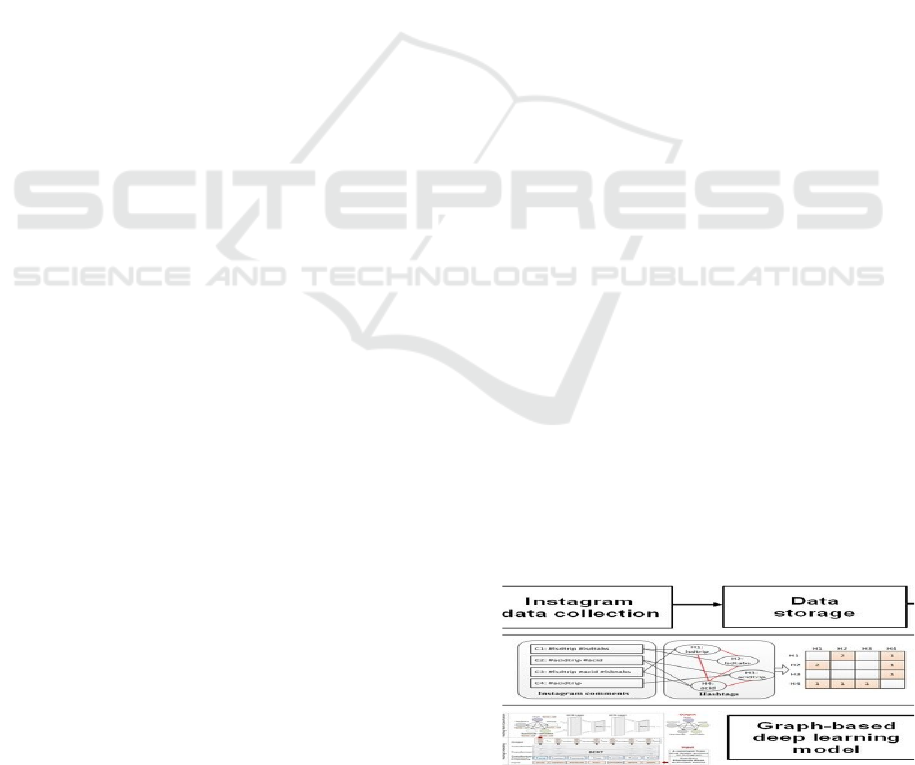
6.4 Application of the Methodology: A
Case Example
The methodology was applied to data collected from
Insta- gram posts and comments to detect and analyze
potential drug trafficking activities. The workflow
illustrates the system’s capability to uncover hidden
patterns and relationships within the data. Below is
the detailed example highlighting each step:
Data Collection and Storage: Instagram posts,
comments, and hashtags relevant to drug-related
activities were gathered. Specific hashtags such as
#acidtrip and #lsdtabs formed the thematic focus of
the dataset. A total of 12,857 posts were securely
stored for further processing to maintain data integrity
and enable advanced computational analysis.
Comments and Hashtags Analysis: The following
combinations of comments and hashtags were
identified:
CommentC1: Included #acidtrip and #lsdtabs,
indicating potential connections.
CommentC2: Focused so lelyon #acidtrip.
Additional comments: Showed varied and recurring
combinations of related hashtags.
These findings form the basis for uncovering patterns
within the data.
Graph Representation: To visualize the
relationships between hashtags, a graph structure
was created:
Nodes represented hash tags, suchasH1(#lsdtabs)
and
H3(#acidtrip).
Edges depicted Connections between nodes. For
instance, #lsd tabs (H1) was linked to #acidtrip (H3),
and #acid (H2) was also associated with #acidtrip
(H3).
This graph served as a critical tool to understand the
underlying network of hashtags.
Matrix Representation: The graph relationships were
converted into a matrix format, enabling
computational analysis:
Rows and columns represented in dividual hashtags.
Matrix values indicated the strength or presence of
links between pairs of hashtags.
This representation facilitated further processing with
advanced mathematical techniques.
Graph-Based Deep Learning Implementation:
A graph based deep learning model was employed to
analyze the data:
Integrated graph and matrix representations
provided in- sights into hidden patterns.
The model demonstrated the ability to detect
key trends, connections, and clusters within the
data.
For instance, the analysis revealed 1,228 flagged
posts and 267 distinct user accounts associated
with potential drug-related activities.
Figure 4: Example.
7 DISCUSSION
ICRDICCT‘25 2025 - INTERNATIONAL CONFERENCE ON RESEARCH AND DEVELOPMENT IN INFORMATION,
COMMUNICATION, AND COMPUTING TECHNOLOGIES
748

The findings of this case study highlight the
effectiveness of the proposed method for finding drug
related activities on social media. Graph-based DEEP
Wanda with traditional data analysis techniques can
consolidate education models, system:
Identify and test their current pattern in hash tags and
user comments. Provide a valuable understanding of
human trafficking network, law enforcement efforts.
Adapt to the development language and coded
terminology used in illegal activities.
This case study emphasizes the possibility of
connecting NLP and graph-based models for
experimental cybersecurity applications, especially
fighting the DRUG trafficking.
This example highlights the potential of integrating
NLP and graph-based models for real-world
applications in cybersecurity.
8 CONCLUSIONS AND
FUTUREWORK
This look at emphasizes the potential of NLP mixed
with digital forensics in detecting and preventing drug
trafficking on encrypted messaging systems. The
consequences display that at the same time as
machine getting to know models can discover illegal
activities, forensic tools play a critical role in getting
better crucial proof that criminals attempt to erase.
Future research should focus on:
Real-Time Detection: Developing deep learning
models that can recognize illegal activities in real-
time.
Forensic Analysis of Other Platforms: Expanding
the forensic framework to other encrypted messaging
applications, such as Signal.
Legal Frameworks: Establishing legal systems that
balance the need for encrypted communication
monitoring while protecting user privacy.
The integration of AI and digital forensics in law
enforcement will enhance authority’s ability to
predict drug traffickers’ operational models and
contribute to as after digital world.
REFERENCES
Aldridge, J., &De´cary-He´tu, D.,” Hidden wholesale: The
drug diffusing capacity of online drug cryp to markets,”
The International Journal on Drug Policy, vol. 35, pp.
7–15, 2016.
Bacon, M.,” Desistance from criminal is a tion: police
culture and new directions in drugs policing,” Policing
and Society, vol. 32, no. 4, pp.522–539, 2022.
Bakken & Demant,” Sellers’ risk perceptions in public and
private social media drug markets,” 2019. Objective:
Risk perception by drug vendors in social media drug
markets. Findings: Sellers on public platforms per-
ceived higher risks than private platforms.
Bakken, S. A.,” App-based textual interviews: interacting
with younger generations in a digitalized social reality,”
International Journal ofSocial Research Methodology,
vol. 0, no. 0, pp. 1–14, 2022.
Cabrera-Nguyen,E.P.,Cavazos-
Rehg,P.,Krauss,M.,Bierut,L.J.,& Moreno, M. A.,”
Young adults’ exposure to alcohol-and marijuana-
related content on Twitter,” Journal of Studies on Al-
cohol and Drugs, vol. 77, no. 2, pp. 349–353, 2016.
Chuanbo, Hu., Bing, Liu., Yanfang, Ye., & Xin, Li.,” Fine-
grained Classification of Drug Trafficking Based on
Instagram Hashtags,” Decision Support Systems, 2022.
DOI: 10.1016/j.dss.2022.113896.
Chuanbo, Hu., Bing, Liu., Xin, Li., &Yanfang, Ye.,” Un-
veiling the Potential of Knowledge-Prompted ChatGPT
for Enhancing Drug Trafficking Detection
on Social Media,” arXiv.org, 2023.
DOI:10.48550/arXiv.2307.03699.
Garcia and Flores,” AI-led bots to interact with drug deal-
ers,” 2019.Objective: Utilize AI bots to ascertain trends
in drug sales by pretending to be a buyer. Findings:
Successfully accrued drug sales trends insights using
bots.
Huang et al.,” NLP for Twitter drug-related conversation
detection,”2018. Objective: Detect slang in drug-
related conversations on Twitter. Findings: Defined and
identified drug slang in tracking illegal transactions.
Kang, R., Dabbish, L., Fruchter, N., &Kiesler, S.,” “My
Data Just Goes Everywhere:” User Mental Mod-
elsoftheInternetandImplicationsfor Privacy and Securi-
ty,” Eleventh Symposium on Usable Privacy and Secu-
rity (SOUPS 2015), Ottawa, Canada, 2015.
M. J.,” Predictors of buying drugs on social media among
young people in New Zealand: Findings from a large
online survey,” International Journal of Drug Policy,
vol. 98, p. 103430, 2021.
Moreno, M. A., & Whitehill, J. M.,” #Wasted: The inter-
section of substance use behaviors and social media in
adolescents and young adults,” Current Opinion in
Psychology, vol. 9, pp. 72–76, 2016.
Moyle, L., Childs, A., Coomber, R., & Barratt, M. J.,
”#Drugsforsale:Anexplorationoftheuseofsocialmediaa
ndencryptedmessagingappsto supply and access
drugs,” The International Journal on Drug Policy, vol.
63, pp. 101–110, 2019.
Rhumorbarbe et al.,” Buying drugs on a Darknet market: A
better deal?” 2016. Objective: Investigate Darknet drug
markets using digital, physical, and chemical data.
Findings: Found higher-quality drugs at better prices on
Darknet markets.
Ryan, J. E., Smeltzer, S. C., &Sharts-Hopko, N. C.,” Chal-
lenges to studying illicit drug users,” Journal of Nursing
Scholarship, vol. 51, no.4, pp. 480–488, 2019.
Shah, N., Li, J., & Mackey, T. K.,” An unsupervised ma-
chine learning approach for the detection and charac-
Investigating Drug Trafficking Using Encrypted Messengers: NLP and Data Analysis Approaches in Cybersecurity
749

terization of illicit drug-dealing comments and interac-
tions on Instagram,” Substance Abuse, vol.43, no.1, pp.
273–277, 2022.
Smith et al.,” Computer vision for the detection of Insta-
gram and Snapchat drug paraphernalia,” 2020. Objec-
tive: Identification of drug paraphernalia in social me-
dia images. Findings: Developed an accurate system to
identify drug-related items.
Tianyi Ma, Yiyue Qian, Chuxu Zhang, &Yanfang Ye,”
HypergraphContrastiveLearningforDrugTraffick-
ingCommunityDetection,”DOI:10.1109/icdm58522.20
23.00149, 2023.
Trottier, D., Social Media as Surveillance: Rethinking
visibility in a converging world, Routledge, 2012.
Vander Sanden,R., Wilkins ,C .,Romeo ,J.S.,Rychert,M.,
&Barratt,
Vannucci, A., Ohannessian, C. M., & Gagnon, S.,” Multi-
site social media use and psychological adjustment
during emerging adulthood,” Emerging Adulthood, vol.
7, no. 6, pp. 501–506, 2019.
ICRDICCT‘25 2025 - INTERNATIONAL CONFERENCE ON RESEARCH AND DEVELOPMENT IN INFORMATION,
COMMUNICATION, AND COMPUTING TECHNOLOGIES
750
