
Artificial Intelligence in Education and Value Education
Shweta Bhatnagar and Rashmi Agrawal
School of Computer Applications, Manav Rachna International Institute of Research and Studies, Delhi Suraj Kund Road,
Sector 43, Faridabad, 121004 Haryana, India
Keywords: AI in Education, AI Applications in Education, Learner Analytics, Value‑Based Education.
Abstract: Delivering moral education requires a unique teaching methodology that differs from traditional learning.
Educational technology offers a platform for providing personalized education. In this paper, we present an
extensive review of recent advancements in Artificial Intelligence (AI) applications in education. The study
aims to answer two fundamental questions: how AI technologies are used in education, and how they can be
integrated into value, moral, and character education. The review focuses on AI-related educational research
carried out in the last five years and reveals a prevalent focus on understanding learners to facilitate
personalization, customization, and recommendations.
1 INTRODUCTION
The integration of Artificial Intelligence (AI) into
education has undergone a transformative journey,
progressing from computer technology to web-based
intelligent systems and even extending to humanoid
robots taking on teaching roles and chatbots assisting
educators (
L. Chen et al., 2020). This evolution has
entailed collaborative efforts from a diverse range of
professionals, including data scientists, statisticians,
psychologists, linguists, and education experts, who
have collectively engineered intelligent systems
capable of decision-making. These systems not only
support educators in their tasks but also empower
them to navigate an ever-changing landscape,
enhancing their knowledge and competencies (
S.
Pokrivcakova., 2019)
.
Against this backdrop of technological
advancement, this paper delves into the recent strides
made in education technology within the past five
years, with a particular focus on applications of
Artificial Intelligence in moral education. Through a
systematic literature review, this study seeks to
address pivotal questions driving the evolution of AI-
based education:
• Which domains and AI-driven technologies
have been explored in the context of
education?
• To what extent has research been undertaken
to leverage AI for value education?
The paper is structured into six distinct sections.
In Section II, the methodology employed for
conducting the comprehensive literature review is
expounded upon. Moving to Section III, a detailed
exploration of AI-based research within mainstream
education is presented. Subsequently, Section IV is
dedicated to scrutinizing AI's impact on value
education. Section V visualizes the findings. The
concluding Section VI briefly summarizes the
findings and delineates prospects for future research.
2 METHODOLOGY
Literature selection for this review followed a
systematic and comprehensive approach to ensure the
inclusion of relevant and recent research findings on
applications of AI in education. Only studies
published within the last five years, from 2018 to
2023, were considered eligible for inclusion. As
evident from Figure 1, the number of papers
published on Artificial Intelligence applications in
education has been increasing since 2018, although
many studies have been conducted from 2008 to
2014.
Papers were included if they contributed to the
application of Artificial Intelligence in education. The
relevance of each study was assessed based on the
title, abstract, and keywords. Only peer-reviewed
journals were considered for inclusion, to maintain
the quality and reliability of the included studies.
Bhatnagar, S. and Agrawal, R.
Artificial Intelligence in Education and Value Education.
DOI: 10.5220/0013942800004919
Paper published under CC license (CC BY-NC-ND 4.0)
In Proceedings of the 1st International Conference on Research and Development in Information, Communication, and Computing Technologies (ICRDICCT‘25 2025) - Volume 5, pages
727-734
ISBN: 978-989-758-777-1
Proceedings Copyright © 2026 by SCITEPRESS – Science and Technology Publications, Lda.
727

Conference proceedings, books, and other non-peer-
reviewed sources were excluded.
The IEEE and Science Direct databases were
searched. Keyword ‘applications of Artificial
Intelligence’ and search terms ‘Education
technology,’ ‘Moral Education’, ‘Value Education,’
and ‘Ethics Education’ were used to retrieve relevant
articles. Boolean operators (AND, OR) were
employed to effectively combine search terms.
Figure 1: Number of publications on Artificial Intelligence
applications in Education in IEEE over the years.
A total of 152 results were generated, of which
127 papers were weeded out based on topics, use of
technologies other than AI, and abstracts. 25 relevant
papers were identified.
These 25 papers were grouped based on their
areas of application in education. The six areas of AI
application in education are smart campuses, library
systems, intelligent tutoring, Examinations,
Laboratories, and Learner Analytics. The search for
moral education resulted in 46 open-access papers
published in Computer Science Journals.
Studies addressing the social science aspects of
ethics were excluded. Of the 46 shortlisted papers, 3
good quality papers with real-life complete
applications matched the criteria. The criteria for
inclusion in the literature review were an AI-based
application for value/moral/character education.
AI-Powered Applications and Technologies in
Education: Educational institutions perform multiple
functions such as academics, governance, student
guidance, examinations, etc. daily for which the
faculty has to spend a lot of time.
These activities are getting automated to an
extent, to facilitate faculty with some right tools for
their work. Technology allows management to get a
holistic view of the organization.
This not only empowers the faculty but also gives
them the necessary tools for 21st-century teaching.
Considerable Work has been done in the past decade,
especially in the last 5 years on developing such tools.
The summary of the applications of Artificial
Intelligence in the field of education is given in Table
1 and the technologies are summarized in Table 2.
Table 1: AI applications in areas of education.
Application
Technological
Advancement
Research
Publications
Smart
Campus
Networked
infrastructure, cloud
storage, IoT for
wearables and smart
gadgets, surveillance,
biometric and smart
attendance
[3], [4], [5], [6],
[7]
Library
AI based search
suggestions, identifying
hot topics for research
[8], [9], [10],
[11], [12]
Intelligent
tutoring
Personalized learning,
dashboards for teachers,
AI-based question
classification on
BLOOM’s taxonomy,
AI-based curriculum
builder, chat-bots for
learning resource
suggestions, teaching
robots using NLP,
English writing
intelligent tools
[13], [14], [15],
[16], [17], [18],
[19], [20], [21],
[22], [23], [24],
[25], [26], [27],
Examination
e-proctoring, safe exam
browsers, AI-based
auto-evaluation, AI-
based formative
assessments
[28], [29],
Laboratory
Virtual laboratories
based on 3D modeling
[30], [31], [32],
[33], [34]
Learner
Analytics
Learner Profiling,
performance prediction,
career path
recommendation,
Mapping of skills with
course outcomes,
identification of open
educational resources for
skills, mapping learners
to skills
[35], [36], [37],
[38], [39], [40],
[41], [42], [43],
[44]
Generative
AI
applications
Language translation,
personalized responses,
Tutoring support
material generation,
[45], [46], [47]
0
50
100
150
200
250
2000
2002
2004
2006
2008
2010
2012
2014
2016
2018
2020
Number of publications on Artificial
Intelligence applications in
Education over the years
Total
ICRDICCT‘25 2025 - INTERNATIONAL CONFERENCE ON RESEARCH AND DEVELOPMENT IN INFORMATION,
COMMUNICATION, AND COMPUTING TECHNOLOGIES
728

Table 2: Technologies used in areas of education.
Area of
Application
Technologies used Ref.
Examination
Machine learning techniques to help understand the learner
learning style, such as KNN-means for regression and Deep
Neural Networks for improving machine learning on the basis of
weights. Data mining processing model SEMMA
[29]
Recurrent Neural Networks are used for creating the prediction
model for the learner performance.
[35]
Decision Trees, Support Vector Machine (SVM), Naïve Bayes
(NB), K-Nearest Neighbour (kNN), Logistic Regression (LR) and
Random Forest (RF). Synthetic Minority Oversampling
Technique (SMOTE)
[36]
DNN to train machine on facial images; CLAHE algorithm for
light normalization; multi-level, multi-modal and multi-task
learning for face recognition
RNN based on LSTM for voice recognition (identification of d-
vector)
CNN+RNN for t
yp
in
g
reco
g
nition
[28]
Random forest, K-Nearest Neighbour, Large-margin nearest
neighbour regression.
Creation of numeric features for the social media activities as
data set.
Regression models were applied in Weka tool
[37]
Improved conditional generative adversarial network based deep
support vector machine (ICGAN-DSVM) algorithm
Comparison between ICGAN and CGAN, while DSVM is
compared with SVM
Heuristic based multiple kernel learning (MKL) is use
d
[38]
Research area
Identification
and library
DeepWalk was used to extract keywords from single paper.
Graph Convolutional Network (GCN) was used to extract
relevant keywords from multiple papers.
TextRank, SurfKE, S-DWKE, M-GCKE are used for ranking the
extracted keywords for hot topic.
Googlenews-vecctors-negative300.bin, with 300-dimensional
news corpus pre-trained by Google with word2vec, and
newsblogbbs.vec a pre-trained Chinese word vector were used for
testin
g
hot to
p
ics
[10]
Unbalanced multistage Heat Conduction and Mass Diffusion
(UHM) algorithm
[9]
Laboratory
MATLAB/Simulink environment
3DS Max for 3D modelling
PD control algorithm for movement control
[32]
Robotic ‘Equilibrium Player’
Ultimatum Game
[33]
Parts of Speech (POS) for breaking word problem into keywords
Object oriented analysis and design (OOAD) to classify the
keywords into numbers and operators
Machine Learning algorithms for classifying keywords into
categories
[34]
Learner
Analytics
Random walk strategy for creating the traversal graph
Precision, recall and F1 score to evaluate the recommender
system
Graph embedding methods like DeepWalk, Node2vec, LINE,
Graph Factorization, SDNE
[42]
Python for creation of Quiz Making Language and LMS
automato
r
[40]
Artificial Intelligence in Education and Value Education
729

latent Dirichlet allocation (LDA) statistical method
Sentiment Analysis
[41]
W3C standards, such as RDFs and OWL
Linked-data ontologies
Protégé LOV plugin
OOPS tool for validation
[27]
Fuzzy logic based on the Mamdani inference [43]
Smart Campus
Support Vector Machine (SVM), Decision Tree (DT), Random
Forest (RF), and K-nearest neighbor (KNN) for identifying the
re
q
uest burst
[6]
Monte Carlo Tree Search (MCTS) and Location Verification
(LV) algorithms are used
[7]
A brief discussion on technologies like google glass, fitbit, oculus
rift, emotive insight, Samsung gear, apple watch, Empatica,
sensewear, etextiles, tactile vest, hip disk, motiv GI, leg mounted
RFID, Go Pro 4 and fitbit iconic, head and pen motion modules
was made
[4]
Teaching/
Intelligent
Tutoring
Machine Learning
Sentiment Analysis
[14]
LSTM model
Wiki Word Vectors pre-trained word embedding
[22]
Speech Act Classifier
SVM algorithm
Google’s Dialog-Flow technology
[17]
LSTM-CRF algorithm
brat rapid annotation tool
[18]
Input channel addition algorithm
Event bundle encoding algorithm
Alternative template learning algorithm
[13]
Table 3: Applications and technologies used in Moral/ ethics education.
Ref. Technologies use
d
[48]
Thematic analysis of literature on CAI
Typically, CAI systems include an Automatic Speech Recognition (ASR), Natural
Language Understanding (NLU), Dialogue Management (DM), Natural Language
Generation (NLG), and Text to Speech (TTS) modules, which together constitute
the hi
g
h-level architecture of CAI.
[52]
Normative reasoning and deontic logics
The enabling technology are higher-order theorem proving systems via the Shallow
Semantical Embedding technique. Interactive theorem proving (ITP) and
automated theorem proving (ATP) for HOL, and also the overall coalescence of
heterogeneous theorem proving systems, as witnessed, in particular, by
Isabelle/HOL, LEO-II and Leo-III, which fruitfully integrate other specialist ATP
systems
[49]
Five separate Binary Logistic Regression models were run. Each model focused on
a different predictor detecting profanity or offensive words. Six separate Ordinary
Least Squares (OLS) Multiple Regression models were run, analyzing how
different factors influence chatbot responses
[53]
Value Group Classifier for identifying stakeholders in the ethical decision-making
tool designed using SVM for educational purpose
d
ICRDICCT‘25 2025 - INTERNATIONAL CONFERENCE ON RESEARCH AND DEVELOPMENT IN INFORMATION,
COMMUNICATION, AND COMPUTING TECHNOLOGIES
730
Research in Artificial Intelligence Assisted Value
Education
The importance of ethics in education is emphasized
in the National Education Policy 2021 of India
through inclusion of ethical concepts in holistic
education, such as service to society, love, peace
duty, non-violence and scientific temperament.
Applications like interactive storytelling (
N. Park et al.,
2021)
using Conversational Artificial Intelligence can
help young children understand the impacts of their
decisions. A
chat-bot that predicts the use of profane
languageduring interaction and replies in a human-
like manner to avoid such interactions was developed
in (
P. E. Torres et al., 2021)
.
The rules for detecting the use of profanity was
based on the participant’s profile. Physical-digital
play applications are helping shape the personalities
and values of young children (
R. A. Shweta Bhatnagar.,
2025)
by including strategies of motivation,
collaboration, problem-solving, decision-making and
physical activity.
The research suggests techniques of action
regulation, social expectations, goal-tool-action
alignment and technical feature creation for
improving the behavior of children. Also, the
numerous bio-wearables are being developed for the
children. The data collected by these can have a lot of
impact on the behavior of children (
B. Coppin., 2004)
.
Ethico-Legal reasoning is exemplified using HOL for
technology applications, as demonstrated in LogiKEy
(
R. H. Hassan et al., 2021)
. The court rulings on ethical
matters were encoded in HOL and are now available
as open reference for reuse by all. These examples
show the existing research in the field of moral
education.
Table 3: Applications and technologies used in
moral/ethics education
3 RESULTS AND DISCUSSION
Literature for the past 5 years was studied to analyze
the first research question on areas of application of
AI and the technologies mostly used for education.
The second research question about the applications
in the field of moral education was searched to
understand the depth of research in this area. Out of
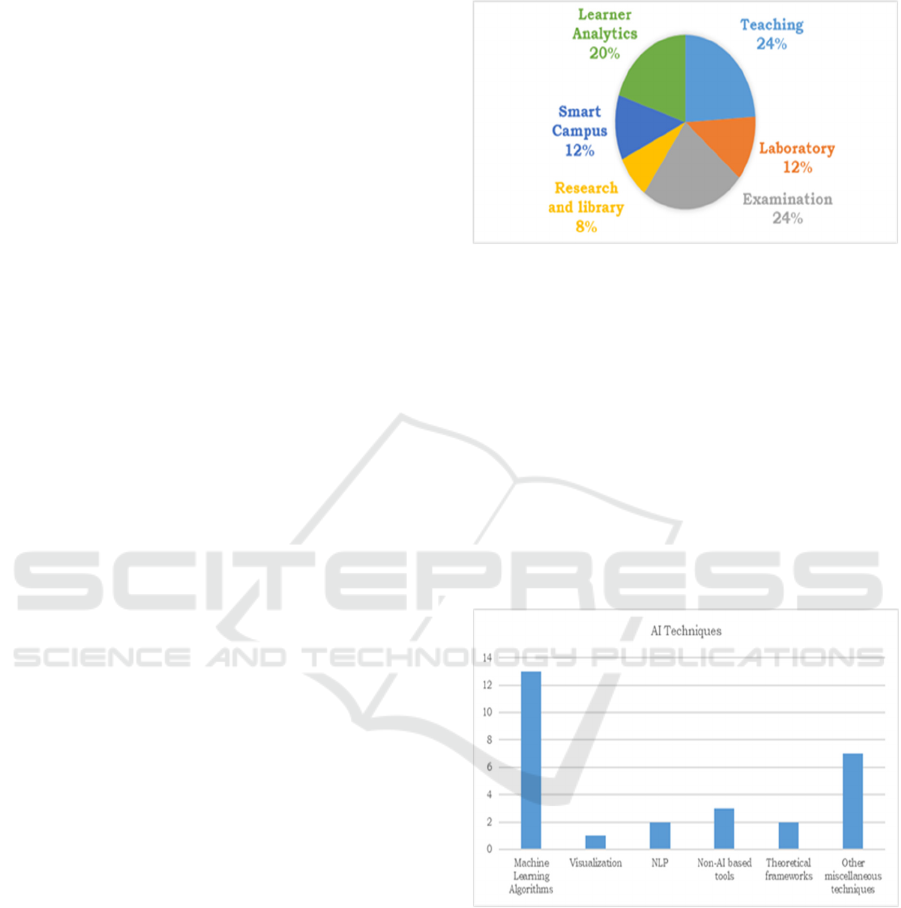
the papers studied on applications of AI in education,
the maximum was in the category of intelligent
tutoring and examination. 20% of the applications in
education focused on understanding the learner or
improving the content delivery for the learner These
three are the core activities of the educational
institutions. Figure2 explains the breakup of the
literature review.
Figure 2: Distribution of research papers on applications in
AI on education.
The technology-wise grouping of applications is
given in Figure 3. Most of the research in this field
has happened using Machine learning algorithms.
Apart from the wearables, laboratories requiring
visualizations, and chatbots requiring NLP; most of
the applications reviewed involved prediction,
recommendation, and classification of information.
Generative AI tools can develop a safe environment
for learners, where their exposure to unwanted
content is reduced, although there is limited research
on building personalized learning environments using
Generative AI.
Figure 3: AI techniques used in education.
The second question about research in moral
education discusses applications with moral
implications. Ethical education has always been a part
of national policies and recommendations of
committees formed for evaluating the education
system. The use of Artificial Intelligence in
addressing value education is limited and has scope
for further research.
Artificial Intelligence in Education and Value Education
731

4 CONCLUSIONS
A comprehensive literature review was undertaken to
identify applications centered around Artificial
Intelligence in education. The research aimed to
address two key inquiries: the domains of application
of AI in education, and specific instances of
application in the realm of value education. The
outcomes show that Artificial Intelligence aids in
establishing a personalized and tailored connection
with learners. Machine learning algorithms and tools
process data for data-driven functions such as
recommendations, classification, and predictions.
Popular applications primarily cater to mainstream
educational contexts, with a lack of representation in
the domain of value education.
In future, the identified gap in the application of
technological solutions within the sphere of moral,
ethical, and value education will be addressed by noel
methods. This approach advocates for the
incorporation of existing digital tools into this
particular domain. By adapting and integrating these
tools, the proposed research seeks to bridge the
technological gap in the field and enhance the
delivery of moral, ethical, and value education in
future.
REFERENCES
A. Takacs, G. Eigner, L. Kovacs, I. J. Rudas and T.
Haidegger, "Teacher’s kit: Development, usability, and
communities of modular robotic kits for classroom
education," IEEE Robotics & Automation Magazine,
vol. 23, no. 2, pp. 30-39, 2016.
A. Jobin, M. Ienca and E. Vayena, "The global landscape
of AI ethics guidelines," Nature Machine Learning, p.
389–399, 2019.
A. Tamò-Larrieux, "Decision-making by machines: Is the
‘Law of Everything’ enough?," Computer Law and
Security Review, vol. 41, 2021.
A. N. Antle and A. Kitson, "1,2,3,4 tell me how to grow
more: A position paper on children, design ethics and
biowearables," International Journal of Child-
Computer Interaction, vol. 30, 2021.
B. Coppin, Artificial Intelligence Illuminated, MA, USA:
Jones and Bartlett, 2004.
B. Wang, B. Yang, S. Shan and H. Chen, "Detecting Hot
Topics from Academic Big Data," IEEE Access, vol. 7,
pp. 185916-185927, 2019.
B. E. V. Comendador, W. F. C. Becbec and J. R. P. d.
Guzman, "Implementation of fuzzy logic technique in a
decision support tool: Basis for choosing appropriate
career path," International Journal of Machine Learning
and Computing, vol. 10, no. 2, p. 339–345, 2020.
B. Custers, "New Digital Rights: Imagining additional
fundamental rights for the digital era," Computer Law
and Security Review, vol. 44, 2022.
C. S. Tzafestas, N. Palaiologou and M. Alifragis, "Virtual
and Remote Robotic Laboratory:Comparative
Experimental Evaluation," IEEE Transactions on
Education, vol. 49, no. 3, pp. 360-369, 2006.
C. Benzmüller, X. Parent and L. v. d. Torre, "Designing
normative theories for ethical and legal reasoning:
LOGIKEY framework, methodology, and tool
support," Artficial Intelligence, 2020.
C. G. Duran and C. M. Ramirez, "Integration of Open
Educational Resources using Semantic Platform," IEEE
Access, vol. 9, pp. 93079-93088, 2021.
C. K. Lo, "What Is the Impact of ChatGPT on Education?
A Rapid Review of the Literature," Education Sciences,
2023.
D. Sampson and D. Fytros, "Competence Based
Educational Metadata for Supporting Lifelong
Competence Development Programmes," in IEEE,
2008.
D. Carlander-Reuterfelt, Á. Carrera, C. A. Iglesias, Ó.
Araque, J. F. S. Rada and S. Munoz, "JAICOB: A Data
Science Chatbot," IEEE Access, vol. 8, pp. 180672-
180680, 2020.
D. Baidoo-Anu and L. O. Ansah, "Education in the Era of
Generative Artificial Intelligence (AI): Understanding
the Potential Benefits of ChatGPT in promoting
Teaching and Learning," Journal of AI, 2023.
E. Popescu and F. Leon, "Predicting Academic
Performance Based on Learner Traces in a Social
Learning Environment," IEEE Access, vol. 6, pp.
72774-72785, 2018.
H. A. Almusawi, C. M. Durugbo and A. M. Bugawa,
"Wearable Technology in Education:A Systematic
Review," IEEE transactions on Learning Technologies,
vol. 14, no. 4, pp. 540-554, 2021.
J. Zheng, Q. Zhang, S. Xu, H. Peng and Q. Wu, "Cognition-
based Context-aware Cloud Computing for Intelligent
Robotic Systems in Mobile Education," IEEE Access,
vol. 6, pp. 49103-49111, 2018.
J. E. Auerbach, A. Concordel, P. M. Kornatowski and D.
Floreano, "Inquiry-Based Learning with RoboGen: An
Open-Source Software and Hardware Platform for
Robotics and Artificial Intelligence," IEEE transcations
on Learning Technologies, vol. 12, no. 3, pp. 356-369,
2019.
J. Chubb, S. Missaoui, S. Concannon, L. Maloney and J. A.
Walker, "Interactive Storytelling for Children: A Case-
study of Design and Development Considerations for
Ethical Conversational AI," International Journal of
Child-Computer Interaction, 2021.
J. Nieuwazny, K. Nowakowski, M. Ptaszynski, F. Masui,
R. Rzepka and K. Araki, "Does change in ethical
education influence core moral values? Towards
history- and culture-aware morality model with
application in automatic moral reasoning," Cognitive
Systems Research, vol. 66, p. 89–99, 2021.
K. T. Chui, R. W. Liu, M. Zhao and P. O. d. Pablos,
"Predicting Students' Performance with School and
ICRDICCT‘25 2025 - INTERNATIONAL CONFERENCE ON RESEARCH AND DEVELOPMENT IN INFORMATION,
COMMUNICATION, AND COMPUTING TECHNOLOGIES
732

Family Tutoring using Generative Adversarial Network
based Deep Support," IEEE Access, 2020.
K. Manning, "8 Smart Campus Technology Examples,"
Process Maker, 16 07 2020. [Online]. Available:
https://www.processmaker.com/blog/8-examples-of-
smart-campus-technology/. [Accessed 05 01 2022].
L. Rodriguez-Gil, J. Garcıa-Zubia, P. Orduna and D.
Lopez-de-Ipina, "Towards New Multiplatform Hybrid
Online Laboratory Models," IEEE Trannsactions on
learning technologies, vol. 10, no. 3, pp. 318-330, 2017.
L. Chen, P. Chen and Z. Lin, "Artificial Intelligence in
Education: A Review," IEEE Access, vol. 8, pp. 75264-
75278, 2020.
M. Coccolia, A. Guerciob, P. Marescac and L. Stanganelli,
"Smarter universities: A vision for the fast-changing
digital era," Journal of Visual Languages and
Computing, vol. 25, no. 6, pp. 1003-1011, 2014.
M. Qamhieh, H. Sammaneh and M. N. Demaidi, "PCRS:
Personalized Career-Path Recommender System for
Engineering Students," IEEE Access, vol. 8, pp.
214039-214049, 2020.
M. A. Razzaq, J. A. Mahar, M. Ahmad, N. Saher, A.
Mehmood and G. S. Choi, "Hybrid Auto-Scaled
Service-Cloud-Based Predictive Workload Modeling
and Analysis for Smart Campus System," IEEE Access,
vol. 9, pp. 42081-42089, 2021.
M. Labayen, R. Vea, J. Florez, N. Aginako and B. Sierra,
"Online Student Authentication and Proctoring System
Based on Multimodal Biometrics Technology," IEEE
Access, vol. 9, pp. 72398-72411, 2021.
M.-H. Chen, W.-F. Chen and L.-W. Ku, "Application of
Sentiment Analysis to Language Learning," IEEE
Access, 2018.
N. Fiorini, K. Canese, G. Starchenko, E. Kireev, W. Kim,
V. Miller, M. Osipov, M. Kholodov, R. Ismagilov, S.
Mohan, J. Ostell and Z. Lu, "Best match: New
relevance search for pubmed," PLOS Biology, 2018.
N. Park, K. Jang, S. C. a and J. Choi, "Use of offensive
language in human-artificial intelligence chatbot
interaction: The effects of ethical ideology, social
competence, and perceived humanlikeness,"
Computers in Human Behavior, vol. 121, 2021.
P. Yin, G. Wang, M. Z. A. Bhuiyan, M. Shan and F. Qi,
"Unbalanced Multistage Heat Conduction and Mass
Diffusion Algorithm in an Educational Digital
Library," IEEE Access, vol. 7, pp. 147302-147313,
2019.
P. E. Torres, P. I. Ulrich, V. Cucuiat, M. Cukurova, M. C.
F. D. l. Presa, R. Luckin, A. Carr, T. Dylan, A. Durrant,
J. Vines and S. Lawson, "A systematic review of
physical-digital play technology and developmentally
relevant child behaviour," International Journal of
Child-Computer Interaction, vol. 30, 2021.
P.-H. Lin, A. Wooders, J. T.-Y. Wang and W. M. Yuan,
"Artificial Intelligence, the Missing Piece of Online
Education?," IEEE Engineering Management Review,
vol. 46, pp. 25-28, 2018.
Q. Liu, Z. Huang, Y. Yin, E. Chen, H. Xiong, Y. Su and G.
Hu, "EKT: Exercise-aware Knowledge Tracing for
Student Performance Prediction," IEEE transactions on
knowledge and data engineering, vol. 33, no. 1, pp. 100-
115, 2019.
R. A. Shweta Bhatnagar, "Value Group Classifier Model
for Ethical Decision-making," Indonesian Journal of
Electrical Engineering and Computer Science, vol. 37,
no. 3, pp. 1899-1907, 2025.
R. Winkler and M. Söllner, "Unleashing the Potential of
Chatbots in Education: A State-Of-The-Art Analysis,"
in Academy of Management Annual Meeting (AOM),
Chicago, USA, 2018.
R. H. Hassan, M. T. Hassan, S. Naseer, Z. Khan and M.
Jeon, "ICT Enabled TVET Education: A Systematic
Literature Review," IEEE Access, vol. 9, pp. 81624-
81650, 2021.
R. L. Amyatun and A. Kholis, "Can Artificial Intelligence
(AI) like QuillBot AI Assist Students’ Writing Skills?
Assisting Learning to Write Texts using AI," ELE
Reviews: English Language Education Reviews, pp.
135-154, 2023.
S. Pokrivcakova, "Preparing teachers for the application of
AI-powered technologies in foreign language
education," Journal of Language and Cultural
Education, vol. 7, p. 135–153, 2019.
S. Nahhas, O. Bamasag, M. Khemakhem and N. Bajnaid,
"Bridging Education and Labor Skills by a Novel
Competency-Based Course Linked-Data Model," IEEE
Access, vol. 7, pp. 119087-119098, 2019.
S. Cunningham-Nelson, M. Baktashmotlagh and W. Boles,
"Visualizing Student Opinion Through Text Analysis,"
IEEE Transactions on Education, vol. 62, no. 4, pp.
305-311, 2019.
S. Orlando, E. Gaudiso and F. D. L. Paz, "Supporting
Teachers to Monitor Student’s Learning Progress in an
Educational Environment With Robotics Activities,"
IEEE Access, vol. 8, pp. 48620-48631, 2020.
S. Shaikh, S. M. Daudpotta and A. S. Imran, "Bloom’s
Learning Outcomes’ Automatic Classification Using
LSTM and Pretrained Word Embeddings," IEEE
Access, vol. 9, pp. 117887-117909, 2021.
S. D. A. Bujang, A. Selamat, R. Ibrahim, O. Krejcar, E.
Herrera-Viedma, H. Fujita, N. Azura and M. Ghani,
"Multiclass Prediction Model for Student Grade
Prediction Using Machine Learning," IEEE Access,
vol. 9, pp. 95608-95621, 2021.
S. Mandal and S. K. Naskar, "Classifying and Solving
Arithmetic Math Word Problems—An Intelligent Math
Solver," IEEE Transactions on learning technologies,
vol. 14, pp. 28-41, 2021.
S. Kleanthous, M. Kasinidou, P. Barlas and J. Otterbacher,
"Perception of Fairness in Algorithmic decisions:
Future developers' perspective," Patterns, 2021.
T. Qian, Q. Li, B. Liu, H. Xiong, J. Srivastava and P. C.-Y.
Sheu, "Topic formation and development: a core-group
evolving process," World Wide Web, pp. 1343-1373,
2014.
T. P. Tran and D. Meacheam, "Enhancing Learners’
Experience through Extending Learning Systems,"
IEEE Transactions on Learning Technologies, vol. 33,
no. 3, pp. 540-551, 2020.
Artificial Intelligence in Education and Value Education
733

T. N. Fitria, "QuillBot as an online tool: Students’
alternative in paraphrasing and rewriting of English
writing," Englisia: Journal of Language, Education, and
Humanities, pp. 183-196, 2021.
W. Zhao, J. Jhang, X. Liu and Z. Jiang, "Application of ISO
26000 in digital education during Covid 19," Ain
Shams Engineering Journal, vol. 13, 2022.
W. M. Lim, A. Gunasekara, J. L. Pallant, J. I. Pallant and
E. Pechenkina, "Generative AI and the future of
education: Ragnarok ¨ or reformation? A paradoxical
perspective from management educators," The
International Journal of Management Education, 2023.
W.-H. Kim and J.-H. Kim, "Individualized AI Tutor Based
on Developmental Learning Networks," IEEE Access,
vol. 8, pp. 27927-27937, 2020.
X. Xiao, R. Sun, Z. Yao, C. Zhang and X. Chen, "A Novel
Framework With Weighted Heterogeneous Educational
Network Embedding for Personalized Freshmen
Recommendation Under the Impact of COVID-19
Storm," IEEE Access, vol. 9, pp. 67129-67142, 2021.
Y. Nieto, V. García-Díaz, C. Montenegro and R. G. Crespo,
"Supporting academic decision making at higher
educational institutions using machine learning-based
algorithms," Soft Computing, 2018.
Y. Li, "An application of EDM: Design of a New Online
System for Correcting Exam Paper," in ICCSE,
Colombo, Sri Lanka, 2018.
Y.-H. An, L. Pan, M.-Y. Kan, Q. Dong and Y. Fu,
"Resource Mention Extraction for MOOC Discussion
Forums," IEEE Access, vol. 7, pp. 87887-87900, 2019.
Z. Zhang, L. Yu and R. Un, "Academic Hot-Spot Analysis
on Information System Based on the Co-Term
Network," In Proceedings of the 18th Pacific Asia
Conference on Information Systems, pp. 109-117,
2014.
Z. Lei, H. Zhou, W. Hu, Q. Deng, D. Zhou, Z.-W. Liu and
X. Gao, "3-D Interactive Control Laboratory for
Classroom Demonstration and Online Experimentation
in Engineering Education," IEEE Transactions on
Education, vol. 64, no. 3, pp. 276-282, 2020.
Z. Gao, Y. Huang, L. Zheng, X. Li, H. Lu, J. Zhang, Q.
Zhao, W. Dia, Q. Fang and J. Fang, "A Student
Attendance Management Method Based on
Crowdsensing in Classroom Environment," IEEE
Access, vol. 9, pp. 31481-31492, 2021.
ICRDICCT‘25 2025 - INTERNATIONAL CONFERENCE ON RESEARCH AND DEVELOPMENT IN INFORMATION,
COMMUNICATION, AND COMPUTING TECHNOLOGIES
734
