
Real‑Time Stock Price Prediction and Market Analysis Using
Machine Learning
S. Reshma, Gangarapu Tulasikrishna, Chennam Setty Prashanth, Cheduluri Rakesh,
Kaukuntla Venkatesh and Kotte Sai Rakesh Kumar
Department of Computer Science and Engineering (DS), Santhiram Engineering College, Nandyal, Andhra Pradesh, India
Keywords: Stock Price Prediction, Machine Learning, LSTM, Market Sentiment Analysis, Time‑Series Forecasting,
RNN, Data Visualization.
Abstract: It will be difficult to predict with a very dynamic and unstable character of the financial markets.
1 INTRODUCTION
Many factors, such as the investor's attitude, geo -
political development and macroeconomic
conditions, have an impact on the stock market. Non-
linearity and high-dimensional data are difficult for
traditional forecasting methods such as moving the
average and Eryima to handle. A powerful alternative
is offered by machine learning, which provides real -
time predictions by learning from historical trends.
This study how many machine learning algorithms,
their efficiency and how they improve the accuracy
of stock price prognos.
The art of predicting stock prices has been a
difficult task for many researchers and analyst. In
fact, investors are very interested in the research
sector to predict stock courses.
For a good and successful investment, many
investors are keen to know the status of the future of
the stock market. Good and effective prediction
system helps traders for the stock market, by
providing support information as an investor, and
analysts' guidelines market. In this work we introduce
a recurring nervous network (RNN) and long -term
short -term Memory (LSTM) approach to predict
stock market indices.
2 LITERATURE REVIEW
Share course prediction has been a field of extensive
research due to its significant impact financial market
and investment strategies. Traditional forecasting
technology autoregressive integrated moving average
(Arima) and linear recovery are models stock market
analysis is widely used. However, these models are
struggling to catch the complex and non-led patterns
of stock prices, which are affected by different
dynamic factors market trends, economic indicators
and investors as spirit. Consequently, machine
learning (Ml) techniques have gained popularity for
their ability to treat uppercase versions of economic
traditional models often miss data and hidden
patterns.
In stock pregnancy, recent research has shown
that deep learning models - especially, Long-term
memory (LSTM) networks and conventionally neural
networks (CNN)-Perform better than traditional
statistical models. While CNN-R removes
geographical and temporary information, LSTMS,
which is sewn for time chain data, captures
effectively.
Long -lasting dependency on stock price. To
increase the accuracy of the forecast, researchers have
also seen hybrid models mixing deep learning
architecture machine learning techniques such as
Support Vector Machine (SVM) and XGBOOST. In
models improve future efficiency by combining
unarmed data (eg. News Spirit) and trends on social
media with structured data (historical stock prices and
technology Indicator).
In financial market analysis, Machine learning has
generally demonstrated encouraging outcomes in
terms of enhancing stock price forecasts. There are
still issues with model interpretability, data
reliability, and market volatility in spite of these
Reshma, S., Tulasikrishna, G., Prashanth, C. S., Rakesh, C., Venkatesh, K. and Kumar, K. S. R.
Real-Time Stock Price Prediction and Market Analysis Using Machine Learning.
DOI: 10.5220/0013942100004919
Paper published under CC license (CC BY-NC-ND 4.0)
In Proceedings of the 1st International Conference on Research and Development in Information, Communication, and Computing Technologies (ICRDICCT‘25 2025) - Volume 5, pages
691-696
ISBN: 978-989-758-777-1
Proceedings Copyright © 2026 by SCITEPRESS – Science and Technology Publications, Lda.
691

developments. It is anticipated that future studies
would concentrate on real-time data processing,
hybrid models, and incorporating blockchain
technology to guarantee data integrity in stock market
forecasting.
3 EXISTING SYSTEMS
3.1 Traditional Statistical Models
Traditional methods such as ARIMA, moving
averages, and regression models are commonly used
for stock price prediction. These models are unable to
capture complicated market movements since they
are based on past data and assume linear correlations.
Their predicting accuracy is frequently below ideal
due to their difficulties in managing abrupt shifts and
market volatility.
3.2 Machine Learning-Based
Forecasting
Support Vector Machine (SVM) and random forests
are two machine learning models analyse the dataset
on a large scale, such as previous stock prices and
technical indicators, to increase Prophet's accuracy.
However, these models are able to identify trends in
stock depending on the prophecies of movements and
production, they still have difficulties with non-
stagnation and extremely unstable market
environment.
3.3 Deep Learning-Based Forecasting
Prolonged memory (LSTM) and Conversional Neural
Network (CNN), two deep learning models are
particularly good in the processing of time series data
and identify non-linear correlation. Long -lasting
stock beaches can be remembered by LSTMS, while
CNN is able to extract important market
characteristics. Although they need a lot of data and
processing power, these models perform better in
traditional methods.
3.4 Hybrid and Real-Time Prediction
Models
For better forecast accuracy, hybrid models are
learning reinforcement and integrate the market
emotional research with the way machine learning
and deep learning. Live stock market data current is
used to modify dynamic forecasts by real -time
prediction models. in methods require effective
calculation resources but still flexibility and decision
-making for high frequency trade.
4 METHODOLOGY
4.1 Data Collection
We collect historical stock price information from
Bloomberg, Yahoo Finance, and Alpha Vantage. For
market trend analysis, technical indicators like
MACD, RSI, and Moving Averages are extracted.
Investor sentiment is captured by incorporating
sentiment research data from social media and
financial news. A more comprehensive market
outlook also considers macroeconomic variables like
GDP growth and interest rates.
4.2 Data Pre-Processing
Data is cleaned by removing outliers and
interpolation of missing values to preserve
consistency. Normalizing indicators and stock prices
into a common scale helps to improve model training
by means of consistency. New attributes like daily
returns and volatility and are created by feature
engineering to raise forecast precision. Time-based
elements including day, week, and month help
identify seasonal trends.
4.3 Data Splitting
For efficient model training the dataset is split into
test (10%), validation (20%), and training (70%), sets.
While hyperparameter adjustment is accomplished
with the validation set, model development is
conducted using the training set. The figure 1 shows
the
Partitioning the data. The test set evaluates model
performance with regard to employing secret stock
price information. This guarantees that the model
generalizes effectively and helps to prevent
overfitting.
ICRDICCT‘25 2025 - INTERNATIONAL CONFERENCE ON RESEARCH AND DEVELOPMENT IN INFORMATION,
COMMUNICATION, AND COMPUTING TECHNOLOGIES
692
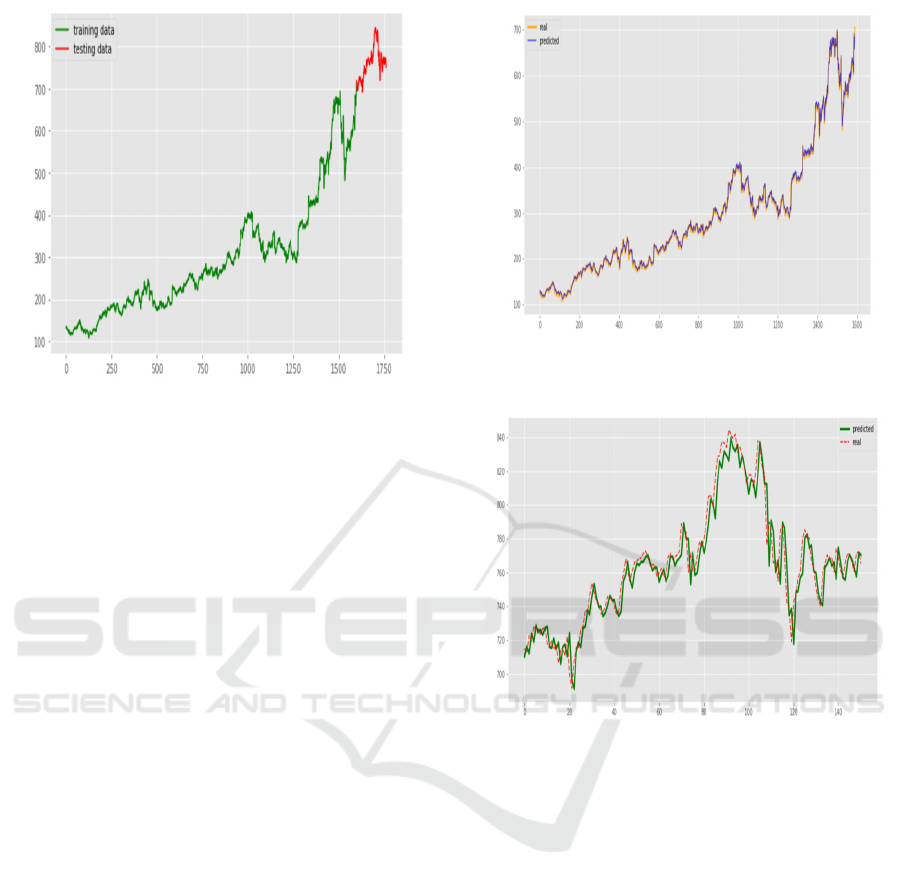
Figure 1: Partitioning the Data.
4.4 Feature Extraction
Important factors affecting the variation in stock
prices are achieved: Volume pattern, market mood
and economic data. Economic news and spirit
analysis are done using NLP methods on lessons
derived from social media. Deep understanding of the
market. The two benefits of extracted functions are
high model accuracy.
4.5 Classification
Stock movements are categorized as "Uptrend,"
"Downtrend," and "Stable" using supervised learning
techniques. Models like Random Forest, Decision
Trees, and Support Vector Machines (SVM) classify
stocks based on features that have been retrieved. The
figure 3 shows the prediction on testing data.
This classification helps traders make informed
investment decisions.
4.6 Prediction
Machine learning models like ARIMA, XGBoost,
and LSTM use historical data to predict future stock
values. LSTM, a deep learning method, is used to
capture time-series dependencies for accurate
forecasting. prediction on training data shown in
figure 2. The anticipated stock values can help traders
and investors enhance their portfolio plans.
Figure 2: Prediction on Training Data.
Figure 3: Prediction on Testing Data.
4.7 Result Generation
The final stock price projections are shown on
interactive dashboards created with Tableau, Power
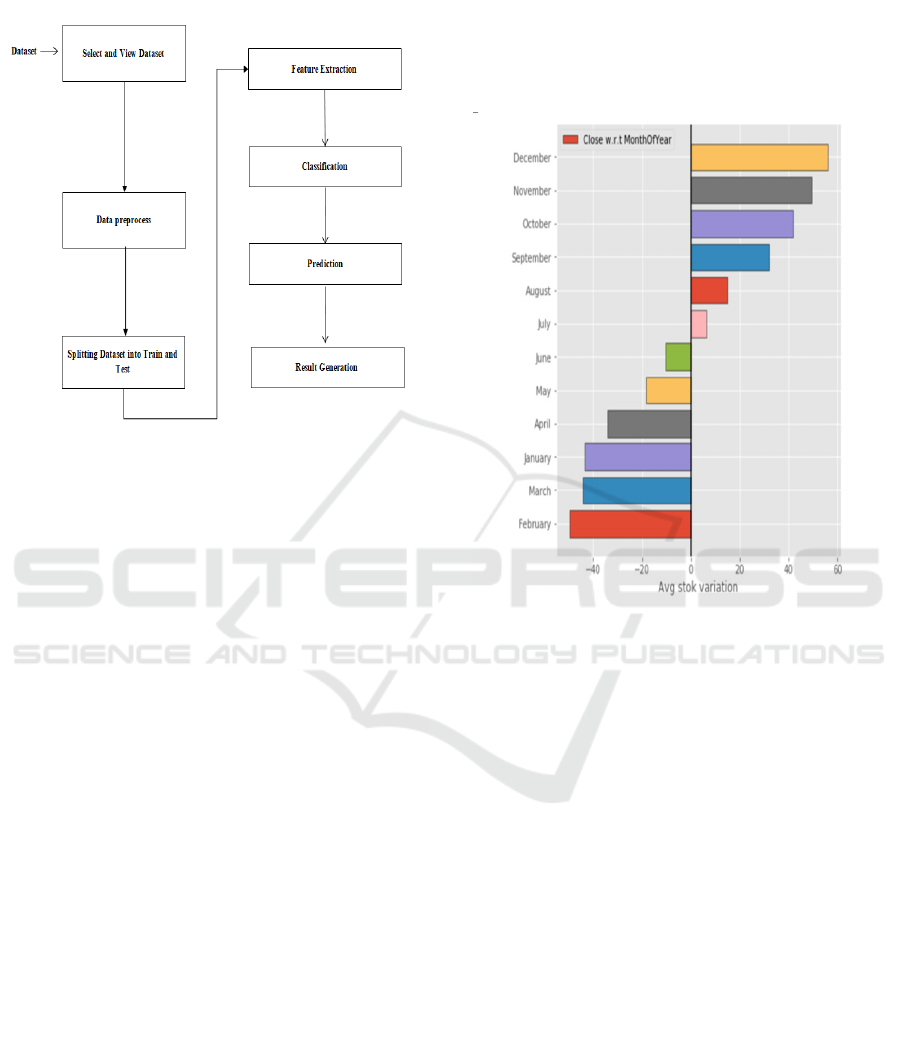
BI, or Matplotlib. The System Architecture shown in
figure 4. Stock prices are compared between forecasts
and actuals in order to evaluate accuracy. The results
are integrated into financial applications or trading
platforms to provide insights in real time.
Real-Time Stock Price Prediction and Market Analysis Using Machine Learning
693
4.8 System Architecture
Figure 4: System Architecture.
5 EXECUTION AND OUTCOMES
5.1 Data Acquisition and Pre-
Processing
Alpha Ventures, Yahoo Finance and Google Finance
are sources of stock market data. Technical indicators
such as RSI and MACD are calculated, and lack of
values are also considered. Data on economic news
and social media is subject to spiritual analysis. Then,
to evaluate the model, the dataset is separated into
training and test sets.
5.2 Model Training and Testing
Examples of trained machine learning models that use
historical share price data include XGBOOST, LSTM
and Arima. Model parameters are optimized during
the training phase using techniques such as web
searches. The test dataset is used to perform the
model performance and to evaluate matrix such as
RMSE and R2 score. The best performing model is
selected for real -time forecasts.
5.3 Real-Time Prediction and
Visualization
The selected model is implemented using Flask or
FastAPI to generate real-time stock price forecasts.
Tableau, Power BI, or Matplotlib are used to create a
dashboard that shows market trends. By contrasting
the expected and actual stock prices, the model's
accuracy is confirmed. The Visualization of amazon
stock price using bar chart shown in figure 5. Users
can make informed trading decisions by using the live
predictions.
Figure 5: Visualization of Amazon Stock Price Using Bar
Chart.
5.4 Performance Evaluation and
Outcomes
The accuracy score, RMSE, MAE, and other
important performance measures are used to assess
the model. The high correlation between predictions
and actual stock prices indicates the reliability of the
model. Important information about market trends
and investment opportunities is provided by the
system. Figure 6 shows the Stock price prediction.
Better forecasting is ensured by ongoing updates as
new data is incorporated.
6 RESULT
From the RNN we can predict next day stock prices
from the previous 10 days stock price value. Figure 9
shows the calculation of AAPL stock predicted
prices.
ICRDICCT‘25 2025 - INTERNATIONAL CONFERENCE ON RESEARCH AND DEVELOPMENT IN INFORMATION,
COMMUNICATION, AND COMPUTING TECHNOLOGIES
694
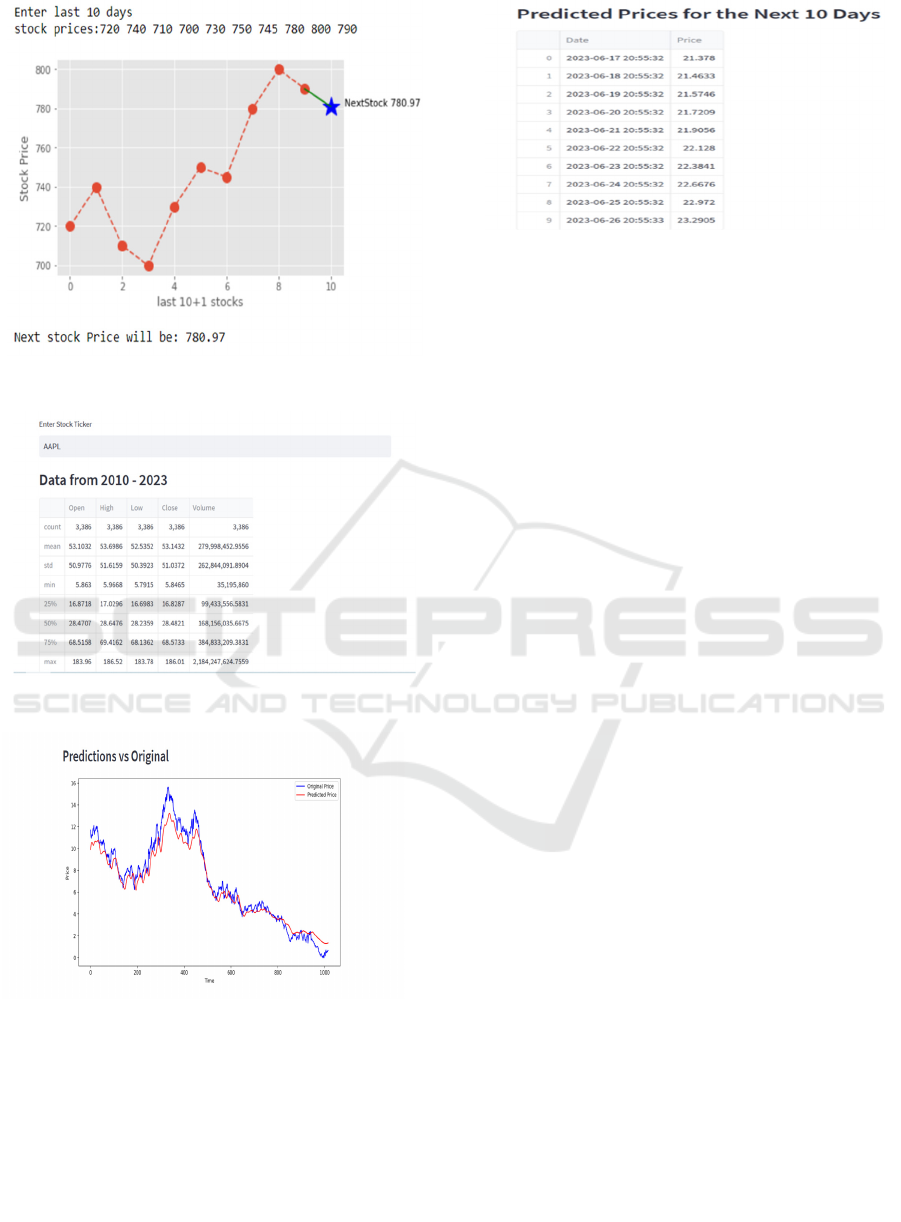
Figure 6: Stock Price Prediction.
Figure 7: AAPL Stock Data.
Figure 8: Actual Price vs Predicted Price of AAPL Stock.
Figure 9: Aapl Stock Predicted Prices.
7 FUTURE SCOPE
There are many ways for future growth and research
for proposed improvements System:
Integration of additional data sources:
include alternative data sources such as
satellite images, consumer spirit index and
geopolitical events can provide rich insights
market dynamics and predictions increase
accuracy.
Ensemble modeling: Searching for a
contingent of artists who combine many
forecast models, LSTM Network,
Convisional Neural Network (CNNS) and
traditional statistical methods, additional
prediction can improve performance and
strengthening. Figure 7 shows the AAPL
stock data.
Dynamic model adaptation: Development
of algorithms for dynamic model adaptation
adjust model parameters and architecture
automatically in response to the changed
market conditions can increase adaptation
and flexibility of the system.
Explainable AI: To increase the
interpretation of model paves through such
techniques as a meditation system and
convenience, importance can provide deep
insight into analysis user increases the
confidence in the recommendations of
factors and models that run share price
movements.
Deployment in real-world trading
platforms: Integration of proposed system
into real. The world's trading platforms and
investment management systems will enable
direct application and verification of its
efficiency in practical investment scenarios
for investments. Figure 8shows the Actual
price vs Predicted price of AAPL stock.
Real-Time Stock Price Prediction and Market Analysis Using Machine Learning
695

By addressing these growth areas, the proposed
system can continue real-time's share price prediction
and state-Ar-species, eventually profit investors,
traders and financial institutions optimize the
investment strategies and to get better returns.
8 CONCLUSIONS
Finally, the proposed LSTM-based structure provides
a promising solution for real time Share course
prediction and market analysis. Using advanced
engine power Learn algorithms and integrate
different data sources, the system provides a holistic
view Enables market trends and timely and accurate
predictions. Empirical assessment Demonstrates the
strength of the model organized and a better future
performance Compared to traditional methods. In
addition is the interpretation of model setting Stock
provides valuable insight into the underlying factors
that run the price change, giving Increase decision -
making in investment strategies.
REFERENCES
Brown, M. T., & Zhang, L. (2019). Machine Learning in
Financial Market Prediction: A Review of Literature
and Implications for Future Research. Journal of
Financial Data Science, 1(2), 31-49. This review article
offers a comprehensive overview of machine learning
applications in financial markets, with a section
dedicated to the use of LSTM models.
Foster, D. P., & Vishwanathan, A. N. (2021). Advances in
Financial Machine Learning: Techniques and
Applications. Cambridge University Press. This book
provides an in-depth exploration of recent advances in
machine learning for finance, including chapters
dedicated to LSTM networks and their application in
predicting financial time series.
Hochreiter, S., & Schmidhuber, J. (1997). Long Short-Term
Memory. Neural Computation, 9(8), 1735-1780. This
seminal paper introduces the LSTM architecture,
providing a foundational understanding of its
mechanisms and advantages over traditional RNNs.
Liu, Y., & Wang, G. (2020). Real-Time Stock Price
Prediction using LSTM and Social Media Sentiment
Analysis. Proceedings of the 2020 International
Conference on Computational Finance and Business
Intelligence. This conference paper presents a case
study on integrating LSTM with sentiment analysis for
enhanced stock price prediction.
Patel, J., Shah, S., Thakkar, P., & Kotecha, K. (2015).
Predicting Stock Market Index using Fusion of
Machine Learning Techniques. Expert Systems with
Applications, 42(4), 2162-2172. Although not solely
focused on LSTM, this paper discusses various
machine learning approaches, including LSTM, for
stock index prediction, providing a broader context for
your research.
Zhang, X., & Wu, D. (2018). Time Series Analysis and
Prediction of Stock Prices: A Deep Learning Approach.
International Journal of Financial Studies, 6(2), 36.
This paper focuses on applying deep learning
techniques, particularly LSTM, to predict stock prices,
offering insights into model architecture and
performance metrics.
ICRDICCT‘25 2025 - INTERNATIONAL CONFERENCE ON RESEARCH AND DEVELOPMENT IN INFORMATION,
COMMUNICATION, AND COMPUTING TECHNOLOGIES
696
