
Machine Learning-Based Prediction and Prevention of Brain Stroke
Analysis
Manish Deep, Rithish R, P Geetha
and T Grace Shalini
Department of Computational Intelligence, SRMIST, Chennai, Tamil Nadu, India
Keywords: Brain Stroke Classification, Machine Learning, Data Preprocessing, Data Visualization, Django Framework.
Abstract: Machine Learning in the Medical domain, especially in brain strokes prediction and prevention is one of the
most sophisticated techniques. Stroke in the brain occurs when blood supply to part of the brain is interrupted
which causes possible cell death. Brain strokes are of two types: hemorrhagic, whenever bleeding occurs
inside the brain, and ischemic, which originate from a blocked artery-ship. When treated early, strokes can be
managed, preserving life and resulting in less disability and better medical outcomes. Innovative machine
learning techniques have been implemented to create a smart framework for stroke classification and
forecasting as presented in this paper. It will consist of major parts like data cleaning, graphical presentation
of data, and various machine learning models to achieve high accuracy in prediction. You are procced on the
data until October 2023. Meaningful stroke-related narratives Using visualization techniques process the
information complexities into a more understandable form. We employ a set of machine learning classifiers
to effectively detect and predict stroke events. Data quality, model interpretability issues and privacy
challenges are critical to successful deployment of ML-based stroke prevention systems. It is also
implemented with a Django-based web platform where health-care professionals can make accurate decisions
on prediction made by the model.
1 INTRODUCTION
A brain stroke develops when blood flow stops
temporarily in any area of the brain thus depriving
brain cells of oxygen before they die. The world-wide
rate of brain strokes constitutes a major global health
challenge because these medical conditions cause
substantial disability together with being frequent
causes of death. The process of early intervention
results in reduced stroke severity and enhanced
patient recovery outcomes after such incidents. The
traditional assessment methods used for stroke
predictions through clinical examinations and
imaging do not efficiently detect minimal early
warning indications. Through medical data analysis
the ML models process comprehensive information
such as both biomedical and clinical and imaging and
biomarker information to make predictions about
potential strokes. The implementation of patient data
systems faces critical privacy and ethical barriers that
must receive proper solutions before becoming
widely accepted. The predictive models built from
dark box systems face challenges because clinicians
need to understand the derivation process behind the
predictions before accepting them as valid.
Weaknesses in prediction and brain stroke prevention
through machine learning will be examined in this
paper with emphasis on the techniques used along
with data sources and technology benefits and
implementation barriers. However, strokes continue
to be one of the major causes of long term disability
and premature death and require fast and accurate
diagnosis. Leveraging AI for Brain Stroke
Classification and Detection. The main idea behind
the project is to develop and evaluate AI models that
are able to predict what type of stroke a person had
based on information available from detailed medical
images and clinical records. This project hope to
enhance the capabilities of healthcare professionals to
make more data informed treatment decision and
better care for the patients. Beyond classification, this
research prioritizes optimizing preprocessing
frameworks and refining feature engineering
strategies for better predictive performance. By
applying deep learning architectures such as CNNs
and multi-layer perceptron’s, to enhance the system’s
ability to recognize stroke indicators accurately.
Automation reduces manual intervention, making the
634
Deep, M., R., R., Geetha, P. and Shalini, T. G.
Machine Learning-Based Prediction and Prevention of Brain Stroke Analysis.
DOI: 10.5220/0013940100004919
Paper published under CC license (CC BY-NC-ND 4.0)
In Proceedings of the 1st International Conference on Research and Development in Information, Communication, and Computing Technologies (ICRDICCT‘25 2025) - Volume 5, pages
634-640
ISBN: 978-989-758-777-1
Proceedings Copyright © 2026 by SCITEPRESS – Science and Technology Publications, Lda.

diagnostic process more efficient and error-free. The
developed real time predictive model helps at
mitigating the virus exponentially by assisting early
intervention and better patient management. The
main goal of this initiative is to hit on the world’s
need for an affordable, scalable tool that can detect
strokes quickly and facilitate discovery in
neurological research and care.
2 LITERATURE REVIEW
Sivapalan et.al, (2022), discusses the utilization of
multiple machine learning models for stroke
classification. For this study, logistic regression,
SVM, CatBoost, Random forest, Multi-Layer
Perceptron (MLP), Naïve Bayes and K nearest
Neighbors (NN) were used as the seven-machine
learning technique. It was found that CatBoost
performed the better accuracy, precision, recall, F1
score. Koh H C et.al, (2011), discusses the growing
role of machine learning in fields like healthcare,
security, and data analytics. This study employs data
mining techniques to analyze stroke-related
information from both linguistic and syntactic
perspectives, making it possible to extract crucial
patient information efficiently.
Yoo et. al, (2012), propose a method where
patient symptoms are extracted from medical case
sheets which are used to train a classification model.
507 patient case sheets were collected from Sugam
Multispeciality Hospital, Kumbakonam, Tamil Nadu,
India which was the data collection, phase. We
processed these documents using maximum entropy
techniques and tagging methods and extracted
features using a customized stemmer for effective
stroke type classification. Meschia et. al, [4],
demonstrate the skill of machine learning in
classifying stroke. Therefore, in this study, Artificial
Neural Networks (ANN), Support Vector Machines
(SVM), Boosting and Bagging techniques and
Random Forests were created from the dataset. In
these cases, the best result (accuracy of 95% with
standard deviation of 14.69) was achieved with the
ANN model trained via Stochastic Gradient Descent
(SGD).
Harmsen et. al. (2006), highlight the need for
faster stroke diagnosis. The proposed model in this
study serves as the first line of defense for a simple
and quick identification of a stroke case using
imaging data in which Support Vector Machines
(SVMs), Decision Trees, and Deep Learning Models,
at its foundation, enable effective identification of
stroke cases. Nwosu et. has introduced multiple
machine learning architectures such as Random
Forest, K-Nearest Neighbors (KNN), and
Convolutional Neural Networks (CNNs) at
diagnosing strokes through brain scans.
Nwosu C.S et
al., (2019)
Models were trained and validated on a
large dataset of labeled images of the brain to ensure
robust model performance.
Pathan et.al, (2020), discuss how morphological
operations and feature extraction improve stroke
detection. These post-processing techniques help in
fine-tuning stroke regions, ultimately boosting
accuracy. Jeena et.al, (2016) explore the
classification of stroke prediction models into four
categories. A systematic review of research studies
revealed Support Vector Machines (SVMs) as the
most optimal model in 10 different studies,
emphasizing their high accuracy in stroke detection.
Luk et.al, (2010) identify that most stroke-related
research focuses on diagnosis, while fewer studies
address treatment, revealing a research gap.
Additionally, CT scans were found to be the most
widely used dataset for stroke classification. Findings
suggest that SVM and Random Forest models remain
among the most efficient approaches in machine
learning-based stroke detection. (Luk J.K et.al, 2006),
proposed Stroke remains one of the leading causes of
illness and mortality worldwide. The objective of this
study is to explore effective methods to improve the
accuracy of stroke classification and diagnosis. The
Kaggle stroke dataset was used in this research, where
preprocessed data significantly aids in enhancing
patient outcomes. Strokes are broadly classified into
ischemic and hemorrhagic types, and machine
learning algorithms are employed to categorize
individuals accordingly.
After a stroke, the brain dynamically reorganizes
its functional networks to compensate for lost or
impaired abilities. Previous studies based on static
modularity analysis have shed light on overarching
behavioral changes, but little is known about time-
resolved reorganization of these networks. Resting-
state functional MRI data were analyzed from 15
stroke patients (mild (n = 6); severe (n = 9)). A
separate control group who were age-matched (n =
15) and healthy was also included as a comparison. In
this context, the study employed a multilayer
temporal network approach to discover time-sensitive
modules and quantified dynamic network attributes
such as recruitment, integration, and flexibility to
give insight regarding post-stroke neural plasticity.
By contrast, severe stroke patients showed less
recruitment with greater inter-network connectivity,
and mild stroke patients showed less flexibility and
less inter-network integration. Interestingly, prior
Machine Learning-Based Prediction and Prevention of Brain Stroke Analysis
635
static network analysis approaches did not identify
such differences in network dynamics based on the
severity. From a clinical perspective, these findings
provide insight into how stroke-induced changes in
posterior cortical connectivity impact motor, speech
and cognitive function. This approach enables not
only an assessment of normal brain activity but also
predictions for future outcomes. This limitation is that
although there were 15 stroke patients, and it is small,
it is not generalizable in the future. And although
dynamic modular analysis provides a fresh
perspective, static techniques still yield critical
insights into the overarching functional organization
of global brain networks. Furthermore, focusing on
dynamic metrics such as recruitment and integration
may distract from other crucial components in
recovery, such as individualized/targeted
rehabilitation protocols and non-neural mechanisms
of recovery.
3 PROPOSED METHODOLOGY
The steps involved in the methodology are: preparing
the Data, Visualization, the prediction model and
Integration with Django to make it user accessible.
Step 1: Preprocessing: In this phase, the brain
imaging data is cleaned and standardized to ensure
data with the highest quality is utilized into machine
learning algorithms. After this, data visualization
tools will be used to create informative graphical
representations that allow for better understanding of
underlying patterns and distributions. Multiple
machine learning algorithms will be used for more
precise classification of stroke types and better
prediction of subsequent functional outcomes.
Finally, a Django coded web-based system will be
used as UI interface to make predictions and view
results. The application of this framework is
packaged with the help of machine learning-based
techniques to create a powerful predictive model that
maximizes efficiency and effectiveness. Histograms,
plots, and graphs are used to analyze data for effective
visualization of trends. Several algorithms were
tested and compared to identify the most accurate
prediction model.
3.1 Data Pre-processing
This machine learning model’s error rate, validation
techniques are implemented, ensuring it aligns
closely with the actual dataset error. If a dataset is
comprehensive enough to depict the full population,
validation may not be essential. However, in practical
scenarios, data samples often fail to represent the
entire dataset accurately. These techniques facilitate
the identification of missing data, duplicate values,
and the classification of numerical data types (integer
or float). The validation process provides an objective
measure of model performance on training data while
adjusting hyperparameters for optimal results.
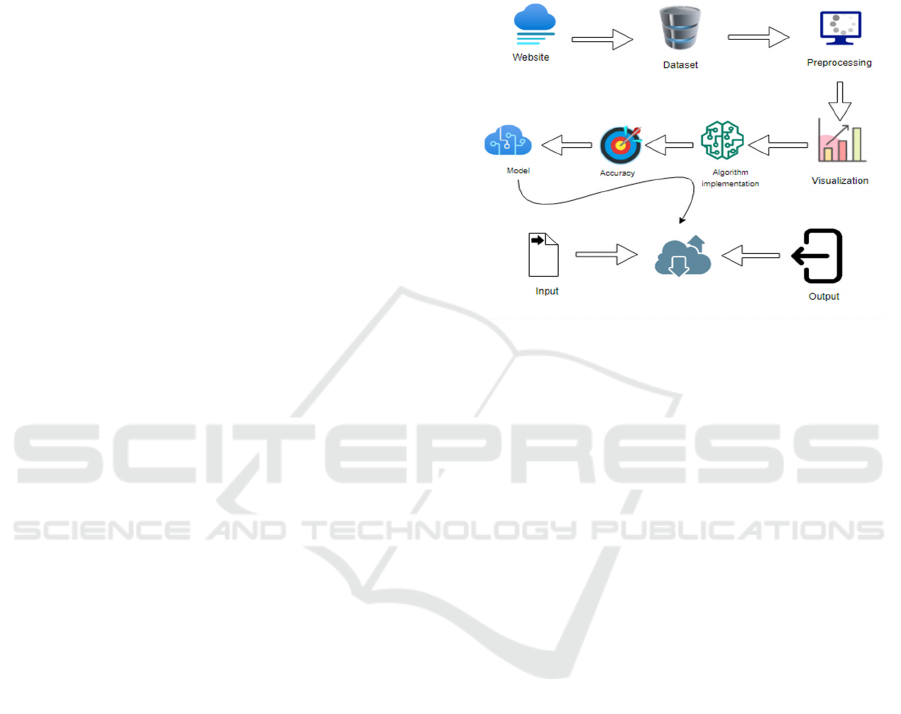
Figure 1: Proposed Architecture.
This Figure 1. Shows the evaluation tends to become
less objective as reliance on the validation dataset
grows during model configuration. The validation set
plays a key role in assessing a model but is also
frequently utilized for hyperparameter optimization.
Data sourcing, examination, and improving its
content, accuracy, and arrangement can be a labor-
intensive process. Gaining insights into data
properties early on assists in choosing the most
effective algorithm for model implementation.
3.2 Data Validation
The essential library packages are imported, and the
provided dataset is loaded. Variable analysis includes
examining the dataset’s structure, data types, and
detecting missing or duplicate values. A validation
dataset is separated from the training dataset to
evaluate the model’s predictive ability while
adjusting its parameters. Effective techniques
optimize the use of validation and test datasets during
model evaluation. This phase is called data
preparation where the dataset is renamed, useless
field is dropped and even analysed with uni-variate,
bi variate and multivariate methods. Since each
dataset demands different methods of cleaning, the
goal is to sort out inconsistencies and raise the quality
of the data to make.
ICRDICCT‘25 2025 - INTERNATIONAL CONFERENCE ON RESEARCH AND DEVELOPMENT IN INFORMATION,
COMMUNICATION, AND COMPUTING TECHNOLOGIES
636
3.3 Comparative Study of Algorithms
In this proposed methodology 3 different algorithms
are compared likely KNN, AdaBoost Classifier and
Random Forest Classifier Each machine learning
algorithm undergoes evaluation using the K-fold
cross-validation approach, which ensures consistent
data division by utilizing the same random seed.
Before comparing different techniques, the Scikit-
Learn library is installed to build the model. This
package supports preprocessing, applies logistic
regression for linear modeling, performs cross-
validation with the K-Fold technique, utilizes random
forests for ensemble learning, and employs decision
trees for classification. The dataset is further divided
into training and testing subsets to predict outcomes
and analyze model accuracy effectively.
3.3.1 K-Nearest Neighbors (K-NN)
K-Nearest Neighbors (K-NN) is a widely used
supervised learning algorithm that operates under the
assumption that similar data points belong to the same
category. Rather than developing a predictive model
during training, K-NN retains the entire dataset and
classifies new data based on proximity. It is
applicable in both classification and regression but is
mainly utilized for classification problems. As a non-
parametric technique, K-NN does not impose
constraints on data distribution. Additionally, it is a
lazy learning algorithm, meaning it processes data
only when a classification task arises. KNN algorithm
measures similarity between points using distance
metrics such as Euclidean and Manhattan distances.
During training, feature data and their respective
labels are stored. When predicting a new instance, K-
NN computes distances to all existing points and
selects k-nearest ones, where k is a user-specified
hyperparameter. In classification, the most frequent
class among these k neighbors is assigned, while in
regression, the output is calculated as the average of
their values. Selecting the right k-value is essential—
too small a k leads to overfitting, while a large k
results in excessive generalization. Cross-validation
helps determine an optimal k. K-NN is highly
dependent on proper data scaling, necessitating
normalization or standardization for accurate distance
measurements. Although it effectively models non-
linear decision boundaries, the algorithm struggles in
high-dimensional spaces due to sparse data
distribution. In addition, K-NN is computationally
very expensive for large sets of data as it is an
exhaustive one, where distance calculations are
performed for all the records computed. sklearn’s
implementation of K-NN is simple yet a powerful
one, suitable for any machine learning applications.
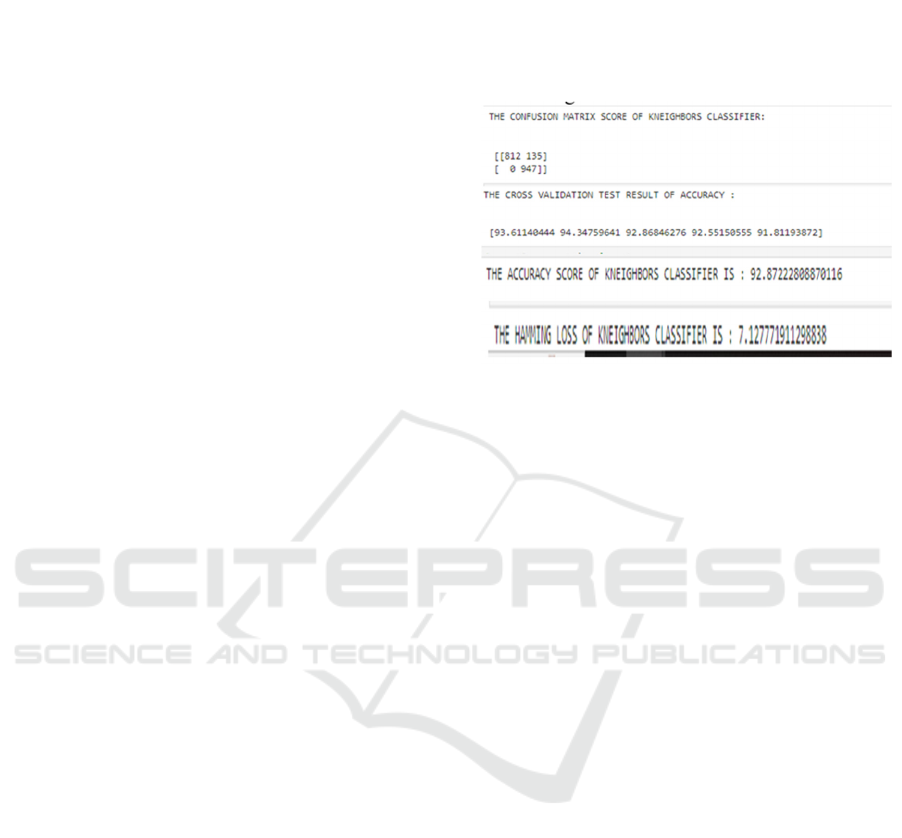
This figure 2 shows the performance results of
confusion matrix, cross validation test result,
accuracy and hamming loss results for KNN classifier
algorithm.
Figure 2: KNN Classifier Algorithmic Results.
3.3.2 AdaBoost Classifier Algorithm
The AdaBoost algorithm starts by training a weak
learner on the full dataset. A weak learner is defined
as a model that performs just slightly better than
random selection. Initially, all training samples are
given the same weight. After training the first weak
learner, the algorithm calculates its error rate by
comparing its predictions to the true labels.
Misclassified instances are assigned greater
significance, and the weak learner’s influence is
adjusted based on its performance—the fewer errors
it makes, the greater its weight. This process is
repeated, with each successive weak learner focusing
more on challenging cases. The iterations continue
for a set number of rounds or until the model reaches
peak accuracy. The final AdaBoost model integrates
multiple weak classifiers into a single, powerful
predictor. Each weak learner contributes by making
weighted predictions, where more accurate models
hold greater voting power. AdaBoost's adaptability
ensures that it progressively prioritizes difficult
samples, thereby refining model accuracy. Key
hyperparameters include the number of weak
learners, the learning rate (which controls each
learner’s influence), and the choice of weak model.
Because of its structure, AdaBoost has a lower risk of
overfitting and generalizes well to unseen data.
Though mainly designed for binary classification,
AdaBoost can also be applied to regression tasks. It is
widely utilized in fields such as handwriting
recognition, spam filtering, and anomaly detection.
Python’s scikit-learn library provides an accessible
Machine Learning-Based Prediction and Prevention of Brain Stroke Analysis
637
implementation of AdaBoost, making it an effective
tool for model training and evaluation.
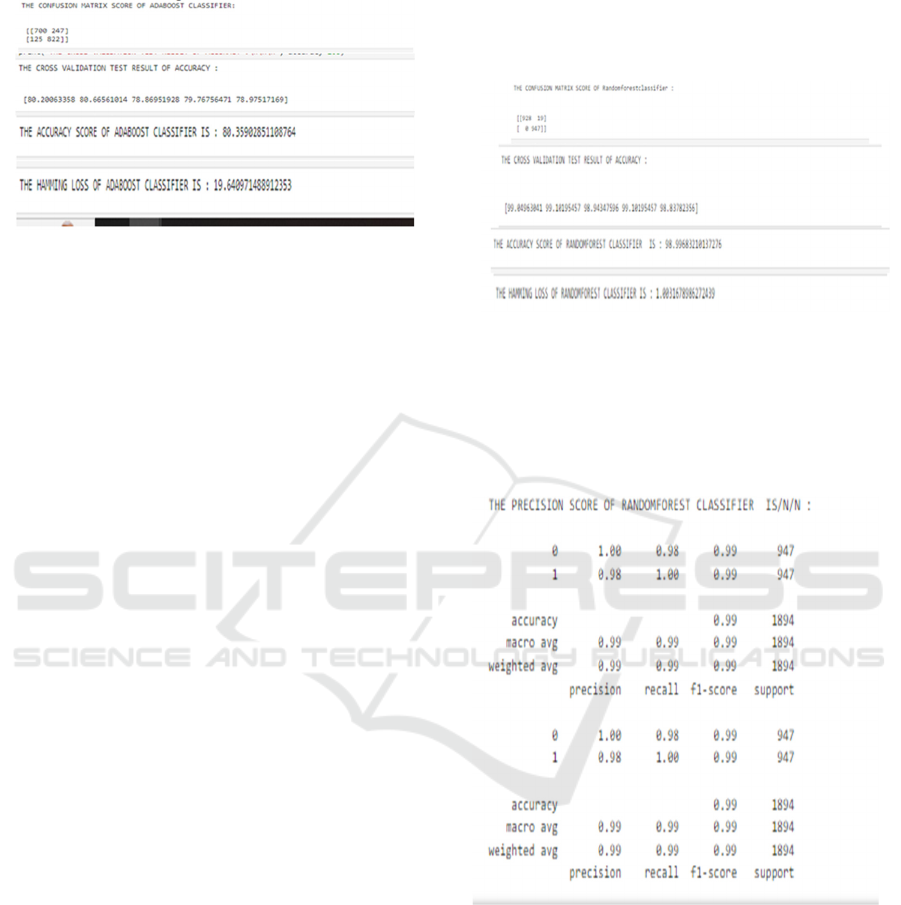
Figure 3: Ada Boost Classifier Algorithmic Results.
This figure 3 shows the performance results of
confusion matrix, cross validation test result,
accuracy and hamming loss results for AdaBoost
classifier algorithm.
3.3.3 Random Forest Classifier Algorithm
The Random Forest Classifier is an ensemble
algorithm that boosts model reliability by merging
multiple decision trees. This approach enhances
accuracy while limiting overfitting by combining the
results of several independent trees. Each tree in the
Random Forest is trained using a unique subset of
data and features, ensuring model diversity. The
algorithm applies Bootstrap Aggregation (bagging),
where trees are trained on randomly sampled data
with replacement. This technique allows certain
instances to appear multiple times in the training set
while others are excluded. Additionally, during the
training process, only a limited number of features are
chosen at each node-splitting stage, minimizing
correlation between trees and improving predictive
accuracy.
Each tree in the ensemble learns distinct
characteristics of the data. Once trained, the
individual predictions from all trees are aggregated to
form the final decision. In classification problems, the
model selects the class with the most votes, whereas
in regression tasks, it computes the average prediction
across all trees. Model accuracy is evaluated using the
Out-of-Bag (OOB) error estimation, which measures
performance based on the data excluded from
training.
The effectiveness of the Random Forest model is
influenced by several hyperparameters, including the
number of trees, the number of features considered
per split, the maximum allowable tree depth, and the
minimum required samples for splitting nodes.
Proper hyperparameter tuning ensures a balance
between model complexity and accuracy. One of
Random Forest’s key strengths is its ability to
generalize well by averaging predictions, reducing
the risk of overfitting, and making it a suitable choice
for large-scale and high-dimensional datasets.
Figure 4: Random Forest Classifier Algorithmic
Results.
This figure 4 shows the performance results of
confusion matrix, cross validation test result,
accuracy and hamming loss results for Random
Forest classifier algorithm.
Figure 5. Accuracy Score of KNN, Adaboost, RF
Algorithms.
This figure 5 shows the performance results accuracy
results for KNN, AdaBoost, RF algorithms.
Based on the results of accuracy results of KNN,
AdaBoost RF algorithms the website has been
developed to describe how machine learning methods
serve to forecast and minimize occurrences of brain
strokes.
ICRDICCT‘25 2025 - INTERNATIONAL CONFERENCE ON RESEARCH AND DEVELOPMENT IN INFORMATION,
COMMUNICATION, AND COMPUTING TECHNOLOGIES
638
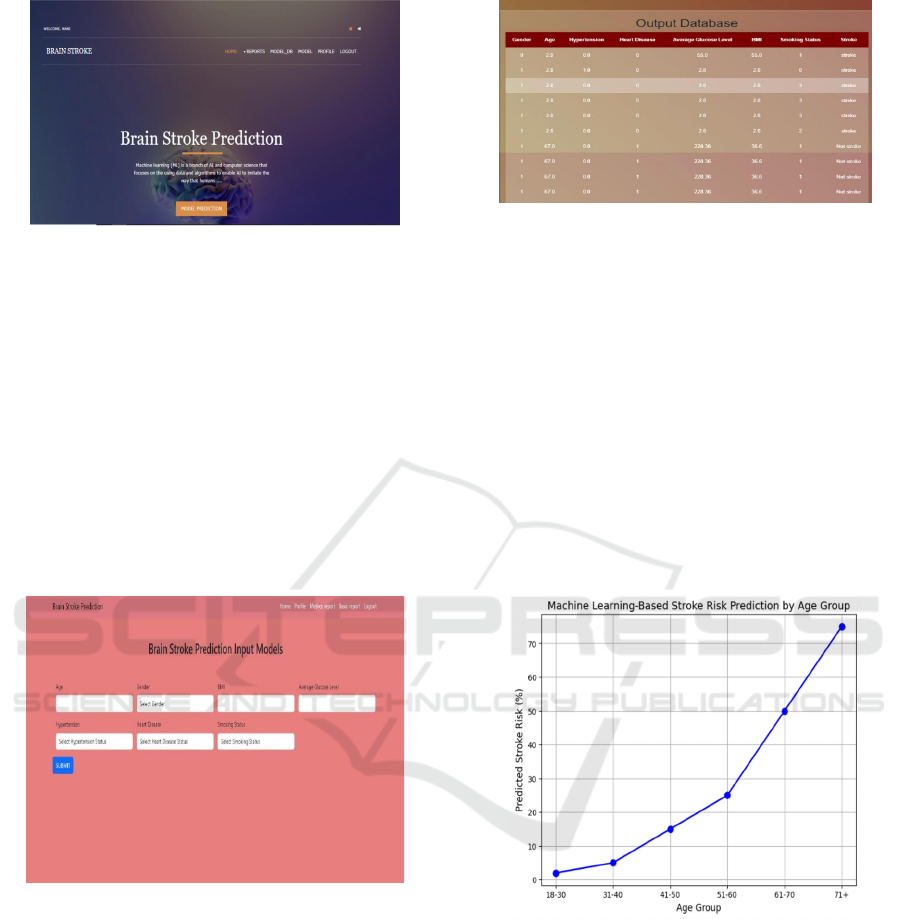
Figure 6: Design Page of Brain Stroke Prediction.
In figure 6, shows the webpage of front page. It is
shown to evaluate technology methods for early
stroke detection alongside prevention
recommendations. Its primary objective is to develop
patient data analysis tools which forecast stroke
probabilities as well as enhance healthcare results and
decrease stroke risk levels. Users should encounter
input forms with spaces to provide their health
information such as age and smoking status and
medical background for predictive purposes. The
website provides complete information about the
stroke prediction algorithms including adaboost,
KNN and random forest algorithms.
Figure 7: Design Page of Brain Stroke Prediction
Input Models.
In figure 7, shows after registration of users, to use
of the website can use the tool to input medical data
and receive stroke risk estimates. The software
demonstrates practical functionality to users by
means of this feature. Users can find the details about
all data used in model training including dataset
origin, list of features along with data processing
methods. Users receive customized prevention and
risk reduction measures through the site depending on
their predicted stroke risk after examination.
Figure 8: Design Page of Brain Stroke Prediction
Output Database.
Users can access information about prediction model
accuracy levels and performance enhancement
procedures which include methods like hyper
parameter tuning or cross-validation on the website.
In figure 8, The website presents information
about ongoing system developments which include
equipment updates and extra data collection features
and performance improvement of prediction
algorithms. The website contains details about the
programming languages that power its construction
along with the model development (Python, Tensor
Flow, Flask, Django) and the website development
technologies.
Figure 9: Predicting and Preventing Brain Strokes
Based on Ages.
In figure 9 shows the graph results for predicting
and preventing brain strokes based on different age
groups and plot a hypothetical distribution of stroke
risk predictions across various age groups. The graph
would show how stroke prediction risk increases or
varies with ages. The curve starts low in the younger
age groups (18-30) and increases sharply as age
progresses (71+), reflecting the higher risk of stroke
in older individuals.
Machine Learning-Based Prediction and Prevention of Brain Stroke Analysis
639

4 CONCLUSIONS
The summary of this project, the study of machine
learning methodologies for stroke classification has
revealed considerable potential in enhancing
diagnostic reliability and patient care. By employing
algorithms such as Support Vector Machines (SVMs)
and Random Forests, this research highlights how
these techniques can identify complex imaging
patterns associated with stroke classification and
severity. The results suggest that deep learning
approaches and ensemble techniques surpass
traditional classification methods, leading to
increased accuracy. These findings indicate that
integrating modern machine learning advancements
into clinical applications could result in faster and
more precise stroke diagnoses, ultimately improving
patient treatment and management. Further research
should focus on refining these models using larger
datasets and extensive cross- validation to improve
their robustness. Additionally, tackling biases and
embracing real-world diversity will be crucial for the
widespread adoption of these systems in various
healthcare settings.
The future work focused on, supplementing stroke
prediction models with insights from external
datasets could lead to improved predictive
performance. This project also intends to gather an
institutional dataset to further evaluate and compare
different machine learning techniques. As a part of
our planned future work, also aim to conduct external
validation of our proposed framework.
REFERENCES
Sivapalan G., Nundy K., Dev S., Cardiff B., Deepu J.
ANNet: a lightweight neural network for ECG anomaly
detection in IoT edge sensorsIEEE Transactions on
Biomedical Circuits and Systems (2) (2022)
Koh H.C., Tan G., et al. Data mining applications in
healthcareJ. Healthc. Inf. Manage., 19 (2) (2011), p. 65
Yoo I., Alafaireet P., Marinov M., PenaHernandez K.,
Gopidi R., Chang J.-F., Hua L. Data mining in
healthcare and biomedicine: a survey of the literatureJ.
Med. Syst., 36 (4) (2012), pp. 2431-2448
Meschia J.F., Bushnell C., BodenAlbala B., Braun L.T.,
Bravata D.M., Chaturvedi S., Creager M.A, Eckel R.H.,
Elkind M.S., Fornage M., et al. Guidelines for the
primary prevention of stroke: a statement for healthcare
professionals from the American heart
association/American stroke association Stroke, 45 (12)
(2014), pp. 3754-3832
Harmsen P., Lappas G., Rosengren A., Wilhelmsen L.
Long-term risk factors for stroke: twenty-eight years of
follow-up of 7457 middle-aged men in goteborg,
swedenStroke, 37 (7) (2006), pp. 1663-1667
Nwosu C.S., Dev S., Bhardwaj P., Veeravalli B., John D.
Predicting stroke from electronic health records, 2019
41st Annual International Conference of the IEEE
Engineering in Medicine and Biology Society (EMBC),
IEEE (2019), pp. 5704-5707
Pathan M.S., Jianbiao Z., John D., Nag A., Dev S.
Identifying stroke indicators using rough setsIEEE
Access, 8 (2020), pp. 210318-210327
Jeena R.S., Kumar S. Stroke prediction using SVMProc.
International Conference on Control, Instrumentation,
Communication and Computational Technologies
(ICCICCT) (2016), pp. 600-602, 10.1109/ ICCICCT.2
016.7988020Hanifa S.-M., Raja-S K.
Stroke risk prediction through non-linear support vector
classification modelsInt. J. Adv. Res. Comput. Sci., 1
(3) (2010)
Luk J.K., Cheung R.T., Ho S., Li L. Does age predict
outcome in stroke rehabilitation? A study of 878
Chinese subjectsnCerebrovasc. Dis., 21 (4) (2006), pp.
229-234
ICRDICCT‘25 2025 - INTERNATIONAL CONFERENCE ON RESEARCH AND DEVELOPMENT IN INFORMATION,
COMMUNICATION, AND COMPUTING TECHNOLOGIES
640
