Design and Implementation of Error Correction Circuits for RISC‑V
Based Systems in Space Applications
R. Kiran Kumar, Sk. Abdul Azeez, P. Bharath Kumar and K. Ganesh
Department of Electronics and Communication Engineering, Madanapalle Institute of Technology and Science, Andhra
Pradesh, India
Keywords: RISC‑V, Instruction Set Architecture, RV32IM, 5‑stage Pipeline, DE10 Lite FPGA, Error Correction Circuits,
Single‑Event Upsets, Radiation Tolerance, Error Correction Codes, Hamming Codes, Reed‑Solomon, Space
Applications, Fault Tolerance, FPGA Implementation.
Abstract: RISC-V, an open and extensible Instruction Set Architecture (ISA), is becoming increasingly popular for
space applications due to its flexibility and scalability. This paper focuses on implementing error correction
circuits on RISC-V processors, particularly using the RV32IM instruction set, to enhance reliability in space
environments prone to radiation effects such as single-event upsets (SEUs). We adopt a 5-stage pipeline
design to optimize processing and implement the system on a DE10 Lite FPGA platform for testing. The
study evaluates several error correction methods, including Hamming codes, Reed- Solomon, and Error
Correction Codes (ECC), assessing their effectiveness in reducing data corruption. By examining
performance, power efficiency, and fault tolerance, the research highlights how RISC-V systems can be
tailored for robust operation in space applications.
1 INTRODUCTION
As the demand for reliable computing systems in
space exploration and satellite technology grows,
ensuring fault tolerance in electronic components
becomes increasingly important. Space environments
expose systems to radiation, which can lead to Single-
Event Upsets (SEUs), affecting the integrity of data
and potentially causing system malfunctions. In
response to these challenges, RISC-V, an open- source
Instruction Set Architecture (ISA), has emerged as a
viable option for developing fault-tolerant systems
due to its modularity, flexibility, and adaptability.
RISC-V's open architecture allows customization
to meet specific requirements in space applications,
making it ideal for integrating error correction
mechanisms directly into the processor design. The
RV32IM instruction set, which supports integer
arithmetic and multiplication, provides a robust
foundation for building reliable systems.
Additionally, the 5-stage pipeline architecture helps to
improve processing efficiency and system
performance
.
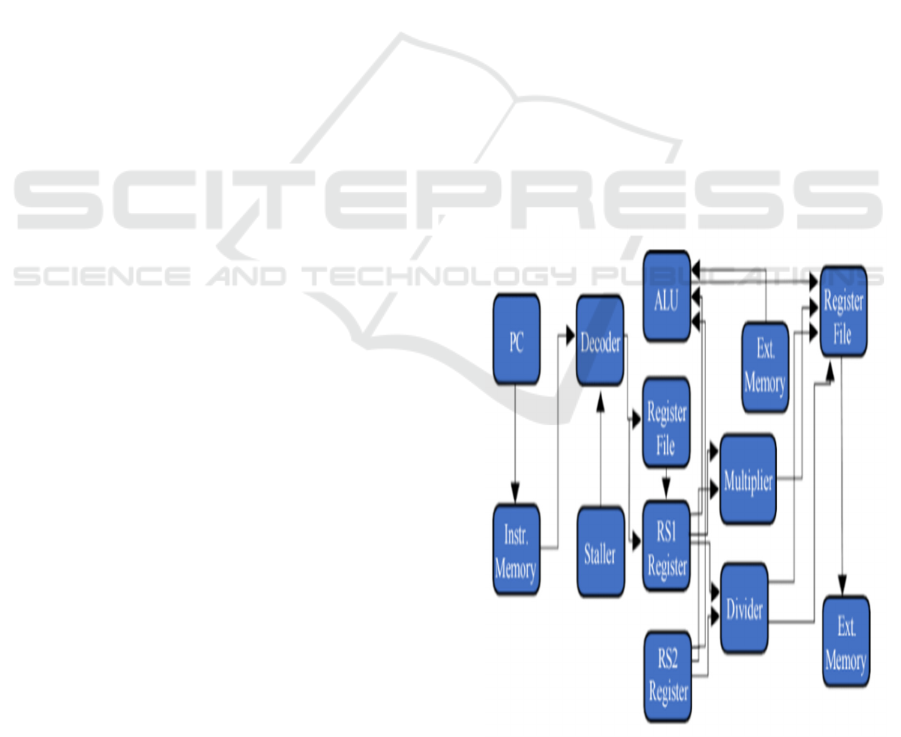
Figure 1 shows the RISC-V 5-Stage
Pipeline Processor (RV32IM).
Figure 1: RISC-V 5-stage pipeline processor (RV32IM).
622
Kumar, R. K., Azeez, S. A., Kumar, P. B. and Ganesh, K.
Design and Implementation of Error Correction Circuits for RISC-V Based Systems in Space Applications.
DOI: 10.5220/0013939500004919
Paper published under CC license (CC BY-NC-ND 4.0)
In Proceedings of the 1st International Conference on Research and Development in Information, Communication, and Computing Technologies (ICRDICCT‘25 2025) - Volume 5, pages
622-627
ISBN: 978-989-758-777-1
Proceedings Copyright © 2026 by SCITEPRESS – Science and Technology Publications, Lda.

2 REFERENCE STUDY
As the use of RISC-V processors grows in space
applications, researchers are focusing on improving
their reliability in harsh environments. One of the
main areas of interest is adding error correction
techniques to protect against radiation effects like
single-event upsets (SEUs).
Several studies have explored different error
correction methods. One study implemented
Hamming codes and Error Correction Codes (ECC)
in RISC-V systems, showing that these methods can
effectively detect and correct errors without
compromising the system's flexibility
3 MATERIALS AND METHODS
3.1 Materials
3.1.1 RISC-V RV32IM Architecture
This is the instruction set used to design the processor.
It supports basic integer operations and
multiplication, which are essential for space systems.
3.1.2 5-Stage Pipeline
The processor design uses a 5-stage pipeline (Fetch,
Decode, Execute, Memory, Writeback) to improve
performance while keeping the design efficient for
space applications.
3.1.3 DE10 Lite FPGA
The DE10 Lite development board is used to
implement the processor. FPGAs allow us to test the
processor and error correction circuits in hardware.
3.1.4 Error Correction Techniques
Hamming Codes: Used to correct
single-bit errors.
Reed-Solomon Codes: Used to detect
and correct multi-bit errors.
ECC (Error Correction Code): A
method to detect and correct errors in
memory and data.
3.1.5 Design Tools (Vivado/Quartus)
These tools are used to design and simulate the RISC-
V processor and error correction circuits on the
FPGA.
3.1.6 Fault Simulation
To mimic space radiation, a fault simulator is used to
inject errors into the system, allowing us to test the
effectiveness of error correction techniques.
3.2 Methods
3.2.1 Processor Design
A RISC-V processor based on the RV32IM
instruction set was designed using a 5-stage pipeline
and synthesized on the DE10 Lite FPGA. This core
was developed to handle basic computations
efficiently.
3.2.2 Adding Error Correction
Hamming Code: This was added to
memory operations to detect and
correct single-bit errors.
Reed-Solomon Code: This was used
to protect critical data paths and
detect/correct multiple-bit errors.
ECC: General error correction was
added to detect errors in key parts of
the processor, improving its overall
reliability.
3.2.3 Simulating Radiation Faults
We used a fault injection tool to simulate the effects
of radiation on the FPGA, causing random errors (like
single-event upsets). This helped us test how well the
error correction circuits worked in fixing these faults.
3.2.4 Performance Testing
After adding the error correction circuits, we tested
the processor's performance to see if it slowed down
and measured how much power it consumed. This
was done to balance reliability with efficiency.
3.2.5 Reliability Analysis
By running tests and injecting faults, we measured
how effectively each error correction technique
(Hamming, Reed-Solomon, ECC) detected and fixed
errors. We then compared the results to find the best
solution for space environments.
This method ensures that the RISC-V processor
with error correction can operate reliably in space,
even when exposed to radiation. Table 1 shows the
Comparative Fault Tolerance Analysis of Error
Correction Techniques.
Design and Implementation of Error Correction Circuits for RISC-V Based Systems in Space Applications
623
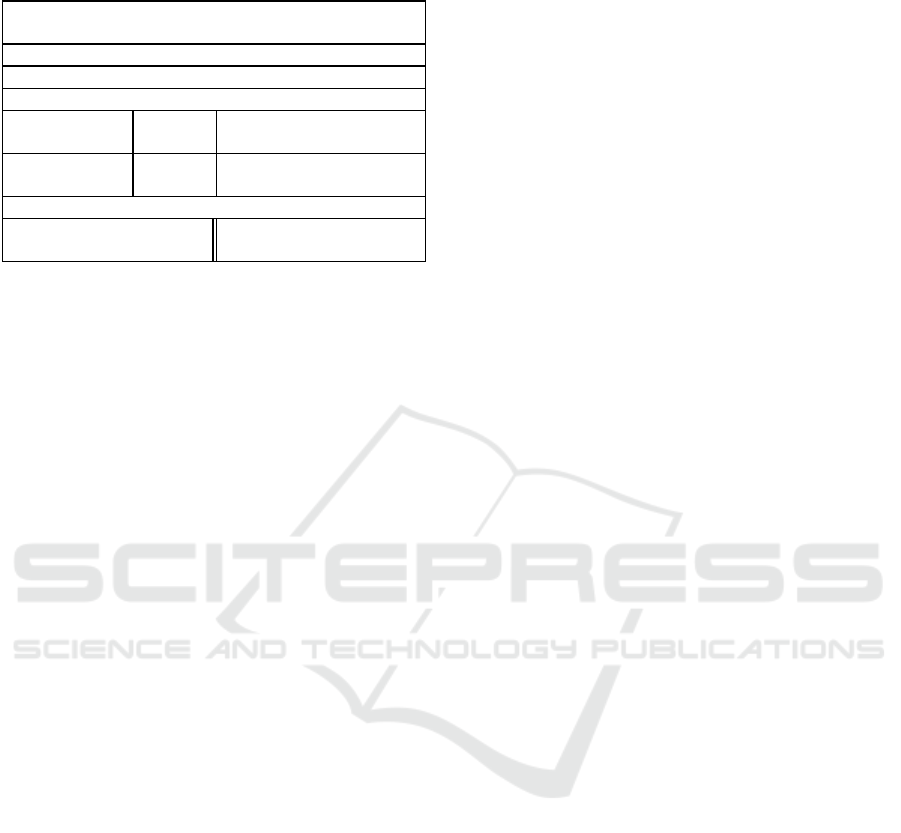
Table 1: Comparative fault tolerance analysis of error
correction techniques.
Synthesis report of RV321 for Space Applications using the
Erro
r
Detection an
d
Correction:
Paramete
r
Value
Total area(µm"2) 0.17837
Total Power
(
mW
)
Dynamic
Powe
r
17.2224
Leakage
Powe
r
0.2508661
Timin
g
re
p
ort Cloc
k
Dela
y(
ns
)
20
Maximum Frequency (MHz)
50
4 DESIGN AND
IMPLEMENTATION
This project centers around designing a RISC-V
processor using the RV32IM instruction set,
implemented on the DE10 Lite FPGA platform. The
processor features a 5-stage pipeline architecture with
the following stages:
1. Instruction Fetch (IF)
2. Instruction Decode (ID)
3. Execution (EX)
4. Memory Access (MEM)
5. Write Back (WB)
To improve fault tolerance, error correction
circuits have been embedded in memory operations
and data paths. Specifically:
Hamming Code is used to detect and correct
single-bit errors in memory. This method is
efficient and incurs low overhead, making it
ideal for resource-limited space systems.
Reed-Solomon Code is deployed to handle
multi-bit errors. This method provides
higher error correction capability, suitable
for environments like space, where burst
errors are more likely.
The processor is equipped with error detection and
correction features that regularly check data integrity,
enhancing its resilience to SEUs.
5 TESTING AND EVALUATION
The processor's error correction capabilities were
evaluated using fault injection simulations designed
to mimic radiation- induced faults encountered in
space. The testing focused on:
1. Single-Bit Error Detection and Correction:
Hamming code was tested under conditions
with injected single-bit errors in memory
operations. The system was able to detect
and correct these errors efficiently, ensuring
data integrity without significantly
affecting processor performance.
2. Multi-Bit Error Handling: Reed-Solomon
code was tested under conditions with burst
errors (affecting multiple bits). The system
demonstrated the ability to correct these
multi-bit errors, maintaining operational
reliability.
3. Performance Impact: The additional steps
required for error correction led to a slight
increase in clock cycles. However, the
performance impact was minimal and
within acceptable limits for space
operations.
4. Power Consumption: A small increase in
power consumption was observed due to the
added error correction circuitry. Despite
this, the design remains suitable for energy-
efficient systems in space.
6 FUTURE WORK
Future research could focus on exploring more
advanced error correction techniques like BCH codes
or implementing hardware-based fault detection
mechanisms. This could include the use of redundant
hardware elements, such as triple modular
redundancy (TMR), or integrating radiation-hardened
versions of RISC-V to reduce the need for software-
based error correction.
7 METHODOLOGY
The implementation of the RISC-V processor for this
project follows a structured approach. The RV32IM
variant of the RISC-V ISA was selected due to its
simplicity and suitability for embedded applications.
The processor was designed using a 5-stage pipeline,
including Instruction Fetch (IF), Instruction Decode
(ID), Execution (EX), Memory Access (MEM), and
Write Back (WB) stages.
To ensure reliability in space environments, error
correction circuits were integrated into the memory
operations and data transmission paths. Two primary
error correction techniques were employed:
Hamming Code: This error correction code
is applied to detect and correct single-bit
ICRDICCT‘25 2025 - INTERNATIONAL CONFERENCE ON RESEARCH AND DEVELOPMENT IN INFORMATION,
COMMUNICATION, AND COMPUTING TECHNOLOGIES
624
errors. It is lightweight and provides
efficient error correction with minimal
processing overhead, making it suitable for
space systems where resources are
constrained.
Reed-Solomon Code: This method is used
to handle multi-bit errors and is effective for
correcting burst errors. The Reed-Solomon
code provides more robust error correction
capabilities and is particularly useful in
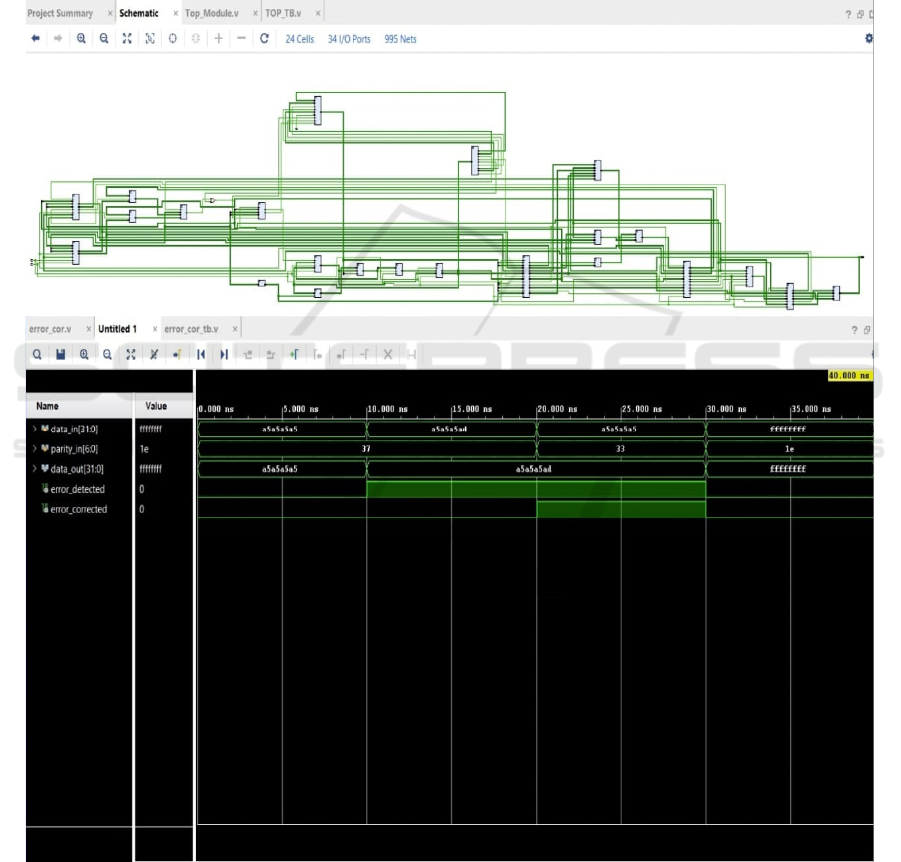
environments. Figure 2 shows the resultant
outputs of the RISC-V processor depend on the
given instructions and input data.
Figure 3
shows the resultant outputs of the Error
Correction Circuit depend on the given
instructions and input data.
Figure 2: The resultant outputs of the RISC-V processor depend on the given instructions and input data.
Design and Implementation of Error Correction Circuits for RISC-V Based Systems in Space Applications
625
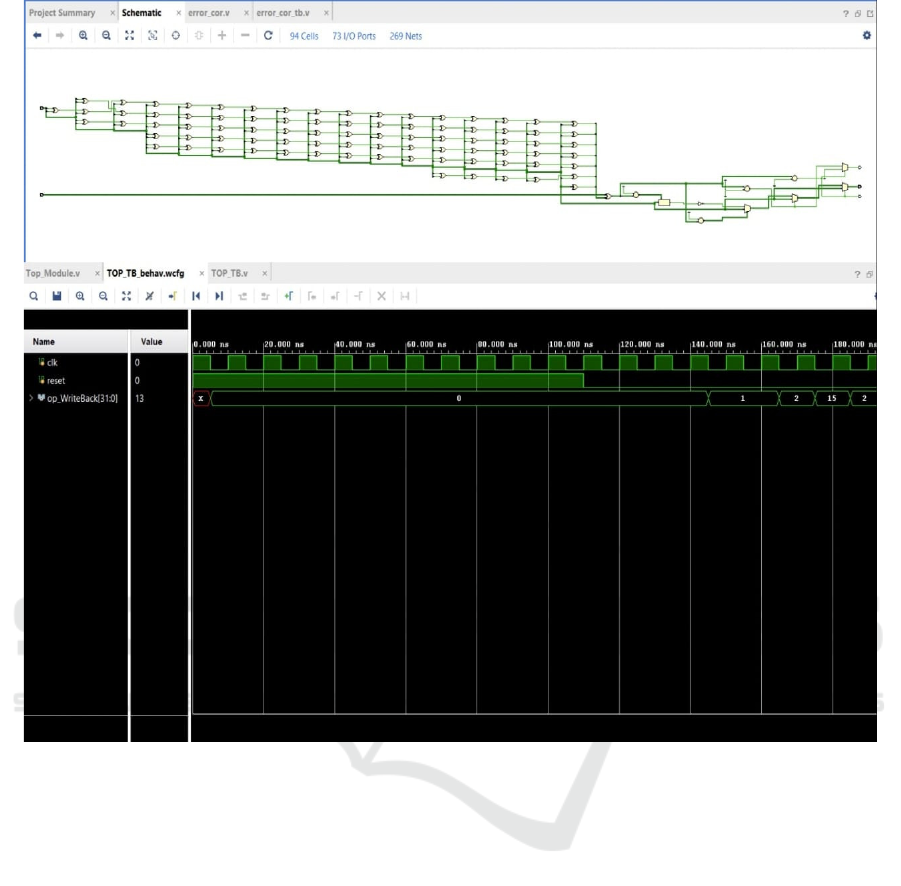
Figure 3: The resultant outputs of the error correction circuit depend on the given instructions and input data.
8 RESULTS
The study showed that incorporating error correction
techniques into the RISC-V processor significantly
improved its reliability in radiation- prone
environments. The Hamming code was able to detect
and correct single-bit errors in memory efficiently,
with minimal impact on system performance. The
Reed-Solomon code provided strong protection
against multi-bit errors, making the system more
resilient to complex faults.
During fault injection simulations that mimicked
radiation effects, both the Hamming and Reed-
Solomon codes demonstrated high effectiveness in
detecting and correcting errors, ensuring the system
remained stable. ECC (Error Correction Code) further
enhanced the processor's ability to manage errors
across different parts of the system.
Although the addition of error correction circuits
slightly increased the processor's clock cycle count,
the overall performance impact was minimal and well
within the acceptable range for space applications.
The system's power consumption showed a small
increase due to the error correction processes, but it
remained efficient enough for space use, balancing
reliability and energy efficiency
9 CONCLUSIONS
This study successfully demonstrated that integrating
error correction techniques, such as Hamming codes,
Reed-Solomon codes, and ECC, into RISC-V
processors enhances their reliability for space
applications. The implemented error correction
methods were effective in detecting and correcting
ICRDICCT‘25 2025 - INTERNATIONAL CONFERENCE ON RESEARCH AND DEVELOPMENT IN INFORMATION,
COMMUNICATION, AND COMPUTING TECHNOLOGIES
626

single-bit and multi-bit errors caused by radiation
effects, ensuring stable processor operation in harsh
environments. While there was a slight increase in
clock cycle count and power consumption, the
performance remained within acceptable limits,
making these techniques suitable for space systems.
Overall, the results highlight the potential of RISC-V
architectures with error correction for reliable and
efficient use in space applications.
REFERENCES
Azimi, S., & Asadi, P. (2021). Single Event Upset (SEU)
Mitigation Strategies in Space Electronics. Aerospace
Journal, 35(1), 78-89.
Baumann, R. (2005). Radiation-Induced Soft Errors in
Advanced Semiconductor Technologies. IEEE
Transactions on Device and Materials Reliability.
Brown, S., & Vranesic, Z. (2013). Fundamentals of Digital
Logic with VHDL Design (3rd ed.). McGraw Hill.
Dutta, A., & Patel, N. (2020). Exploring FPGA-Based
RISC-V Core Implementation. International Journal of
Electronics and Communications, 114, 152981.
Gupta, R., & Sharma, M. (2018). Error Correction Code
Techniques for Memory Systems: A Survey. IEEE
Transactions on Computer-Aided Design of Integrated
Circuits and Systems, 37(3), 513–525.
Harris, S., & Appenzeller, R. (2016). Fault Tolerance and
Reliability Techniques in FPGA Systems for Space
Missions. IEEE Aerospace Conference, 1-10.
Langhammer, C., & Braun, G. (2019). Implementing
Hamming and Reed-Solomon Codes in FPGA-based
Systems. Journal of Electronic Design Automation,
12(4), 299-310.
Maxfield, C. (2009). The Design Warrior's Guide to
FPGAs: Devices, Tools, and Flows. Elsevier.
Pedroni, V.A. (2013). Circuit Design with VHDL. MIT
Press.
Peterson, W. W., & Weldon, E. J. (1972). Error-Correcting
Codes (2nd ed.). MIT Press.
Santos, D. A., et al. (2020). "Reliability Analysis of a Fault-
Tolerant RISC-V System-on-Chip." Microelectronics
Reliability, 116, 113858.
Santos, D. A., et al. (2021). "Reliability Analysis of a Fault-
Tolerant RISC-V System-on-Chip." Microelectronics
Reliability, 116, 113858.
Shu Lin, Daniel J. Costello Jr. (2004). Error Control Coding
(2nd ed.). Pearson.
Waterman, A., Lee, Y., Patterson, D., & Asanović, K.
(2011). The RISC-V Instruction Set Manual, Volume I:
User-Level ISA, Version 2.0. EECS Department,
University of California, Berkeley.
Wong, S., & Delvaux, M. (2020). Radiation Effects and
Error Correction in Space Applications. Journal of
Aerospace Technology, 45(2), 105-118.
Design and Implementation of Error Correction Circuits for RISC-V Based Systems in Space Applications
627
