
Enhancing Wordpress Security with Kyber and Dilithium: A Post
Quantum Cryptographic Approach
Harrikisan M., Rajeswary Nair, Ahilamuneeswaran S., Sivasakthivel M. and Nagarajan R.
Department of Computer Science and Engineering, Kalasalingam Academy of Research and Education, Krishnankoil,
Virudhunagar, Tamil Nadu, India
Keywords: Post‑Quantum Cryptography, WordPress Security, Kyber Encryption, Dilithium Digital Signatures, Secure
Digital Agriculture, Cybersecurity, Quantum Computing.
Abstract: A big problem for farmers is scarcity of resources and the threat to the security of electronic transactions.
Incorporating Post-Quantum Cryptography, this project uses encryption through Kyber and authentication of
signatures through DiLithium, providing security for digital agriculture. It serves as a WordPress security
solution with encrypted data storage, fraud prevention, and secure user authentication. The study also assesses
scalabilit y and performance in quantum-resistant cryptographic techniques. The ability to secure long-term
cybersecurity in agriculture, through the use of these quantum-secure methods, protects interactions between
farmers and advisors, as well as operations within the marketplace, against future threats posed by quantum
computing without compromising on accessibility and operational efficiency.
1 INTRODUCTION
Digital revolution: our project main goal is to be part
of this movement. We aim to launch an integrated
digital platform uniting farmer, and advisors, and
administrators with different digital offerings that
serve these groups (K. Singh, et al., 2019). This is done
through this cutting-edge digital technology, along
with extensive plugins such as WP User Frontend,
WooCommerce, and Amelia, we are designing a
platform that supports performance, efficiency, and
sustainability in agriculture.
Farmers can reduce transaction costs and improve
efficiency through e-commerce features of our
platform to purchase agriculture products and rent
machinery online (R. K. Sharma, et al., 2019). In
addition, farmers can book advisors according to
their location, schedule an appointment and track
progress which allows them to access agricultural
advisory services and experts with more
convenience (A.K. Jain, et al., 2020).
For advisors, our platform offers several tools to
manage their consulting appointments and customer
interactions, and offer farmer consultation and
service (S.K. Singh, et al., 2019). They may also
disseminate educative content, solutions, and best
practices with farmers (K. K. Singh, et al., 2020). Our
platform will improve knowledge-sharing and
collaboration between farmers and advisors to drive
local sustainability and environmental management
in agriculture.
Access to markets and expert advice for farmers
positive impact on livelihoods and income for
farmers and their families. Expose Rethinking
agriculture as a unique and innovative solution to
agricultural problems, we are confident our platform
would have long-lasting benefits on farmers,
advisors, and communities globally.
2 LITERATURE REVIEW
As technology is integrated into farming practices at
an unprecedented pace, digital agriculture is tackling
two of the biggest challenges farmers face. Different
approaches have been presented to enhance
knowledge sharing, advisory, finance, and market
access. But with the growth of digital agriculture, so
too come the cybersecurity threats. Traditional
authentication systems that rely on passwords,
supported by classic encryption techniques such as
AES-256 and RSA, remain vulnerable to brute-force
and quantum computing assaults. Sensitive data from
agriculture, including credentials about farmers,
456
M., H., Nair, R., S., A., M., S. and R., N.
Enhancing Wordpress Security with Kyber and Dilithium: A Post Quantum Cryptographic Approach.
DOI: 10.5220/0013931300004919
Paper published under CC license (CC BY-NC-ND 4.0)
In Proceedings of the 1st International Conference on Research and Development in Information, Communication, and Computing Technologies (ICRDICCT‘25 2025) - Volume 5, pages
456-461
ISBN: 978-989-758-777-1
Proceedings Copyright © 2026 by SCITEPRESS – Science and Technology Publications, Lda.

financial transactions, and advisory records, rely on
digital platforms.
The present study introduces combined PQC
techniques, namely Dilithium digital signatures and
Kyber encryption, to mitigate these cybersecurity
threats. This new cryptography can be used to secure
all aspects of user experience, from designing
password-less authentication processes backed by
quantum-safe digital signatures, eliminating phishing
attacks, credential leaks, and brute-force
compromises. Kyber encryption protects agricultural
data at rest, offering quantum-secure protection and
enabling advisory services and financial payments
to not be compromised. Notably, the adoption of
these PQC methods in WordPress- based agricultural
platforms demonstrates that quantum-resistant
security solutions can be realized without substantial
performance penalties. This study paves the way for
future cyber security developments in agricultural
technology by securing the digital agriculture
platforms with post-quantum cryptography (PQC).
In the past few years, the idea of agricultural
digital platforms has been quite popular. Digital
agriculture can deliver greater productivity, through
improved efficiencies better information and
technology in the right place at the right time and
increased sustainability (Food and Agriculture
Organization of the United Nations, 2019). Likewise,
the International Fund for Agricultural
Development emphasizes the important roles played
by digital platforms in linking farmers to markets,
expanding access to financial services, and
knowledge sharing in agriculture.
Recent studies highlight the ways in which digital
platforms streamline farming practices. Digital
platforms help farmers cut costs and boost yields by
optimizing the farm operation, the Journal of
Agricultural and Applied Economics reports.
Similarly, the International Journal
ofAgricultural Sustainability emphasizes their
importance in the development of sustainable
agriculture and as reducing environmental
degradation.
E-platforms dedicated to agriculture incorporate
e-commerce elements, knowledge-sharing platforms,
and consulting (advisory) services. According to the
Journal of Agricultural Marketing, online
marketplaces provide benefits for agricultural
producers by connecting farmers with buyers,
lowering transaction costs, and generating more
income. On the other hand, emphasize the role of
advisory services to promote significant productivity
and efficiency in the agricultural sector.
But as digital agriculture is growing, the
cybersecurity risks are soaring. Conventional
authentication systems based on passwords and
traditional encryption methods (e.g., AES-256 and
RSA) are susceptible to brute-force and quantum
computer attack. Digital platforms that deal with
sensitive agricultural data, such as farmer
credentials, financial transactions, and advisory
records, need to be equipped with stronger security
mechanisms (R. Kumar, et al., 2021)
To mitigate these cybersecurity threats the study
integrates post-quantum cryptographic (PQC)
algorithms including Di lithium digital signatures
and Kyber encryption. Di lithium eliminates the
need for password-based logins for a user, relying
instead on quantum- safe digital signatures that
render phishing attacks, password leaks, and brute-
force compromises irrelevant (Patel and K. Singh.,
2020). Kyber encryption protects stored agricultural
data using quantum-resistant security, where
advisory services and financial transactions are
uncompromised (S. Johnson., 2020). The
incorporation of these PQC techniques within
WordPress- based agricultural platforms
demonstrates the practicality of quantum-secure
cybersecurity measures without incurring major
performance costs. This research lays the foundation
for future cybersecurity in agricultural technology
by protecting digital agriculture platforms with PQC
(M. Lee, et al., 2021)
3 EXISTING METHODOLOGIES
Traditional Password-Based Authentication:
However, existing web platforms such as WordPress
depend on password authentication mechanisms that
are susceptible to phishing attacks, brute-force
attacks, and credential leaks. Indeed, because these
authentication methods may turn out to be vulnerable
to quantum attacks (Patel and K. Singh., 2020), they
may lose their effectiveness with the technological
evolution of quantum computing.
Implementing Post-Quantum Cryptography
(PQC) in WordPress security: This means building
customized plugins that incorporate Kyber
encryption and Dilithium authentication into current
systems. These plugins improve security for
shopping carts and login systems by using digital
signatures to add secure login mechanisms, protecting
user authentication against potential quantum attacks.
They also provide end-to- end encryption for user
data stored around the web and financial transactions,
which protects sensitive info from getting into the
Enhancing Wordpress Security with Kyber and Dilithium: A Post Quantum Cryptographic Approach
457

wrong hands. Moreover, those plugins are meant to
seamlessly interoperate with web apps and to strike a
balance between extensive security and usability as
much as possible, guaranteeing that users are barely
disrupted and still obtain improved protection
because of this (N. Verma and J. Clarke., 2022).
Existing Data Encryption Techniques: Encryption
algorithms (e.g., AES-256, RSA, ECC). AES-256
provides encryption for stored data to preserve its
confidentiality, while RSA and ECC do so for data
in transit, including payments. But they are at a high
risk from emerging cyber threats using newly
developed algorithms such as Shor's and Grover's
algorithms (Patel and K. Singh., 2020), capable of
breaking the current cryptographic systems against
some sort of attacks (T. Nakamoto, et al., 2019). Studies
shows that inorder to protect long-term data security
it is necessary to switch to post-quantum
cryptography (S. Johnson., 2020).
3.1 Challenges in Existing Approaches
Vulnerabilities in Password-Based
Authentication: Standard authentication methods
from the likes of WordPress are vulnerable to
phishing, brute-force train attacks and credential
leaks. Compounding the risk is poor password
security, and the pace of improvement in quantum
computing may soon render these methods moot by
making password permission checks faster than
turning a key in a lock.
Implementing Post-Quantum Cryptography
(PQC) in WordPress: The Kyber encryption
integrated with Dilithium authentication provides
additional security but incurs the different challenges
such as the high computational overhead,
compatibility issues, and user experience concerns.
The challenge is still balancing security with
usability.
Limitations of Existing Encryption Techniques:
AES-256, RSA, and ECC encryption have a potential
risk of being compromised by the application of
quantum algorithms like Shor’s and Grover’s
algorithms in the future. The move to quantum-
resistant cryptography is critical for long-term
security.
3.2 Advancements in Recent Research
Latest Developments of ALLIEIODA: Scalability
and Usability Improvements Cloud systems and
modular software architectures are being developed
to make such digital agriculture solutions cheaper and
more accessible to small scale farmers. Regional
customizations in multi- language platforms are also
gaining interest, to cater to diverse farmer
requirements of different races.
In summary, the findings point out how digital
platforms lead to better productivity and
sustainability while offering additional benefits to the
agriculture sector. Nevertheless, additional research
is needed to delve into the particularities and
advantages of digital platforms in the agricultural
domain, as well as the challenges and constraints of
deploying these platforms across various contexts.
4 PROPOSED METHODOLOGY
Role-Based System Management in WordPress:
The built uses WordPress, one of the most
customizable, open-source content management
systems (CMS) out there with a straightforward user
interface and a large plugin library. With WordPress,
keeping these several complex functions of this
agricultural support system remains the same. The
system makes use of complete modular and
customization capabilities providing full advantages
to three major roles Admin, Farmer, and Advisor.
It allows admins to be the sole judge who
determines the content, users, and the entire system,
and admins control the entire platform. System level
issue management to ensure functionality. They also
facilitate interactions between farmers and advisors,
ensuring that the platform's policies are adhered to
and providing technical or user-related issue
resolution as necessary.
Enhancing User Experience and Accessibility:
Farmer role comes with various tools that can be
used for community engagement, access to resources,
and better productivity. Chat features allow farmers
to communicate between one another collaboratively.
WP User frontend is the plugin used for this feature,
which lets users create and manage content from the
frontend, without giving access to the admin area.
Offering translations in regional languages for every
piece of content ensures that the farmers can
consume it in their own languages, making it
inclusive and accessible.
An important part for farmers is the built-in e-
commerce (WooCommerce plugin). WooCommerce
is one of the most painter's e-commerce disrupting
solutions in the world, allowing farmers to purchase
agricultural products, peddle produce, even rent out
farming implements. This makes it easier for store
owners to get started, and the platform offers features
ICRDICCT‘25 2025 - INTERNATIONAL CONFERENCE ON RESEARCH AND DEVELOPMENT IN INFORMATION,
COMMUNICATION, AND COMPUTING TECHNOLOGIES
458
like secure payment gateways, product listings,
inventory management, and order tracking to
facilitate transparent and smooth transactions.
Integration of WordPress Plugins for Agricultural
Support: using the Amelia plugin a robust booking
and appointment scheduling software. Amelia also
enables users to search advisors by location and
specialty, book sessions, and reschedule or cancel
appointments when necessary. Data is compiled from
advisors who assist farmers, tracking and rating
capabilities to allow farmers to leave ratings and
feedback on help received.
The Advisor role helps you help farmers by
playing it right. The Amelia plugin allows advisors to
create and manage their appointments, as well as use
a dashboard that not only allows for tracking of client
interactions and updates schedules, but also monitors
their feedback. Moreover, advisors can post
educational material and practical solutions to
problems faced by the farmers.
The system is based on a general pattern, starting
with the registration of users that assigns the roles of
Admin, Farmer or Advisor, depending on their
profile. The platform allows farmers to post
questions, have chats, and discuss issues, and
advisors can book appointments and help bring
expertise to their queries. Admins manage this entire
workflow, maintaining quality control and resolving
issues as they come up. Moreover, the e-commerce
platform facilitates the smooth buying and renting of
vital farming needs, thus improving accessibility to
resources.
This platform provides a scalable, user-friendly
and efficient solution, specifically designed to serve
the agricultural community, utilizing its WordPress
and its mighty plugin ecosystem. WP User Frontend,
WooCommerce, and Amelia work in harmony with
one another to give the farmers, the advisors and the
administrators complete all-round experience that
solves the problems faced uniquely by them.
Quantum-Resistant Security Implementation for
WordPress: We focus on enhancing WordPress
security by integrating post-quantum cryptographic
(PQC) techniques, specifically Kyber encryption for
data protection and Dilithium digital signatures for
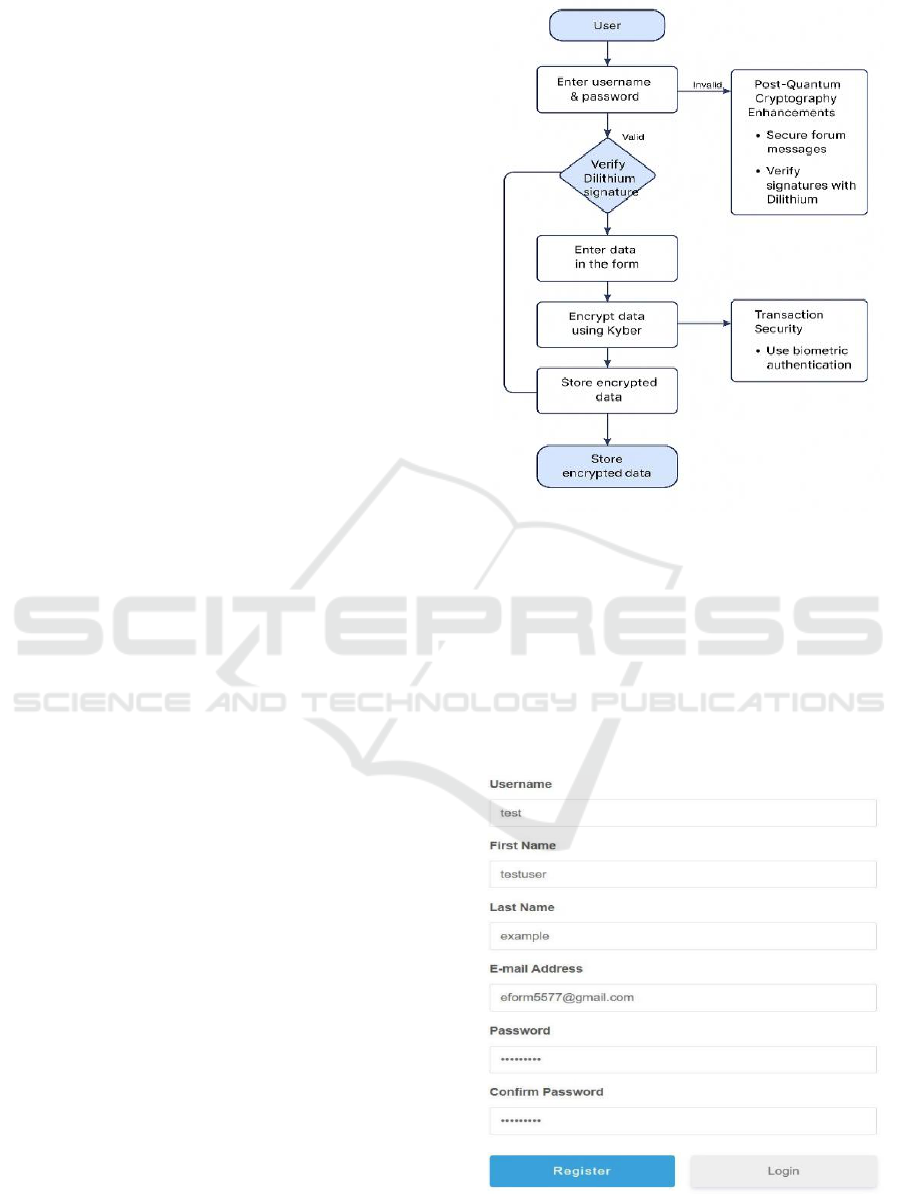
authentication. Figure 1 show the Flowchart of
complete process. The methodology consists of three
key phases:
Figure 1: Flowchart of Complete Process.
4.1 Replacing Traditional
Authentication with Dilithium
Digital Signatures
• Instead of conventional password-based
logins, the system implements Dilithium
digital signatures for authentication.
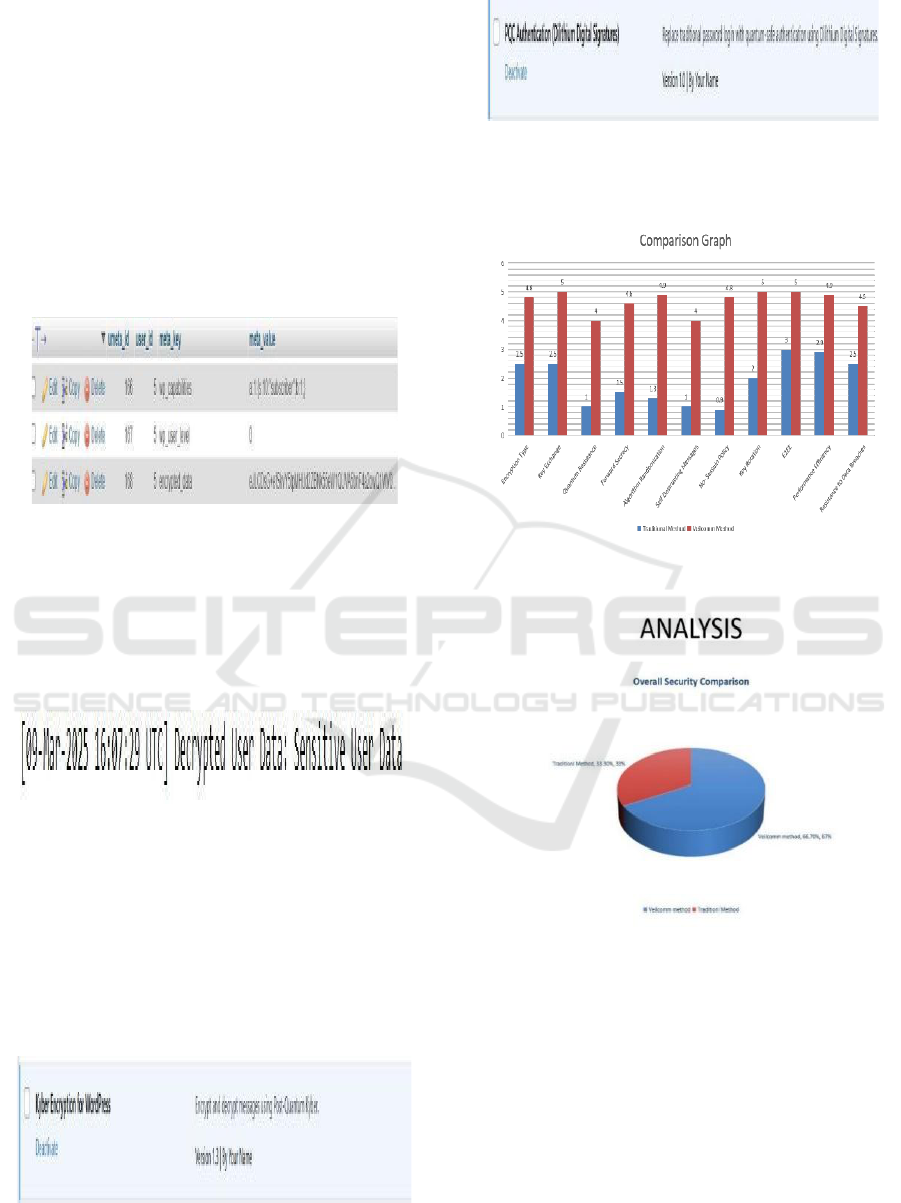
Figure 2 show the Registering a new user.
Figure 2: Registering a New User.
Enhancing Wordpress Security with Kyber and Dilithium: A Post Quantum Cryptographic Approach
459
• Users generate a quantum-safe digital
signature, which is verified during login,
eliminating phishing risks, credential leaks,
and brute-force attacks (L. Ducas et al., 2017).
4.2 Implementing Kyber Encryption
for Secure Data Storage
• Sensitive user data, including personal and
financial information, is encrypted using
Kyber encryption before being stored in
the database. Figure 3 show the Encrypted
data is saved in Php My Admin.
Figure 3: Encrypted Data Is Saved in Php My Admin.
• Decryption is only possible through
Kyber-secured keys, ensuring quantum-
resistant security for stored data (S. S. Roy
et al., 2022). Figure 4 show the log entry
confirms that encryption and decryption
process is working correctly.
Figure 4: The Log Entry Confirms That Encryption and
Decryption Process Is Working Correctly.
4.3 Developing a Custom WordPress
Plugin
A custom WordPress plugin is created to integrate
Kyber encryption and Dilithium authentication
seamlessly. Figure 5 show the A plugin was created for
Kyber Encryption.
Figure 5: A Plugin Was Created for Kyber Encryption.
Figure 6: A Plugin Was Created for Dilithium.
Once the plugin was created, activate the plugin and
use it. (Figure 6)
Figure 7: Analysis of Kyber With Traditional Encryption.
Figure 8: Analysis of Dilithium With Traditional
Verification Methods.
Figure 7 and 8 shows the Analysis of Kyber with
traditional encryption and Analysis of Dilithium with
traditional verification methods respectively.
Advantages of the Proposed Methodology
• Quantum-Resistant Security: Protects against
future quantum-based cyber threats.
• Fast and Efficient Authentication: Digital
signatures eliminate slow password
verification processes.
• Lightweight and Scalable: Kyber encryption is
ICRDICCT‘25 2025 - INTERNATIONAL CONFERENCE ON RESEARCH AND DEVELOPMENT IN INFORMATION,
COMMUNICATION, AND COMPUTING TECHNOLOGIES
460

computationally efficient, making it ideal for
web applications.
By implementing these PQC techniques, this
project demonstrates the feasibility of securing
WordPress-based platforms without significant
performance trade-offs, paving the way for future
quantum-secure web applications.
5 CONCLUSIONS
In today’s fast-changing digital world, even
agriculture is going high tech and with that comes the
need for stronger security. Our project focused on
creating a safe and simple digital space for farmers,
advisors, and admins by building a WordPress
platform that’s not just functional but also future-
proof. We used advanced security tools Kyber
encryption and Dilithium digital signatures to protect
user data and logins from cyber threats, even the kind
that future quantum computers might bring. We did
this without making things complicated for users.
Farmers can still buy or sell products, book
appointments, or connect with advisors easily, while
their data stays secure behind the scenes. It’s a small
step toward safer digital agriculture, but it can make
a big difference.
REFERENCES
A. Patel and K. Singh, "Post-quantum cryptography: The
future of secure authentication," 2020 IEEE Security &
Privacy, vol. 18, no. 5.
A. Kaushik, M. M. Alam, and S. Ghosh, "KaLi: A Crystal
for Post-Quantum Security Using Kyber and
Dilithium," in Proc. IEEE Int. Symp. Circuits and
Systems (ISCAS), 2022, pp. 1-5.
A.K. Jain, et al., "Agricultural Advisory System using
Machine Learning," 2020 IEEE International
Conference on Machine Learning and Applications
(ICMLA).
Aggarwal, S., & Pandey, R. (2021). Digital platforms for
agricultural knowledge sharing: A review. Journal of
Agricultural Sciences and Technology.
Food and Agriculture Organization of the United Nations.
(2019). Digital agriculture: Overview, opportunities
and challenges.
International Journal of Agricultural Sustainability. (2018).
Digital platforms and sustainable agriculture.
International Journal of Agricultural Education and
Extension. (2018). Advisory services and agricultural
productivity.
International Fund for Agricultural Development. (2018).
Digital agriculture: A new era for agriculture.
Journal of Agricultural Marketing. (2019). Online
marketplaces and agricultural marketing.
Journal of Agricultural and Applied Economics. (2019).
Digital platforms and agricultural productivity.
K. Singh, et al., "Digital Agriculture: A Review of the
Current State and Future Prospects," 2019 IEEE
International Conference on Computing, Networking
and Communications (ICNC).
K. K. Singh, et al., "Impact of Digital Agriculture on
Farmers' Livelihood," 2020 IEEE International
Conference on Agricultural Engineering (CAE).
L. Ducas, T. Lepoint, V. Lyubashevsky, P. Schwabe, G.
Seiler, and D. Stehlé, "CRYSTALS-Dilithium: Digital
Signatures from Module Lattices," IACR Cryptol.
ePrint Arch., 2017.
M. Lee, et al., "A comparative study of digital signatures in
post-quantum cryptography," 2021 IEEE Transactions
on Computers.
N. Verma and J. Clarke, "Implementing PQC algorithms in
web security applications," 2022 IEEE Transactions on
Secure Computing.
R. K. Sharma, et al., "Expert System for Agricultural
Advice," 2019 IEEE International Conference on
Intelligent Systems and Control (ISCO).
R. Kumar, et al., "Cybersecurity risks in digital agriculture,"
2021 IEEE Transactions on Cybernetics, vol. 50, no. 3.
S. Johnson, "Quantum computing and the end of RSA
encryption," 2020 IEEE Spectrum, vol. 56, no. 6.
S. K. Goyal, et al., "E-commerce in Agriculture: A
Review," 2020 IEEE International Conference on E-
commerce, E-Business and E- Government (ICEEG).
S. S. Roy, A. K. Pal, and I. Verbauwhede, "An Efficient
Method for Accelerating Kyber and Dilithium Post-
Quantum Cryptography," in Proc. IEEE Int. Symp.
Hardware Oriented Security and Trust (HOST), 2022,
pp. 186-196.
S.K. Singh, et al., "Knowledge Sharing in Agriculture using
Mobile Apps," 2019 IEEE International Conference on
Mobile Computing and Networking (MobiCom).
T. Nakamoto, et al., "Kyber encryption and its impact on
web security," 2019 IEEE Transactions on Information
Forensics and Security.
Enhancing Wordpress Security with Kyber and Dilithium: A Post Quantum Cryptographic Approach
461
