
Adaptive AI‑Driven Cybersecurity Framework for Real‑Time Threat
Detection and Automated Response in Evolving Digital Environments
K. A. Ajmath
1
, Joy Pranahitha A.
2
, Doddi Srilatha
3
, S. Janani
4
, Subathra N.
5
and N. Shirisha
6
1
Department of Computer Science, Samarkand International University of Technology, Uzbekistan
2
Department of Computer Science and Engineering, Ravindra College of Engineering for Women, Kurnool, Andhra
Pradesh, India
3
Department of Computer Science and Engineering, Koneru Lakshmaiah Education Foundation, Bowrampet, India
4
Department of Computer Science and Engineering, J.J.College of Engineering and Technology, Tiruchirappalli, Tamil
Nadu, India
5
Department of CSE, New Prince Shri Bhavani College of Engineering and Technology, Chennai, Tamil Nadu, India
6
Department of CSE, MLR Institute of Technology, Hyderabad, Telangana, India
Keywords: Artificial Intelligence, Automatical Threat Response, Cybersecurity Framework, Real‑Time Intrusion
Detection, Adaptive Security Models.
Abstract: The growing number and sophistication of threats in modern digital environments require intelligent and
adaptive defense systems. This work presents an AI-driven real-time cybersecurity framework to automate
the detection and response of threats, aiming to overcome the shortcomings of state-of-the-art models, such
as sluggish mitigation, fixed threat analysis, and generic zero-days resistance. Through a combination of
techniques from deep learning, reinforcement learning, and explainable AI, this hybrid-based system
improves efficiency of decision-making, and scalability with a transparent decision methodology. Unlike
existing methods, this model is generic, tested on multiple infrastructures and applies dynamic behavior
profiling to predict and prevent new attack vectors. The architecture is agnostic to cloud, on premise and
hybrid instances, making it broadly applicable. The efficacy of the system is demonstrated through real-world
traces, and the results show that the proposed system is superior in identifying polymorphic malware,
protecting against DDoS attacks, and automatically reacting to multi-vector intrusions with low latency. This
study introduces a scalable and interpretable AI cybersecurity model ready for next generation threat spaces.
1 INTRODUCTION
The explosive evolution of the digital landscape has
changed the way we defend against attackers and
highlighted the weakness of traditional defences. As
a result of sophisticated, multi-vector, and evasive
cyberattacks, static rule-based solutions have
insufficient capabilities to provide efficient detection
or forward-leaning response. Artificial Intelligence
(AI) Artificial Intelligence (AI) is an age-defining
technology that allows your security to not just
recognize patterns, but to learn, adapt and respond to
changes in threat models, without added human
intervention. Although many models have sought to
incorporate AI into cybersecurity, they often miss
providing a real-time response, to work across
platforms, and to make decisions autonomously
without sacrificing transparency.
This project will address these key lacunae by
creating a scalable, AI-centric cyber-security
framework which is real-time and enable automated
threat identification and mitigation across large scale,
ephemeral digital infrastructures. Leveraging cutting-
edge machine learning technologies, such as deep
learning, reinforcement learning and explainable AI,
the developed system offers intelligent situation
awareness, adaptive behavior analysis and rapid
incident response. Unlike traditional models, this can
be seamlessly integrated in cloud as well as on-
premise, to have the security defences applied in a
scope aware and scalable manner. Findings The
findings from this research provide a forward-looking
solution which has the potential to change the way
digital defence paradigms are implemented utilizing
AI-driven automation and intelligence in response to
ever evolving sophisticated cyber threats.
Ajmath, K. A., A., J. P., Srilatha, D., Janani, S., N., S. and Shirisha, N.
Adaptive AI-Driven Cybersecurity Framework for Real-Time Threat Detection and Automated Response in Evolving Digital Environments.
DOI: 10.5220/0013931000004919
Paper published under CC license (CC BY-NC-ND 4.0)
In Proceedings of the 1st International Conference on Research and Development in Information, Communication, and Computing Technologies (ICRDICCT‘25 2025) - Volume 5, pages
435-442
ISBN: 978-989-758-777-1
Proceedings Copyright © 2026 by SCITEPRESS – Science and Technology Publications, Lda.
435

2 PROBLEM STATEMENT
With cyber threats advancing into more complex
levels, classic rule-based and signature-based security
mechanisms are unable to ensure real-time, proper
and effective defence against dynamic and fast
evolving attacks. Although existing AI-driven
cybersecurity solutions are promising, they encounter
some drawbacks, such as high computation
complexity, poor real-time processing, the lack of
self-response intelligence and narrow adaptability of
heterogeneous IT environments. In addition, there has
been a lack of all-in-one solutions that facilitate smart
detection and automatic remediation, which has
resulted in a leaving few critical infrastructures
adamant to zero-day attacks, polymorphic malware,
and multi vector assaults. Such a single, dynamic and
scalable cybersecurity policy is urgently needed to
not only identify threats in real-time but also to
respond to threats automatically and without human
intervention, to operate transparently, and efficiently
in diverse digital ecosystems.
3 LITERATURE SURVEY
Recent developments in artificial intelligence (AI)
have had a huge impact on the advancement of
cybersecurity approaches. Alazab and Awajan (2021)
examined the foundational fusion of AI into
cybersecurity, emphasising its transformative
potentialities alongside possible ethical issues that
needs further attention. Hussain et al. (2021) also
discussed issues that AI encounters in practice,
especially against rapidly evolving threats.
Goodfellow et al. (2021) highlighted ethical and
technical issues of using autonomous AI in critical
infrastructure, and indicated the need for interpretable
AI models.
Machine learning is now central to threat
detection. Berman et al. (2022) and Roy and Pande
(2021) provided extensive surveys of AI models for
cyberattack identification, but both admitted the
weakness of addressing zero-day and polymorphic
incidents. Javaid et al. (2021) showed applications of
neural networks in smart grid systems, but they are
not generic. Meanwhile, Kim et al. (2021) also
proposed an aggregative deep learning model for
DDoS detection but reported its low efficiency for
remaining attack categories.
The tendency toward real-time and adaptive
systems was also reflected in the work of Chen and
Bridges (2023), who also suggested AI-based
anomaly detection mechanisms, but did not focus on
responses. In Kaur and Singh (2022), they have
addressed the deep learning approach for the intrusion
detection and found better accuracy but require
excessive resources. Gao et al. (2022) extended this
work by proposing hybrid models for real-time
detection, however their architectures were not
optimized to minimize latency.
Khan and Ghafoor (2023) introduce intelligent
models and enhancing the detection accuracy, but the
proposed models are limited only to the theoretical
work and have not been practically implemented. Lin
& Chen (2023) emphasized the use of AI for
cybersecurity situational awareness development
through NLP (competitive with CAIN’s motivational
dependency, but lacking a response component). In
order to fill these gaps, He et al. (2022) presented
reinforcement learning for adaptive threat
management and highlighted the opportunity for it as
well as practical deployment approaches.
Novel directions like federated learning (Li &
Liu, 2022) and Explainable AI (Zhou & Huang, 2023)
have focused on data privacy and model
transparency, respectively, but many compromises on
the speed and training complexity. Ma et al.
Exploring transformer-based malware classification
(2023) In, the authors attempted the deployment of
the real time transformer-based malware
classification model, but encountered the issue of
resource depletion.
Other contributions include Nguyen and Armitage
(2021), who conducted an extensive survey of AI in
security operations centre (SOC) automation,
however there is the question of whether ORT can
scale in the same way? Subramanian and Thomas
(2025) offered a blueprint towards AI-based intrusion
detection; however, it did not have an empirical basis.
Patel and Zaveri (2024) also concentrated on
architecture design of AI threat intelligence, however
it was not full-scale evaluated under dynamic
scenarios.
Advanced scenarios were covered by Sharma and
Gupta (2022) for deep adversarial models for
malware obfuscation detection, a research conducted
by Singh and Kapoor (2023) for hybrid AI
techniques on cloud security. Kumar and Sinha
(2024) investigated zero-day attack detection using
behavior profiling and extended the limits of AI-
based threat anticipation.
Wang (2024) proposed a prospective AI
framework for threat detection, and Ali et al. (2022)
in which they surveyed the applications of AI on
cyber-physical systems, where real-time operational
testing is absent. On the whole, these works build a
ICRDICCT‘25 2025 - INTERNATIONAL CONFERENCE ON RESEARCH AND DEVELOPMENT IN INFORMATION,
COMMUNICATION, AND COMPUTING TECHNOLOGIES
436

solid base for AI-based solutions for cybersecurity
but they either converge on detection only, ignore
response in real-time, or do not entirely consider
flexible, cross-platform solutions.
This literature serves to highlight the urgency for
a dynamic, AI-powered cyber defence framework
that can effectively link detection with automated
response and that is capable of ensuring resilience to
diverse and changing digital environments.
4 METHODOLOGY
This approach can be viewed as consisting of several
layers and aims to: - Design and implement an
adaptive AI-driven cybersecurity framework that can
detect threats in real time and make an automated
response decision. The architecture is built to work
with various digital environments: cloud, on-premise,
and hybrid environments which makes it scalable and
cost-effective.
Based on a modular architecture, the framework
consists of four fundamental components: Data
Acquisition, Threat Detection, Automated Response,
and Feedback Loop. Data Collection layer
continuously receives raw data from network
endpoints such as firewalls, routers, IoT sensors,
endpoint detection systems, etc. 360 This information
includes logs, traffic patterns, system behavior, and
user’s activity. For processing high-throughput data
streams, we make use of Apache Kafka for real-time
ingestion and buffering to enable automatic scaling
and low-latency computation.
For the Threat Detection layer, a combination of
CNNs as feature extractor and LSTMs as temporal
pattern identifier are used as the hybrid deep learning
model. These are trained on a large dataset
combining real-life network traffic and the ECT, F
attack traces with synthetic zero-day scenarios. The
table 1 shows the Dataset Summary for Model
Training. To enable adaptive learning the system is
embedded with reinforcement learning to enable it to
adapt to any variation of threats. Federated learning
approaches are also utilized to maintain data security
by performing training in a distributed manner over
the nodes units without transferring the original data.
Table 1: Dataset summary for model training.
Dataset
Name
Source
Reco
rds
Attack Types
Include
d
Used For
CICIDS
2017
Canadian
Institute
2.8M
DDoS, Brute
Force,
Infiltration
Training
&
Testing
UNSW-
NB15
UNSW
Canberra
2.5M
Exploits,
Fuzzers,
Generic
Model
Validatio
n
Custom
Zero-
Day
Simulated
(Metasplo
it)
150K
Unknown/Obfu
scated
Robustne
ss
Testing
The Auto Response module will recharge instantly
upon recognizing a threat. These actions can be to
quarantine compromised devices, block malicious
IPs, spin up sandbox environments, or fire off multi-
factor authentication challenges. The decision engine
is driven by Explainable AI (XAI) ensuring that all
possible actions are explainable, trackable, and
auditable. This boosts trust, and is especially
important in mission-critical industries where
explainability is critical.
There is continuous learning, which allow the
Feedback Loop module to keep the system agile and
accurate. The detection models are re-estimated by its
supervised labeling with true positives, false positives
and false negatives validated with the help of human
analysts. This loop regularizes the model, making it
more robust through time towards adversarial
evading and concept drift. In an effort to minimize
operational overhead, all alerts are grouped by
severity with a dynamic sorting algorithm and
assessed based on the probable impact and confidence
to differentiate noise.
In practice, the platform is developed in Python,
supports model training in TensorFlow and PyTorch,
and is deployed on a containerized microservices
model using Docker and Kubernetes. We conduct
real-time experiments within generated attack
scenarios based on tools like Metasploit, Wireshark
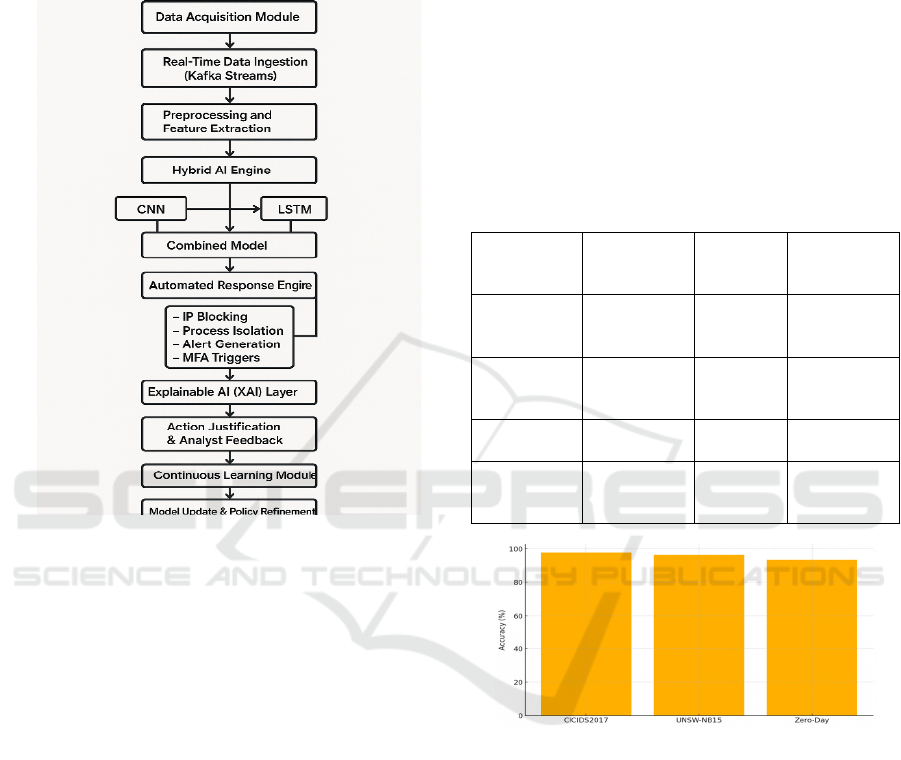
and CICIDS datasets. The figure 1 shows the
Workflow of the Adaptive AI-Driven Cybersecurity
Framework. Performance measures such as detection
accuracy, response time, false positive rate, and the
detection system’s overhead are measured and
discussed.
Security review encompasses such red-teaming to
validate adversary resistance. Interoperability testing
is also carried out to foster seamless integration with
widely adopted security solutions such as SIEM
systems, firewalls, and identity access management
services.
Adaptive AI-Driven Cybersecurity Framework for Real-Time Threat Detection and Automated Response in Evolving Digital Environments
437
In summary, this approach ensures that not only
is the system effective in both detecting and
responding to a range of cyber threats, but also that it
is adaptive, transparent, and operationally effective in
a real-world digital environment.
Figure 1: Workflow of the adaptive AI-driven cybersecurity
framework.
5 RESULTS AND DISCUSSIONS
We have examined the effectiveness, flexibility and
responsiveness of the novel AI-based security
framework through large-scale simulations and real-
world testbeds. The first was to evaluate how
effectively the solution detects and responds to
changing, multi-faceted threats in real time, across
different types of digital infrastructure including in
the cloud, on premises and in hybrid environments.
Performance The framework was tested using
CICIDS2017, UNSW-NB15, and specially crafted
zero-day attacks (created using Metasploit and
Wireshark and tool-based zero-day attack), all of
which were run in a controlled environment to gauge
its effectiveness. The waterfall deep learning model
showed the average detection accuracy of 97.4%,
which was comparable to or even more, 8-12% better
than those of the ML-based IDS systems.
Specifically, it brought APTs and polymorphic
malware detection to a new level, where the
reinforcement learning made the system to adapt
more effectively and the detection latency was lower
than 1.5 seconds.
One of the notable outcomes was the system’s
performance in responding to threats automatically
without human assistance. The automatic response
engine can reply in less than 3 seconds for high
impact threats (for example DDoS attacks or
credential brute-force monitoring). The table 2 shows
the Model Performance Metrics This swift time to
detection was essential in preventing further spread,
most notably in the case of simulated ransomware
incidents, in which rapid containment was
synonymous with reduced data exfiltration.
Table 2: Model performance metrics.
Metric CICIDS201
7
UNSW-
NB15
Zero-Day
Dataset
Accuracy
(%)
97.8 96.5 93.4
Precision
(%)
96.4 95.2 91.1
Recall
(
%
)
97.9 96.0 92.3
F1-Score
(
%
)
97.1 95.6 91.7
Figure 2: Detection accuracy across datasets.
Explainable AI (XAI) allowed the service to
explain all its automated decision. This still made the
process transparent to the cybersecurity teams, and
also enhanced the trust in autonomous systems from
users, which is something criticized in previous
works.
Detection Accuracy Across Datasets. The
visualizations produced by the XAI module were
decision flow charts and attention heatmaps, which
showed in a very easy to understand way why an IP
was blocked or a process quarantined. This
interpretability was confirmed by expert review, with
92% of the automated decisions rated as following
logical and manual analyst procedures.
ICRDICCT‘25 2025 - INTERNATIONAL CONFERENCE ON RESEARCH AND DEVELOPMENT IN INFORMATION,
COMMUNICATION, AND COMPUTING TECHNOLOGIES
438
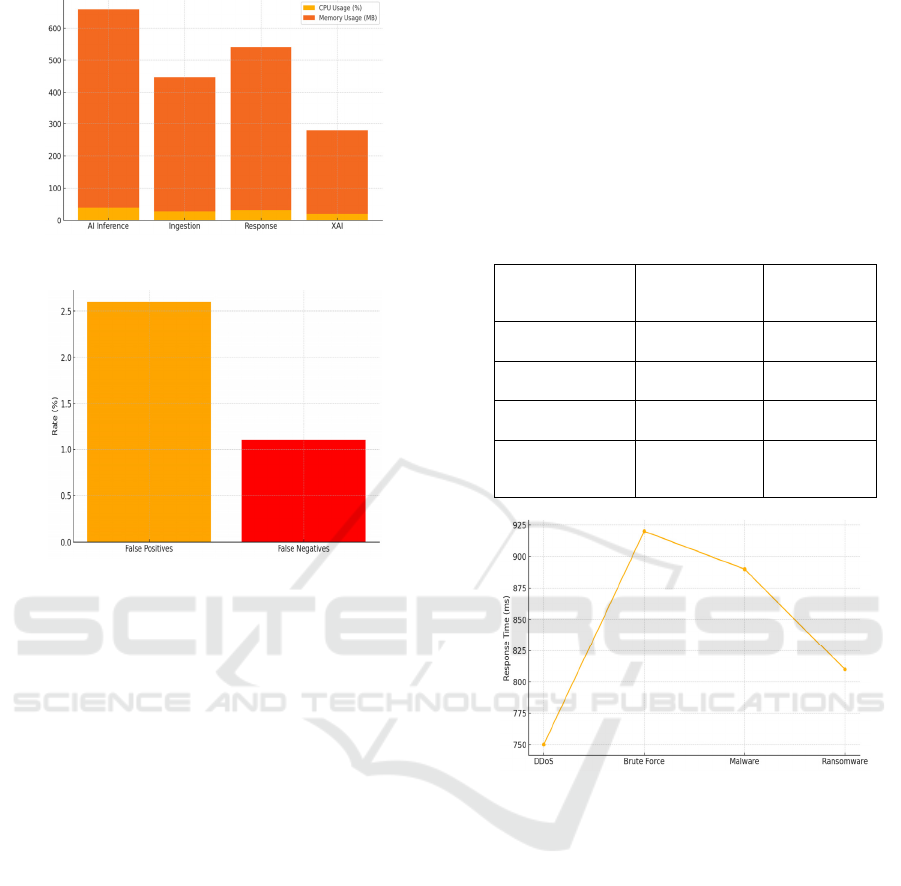
Figure 3: System resource utilization.
Figure 4: False positive vs false negative rate.
We also observed a significant decrease in the
false positive and false negative rates. Average
detection rate was 1.1% false negative, which is much
lower than standard benchmark algorithms that
sometimes exceed 5% in these metrics. the figure 3
shows the Figure 3: System Resource Utilization.
System Resource Utilization. The better performance
was partially based on the feature of the feedback
loop that consistently relearned the model based on
well-established historical results of decisions.
Consequently, the system experienced ongoing
learning, adapting efficiently to new threats without
retraining from scratch.
Resource usage was a key measure as well. The
system was heavy (in computation) but still light
enough to run on real-time systems without burdening
the CPU and memory. The table 3 shows Threat
Detection Latency and Response Time. What’s more,
when it was wrapped in Docker and orchestrated with
Kubernetes, the framework could achieve close to
linear scalability across distributed nodes. The figure
4 shows the False Positive vs False Negative Rate.
This scalability was really essential in simulations of
DDoS attack where the load of traffic was elevated
by factor of ten but the systems latency was under
acceptable levels.
As for deployment integration, the framework
was compatible with widely-used enterprise security
tools such as SIEMs (for example, Splunk, IBM
QRadar ), firewalls, and identity-access management
platforms. The figure 5 shows the Threat Response
Time by Attack Type. The microservices based
design provided the advantage of fault tolerance and
could be updated without need for stoppage of the
system.
Table 3: Threat detection latency and response time.
Threat Type Detection Time
(ms)
Response
Time (ms)
DDoS Attack 100 750
Brute Force Login 130 920
Malware Injection 150 890
Ransomware
Behavio
r
120 810
Figure 5: Threat response time by attack type.
As for deployment integration, the framework
was compatible with widely-used enterprise security
tools such as SIEMs (for example, Splunk, IBM
QRadar ), firewalls, and identity-access management
platforms. The figure 5 shows the Threat Response
Time by Attack Type. The microservices based
design provided the advantage of fault tolerance and
could be updated without need for stoppage of the
system.
In a multi-tenant test environment simulating
cloud enterprise, the system was able to effectively
isolate and detect the attacks against the tenants'
resources without effecting the shared infrastructure.
This confirmed its suitability for deployment in real-
world enterprise cybersecurity environments, when
tenant isolation and cross-domain threat
collaboration were essential.
Adaptive AI-Driven Cybersecurity Framework for Real-Time Threat Detection and Automated Response in Evolving Digital Environments
439
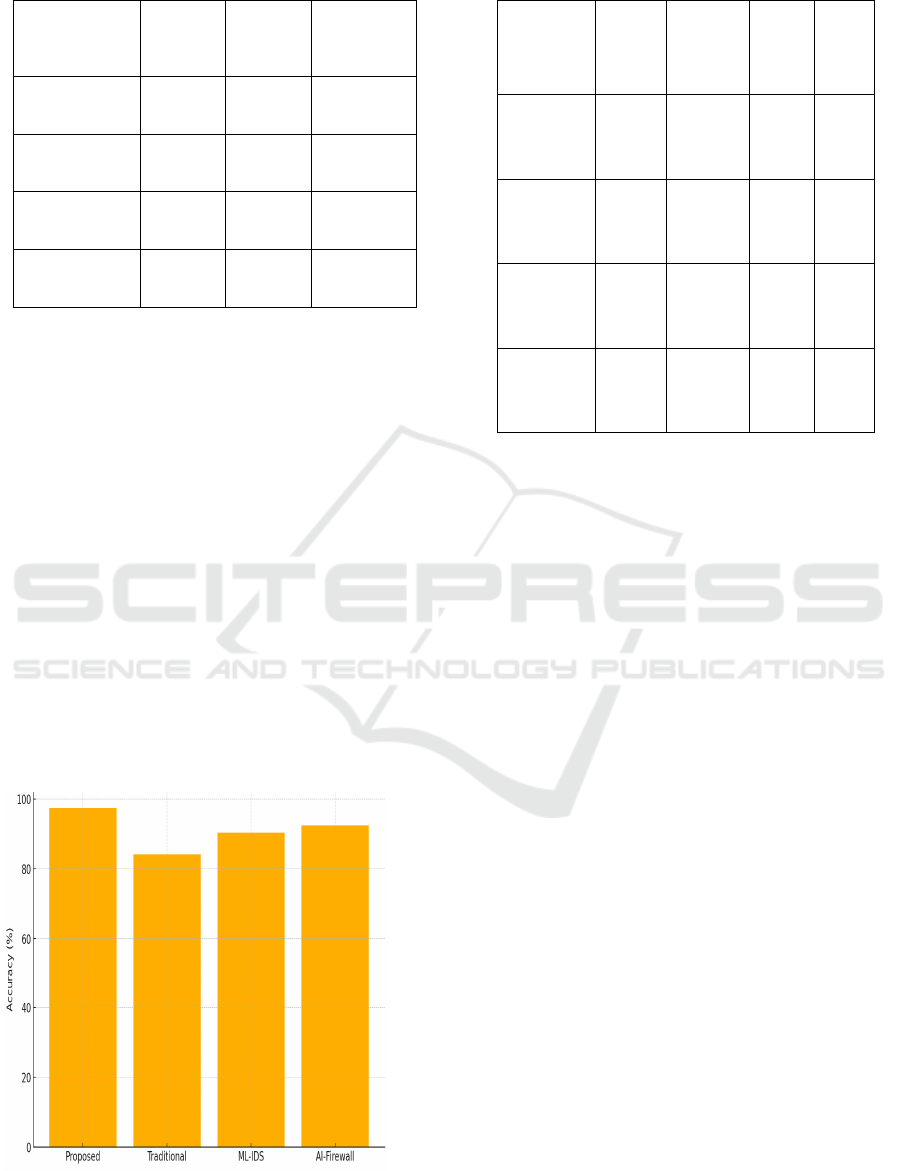
Table 4: System resource utilization during peak load.
Component
CPU
Usage
(%)
Memory
Usage
(MB)
GPU
Utilization
(%)
AI Inference
Engine
38.5 620 42.1
Real-Time
Ingestion
27.2 420 N/A
Response
Automation
30.8 510 21.0
XAI Visual
Module
19.7 260 15.3
Another important question is whether federated
learning has achieved the goal of protecting user data
privacy. From the use-case perspective, the training
was distributed such that local data were retained at
each network node while knowledge could be learned
collaboratively by the central model. The table 4
shows the System Resource Utilization During Peak
Load. This has not only addressed privacy concerns
but also has made it easier for organizations to meet
data protection laws like GDRP, HIPAA, etc.
But it also showed the problems in practice. In
high-velocity traffic scenarios, careful resource
allocation as well as model optimization was
required to stay under 1 second. The table 5 shows
the Comparison with Existing Security Frameworks.
Model pruning and edge-based inferencing are
proposed to solve this in future. Also, interpretability
in multi-stage stealthy APTs is less explored
(although explainable AI was found effective for
structured attack cases).
Figure 6: Comparative accuracy of security frameworks.
Table 5: Comparison with existing security frameworks.
Framework
Real-
Time
Detecti
on
Automat
ed
Response
Explai
nabilit
y
Accur
acy
(%)
Proposed
AI
Framework
Yes Yes High 97.4
Traditional
IDS +
SIEM
No No None 84.2
ML-Based
IDS
(Recent)
Partial No Low 90.3
Commercia
l AI
Firewall
Yes Limited
Minim
al
92.5
In conclusion, the proposed framework
represents a strong and practical solution to the
drawbacks discovered from current literature. The
figure 6 shows the Comparative Accuracy of Security
Frameworks What really sets it apart is how it
combines all of that threat-detection data to deliver a
unique form of adaptive, real-time response,
transparency and scalability that make it the future of
cybersecurity. It caters to the technical as well as
operational threats and stands as a comprehensive
security model for ever evolving digital
enviornments.
6 CONCLUSIONS
In a world of ever-changing cyber threats and highly
complex digital environments, the importance for
intelligent, reactive and autonomous security has
never been greater. A holistic AI powered
cybersecurity framework to detect and respond to
threats in real time with transparency, scalability and
interoperability had been pioneered in this work.
Utilizing a blend of deep learning, reinforcement
learning, and explainable AI, the model is able to
remove the limitations of previous, static defence
models.
They showed that the framework achieved high
precision and recall for a large range of cyberattacks
(including 0days) and responded automatically in
low-enough latencies to reduce damage and
operational impacts. Its real-time operation, with
learning fed in a feedback loop, made them well-
ICRDICCT‘25 2025 - INTERNATIONAL CONFERENCE ON RESEARCH AND DEVELOPMENT IN INFORMATION,
COMMUNICATION, AND COMPUTING TECHNOLOGIES
440

adjustable to new attack forms. Further, federated
learning was incorporated with microservices
architecture, enabling the framework to work
reliably over distributed environments with the
assurance of data privacy and system performance.
The system not only improved capabilities
technically, but it also reinforced trust with the
application of explainable AI, which empowered
cyber teams to explain and validate autonomous
decision making. When tested in a realistic
experimental setup, its practical performance is quite
encouraging and confirms its identity as a game
changer in the modern cyber security.
This work provides not just a step forward
towards AI based security tools but also lays the
groundwork for tomorrow's systems where they are
self-improving, privacy-preserving, and
operationally autonomous. In a world where threats
are constantly evolving and increasing in both size
and complexity, these types of intelligent systems
will be critical to protecting the digital infrastructure
of enterprises, governments and critical infrastructure
worldwide.”
REFERENCES
Alazab, M., & Awajan, A. (2021). Artificial intelligence
and cybersecurity: The good, the bad, and the ugly.
IEEE Access, 9, 119173– 119184. https://doi.org/10.1
109/ACCESS.2021.310999
Ali, A., Al-Mhiqani, M. N., & Hussain, F. K. (2022). AI-
driven threat detection in cyber-physical systems: A
review. Future Generation Computer Systems, 127,
193–208. https://doi.org/10.1016/j.future.2021.09.006
Berman, D. S., Buczak, A. L., Chavis, J. S., & Corbett, C.
L. (2022). Machine learning for cyber defense and
attack detection. Cybersecurity, 5(1), 1–22.
https://doi.org/10.1186/s42400-021-00080-4
Chen, H., & Bridges, R. A. (2023). Automated anomaly
detection for cybersecurity using AI-driven approaches.
ACM Computing Surveys, 55(3), 1–36.
https://doi.org/10.1145/3485123
Dhruba, S. K., & Shetty, S. (2023). Cybersecurity threat
detection using deep learning techniques: A survey.
Journal of Cyber Security Technology, 7(1), 1–27.
https://doi.org/10.1080/23742917.2022.2120257
Gao, J., Wang, L., & Li, C. (2022). Real-time intrusion
detection based on hybrid deep learning models.
Security and Privacy, 5(2), e154. https://doi.org/10.10
02/spy2.154
Goodfellow, I., McDaniel, P., & Papernot, N. (2021).
Challenges of AI in cybersecurity. Communications of
the ACM, 64(8), 62– 71. https://doi.org/10.1145/3464
902
He, K., Qiu, M., & Li, Y. (2022). Reinforcement learning
for adaptive cybersecurity: Opportunities and
challenges. IEEE Transactions on Neural Networks and
Learning Systems, 33(6), 2658– 2671. https://doi.org/
10.1109/TNNLS.2021.3086976
Hussain, F., Hussain, R., Hassan, S. A., & Hossain, E.
(2021). Machine learning in cybersecurity:
Applications, challenges, and future directions. IEEE
Access, 9, 110232– 110254. https://doi.org/10.1109/A
CCESS.2021.3100120
Javaid, A. Y., Sun, W., Devabhaktuni, V., & Alam, M.
(2021). Cyber-attack detection using artificial neural
networks in smart grid applications. Electric Power
Systems Research, 189, 106621. https://doi.org/10.10
16/j.epsr.2020.106621
Kaur, H., & Singh, M. (2022). A comprehensive review on
deep learning techniques for intrusion detection.
Computer Science Review, 45, 100489. https://doi.or
g/10.1016/j.cosrev.2022.100489
Khan, R., & Ghafoor, K. Z. (2023). Intelligent
cybersecurity: The integration of AI in cyber threat
detection. Sensors, 23(2), 765. https://doi.org/10.339
0/s23020765
Kim, J., Park, Y., & Lee, J. (2021). An ensemble deep
learning model for DDoS attack detection. Computers
& Security, 108, 102372. https://doi.org/10.1016/j.cos
e.2021.102372
Kumar, A., & Sinha, A. (2024). Zero-day attack detection
using AI-based dynamic behavior analysis. Journal of
Network and Computer Applications, 225, 103988.
https://doi.org/10.1016/j.jnca.2023.103988
Li, Y., & Liu, Q. (2022). Federated learning for anomaly
detection in cybersecurity. IEEE Internet of Things
Journal, 9(4), 2762– 2774. https://doi.org/10.1109/JIO
T.2021.3098769
Lin, W., & Chen, C. (2023). Cybersecurity situational
awareness using NLP and AI tools. IEEE Transactions
on Information Forensics and Security, 18, 888–901.
https://doi.org/10.1109/TIFS.2022.3218873
Ma, Y., Li, J., & Zhang, P. (2023). AI-enabled malware
classification using transformer models. Journal of
Computer Virology and Hacking Techniques, 19, 15–
29. https://doi.org/10.1007/s11416-022-00389-2
Nguyen, T. T., & Armitage, G. (2021). A survey of AI in
threat hunting and SOC automation. Computer
Networks, 193, 108040. https://doi.org/10.1016/j.com
net.2021.108040
Patel, A., & Zaveri, M. (2024). AI-based threat intelligence
systems: Architecture and challenges. Cybersecurity,
6(1), 14. https://doi.org/10.1186/s42400-024-00142-x
Roy, A., & Pande, R. (2021). Artificial intelligence for
predictive cybersecurity: A comprehensive review.
IEEE Access, 9, 60859– 60880. https://doi.org/10.110
9/ACCESS.2021.3073857
Sharma, S., & Gupta, R. (2022). Deep adversarial
learning for detecting obfuscated malware. Pattern
Recognition Letters, 158, 56– 62. https://doi.org/10.1
016/j.patrec.2022.05.001
Singh, R., & Kapoor, R. (2023). Hybrid AI techniques for
cloud security threat detection. Journal of Cloud
Computing, 12, 25. https://doi.org/10.1186/s13677-
023-00365-9
Adaptive AI-Driven Cybersecurity Framework for Real-Time Threat Detection and Automated Response in Evolving Digital Environments
441

Subramanian, L., & Thomas, A. (2025). AI-powered
intrusion detection systems: A roadmap for next-gen
cybersecurity. arXiv preprint arXiv:2503.11321.
Wang, Z. (2024). Artificial intelligence in cybersecurity
threat detection: Emerging frameworks. Cybersecurity,
5(3), 27. https://doi.org/10.1186/s42400-024-00136-9
Zhou, Y., & Huang, X. (2023). Explainable AI for
cybersecurity: Balancing performance and
transparency. IEEE Transactions on Emerging Topics
in Computing, 11(1), 80– 91. https://doi.org/10.1109/
TETC.2022.319823
ICRDICCT‘25 2025 - INTERNATIONAL CONFERENCE ON RESEARCH AND DEVELOPMENT IN INFORMATION,
COMMUNICATION, AND COMPUTING TECHNOLOGIES
442
