
Unified Payments Interface Fraud Detection Using Machine Learning
P. Sirisha
1
, S. Jaheda
2
, G. Afra Tahaseen
2
, K. Divya Madhuri
2
and P. Mohammad Arshad
2
1
Department of CSE, Srinivasa Ramanujan Institute of Technologv, Anantapur, Andhra Pradesh, India
2
Department of CSE (Data Science), Srinivasa Ramanujan Institute of Technology,
Anantapur, Andhra Pradesh, India
Keyword: Machine Learning, XGB-Classifier, Decision Tree, Random Forest, UPI Digital Payments, Fraud Detection.
Abstract: Digital transaction fraud has become more common due to the widespread use of the Unified Payments
Interface (UPI). Our proposed fraud detection system employs six machine learning algorithms to address
this issue: XGBClassifier, Decision Tree, Random Forest, and Gradient Boosting Machines (GBMs). A
logical framework for classifying transactions is provided by the Decision Tree algorithm. By enhancing
accuracy and resilience, Random Forest successfully detects fraud. By combining weak learners, GBMs are
able to identify changing fraud trends over time and capture intricate fraud patterns. training the model to
converge efficiently. When it comes to classification jobs, XGBClassifier is a formidable gradient boosting
method. Quick, it deals with missing values, and it stops overfitting. Enhancing UPI security, this multi-
algorithm technique processes UPI transactions securely and accurately, differentiating between fraudulent
and authentic ones. We are on the cusp of seeing this paradigm implemented in actual financial systems.
1 INTRODUCTION
The Unified Payments Interface (UPI) has
transformed the digital payment landscape, enabling
instant and seamless financial transactions. UPI
allows users to send and receive money using their
mobile devices without requiring traditional banking
details such as account numbers and IFSC codes. Its
convenience and accessibility have led to rapid
adoption across individuals, businesses, and financial
institutions. However, as digital transactions increase,
so do the risks associated with fraudulent activities.
Cybercriminals exploit vulnerabilities in the system
using tactics like phishing, fake payment requests,
identity theft, and transaction manipulation. These
frauds pose a serious threat to both users and financial
institutions, leading to monetary losses and decreased
trust in digital payments.
Traditional fraud detection methods rely on rule-
based approaches, where predefined conditions flag
potentially fraudulent transactions. However, these
static rules often fail to detect new and sophisticated
fraud patterns. Fraudsters continuously evolve their
tactics, making it essential to implement intelligent
and adaptive fraud detection systems. This is where
machine learning (ML) comes into play. ML-based
fraud detection systems can analyze vast amounts of
transaction data, learn from historical fraud patterns,
and automatically identify suspicious activities. By
leveraging advanced ML algorithms, we can enhance
fraud detection accuracy, reduce false positives, and
improve real-time security measures in UPI
transactions.
In this study, we propose a machine learning-driven
UPI fraud detection system that utilizes six powerful
algorithms: Decision Tree, Random Forest, Gradient
Boosting Machines (GBMs), and XGBClassifier.
These models help in detecting fraudulent transactions
with high precision. Decision Tree provides a clear
decision-making process for transaction classification.
Random Forest enhances detection accuracy by
combining multiple decision trees, making it robust
against fraudulent anomalies. Gradient Boosting
Machines (GBMs) use weak learners to identify
evolving fraud patterns, while XGBClassifier, a fast
and efficient gradient boosting algorithm, prevents
overfitting and handles missing values effectively.
By implementing this multi-algorithm approach, our
system ensures secure, accurate, and real-time fraud
detection in UPI transactions. Financial institutions
can integrate this model into their existing security
infrastructure to prevent fraudulent activities and
protect users. The proposed system not only improves
fraud detection efficiency but also contributes to a
420
Sirisha, P., Jaheda, S., Tahaseen, G. A., Madhuri, K. D. and Arshad, P. M.
Unified Payments Interface Fraud Detection Using Machine Learning.
DOI: 10.5220/0013930800004919
Paper published under CC license (CC BY-NC-ND 4.0)
In Proceedings of the 1st International Conference on Research and Development in Information, Communication, and Computing Technologies (ICRDICCT‘25 2025) - Volume 5, pages
420-426
ISBN: 978-989-758-777-1
Proceedings Copyright © 2026 by SCITEPRESS – Science and Technology Publications, Lda.

safer digital payment ecosystem, enhancing user
confidence in UPI transactions.
2 LITERATURE SURVEY
i) CARDWATCH: a neural network based database
mining system for credit card fraud detection
https://ieeexplore.ieee.org/document/618940
Here we introduce CARDWATCH, a database mining
method that can identify credit card fraud. An intuitive
graphical user interface, connectivity to several
commercial databases, and a neural network learning
module form the basis of the system. Very high
success rates in detecting fraud were found in tests
using autoassociative neural network models and
synthetically created credit card data.
ii) Understanding telephony fraud as an essential step
to better fight it
https://www.semanticscholar.org/paper/Understandi
ng-telephony-fraud-as-an-essential-step-
Sahin/4f88de8f9ffb34aa147b2c10d4bf08b350ae917
b
The first large-scale network, which reached around
7 billion people over a century ago, was the telephone
network. The complex nature of telecommunications
and the possibility of monetising several services
make it an attractive target for fraudsters. Academic
studies on these networks are few because of their
complexity and closed nature. A comprehensive
examination of fraud in telecommunication networks
is the first part of this thesis. We present a taxonomy
that differentiates between basic reasons,
weaknesses, ways of exploitation, types of fraud, and
benefits to fraudsters. We break it down for you and
show how our taxonomy sheds light on CAller NAMe
(CNAM) revenue sharing fraud. We look at two types
of wholesale billing fraud that operators face head-on
in the second part of the article. New forms of
interconnect telecom fraud include Over-The-Top
(OTT) bypass fraud. Directed via IP to a voice chat
app on a smartphone, rather than terminating it over
the telco infrastructure, is how OTT bypass works.
We analyse the effects of this fraud on a small
European country and how to identify it using more
than 15,000 test calls and a thorough user survey. A
big wholesale scam, the International Revenue Share
fraud (IRSF), will be discussed later. Calls from IRSF
numbers are being diverted to "international premium
rate services" by con artists. In order to gain a deeper
understanding of the IRSF ecosystem, we examine
data from several third-party premiu rate service
providers' worldwide premium rate tests. Using this
data, we suggest characteristics for IRSF-detection
for both the source and destination numbers of calls.
The latter section of the thesis delves into consumer-
side telephonic fraud, namely voice spam. A recent
approach to stop unsolicited phone calls includes
linking the spammer with a phone bot (“robocallee”)
that impersonates a genuine person. Lenny, a bot,
plays pre-recorded audio messages to communicate
with the user.
iii) Fraud detection system: A survey
https://www.sciencedirect.com/science/article/abs/pi
i/S1084804516300571
Credit card, telecommunication, and healthcare
insurance systems are just a few examples of the
many forms of electronic commerce that have
emerged as a result of the proliferation of both
personal computers and large corporations. There are
legitimate and dishonest individuals on these
networks, unfortunately. There were a number of
methods in which fraudsters gained access to e-
commerce platforms. Fraud prevention systems
(FPSs) do not adequately safeguard e-commerce
networks. Electronic commerce systems may be
protected, nevertheless, through FDS-FPS
cooperation. Several challenges, including as concept
drift, real-time detection, skewed distribution, and
huge data, impede the performance of FDS. In a
systematic fashion, this survey study examines these
worries and roadblocks that impede FDS operation.
Our five e-commerce platforms include online
auctions, credit card processing, telecommunications,
healthcare insurance, and auto insurance. We will go
over the two main categories of online shopping
fraud. Additionally, selected E-commerce sites'
modern FDSs approaches are showcased. Here is a
concise synopsis of the patterns and conclusions that
will shape future study.
iv) Network Analysis (From Criminal Intelligence
Analysis, P 67-84, 1990, Paul P Andrews, Jr and
Marilyn B Peterson, ed. -- See NCJ-125011)
https://www.ojp.gov/ncjrs/virtual-
library/abstracts/network-analysis-criminal-
intelligence-analysis-p-67-84-1990-paul-p
Relational matrices and maps of relationships are
described together since they both provide the same
information. You may find the frequency, intensity,
and strength of the relational linkages between the
subjects of investigation using the diagrams and
matrices. The presentation of mathematical models
serves to demonstrate how conclusions may be
derived from network models. We take a look at a
sophisticated use of network analysis by the police.
twelve figures and fourteen references.
Unified Payments Interface Fraud Detection Using Machine Learning
421
v) Modelling different types of automobile insurance
fraud behaviour in the Spanish market
https://www.sciencedirect.com/science/article/abs/pi
i/S0167668798000389
Controlling insurance fraud necessitates in-depth
understanding of insureds' conduct, according to
microeconomic theory. We quantify the impact of
insured and claim variables on the risk of fraud using
discrete-choice models that we propose in this
research. The data is based on a sample from Spain.
Oversampling of fraud claims necessitates correction
for choice-based sampling in the estimation. Also
covered is the organisation of the Spanish vehicle
insurance sector. Our findings vary depending on the
specific form of fraudulent activity being examined.
3 METHODOLOGY
3.1 Proposed Undertaking
The proposed system enhances UPI fraud detection by
integrating multiple machine learning algorithms,
including Random Forest, Decision Tree, Gradient
Boosting Machines (GBMs), and XGBClassifier. This
multi-algorithm approach leverages the strengths of
each model to improve accuracy, robustness, and real-
time fraud detection. Random Forest, an ensemble
method, builds multiple decision trees and aggregates
their predictions, making it effective in handling noisy
and imbalanced data while capturing intricate feature
relationships. Decision Tree, a simple yet interpretable
model, provides clear decision paths but is prone to
overfitting on complex datasets. However, it serves as
a foundational component for advanced ensemble
methods. GBMs enhance performance by refining
predictions iteratively, making them adept at detecting
non-linear fraud patterns within large datasets.
XGBClassifier, an optimized version of GBMs, offers
high speed, scalability, and regularization techniques
to prevent overfitting while handling missing values
efficiently. This system ensures enhanced accuracy,
robustness against overfitting, real-time detection
capabilities, and adaptability to evolving fraud
patterns. By leveraging these machine learning
techniques, the proposed model significantly
strengthens UPI security, ensuring faster, more
reliable fraud detection and protecting users from
financial risks.
3.2 Design of the System
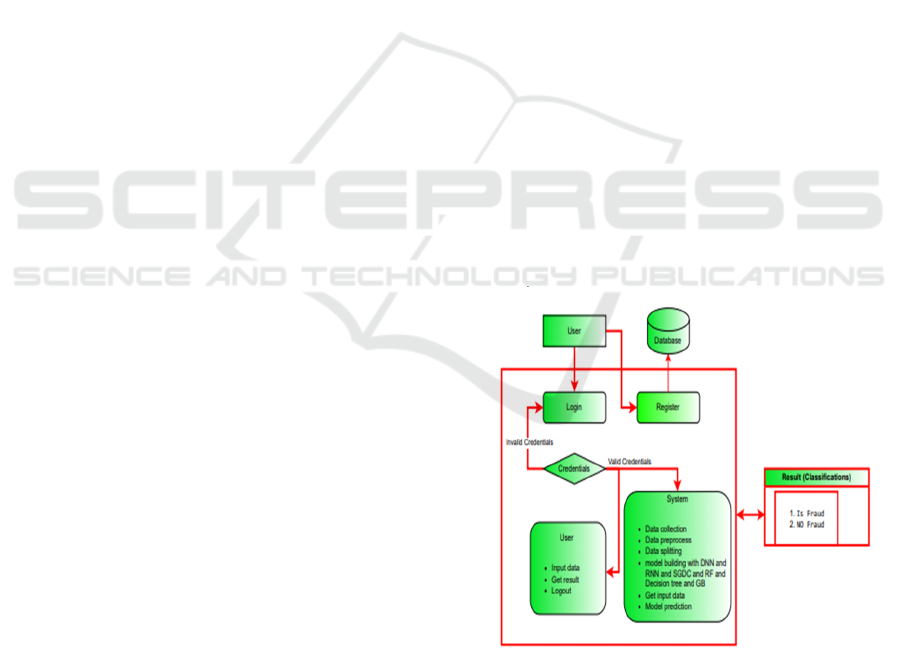
The architecture of the proposed UPI fraud detection
system is designed to efficiently analyze transaction
data, identify fraudulent patterns, and provide real-
time security measures. The system follows a
structured approach, starting with data collection and
preprocessing, where transaction data, including
amount, sender and receiver details, timestamps, and
transaction types, are gathered and cleaned to remove
inconsistencies. Feature engineering is then applied to
extract relevant attributes that contribute to fraud
detection.
Once the data is prepared, it is fed into multiple
ML models, including RF, DT, GBMs, and
XGBClassifier. Each model processes the input data
to identify anomalies and patterns indicative of
fraudulent activities. Random Forest, with its
ensemble of decision trees, enhances detection
accuracy by reducing overfitting, while Decision Tree
provides an interpretable decision-making
framework. GBMs and XGBClassifier further refine
predictions, capturing complex relationships and
improving classification precision.
The system integrates a real-time detection
module, which continuously monitors transactions
and flags suspicious activities. When a potentially
fraudulent transaction is detected, an alert mechanism
is triggered, notifying users and financial institutions
for further action. Additionally, the model undergoes
continuous training and updating to adapt to emerging
fraud techniques, ensuring long-term effectiveness.
Figure 1 architecture ensures a robust, scalable, and
adaptive fraud detection system, providing enhanced
security for UPI transactions.
Figure 1. Proposed architecture.
ICRDICCT‘25 2025 - INTERNATIONAL CONFERENCE ON RESEARCH AND DEVELOPMENT IN INFORMATION,
COMMUNICATION, AND COMPUTING TECHNOLOGIES
422

4 IMPLEMENTATIONS
4.1 Modules
The UPI Fraud Detection System is able to identify
and stop fraudulent transactions because to its many
key components. System primary components:
a) Data Collection and Preprocessing: This
module gathers transaction data, including
sender and receiver details, transaction
amount, timestamps, and payment methods.
The data is then cleaned, removing
duplicates and handling missing values to
ensure accurate model training.
b) Feature Engineering: In this module,
relevant features are extracted and
transformed to improve fraud detection
accuracy. Key features include transaction
frequency, average transaction amount, and
user behavior patterns, which help in
distinguishing fraudulent activities from
legitimate ones.
c) Machine Learning Model Training: The
system trains multiple ML models RF, DT,
GBMs, and XGBClassifier on historical
transaction data. These models learn fraud
patterns and classify transactions based on
their likelihood of being fraudulent.
d) Real-Time Fraud Detection: This module
applies trained models to live transactions,
analyzing them in real-time. If a transaction
is flagged as suspicious, an alert is triggered
for further verification.
e) Alert and Notification System: When
fraudulent activity is detected, the system
sends alerts to the user and financial
institutions, enabling immediate action to
prevent losses.
f) Model Update and Continuous Learning:
Fraud patterns evolve over time, so this
module updates the machine learning
models with new transaction data, ensuring
they remain effective against emerging fraud
techniques.
4.2 Algorithms
The UPI Fraud Detection System utilizes multiple
machine learning algorithms to enhance fraud
detection accuracy and efficiency. The key
algorithms used in the system are:
a) Decision Tree: This algorithm classifies
transactions based on feature importance by
creating a tree-like structure of decisions. It
is easy to interpret but may overfit on
complex datasets.
An algorithm that uses decision trees is
called a random forest. As a decision-
support tool, a decision tree resembles a tree.
Gaining familiarity with decision trees can
facilitate comprehension of random forest
techniques.
Nodes at the decision, leaf, and root levels
make up decision trees. The training dataset
is partitioned into additional branches using
a decision tree approach. At a leaf node, the
series terminates. There is no differentiation
at the leaf node.
Nodes in a decision tree represent
characteristics that are utilised to make
predictions. Decided nodes link leaves. The
following diagram shows the three types of
nodes in a decision tree.
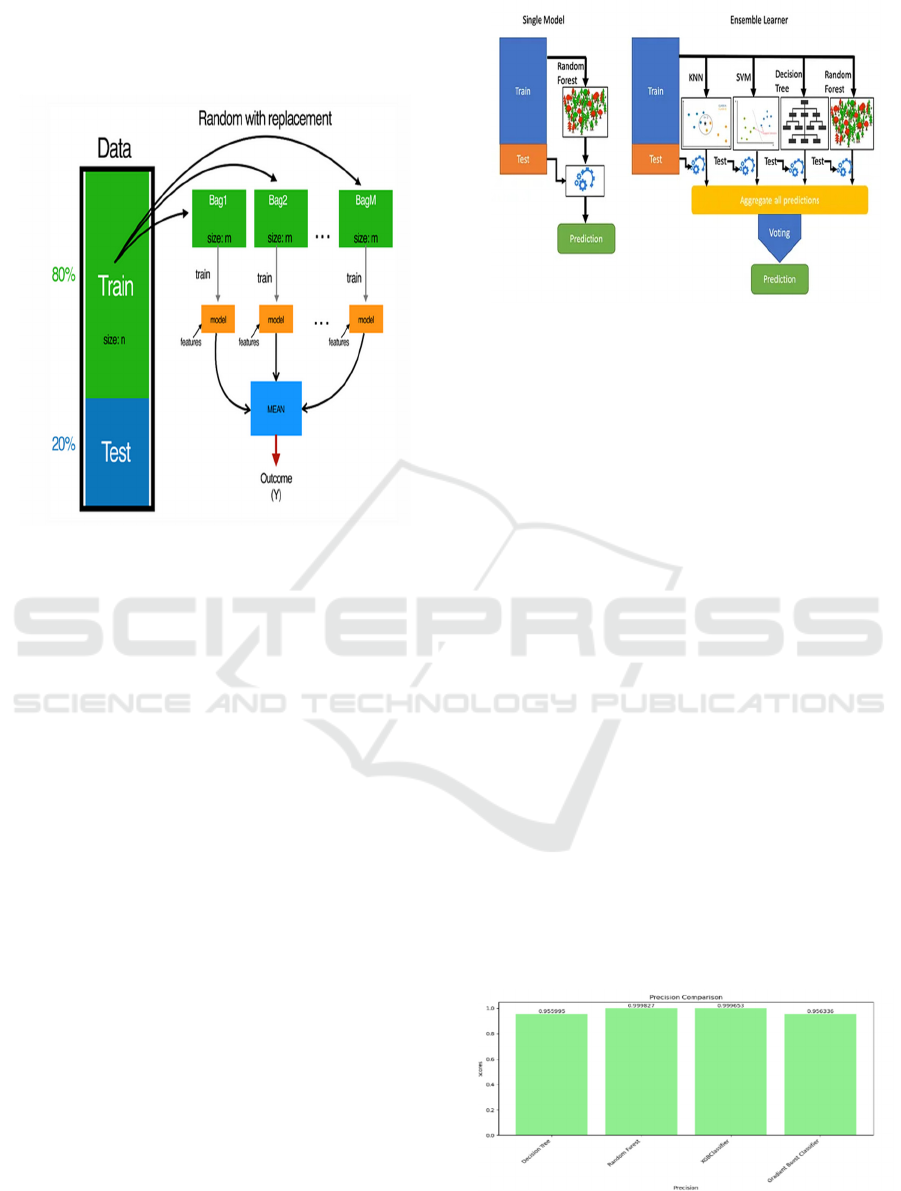
b) Random Forest: When it comes to
regression and classification problems,
machine learning employs random forests.
In ensemble learning, many classifiers are
used to tackle complex problems as shown
in figure 2.
An array of decision trees is employed by a
random forest approach. The 'forest' that the
random forest approach uses to train is
accomplished by bagging or bootstrap
aggregation. Machine learning accuracy is
improved by using the ensemble meta-
algorithm bag.
The outcome is determined by the decision
tree projections using the random forest
approach. It averages the output of trees to
make predictions. When there are more
trees, the results are more accurate.
Decision trees are limited, whereas random
forests are not. This lessens the likelihood of
dataset overfitting and increases accuracy.
Like Scikit-learn, it generates predictions
without requiring a plethora of package
options.
Features of a Random Forest Algorithm:
Better at managing missing data and
more accurate than decision tree
algorithms.
It is possible to make accurate
predictions without adjusting the
hyperparameters.
Addresses problems with decision tree
overfitting.
Unified Payments Interface Fraud Detection Using Machine Learning
423
The splitting point of each node in a
random forest tree is used to randomly
choose a subset of attributes.
Figure 2: Random forest process.
c) Gradient Boosting Machines (GBMs): A
boosting technique that improves prediction
performance by combining weak learners
sequentially. It captures complex, non-linear
fraud patterns and enhances classification
precision.
d) XGBClassifier (Extreme Gradient
Boosting): Improving GBM performance on
massive datasets in terms of speed,
scalability, and efficiency. For real-time
fraud detection, regularisation is ideal since
it manages missing data and reduces
overfitting.
XGBoost is a scalable machine learning
system that uses distributed gradient-
boosted decision trees (GBDTs). With
parallel tree boosting, it is the best machine
learning software for ranking, classification,
and regression.
A solid grasp of supervised ML, decision
trees, ensemble ML, and gradient boosting is
necessary for fully grasping XGBoost.
Through the use of algorithms, supervised
machine learning trains a model to recognise
patterns in a dataset that already contains
labels and features, and then uses that model
to predict labels for new features as shown
in figure 3.
Figure 3. XGoost.
5 EXPERIMENTAL RESULTS
The UPI Fraud Detection System was tested on a
dataset containing real and fraudulent transactions to
evaluate its effectiveness. The system was trained
using Decision Tree, Random Forest, GBMs, and
XGBClassifier, and performance metrics such as
accuracy, precision, recall, and F1-score were
analyzed. Among the models, XGBClassifier
demonstrated the highest accuracy due to its efficient
handling of missing values and overfitting prevention
techniques. Random Forest provided robust fraud
detection with reduced false positives, while GBMs
effectively captured complex fraud patterns. The
system successfully detected fraudulent transactions
with high precision and recall, minimizing false
alarms while ensuring security. These results confirm
that the proposed multi-algorithm approach
significantly enhances fraud detection accuracy, real-
time processing, and adaptability to emerging fraud
trends in UPI transactions.
i) Precision: Accuracy is measured by precision
when it comes to positively classifying instances or
samples. The correctness formula is:
𝑃𝑟𝑒𝑐𝑖𝑠𝑖𝑜𝑛 𝑇𝑃 / 𝑇𝑃 𝐹𝑃 (1)
Figure 4: Precision comparison graph.
ICRDICCT‘25 2025 - INTERNATIONAL CONFERENCE ON RESEARCH AND DEVELOPMENT IN INFORMATION,
COMMUNICATION, AND COMPUTING TECHNOLOGIES
424

ii) Recall: The ability of a model to identify all
important instances of a class is measured by its
machine learning recall. To determine if a model
successfully captures class instances, we compare the
total number of positive observations to the number
of ones that were accurately predicted.
𝑅𝑒𝑐𝑎𝑙𝑙 𝑇𝑃 / 𝑇𝑃 𝐹𝑁
(2)
Figure 5: Recall comparison graph.
iii) Accuracy: The accuracy of a model can be
measured by looking at the percentage of valid
classification predictions.
𝐴𝑐𝑐𝑢𝑟𝑎𝑐𝑦 𝑇𝑃 𝑇𝑁 / 𝑇𝑃 𝑇𝑁 𝐹𝑃
𝐹𝑁
(3)
Figure 6: Accuracy graph.
iv) F1 Score: Use the F1 Score, a harmonic
mean of recall and accuracy, to equalise false
positives and negatives if your dataset is not uniform.
𝐹1 𝑆𝑐𝑜𝑟𝑒 2 𝑃𝑟𝑒𝑐𝑖𝑠𝑖𝑜𝑛 𝑅𝑒𝑐𝑎𝑙𝑙 /
𝑃𝑟𝑒𝑐𝑖𝑠𝑖𝑜𝑛 𝑅𝑒𝑐𝑎𝑙𝑙
(4)
Figure 7: F1 Score.
Figure 4 shows the precision comparison, Figure 5
shows the recall comparison, Figure 6 shows the
accuracy graph and figure 7 shows the F1 score.
6 CONCLUSIONS
By fixing problems with privacy and openness,
Federated Learning (FL) and Explainable AI (XAI)
revolutionise the identification of financial crime.
Model interpretability and performance are enhanced
compared to prior approaches by XGBClassifier,
Random Forest, Decision Trees, and Gradient
Boosting Machines (GBMs).
Financial organisations can better understand the
classification results provided by Random Forest
and Decision Trees, while XGBClassifier and
GBMs are able to capture complex patterns for
improved fraud detection. By eliminating the need
to share sensitive financial data, Federated Learning
(FL) enables decentralized model training.
This two-pronged approach makes the framework
more private and transparent while also enhancing
fraud detection. The findings demonstrate that
financial fraud detection systems may be enhanced by
combining XAI with FL, all while maintaining
privacy requirements. A more stable and accountable
financial system may be the result of this paradigm
shift.
7 FUTURE SCOPE
More accurate, interpretable, and private fraud
detection systems are available for future usage. To
enhance the accuracy of fraud detection, it is
recommended to combine XGBClassifier with other
Unified Payments Interface Fraud Detection Using Machine Learning
425

hybrid models such as DT, RF, and GBMs.
Transformer models and other deep learning
architectures have the potential to detect intricate
fraud patterns.
FL frameworks that have their communication
strategies fine-tuned can improve the efficiency and
accuracy of models used by financial organisations
while keeping customer data private.
By using differentiated privacy techniques,
sensitive financial data may be protected in FL,
reducing the risk of data leakage and making fraud
detection easier.
With the use of streaming data and adaptive
learning algorithms, fraud may be detected and
prevented in real-time, reducing reaction time and
financial losses. It is possible to improve the scalable
and fast XGBClassifier and GBMs for use in real-
time scenarios.
REFERENCES
UKFinance. (2022). Annual Fraud Report 2022. [Online].
Available: https://www.ukfinance.org.uk/policy-and-
guidance/reports-andpublications/annual-fraud-report-
2022
A. Abdallah, M. A. Maarof, and A. Zainal, ‘‘Fraud
detection system: A survey,’’ J. Netw. Comput. Appl.,
vol. 68, pp. 90–113, Jun. 2016.
A. Pascual, K. Marchini, and S. Miller. (2017). 2017
Identity Fraud: Securing the Connected Life. Javelin.
[Online]. Available: http://www.
javelinstrategy.com/coverage-area/2017-identity-fraud
S. Bhattacharyya, S. Jha, K. Tharakunnel, and J. C.
Westland, ‘‘Data mining for credit card fraud: A
comparative study,’’ Decis. Support Syst., vol. 50, no.
3, pp. 602–613, Feb. 2011
L. T. Rajesh, T. Das, R. M. Shukla, and S. Sengupta, ‘‘Give
and take: Federated transfer learning for industrial IoT
network intrusion detection,’’ 2023, arXiv:2310.07354.
S. Vyas, A. N. Patra, and R. M. Shukla, ‘‘Histopathological
image classification and vulnerability analysis using ,’’
2023, arXiv:2306.05980.
R. J. Bolton and D. J. Hand, ‘‘Statistical fraud detection: A
review,’’ Stat. Sci., vol. 17, no. 3, pp. 235–255, Aug.
2002.
H. van Driel, ‘‘Financial fraud, scandals, and regulation: A
conceptual framework and literature review,’’ Bus.
Hist., vol. 61, no. 8, pp. 1259–1299, Nov. 2019.
G. M. Trompeter, T. D. Carpenter, N. Desai, K. L. Jones,
and R. A. Riley, ‘‘A synthesis of fraud-related
research,’’ AUDITING, A J. Pract. Theory, vol. 32, no.
Supplement 1, pp. 287–321, May 2013.
P. Raghavan and N. E. Gayar, ‘‘Fraud detection using
machine learning and deep learning,’’ in Proc. Int.
Conf. Comput. Intell. Knowl. Economy (ICCIKE), Dec.
2019, pp. 334–339.
M. Zareapoor and P. Shamsolmoali, ‘‘Application of credit
card fraud detection: Based on bagging ensemble
classifier,’’ Proc. Comput. Sci., vol. 48, pp. 679–685,
2015.
ICRDICCT‘25 2025 - INTERNATIONAL CONFERENCE ON RESEARCH AND DEVELOPMENT IN INFORMATION,
COMMUNICATION, AND COMPUTING TECHNOLOGIES
426
