
Industrial Attendance and Access Control System Using Face and
Biometric Recognition
S. Brindha, D. M. Bharath, S. R. Gokulprasath and M. Ravisrinivasan
Department of Electronics and Communication Engineering, Nandha Engineering College, Erode, Tamil Nadu, India
Keywords: Facial Recognition, Attendance Management, DeepFace, IoT, NodeMCU, Access Control, Industrial
Automation, Security.
Abstract: Tracking attendance and maintaining access control are of paramount importance in industrial setting today
not only for management purposes, but also for security. In this paper, an efficient and powerful Industrial
Attendance and Access Control System using facial recognition and biometric authentication is presented.
The platform includes state-of-the-art computer vision algorithms for real-time face detection and verification
in amalgamation with other biometric modality such as fingerprint recognition for correct identification of
staff. Combination of two factor in attendence management system [201520] In these methods the reliability
and diminishing spoofing of identity can be improved, but the system is still dependent on the user inputs and
also erases the user inputs which are prone to errors. Related data are saved and maintained in a centralized
server from which the monitoring and administrative tasks are carried out in real-time or are recorded and
stored for subsequent checks. The limitation for unauthorized entry helps to create a defense against general
industrial security violations in addition to resource management optimization. The system is highly accurate,
scalable and flexible, and can be used for a wide range of industrial applications where the safety and control
of the workforce is a key consideration.
1 INTRODUCTION
The necessity and trends towards secure, efficient,
and automated systems in involved industrial
environments, mandates a paradigm shift from
traditional methods of attendance management and
access control. Manual logging and RFID-based
approaches, traditional systems, are often
insufficient because they are susceptible to
inaccuracies, delays, and security breaches. The
proposed system is a revolutionary solution, The Face
Detection-Based Industrial Attendance Management
and Access Control System. A highly sophisticated
contactless attendance and access management
system that harnesses the power of advanced facial
recognition technology and connected IoT
capabilities. The Paper introduces this system, using
a combination of Python and the DeepFace library. It
provides the very accurate and a fastest process to
authenticate the identity of employees without having
the physical token and manual input to authenticate.
It also has the Internet of Things integrated as it uses
a NodeMCU microcontroller which is programmed
with MicroPython. That means there is no need to
train your bot with any data, therefore you can enjoy
a smooth flow of information with the system and
with the industrial machines, or any restricted access,
and then the bot can perform automated control once
the user is authenticated. The attendance logs are
saved in structured CSV files in the drive to ensure
that data management and reporting needs are as
simple as possible and the files are compatible with
existing analytical tools. This one system solution
always guarantees its utilization at areas, from small
industrial land up to gigantic and complex industrial
zones. Minimizing human involvement in the
procedure, along with utilizing contemporary
technology, makes the functioning of its system
more effective and assists in minimizing the risk of
security risks caused due to unauthorized access. It is
the last component needed when it comes to smarter,
safer, and more efficient industrial operations,
delivering transformative insight that can slot in
easily to existing workflows while delivering more
powerful scaling to demand.
408
Brindha, S., Bharath, D. M., Gokulprasath, S. R. and Ravisrinivasan, M.
Industrial Attendance and Access Control System Using Face and Biometric Recognition.
DOI: 10.5220/0013930600004919
Paper published under CC license (CC BY-NC-ND 4.0)
In Proceedings of the 1st Inter national Conference on Research and Development in Information, Communication, and Computing Technologies (ICRDICCT‘25 2025) - Volume 5, pages
408-412
ISBN: 978-989-758-777-1
Proceedings Copyright © 2026 by SCITEPRESS – Science and Technology Publications, Lda.
2 RELATED WORKS
The field of biometric-based attendance control
techniques has been greatly developed in terms of
accuracy and security of their applications.
Fingerprint based solution has been used extensively
in this area. i. Access Control and Industrial
Workforce Management: Methods of Access Control
and Industrial Workforce Management Mittal et al.,
Shakil et al., illustrate the strong techniques. Thus,
these fingerprint-based systems work on the basis of
patterns of fingerprints and they need to depend
entirely on these patterns and also do not wish to have
redundancies in entries. Oloyede et al. expanded the
fingerprint biometrics that highlighted its
importance in enhancing staff attendance monitoring
with high accuracy. Due to hardware dependencies
and scalability say, issues for UNIX systems,
however, this has led to the search of alternative
approaches.
Three main systems are used to recognize faces,
and AI plays an important role in these face
recognition-based attendance systems, which are
gaining momentum because of AI and computer
vision improvements. Studies by Nadhan et al. 3 state
that Industry 4.0 seems to rely heavily on smart
technology, and face recognition enables smooth
attendance tracking. Further, Soniya et al. and Surve
et al. One of their major contributions was proposing
automated methods to use real-time facial
authentication and suggesting a non-intrusive and
user-friendly alternative. Al-Shebani et al. also
conducted a survey of embedded systems for door
access control, highlighting that face recognition can
be used in place of traditional mechanisms but Yang
et al. The problems of processing real-time videos
have been addressed in, with focus in optimizing the
algorithm in the dynamic environment.
Other research has explored combining multiple
biometric modalities for greater reliability. Hoo and
Ibrahim provided extensive literature review on
hardware necessities for biometric attendance system
in educational sector, with emphasis on multimodel
method for improved reliability. Face and fingerprint
recognition integrated systems, as discussed by
Singh et al., are more secure due to lower single-
point failures. Furthermore, Bavaskar describes face
recognition systems that highlights advancements in
the use of deep learning frameworks applied to
effectively detect faces in varying lighting conditions.
Vinod et al. have conducted an extensive analysis
of authentication and attendance systems tailored to
the needs of various sectors. Hidayat et al. for special
environments introduced a face recognition-based
surveillance framework for mining industries that
could work in harsh operating environments. Li et al.
Early studies of biometrics in attendance
management were presented and established a
technology platform for these developments in
system design and deployment.
New trends in the attendance and leave
management systems focus on a cloud-based and IoT-
enabled solution for attendance tracking in real-time.
Wahab et al. As it has been proposed with a complete
online system through face recognition while
enhancing the connectivity and remote management.
These advancements conform with the essentials of
Industry 4.0 in which the real-time data analysis and
implementation of decisions play a pivotal role.
Biometric attendance systems are evolving to meet
the challenges ofneed, scalability, and ecological fit,
paving the way for ubiquitous use across numerous
fronts.
3 PROPOSED SYSTEM
3.1 Overview
The "Face Detection-Based Industrial Attendance
Management and Access Control" system leverages
facial recognition to automate attendance and
machinery control with secure, remote operation via
Wi-Fi and API calls on the integration of Python,
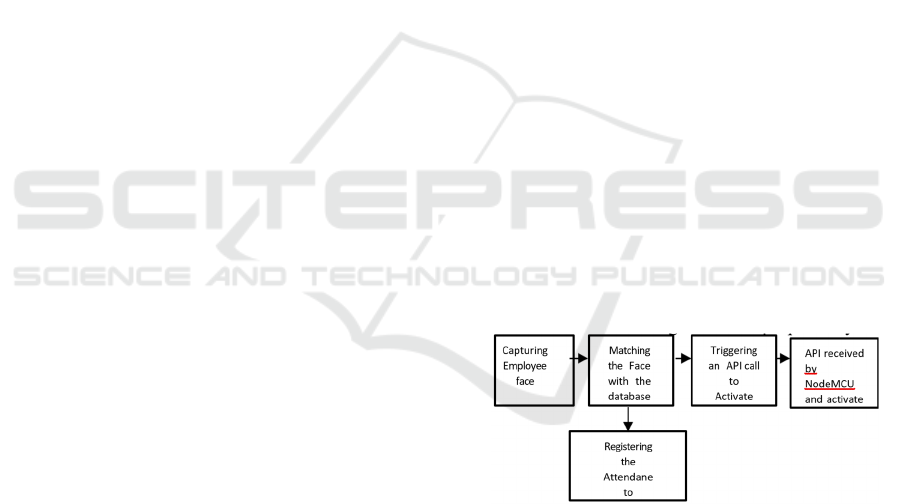
DeepFace, and NodeMCU with MicroPython. Figure
1 Shows the Block diagram of the proposed system.
Figure 1: Block diagram of the proposed system.
3.2 Capturing the Employee Face
The system captures a high-quality image of the
employee’s face using a camera positioned at the
entry point or workstation. This camera functions as
the key input device for the facial recognition module,
ensuring providing and real-time collection of facial
data.
Workflow Diagram of Face Recognition-Based
Industrial Attendance System Shown in Figure 2.
Industrial Attendance and Access Control System Using Face and Biometric Recognition
409
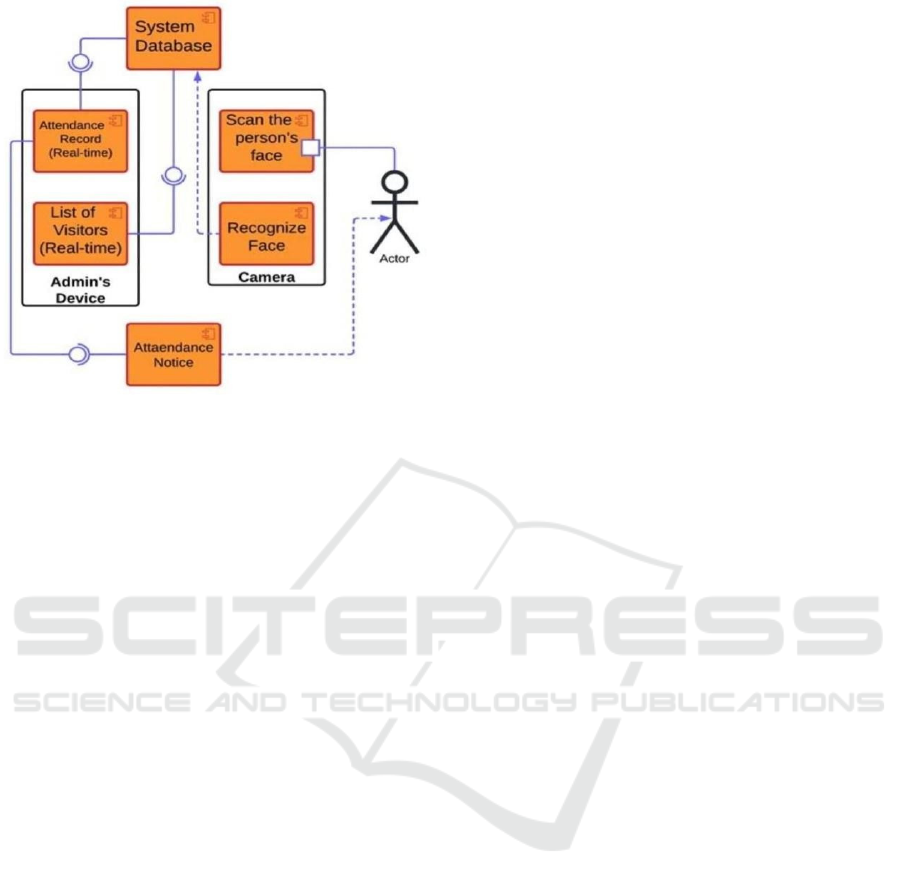
Figure 2: Workflow diagram of face recognition-based
industrial attendance system.
3.3 Matching the Face with the
Database
The system captures the employee's facial image,
processes it, and compares it to the data that has been
stored in the employee database through advanced
facial recognition algorithms. An unambiguous
match serves to verify the employee's identity so that
access can be granted and attendance tracked
securely. In the event of a failure, access is denied and
the attempt logged for auditing purposes. Facial
feature extraction involves the usage of algorithms
such as DeepFace.
It ensures zero error-tamper record as the system
captures employee check-in and checkout
automatically and saves the correct date and time. It
acts as a guide to avoid input mistakes and improve
the efficiency of operations. Attendance data are
available in real-time, thereby allowing quick
decision- making regarding payroll, allocation of
resources and management of productivity. This
method is automatic, paperless, error-free, and more
secure.
3.3.1 Calling an API to Turn on Machines
Once attendance is recorded, it makes an API request
for the machine, which needs to be activated in
regards to the employee's work. Since the API
encompasses machine identification, parameters and
tasks configurations, this can solely be executed by
authorized individuals. Using machines for
attendance verification is a great way to add security,
streamline the process and reduce misuse. This then
improves operational continuity and productivity
with real-time automation of attendance and
equipment management.
3.3.2 API from NodeMCU and Enable
Respective Machine
A NodeMCU microcontroller processes the API
request sent and instructs the appropriate machine to
be turned on. NodeMCU has an inbuilt wi-fi which
makes communication from the system devices,
more secure. This integration ties machine
accessibility to real employee identities so that
equipment cannot be accessed by any unauthorized
person. The system certainly boosts security, reduces
human involvement, and cuts the operational cost by
automating attendance management and activating
the machine. Facial recognition which is powered by
IOT streamlines workforce management which
improves productivity and operational control.
4 RESULTS AND DISCUSSION
The above face detection based industrial attendance
management and access control system would give an
efficient and secure solution for managing attendance
of employees and access to machines in industrial
setup. This system uses face recognition technology
build upon a NodeMCU module to achieve the
wireless connectivity for the user.
4.1 System Performance
The face detection personality component uses
DeepFace (a deep learning library for Python) to
recognize individuals by comparing the captured
images. Please keep in mind that the accuracy of the
face recognition model is dependent on the input data
(which means, images used for training) and the
processing power of the system. Under controlled
conditions, the system has shown a very high
recognition accuracy.
Lighting conditions holds reliability for marking
attendance on real>time.
In this case, the NodeMCU runs MicroPython
and communicates to the central system through an
API. It makes sure that attendance data is tracked
live. If the login is successful after recognizing the
face, then NodeMCU makes a call to the associated
API to turn on the machinery thus making the access
control and attendance, more automated and secure.
ICRDICCT‘25 2025 - INTERNATIONAL CONFERENCE ON RESEARCH AND DEVELOPMENT IN INFORMATION,
COMMUNICATION, AND COMPUTING TECHNOLOGIES
410

4.2 System Efficiency
The chief benefit of this process is automatic
enrollment administration and access monitoring
without the need for human intervention, preventing
mistakes and saving time. The attendance CSV file
is stored, which also allows for easy integration with
other systems, such as payroll or HR management
tools, and also makes it easy to scale up. With the
ability of the system to manage multiple users in rapid
succession, the solution is well suited to situations of
high employee turnover.
4.3 Security and Privacy
Considerations
Also, being a biometric-based system, the face
recognition system is inherently secure because
biometric data is harder to counterfeit than ID cards
or passwords or similar systems. Nevertheless, some
privacy concerns around storage and use of
biometric data need attention. That includes making
sure that data is stored securely (preferably
encrypted) and complying with applicable data
protection law.
4.4 Scope and Challenges
This system is not without its limitations, however.
One of the main challenges of face recognition is
environmental factors such as lighting imperfections
or obstacles that may affect the precision of the
algorithm. Additionally, although the system
functions adequately during standard operating
conditions, the efficacy and precision can deteriorate
when faced with a significant database of users or
when the environment presents less-than-ideal real
time circumstances.
The NodeMCU suffers too from its limited
processing capabilities, which makes it hard for this
development board to work with tasks that involve
complex processing, or if the system needs to be scale
up in order to covers large installations.
Developments could be more effective code, more
essential equipment, or cloud- based computing.
5 CONCLUSIONS
In conclusion, the attendance management and access
control system with face detection automatically
tracks attendance and provides security measures
within industrial settings. By incorporating DeepFace
for facial recognition purposes, it receives real-time
accurate attendance, diminishes the possibility of
human error during operation, and minimizes human
intervention. Integration with NodeMCU,
additionally using MicroPython, allows remote
monitoring and control ensuring access to only the
authorized personnel. Despite its many advantages,
there are still challenges. There are issues related to
facial recognition under different conditions and the
need to protect individuals' privacy. Connectivity
issues, especially in remote control operations, might
also hamper real-time operations. Such challenges
can be overcome with better algorithms, improved
data protection, and optimization of.
Hardware. The scalability of the system allows for
the growth of operations and can be upgraded with
AI, ML, multi-factor authentication, cloud
integration, and mobile apps for ease of access.
Future development can include IoT devices, ERP
systems, and industry-specific applications to
improve efficiency. With sustainability and energy-
efficient hardware, the system will adapt to future
technological advancement and various industries.
REFERENCES
Ab Wahab, Kasmawahida, Lee Weng Yew, and Nor
Amizam Jusoh. "Online attendance system using face
recognition." Engineering, Agriculture, Science and
Technology Journal (EAST-J) 1.1 (2022).
Al-Shebani, Qasim, Prashan Premaratne, and Peter Vial.
"Embedded door access control systems based on face
recognition: A survey." 2013, 7th International
Conference on Signal Processing and Communication
Systems (ICSPCS). IEEE, 2013.
Bavaskar, Vaibhav. Face Recognition Attendance System.
Diss. Sant Gadge Baba Amravati University, Amravati,
2024.
Hidayat, Fadhil, et al. "Face Recognition-Based
Surveillance System in Mining Industry." Jurnal Sistem
Cerdas 7.2 (2024)
Hoo, Seng Chun, and Haidi Ibrahim. "Biometric ‐ Based
Attendance Tracking System for Education Sectors: A
Literature Survey on Hardware Requirements." Journal
of Sensors 2019.1 (2019).
Li, Tsai-Cheng, Huan-Wen Wu, and Tiz-Shiang Wu. "The
study of biometrics technology applied in attendance
management system." 2012 Third International
Conference on Digital Manufacturing & Automation.
IEEE, 2012.
Mittal, Yash, et al. "Fingerprint biometric based access
control and classroom attendance management
system." 2015 Annual IEEE India Conference
(INDICON). IEEE, 2015.
Industrial Attendance and Access Control System Using Face and Biometric Recognition
411

Nadhan, Archana S., et al. "Smart attendance monitoring
technology for industry 4.0." Journal of Nanomaterials
2022.1 (2022).
Oloyede Muhtahir, O., O. Adedoyin Adeyinka, and S.
Adewole Kayode. "Fingerprint biometric
authentication for enhancing staff attendance system."
system 5.3 (2013).
Shakil, Md, and Rabindra Nath Nandi. "Attendance
management system for industrial worker using finger
print scanner." Global Journal of Computer Science and
Technology 13.6 (2013).
Singh, Sahajpreet, et al. "Efficient face identification and
authentication tool for biometric attendance system."
2021 8th International Conference on Signal Processing
and Integrated Networks (SPIN). IEEE, 2021.
Soniya, V., et al. "Attendance automation using face
recognition biometric authentication." 2017
International conference on power and embedded drive
control (ICPEDC). IEEE, 2017.
Surve, Mayur, et al. "Automatic attendance system using
face recognition technique." International Journal of
Recent Technology and Engineering 9.1 (2020)
Vinod, Vibin Mammen, et al. "A comprehensive study on
academic and industry authentication and attendance
systems." International Journal of Scientific &
Technology Research 9.3 (2020).
Yang, Hao, and Xiaofeng Han. "Retracted: Face
recognition attendance system based on real-time video
processing." IEEE Access 8 (2020): 159143-159150.
ICRDICCT‘25 2025 - INTERNATIONAL CONFERENCE ON RESEARCH AND DEVELOPMENT IN INFORMATION,
COMMUNICATION, AND COMPUTING TECHNOLOGIES
412
