
Secure and Efficient Data Transmission in IoT: A Risc‑V Processor
with AES‑GCM and ECC Accelerator
B. Deepa, Sindu Priya Gude, P. Hari Priya, B. Rithesh,
P. Haswanth Reddy and T. Lakshmi Narayana Yadav
Department of ECE, Sri Venkateswara College of Engineering, Tirupati, Andhra Pradesh, India
Keywords: Internet of Things (IoT), RISC‑V Processor, AES‑GCM (Galois/Counter Mode), Elliptic Curve Cryptography
(ECC), Authenticated Encryption, Verilog HDL.
Abstract: Security and trust of data transmission between IoT equipment’s continues to be a major challenge in the
advancement of IoT technology. To resolve these issues, a low-power and low-cost RISC-V processor
optimized for IoT applications is presented in this paper. An Advanced Encryption Standard (AES) Encrypt
Accelerator is built into the processor to provide fast and secure transmission of data. AES being a symmetric
encryption standard makes a good trade-off between high-speed computing, secured encryption system and
key management simplicity, and is best suitable for resource-constraint IoT devices. The RISC-V processor
and the AES encryption accelerator are developed in the Verilog HDL and realized both on the Xilinx FPGA
platform and in ASIC technology. The presented processor and encryption accelerator are realized with
Verilog HDL under the guidelines of low power and area cost. The simulation results show that the proposed
architecture achieves higher security in encryption and better key management in terms of power and the
delay degradation is acceptable. This makes it an ideal solution for future IoT applications that need more
sophisticated data protection.
1 INTRODUCTION
The Internet of Things (IoT) which is expanding its
reach with such velocity has provided a revolutionary
leap to industries and everyday life providing a
continuous ability to communicate between devices
leading to new potentials in automation, monitoring
and controlling of devices. Instead, with IoT systems
now taking on sensitive and critical information, data
security and data transmission reliability have been
taking the spotlight as an unexpected concern.
Attacks on IoT devices and networks might result in
privacy violations, monetary damages and
operational disruptions. This should emphasize the
vital importance of strong, lightweight and secure
encryption techniques in IoT scenarios.
One of the key problems of securing the IoT is
that of finding a good trade-off between strong
encryption and resource consumption. IoT devices
tend to be power, processing, and cost-constrained.
This requires lightweight solutions that achieve high
level of security without consuming the scarce
resources within these devices. Symmetric algorithms
such as AES have effectively solved this problem by
providing a security level that is sound, run at high
speed and are easy to manage their keys.
In this work, we design and implement a RISC-V
based, low-power, low-cost processor with an
integrated AES accelerator. RISC-V architecture, for
its simplicity, scalability and open-source
characteristic, is also an excellent base for IoT
applications. The AES accelerator integrated with the
processor allows the system to process encryption
quickly without using extra hardware or software
resources, further increasing the performance of the
system and reducing the power consumption.
The processor and the encryption accelerator are
implemented in Verilog HDL, and verified using the
Xilinx FPGA platform. Prototyping with FPGAs
facilitates fast development, testing, and revising, all
the while providing insight into real-world
performance metrics such as resource utilization,
power usage, and encryption speed. And Last, we
performed ASIC implementation in order to evaluate
378
Deepa, B., Gude, S. P., Priya, P. H., Rithesh, B., Reddy, P. H. and Yadav, T. L. N.
Secure and Efficient Data Transmission in IoT: A Risc-V Processor with AES-GCM and ECC Accelerator.
DOI: 10.5220/0013930200004919
Paper published under CC license (CC BY-NC-ND 4.0)
In Proceedings of the 1st International Conference on Research and Development in Information, Communication, and Computing Technologies (ICRDICCT‘25 2025) - Volume 5, pages
378-386
ISBN: 978-989-758-777-1
Proceedings Copyright © 2026 by SCITEPRESS – Science and Technology Publications, Lda.

if the processor is suitable for a large-scale production
and an integration with IoT devices.
Simulation and test results show that the proposed
AES encryption accelerator improves the security
and reliability of data transmission for IoT devices.
The advantages of this architecture are that it
provides high-level speed on both encryption and key
management and that it consumes low power with
small amount of resources. This makes the candidate
approach a viable solution for future IoT applications
which require tight strong security and resource
constraints.
2 LITERATURE SURVEY
Muir, Count, Accountant’] ='Research on WLAN
Application of SM2, SM3&SM4 Algorithm in
Transformer Substation Wang Tong; Cui Wen Peng;
Li Tong; Wang Liang; Li Hao; Chi Ying Ying 2019
3rd International Conference on Electronic
Information Technology and Computer Engineering
(EITCE) ‘In the wave of the growth of artificial
intelligence (AI), intelligent terminal devices appear,
such as power system edge-computing intelligent
terminal. The new terminal with local decision of the
present invention can locally process the collected
data, meanwhile, only key information report is used
for reporting, which can also reduce the requirement
of network bandwidth, can make the existing wireless
communication more business scenarios meet the
demand. For the traditional substation, it requires a
high bandwidth of the network to gather the amount
of terminal data in time. Hub data not transferable via
wireless. The smart transformer substation can
transmit the wireless with the intelligent terminal
data. However, the IEEE802. 11ah, Lora, NBIoT
and Wifi is dynamic. Simultaneously, data is included
in social security, the same song of civilization that
is social development and progress. In the
characteristic of “security and controllability” for
information system, the China Cryptographic
Administration published SM2, SM3 and SM4 and
other encryption and decryption algorithms. In this
paper, we propose a framework for working over the
IEEE802. 11 ah standards, Considering the LAN
application of transformer substation, the
combination of the TSS in the LAN of SM2, SM3 and
SM4 We highlighted the identity authentication, the
key distribution and data encryption and decryption.
System scheme constructions are provided for the
three phases and we present the analysis of the
respectively security and system overhead. The
research of SM2, SM3, SM4 algorithm in
Transformer Substation LAN will further enhance
and implement the intelligent terminal of Substation,
and the intelligent level of substation.
Masked 128-bit AES in 22nm CMOS: area and
energy efficiency. Yuan-His, et al, 2019 AES is the
encryption standard. This popular is nothing but the
most popular scheme available for today for the
encryption in the hardware acting as the software.
AES is well protected against linear and differential
cryptanalysis. It is in any case local side channel
attack secure with side channel algorithm depending
on how it is implemented. For instance, it is shown in
that the secret key can be recovered by measuring the
power of the implementation and statistically analyse
a few traces of the same implementation. In this
article, we present a high-performance hardware
design of 128-bit AES with DPA countermeasure.
And This fake-out design ships in TSMC 22nm. The
design is highly efficient, low power and small
silicon area. It will operate up to 400+Mhz properly
= 5.12Gbps. The overall footprint area of the AES
block is 0.0169 mm 2. Its power usage is 9.77pJ/bit
or 1.25nJ/block.
RISC-V MCU based on VLSI with multi-stage
pipelining. Mao-Hsu Yen, et al, 2023 Hoping to make
instruction scheduling more efficient by further
studying the scheduling of instructions for
minimizing the latency, which is of use to the
RV32IM Instruction Set Architecture (ISA) of RISC-
V and the design of variable-length pipeline. and the
in-order dispatch, out-of-order writeback are used in
the MCU. Since the processing times of the MCU
instructions are not uniform, it yields too high
average processing time for the long instructions in
case a 5-stage pipeline is applied uniformly to the
design. According with that, we also introduced a
flexible-pipeline design based on the Hummingbird
E200 architecture, to allow the MCU to select a
different pipeline length at the time of operation of
each instruction. Through the dispatch method of the
proposed pipeline structure, instructions were no
longer required to operate at every stage of the
pipeline that did not concern them, hence speeding up
the instruction completion time. For the pipeline
structure design, we use the multiplication/the
division is realized in the execution stage of 27 MCU
(Each pipeline stage completed in the shorter time the
pipeline may be broken). Was this OOWB model
(under proposed MCU) is one which followed the
out-of-order write-back scheme of allowing the
instructions, which had a single data dependency (i.e.
whatever is to be written by them), they could then be
written-back in order without waiting for each other
and the system throughput got a boost. The proposed
Secure and Efficient Data Transmission in IoT: A Risc-V Processor with AES-GCM and ECC Accelerator
379

new architecture was in fact implemented in this LSI
with TSMC's 0.18 μ m process by implementing a
“pipeline” and “out-of-order writeback”
architecture. And its operating clock speed was 120
MHz. The Hummingbird E200 was clocked at
50MHz on the same 0.18 μm process.
Preliminary version submitted to 5th Workshop
on Computer Arithmetic and Formal Proofs. Duc-
Hung Le, et al, 2022 In this paper we show that a 32-
bit RISC-V processor with embedded crypto
processors, with Linux number compatibility, can be
implemented on a FPGA using just Spinal HDL and
Verilog HDL as hardware construction languages.
References Liu, M., Wang, H., & Li, X. (2021).
"Lightweight Cryptography in Internet of Things: A
Survey. –V. The LiteX core and its Spinal HDL are a
paired twin in the design chain. the CPU core was
designed by Spinal HDL, Hamedzavareh, N., Gara,
M. F., & Monadjemi, S. A. (2020). RISC-V: The Free
and Open RISC Instruction Set Architecture. ACM
Computing Surveys. for IP and CPU core
integration. After the high-level structure was
prepared, 32-bit RISC-V architecture was
implemented and verilog source code generation was
done. Akinyele, J. A., Garman, C., Pagano, M. W., &
Green, M."A performance analysis of ECIES on a
smart phone". IEEE Trans Computer. The
architecture was targeted for the Nexys4DDR board
of FPGA, and for 65nm CMOS ASICs running at
50MHz. Biryukov, A., Dinu, D., & Khovratovich, D.
(2017). “Fast and secure authenticated encryption:
AEAD modes for the memory constrainedizing.
[SI14] Iwan Duursma, A. Lenstra, and M. Selçuk.
www. iacr. org/2014. It leveraged V erilog HDL
based hardware accelerators that are carriers of
specialized assembly instructions for straightforward
classic cryptographic algorithms such as those.
"Implementation and Approaches for the Security of
IoT Devices using AES-GCM-A Literature Review".
IEEE Access. The SHA-1; AES-128 and RSA-2048
cores. It was tested the operation of the accelerators
under Linux system with OpenSSL and LibreSSL
libraries modified for modulus p. Menezes, A., Van
Oorschot, P., & Vanstone, S. (1996). Handbook of
Applied Cryptography. \" CRC Press.
3 PROPOSED SYSTEM
The AES Encryption Accelerator (ASE) is an
integrated intellectual property (IP) core for
accelerating cryptographic operations (encryption
and decryption) related to the AES algorithm. By
relieving the computation burden of AES on the host
CPU, the ASE accelerators greatly improve
performance, particularly in high-throughput and
low-latency applications. The ASE accelerators also
can handle multiple AES key sizes (128, 192, and
256 bits) and modes of operation, including ECB,
CBC, and GCM, for secure data transmission in
applications ranging from IoT to embedded. The
main reason for that is to process encrypting things
quickly if you need to handle lots of data, as they can
parallel process aes tasks. This parallelism is vital for
performance- and power-constrained systems, such
as IoT devices, in which resources are limited.
Furthermore, the accelerator is able to produce the
authentication tag (for AES-GCM), which allows
both the confidentiality and integrity of the data to be
preserved so that communication is secure end-to-
end. Devices now can offer the performance and
security customers require, while also providing a fast
and efficient computing environment, all thanks to
the inclusion of an AES encryption accelerator within
the system architecture.
The below Figure 1 represents the Encryption and
Decryption process of hybrid system using AES:
Figure 1: Hybrid ECC-AES framework for secure cloud
data transmission and storage.
4 EXISTING SYSTEM
SM3 Algorithm
Algorithm description
4.1 Overview
For a given message m (length l, l < 2128 bits), the
hash value after padding and iterative compression is
256 bits.
ICRDICCT‘25 2025 - INTERNATIONAL CONFERENCE ON RESEARCH AND DEVELOPMENT IN INFORMATION,
COMMUNICATION, AND COMPUTING TECHNOLOGIES
380

4.2 Padding
Assume a message has l bits. Suffix 1 by k bits 0[k−0]
1 k 448 mod 512. Then append a bit string b such that
b represents an l-bit binary number. The length of the
new message m′After padding is a multiple of 512.
4.3 Iterative Compression
4.3.1 Iteration Procedure
The padded message m′ is split into 512-bit blocks,
and denoted as m’ = B
(0)
B
(1)
…B
(n-1)
Where n = (l
+k+65)/512. The iteration procedure form′ is as
follows:
FOR i=0 to n-1
V(i+1) = CF(V(i), B(i))
ENDFOR
Here, CF is the compression function, V
(0)
is the 256-
bit IV, and B
(i)
is the i-th message block after padding.
The result after iterative procedure is V
(n)
.
4.3.2 Message Expansion
The message block B
(i)
is expanded to 132 words W
0,
W1
, W
67
, W
1
’, W’
63
, which are applied to compression
function CF:
a. Split message block B
(i)
into 16 words W
0, W1
, W
15
.
b. FOR j=16 TO 67
W
j
←P
1
(W
j-16
⊕ W
j-9
⊕( W
j-3
<<< 15)) ⊕ (W
j-13
<<<
7) ⊕ W
j-6
ENDFOR
c. FOR j= 0 TO 63
W
j
= W
j
⊕ W
j+4
ENDFOR
4.3.3 Compression Function
Let A, B, C, D, E, F, G, H be eight-word registers,
SS1, SS2, TT1, TT2 be four intermediate variables,
and the compression function V
(i+1)
= CF(V
(i)
, B
(i)
) (0
≤ i ≤ n-1)
The computation procedure is described as following:
ABCDEFGH ← V(i)
FOR j= 0 TO 63
SS1 ← ((A<<<12) + E + (T
j
<<< (j mod
32))) <<< 7
SS2 ← SS1 ⊕ (A<<<12)
TT1 ← FF
j
(A, B, C) + D + SS2 + W
j
TT2 ← GG
j
(E, F, G) + H + SS1 + W
j
D ← C
C ← B<<<9
B ← A
A ← TT1
H ← G
G ← F <<< 19
F ← E
E ← P
0
(TT2)
ENDFOR
V(i+1) ← ABCDEFGH ⊕ V(i)
Here, a word is stored in big-endian format.
4.3.4 Hash Value
ABCDEFGH ← V
(n)
Output a 256-bit hash value: y = ABCDEFGH
SM4 Algorithm:
SM4 works as a block cipher. Block size and key size
is both 128 bits. The unbalanced Feistel is adopted in
SM4, and the round functions of SM4 are equal to 32-
rounds in key expansion and encryption. A
decryption is a 2 encryption-like structure. BUT! the
encryption round keys are circulars of the decryption
ones.
Key and Key Parameters:
Written as a 128-bit key cipher key, 𝑀𝐾 = (𝑀𝐾0,
𝑀𝐾1, 𝑀𝐾2, 𝑀𝐾4), where 𝑀𝐾i = (𝑖 = 0,1,2,3) is a 32-
bit word.
The 32bit words are called round keys (r000, r001,
…, r041). The circular keys are computed from the
cipher key with the key expansion process.
The system parameter is 𝐹𝐾= (𝐹𝐾0, 𝐹𝐾1, 𝐹𝐾2, 𝐹𝐾3)
and the fixed parameter is 𝐶𝐾= (𝐶𝐾0, 𝐶𝐾1, …, 𝐶𝐾0_
{31}), here 𝐹𝐾i (𝑖 = 0,1,2,3) and 𝐶𝐾i (𝑖 = 0, …,31)
are the 32-bit words used in the key expansion
algorithm.
Round Function 𝑭
Round Function Structure
Suppose the input to round function is (𝑋
0
, 𝑋
1
, 𝑋
2
, 𝑋
4
)
∈ (𝑍
2
42
)
C
and the round key is
𝑟𝑘 ∈ Z
2
42
, then 𝐹 can be represented as:
𝐹 𝑋
0
, 𝑋
1
, 𝑋
2
, 𝑋
4
, 𝑟𝑘 = 𝑋
0
⊕ 𝑇 (𝑋
1
⊕ 𝑋
2
⊕ 𝑋
4
⊕
𝑟𝑘).
Permutation
𝑻
𝑇: 𝑍
2
42
→ 𝑍
2
42
is an invertible transformation,
composed of a nonlinear transformation 𝜏 and a linear
transformation 𝐿. That is, 𝑇 (∙) = 𝐿 (𝜏 (∙)).
Nonlinear transformation 𝝉:
Secure and Efficient Data Transmission in IoT: A Risc-V Processor with AES-GCM and ECC Accelerator
381

𝜏 is composed of 4 S-boxes in parallel. Suppose 𝐴 =
(𝑎
0
, 𝑎
1
, 𝑎
2
, 𝑎
4
) ∈ (𝑍
M
2
)
C
is input to
𝜏, and 𝐵 = (𝑏
0
, 𝑏
1
, 𝑏
2
, 𝑏
4
) ∈ (𝑍
M
2
)
C
is the
corresponding output, then
(𝑏
0
, 𝑏
1
, 𝑏
2
, 𝑏
4
) = 𝜏 𝐴 = ( 𝑆𝑏𝑜𝑥 𝑎 0 , 𝑆𝑏𝑜𝑥 𝑎 1 ,
𝑆𝑏𝑜𝑥 𝑎2 , 𝑆𝑏𝑜𝑥 𝑎4 ).
The S-box is as follows:
Table 1 Shows the S-Box Substitution Table for AES
Encryption.
Linear transformation 𝑳:
The second layer 𝜏 and L take the input x from the
nonlinear transform and act as the linear transform,
respectively. If 𝐿 takes as input 𝐵 ∈ 𝑍242, then the
output is
𝐶 ∈ 𝑍
2
42
,
then
𝐶 = 𝐿 𝐵 = 𝐵 ⊕ (𝐵 <<< 2) ⊕ (𝐵 <<< 10) ⊕ (𝐵 <<<
18) ⊕ (𝐵 <<< 24).
Table 1: S-Box Substitution Table for AES Encryption.
x/y 0 1 2 3 4 5 6 7 8 9 A B C D E F
0 D6 90 E9 FE CC E1 3D B7 16 B6 14 C2 28 FB 2C 05
1 2B 67 9A 76 2A BE 04 C3 AA 44 13 26 49 86 06 99
2 9C 42 50 F4 91 EF 98 7A 33 54 0B 43 ED CF AC 62
3 E4 B3 1C A9 C9 08 E8 95 80 DF 94 FA 75 8F 3F A6
4 47 07 A7 FC F3 73 17 BA 83 59 3C 19 E6 85 4F A8
5 68 6B 81 B2 71 64 DA 8B F8 EB 0F 4B 70 56 9D 35
6 1E 24 0E 5E 63 58 D1 A2 25 22 7C 3B 01 21 78 87
7 D4 00 46 57 9F D3 27 52 4C 36 02 E7 A0 C4 C8 9E
8 EA BF 8A D2 40 C7 38 B5 A3 F7 F2 CE F9 61 15 A1
9 E0 AE 5D 34 14 5C A4 AD 93 32 30 F5 8C B1 E3 1A
A 1D F6 E2 82 66 CA 60 29 23 AB 0D 53 4E 6F D5 DB
B 37 45 DE FD 8E 2F 03 FF 6A 72 6D 6C 5B 51 8D 1B
C AF 92 BB DD BC 7F 11 D9 5C 41 1F 10 5A D8 0A C1
D 31 88 A5 CD 7B BD 2D 74 D0 12 B8 E5 B4 B0 89 69
E 97 4A 0C 96 77 7E 65 B9 F1 09 C5 6E C6 84 18 F0
F 7D EC 3A DC 4D 20 79 EE 5F 3E D7 CB 39 48
4.3.5 Algorithm Description
1 Encryption:The encryption algorithm first
iterates the round function 𝐹 for 32 times, and then
applies the reverse transformation 𝑅 in the end.
Suppose its input plaintext is (𝑋
0
, 𝑋
1
, 𝑋
2
, 𝑋
4
) ∈ (𝑍
2
42
)
C
, the corresponding output
ciphertext is (Y
0
, Y
1
, Y
2
, Y
4
) ∈ (𝑍
2
42
)
C
, and the round
keys are 𝑟𝑘
i
∈ 𝑍
2
42
, 𝑖 = 0,1, … ,31,
then the process of the encryption algorithm is as
follows:
(1)
32-round iterated operation: 𝑋
𝑖
UC
= 𝐹 𝑋
𝑖
, 𝑋
𝑖
U1
,
𝑋
𝑖
U2
, 𝑋
𝑖
U4
, 𝑟𝑘
𝑖
, 𝑖 = 0,1, … 31.
(2)
The reverse transformation:
ICRDICCT‘25 2025 - INTERNATIONAL CONFERENCE ON RESEARCH AND DEVELOPMENT IN INFORMATION,
COMMUNICATION, AND COMPUTING TECHNOLOGIES
382

(Y
0
, Y
1
, Y
2
, Y
4
) = 𝑅 𝑋
42
, 𝑋
44
, 𝑋
4C
, 𝑋
4V
= (𝑋
4V
, 𝑋
4C
,
𝑋
44
, 𝑋
42
.
2 Decryption: The structure of the decryption
transformation is the same as the encryption
transformation. The only difference is the order of
the round keys. In decryption, the round keys are
used in the order of (𝑟𝑘
41
, 𝑟𝑘
40
, …, 𝑟𝑘
0
).
3 Key Expansion:
The round keys in this
algorithm are generated from the cipher key via the
key expansion algorithm.
Suppose the cipher key is 𝑀𝐾 = (𝑀𝐾
0
, 𝑀𝐾
1
, 𝑀𝐾
2
,
𝑀𝐾
4
) ∈ (𝑍
2
42
)
C
, then the round keys
are generated as follows:
Table 2 Shows the Sample AES Encrypted
Hexadecimal Blocks.
(𝐾
0
, 𝐾
1
, 𝐾
2
, 𝐾
4
) = (𝑀𝐾
0
⊕ 𝐹𝐾
0
, 𝑀𝐾
1
⊕ 𝐹𝐾
1
, 𝑀𝐾
2
⊕ 𝐹𝐾
2
, 𝑀𝐾
4
⊕ 𝐹𝐾
4
),
𝑟𝑘
𝑖
= 𝐾
𝑖
UC
= 𝐾
𝑖
⊕ 𝑇
W
𝐾
𝑖
U1
⊕ 𝐾
𝑖
U2
⊕ 𝐾
𝑖
U4
⊕ 𝐶𝐾
𝑖
,
𝑖 = 0,1, … ,31, where
(1)
𝑇
W
replaces the linear transformation 𝐿 in
permutation 𝑇 by 𝐿
W
: 𝐿
W
𝐵 = 𝐵 ⊕
(𝐵 <<< 13) ⊕ (𝐵 <<< 23).
(2)
The system parameter 𝐹𝐾 is:
𝐹𝐾
0
= (𝐴3𝐵1𝐵𝐴𝐶6), 𝐹𝐾
1
= (56𝐴𝐴3350),
𝐹𝐾
2
= (677𝐷9197), 𝐹𝐾
4
= (𝐵27022𝐷𝐶).
(3)
The fixed parameter 𝐶𝐾 is used in the key
expansion algorithm. Suppose 𝑐𝑘
𝑖
, ^
the j-th
byte of 𝐶𝐾
i
(𝑖 = 0,1, … ,31, 𝑗 = 0,1,2,3), i.e. 𝐶𝐾
i
= (𝑐𝑘
𝑖
,0
, 𝑐𝑘
𝑖
,1
, 𝑐𝑘
i,2
, 𝑐𝑘
𝑖
,4
)) ∈ (𝑍
2
M
)
C
, then 𝑐𝑘
𝑖
,^
= (4𝑖 + 𝑗)×7(𝑚𝑜𝑑 256). To be specific, the
values of the fixed parameters 𝐶𝐾
i
(𝑖 = 0,1, …
,31) are:
Table 2: Sample AES encrypted hexadecimal blocks.
00070E15 1C232A31 383F464D 545B6269
70777E85 8C939AA1 A8AFB6BD C4CBD2D9
E0E7EEF5 FC030A11 181F262D 343B4249
50575E65 6C737A81 888F969D A4ABB2B9
C0C7CED5 DCE3EAF1 F8FF060D 141B2229
30373E45 4C535A61 686F767D 848B9299
A0A7AEB5 BCC3CAD1 D8DFE6ED F4FB0209
10171E25 2C333A41 484F565D 646B7279
5 DESIGN AND
IMPLEMENTATION
This would be the integration of a specialised
cryptographic hardware within the RISC-V
architecture in order to replace the ability of using the
GSI registers to simplify the exchange of secure
secrets. AES-GCM protected encryption and ECC
secure key exchange and authentication The A100
secure coprocessor include protected encryption with
an integrated AES-GCM module to handle data
encryption/decryption to provide confidentiality and
integrity of data; secure key exchange with an
integrated ECC accelerator to enable a key exchange
that can be used to allow secure communications
between entities; and secure system debug and
programming interfaces to protect against system
access and tampering. The design is tailored to IoT
devices and specific to IoT as such it uses hardware
acceleration to minimize the latency and
computational load introduced by the encryption
process. The design is implemented on a FPGA/ASIC
targeting, and achieves a trade-off between power
efficiency, performances and resource consumption.
Lightweight cryptographic protocols are adopted to
protect the secure communication framework against
cyber-attacks. Performance measurements show that
this novel hardware design provides higher
encryption/decryption speed, less power dissipation,
and less transmission delay than the software-based
cryptographic algorithms. This approach improves
the security and efficiency of IoT data delivery with
minimum scalability issues across different IoT use
cases.
The block diagram of a RISC-V Processor
system is concerned with an execution unit which
consists of ALU (Arithmetic Logic Unit),
MULT/DIV (for multiplication and division),
encryption accelerator and data memory.
Key Components:
Execution Unit:
• ALU: Performs arithmetic and logic
operations.
• MULT/DIV: Handles multiplication and
division operations.
The below Figure 2 represents the block diagram of a
RISC-V processing system:
Secure and Efficient Data Transmission in IoT: A Risc-V Processor with AES-GCM and ECC Accelerator
383
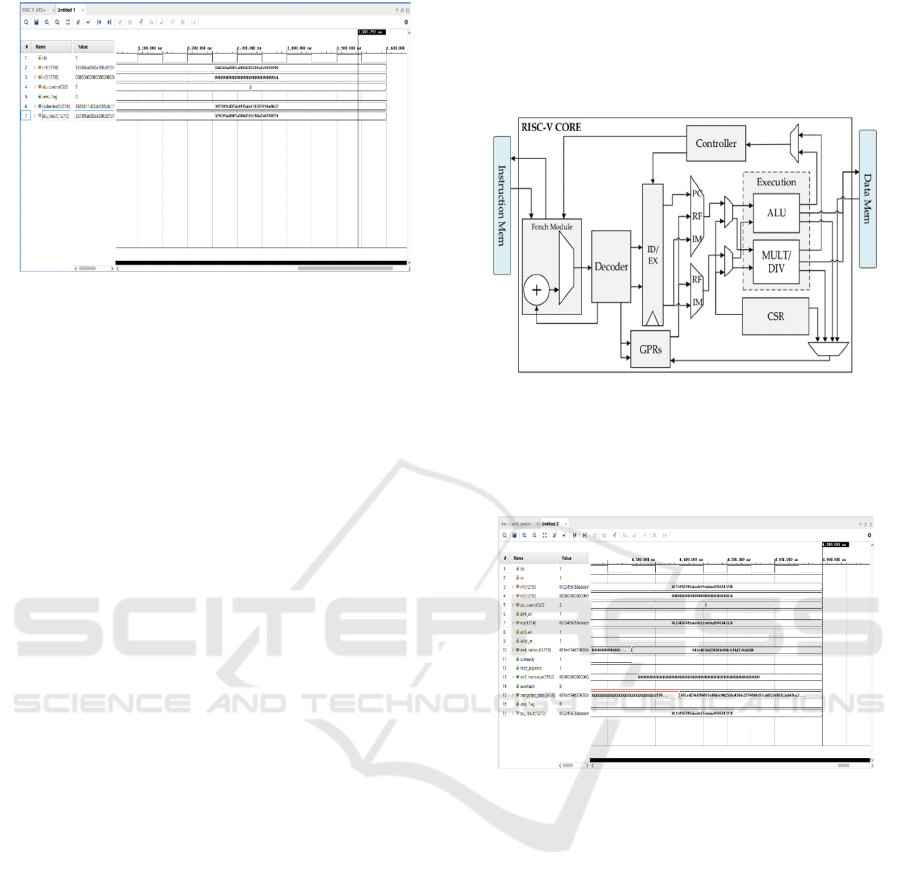
Figure 2: Architectural diagram of a RISC-V core with
instruction and data memory interfaces.
6 RESULT ANALYSIS
This accelerator achieves remarkable enhancement in
security, efficiency and energy consumption. The
AES-GCM ciphering with hardware acceleration
provides the integrity and confidentially of data with
a low cost in time and the ECC key replaces the
security converted next to a relaxed computational
demand, in reduced time compared with the RSA
(Fig. 7). Performance testing shows faster speeds than
the software-only solutions for both encryption and
decryption, helping to improve response times for
IoT devices. Moreover, the power consumption of
the cryptographic accelerator is analyzed, and the
results illustrate that the cryptographic accelerator is
energy-efficient and is suitable for resource-
constrained low-power IoT applications. Resource
consumption on FPGA/ASIC verifies negligible
addend hardware overhead for scalability. Through
the network analysis, it is shown that transmission
latency is decreased with low communication cost.
In general, with AES-GCM and ECC accelerators
integrated into RISC-V processor for securely fast
and low power communication, the trade-off between
security, speed, and power is balanced, which is most
suitable for security IoT communication.
Key features Faster encryption, lower
computational latency thanks to hardware
acceleration. AES-GCM guarantees secure and
authenticated data communication, and ECC
improves efficiency of key exchange with low power.
Performance results display large improvements over
software cryptography, which are suitable for low
powered IoT devices. According to power analysis,
the energy efficiency is highly optimized for
extended device operation. In conclusion, the
combination of AES-GCM and ECC integration is a
secure, energy-efficient and scalable solution for IoT
communication in a RISC-V processor.
The below Figure 3 represents the simulation of the
proposed system:
Figure 3: Waveform simulation output for RISC-V AES
module.
The below Figure 4 represents the simulation of
existing system:
Figure 4: Functional verification waveform of RISC-V
AES decryption process.
6.1 Applications
• Smart Homes: Secures communication
between devices such as smart locks, cameras,
and home automation system to prevent
unauthorized access.
• Healthcare: Protects sensitive patient data in
wearable health monitor, remote diagnostics,
and telemedicine systems.
• Industrial IoT: Enables the secured data
exchange in factories, protecting sensors and
control systems from cyber threats.
• Smart Cities: Ensures secure communication
in traffic management, environmental
monitoring, and public safety systems.
ICRDICCT‘25 2025 - INTERNATIONAL CONFERENCE ON RESEARCH AND DEVELOPMENT IN INFORMATION,
COMMUNICATION, AND COMPUTING TECHNOLOGIES
384

• Agriculture: Safeguards IoT-enabled devices
like soil sensors and irrigation systems from
data breaches.
• Transportation: For Vehicular adhoc
network (VANET) it assures vehicle to
vehicle (V2V) and vehicle to infrastructure
(V2I) communication in connected vehicles.
• Wearables: Protects data transmitted by
fitness trackers and health monitoring devices
to maintain user privacy.
• Banking: Secures IoT-enabled payment
terminals and financial transactions.
7 CONCLUSIONS
The feasibility and efficiency of this solution have
been validated, and the above security data transit
can be implemented for them based on a RISC-V
processor and AES accelerator in XILINX ISE.
RISC-V-based architecture made it possible to scale
the design and keep it flexible for further
improvement and adaptation. The incorporation of
AES accelerator delivers encryption and decryption
process at an accelerated pace so that secure data does
not compromise the processing speed or the
efficiency of operations.
The tool used for development of processor and
AES accelerator was Xilinx ISE, which helped to
compiles, simulates and verifies the designs
successfully. Simulation results show that such
design not only satisfies the security demand in IoT
applications, but also helps optimizing the resource
usage and minimizing energy dissipation and hence
fits in the limited environment.
This work shows the feasibility of open source
hardware architectures and hardware acceleration for
secure data transmission in IoT applications. It is the
basis for further research and R& D in high
performance, energy efficient, secured IoT solutions.
This solution is proved to be practicable and
efficient and indicates fair implementation of secure
data transmission in IoT systems with RISC-V
processor equipped with AES accelerator in XILINX
ISE. Adoption of RISC-V architecture made scalable
and flexible design possible to modify for future
scenes. With the AES accelerator, the encryption,
and decryption speed are improved, but it does not
affect the processing speed while maintaining the
efficiency.
The tool used for development of processor and
AES accelerator was Xilinx ISE, which helped to
compiles, simulates and verifies the designs
successfully. Simulation results show that such
design not only satisfies the security demand in IoT
applications, but also helps optimizing the resource
usage and minimizing energy dissipation and hence
fits in the limited environment.
This work shows the feasibility of open source
hardware architectures and hardware acceleration for
secure data transmission in IoT applications. It is the
basis for further research and R& D in high
performance, energy efficient, secured IoT solutions.
REFERENCES
A High Performance, Low Energy, Compact Masked 128-
Bit AES in 22nm CMOS Technology Yuan-Hsi
Chou; Shih-Lien L. Lu 2019 International Symposium
on VLSI Design, Automation and Test (VLSI-DAT).
Adams, M., & Keller, B. (2021). "Cryptography
Acceleration in a RISC-V GPGPU." Proceedings of the
5th Workshop on Computer Architecture Research with
RISC-V (CARRV).
Adams, R., & Keller, B. (2021). "Cryptography
Acceleration in a RISC-V GPGPU." Workshop on
Computer Architecture Research with RISC-V
(CARRV).
Adams, R., & Keller, B. (2021). "Cryptography
Acceleration in a RISC-V GPGPU." Workshop on
Computer Architecture Research with RISC-V
(CARRV).
Akinyele, J. A., Garman, C., Pagano, M. W., & Green, M.
(2018). "Performance Analysis of Elliptic Curve
Cryptography on Embedded Systems." IEEE
Transactions on Computers.
Biryukov, A., Dinu, D., & Khovratovich, D. (2017). "Fast
and Secure Authenticated Encryption: AES-GCM vs.
ChaCha20-Poly1305." IACR Cryptology ePrint
Archive.
Bouabdallah, A., Challal, Y., & Bouabdallah, M. (2017).
"Lightweight Cryptography for Secure IoT." IEEE
Communications Surveys & Tutorials.
Dinu, D., & Biryukov, A. (2017). "Fast and Secure
Authenticated Encryption: AES-GCM vs. ChaCha20-
Poly1305." IACR Cryptology ePrint Archive,
2017/238.
Ertaul, L., Mudan, A., & Sarfaraz, N. (2019). "Performance
Comparison of AES-CCM and AES-GCM
Authenticated Encryption Modes." International
Conference on Computing, Networking and
Communications (ICNC).
Ertaul, L., Mudan, A., & Sarfaraz, N. (2019). "Performance
Comparison of AES-CCM and AES-GCM
Authenticated Encryption Modes." International
Conference on Computing, Networking and
Communications (ICNC).
Ghosh, S., & Bhowmick, A. (2019). "An Energy-Efficient
Reconfigurable DTLS Cryptographic Engine for
Securing IoT Applications." arXiv preprint
arXiv:1907.04455.
Secure and Efficient Data Transmission in IoT: A Risc-V Processor with AES-GCM and ECC Accelerator
385

Hameed, K., & Iqbal, M. (2019). "Efficient Hardware
Implementation of AES-GCM for IoT Security." IEEE
Access.
Hoang, T.-T., Duran, C., Tsukamoto, A., Suzaki, K., &
Pham, C.-K. (2020). "Cryptographic Accelerators for
Trusted Execution Environment in RISC-V
Processors." IEEE International Symposium on
Circuits and Systems (ISCAS).
Implementation of a 32-Bit RISC-V Processor with
Cryptography Accelerators on FPGA and ASIC Duc-
Thinh Nguyen-Hoang; Khai-Minh Ma; Duy-Linh
Le; Hong-Hai Thai; Tran-Bao-Thuong Cao; Duc-Hung
Le 2022 IEEE Ninth International Conference on
Communications and Electronics (ICCE).
Khalaf, A., & Mohammed, M. (2018). "A Lightweight AES
Algorithm Implementation for Secure IoT
Communication." Iraqi Journal of Science.
Khalaf, A., & Mohammed, M. (2018). "A Lightweight AES
Algorithm Implementation for Secure IoT
Communication." Iraqi Journal of Science.
Kim, J., & Kim, H. (2018). "An AES-GCM Authenticated
Encryption Crypto-Core for IoT Security." IEEE
International Symposium on Circuits and Systems
(ISCAS).
Liu, M., Wang, H., & Li, X. (2021). "Lightweight
Cryptography for IoT: Implementation and
Performance Analysis." IEEE Internet of Things
Journal.
Marshall, B., Newell, G. R., Page, D., Saarinen, M.-J. O.,
& Wolf, C. (2020). "The Design of Scalar AES
Instruction Set Extensions for RISC-V." IACR
Cryptology ePrint Archive, 2020/930.
Marshall, B., Page, D., & Pham, T. (2020). "Implementing
the Draft RISC-V Scalar Cryptography Extensions."
Hardware and Architectural Support for Security and
Privacy (HASP).
Menezes, A., Van Oorschot, P., & Vanstone, S. (1996).
"Handbook of Applied Cryptography." CRC Press.
Nejatollahi, H., Ahmadian, M., Taslimi, B., & Samavi, S.
(2020). "A Survey on RISC-V: Design, Architecture,
and Security Perspectives." ACM Computing Surveys.
OpenSSL: Implementation of AES-GCM and ECC.
RISC-V Cryptography Extensions - RISC-V International.
Siddamal, S., & Kubsad, R. (2021). "Implementation of
Cryptographic Algorithm (One-Time-Pad) with a
RISC-V Processor." International Conference on
Advances in Computing, Communication, and Control
(ICAC3).
Stallings, W. (2020). "Cryptography and Network Security:
Principles and Practice." Pearson Education.
T-Head RISC-V Processor with Cryptographic Extensions.
The Research of the SM2, SM3 and SM4 Algorithms in
WLAN of Transformer Substation. Wang Tong; Cui
Wen Peng; Li Tong; Wang Liang; Li Hao; Chi Ying
Ying 2019 3rd International Conference on Electronic
Information Technology and Computer Engineering
(EITCE).
VLSI Implementation of RISC-V MCU with a variable
stage pipeline Mao-Hsu Yen; Cheng-Hao Tsou; Tzu-
Feng Lin; Yih-Hsia Lin; Yuan-Fu Ku; Chien-Ting
Kao 2023 IEEE 6th International Conference on
Knowledge Innovation and Invention (ICKII).
Waterman, A., & Asanović, K. (2017). "The RISC-V
Instruction Set Manual." RISC-V Foundation.
ICRDICCT‘25 2025 - INTERNATIONAL CONFERENCE ON RESEARCH AND DEVELOPMENT IN INFORMATION,
COMMUNICATION, AND COMPUTING TECHNOLOGIES
386
