
Comparison of Rest vs GraphQL: Performance, Authentication and
Scalability
Khushnuma Sadaf, Sidra Aslam Khan, Deepanshi Chourasia, Neelanjana Rai and Maria Jamal
Department of Electronics and Communication Engineering, Indira Gandhi Delhi Technical University for Women, James
Church, New Church Rd, Opp. St, Kashmere Gate, South Delhi, Delhi - 110006, New Delhi, India
Keywords: REST API(RA), GraphQL API(GA), Query Optimization (QO), Over‑Fetching, Under‑Fetching (of, UF),
OAuth 2.0, JSON Web Tokens (JWT).
Abstract: As the need for smooth data transfer between back and front-end applications grows within web and mobile
platforms, choosing the proper API architecture has become a matter of critical importance for developers.
APIs have evolved from SOAP services to REST design, and more recently, GraphQL solutions. These
models come with their own strengths and weaknesses regarding performance, scalability, and security. The
Researchers study a comparative analysis of REST and GraphQL highlighting key emphasis metrics like data-
fetching efficiency, bandwidth consumption, query complexity, response time, and security concerns. We also
consider authentication mechanisms, common security vulnerabilities, and the effect of rate limiting and
caching strategies on API performance. This research attempts to provide practical guides for selecting the
most suitable API paradigm, depending on particular requirements of the use-case in the form of data-driven
practical analysis and a set of real-world use-case studies. Conclusions: REST is a solid foundation that is
built with consideration of the specs of caching, while GraphQL allows for a more flexible querying
capability, and can eliminate redundant clauses to reduce bandwidth. The research behind this paper provides
useful directions for both developers and architects when it comes to deciding how APIs are implemented.
1 INTRODUCTION
The APIs are regarded as the fundamental
components for web and mobile apps since it allows
the system clients and servers to communicate easily
in today’s digital environment. One of the key
factors influencing the performance, scalability and
security of the entire application is an API efficiency.
As the need for data-heavy and real-time applications
has increased, API design has adapted to the
challenges around data retrieval, response-time and
security.
One of the first communication mechanism used
in the early days of web services is a strict XML-
based messaging protocol called SOAP (Simple
Object Access Protocol), providing a reliable way to
transmit data, but with a lot of overhead and
complexity. Due to those limitations,
Representational State Transfer (REST) has emerged
as a simpler and more flexible alternative. REST’s
lightweight, stateless architecture described the
industry standard, handling resources through HTTP
methods such as GET, POST, PUT and DELETE.
REST-style APIs are often criticized for their concept
of over-fetching and under-fetching data as such they
require multiple requests to gather related
information which is not only hurtful to performance
in data-heavy applications, but it also couples’ clients
with the API endpoints resulting in the need for
multiple sets of endpoints on the server.
Well to fight with such in-efficiencies, GraphQL
was introduced in 2015 and a query based flexible
way of API designing came into existence. REST
depends on endpoints that return static payloads,
while in Graph QL the clients define what fields of
data they need and only the requested data is returned,
reducing used bandwidth and improving the speed of
data handing. While GraphQL provides the ability to
fetch dynamic data, it comes with its complexities in
terms of having a greater query processing overhead
(for parsing, validation, and execution), caching
complexities.
These architectural differences can often force
the developer to choose, so they often have to decide
which of the two API models would fit their
application best. We provide a deep dive into REST
Sadaf, K., Khan, S. A., Chourasia, D., Rai, N. and Jamal, M.
Comparison of Rest vs Graphql: Performance, Authentication and Scalability.
DOI: 10.5220/0013930100004919
Paper published under CC license (CC BY-NC-ND 4.0)
In Proceedings of the 1st International Conference on Research and Development in Information, Communication, and Computing Technologies (ICRDICCT‘25 2025) - Volume 5, pages
369-377
ISBN: 978-989-758-777-1
Proceedings Copyright © 2026 by SCITEPRESS – Science and Technology Publications, Lda.
369
and GraphQL and analyse their performance based on
data-fetching efficiency, response size, query
complexity, security mechanisms, rate limiting,
caching and scalability. We are looking for example
applications and performance metrics so we can
provide tangible knowledge that will help software
developers decide the optimal API design for their
application.
The rest of the paper is organized as follows: in
Section 2, we introduce the history of API. In Section
3 we examine architectures, and highlight key
technologies. Section 4 compares REST and
GraphQL on their performance metrics axis e.g how
well they retrieve data, bandwidth metrics and
response times. In section 5, we discuss
authentication strategies and common security
mistakes. 1.6 Rate limiting, caching, and scaling
considerations the results and discussion from
implementation is presented in Section 7. 5. Similar
is Section 8 with a summary of findings regarding
differences in models and recommendations for
selecting the one that is most suitable for your
application.
2 LITERATURE REVIEW
APIs are the true backbone of modern web
development, enabling disparate systems to
interoperate. API architectures have progressed from
traditional SOAP web services to REST APIs and
further enrich the architecture, adding GraphQL.
However, with the increasing requirement for scale,
flexibility, and security, developers have been
looking for new API paradigms to improve
performance and do better at exchanging data.
The SOA architecture used during the first few
generations of web service communication was
Simple Object Access Protocol (SOAP), which
enabled structured information to be exchanged
between web services through XML messaging in a
well-defined but restrictive way. While SOAP APIs
were incredibly powerful and useful, they came under
fire for their more complex syntax and verboseness,
and REST (Representational State Transfer) emerged
as a simpler and more flexible, API standard. Given
these pros, RESTful APIs became popular as it was
stateless, easily scalable, and uses standard HTTP
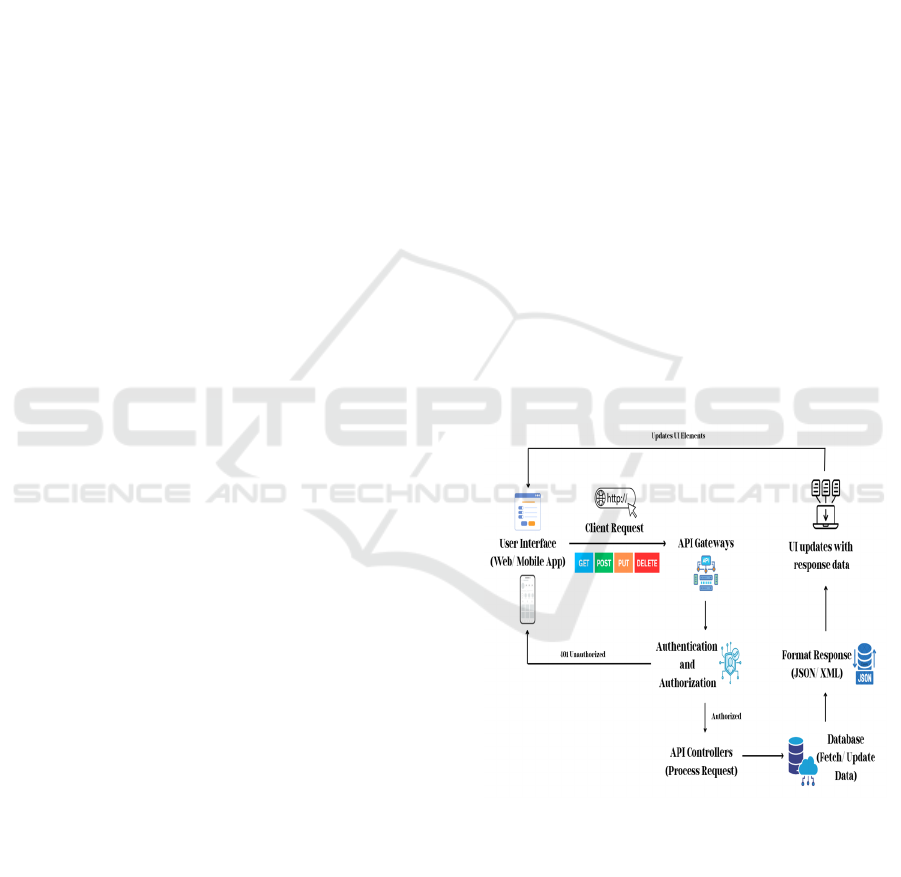
methods. The figure 1 shows the Architecture of
REST.
But the advantages of REST come with some
disadvantages as well: data over-fetching, under-
fetching, and excessive network calls have led to an
increased interest in GraphQL. GraphQL is more of a
query language where the client can ask for exactly
what it requires, thereby consuming a lot less
bandwidth and improving API performance.
Transitioning from fixed resource-based endpoints
with REST to a flexible, Schema-first methodology
present in GraphQL has represented a massive leap-
forward in the field of API design
3 ARCHITECTURE
3.1 REST Architecture
REST (or Representational State Transfer) is an
architectural style used for constructing APIs that
communicate using the HTTP protocol. Although
commonly mistaken for a protocol, REST is really an
architectural style (or, more appropriately, a set of
constraints) that specifies how resources should be
represented and manipulated in a distributed system.
RESTful APIs operate in a stateless client-server
environment, facilitating interaction between the
front-end and back-end by sending HTTP requests
and receiving HTTP responses, emphasizing
scalability, reliability, and simplicity and are more
widely used for application development which is
your case.
Figure 1: Architecture of REST.
Key Principles of REST Architecture
• REST APIs are stateless, which means that
every request from the client must contain all the
data required to fulfil that request, as the
server
does not retain information about previous
requests of the client. This increases scalability
as client API calls can be
served in parallel and
do not require persistence of session.
ICRDICCT‘25 2025 - INTERNATIONAL CONFERENCE ON RESEARCH AND DEVELOPMENT IN INFORMATION,
COMMUNICATION, AND COMPUTING TECHNOLOGIES
370
• REST architecture is resource-based, which
means data entities are changed to resources,
like users, products & orders, where each
resource
has a unique URI (uniform resource
identifier). These resources are actuated using
common HTTP methods e.g.
GET, POST,
PUT, DELETE.
• REST APIs follow a standard interface,
allowing a streamlined communication between
clients and servers. Designed to a specification
which enables inter-operation across a wide set
of platform and programming
language- a
request-response is as structured as possible.
• REST APIs also use caching mechanisms,
which
are used to increase performance by
storing data. HTTP headers like Cache-Control
and
ETag allow the caching of requests on
multiple levels, preventing unnecessary calls to
your database and speeding up response times.
• REST APIs authenticate and authorize access
using Oauth 2.0, JWT (JSON Web Tokens), and
API
key-based methods. They are used to limit
access to sensitive resources and to facilitate
secure interactions between clients and servers
when verifying user identity.
• REST APIs are good for
microservices-based
architecture, where different microservices
expose their individual REST APIs. This
modular architecture allows services to be
scaled up individually
and deployed in cloud
environments with ease.
Rate limiting and throttlingExample in REST
APIsThe single user (client) abuse is restricted in
recommended REST APIs using rate limiting and
throttling. They enhance security, keep systems
stable, and ensure maximum performance in high
traffic situations by limiting requests on a per user or
IP address basis.
3.2 GraphQL Architecture
GraphQL: A query language for your API and a
server-side runtime that accepts queries and returns
fast results based on the specific data type definition.
While GraphQL was created by Facebook in 2012
and publicly released in 2015, it's a comparatively a
newer technology that provides a flexible, efficient,
and scalable alternative to REST APIs. Unlike REST
APIs, where clients have to pull data from hard-coded
endpoints, GraphQL grants clients the power to create
their own queries in order to receive exactly what
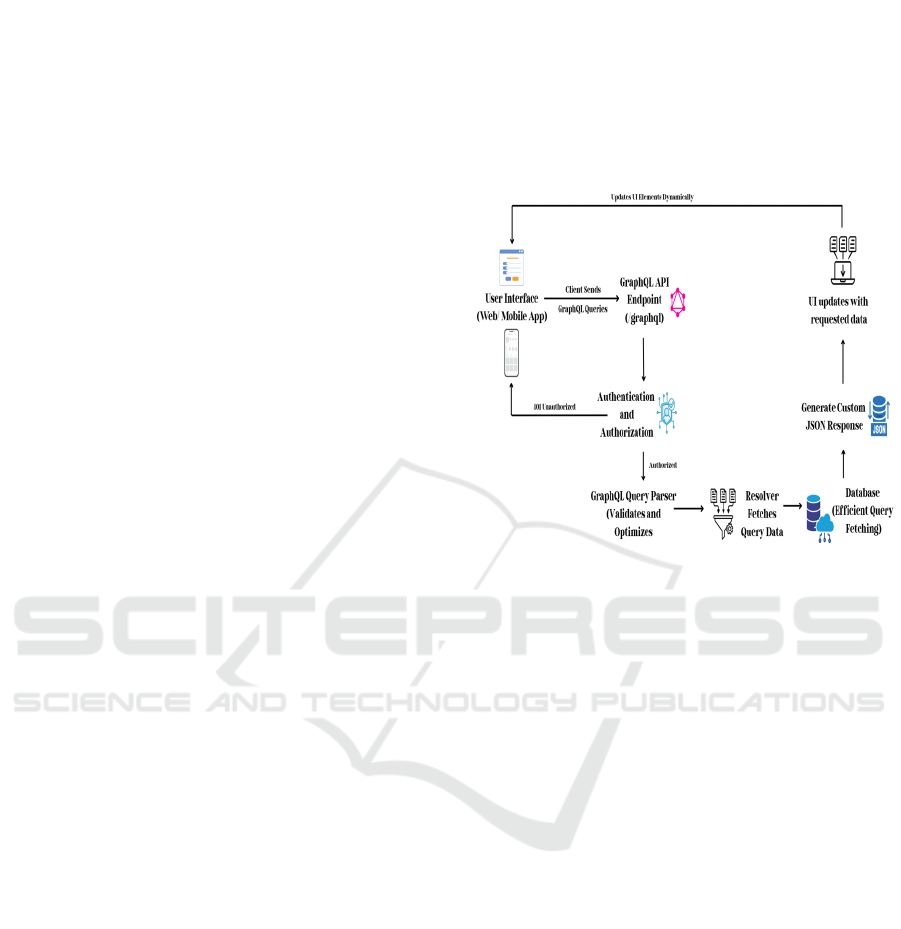
they need in a structured response.the figure 2 shows
Architecture of GraphQL.
Key Principles of GraphQL Architecture
• Whereas REST uses multiple endpoints to
access different resources, GraphQL works
through a single endpoint. This design allows
clients to retrieve all the necessary data in a
single request and avoids making multiple
requests to different endpoints.
Figure 2: Architecture of GraphQL.
• Declarative data fetching With GraphQL,
clients have the capability to describe which
data they need in a query. Using this method,
allows for no over-fetching, where it retrieves
unnecessary information, and no under-
fetching, where multiple requests must be
performed in order to obtain related data.
• A strongly typed schema describes the data that
can be fetched through a type system with your
GraphQL server, including types, queries, and
mutations. This schema-driven approach
enables better data validation, consistency, and
self-documentation, making it easier to
understand and use the API.
• One of the cores idea behind GraphQL is
pulling multiple nested or relational data in a
single query and reducing the network latencies.
GraphQL collects related resources into a single
execution and allows for query batching, unlike
make separate API calls to get those
relationships.
• GraphQL also has more structured error
handling than REST, as error messages are
included in API responses. Unlike REST APIs
that use HTTP status codes to identify errors,
GraphQL provides detailed error objects,
including the error itself, its location, and
Comparison of Rest vs Graphql: Performance, Authentication and Scalability
371

possible solutions, enhancing our debugging
capabilities.
• GraphQL has built-in protections against abuse,
with features like query complexity control to
limit depth and analyze costs. Such
mechanisms can limit very deep or expensive
queries, thus helping to prevent resource over-
consumption, and virtual denial-of-service
attacks.
• GraphQL's integration with microservices and
federated architectures is natural, with each
microservice able to define and expose its own,
separate schema and then being combined into a
unified API in so-called "API composition."
This improves the scalability of distributed
applications while also simplifying integration
of heterogeneous data sources.
4 PERFORMANCE
Performance evaluation is an important part of any
API development to ensure scalability,
responsiveness, and resource utilization. In this
section, the focus will be on key performance metrics
such as efficiency, bandwidth use, and response time
to analyze how effective REST and GraphQL are for
communicating workloads. We hope to learn more
about the trade-offs between the two methods for
real-world use by measuring the previous variables.
4.1 Efficiency
Data efficiency is the measure of the amount of data
fetched (in bytes or number of records) in a certain
amount of time. So, the formula for efficiency can be
like this:
𝐸𝑓𝑓𝑖𝑐𝑖𝑒𝑛𝑐𝑦 = 𝐴𝑚𝑜𝑢𝑛𝑡 𝑜𝑓 𝐷𝑎𝑡𝑎 𝐹𝑒𝑡𝑐ℎ𝑒𝑑 ÷
𝑅𝑒𝑠𝑝𝑜𝑛𝑠𝑒 𝑇𝑖𝑚𝑒 (1)
The efficiency hence can vary with change in the
amount of data fetched and the time taken to fetch that
data. The two methods REST and GraphQL both have
different efficiency due to their difference in their
way of working. While REST uses the approach of
multiple endpoints to fetch the data, the GraphQL
method uses the query approach to access the data.
So firstly, focusing on response time, REST has a
relatively faster response time than that of GraphQL
due to the complexities in the query of GraphQL,
which can take higher time to process. REST fetches
data from the database when requested. GraphQL
also fetches data when requested, but before querying
the database, it first resolves the query to determine
what specific fields are needed, fetching only the
required data. This processing of query in the middle
of request and response cycle leads to increase in the
time of response for GraphQL APIs.
Secondly, since REST fetches all the data from
the database and GraphQL fetch only what is queried,
the amount of data fetched is also different. Hence
REST fetches way more data than GraphQL.
This relatively faster and more data fetching
nature of REST results in REST having a higher
efficiency that the GraphQL API methods.
4.2 Bandwidth
Bandwidth refers to the maximum rate at which data
can be transferred over a network connection in a
given amount of time.It measures the capacity of a
channel for data transferring. The higher the
bandwidth the higher the capacity of the channel to
transfer large information at a particular instance of
time.
𝐵𝑎𝑛𝑑𝑤𝑖𝑑𝑡ℎ (𝑏𝑝𝑠) 𝑇𝑜𝑡𝑎𝑙 𝐷𝑎𝑡𝑎 𝑇𝑟𝑎𝑛𝑠𝑓𝑒𝑟𝑟𝑒𝑑 (𝑏𝑖𝑡𝑠) ÷
𝑇𝑖𝑚𝑒 (𝑠𝑒𝑐𝑜𝑛𝑑𝑠) (2)
REST relies on endpoints to request the data,
which can also return unnecessary data and
sometimes it may require multiple endpoints to
collect different data fields which along with them
bring unrequired data as well. This multiple endpoint
requesting and collection of unnecessary data results
in REST having a requirement of higher bandwidth
then GraphQL.
GraphQL on the other hand has a structured query
response requesting and fetching only the data fields
which are necessary or required. This makes the
Bandwidth of GraphQL much more optimized than
that of REST, as unlike REST it doesn’t over-fetch or
under-fetch the data.
4.3 Query Complexity and Response
Time
Query complexity refers to the computational cost of
processing a query, influenced by factors like depth,
the number of requested fields and objects, and the
use of filters or aggregations. Higher complexity
increases the server's processing load, making queries
slower and more resource-intensive.
Response time is the total time taken from sending
a request to receiving a response. It depends on query
complexity, database efficiency, network latency, and
server performance. Optimizing queries and reducing
ICRDICCT‘25 2025 - INTERNATIONAL CONFERENCE ON RESEARCH AND DEVELOPMENT IN INFORMATION,
COMMUNICATION, AND COMPUTING TECHNOLOGIES
372

unnecessary data retrieval can help improve response
time.
𝑅𝑒𝑠𝑝𝑜𝑛𝑠𝑒 𝑇𝑖𝑚𝑒 = 𝑇𝑖𝑚𝑒 𝑜𝑓 𝐷𝑎𝑡𝑎 𝑅𝑒𝑐𝑒𝑖𝑣𝑖𝑛𝑔 −
𝑇𝑖𝑚𝑒 𝑜𝑓 𝐴𝑃𝐼 𝑅𝑒𝑞𝑢𝑒𝑠𝑡 𝑆𝑒𝑛𝑡 (3)
In simple use cases, REST APIs generally have lower
response times than GraphQL because the execution
of REST is straightforward with established
endpoints which return static data. This minimizes
processing overhead, as the server has no need to
parse complex queries, nor dynamically deduce
response structures. Additional benefits of RESTful
architecture include caching on multiple levels
(browser, CDN, and server-side), further reducing the
amount of response time for repeatedly fetched data.
On the other hand, GraphQL lets clients request
only the data that they require, mitigating issues with
over-fetching. This flexibility comes with an
additional computational cost, however. This also
means the server has to dynamically process and
resolve every field requested by a query which can
slow down response time — particularly for deeply
nested queries or when you're resolving relationships
across multiple database tables. Moreover, GraphQL
queries are often complex demands for multiple
resolvers, which make them take longer to process
compared to the single endpoint responses from Rest.
5 AUTHENTICATIONS
Authentication is the primary security mechanism of
confirming the identity of users and applications
accessing resources. REST and GraphQL also
support common authentication methods like API
keys, Basic Authentication, OAuth 2.0, and JSON
Web Tokens (JWT), but their implementation is
different.
Authentication is normally applied per endpoint
in RESTful APIs. API Keys and Basic Authentication
are easily implemented but with no advanced
security. Moreover, these approaches explicitly
expose a secret that needs to be sent in every request,
which can be detrimental if this secret is not
encrypted. The more secure alternatives are OAuth
2.0, which lets third-party applications access
resources securely, and JWT which provides stateless
authentication by putting userclaims (information
about the user) directly in the token.
On the other hand, GraphQL authentication works
at the resolver level instead of per endpoint because
GraphQL is exposed through one entry-point. This
enables developers to manage access more broadly,
all the way down to the field level of a non-Basic ");},
But with that only increasing complexity as we would
now have to enforce authentication logic within each
resolver function.
All in all, REST combines simple authentication
approaches with lots of support, whereas GraphQL
allows more fine-grained control but can be difficult
to integrate securely.
5.1 Common Security Risks
APIs come with many security vulnerabilities, but
the nature of these vulnerabilities is not the same
between REST and GraphQL because of their
architectural differences.
• Injection Attacks: If user inputs are not sanitized
correctly, REST and GraphQL applications are
susceptible to SQL injection, NoSQL injection,
and command injection. As REST has multiple
endpoints, all of them could be a surface of
attack. On the other hand, the dynamic query
approach of GraphQL necessitates extensive
input validation in resolvers to prevent
malicious queries.
• Broken Authentication: REST APIs can suffer
from misconfigured authentication on several
endpoints, while with GraphQL the single
endpoint presents a security risk if not
adequately secured. Furthermore, GraphQL’s
introspection feature can reveal sensitive
schema details if it is left enabled in production.
• Excessive Data Exposure: REST can return
more data than what is needed (e.g. all fields),
whereas GraphQL by definition can query only
what is needed - assuming their access controls
are well enforced.
• Denial-of-Service (DoS) Attacks: REST can be
targeted through brute-force endpoint requests
while GraphQL can be targeted using deeply
nested or recursive queries, both of which can
consume a lot of server resources. To protect
against abuse, GraphQL APIs require defenses
such as limiting query depth and analyzing
complexity.
5.2 Rate Limiting and Caching
To avoid this storm and have a better performance in
the API by preventing Abuse, rate limiting, and
caching is a necessary process.
In REST, rate limiting is trivial because the
requests flow to a specific endpoint. Commonly used
by API gateways and proxy tools, traffic monitors use
IP, API keys, or user accounts for abuse detection and
Comparison of Rest vs Graphql: Performance, Authentication and Scalability
373

set up different rate limits based on fixed-window or
token-bucket algorithms.
For GraphQL this can be a little less straightforward.
Because all requests pass through a single endpoint,
standard request-based limits don’t work.
Alternatively, GraphQL relies on a query cost
analysis, assigning a "weight" to each query
according to the complexity. By limiting the depth of
queries the server will process, query depth limiting
protects the server from excessive nesting of queries.
REST is generally simpler to cache — which
makes it well-suited for the storage of frequently-
accessed data — since you can easily use built-in
HTTP caching mechanisms such as Cache-Control as
well as the ETag and Last-Modified headers.
GraphQL’s flexible query will make you more
difficult to cache, the server response will be different
depending on the fields requested. Instead GraphQL
caching works on a client-side (like Apollo Client),
persisted queries and response normalization.
Well-known and simpler solutions for
authentication, caching and rate limiting is already
providing by REST. Correctly implemented,
GraphQL can be more flexible and performant, albeit
makes it more challenging to optimize for security
and performance.
6 SCALABILITY
CONSIDERATIONS
Scalability is a critical factor in modern API design,
ensuring that a system can handle increasing
workloads without significant performance
degradation. This section explores key aspects of
scalability, including managing high traffic loads,
optimizing database queries, and ensuring flexibility
in API evolution. By analysing these factors, we aim
to assess how REST and GraphQL adapt to growing
demands and evolving application requirements.
6.1 Handling High Traffic Loads
In an era where digital applications are scaling at an
unprecedented rate, APIs are expected to manage
high traffic volumes without a decline in
performance. REST APIs are stateless, which means
it is inherently load-balanced and caches requests,
making them suitable to handle a surge of requests
from users. But with more distributed services
depending on REST APIs, the design of API
gateway solutions and rate-limiting solutions need
more improvement to speed performance in large-
scale applications.
In stark contrast, GraphQL allows you to
consolidate multiple requests into a single query,
flowing less network overhead and performing
effectively for high-demand applications.
Nonetheless, this benefit has a processing cost, as
complex queries can put a high load on servers. future
work can revisit considerations of how to manage
consumed resources through either cost analysis of
the overall graph and therefore on query complexity
automatically, sentence rate limiting, similar to what
is done in rest (aka Oas) regarding route limits, and
other measures to ensure that the graph remains
scalable under heavy traffic. One hypothesis for an
improvement in this case, could be adding caching at
the level of query in GraphQL, significantly reducing
not only the execution time but also eliminating
redundant calculations
6.2 Database Performance and Query
Optimization
The interaction of the APIs with the database is one
of the most important aspects of performance.
Traditionally REST APIs depend on structured SQL
databases, and the queries pass through predefined
endpoints that return fixed datasets. However,
maintaining data integrity in such scenarios leads to
redundant queries being fired, which is a bottleneck
for the response time especially for complex data
relationships. In RESTful architectures, future
investigations into AI is also needed, including
automated query rewriting and dynamic indexing
with an emphasis on evaluating the quality and use of
query logs in AI-enabled indexing systems.
GraphQL also has the model of executing a query
on-demand with respect to NoSQL databases. On the
other hand, too deeply nested queries in the case of
GraphQL can lead to expensive database joins to
occur for a long query execution time. Predictive
caching, which refers to loading frequently accessed
data cognizant of user behaviour, can also be explored
in future studies to reduce latency experienced by
query users. Batched queries would fall into this
category, as would deferred execution strategies that
optimize database access without requiring all data
to be fetched and derived by the server just to satisfy
a GraphQL–style resolver.
6.3 Flexibility in API Evolution
To support Lightbend Akka HTTP v10.1.0, we
introduce two major additions: Revisions to the API
ICRDICCT‘25 2025 - INTERNATIONAL CONFERENCE ON RESEARCH AND DEVELOPMENT IN INFORMATION,
COMMUNICATION, AND COMPUTING TECHNOLOGIES
374
and an up-gradation to the latest version of Akka
HTTP. REST APIs generally use versioning
strategies (v1/v2, etc. as part of the URL or headers)
to allow changes while preserving backward
compatibility. Although this strategy ensures
stability, it can result in progressive fragmentation
and maintenance problems when the Added several
versions of the API exist. Future studies might
include automated version migration tools, and self-
adapting API frameworks that assure minimum
disruption in updates.
The fast development of API is due to GraphQL
and it may introduce new fields to the schema and
will not affect the existing queries. It allows
backwards compatibility; i.e., any changes introduced
to the API can be done without breaking existing
consumer applications, reducing the need for
versioning. This is very challenging though to
manage schema complexity as the APIs eventually
grow. Future work can explore automated schema
refactoring approaches that incrementally removes
deprecated fields, and AI-based schema evolution
assessment that aims to foresee performance
bottlenecks before they occur.
7 RESULTS AND DISCUSSION
7.1 GraphQL Method
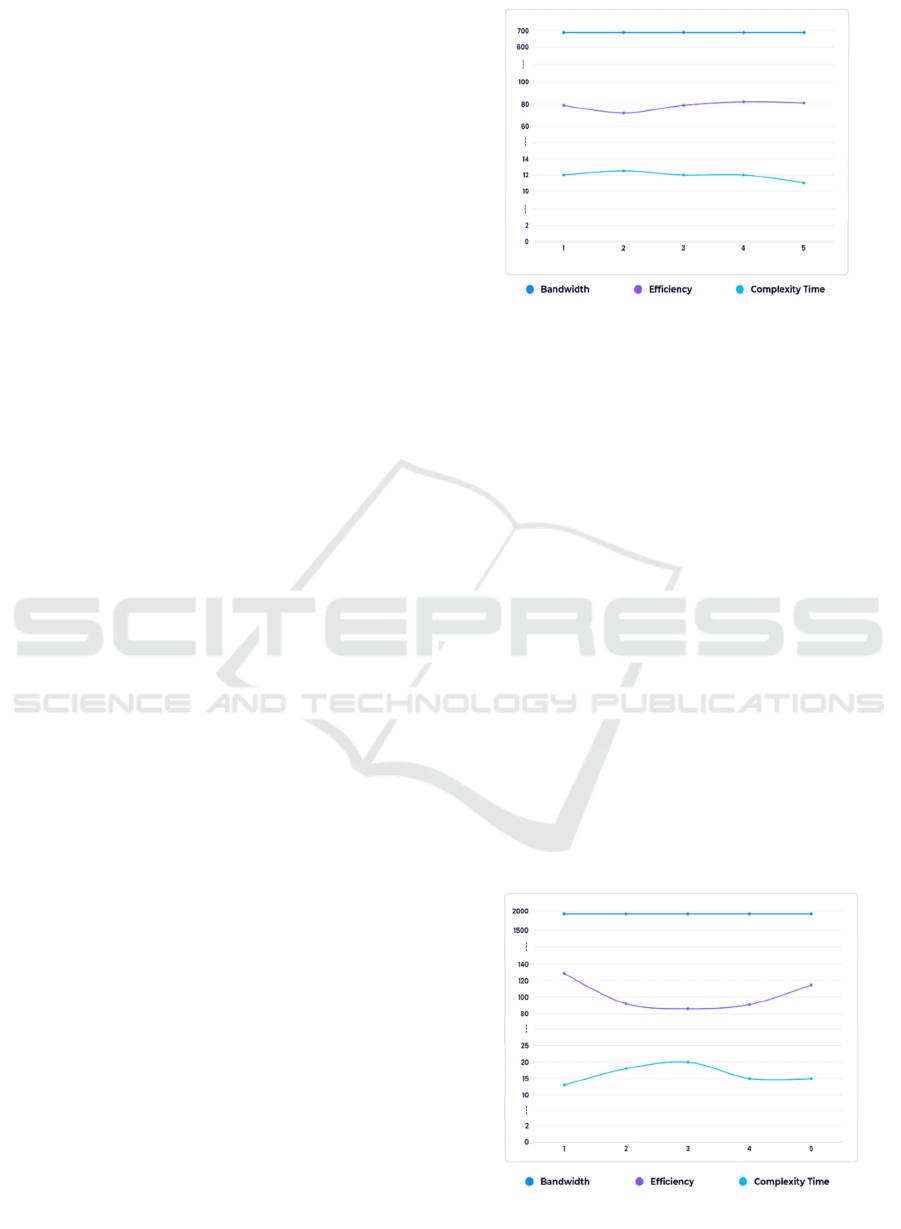
The performance evaluation of the GraphQL API was
conducted by analyzing key metrics: Bandwidth,
Efficiency, and Complexity Time. The results are
visualized in Figure 3, showcasing variations over
five test instances.
The Bandwidth (indicated by the blue line) seems
to be unchanged under all test instances, while the
values is high (around 689 units). This means that, no
matter how complex your query may become,
GraphQL always transfers the same amount of data.
The Efficiency metric (shown as purple) does
have a slight amount of variation but most of the time
is stable and stays between 60 and 80. The line shows
a gradual increase between the 2nd and 3rd cases
which implies that under some conditions, we are
able to retrieve data more efficiently than the previous
example. But the small differences suggest that
efficiency can depend on the structure of the query as
well as one-time server-side optimisations.
Figure 3: Performance metrices of GraphQL.
The Complexity Time (cyan line) oscillates over
classic 10 and 14 of unit, that measures that
supervises execution time in the query is slightly
variable, but gets manage in the unit acceptable. The
slight fluctuations indicate that a GraphQL query has
stable complexity and does not have a compounded
performance degradation at the tested cases.
In general, the study shows that GraphQL APIs are a
fundamentally efficient way for querying and
resolving data, due to their remarkably consistent
bandwidth usage as well as reasonable bandwidth
consumption and overall GraphQL execution times.
The findings indicate that query optimization
techniques and caching strategies could provide
additional performance improvements.
7.2 REST Method
The performance evaluation of the REST API was
conducted by analyzing key metrics: Bandwidth,
Efficiency, and Complexity Time. The results are
presented in Figure 4, illustrating trends across five
test instances.
Figure 4: Performance metrics of rest.
Comparison of Rest vs Graphql: Performance, Authentication and Scalability
375

Bandwidth (blue line) remains fairly high at
~1927 units for all test instances. This indicates that
REST APIs are bandwidth heavy compared to
GraphQL, possibly due to over-fetching of data.
The Efficiency metric (purple line) follows a U-
trend, it starts at a high value, gets a little down at the
second instance, drops very low at the third instance,
and then raises up towards the fifth instance. This
means REST APIs become inefficient based on how
the resource request-response structure works and can
suffer in performance while dealing with complex
queries.
Complexity Time (cyan line) differs a lot from
instance to instance rising from the first instance to
the third, then dipping slightly and finally
converging. The peak indicates that some queries take
longer to process, probably because they require
more than one endpoint request because GraphQL
gather in one query.
The results of the analysis show that REST APIs
are the ones that consume more bandwidth and are
less stable in terms of efficiency compared to
GraphQL. Since REST essentially needs multiple
calls to get associated data, higher complexity time is
observed. Such data retrieval is better in use cases
where optimized data fetching is needed which
concludes that GraphQL can serve as a better
alternative for such scenarios.
8 CONCLUSIONS
In this study, we thoroughly analysed the
performance, scalability, and authentication
mechanisms of the REST and GraphQL APIs based
on essential metrics (such as bandwidth usage,
throughput, complexity time, and security concerns).
Our results show that GraphQL considerably
increases data-fetching efficiency, minimizing over-
fetching and under-fetching, which in turn reduces
the amount of data sent over the wire and decreases
the complexity of queries. On the other hand, the
REST APIs show more bandwidth and flutter time
complexities for the same reasons (i.e., multiple
endpoint calls and see the duplicate Transfer of data).
Regarding data scalability, GraphQL has a main
advantage over REST, because each REST endpoint
answers only one part of the object, and the client has
to call many different URLs to fetch data about that
object. However, the additional per-query overhead
in GraphQL could lead to an increased response time
under high concurrency conditions. In contrast,
REST APIs have less complexity to deal with,
predictable load balancers and more simplified
caching mechanisms.
In terms of authentication and security, both API
architectures offer support for common mechanisms
like OAuth 2.0, JWT, and role-based access control
(RBAC). Yet, GraphQL also adds new such as deep
query complexity attacks and unauthorized data
exposure, so it's crucial to limit query depth and
include access control logic. The statelessness of
REST allows for more structured enforcement of
security policies at each endpoint, allowing stricter
authentication to be more easily enforced.
In general, the performance-oriented and dynamic
nature of GraphQL makes it superior for use cases
where we can reduce bandwidth consumption with
higher fetching efficiency but if you need an
environment with scalability and security the REST
API approach seems to be the best solution. This will
include testing these APIs on different network
conditions, applying advanced caching mechanisms
and analyzing security vulnerabilities.
REFERENCES
A. Johnson, B. Lee, and C. Martinez, "Bandwidth and
Latency Considerations in RESTful and GraphQL APIs
for Scalable Systems," in Proceedings of the
International Conference on Cloud Computing and Big
Data (ICCCBD), 2022, pp. 215-223.
A. Gupta, P. Singh, and R. Patel, "Comparative Analysis of
Authentication Mechanisms in REST and GraphQL
APIs," in Proceedings of the IEEE International
Conference on Cybersecurity and Privacy (ICCP),
2022, pp. 350-360.
C. Lewis and D. Zhang, "Reducing Network Overhead in
Web Applications: A Performance Analysis of
GraphQL," in Proceedings of the International World
Wide Web Conference (WWW), 2019, pp. 510-519.
D. K. Smith and E. Miller, "Optimizing API Performance:
A Comparative Study of REST and GraphQL Under
Varying Load Conditions," in Proceedings of the IEEE
International Conference on Web Services (ICWS),
2019, pp. 78-85.
J. Anderson and P. White, "Scalability and Maintainability
of API Architectures: REST vs. GraphQL," in
Proceedings of the IEEE International Conference on
Software Engineering and Knowledge Engineering
(SEKE), 2022, pp. 415-423.
K. Wang, J. Luo, and M. Patel, "A Comparative Study on
Data Fetching Efficiency in RESTful and GraphQL
APIs," in Proceedings of the IEEE International
Symposium on Performance Analysis of Systems and
Software (ISPASS), 2021, pp. 143-152.
L. R. Barros, G. Gousios, and A. Zaidman, "Comparing the
Efficiency of GraphQL and REST APIs: An Empirical
Study," in Proceedings of the IEEE International
ICRDICCT‘25 2025 - INTERNATIONAL CONFERENCE ON RESEARCH AND DEVELOPMENT IN INFORMATION,
COMMUNICATION, AND COMPUTING TECHNOLOGIES
376

Conference on Software Maintenance and Evolution
(ICSME), 2021, pp. 450-461.
P.M. Runeson, J. Malmqvist, and R. Torkar, "Performance
Implications of REST vs. GraphQL: A Case Study in
API Design," in Proceedings of the ACM/IEEE
International Conference on Software Engineering
(ICSE), 2020, pp. 330-342.
S. Bose, M. Roy, and L. Kim, "Load Balancing and Caching
Strategies for Scalable GraphQL APIs," in Proceedings
of the IEEE International Conference on Cloud
Computing (CLOUD), 2023, pp. 98-107.
T. Nakamura and L. Chen, "A Study of Over-Fetching and
Under-Fetching in REST and GraphQL APIs," in
Proceedings of the ACM International Conference on
Distributed Systems and Web Engineering (ICDSWE),
2021, pp. 180-192.
Comparison of Rest vs Graphql: Performance, Authentication and Scalability
377
