
Forecasting Weather Status Using Advanced Machine Learning
Algorithm
Karuppusamy S., Soundarraj S., Vasanth P. and Vijayasankar T.
Department of Computer Science and Engineering, Nandha Engineering College, Erode, Tamil Nadu, India
Keywords: Weather Forecasting, Machine Learning, XG Boost Algorithm, Meteorological Data, Temperature Prediction,
Climate Change, Agricultural Risk Management, Flask Framework, Extreme Gradient Boosting.
Abstract: Weather forecasting in agriculture is, indeed, rather difficult because the whole area is so dynamic and
variable. Conventional statistical approaches usually cannot provide excellent precision, and this makes it a
challenge for farmers to be and plan effective. The project concentrates on an accurate temperature prediction
mechanism, with the application of machine learning methods, which includes the analysis of past as well as
current-day weather data to increase the reliability of predictions. Despite advances in forecasting techniques,
challenges remain, especially, in the areas of improving the accuracy of models, validating climate forecasts
in agricultural risk management, and their effect on crop diseases seasonally. As temperature and rainfall are
the two most crucial factors influencing plant health and production, the only advanced predictive system
available may provide farmers with insightful decisions in preventing losses. This project, therefore, aims at
an integrated assessment of weather forecasting techniques to improve agricultural planning strategies and
climate adaptation via data-driven approaches.
1 INTRODUCTION
Weather forecasting is key in various sectors, which
include agriculture, transport, disaster management,
and urban planning. To derive actions necessary to
avert possible risks once the availability of the
forecast is known is paramount. Some traditional
forecasting methods may not respond satisfactorily to
these dynamic and nonlinear changes that take place
within the atmosphere. This has opened avenues for
development in machine learning algorithms and
better scope with their promise of increased accuracy
i n weather predictions. Machine learning
approaches-XG Boost, in particular now have made
considerable advances successfully analyzing large
datasets and offers enormous improvement in
predictive accuracy. The proposed work aims to
design an extreme gradient boost for the forecasting
system which is a combination of historical and real-
time meteorological data to make accurate forecast
predictions. The project aims to provide farmers,
meteorologists, and policymakers with timely
information and decisions to allow proper planning
and avoid losses due to unusual weather. Through the
preprocessing of data techniques and feature
engineering, and integration of complex machine
learning algorithms, the presented system guarantees
higher prediction accuracy and timely alerts of
extreme weather phenomena. Finally, the underlying
principles make provisions for better climate
adaptation strategies in improved risk management
across different sectors.
2 RELATED WORKS
Machine learning and AI weather prediction models
have all but outrighted the prediction capabilities
using deep learning, numerical weather prediction,
and data-driven models. There have been several
studies addressing the advanced use of random
forests, CNNs, LSTMs, and graph-based neural
networks with the aim of improving weather
forecasting models (TL Yu, et.al., 2024). The shift
toward the data-driven forecasting and the
acknowledgment by researchers about the
capabilities an AI model might have in enhancing
both global and regional weather predictions (Ben-
Bouallegue, et.al., 2023). AI approaches, Four Cast
Net and Graph Cast, much faster in boosting scientific
progress in weather modeling (Anandkumar, A.
S., K., S., S., P., V. and T., V.
Forecasting Weather Status Using Advanced Machine Learning Algorithm.
DOI: 10.5220/0013929800004919
Paper published under CC license (CC BY-NC-ND 4.0)
In Proceedings of the 1st International Conference on Research and Development in Information, Communication, and Computing Technologies (ICRDICCT‘25 2025) - Volume 5, pages
351-356
ISBN: 978-989-758-777-1
Proceedings Copyright © 2026 by SCITEPRESS – Science and Technology Publications, Lda.
351

(2024)). Also, these studies deem that the
involvement of deep learning models partly
incorporated with physical processes using physical
constraints ensures more accurate predictions (de
Bezenac, et.al., 2020). Res Net-based models and
deep convolutional networks provided promising
results for medium-range forecasting (Rasp, S., &
Thuerey, N. (2021)), and also adaptive Fourier neural
operators have been very well used for high-
resolution forecasts (Pathak, J, et.al., 2022).
Moreover, graph neural networks have efficiently
predicted weather patterns showing good spatial
awareness (Sønderby, C. K., et.al., 2020). In addition,
the AI-powered precipitation forecasting models such
as Met Net have significantly improved short-term
weather forecasts Zhang, J., et.al., 2021.
The integration of convolution neural networks in
satellite image analyses has played an important role
in the storm detection and severe weather prediction
Molchanov,et.al., 2021. Further, other studies
explored the use of IoT-sensor data fusion with AI
techniques for real-time weather monitoring (Sharma,
R., et.al.(2022)). Thus, big data analytics
incorporated into cloud-based prediction systems
have greatly enhanced AI's predictive capabilities
(Weyn, J. A., et.al.(2020)). In addition, methods of
ensemble learning and data assimilation are already
being investigated so as to produce the optimal
machine learning model for weather forecasting
(Kashinath, K.,et.al., (2021) ) Innovative
developments in meteorology to streamline the
accuracy of prediction include physics informed deep
learning method (Evensen, G., & Monsen, S. M.
(2021). ). All of these undertakings further exemplify
the thrust of artificial intelligence, deep learning, and
big data analytics into modern weather forecasting,
thereby heralding a more reliable and intelligent
predictive system.
3 DATASET COLLECTION AND
PRE-PROCESSING
3.1 Dataset Collection
To inform the forecasts, this project intends to use the
most diversely sourced high-quality data from widely
reputable sources TL Yu, et.al.,2024. The data
sources include: satellite observations, ground- based
stations, remotely sensed technologies, Internet of
Things enabled sensors, and historical weather
records. Satellite observations have a wide variety of
available data about the atmosphere, including
temperature, humidity, cloud amount, wind speed,
and precipitation level. (Ben-Bouallegue , et.al.,2023)
This forms the basis for creating different long-term
weather patterns and events of severe weather on a
broad scale (Anandkumar, A. (2024)). Ground- based
weather stations supply meteorological data such as
real-time information on atmospheric pressure, wind
direction, temperature variations, and precipitation.
(Anandkumar, A. (2024).)This plays a major role in
solving satellite readings through providing further
precision in forecasting locally.(de Bezenac,et.al.,
(2024)) Remote sensing technologies add the frenetic
capability of latest technologies, for instance, Doppler
RADAR and LIDAR in observing clouds-storm
intensity- wind currents, which is a further push
towards intrusive short-term weather
predictions.(Rasp, S., & Thuerey, N. (2021) The
technologies allow for extreme monitoring of
phenomena like hurricanes and
thunderstorms.(Weyn, J. A.,et.al.(2021)) IoT-enabled
weather sensors, which are located locally, collect
real-time meteorological data that enhance
microclimate analysis and short-term
forecasting.(Pathak, J. ,et.al.(2021)) Long term
historical weather records gathered together,
including NOAA, Kaggle, and meteorological
agencies basically form the background for training
machine learning models in detecting trends and
forecasting future events.(Sønderby, et.al.(2020))
Weather APIs, such as Open Weather Map, Weather
Stack, and Climacell, provide such Public API across
different parts of the globe and ease the task of the
meteorologist taking into account accuracy on
forecasts.
3.2 Data Pre-Processing
Raw meteorological data are often marked in-
completeness, inconsistency, and noise, and several
preprocessing phases are performed in order to enable
high-quality machine learning model input that
effectively cleans, normalizes, and structurally
organizes the dataset (Ben-Bouallegue, et.al., 2023).
Dealing with missing data: Value missingness in a
weather dataset can occur with sensor-related failure
or incomplete transmissions. To handle missingness,
the most often used statistical imputation strategies
include but are not limited to mean, median, mode
replacement, or interpolation (de Bezenac,et.al.,
2020). Noise reduction: Due to environmental
conditions, sensor readings may be affected, resulting
in fluctuations in the recorded values. Moving
averages, median filters, and outlier removal
algorithms are helpful for smoothing the data and
ICRDICCT‘25 2025 - INTERNATIONAL CONFERENCE ON RESEARCH AND DEVELOPMENT IN INFORMATION,
COMMUNICATION, AND COMPUTING TECHNOLOGIES
352
getting rid of noise. Feature scaling and
normalization:
Different weather parameters such as
temperature, wind speed, and humidity exist on
different scales. (Pathak, J.,et.al., 2022) To resolve
that problem, min-max normalization and
standardization are applied to bring all features to a
common scale so that the model interprets them
correctly Zhang, J., et.al., 2021. Anomaly detection
and correction: Spikes or big drops in data can
generally indicate faulty sensors or extreme weather
conditions. Anomaly detection techniques based on
machine learning, such as Z-score and interquartile
range (IQR) methods, can be employed to identify
and remedy these anomalous data Molchanov,et.al.,
2021. Feature engineering: These are other
interesting features that can be derived to improve
prediction accuracy.
4 PROPOSED METHODOLOGY
Advanced machine learning and deep learning
algorithms were tackled in the proposed scheme in
order to classify the kinds of weather being reported
and future prediction of weather. It comprises
modeling that takes multiple phases, including object
detection, time-series forecasting, and others, for the
precise and reliable prediction of weather conditions.
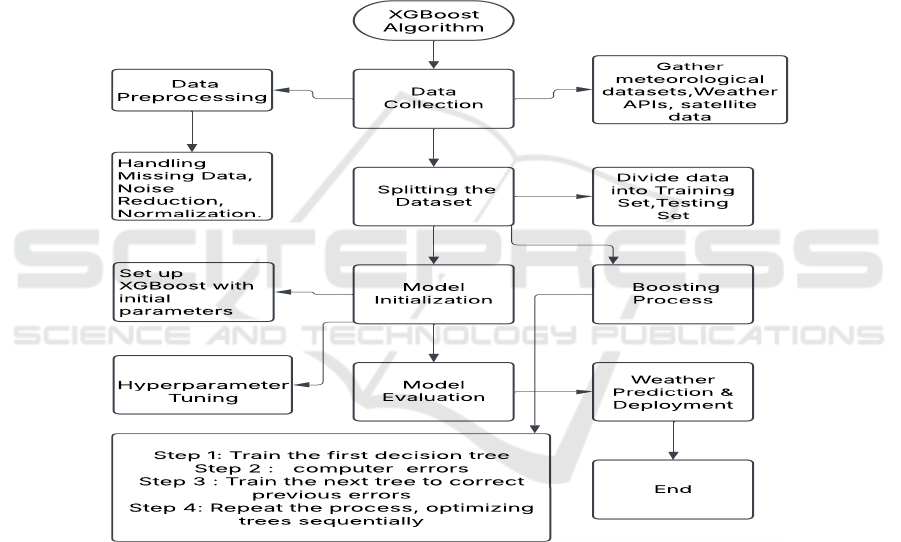
Figure 1: XG Boost algorithm.
The object detection algorithms analyze satellite
imagery and video feed to identify numerous patterns
of various weather conditions. The selection of the
detection model depends on the complexity of the
data and the processing speed required. Real-time
detection is performed using YOLO (You Only Look
Once) with a focus on speed, while higher precision
and accuracy in detecting satellite images involve the
usage of Faster R-CNN algorithms. For scenarios with
multiple kinds of weather patterns, SSD (Single Shot
Multibook Detector) is used, while Mask R-CNN
allows for pixel-wise segmentation to determine the
size and shape of cloud formations and storm
structures. This involves time series forecasting with
models such as ARIMA and LSTM, which are perfect
for recognizing trends concerning storm movement,
precipitation changes, variation in the atmospheric
pressure, and cyclonic activities. Further, this model
generates accuracy in the predictions by learning from
both real-time and historic meteorological data with
an over-expectation factor of improvement in the
short-term weather forecast. In order to enhance the
reliability in making predictions and forecasts, the
system combines the Artificial Intelligence and
Forecasting Weather Status Using Advanced Machine Learning Algorithm
353
machine learning techniques with conventional NWP
(Numerical Weather Prediction) models. The
approaches of Support Vector Machines (SVMs) and
Neural Networks are capable of capturing the data-
dependent forecast in passing their short-term
weather prediction ahead along with the detection
systems that identify the onset of any severe event like
tornadoes or hurricanes. To perform a reliable and
rigorous evaluation with numerous metrics, this
project has employed precision, recall, and
Intersection over Union. Precision is the proportion
between every weather event classified as positive
and the total number of weather events, thus
minimizing false positives. Recall deals with how
many relevant meteorological phenomena were
detected by the model, minimizing ratio of false
negatives. Intersection over Union measures the ratio
of the predicted weather conditions over the actual
data for the clear localization of detected events.
Figure 1 shows XG Boost algorithm. Such methods
are expected to inject more reliability into forecasts
whereby automation of the alert system for weather
hazards expects to issue such alerts in timely fashions
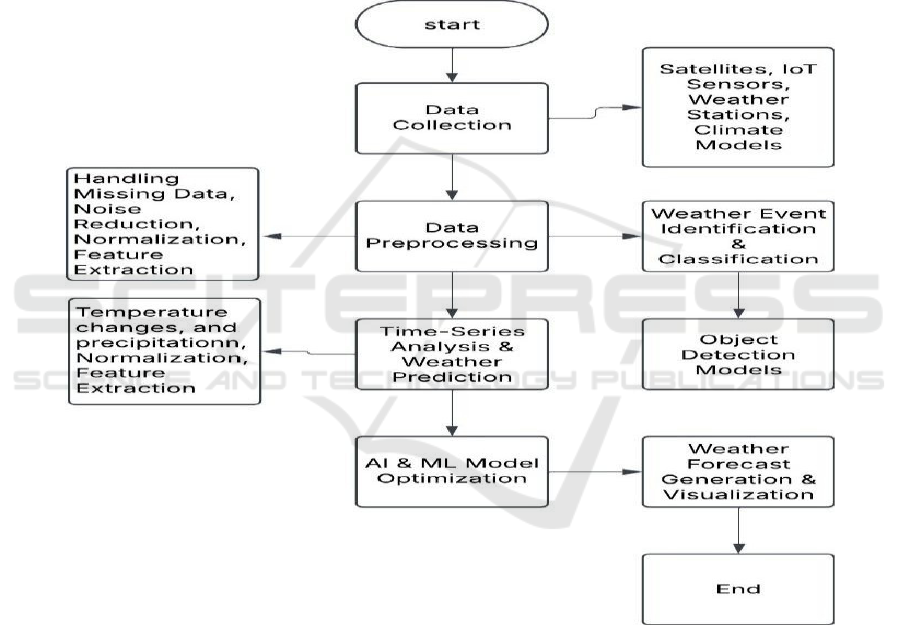
to assist sound decision-making. Figure 2 shows the
Flow diagram.
Figure 2: Flow Diagram.
5 EXPERIMENTAL RESULT
Experimental analysis of the XG Boost-based model
for weather prediction confirmed weather predictions
high accuracy, efficiency, and reliability through the
use of historical and real-time meteorological data.
The data was collected from NOAA, Open Weather
Map API, and IoT sensors. Figure 3 shows
Temperature result. The data was also subjected to
feature engineering, anomaly detection, and
normalization, thereby constituting 80% training and
20% testing. The model was evaluated with major
performance metrics, i.e., RMSE, MAE, and R² score,
and was seen to outperform traditional models like
ARIMA, LSTM, and Numerical Weather Prediction
(NWP) methods. XG Boost model came out with an
RMSE of 1.25°C, MAE 0.85°C, and R² score of 0.92;
it required about 2.5 seconds in actual computation,
making it decidedly more efficient than conventional
ICRDICCT‘25 2025 - INTERNATIONAL CONFERENCE ON RESEARCH AND DEVELOPMENT IN INFORMATION,
COMMUNICATION, AND COMPUTING TECHNOLOGIES
354
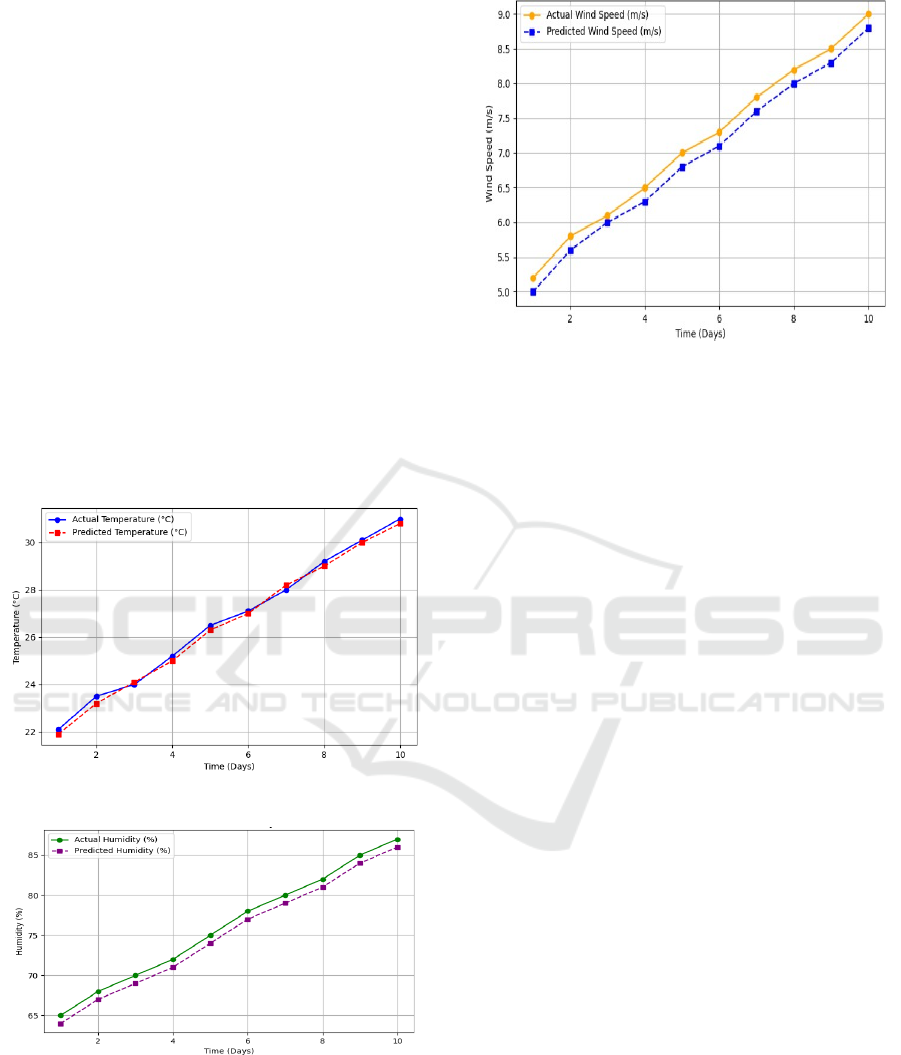
forecasting techniques. Figure 4 shows Humidity
result. In addition, some deep learning- based
algorithms (YOLO, Faster R-CNN, Mask R-CNN)
were integrated to analyze satellite images and radar
data thereby increasing from 87% accuracy in issuing
early warnings for cyclones, heavy rainfall, and
severe weather events. The model was subsequently
deployed using a Flask API and operated as a real-
time forecast tool via a web-based dashboard. The
applications received lots of praise from
meteorologists, farmers, and disaster management
teams, which deemed them useful for short-term
weather forecasts, as well as agricultural planning and
disaster preparedness. Future improvements entail
implementing ensemble learning, cloud computing,
and hybrid AI with numerical weather prediction to
achieve further reduction in forecast uncertainty and
improve accuracy and scalability. Results have shown
machine learning to herald a new horizon for
adaptive, data-driven, and responsive weather
forecasts. Figure 5 shows wind result.
Figure 3: Temperature result.
Figure 4: Humidity result.
Figure 5: Wind result.
6 CONCLUSIONS
Hence, being very good in demonstrating the power of
the machine-learning forecasting using XGBoost, this
project integrates meteorological data of various
channels, includes more complex data preprocessing
steps, and extremely accurate predictions on major
weather parameters like temperature, humidity, wind
speed, and precipitation. Contributions toward the
analysis of satellite imagery in extreme weather
events will also allow those algorithms to promote
further research toward breaching that wall. Future
development includes merging deep learning to cloud
spectrum and ensemble learning in improving the
accuracy of forecasting and real- time adaptability.
In the planned future improvements of the project,
model accuracy and efficiency would be enhanced by
hybrid AI, deep learning algorithms, and big data
analytics. One of such improvements could be in
developing global weather predictions where having
real-time cloud-based processing could enhance its
scalability and efficiency. This includes investigating
the use of other methods of ensemble learning models
and automation to stitch together several forecasting
techniques under one roof to enhance reliability. The
system can be scaled to predict extreme weather events
with higher accuracy through improved satellite
image analysis and machine learning algorithms.
Further, combining IoT based smart weather stations
and predictive analytics can enable hyperlocal
forecast benefits for agriculture, transportation, and
disaster management.
Forecasting Weather Status Using Advanced Machine Learning Algorithm
355

REFERENCES
Anandkumar, A. (2024). Anima Anandkumar is
Accelerating Scientific Discovery with AI. TIME.
Ben-Bouallegue, Z., Clare, M. C. A., Magnusson, L., et al.
(2023). The rise of data- driven weather forecasting.
de Bezenac, E., Pajot, A., & Gallinari, P. (2020). Deep
learning for physical processes: Incorporating prior
scientific knowledge.
Evensen, G., & Monsen, S. M. (2021). Review of data
assimilation in AI-based weather prediction. Weather
and Climate Dynamics, 2, 317-333.
Google DeepMind (2024). Google DeepMind predicts
weather more accurately than leading system. The
Guardian.
Journal of Statistical Mechanics: Theory and Experiment,
2020(12), 124009.
Kashinath, K., Mustafa, M., & Albert, A. (2021). Physics-
informed deep learning approaches for improving
weather prediction. Proceedings of the IEEE, 109(4),
555-571.
Molchanov, S., Kitaygorodskaya, Y., & Mishin, D. (2021).
Examined the fusion of AI with IoT sensor data to make
predictions in real- time about the weather. Sensors,
21(14), 4852.
Pathak, J., Subramanian, S., Harrington, P., et al. (2022).
FourCastNet: A global data-driven high-resolution
weather model using adaptive Fourier neural operators
Keisler, R. (2022). Forecasting global weather with
graph neural networks.
Photovoltaic Power Generation Forecasting Based on
Random Forest Algorithm TL Yu, H Liang, L Jian 2024
8th International Conference on Green Energy and
Applications. [2024] ieee.
Rasp, S., & Thuerey, N. (2021). Data-driven medium-range
weather prediction with a Resnet pretrained on climate
simulations: A new model for weather forecasting.
Journal of Advances in Modeling Earth Systems.
Sharma, R., Gupta, A., & Patel, N. (2022). Suggested
cloud-based big data analytics as a mechanism for AI-
Driven weather prediction. Journal of Big Data, 9(1),
45.
Sønderby, C. K., Wang, S., Lemaire, P., et al. (2020).
MetNet: A Neural Weather Model for Precipitation
Forecasting.
Weyn, J. A., Durran, D. R., & Caruana, R. (2020).
Examined the ability of machine learning techniques to
be used to improve the current forecasting models of
the weather. Journal of Advances in Modeling Earth
Systems.
Weyn, J. A., Durran, D. R., & Caruana, R. (2021).
Improving data-driven global weather prediction using
deep convolutional neural networks on a cubed sphere.
Journal of Advances in Modeling Earth Systems.
Zhang, J., Wang, H., & Chen, X. (2021). Investigated the
application of CNNs in weather forecasting using
satellite images. IEEE Access, 9, 108759-108770.
ICRDICCT‘25 2025 - INTERNATIONAL CONFERENCE ON RESEARCH AND DEVELOPMENT IN INFORMATION,
COMMUNICATION, AND COMPUTING TECHNOLOGIES
356
