
AI‑Enabled Academic Conference Management System
Ranjit Reddy Midde, Geetha Seri Lingala, Hemalatha Dubasi,
Gayathri Mangala and Prashanth Kumar Reddy Pullaiahgari
Department of CSE, Srinivasa Ramanujan Institute of Technology, Rotarypuram Village, B K Samudram Mandal,
Anantapuramu - 515701, Andhra Pradesh, India
Keywords: Support Vector Machines (SVM), K‑Nearest Neighbors (KNN), Random Forest Algorithm.
Abstract: Academic conferences play a vital role in fostering knowledge sharing and collaboration among researchers
and experts. However, managing these events involves complex tasks such as paper submission, peer review,
scheduling and communication which are often inefficiently handled. Existing methods and systems show
significant limitations such as inconsistent reviewer assignments, reliance on manual sorting of papers and
limited interaction between authors and reviewers. These issues make the conference process less efficient.
Addressing these issues, AI-enabled Academic Conference Management System aims to overcome these
challenges by using machine learning techniques such as Support Vector Machines, K-Nearest Neighbors and
Random Forest to automatically classify research papers by domain and assign reviewers based on domain
expertise. Additionally, it introduces organized feedback mechanisms via email and supports direct author-
reviewer collaboration through video conferencing to facilitate the review process. The system reduces
manual effort by automating paper classification, ensuring accurate matches, user-friendly interface enables
faster workflows and a more efficient review process.
1 INTRODUCTION
Academic conferences are essential platforms for
researchers and experts to share knowledge, foster
collaborations, and disseminate groundbreaking
research. However, managing these conferences is a
complex process that involves numerous
interdependent tasks, including paper submissions,
reviewer assignments, session scheduling, and
participant communication. Traditional conference
management systems often struggle to address these
challenges effectively. Issues such as manual sorting
of research papers, inconsistent reviewer
assignments, and inadequate communication
channels between authors and reviewers lead to
inefficiencies, delays, and potential errors. For
instance, manual paper review processes are prone to
human error, while poorly matched reviewers may
result in superficial evaluations, negatively impacting
the quality of feedback and the overall conference
experience.
To overcome these challenges, this research
introduces an AI-enabled Academic Conference
Management System designed to optimize and
streamline conference workflows. The system
leverages advanced machine learning techniques
such as Support Vector Machines (SVM), K- Nearest
Neighbors (KNN), and Random Forest for
automating classification of research papers into
specific domains, ensuring precise reviewer
assignments based on domain expertise.
Additionally, the system integrates innovative
features such as structured feedback mechanisms and
direct collaboration through video conferencing.
These enhancements facilitate seamless
communication between authors and reviewers,
accelerate the review process, and foster meaningful
interactions. By reducing manual effort, improving
collaboration and due to a user-friendly interface the
proposed system aims to transform academic
conference management, addressing inefficiencies
and promoting a more organized and effective review
process.
2 RELATED WORK
Several systems for managing conferences are
developed to streamline various processes like paper
submission, review, and feedback.
328
Midde, R. R., Lingala, G. S., Dubasi, H., Mangala, G. and Pullaiahgari, P. K. R.
AI-Enabled Academic Conference Management System.
DOI: 10.5220/0013927800004919
Paper published under CC license (CC BY-NC-ND 4.0)
In Proceedings of the 1st International Conference on Research and Development in Information, Communication, and Computing Technologies (ICRDICCT‘25 2025) - Volume 5, pages
328-334
ISBN: 978-989-758-777-1
Proceedings Copyright © 2026 by SCITEPRESS – Science and Technology Publications, Lda.

M. Spilker, F. Prinsen, and M. Kalz (2019)
analyzed the impact of technology-enhanced
academic conferences on professional development,
highlighting benefits such as improved accessibility,
interactive learning, and global reach, while
addressing challenges like equitable access and
interaction quality. Similarly, MyConfree, developed
by Metta Santiputri Nindy et al. (2018), leverages
PHP, CodeIgniter, and MySQL to streamline
workflows with features like paper submissions, call-
for-paper announcements, and traditional review
processes, demonstrating how technology simplifies
conference management.
Other systems further emphasize innovation in
conference workflows. Cheng Zheng et al. (2008)
introduced a collaborative platform with tools for
real-time updates, session scheduling, and participant
registration to improve coordination. K. Ahmad et al.
presented a system tailored for higher education,
offering features like author notifications and
deadline alerts. OpenConf, introduced by the Zakon
Group (2001), simplifies tasks such as peer reviews,
attendee registration, and scheduling with its user-
friendly interface, reducing administrative burdens
and improving the experience for organizers and
participants alike.
A. Malinowski and B. Wilamowski, in their work
titled “Paper Collection and Evaluation through the
Internet” (Proceedings of the 27th Annual
Conference of the IEEE Industrial Electronics
Society, Denver) , addressed limitations in standalone
web-based conference management systems. These
systems often lack fault tolerance, and the capacity to
support distributed users. To overcome these
challenges, they proposed a collaborative conference
management system that utilizes advanced
collaboration technologies to improve fault tolerance,
scalability, and user accessibility.
Rigaux Ph., in “An Iterative Rating Method:
Application to Web-based Conference Management”
(Proceedings of the 2004 ACM Symposium on
Applied Computing), proposed a method for
collecting user preferences or ratings on a large set of
items without asking each user to rate each one. The
approach relies on an iterative process, where each
step, or ballot, involves users rating a sample of items.
A collaborative filtering algorithm predicts the
missing ratings along with their confidence levels,
which are initially set to zero. Subsequent ballots
improve the prediction accuracy, and the system
administrator determines when to stop the iteration
upon reaching a satisfactory level. This method was
applied to assign reviewers to papers prior to the
review phase in conference management and was
implemented in the MYREVIEW web-based system.
A web-based academic conference management
system called ConfSys (Huang et al., 2008) is
introduced. ConfSys is intended to assist program
chairs, general chairs, and program committees in
overseeing the operations of scholarly conferences
and to offer conference-related services to authors
and attendees. It can post papers, assign them to
reviewers automatically, let the chairs change the
assignment, debate and rate papers, create the
program, register for conferences, gather presentation
slides, and more. These features facilitate rapid and
simple conference management.
Ware M., in “Online Submission and Peer‐
Review Systems” (Learned Publishing, Vol. 18, No.
4, pp. 245-250, 2005), explored the adoption of online
systems for managing submissions and peer reviews
in academic publishing. The study highlighted the
benefits of such systems, including streamlined
submission processes, efficient reviewer
assignments, and improved communication between
authors, reviewers, and editors. Organizing scientific
conferences involves managing paper submissions
and reviews, which are crucial yet often complicated
tasks. Existing systems are complex, with many
unused features, and typically rely on hosting
services, raising concerns about data security. This
study presents the Online Paper Submission System
(OPSS) (Rotikan, Reymon. 2016), an online
application created to streamline the process of
submitting and reviewing papers.
3 PROPOSED SYSTEM
3.1 Workflow of Proposed System
The workflow of AI-Enabled Academic Conference
Management System consists of the following major
steps: Step 1: Abstract Submission – Authors submit
abstracts through a user- friendly web interface,
ensuring ease of access. Step 2: Domain
Classification – These abstracts are classified into
specific domains using advanced machine learning
techniques like SVM, KNN, and Random Forest,
enabling accurate domain categorization. Step 3:
Reviewer Assignment – Domain-specific reviewers
are assigned to evaluate the abstracts and provide
feedback. Step 4: Full Paper Submission – Abstracts
that meet the required standards lead to the
submission of full papers for further review. Step 5:
Full Paper Evaluation – These full papers undergo a
thorough evaluation process, and feedback is sent to
the authors via email. Step 6: Collaboration – Video
AI-Enabled Academic Conference Management System
329
conferencing tools facilitate discussions between
authors and reviewers, fostering better
communication and understanding.
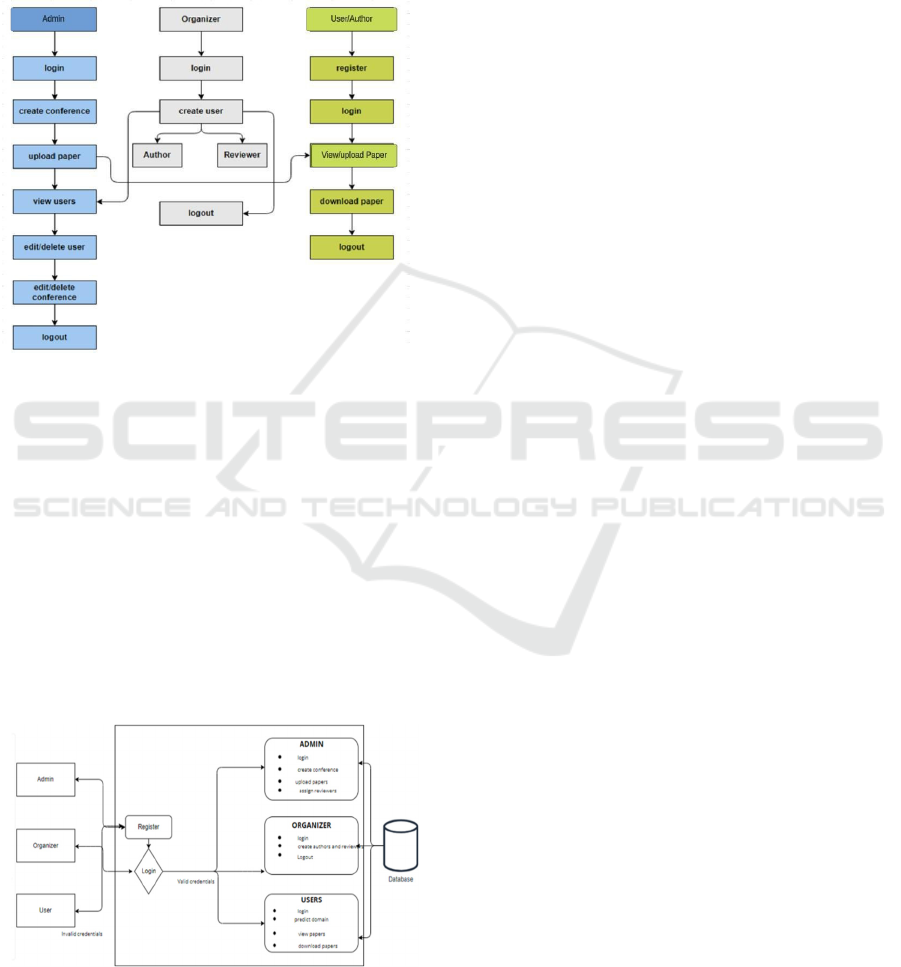
Figure 1 depicts the suggested system’s structured
process. It begins with the submission of an abstract,
which is classified into a relevant domain using
machine learning algorithms and ends with the paper
submission.
Figure 1: Proposed system workflow.
3.2 Architecture of the Proposed
System
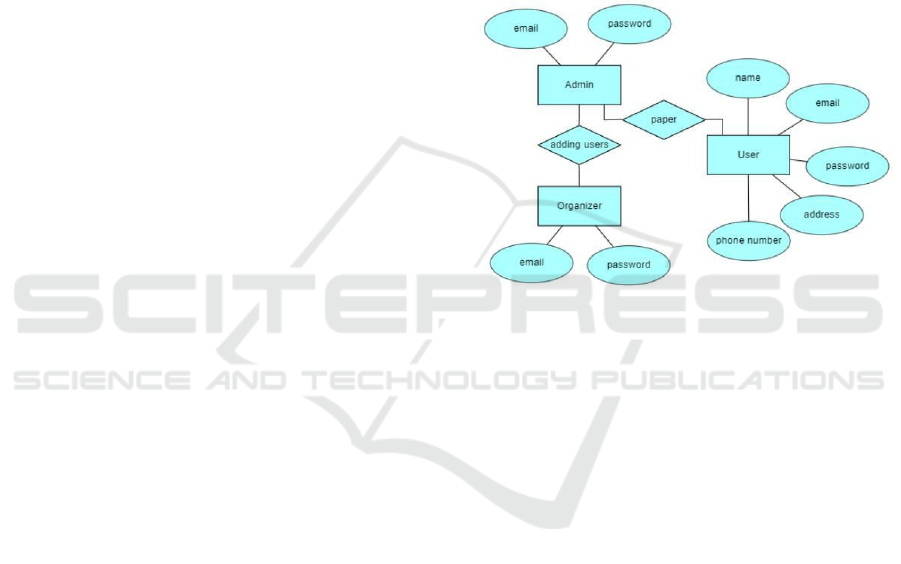
Three main roles are included in the centralized
database and role-based access control architecture of
the AI-Enabled Academic Conference Management
System: Admin, Organizer, and User. Admin
manages critical functionalities such as creating
conferences, uploading research papers, and
assigning reviewers to specific domains. Organizers
act as intermediaries, handling the creation and
management of authors and reviewers while ensuring
smooth workflow execution.
Figure 2: Architecture of proposed system.
Users submit abstracts through a user-friendly
web interface, which are then classified into relevant
domains using machine learning algorithms like
SVM, KNN, and Random Forest. The system ensures
efficient handling of data through secure storage and
retrieval in the database, with seamless interaction
between roles and real-time collaboration enabled via
integrated video conferencing tools. This architecture
provides a streamlined and scalable framework for
managing academic conferences (figure 2).
The system architecture showcases a role-based
login mechanism where Admin, Organizer, and Users
have distinct functionalities. The Admin manages
conferences, uploads papers, and assigns reviewers,
while the Organizer handles creating authors and
reviewers. Users can log in to predict domains, view,
and download papers, with all actions interacting with
a centralized database.
4 IMPLEMENTATIONS
4.1 Dataset
Abstracts were manually curated from research
papers available online. Each abstract was labeled
with its respective domain like cybersecurity,
blockchain, cloud computing etc. In the dataset
preparation stage, the dataset is loaded from an Excel
file, where the first column represents the textual
content (abstracts), and the second column contains
the corresponding labels. The dataset is examined
to identify the number of rows and columns for
a clearer understanding of its structure. Text data
undergoes preprocessing to ensure uniformity and
remove noise. This requires converting text to
lowercase, deleting digits and special characters,
eliminating stopwords, and performing
lemmatization to retrieve the base form of words.
After processing, the text input is vectorized to
provide numerical feature representations using the
TF- IDF (Term Frequency-Inverse Document
Frequency) technique. Simultaneously, the labels are
encoded into numerical values using a label encoder.
Finally, the data is then divided into two parts: 80%
for training the model and 20% for testing it. This
ensures a fair evaluation of the model's performance.
4.2 Algorithms Used
Three machine learning techniques were
implemented for classifying the abstracts into specific
domains as follows: Support Vector Machine (SVM)
was used to classify research paper abstracts by
ICRDICCT‘25 2025 - INTERNATIONAL CONFERENCE ON RESEARCH AND DEVELOPMENT IN INFORMATION,
COMMUNICATION, AND COMPUTING TECHNOLOGIES
330
creating the best possible boundary in a high-
dimensional space. This boundary helps separate the
abstracts into their respective domains. The main goal
of SVM is to ensure there is as much space as possible
between this boundary and the closest data points
from each category, which are called support vectors.
This approach improves classification accuracy by
clearly distinguishing different domains. The SVM
classifier was particularly effective for this project
because of its ability to handle high-dimensional data,
making it ideal for the TF-IDF feature representation
of abstracts. Random Forest was used as an ensemble
learning algorithm to improve classification
performance by constructing multiple decision trees
and aggregating their predictions through majority
voting. Each decision tree in the forest was trained on
different bootstrap sample of dataset, and feature
selection was performed randomly at each split,
ensuring diversity among the trees. K-Nearest
Neighbors (KNN) was employed as a simple,
instance-based learning algorithm to classify
abstracts by measuring their proximity to labeled
examples in the feature space. KNN will operate by
calculating the Euclidean distance in between a test
sample and all other training samples, selecting k
nearest neighbors and determining the class label
based on the category that appears most frequently
among them.
4.3 Model Training
The Support Vector Machine (SVM), Random
Forest, and K-Nearest Neighbors (KNN) models are
trained using data that has been split into 80% for
training and 20% for testing to ensure reliable
evaluation, where 80% of the 330 manually labeled
abstracts were used for training and 20% for testing.
SVM was tuned to find an optimal hyperplane for
separating the data based on their respective domains.
Random Forest utilized multiple decision trees,
aggregating results through majority voting to
improve classification accuracy. KNN classified
abstracts based on the proximity of test samples to
labeled training examples, using distance-based
classification.
4.4 Model Performance Evaluation
The evaluation focuses on accuracy, precision, recall,
and F1-score, providing a clear understanding of how
well each model performs in classifying abstracts,
assigning reviewers, and facilitating the overall
workflow. Through these metrics, we aim to validate
the efficiency and reliability of the implemented
algorithms in real-world conference management
scenarios.
4.5 Web Development
A relational database structure to store and manage
information, including author submissions, reviewer
assignments, paper classifications, review statuses,
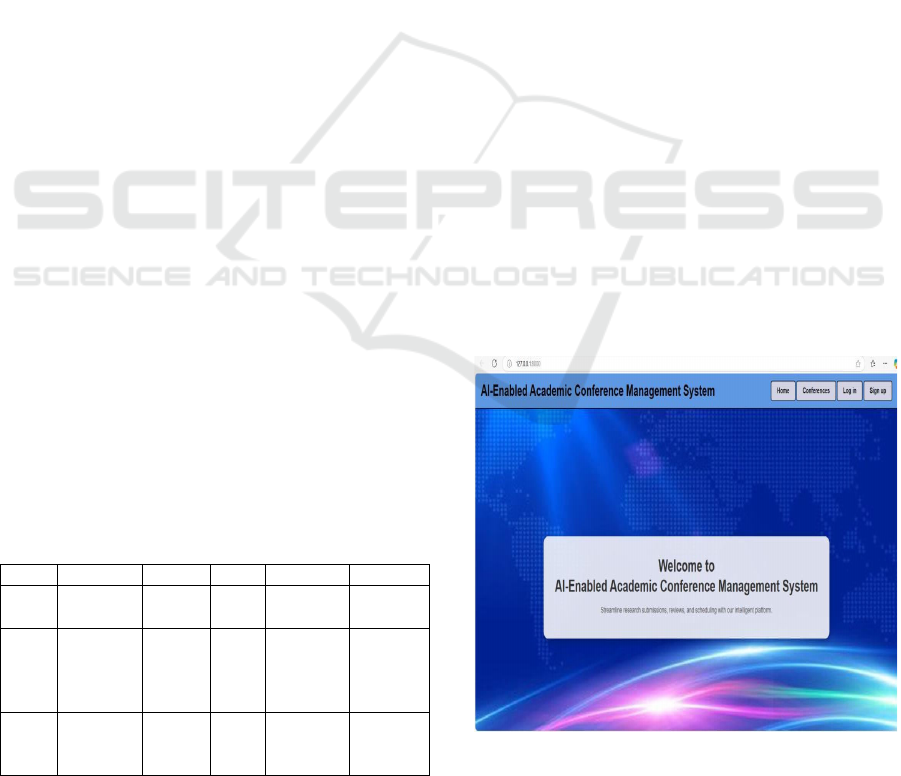
and video conference schedules. The below Figure 3
depicts ER diagram that illustrates the structure and
relationships within the database. It showcases the
entities, their attributes, and the connections between
them, providing a clear overview of how data is
organized and interrelated.
Figure 3: Entities and their relations.
The AI-Enabled Academic Conference Management
System uses Django's built-in SQLite database to
manage all application tables efficiently. Django's
ORM automatically translates models into tables and
handles data operations like insertion, updates, and
queries. SQLite's lightweight nature and seamless
integration with Django make it an ideal choice. The
database consists of the following tables:
main_author, main_chair, main_conference,
main_reviewer, main_user, main_creates,
main_paper, main_schedules, main_submits,
main_assigns, and main_reviews. The database
designed to manage various entities and operations
within the system. to the system's functionality. The
AI-Enabled Academic Conference Management
System was built using Django's MVT (Model-
View-Template) architecture, where the Model
defines the application's data structure and handles
database operations, such as managing entities like
authors, reviewers, papers, conferences, and
schedules. The View serves as the intermediary,
processing user requests, manipulating data through
the Model, and passing it to the Template for
rendering. The Template is responsible for the user
interface, dynamically presenting data using
AI-Enabled Academic Conference Management System
331
Django's templating engine, with templates designed
for pages like the home page, domain prediction,
reviewer assignment, submission status, and
schedule, ensuring a user-friendly and visually
appealing interface.
4.6 Integration of Machine Learning
Model into the Web Page
Machine learning model, trained to classify abstracts
into specific domains using algorithms like Support
Vector Machines (SVM), Random Forest, and K-
Nearest Neighbors (KNN), was seamlessly integrated
into the Django-based MVT (Model-View-Template)
architecture. After training and evaluating the model
using metrics like recall, precision, and F1-score,
final model was serialized and saved using the joblib
library for efficient reuse in the application. The
integration process of the trained machine learning
model into the MVT architecture involved several
steps. First, the model was serialized and saved as a
.joblib file, enabling efficient loading during runtime
without the need for retraining. In the View
component of the Django framework, the saved
model was loaded and utilized for predicting the
domain of submitted abstracts. Upon submission, the
abstract data was preprocessed and passed to the
model for classification. The classification results
were then stored in the Model component of the
application, associating each abstract with its relevant
domain to ensure the appropriate assignment of
reviewers based on domain expertise. Finally, the
prediction results were dynamically displayed on the
Template pages, such as the abstract submission
status page and reviewer assignment page, providing
users with real-time feedback and facilitating a
streamlined workflow.
5 RESULTS
Table 1: Performance ranking and accuracy.
Ran
k
Algorith
m
Precision Recall F1-Score Accurac
y
1
Random
Forest
84% 85% 84% 89%
2
Support
Vector
Machine
(SVM)
87% 86% 86% 86%
3
K-Nearest
Neighbors
(
KNN
)
76% 82% 76% 82%
Performances of different Algorithms were checked
and contrast has been made to identify the most
efficient algorithm for the domain prediction of the
uploaded abstract.
Table 1 represents performance comparison of the
machine learning techniques used in the system based
on metrics like F1-score, accuracy, precision, and
recall. Random Forest algorithm achieved the highest
accuracy at 89%, with strong precision and recall
values, making it the top- performing model. The
Support Vector Machine (SVM) closely followed,
demonstrating balanced performance across all
metrics. K-Nearest Neighbors (KNN), while showing
reasonable recall, had lower precision and F1-scores,
ranking third. This ranking highlights the
effectiveness of Random Forest for domain
classification tasks in the system.
Finally, the Random Forest model is seamlessly
integrated with the web interface using Django,
making the system highly user-friendly. This
integration allows for easy and accurate domain
prediction of abstracts. Additionally, other
functionalities, such as creating conferences and
reviewing abstracts, are designed with intuitive and
user-friendly interfaces. The AI-enabled Academic
Conference Management System is designed to
support four distinct user roles: Admin,
Chair/Organizer, Author, and Reviewer. Each role is
provided with a tailored interface that allows them to
perform specific tasks relevant to their
responsibilities in the conference management
process. The following key web pages illustrate how
the interface accommodates the needs of each role.
Figure 4: Home page.
Figure 4 depicts homepage that serves as a central
ICRDICCT‘25 2025 - INTERNATIONAL CONFERENCE ON RESEARCH AND DEVELOPMENT IN INFORMATION,
COMMUNICATION, AND COMPUTING TECHNOLOGIES
332
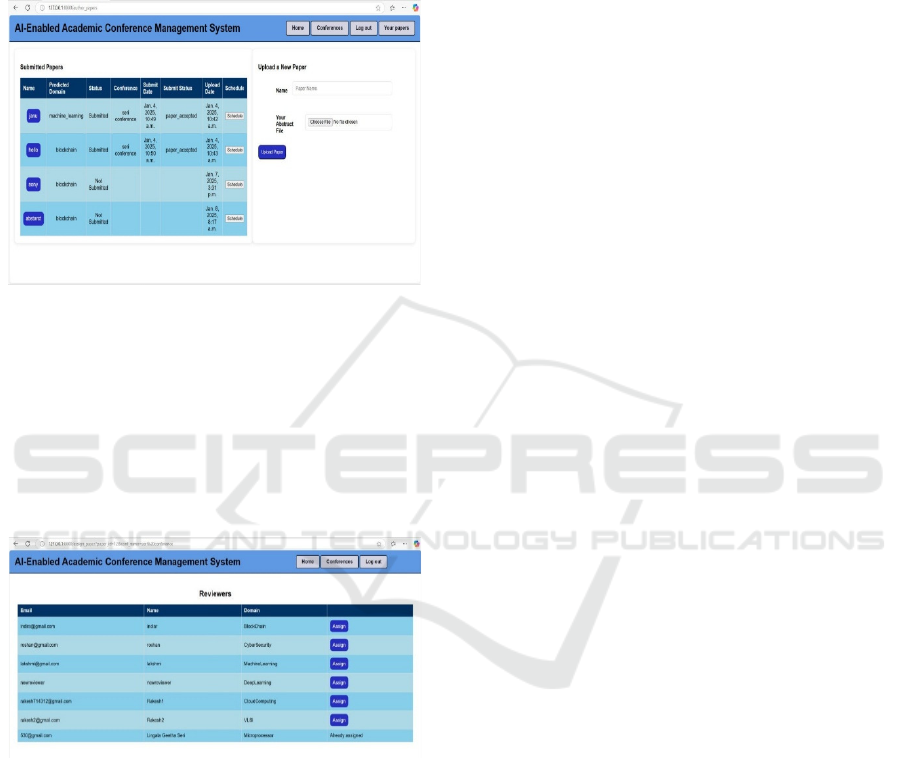
hub, offering intuitive navigation tailored to authors,
reviewers, and administrators. It streamlines access to
role-specific features, enabling authors to submit
papers, reviewers to evaluate assignments, and
administrators to manage workflows efficiently,
ensuring a seamless user experience.
Figure 5: Page for domain prediction.
Figure 5 depicts the abstract classification page,
where page highlights the predicted domain and
provides transparency into the classification results.
The machine learning model is integrated into the
webpage using Django, enabling seamless interaction
between the backend and the user interface. All the
conference details are stored in the backend using
sqlite database which is a built in database in Django.
Figure 6: Page for reviewer assignment.
Figure 6 depicts the reviewer assignment page, where
administrators assign reviewers to abstracts based on
their classified domains. The interface displays the
abstract details, predicted domain, and a list of
available reviewers with their respective expertise.
This ensures that reviewers are matched with
abstracts relevant to their domain, improving the
quality of feedback and reducing manual workload.
The streamlined process enhances the efficiency of
the review workflow.
6 FUTURE SCOPE
The future scope of the AI-enabled Academic
Conference Management System includes integrating
multiple conferences on a unified platform, enabling
centralized management and resource sharing. The
system can be enhanced with scalable conference
management, dynamic reviewer matching across
events, and real-time collaboration tools for authors
and reviewers. Mobile application development can
improve global accessibility, while AI-driven
analytics can offer valuable insights for organizers.
Additionally, integrating blockchain technology can
enhance transparency, and automated session
scheduling can streamline event organization, making
the platform a comprehensive solution for academic
conferences.
7 CONCLUSIONS
The AI-enabled Academic Conference Management
System successfully achieves its objectives of
automating abstract classification, streamlining
reviewer assignment, and enhancing collaboration
between authors and reviewers. By employing
machine learning techniques like Random Forest, K-
Nearest Neighbors, and Support Vector Machines,
the system ensures precise domain classification of
abstracts, facilitating efficient reviewer allocation.
Integrated tools, including structured feedback
mechanisms and video conferencing, further promote
effective communication and collaboration. The
platform addresses inefficiencies in traditional
conference workflows by providing an organized,
transparent, and user-friendly interface for all
stakeholders. With these advancements, the system
establishes a strong foundation for modernizing
academic conferences while meeting the objectives
set forth in the project.
REFERENCES
Cheng Zheng, Weiming Shen, Qinghua Zheng, Feng Tian,
"Design and Implementation of a Collaborative
Conference Management System", 2008.
Huang, M., Y. Feng, B. C. Desai. CONFSYS: A Webbased
Academic Conference Management System.
Proceedings of 2008 C3S2E conference. ACM Press,
2008.
K. Ahmad, A. A. Abdullah, and A. M. Zeki, “Web-based
Conference Management System for Higher Learning
Institutions,” International Islamic University Malaysi
AI-Enabled Academic Conference Management System
333

a, Kulliyyah of Information and Communication
Technology.
M. Spilker, F. Prinsen and M. Kalz, "Valuing technology-
enhanced academic conferences for continuing
professional development", A systematic literature
review Professional Development in Education, 2019.
Malinowski and B. Wilamowski, "Paper Collection and
Evaluation through the Internet", Proceedings of the 27
Annual Conference of the IEEE Industrial Electronics
Society, Denver.
Metta Santiputri, Nindy, Surya Agustin, MeraKartika
Delimayanti, “MyConfree: A Web- based Conference
Management System” Published by IEEE, Proceedings
of IEEE 2018.
Rigaux Ph. An Iterative Rating Method: Application to
Web-based Conference Management. Proceedings of
the 2004 ACM symposium on applied computing.
Rotikan, Reymon. 2016. OPSS: Online Paper Subm-ission
System Untuk Kegiatan Konferensi Ilmiah Cogito
Smart Journal/VOL.2/No/2/Desember 2016.
Ware M. “Online submission and peer‐review systems” in
learned publishing.
Zakon Group, “OpenConf Conference Management
System,” Web Site: www.openconf.org, 2001.
ICRDICCT‘25 2025 - INTERNATIONAL CONFERENCE ON RESEARCH AND DEVELOPMENT IN INFORMATION,
COMMUNICATION, AND COMPUTING TECHNOLOGIES
334
