
Advanced Integrated Damage Detection System for Bulletproof
Materials Using Ultrasonic and X‑Ray Sensors with AI Algorithms
P. Sreedevi, A. Sabina Parveen, S. Diva, S. Subasanjeev, D. Pranavika and V. Rakshitha
Department of Computer Science and Engineering, V.S.B College of Engineering Technical campus, Kinathukadavu,
Coimbatore, Tamil Nadu, India
Keywords: Damage Detection, Bulletproof Materials, Integrated System, Ultrasonic Sensors, X‑Ray Sensors, Artificial
Intelligence (AI), High Risk Situations.
Abstract: A new integrated damage detection system for bullet proofing materials during high complicated situation
such as war in the border. Two sensors are combined by conventional inspection method in sensitivity in
identifying minor damage in the bulletproof material. We have developed a novel system that combine X-
Ray sensor and ultrasonic sensors to meet the need of bulletproof material damage. The ultrasonic sensors
were developed to reveal the flaws in the outside of the bulletproof material and the X-Ray sensors detect the
flaws in the internal structure of the bullet proof material using AI algorithms. The ai algorithm are trained to
detect complex patterns with damage and enable the system to detect even the smallest imperfection in the
bulletproof material. This integrated system not only speed ups the inspection and also enhance the efficiency
of the inspection compared to the conventional technique. This is a fully automatic process which mainly
avoids the human error and reduction of time and provides an accurate result. this project enables us to get
the overall safety of the bulletproof materials that are used in the high-risk environment. This project is a
stepping stone idea for the inspection and maintenance of the bulletproof materials.
1 INTRODUCTION
1.1 Background
The people who working in high-risk environments
like Military bases, police and protecting the most
important and valuable buildings and things wants the
high priority in integrity of bulletproof materials.
Such materials are manufactured to protect from the
penetration of the war materials like bullets from the
rifles. Any mistakes are small damage in these
materials have the high chance of putting the people
in the risk of death.
1.2 Problem Statement
The old and traditional methods for testing the
bulletproof materials are ineffective for detecting the
small and internal faults in the materials. These are
time-consuming, requires many labours and having
high risk of human errors. Also, here it is impossible
to detect some hidden defects that are not visible to
our naked eye, even though it is a small hidden defect
it leads to reduce the quality of the material.
1.3 Project Objective
This project creates a new system that combines
Artificial intelligence (AI) and cutting-edge sensors
to create solution for this issue. By providing fully
automatic, more accuracy, more effective solution,
this system makes fundamentally alter the way of
identifying the defects in the bulletproof materials. It
will produce the result that are more and more
accurate, faster and reduce the labour count. It is the
most intelligent idea and it guarantees the lifetime and
safety of the bulletproof materials.
316
Sreedevi, P., Parveen, A. S., Diva, S., Subasanjeev, S., Pranavika, D. and Rakshitha, V.
Advanced Integrated Damage Detection System for Bulletproof Materials Using Ultrasonic and X-Ray Sensors with AI Algorithms.
DOI: 10.5220/0013927600004919
Paper published under CC license (CC BY-NC-ND 4.0)
In Proceedings of the 1st International Conference on Research and Development in Information, Communication, and Computing Technologies (ICRDICCT‘25 2025) - Volume 5, pages
316-320
ISBN: 978-989-758-777-1
Proceedings Copyright © 2026 by SCITEPRESS – Science and Technology Publications, Lda.

2 CORE TECHNOLOGIES
2.1 Ultrasonic Sensors
2.1.1 Principle of Operation
Ultrasonic sensors are extremely efficient at
finding subsurface defects and variations in
material properties. They work by sending high-
frequency sound waves that penetrate the material
and bounce back when they come across
irregularities like cracks, delamination, or voids.
The reflected waves are then picked up and
examined to detect hidden damage that cannot be
seen by the naked eye.
2.1.2 Advantages
High Sensitivity: Ultrasonic sensors are able to
detect very small subsurface defects that typically
escape detection by visual inspection.
Non-Destructive: The inspection process will not
damage the material so can be repeated over time.
Versatility: These sensors can be utilized on a
wide range of materials, such as metals,
composites, and ceramics.
2.2 X-Ray Sensors
2.2.1 Principle of Operation
X-Ray sensors provide a high-quality image of the
internal structure of the bulletproof material by
passing the X-Rays through the material and record
the result images. This is more effective for finding
the internal defects like fractures, variation in the
packing mass of the material with high accuracy.
By using X-Ray imaging, we can get the detailed
information about the internal structure if the
materials and easily finds the damage or defects in
it.
2.2.2 Advantages
High-quality Imaging: X-Ray sensors provide the
close-up images of the internal part of the material.
So, it allows us to find the defect easily.
Non-Destructive: By passing the X-Ray sensors
repeatedly to the material for the continuous testing
it will not make any damage to the material. It just
provides the internal structure of the bulletproof
material.
3 SYSTEM INTEGRATION AND
AI
3.1 Sensor Technology Integration
3.1.1 Complementary Strengths
The system uses both ultrasonic and X-ray sensors
because they work well together and help each
other. Ultrasonic sensors are best for finding
hidden problems under the surface, and X-ray
sensors show clear picture of inside structure.
When we combine data from both sensors, the
system can find problems more accurate and
reliable than old methods.
3.1.2 Data Fusion Techniques
One of the big challenges in making this system is
combining data from ultrasonic and X-ray sensors
without any missing parts. These sensors work
differently and give different types of data, so their
outputs need to be merged using smart data fusion
techniques. The project solves this problem by
creating algorithms that can sync data from both
sensors and give a single view of the material's
condition. This combined data is then fed into AI
algorithms for analysis, allowing a detailed check
of the material's strength and condition.
3.2 AI Algorithms for Data Analysis
3.2.1 Training Process
Advanced AI algorithms are used to understand the
data from the sensors. The AI is trained using lots
of data from both damaged and undamaged
materials so it can learn to spot patterns linked to
damage. The training involves giving the AI huge
amounts of sensor data so it can tell the difference
between slightly damaged and undamaged
materials. Over time, the AI gets really good at
finding even small flaws, which helps it detect
damage quickly and accurately.
3.2.2 Benefits of AI
Automation: The AI automates the analysis
process, so there’s no need for humans to step in,
and it reduces chances of mistakes.
Increased Sensitivity: AI can spot very tiny
patterns, making damage detection more sensitive.
It can find flaws that normal methods might miss.
Advanced Integrated Damage Detection System for Bulletproof Materials Using Ultrasonic and X-Ray Sensors with AI Algorithms
317

Continuous Improvement: The system can keep
getting better as it gets more data. This means it
stays useful even when new types of damage or
materials show up.
4 PRACTICAL APPLICATIONS
AND BENEFITS
4.1 Real-World Application
4.1.1 Military and Law Enforcement
The system is commonly used in dangerous places
where the strong and non-vulnerable bulletproof
materials are very important. One of its main jobs
is to check the body armour used by soldiers and
police officers. By making sure the armour has no
problems or weaknesses, the system helps keep
these people safer and better prepared while they’re
on duty.
4.1.2 Critical Infrastructure
The system can also be used to check armoured
vehicles, airplanes, and other structures. If the
protective materials in these fails, it could lead to
serious disasters. By using the system to find
damage early and fix it, companies can prevent
future problems and ensure their equipment is safe
and reliable.
4.2 Benefits over Manual Methods
4.2.1 Automation
Adding AI to this system brings several big
improvements compared to traditional inspection
methods. One of the biggest advantages is that it
will automates the process. By letting AI to handle
the analysis, the system reduces the need for human
involvement and the chance of mistakes. This
speeds up inspections and ensures the results are
consistent and reliable every time.
4.2.2 Enhanced Sensitivity
Another big advantage of the system is how much
best it is at spotting tiny details. The AI can pick up
on weak patterns or signs of damage that older
methods might miss. This makes it way more
sensitive and accurate when checking for flaws.
For things like bulletproof materials used in
dangerous situations, this extra sensitivity is most
important to make sure everything stays strong and
reliable.
4.2.3 Continuous Enhancement
The system is super flexible, meaning it can keep
getting better as more data is collected. This system
will be always useful, even when dealing with new
types of damage or materials. Because it can
constantly update and improve itself, the system
adapts to new situations and keeps performing well
for a long time.
5 FUTURE IMPROVEMENTS
AND CHALLENGES
5.1 Scalability and Adaptability
5.1.1 Suitability for Various Materials
The project focuses on making the system scalable
and adaptable to different materials and
environments. Bulletproof materials come in many
forms, like ceramics, composites, and metals, each
with unique properties and ways they might fail.
The system is designed to be flexible, so it can be
customized for different materials and uses. This
adaptability ensures that it works well for a wide
range of tasks, from checking lightweight body
armour to inspecting heavy armoured vehicles.
5.2 Ethical and Safety Considerations
5.2.1 Minimizing Radiation Exposure
The project ensures the ethical and safety measures,
like minimizing radiation exposure from X-ray
sensors. Keeping the system safe for both operators
and the items being checked is a high priority. By
cutting down on radiation exposure, the project
ensures the system can be used safely in various
environments.
5.2.2 Transparency and Collaboration
This project also ensures that the AI's decision-
making is clear and trustworthy. This means users
easily can understand how the AI works and feel
confident in its choices. By building transparency and
accountability into the AI, the project ensures the
system is more reliable and gains the trust from
everyone who are all involved in it, which is key for
its success and widespread use.
ICRDICCT‘25 2025 - INTERNATIONAL CONFERENCE ON RESEARCH AND DEVELOPMENT IN INFORMATION,
COMMUNICATION, AND COMPUTING TECHNOLOGIES
318
5.3 Cost-Effectiveness and Accessibility
5.3.1 Affordability
The system is affordable and can be used by a wide
range of people. This is achieved by using readily
available parts, efficient data processing techniques
and scalable AI models. By keeping costs low, the
project aims to make the system accessible to small
organizations, like local police departments or
developing countries and the people who might have
limited budgets.
5.3.2 Practicality
Figure 1: Quality Testing of the Bullet Proof Vest.
Besides being affordable, this system is also designed
to be practical and easy to use for mostly the people.
This means it is user-friendly and does not require any
advanced technical skills. By focusing on simplicity,
the project ensures that organizations of all sizes and
skill levels can be easily adoptable and use this
system effectively.
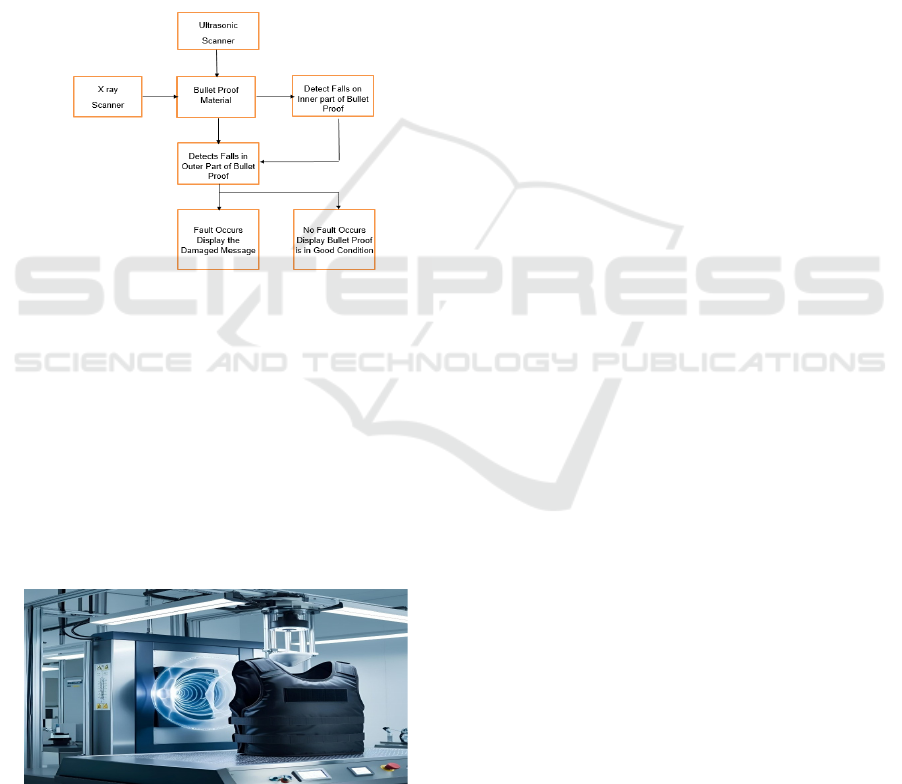
Figure 1 shows the Quality
Testing of the Bullet Proof Vest. Figure 2 shows the
Representation of Quality Testing of the Bullet Proof
Ves t.
Figure 2: Representation of Quality Testing of the Bullet
Proof Vest.
6 CONCLUSIONS
This project is a huge step forward in technology for
detecting damage in bulletproof materials. By
combining ultrasonic and X-ray sensors with smart
AI, the system offers better accuracy, speed, and
reliability. It’s designed for high-risk situations and
focuses on being easy to use, adaptable, and
affordable, making it a valuable tool for ensuring the
safety and effectiveness of bulletproof materials.
Through ongoing testing, teamwork, and innovation,
the project aims to deliver a practical and efficient
solution that addresses a critical need in the safety and
security industry.
REFERENCES
Liu, H., & Liu, Y. (2019). "Damage detection of composite
materials using ultrasonic wave propagation." Materials
Science and Engineering A, 747, 155-165.This paper
reviews ultrasonic techniques for detecting damage in
composite materials, which could include ballistic
materials like Kevlar and ceramics.
Pérez, M. T., & Cabrera, J. F. (2017). "X-ray inspection of
composite materials used in aerospace applications."
Materials Testing Journal, 59(1), 45-52. This research
examines the application of X-ray inspection for
detecting internal damage or voids in composite
materials, which are similar to those used in bulletproof
materials.
Ting, Y., & Hsieh, C. (2015). "X-ray tomography for
nondestructive inspection of composite materials."
Journal of Materials Science, 50(22), 7435-7444.This
paper discusses X-ray tomography as a powerful tool
for non-destructive testing, including applications for
damage detection in high-performance composite
materials.
Wang, X., & Zou, J. (2020). "Ultrasonic guided wave
technology for damage detection in composite
structures." Composites Science and Technology, 185,
107885.This study covers how ultrasonic guided waves
can be utilized to detect damage in composite materials,
which is highly relevant for bulletproof materials.
Yang, J., & Lee, S. (2021). "Applications of X-ray imaging
in structural health monitoring of advanced materials."
Journal of Structural Health Monitoring, 20(4), 1368-
1379.This review provides an overview of X-ray
imaging techniques and their applications in structural
health monitoring, particularly for materials subjected
to high stress, such as bulletproof composites.
Yun, H., & Lee, Y. (2018). "Ultrasonic Nondestructive
Testing for Damage Detection of Bulletproof
Materials." Journal of Applied Acoustics, 136, 45-58.
This paper discusses the application of ultrasonic waves
for non-destructive testing (NDT) of materials,
Advanced Integrated Damage Detection System for Bulletproof Materials Using Ultrasonic and X-Ray Sensors with AI Algorithms
319

including bulletproof composites, to detect damage or
defects.
Zhang, Y., & Liu, X. (2020). "Artificial Intelligence-based
damage detection using ultrasonic and X-ray sensors."
Computers in Industry, 117, 103221.This paper
discusses how AI algorithms can process ultrasonic and
X-ray sensor data for damage detection in materials,
improving accuracy and speed.
ICRDICCT‘25 2025 - INTERNATIONAL CONFERENCE ON RESEARCH AND DEVELOPMENT IN INFORMATION,
COMMUNICATION, AND COMPUTING TECHNOLOGIES
320
