
Transforming Agriculture with IoT and AI: A Comprehensive Crop
Monitoring and Management System
B. Marikumar, M. Arjun, A. Arul Thiraviam, K. Gowtham Sidharth, G. Vasunthraa
and S. Roshini
Department of Computer Science and Engineering, V.S.B College of Engineering Technical Campus,
Kinathukadavu, Coimbatore, Tamil Nadu, India
Keywords: Blockchain Technology, Smart Technology Integration, Real-Time Decision Making, Machine Learning
Algorithms, Edge Computing Analyses, Soil Moisture, Temperature, Humidity, Light Intensity.
Abstract: Agriculture remains crucial for food production; however, it is continuously impacted by climate change,
limited water supply, pest infestation, and poor management of resources. Farming practices of the past are
no longer sufficient, requiring new approaches. In this paper, I present and, in this paper, I discuss the
development and deployment of an intelligent Internet of Things (IoT)-based agricultural crop monitoring
and control system that automates farming through smart technology integration. Smart sensors form a
network for monitoring environmental factors including soil moisture, temperature, humidity, light intensity,
and soil ph. Drones offer fully automated aerial imaging for remote sensing to monitor crop health, while
edge computing analyses data close to the source for real-time decision making. The cloud serves as the
system's repository and the machine learning algorithms provide predictive analysis, which enables farmers
to take proactive measures against pest infestation and bad weather. Furthermore, blockchain technology
guarantees security, transparency, and traceability of products in an agricultural supply chain. Farmers can
access real-time concrete guidance through the mobile app or the web app, enabling them to make informed
decisions such as conserving water, fertilizers, and pesticides.
1 INTRODUCTION
The agricultural sector remains crucial to world food
security but struggles with climate change, water and
pest management, and poor resource mobilization.
Efforts toward modern service industrialization have
made traditional farming, which depends on manual
labour and simple agricultural tools, unfit to meet
contemporary requirements. This project seeks to
solve these problems by implementing sophisticated
technologies so that they can assist farmers in
overcoming challenges by developing an advanced
IoT-based crop monitoring system. The system is
designed to optimize agrotechnology’s, improve
productivity, and foster sustainable agricultural
practices. The integration of IoT, edge computing,
drone technology, machine learning, and blockchain
delivers a holistic approach to farmers of all scales,
allowing for data-driven approaches to move farming
away from guesswork towards enhanced production
and lowered repercussions on the ecosystem.
1.1 System Overview
The modules included in the system are as follows:
• Smart Sensor Network: Keeps track of
environmental factors like soil moisture,
temperature, humidity, light intensity, and
soil PH.
• Edge Computing Unit: Analyses
information on site to decrease latency and
improve responsiveness.
• Drone Surveillance: Takes overhead pictures
of the fields to check the health of the crops
and identify pest issues.
• Cloud Based Platform: Uses the data and
applies machine learning for data analysis
and information storage as well as predictive
analytics.
• Blockchain Framework: Guarantees the
traceability and transparency of the
agricultural supply chain data.
238
Marikumar, B., Arjun, M., Thiraviam, A. A., Sidharth, K. G., Vasunthraa, G. and Roshini, S.
Transforming Agriculture with IoT and AI: A Comprehensive Crop Monitoring and Management System.
DOI: 10.5220/0013925800004919
Paper published under CC license (CC BY-NC-ND 4.0)
In Proceedings of the 1st Inter national Conference on Research and Development in Information, Communication, and Computing Technologies (ICRDICCT‘25 2025) - Volume 5, pages
238-242
ISBN: 978-989-758-777-1
Proceedings Copyright © 2026 by SCITEPRESS – Science and Technology Publications, Lda.
• Controlled Systems: Controls the sensors
and actuators for irrigation, fertilization, and
pest control in conjunction with real-time
data.
• Community Knowledge-Sharing Platform:
Promotes interaction and creativity among
farmers.
1.2 Before IoT System
1.2.1 Smart Sensor Network
A network of smart sensors is deployed over
agricultural fields to monitor vital environmental
parameters. These sensors report text messages for
soil moisture content, temperature, humidity, light
intensity, and soil ph in real time. The data is
processed locally with edge computations to ensure
timely responses to critical changes, such as sudden
drops in soil moisture or temperature spikes.
1.3 Edge Computing Unit
The edge unit does local data processing to eliminate
response latency. This ensures prompt protective
interventions to maintain crop health. The processed
information is relayed to a central microcontroller
which fuses the data and uploads it to a cloud platform
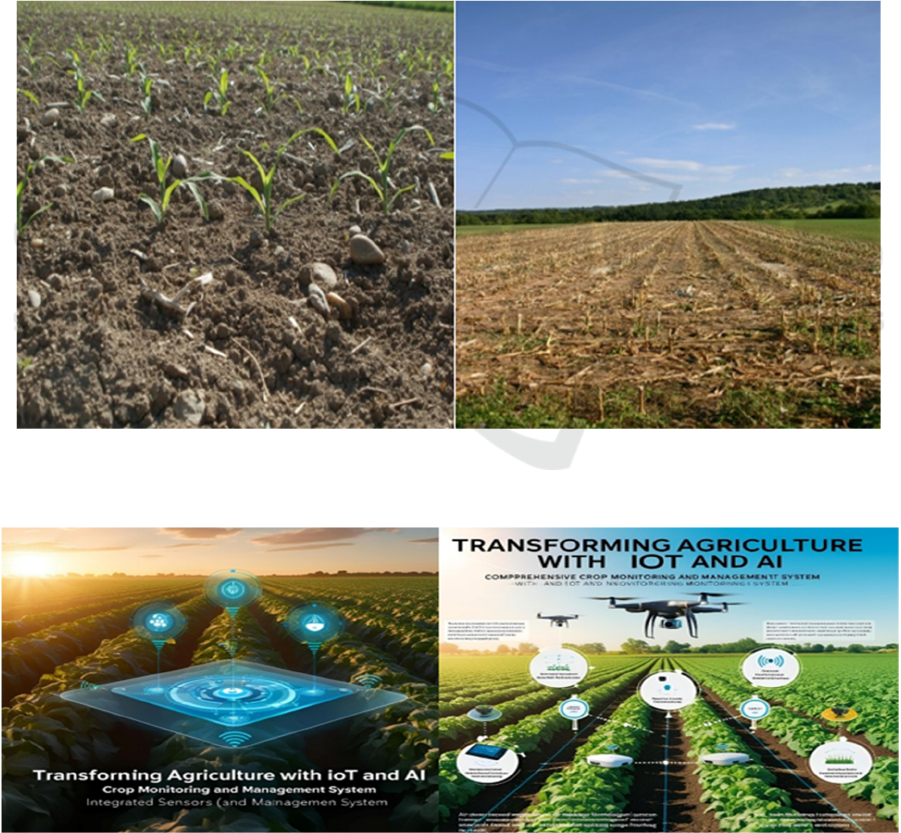
for detailed processing. Figure 1 shows the
Representation of before IoT Invention in Agriculture
field. Figure 2 shows the Representation of after IoT
Invention in Agriculture field.
Figure 1: Representation of before IoT Invention in Agriculture field.
1.3.1 After IoT System
Figure 2: Representation of after IoT Invention in Agriculture field.
Transforming Agriculture with IoT and AI: A Comprehensive Crop Monitoring and Management System
239

1.4 Drone Surveillance
Farms are surveyed using drones that have high
resolution cameras and multispectral sensors to take
pictures of the fields. This sensor provides high aerial
data and when combined with ground data captures,
help the farmers acquire better understanding of their
fields and more articulation in the necessary
adjustments.
1.5 Cloud-Based Platform
This cloud platform is the systems brain where data is
stored and visualized using sophisticated mobile and
web applications interfaces. Advanced machine
learning analyses the information to create predictive
analytics of greatly potential problems such us pest
infestation, disease outbreak or we
1.6 Blockchain Structure
The data management framework utilizes blockchain
technology to maintain an unalterable record of
agricultural activities. This improves accountability
and traceability in the supply chain while satisfying
regulatory needs and consumer expectations.
1.7 Self-Regulating Control
Mechanisms
Real-time sensor data triggers automated irrigation,
fertilization, and pest control systems. For instance, if
soil moisture is recorded below a specific value, crops
are watered as the system initiates irrigation.
1.8 Farmers’ Innovative Practices
Community Platform
The platform features a community-based innovative
practices sharing platform where farmers share
knowledge, strategies, and solutions relevant to local
constraints. This improves collaborative innovation
as farmers support each other and respond to
variability more effectively.
2 A SYSTEM DEVELOPMENT
AND DEPLOYMENT
2.1 Intelligent Sensor System
• Parts: pH, light, temperature, humidity, and
soil moisture sensors.
• Operation: Captures information on
environmental conditions and sends it to the
edge computing unit for further processing.
2.2 Edge Computing Unit
• Parts: Edge computing module,
microcontroller.
• Operation: Controls the captured data
locally to decrease latency and enable
quicker responses.
2.3 Drone Surveillance
• Componentry: Drones with high resolution
cameras and multispectral sensors.
• Operational: Takes aerial photographs to
assess plant health and identify potential
pests.
2.4 Cloud Based Platform
• Componentry: Cloud server, machine
learning, mobile and web applications.
• Operational: Data storage and analysis,
predictive modelling, and insight generation
to farmers.
2.5 Blockchain Framework
• Componentry: Blockchain network and QR
codes.
• Operational: Principally guarantees
visibility and traceability within the
agriculture supply chain.
2.6 Automated Control Systems
• Componentry: Automated irrigation,
fertilization, and pest control systems.
• Operational: Carried out automated
processes dependent on real-time sensor
information.
2.7 Community Knowledge Sharing
Platform
• Componentry: Online platform, professional
consultation, published research papers,
training documentation.
• Operational: Enable farmers to collaborate
and enhance productivity through
innovation.
ICRDICCT‘25 2025 - INTERNATIONAL CONFERENCE ON RESEARCH AND DEVELOPMENT IN INFORMATION,
COMMUNICATION, AND COMPUTING TECHNOLOGIES
240
3 LITERATURE REVIEW
3.1 Current Systems and Their
Challenges
• Excessively Expensive: Sensors, drones, and
other hardware IoT-based systems come
with high costs that are typically out of reach
for small-scale farmers.
• Rural areas have unreliable internet
coverage which obstructs real-time data
streaming and analytics.
• Farmers who do not have sufficient training
and experience using IoT systems have a
tough time trying to understand and interpret
the hundreds of data points IoT-enabled
systems generate.
• Remote and off-grid farming areas are prone
to unreliable power sources which poses a
problem for many IoT devices that need
constant power.
• Smart sensors and drones have to undergo
routine maintenance and recalibrations that
many farmers find difficult to perform due to
the level of skill required.
• The current smart systems available are not
designed to accommodate businesses of
different sizes, making it more difficult for
larger operations to scale.
• IoT systems are open to cyberattack without
strong encryption, risking data security and
privacy.
• The lack of sufficient historical data and
localized variable consideration results in
reduced predicted accuracy from machine
learning models.
• Different manufacturers’ devices and
platforms are often incompatible with each
other, leading to less efficient work
processes.
4 RESEARCH DESIGN
4.1 System Architecture
The system is made up of these parts:
• Smart Sensor Network: It gathers real-time
info about things like soil, weather, and
crops.
• Edge Computing Unit: It processes data
right where it’s collected to make things
faster.
• Drone Surveillance: Drones take pictures
from the air to check how healthy the crops
are.
• Cloud-Based Platform: It stores all the data
and uses smart tools to analyse it.
• Blockchain Framework: It keeps
everything clear and traceable, so you can
track where stuff comes from.
• Automated Control Systems: It handles
watering, adding fertilizers, and dealing with
pests automatically.
• Community Knowledge-Sharing
Platform: A place where farmers can share
tips, ideas, and work together to improve
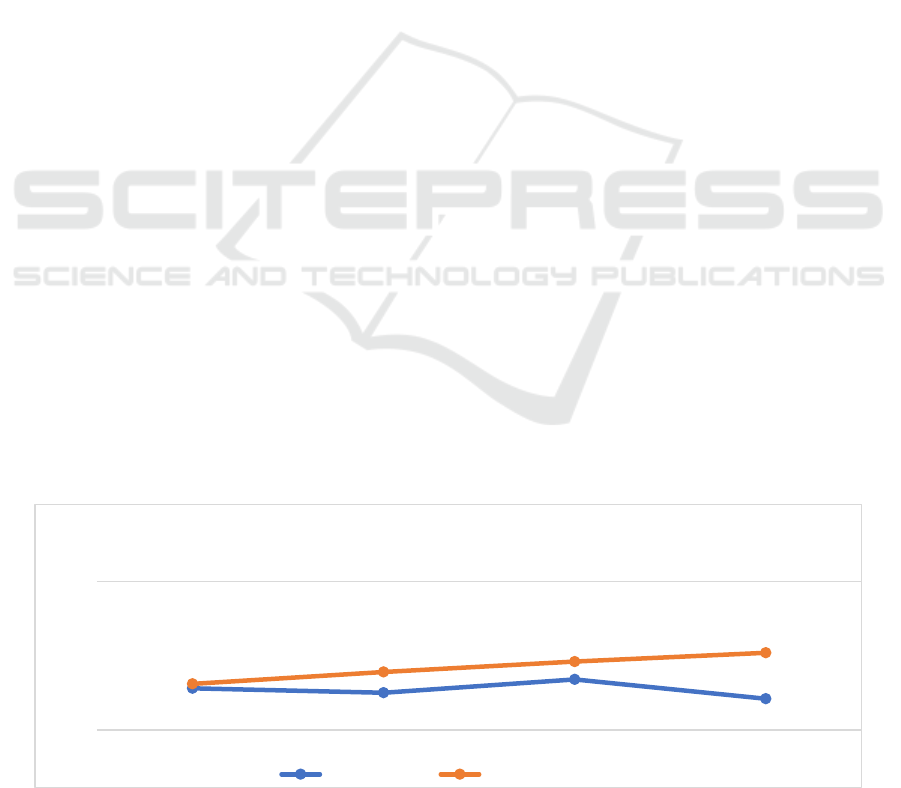
farming. Figure 3 illustrates the Impact of
IoT on Farming Efficiency over Time.
5 RESULTS AND DISCUSSION
Figure 3: Impact of IoT on Farming Efficiency over Time.
0
10
Month 1 Month 2 Month 3 Month 4
IoT System for Precision Farming and
Resource Efficiency
Before IOT After IOT
Transforming Agriculture with IoT and AI: A Comprehensive Crop Monitoring and Management System
241

6 CONCLUSIONS
This IoT crop monitoring system is a huge step
forward for smart farming. It uses high-tech tools to
give farmers real-time updates, smart guesses about
what’s coming, and automatic controls to help them
use water, fertilizer, and other stuff more efficiently
and grow more crops. It’s easy to use, works for small
or big farms, and is good for both the planet and the
wallet. This system is a great way to solve today’s
farming problems and create a future where food is
more sustainable and reliable.
REFERENCES
Christodoulou, A., Christidis, P., and Bissel ink, B., 2020.
Forecasting the impacts of climate change on inland
waterways. Transportation Research Part D: Transport
and Environment, 82: 102159.
Weng, C.N., 2005. Sustainable management of rivers in
Malaysia: Involving all stakeholders. International
Journal of River Basin Management, 3(3): 147-162.
Tori man, M.E., Hassan, A.J., Gazim, M.B., Mokhtar, M.,
SA, S.M., Jaafar, O., and Aziz, N.A.A., 2009.
Integration of 1-d hydrodynamic model and GIS
approach in flood management study in Malaysia.
Research Journal of Earth Sciences, 1(1): 22-27.
Kamarudin, M.K.A., Tori man, M.E., Wahab, N.A., Rosli,
H., Ata, F.M., and Faudzi, M.N.M., 2017.
Sedimentation study on upstream reach of selected
rivers in Pahang River Basin, Malaysia. International
Journal on Advanced Science, Engineering and
Information Technology, 7(1): 35-41.
Adhiharto, R., and Komara, F.A., 2018. Perancangan
Konstruksi Trash Bucket Conveyor (Tbc) Sebagai
Mekanisme Pembersih Sampah Di Sungai.
Khekare, G.S., Dhanre, U.T., Dhanre, G.T., and Yede, S.S.,
2019. Design of Optimized and Innovative Remotely
Operated Machine for Water Surface Garbage
Assortment. International Journal of Computer
Sciences and Engineering, 7(1): 113-117.
Othman, H., Petra, M.I., De Silva, L.C., and Caesarendra,
W., 2020. Automated trash collector design. In Journal
of Physics: Conference Series, 1444(1): 012040.
Kader, A.S.A., Saleh, M.K.M., Jalal, M.R., Sulaiman, O.O.,
and Shamsuri, W.N.W., 2015. Design of rubbish
collecting system for inland waterways. Journal of
Transport System Engineering, 2(2): 1-13.
Akib, A., Tasnim, F., Biswas, D., Hashem, M.B., Rahman,
K., Bhattacharjee, A., and Fattah, S. A., 2019.
Unmanned Floating Waste Collecting Robot. In
TENCON 2019-2019 IEEE Region 10 Conference
(TENCON), 2645-2650.
Balasuthagar, C., Shanmugam, D., and Vigneshwaran, K.,
2020. Design and fabrication of beach cleaning
machine. In IOP Conference Series: Materials Science
and Engineering, 912(2): 022048.
Kong, S., Tian, M., Qiu, C., Wu, Z., and Yu, J., 2020.
IWSCR: An intelligent water surface cleaner robot for
collecting floating garbage. IEEE Transactions on
Systems, Man, and Cybernetics: Systems, 1-11.
Lindquist, A., 2016. Baltimore’s Mr. Trash Wheel. The
Journal of Ocean Technology, 11(12): 35-37.
Geraeds, M., van Emmerik, T., de Vries, R., and bin Ab
Razak, M.S., 2019. Riverine plastic litter monitoring
using unmanned aerial vehicles (UAVs). Remote
Sensing, 11(17): 2045.
ICRDICCT‘25 2025 - INTERNATIONAL CONFERENCE ON RESEARCH AND DEVELOPMENT IN INFORMATION,
COMMUNICATION, AND COMPUTING TECHNOLOGIES
242
