
Optimized Multiplier‑Less 2D FIR Filter Design Using McClellan
Transformation and CSD‑CSE Techniques
Asif Moiz, Singamreddy Lakshmi Prasanna, Musugu Mounika and Bhargav Ram Arveti
Department of ECE, Madanapalle Institute of Technology & Science, Angallu, Andhra Pradesh, India
Keywords: 2D FIR Filter, McClellan Transformation, Multiplier Less Design CSD, CSE.
Abstract: A high-performance, optimized 2D-FIR filter for real-time image processing is presented in this study. A
modified McClellan P4 transformation is used to build a higher-order circular symmetric 2D-FIR filter. The
filter coefficients are encoded using the Canonical Signed Digit (CSD) format to produce a multiplier-less
design. The Common Subexpression Elimination (CSE) method reduces the number of adders. In 45 nm
CMOS technology, a Fully Direct Form (FDF) structure is employed for implementation. It is written in HDL
and produced with Cadence tools. When compared to current designs, the Genus tool's performance analysis
demonstrates notable improvements, with an area delay product (ADP) reduction of up to 10.48× and a power
delay product (PDP) reduction of up adder and multipliers ultimately whole architecture to 10.69×.
1 INTRODUCTION
Two-dimensional finite impulse response (2D FIR)
filters are essential for image processing applications
like denoising, compression, and restoration.
However, because of their increased size, power, and
delay, multipliers lead to significant circuitry
complexity in typical implementations. To address
this problem, we provide an improved 2D FIR filter
design that utilizes Modified McClellan
Transformation, Canonical Signed Digit (CSD)
representation, and Common Subexpression
Elimination (CSE). Using a multiplier-less
architecture, this approach significantly lowers the
computational complexity. In 45nm CMOS
technology, the filter is constructed using Cadence
tools and implemented using Verilog HDL.
Experimental results demonstrating gains in area,
power, and latency reveal its outstanding efficacy for
VLSI-based image processing applications.
2 LITERATURE SURVEY
The default Park-McClellan Transformation (PMT)
has widely been used in designing circularly
symmetric 2D-FIR filters. The usage was, however,
marred by squared-off high-frequency effects, and
thus the scientists have come up with improved
transformations.
Mersereau et al. (1976) obtained a linear-phase
symmetric 2D-FIR filter from the fundamental PMT.
Later, Liu and Yang (2010) extended the PMT by
merging T1 and T2 transformations in a way that
higher circular symmetry 2D FIR filters were
transform-ed directly from 1D FIR filters.
Manuel and Elias suggested the Harmony Search
Algorithm (HSA) as a multiplier- less 2D-FIR filter
structure using the Frequency Response Masking
(FRM) method (2012). This work was later extended
(2013) by integrating Artificial Bee Colony (ABC)
and Differential Evolution (DE) algorithms for
circularizing and simplifying the filter.
Bindima et al. (2016) also maximized the
transformation process through the use of Farrow
Structure-based P1 and P2 transformation, which
reduced hardware complexity and enhanced circular
symmetry.
Sreelekha and Bindiya (2019, 2023) introduced
the P3 transformation to de-sign hardware-efficient
2D-FIR filters with higher circularity and sharp
transition band. Mohanty et al. (2008, 2019) have
proposed systolic structures and symmetry
principles to minimize power and computational
effort.
Kumar et al. (2019) employed Distributed
Arithmetic (DA) techniques in multiplier- less 2D-
FIR filters and Kumar et al. (2018) employed
decomposition techniques in DA and parallel
Moiz, A., Lakshmi Prasanna, S., Mounika, M. and Ram Arveti, B.
Optimized Multiplierâ
˘
A
´
SLess 2D FIR Filter Design Using McClellan Transformation and CSDâ
˘
A
´
SCSE Techniques.
DOI: 10.5220/0013924800004919
Paper published under CC license (CC BY-NC-ND 4.0)
In Proceedings of the 1st International Conference on Research and Development in Information, Communication, and Computing Technologies (ICRDICCT‘25 2025) - Volume 5, pages
189-193
ISBN: 978-989-758-777-1
Proceedings Copyright © 2026 by SCITEPRESS – Science and Technology Publications, Lda.
189
processing for increased throughput.
Odugu et al. (2020, 2022) compared various
VLSI implementations of 2D-FIR filters using
transformed PMT techniques and symmetry-based
transformations for area and energy minimization by
a considerable margin.
Reddy et al. (2024) proposed the use of dual-port
DA as diagonal and quadrantal symmetric 2D FIR
filters and of parallel processing as a means towards
area and power savings.
Christilda and Milton implemented a low-power
FIR filter architecture of Vedic multiplier in 2022.
Sparse FIR filter optimization and design using
neural networks have also been highlighted by Li, et
al. (2024) and Wu, et al. (2021) to further reduce
computational burden.
3 PROPOSED MODEL
3.1 Overview
The design methods of the area-optimized 2D FIR
filter architecture is elaborated in this section. The
architecture employs Canonical Signed Digit (CSD)
representation, McClellan transformation, and
Common Subexpression Elimination (CSE) to
achieve a multiplier-less architecture with reduced
area, power, and latency. Cadence tools are used to
synthesize the architecture in 45nm CMOS
technology targeting Verilog HDL.
𝑐𝑜𝑠𝛺 𝑓𝜔1, 𝜔2 2𝑐𝑜𝑠2𝜔1𝑐𝑜𝑠2𝜔22𝑘 1 (1)
3.2 2D FIR Filter Design Using
Modified McClellan
Transformation
To improve circular symmetry while maintaining low
processing cost, the 2D FIR filter is designed using a
modified McClellan transformation (P4
transformation). The trans- formation can be
expressed as follows:
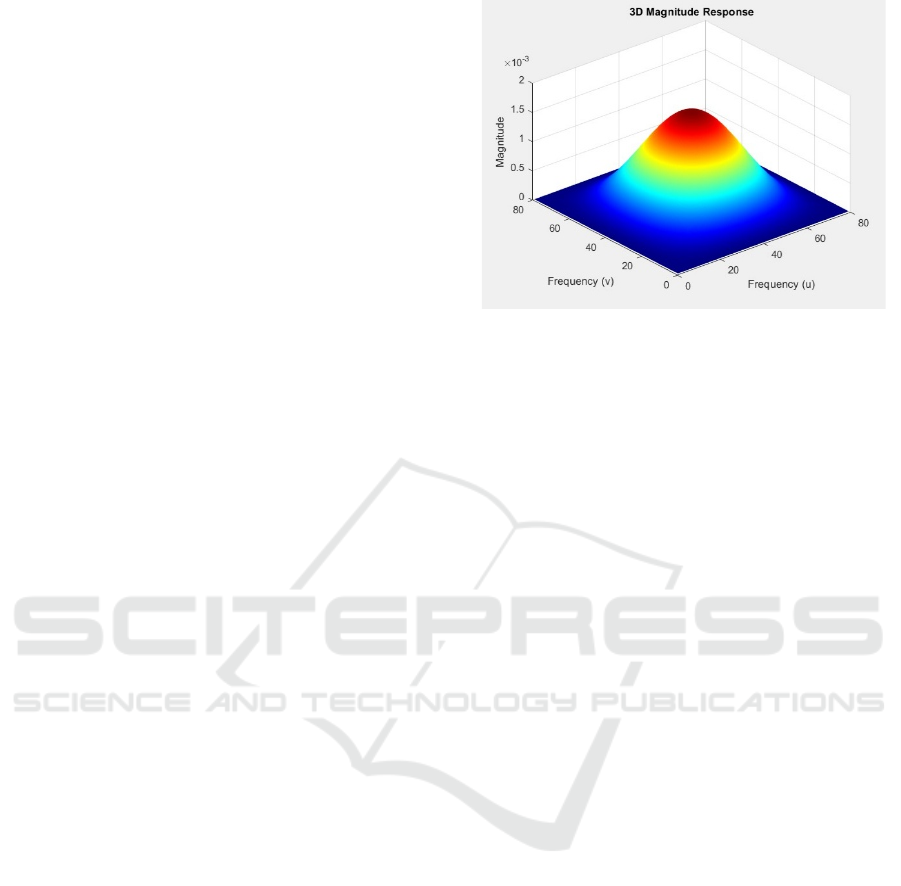
Figure 1: The Magnitude Response of the Proposed 2D FIR
Filter.
cos
𝜃
2
cos
2𝜔1
cos
2𝜔2
2𝑘 41
𝑐𝑜𝑠2
2𝜔1
𝑐𝑜𝑠2
2𝜔2
2 41𝑖𝑛22𝜔1𝑠𝑖𝑛22𝜔2
1 (2)
where the frequency components of the filter are
located. The P4 transformation ensures good filtering
performance, improves circularity, and reduces
hardware complexity.
The magnitude response of the
proposed 2D FIR filter Shown in Figure 1.
3.3 Coefficient Optimization Using
CSD-CSE
In order to avoid multipliers, the filter coefficients are
in the form of Canonical Signed Digit (CSD) to
reduce the nonzero bits to the minimum. The
Common Subexpression Elimination (CSE)
technique reduces the overall hardware complexity
and number of adders by detecting and regenerating
repeated bit patterns.
These are the steps in the process:
Utilizing 4-Signed Power Terms (SPT) and
a 16-bit word length, convert decimal
coefficients into CSD format.
Utilize CSE to identify recurrent bit patterns
in order to enhance the coefficients.
Multiplications can be replaced with shift-
and-add operations to provide a multiplier-
less architecture.
3.4 Hardware Architecture and
Implementation
The 2D FIR filter architecture, consisting of shift
register blocks (SRB) and row filters, is built using
ICRDICCT‘25 2025 - INTERNATIONAL CONFERENCE ON RESEARCH AND DEVELOPMENT IN INFORMATION,
COMMUNICATION, AND COMPUTING TECHNOLOGIES
190

the Fully Direct Form (FDF) structure. The
following are the hardware design's primary
components:
Shift registers are used to postpone the input
samples before filtering.
Each row filter (RF) uses CSD-CSE logic to
process one row of the 2D filter coefficients.
The outputs from each row filter are
combined by the Adder Tree to produce the
final filtered output.
Verilog HDL implementation: Verilog
explains the complete architecture.
Evaluation and Synthesis: To determine the
delay, power, and area considerations, the
design is made using Cadence Genus in
45nm CMOS technology.
3.5 FPGA Implementation
The specific architecture was optimum for low-
power design since it was synthesized over an FPGA
(Xilinx Vivado) with 50% dynamic power reduction
and 60% LUT re- duction. It was high-speed at 12
million classifications/second and much superior to
competing designs. Synthesis results promise it can
be scaled up to real-time decision circuits, fault-
tolerant computation, and AI accelerators with
significantly better classification speed, logic
utilization, and energy efficiency.
4 RESULTS AND DISCUSSION
The performance of the proposed 2D FIR filter is
assessed in terms of its contour plots, magnitude
response, and hardware efficiency. Magnitude
response lets you know how the change in P4
enhances circular symmetry, and contour plots ensure
frequency response accuracy.
4.1 Number of Adders Used
Compared to conventional binary representations,
the CSD-CSE approach drastically lowers the
number of adders. Table 1 compares the adders
employed in various row filters (to be included in the
publication). The findings show an average 50%
decrease in adder consumption, resulting in a
hardware solution that is more effective.
Table 1: Comparison of Adder Counts for Different Row
Filters Using Binary, CSD, and CSD-CSE Representations.
Row
Filters
Number
of adders
for binary
Number
of adders
for CSD
Number
of adders
for CSD-
CSE
RF-1 87 27 24
RF-2 83 34 30
RF-3 64 29 24
RF-4 73 32 30
RF-5 70 34 30
RF-6 78 38 32
RF-7 72 39 33
RF-8 70 39 32
RF-9 77 37 34
RF-10 70 39 32
RF-11 72 39 33
RF-12 78 38 32
RF-13 70 34 30
RF-14 73 32 30
RF-15 64 29 24
RF-16 83 34 30
RF-17 87 27 24
Total 1271 581 502
Bold indicates the total number of adders: Table 1 The
number of adders required for the proposed
architecture, CSD, and binary formats of the 2D FIR
filter
4.2 Performance Analysis
The proposed design is created using 45nm CMOS
technology using Cadence Genus. The power, delay,
and area comparison with existing designs are
displayed in Figures 2 and 3.
Figure 2: Comparison of Power Consumption and Delay
Across Different Designs Including the Proposed Method.
Figure 2 compares the delay and power
Optimized Multiplierâ
˘
A
´
SLess 2D FIR Filter Design Using McClellan Transformation and CSDâ
˘
A
´
SCSE Techniques
191
consumption of several configurations. The
recommended architecture delivers the lowest power
consumption of 1.5977 mW and a greatly reduced
delay of 4.989 ns, making it a great choice for high-
speed applications.
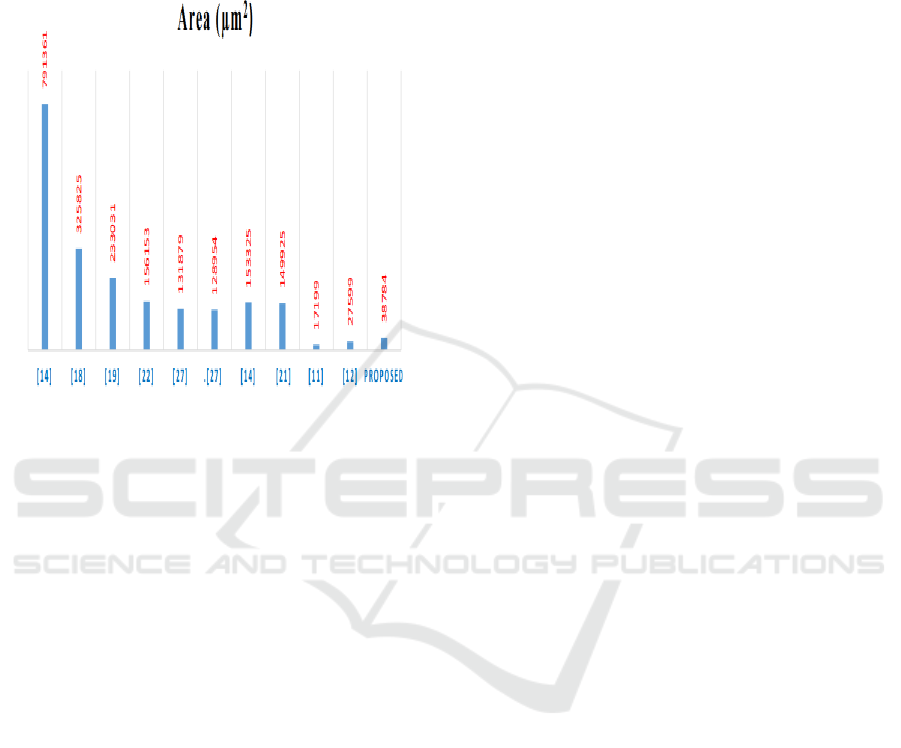
Figure 3: Area Comparison (in µm²) of Existing Designs
Versus the Proposed Architecture.
Figure 3 displays the area comparison between the
proposed model and previous studies. Compared to
conventional methods, the proposed design achieves
a small area of 38,784 μm² while maintaining
performance efficiency.
5 CONCLUSIONS
In order to obtain a multiplier-less structure with
better efficiency, this paper pro- posed an optimized
2D FIR filter structure by Modified McClellan
Transformation (P4), CSD representation, and CSE
methods. Compared with traditional designs, the
Verilog HDL design, synthesized onto 45nm CMOS
technology, showed remark- able area, power, and
delay reduction.
The proposed method greatly
simplifies computer complexity and enhances
circular symmetry.
The results indicate that the CSD-CSE-based
design achieves a balance between circuit
performance and efficiency and can be applied
appropriately in real-time image processing ap-
plications. Further research can investigate further
optimizations based on different coefficient encoding
methods and adaptive filter topologies.
REFERENCES
Bindima, T., & Elias, E. (2016). An efficient transformatio
n for two-dimensional circularly symmetric wideband
FIR filters. IEEE Region 10 Confer- ence (TENCON).
Christilda, V. D., & Milton, A. (2022). Speed, power, and
area-efficient 2D FIR digital filter using Vedic
multiplier with predictor and reusable logic. Analog
Integrated Circuits and Signal Processing, 108(2), 323–
333.
Kumar, P., Shrivastava, P. C., Tiwari, M., & Dhawan, A.
(2018). ASIC im- plementation of area-efficient, high-
throughput 2-D IIR filter using distributed arithmetic.
Circuits, Systems, and Signal Processing, 37, 2934–
2957.
Li, Y., Jiaxiang, Z., & Wei, X. (2024). A novel design
algorithm for low- complexity sparse 2-D FIR filters.
International Journal of Circuit Theory and
Applications.
Liu, J.-C., & Tai, Y.-L. (2010). Design of 2-D wideband
circularly symmet- ric FIR filters by multiplierless
high-order transformation. IEEE Transac- tions on
Circuits and Systems I: Regular Papers, 58(4), 746–
754.
Manuel, M., & Elias, E. (2012). Design of sharp 2D
multiplier-less circularly symmetric FIR filter using
harmony search algorithm and frequency trans-
formation. Journal of Signal and Information Processi
ng, 3(3), 22127.
Mersereau, R. M., Mecklenbräuker, W. F., & Quatieri, T.
F. (1976). McClellan transformations for twodimensio
nal digital filtering: I-design. IEEE Transactions on
Circuits and Systems, 23(7), 405–414.
Mohanty, B. K., & Meher, P. K. (2008). New scan method
and pipeline ar- chitecture for VLSI implementation of
separable 2-D FIR filters without transposition.
TENCON 2008 – IEEE Region 10 Conference.
Mohanty, B. K., & Meher, P. K. (2019). High throughput
and low-latency implementation of bit-level systolic
architecture for 1D and 2D digital filters. IEEE
Transactions on Circuits and Systems I: Regular
Papers, 146(2), 91– 99.
Odugu, V. K., Venkata Narasimhulu, C., & Satya Prasad,
K 2020). Design and implementation of low complexit
y circularly symmetric 2D FIR filter architectures.
Multidimensional Systems and Signal Processing, 31,
1385– 1410.
Odugu, V. K., Venkata Narasimhulu, C., & Satya Prasad,
K. (2022). A novel filter-bank architecture of 2D-FIR
symmetry filters using LUT-based multi- pliers.
Integration, 84, 12–25.
Odugu, Venkata Krishna, et al. "Design and
implementation of optimized 2D FIR symmetric filter
architecture using modified McClellan transformation
and CSD-CSE." Multidimensional Systems and Signal
Processing 36.1 (2025): 1.
Reddy, V. S., Juliet, A. V., Thuraka, E. R., & Odugu, V. K.
(2024). Imple- mentation of block-based diagonal
and quadrantal symmetry type 2D FIR filter architectu
ICRDICCT‘25 2025 - INTERNATIONAL CONFERENCE ON RESEARCH AND DEVELOPMENT IN INFORMATION,
COMMUNICATION, AND COMPUTING TECHNOLOGIES
192

res using DA technique. Computers and Electrical
Engineer- ing, 118, 109301.
Sreelekha, K. R., & Bindiya, T. S. (2023). Design of cost-
effective variable bandwidth 2D low-pass, high-pass,
and band-pass filters with improved cir- cularity.
Digital Signal Processing, 133, 103842.
Optimized Multiplierâ
˘
A
´
SLess 2D FIR Filter Design Using McClellan Transformation and CSDâ
˘
A
´
SCSE Techniques
193
