
Bridging Vision and Language: A CNN‑Transformer Model for
Image Captioning
Radha Seelaboyina, Naveen Rampa, Alle Sai Shivanandha and Chamakura Yashwanth Reddy
Associate Professor, Department of Computer Science and Engineering, Geethanjali College of Engineering and
Technology, Hyderabad, Telangana, India
Keywords: Image Captioning, Computer Vision, NLP, Deep Learning, CNNs, Transformers, EfficientNetB0, Flickr8k
Dataset.
Abstract: Computer vision and natural language processing have recently received a lot of attention in building models
to automatically generate descriptive sentences for images, a task referred to as image captioning. This entails
grasping image semantics and building well-structured sentences to describe visual content in textual form.
Recent developments in artificial intelligence (AI) prompted scientists to venture into deep learning methods
using large data sets and computing capabilities to create effective models. The Encoder-Decoder mechanism,
combining the Convolutional Neural Networks (CNNs) and Transformers, is most commonly employed for
this purpose. A pre-trained CNN, e.g., EfficientNetB0, first extracts image features, which are subsequently
processed by a Transformer-based decoder to produce relevant captions. The model is also trained on the
Flickr_8k dataset of 8,000 images with five different captions each, thereby improving its contextual richness
in the descriptions.
1 INTRODUCTION
The human faculty for easily picturing scenes
through the use of words is one that is staggering, but
a computerized counterpart of this potential remains
a prime goal of artificial intelligence. Automatically
generating text explanations of images and thereby
bridging the gap between vision and language by
combining NLP and computer vision is something
that image captioning does. The aim of an image
caption generator is to create a system that generates
grammatically and semantically correct captions for
images. This technology finds broad application in
social media, image search, editing suggestions,
visually impaired assistive aids, and many NLP-based
applications. On the Flickr 8k dataset, which has
about 8,000 images with five caption descriptions
each, a deep learning-based model is created. The
three major stages of the process are extracting image
visual features at a high level from images via a
Convolutional Neural Network (CNN), making use of
attention mechanisms in the Transformer Encoder for
parallel processing of visual information, and word-
by-word generation of captions via the Transformer
Decoder. The synergy between CNNs for feature
extraction and Transformers for sequential text
generation makes this method extremely effective for
image captioning tasks.
2 RELATED WORK
2.1 Image Caption Generation using
Attention Mechanism
Many researchers have tried using visual attention in
English-language corpora for image and video
captioning in the encoder-decoder model. Two major
types of attention mechanisms have been utilized:
semantic attention, where words are the focus, and
spatial attention, where certain areas of an image are
the focus. Xu et al originally proposed visual attention
in image captioning by using either "soft" pooling
spatial features averaging assigned attentive weights
or "hard" pooling, finding the most informative
regions. Also, CNN-based attention mechanisms, like
Channel-wise Attention and Spatial Attention, were
used for better feature extraction (L. Chen et al,
Seelaboyina, et al, Radha et al). Chen et al. further
extended this by applying visual attention to improve
image captioning. To create a more direct connection
Seelaboyina, R., Rampa, N., Shivanandha, A. S. and Reddy, C. Y.
Bridging Vision and Language: A CNN-Transformer Model for Image Captioning.
DOI: 10.5220/0013923800004919
Paper published under CC license (CC BY-NC-ND 4.0)
In Proceedings of the 1st International Conference on Research and Development in Information, Communication, and Computing Technologies (ICRDICCT‘25 2025) - Volume 5, pages
125-132
ISBN: 978-989-758-777-1
Proceedings Copyright © 2026 by SCITEPRESS – Science and Technology Publications, Lda.
125

between visual attributes and semantic concepts,
semantic attention models were also incorporated into
recurrent neural networks (RNNs) Z. Wang et al,
allowing for more precise and contextually
appropriate image descriptions.
2.2 Image Caption Generation in
Different Languages
The attention-based approach has also been modified
to be used for image caption generation, with research
in the past mostly being applied to English given the
presence of datasets in the language J. Aneja et al.
Convolutional Neural Networks (ConvNets)
Seelaboyina et al like VGG-16 have seen extensive
use within the encoder portion of captioning models
S. Liu, et al. Moreover, researchers have worked with
pre-trained models such as AlexNet H. Shiet al, Wang,
C., et al and Residual Networks (ResNet) H. Shiet al
to obtain visual features and augment caption
generation using BiLSTM. Even though English
datasets rule the roost, attempts have been made to
create datasets in other languages as well, namely
Chinese W. Lan et al, J. Dong et al, Japanese
(Yoshikawa), Arabic, and Bahasa Indonesia
(Mulyanto et al. 2019), which combines Flickr30k and
MS COCO. In addition, Indonesian-specific image
datasets like Indonesian Flickr30k and FEEH-ID, a
modified version of the Flickr8k dataset, have also
been presented which widen the multilingual domain
of image captioning studies.
2.3 Image Caption Using CNN and
RNN
Chetan Amritkar et al Deep learning techniques are
used here for image captioning.According to this
technique, natural sentences that eventually portray
the image are generated. RNN (Recurrent Neural
Network) and CNN (Convolutional Neural Network)
constitute this paradigm. Sentences are constructed
using RNN, and extracting features from the image is
using CNN. The model is modeled in a manner such
that it gives captions in response to input images,
pretty much describing them. Differing datasets are
utilized in verifying the accuracy of the model and,
additionally, in furthering the smoothness or control
over language the algorithm is taught via picture
descriptions. These experiments exhibit the fact that
the model mostly offers accurate descriptions for the
given input image.
2.4 Image Caption Using CNN and
LSTM
H. Shi et al, the paper describes a deep learning
method for the deployment of an image captioning
model, organized in three phases. The initial phase is
image feature extraction, in which the Xception
model is used to extract necessary visual features
from the Flickr_8k dataset. The second phase,
referred to as the Sequence Processor, processes text
input by acting as a word embedding layer, leveraging
the use of masking to discard unwanted values and
retain important linguistic content. This stage is then
linked to an LSTM network to facilitate the
production of descriptive image captions. The third
and last stage is the Decoder, which combines inputs
from the image feature extraction and sequence
processing stages. The data that has been processed is
then input into neural layers, leading up to the Dense
layer, which produces the final caption by stringing
words together using the extracted visual and text
features.
3 MATERIALS AND METHODS
3.1 Dataset
This evaluation relies on the Flickr8K dataset as a
benchmark, which includes 8,092 images and each
image being annotated with five different captions
presenting principal entities and events. It is a
benchmark dataset for image description and
sentence-based retrieval. To train the models and
measure the performance, the dataset splits into 6,114
for training, 1,529 for validation, and 449 for testing.
The photos were chosen with care from six Flickr
groups to achieve diversity in situations and scenes,
as opposed to concentrating on well-known
individuals or places.
3.2 System Design
Convolutional Neural Networks (CNNs) are deep
neural networks that specialize in processing input
data in the form of a two-dimensional matrix, and
they are especially suited for image classification
problems. They scan images from top to bottom and
left to right and extract meaningful features to classify
objects like birds, planes, or even characters from
fantasy novels. CNNs can also process
transformations such as perspective change,
translation, rotation, and scaling. As a contrast,
ICRDICCT‘25 2025 - INTERNATIONAL CONFERENCE ON RESEARCH AND DEVELOPMENT IN INFORMATION,
COMMUNICATION, AND COMPUTING TECHNOLOGIES
126
Transformers utilize multi-head attention
mechanisms and self-attention to learn long-range
dependencies among extracted features and produced
words. This feature allows the model to learn
complex relations and contextual information in an
image and generate more accurate and semantic
captions. As opposed to sequential models like
LSTMs, Transformers process all image features
concurrently, drastically improving caption
generation speed. Also, their flexibility enables them
to process different image types and captioning
modes with more ease.
EfficientNetB0 can be employed as a pre-trained
model for image captioning because it can attain
similar or even better performance at the cost of less
memory and computational power. Its efficiency
recommends it for resource-limited scenarios. With
pre-trained weights, EfficientNetB0 can be easily
incorporated into image captioning pipelines to
provide a solid platform for extracting high-level
image features. These features so obtained are then
passed through a decoder architecture that produces
effective and meaningful captions, so that
performance, flexibility, and computational
efficiency are balanced.
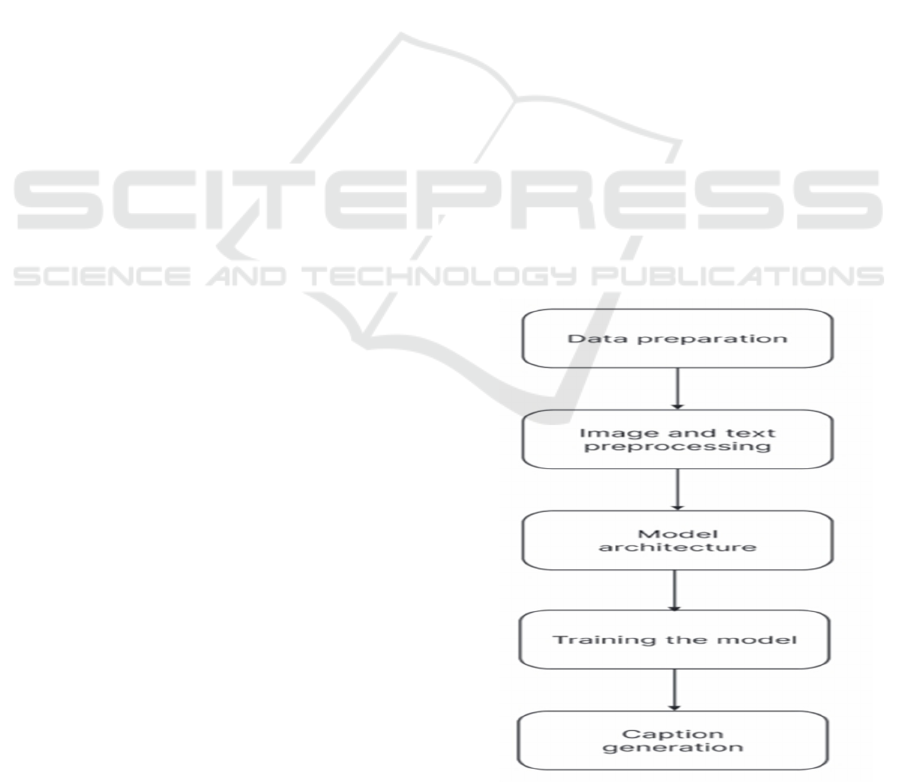
The following are the primary steps that comprise the
overall workflow:
3.2.1 Data Preparation
Prior to processing and analysis of raw data, the data
needs to be cleaned and transformed first, an
important step that guarantees data quality and
consistency. The transformation process entails
reformatting, error correction, missing value
handling, and duplication or inconsistency
elimination from the data set. Adequate preprocessing
of data increases the model's reliability by
guaranteeing correct input. After cleaning, the dataset
is ready for validation and training as input to the
CNN-based model. Transfer learning methods are
subsequently used during training, using pre-trained
models for enhanced efficiency and performance in
captioning images.
3.2.2 Text and Image Pre-Processing
• The Flickr8K dataset is downloaded and
preprocessed first, which includes images
along with related captions.
• Preprocessing of text data is done by removing
special characters, converting to lowercase,
and excluding captions that are too short or too
long.
• The image data is also preprocessed by
transforming it into floating-point format,
resizing it to a uniform dimension, and
normalizing the pixel values for model
training consistency.
3.2.3 Model Architecture
Constructing an image captioning system involves
two primary components:
• Image Feature Extractor: A pre-trained CNN is
used to extract high-level visual features from
images, capturing essential details for caption
generation.
• Transformer-based Caption Generator: Utilizing
a sequence-to-sequence model, the Transformer
processes the extracted features and generates
meaningful captions by understanding the contextual
relationships within the image.
3.2.4 Training Model
A training model is constructed based on a dataset
that trains a machine learning algorithm. It is made up
of corresponding sets of input data and their
respective output labels, enabling the model to learn
patterns and relationships. The diversity and quality
of the training dataset have a major impact on the
model's performance and accuracy.
3.2.5 Caption Generation
Figure 1: Model analysis flowchart.
Bridging Vision and Language: A CNN-Transformer Model for Image Captioning
127

Prediction is the result produced by an algorithm
trained on a historical data set to make an estimate of
the probability of a particular outcome. For image
captioning, the algorithm makes a prediction of a
descriptive caption for an image by extracting its
features and creating text from learned patterns.
Figure 1 shows the Model Analysis Flowchart. Figure
2 shows the CNN - Transformer Encoder-Decoder
based Architecture.
3.3 CNN: Transformer Architecture
Figure 2: CNN - Transformer encoder-decoder based
architecture.
3.3.1 Feature Extraction with
EfficientNetB0
• The extracted feature map of EfficientNetB0
is first flattened and then input into the
Transformer encoder.
• Positional encoding elements are added to the
flattened feature vector afterward to encode
relative positional information in order to help
the Transformer know about spatial relations
within the image.
• The Transformer encoder uses a multi-head
attention to jointly encode multiple
components of the feature vector in parallel,
and it captures relationships between
components and long-range dependencies.
• The encoder provides a context vector that
captures the main information drawn from the
image, summarizing its general meaning and
structural connections.
• The dimensions of output are expressed as H
× W × C, where H and W stand for the feature
map height and width (generally less than that
of the input image) and C denotes the number
of channels of the feature capturing various
content aspects of an image.
3.3.2 Transformer Encoder
• The Transformer encoder takes the flattened
feature map from EfficientNetB0 as input.
• Positional encoding is used to the sequence
that is being processed by the Transformer so
that positional context is infused, and the
model knows how elements are placed in the
image.
• The multi-head attention mechanism of the
Transformer encoder enables it to attend to
multiple parts of the feature vector in parallel,
and as a result, it can capture long-range
dependencies and relationships between
different image regions.
• The context vector, generated by the
Transformer encoder, is the most important
information in the image, summarizing its
meaning and structural relationships.
3.3.3 Transformer Decoder
• The Transformer decoder begins with a
context vector, which is a concatenation of
the output from the encoder and a "start of
sentence" token.
• A word vector encoding is employed to
represent semantic word relationships in the
vocabulary.
• The attention-based mechanism in the
decoder considers both the context vector
and previously generated words, ensuring
that each word is given a different weightage
based on image details and the context of the
sentence.
• The Transformer decoder produces captions
word by word, predicting a word at a time
based on both the current context vector and
words already generated.
• In contrast to RNN-based models
(LSTM/GRU), which do word-level
sequential processing, the Transformer-
ICRDICCT‘25 2025 - INTERNATIONAL CONFERENCE ON RESEARCH AND DEVELOPMENT IN INFORMATION,
COMMUNICATION, AND COMPUTING TECHNOLOGIES
128
based method handles all words
simultaneously, making training much faster
and more efficient.
4 RESULTS AND DISCUSSION
The combination of CNNs with Transformer
architecture offers a model for generating descriptive
and contextually appropriate captions from visual
material, aiding image captioning progress.
Continued research and development continue to
advance natural language processing and computer
vision, resulting in new developments and
applications in these areas.
4.1 Image Feature Extraction
Used the pre-trained EfficientNetB0 model with
frozen weights to preserve features learned before,
creating a flat vector that captures the key visual
features of the image.
4.2 Transformer Encoder
Processes the extracted visual features using a single
Transformer Encoder Block, transforming them into
a fixed-length representation suitable for generating
image captions.
4.3 Transformer Decoder
Create captions based on several Transformer
Decoder- Blocks, where every block is processing the
already generated tokens with encoded image
features. In inference, the attention mechanisms assist
in concentrating on parts of the image and the
developing caption.
4.4 Combined Approach
CNN-Transformer models surpass individual models,
posting state-of-the-art performance on image
captioning when trained on benchmark datasets such
as MS-COCO and more. How well they are able to
handle the intricate object relations and accurately
create descriptions explains their high proficiency at
this activity.
Our model, when executed, correctly generates
descriptive text of images in grammatically correct
English sentences at validation. The descriptions are
able to give the details needed to identify the objects
and components within an image. Accuracy and loss
measures of the system have helped it achieve so
successfully.
Although the model generates good captions for
validation images, there is always scope for
improvement. Improvements can be achieved by
trying various CNN architectures, hyperparameter
tuning, and training on bigger datasets. These changes
could result in more accurate and varied captions.
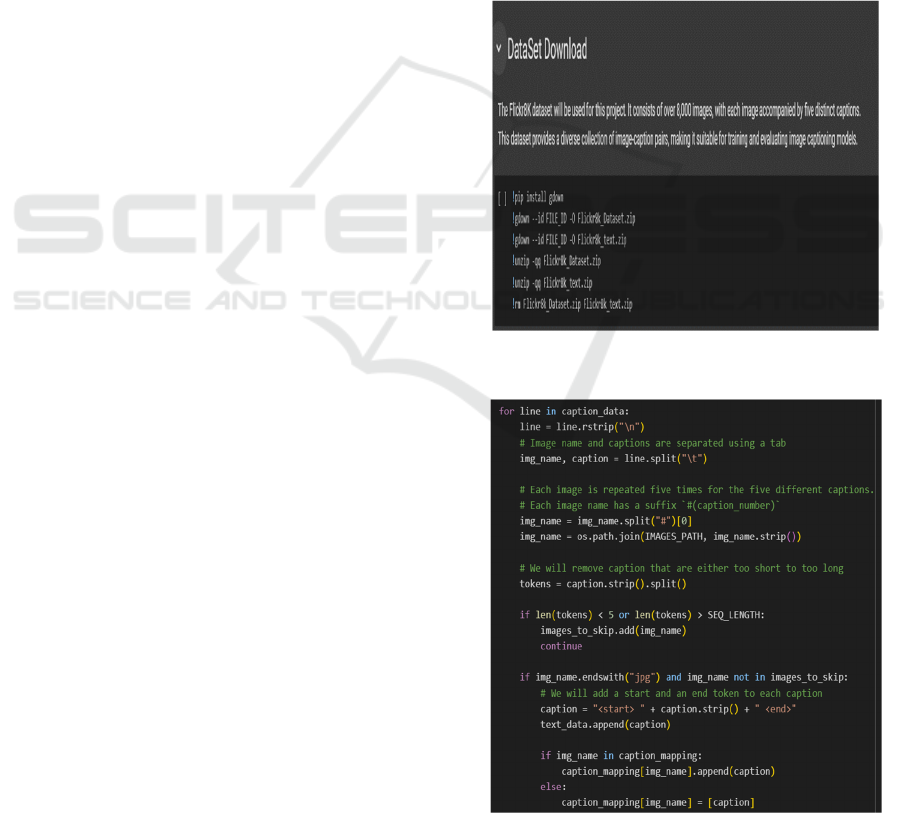
The method involves several phases, such as dataset
collection, image and text preprocessing, text data
vectorization, model building, training, validation,
and caption generation. The subsequent figure 3 will
demonstrate step-by-step process implementation and
results obtained. Figure 3 shows the Downloading
Flickr_8K dataset. Figure 4 shows the Image and
Data Pre-Processing. Figure 5 shows the Text
Vectorization. Figure 6 shows the Training and
Validation Phase.
Figure 3: Downloading Flickr_8K dataset.
Figure 4: Image and data pre-processing.
Bridging Vision and Language: A CNN-Transformer Model for Image Captioning
129
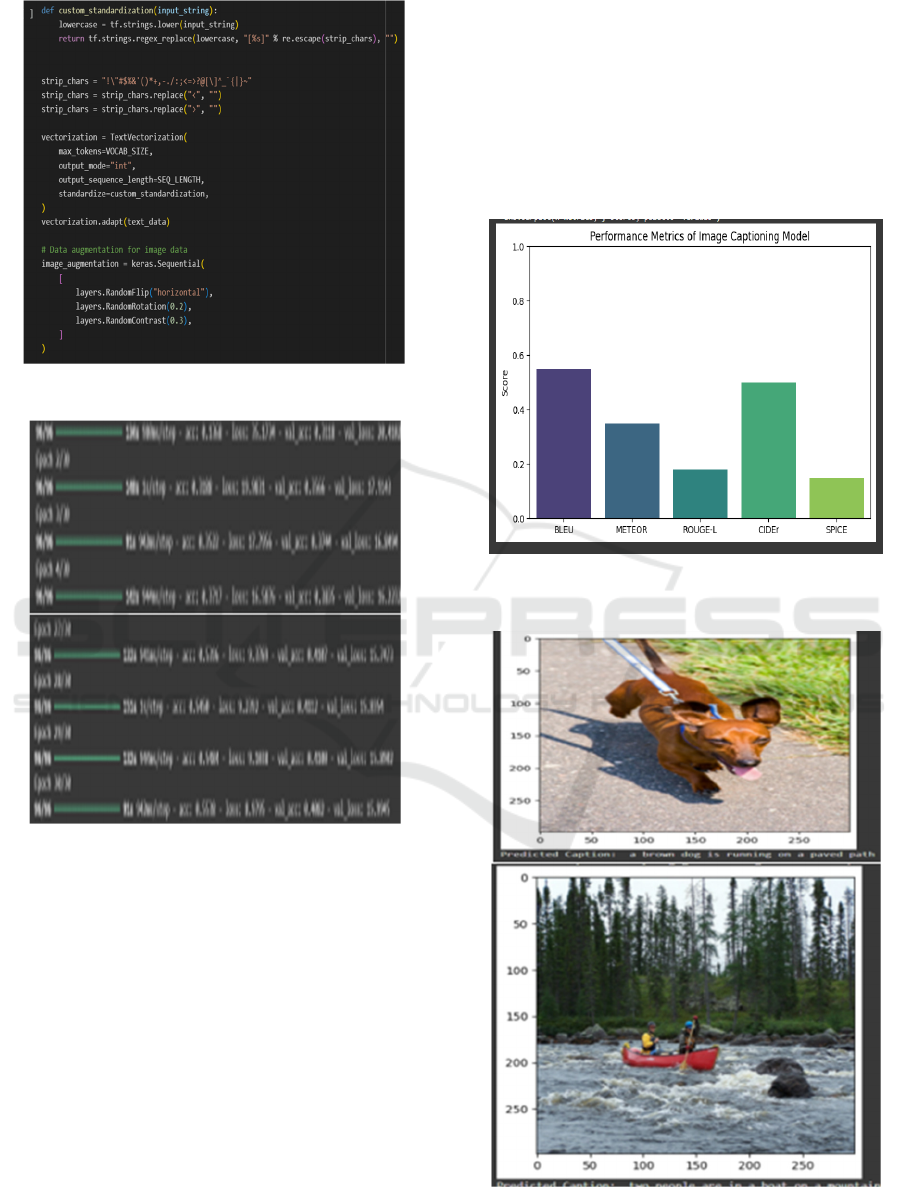
Figure 5: Text vectorization.
Figure 6: Training and validation phase.
5 PERFORMANCE EVALUATION
To assess the effectiveness of the proposed image
captioning model, standard performance metrics were
utilized, including BLEU (Bilingual Evaluation
Understudy), METEOR (Metric for Evaluation of
Translation with Explicit ORdering), ROUGE-L
(Recall-Oriented Understudy for Gusting
Evaluation), CIDEr (Consensus-based Image
Description Evaluation), and SPICE (Semantic
Propositional Image Caption Evaluation). These
metrics quantify the similarity between the generated
captions and the ground truth captions based on
different linguistic aspects.
Figure 7 illustrates the evaluation results,
showcasing the model’s performance across various
metrics. The results indicate that while the model
generates meaningful and contextually relevant
captions, there remains scope for improvement in
certain areas. Fine-tuning hyperparameters,
increasing the dataset size, and incorporating more
sophisticated attention mechanisms could further
enhance the model's accuracy. Figure 8 shows the
Image Caption Generation.
Figure 7: Performance evaluation of the image captioning
model across different metrics.
Figure 8: Image caption generation.
ICRDICCT‘25 2025 - INTERNATIONAL CONFERENCE ON RESEARCH AND DEVELOPMENT IN INFORMATION,
COMMUNICATION, AND COMPUTING TECHNOLOGIES
130

6 CONCLUSIONS
The suggested image captioning model combines
CNNs and Transformers to produce descriptive and
contextually accurate captions. Employing the
Flickr_8k dataset consisting over 8,000 images with
five captions each, the model utilizes EfficientNetB0,
a pre-trained CNN, to extract visual features, which
are then fed into a Transformer encoder to account for
contextual relationships and long-distance
dependencies. The Transformer decoder produces
word-for-word captions from the encoded features
and already generated tokens, supporting real-time
captioning of multiple images. Although this solution
shows the efficacy of blending CNNs with
Transformers, things can be improved in the future
using larger datasets such as MS COCO and
Flickr30k, hyperparameter tuning, and testing
different CNN architectures like InceptionV3,
Xception, and ResNet. Also, this work may be
extended to video captioning and multi-lingual
captioning, generalizing its usefulness. With
increasing advancements in deep learning, greater
improvements in understanding images and natural
language generation may be anticipated in the future,
and image captioning systems can become more
accurate and efficient.
7 FUTURE SCOPE
The suggested CNN-Transformer-based image
captioning model holds great prospects for future
refinement and use. Larger and more varied datasets
like MS COCO and Flickr30K can help enhance
captioning quality, whereas domain-specific data can
increase its usage in medical and autonomous
vehicles. Fine-tuning various CNN architectures (like
ResNet, InceptionV3, and Xception) and
hyperparameters can be made to further the
performance. Cross-lingual and multi-lingual
captioning can be attained by applying cross-lingual
transfer learning and language models. Expanding the
model to captioning videos through the inclusion of
temporal attention mechanisms can provide dynamic
content description, which is beneficial for real-time
use cases like assistive technology for visually
impaired individuals. Further, deploying the model
on mobile and web platforms will provide enhanced
accessibility, and optimizing the model for edge
devices can help in improving efficiency. The
integration of knowledge graphs and external text
data can enhance contextual comprehension, while
the development of Vision-Language Pretrained
Models (e.g., BLIP, Flamingo) and diffusion models
can enhance caption creativity and accuracy further.
Through these future directions, the model can be
made stronger, scalable, and flexible to real-world
applications, making it a useful tool for industries.
REFERENCES
"Adding Chinese captions to images," by X. Li, W. Lan, J.
Dong, and H. Liu ACM Int. Conf. Multimed. Retr., pp.
271–275, 2016, doi:10.1145/2911996.2912049; ICMR
2016 - Proc.
"Deep Neural Network-Based Visual Captioning," S. Liu,
L. Bai, Y. Hu, and H. Wang, MATEC Web Conference,
vol. 232, pp. 1–7, 2018, doi:
10.1051/matecconf/201823201052.
"Image captioning with lexical attention," by Q. You, H.
Jin, Z. Wang, C. Fang, and J. Luo 2016, pp. 4651–4659
in Proc. IEEE Comput. Soc. Conference. Comput. Vis.
Pattern Recognit., vol. 2016-Decem, doi:
10.1109/CVPR.2016.503.
"SCA-CNN: Spatial and channel wise attention in
convolutional neural networks (CNN) f or image
captioning," by L. Chen and colleagues Proc. - 30th
IEEE Conf. Vis. Pattern Recognition in Computing,
CVPR 2017, vol. 2017-Janua, pp. 6298– 6306, 2017,
doi: 10.1109/CVPR.2017.667.
"Show, Attend, and Tell: Attribute-driven attention strategy
for describing pictures," by H. Chen, G. Ding, Z. Lin,
S. Zhao, and J. Han doi: 10.24963/ijcai.2018/84. IJCAI
Int. Jt. Conf. Artif. Intell., vol. 2018- July, pp. 606–612,
2018.
2020 Ali Ashraf Mohamed: CNN and LSTM Image
captioning.
A. Arifianto, A. Nugraha, and Suyanto, Indonesian
language: text caption generation using cnn-gated RNN
model," 7th Int. Conf. Inf. Commun. Technol. ICoICT
2019, pp. 1–6, 2019, doi: 10.1109/
ICoICT.2019.8835370.
ACM Int. Conf. Proceeding Ser., vol. 01052, pp. 1–7, 2018,
doi: 10.1145/3240876.3240900, H. Shi, P. Li, B. Wang,
and Z. Wang, "Using reinforcement learning for image
description".
C.-Y. Lin, "ROUGE: A Package for Automatic Evaluation
of Summaries," Proc. Workshop on Text
Summarization Branches Out, 42nd Annual Meeting of
the Association for Computational Linguistics (ACL),
2004.
Chetan Amritkar and Vaishali Jabade, 14th International
Conference on Computing, Communication Control,
and Automation (ICCUBEA), IEEE, 2018, 978-1-
5386-5257-2/18, "Image Caption Generation via Deep
Learning Technique”.
Convolutional image captioning, J. Aneja, A. Deshpande,
and A.G. Schwan, Proc. IEEE Comput. Soc. Conf.
Comput. Vis. Pattern Recognit., pp. 5561–5570, 2018,
doi: 10.1109/ CVPR.2018.00583.
Bridging Vision and Language: A CNN-Transformer Model for Image Captioning
131

Fluency-guided cross-lingual image captioning, W. Lan, X.
Li, and J. Dong. Proceedings of the 2017 ACM
Multimed Conference, MM 2017; doi:
10.1145/3123266.3123366; pp. 1549–557).
H.A. Almuthuzini,T.N.Alyahya, andH. Benhidour, an
automatic Arabic image captioning using RNN.LSTM
based language models and CNN Int. J. Adv. Comput.
Sci. Appl., vol. 9, no. 6, pp. 67–73, 2018, doi: 10.14569/
IJACSA.2018.090610.
K. Papineni, S. Roukos, T. Ward, and W.-J. Zhu, "BLEU:
A Method for Automatic Evaluation of Machine
Translation," Proc. 40th Annual Meeting of the
Association for Computational Linguistics (ACL),
2002, doi:10.3115/1073083.1073135
K. Xu and colleagues, "Show, Attend and Tell: Neural
Image Caption Generation with Visual Attention,"
32nd International Conference on Machine Learning
(ICML 2015), vol. 3, pp. 2048–2057, 2015.
P. Anderson, B. Fernando, M. Johnson, and S. Gould,
"SPICE: Semantic Propositional Image Caption
Evaluation," Proc. Eur. Conf. Comput. Vis. (ECCV),
2016, pp. 382–398, doi: 10.1007/978-3-319-46454-
1_23.
R. Vedantam, C. L. Zitnick, and D. Parikh, "CIDEr:
Consensus-based Image Description Evaluation," Proc.
IEEE Conf. Comput. Vis. Pattern Recognit. (CVPR),
2015, pp. 4566–4575, doi:
10.1109/CVPR.2015.7299087.
Research presented by Mulyanto et al. (2019) in their study
on automatic image caption generation in Indonesian.
The authors leverage a CNN-LSTM model and
introduce the FEEH-ID dataset for training and
evaluation purposes.IEEE Int. Conf. Comput. Intell.
Virtual Environ. Meas. Syst. Appl. CIVEMSA 2019 -
Proc., 2019, doi: 10.1109/
CIVEMSA45640.2019.9071632.
S. Banerjee and A. Lavie, "METEOR: An Automatic
Metric for MT Evaluation with Improved Correlation
with Human Judgments," Proc. Workshop on Intrinsic
and Extrinsic Evaluation Measures for Machine
Translation and/or Summarization, 43rd Annual
Meeting of the Association for Computational
Linguistics (ACL), 2005, pp. 65–72.
Seelaboyina, Radha, and Rajeev Vishwkarma. "Feature
Extraction for Image Processing and Computer
Vision—A Comparative Approach." In Proceedings of
the International Conference on Cognitive and
Intelligent Computing: ICCIC 2021, Volume 1, pp.
205-210. Singapore: Springer Nature Singapore, 2022,
https://doi.org/10.1007/978-981-19-2350-0_20.
Seelaboyina, Radha, and Rais Abdul Hamid Khan.
"Enhance Image Quality with CAS-CNN: A Deep
Convolutional Neural Network for Compression
Artifact Suppression." Journal of Electrical Systems,
vol. 20, no. 6s, 2024, pp. 2432-2443.
https://doi.org/10.52783/jes.323
The Eighth International Conference on ICT, "Indonesia
Image Captioning: Adaptable Attention Generation,"".
ICoICT 2020, 10.1109/ ICoICT49345.2020.9166244,
M. R. S. Mahadi, A. Arifianto, and K. N. Ramadhani.
Wang, C., Yang, H., & Meinel, C. (2018, April 25). Image
Captioning with Deep Bidirectional LSTMs and Multi-
Task Learning. ACM Transactions on Multimedia
Computing, Communications, and Applications,
14(2s), 1–20. https://doi.org/10.1145/3115432
Y. Yoshikawa, Y. Shigeto, and A. Takeuchi, "STAIR
captions: Building a comprehensive dataset of Japanese
image captions," ACL 2017, the 55th Annual Meeting
of the Association for Computer-Assisted Linguistics,
Proceedings of the Conference (Long Papers, vol. 2, pp.
417–421, 2017, doi: 10.18653/v1/P17- 2066.
ICRDICCT‘25 2025 - INTERNATIONAL CONFERENCE ON RESEARCH AND DEVELOPMENT IN INFORMATION,
COMMUNICATION, AND COMPUTING TECHNOLOGIES
132
