
Deep Learning for the Identification of Cyberbullying in Social
Networks
Loveleen Kaur Pabla
1
, Prashant Kumar Jain
2
, Prabhat Patel
2
and Shailja Shukla
1
1
Department of Information Technology, Jabalpur engineering College Jabalpur, Madhya Pradesh, India
2
Department of Electronics and telecommunication, Rajiv Gandhi Proudyogiki Vishwavidyalaya Bhopal,
Madhya Pradesh, India
Keywords: Social Media Companies, Online Businesses, Media Platforms, Related Private Stakeholder, Natural
Language Processing, Hate Speech Detection.
Abstract: Using effective algorithms to automatically comprehend user-generated internet debates is the goal of this
thesis. Governments around the world have been urging social media companies, online businesses, media
platforms, and related private stakeholders to take greater responsibility for what appears in their virtual
spaces in recent years. They are also urging them to invest more in the early detection of users' emotions,
particularly negative ones, and the swift removal of hostile and hateful content. These demands are being
bolstered by recent serious crime events and mounting media pressure. As a result of this pressure, businesses
are investing more in research on effective algorithms for a recently developed problem in natural language
processing, hate speech detection, for which there is now relatively little research literature accessible.
1 INTRODUCTION
Social media analysis is becoming more and more
popular these days, and a number of artificial
intelligence research projects have recently focused
on creating precise text classification algorithms for
sentiment analysis, a task that aims to automatically
assign a sentiment polarity to user-generated
comments. Sentiment analysis can be used, for
example, to predict how news will affect financial
markets, but its primary applications are in political
communication and brand reputation. Not as much
work has been done to use artificial intelligence
approaches for categorisation problems like hate
speech detection, which are closely connected to
sentiment analysis but have a significant and valuable
societal impact. In the Framework Decision
2008/913/JHA of November 28, 20082, the European
Union defined hate speech as "any conduct publicly
inciting to violence or hatred directed against a group
of persons or a member of such a group defined by
reference to race, color, religion, descent, or national
or ethnic origin." Hate speech is a serious and
increasingly prevalent phenomenon. "Any
communication that disparages a
person or a group on the basis of some characteristic
such as race, color, ethnicity, gender, sexual
orientation, nationality, religion, or other
characteristic" is the broader definition of hate speech
provided by The Encyclopaedia of the American
Constitution. As political attention to the issue has
grown in recent years, so too has media coverage of
this issue. Institutions around the world have recently
called on social media corporations to invest more in
the early identification and prompt removal of hostile
information and to take greater accountability for
what happens in their networks. The Council of
Europe played a major role in the establishment of the
No Hate Speech Movement3 initiative in Europe, and
EU regulators have been pressuring social media
companies to promptly remove violent and racist
content from their platforms for years. The German
government authorised a plan in April of late 2017 to
begin fining Facebook, Twitter, and other platforms
up to 50 million euros (59 million dollars) if they do
not take down hate speech and false news items
within 24 hours of being reported. After being
reported, any additional unlawful content must be
removed within seven days. However, it still takes
web platforms more than a week on average to
remove unlawful information in more than 28% of
cases in Europe. You can get a sense of how late the
114
Pabla, L. K., Jain, P. K., Patel, P. and Shukla, S.
Deep Learning for the Identification of Cyberbullying in Social Networks.
DOI: 10.5220/0013923600004919
Paper published under CC license (CC BY-NC-ND 4.0)
In Proceedings of the 1st International Conference on Research and Development in Information, Communication, and Computing Technologies (ICRDICCT‘25 2025) - Volume 5, pages
114-118
ISBN: 978-989-758-777-1
Proceedings Copyright © 2026 by SCITEPRESS – Science and Technology Publications, Lda.
real interventions against unlawful contents were by
adding to this the time it took to identify and the
manual labor required to screen social contents.
2 THE CYBERBULLYING
DETECTION METHOD
(i) Dataset- This study makes advantage of publicly
accessible dataset designed for detecting
cyberbullying in Facebook comments includes more
than 81,000 posts, each labeled as either "clean" or
"cyberbullying." The categorization is based on
manual annotations, threat assessments, and keyword
identification, with a clear definition of
"cyberbullying" within the dataset encompasses
attacks that are racist, sexist, cultural, intellectual,
political, and based on appearance. Random
undersampling is employed to guarantee that there are
an equal number of samples in each class because the
dataset is imbalanced, containing 72% clean
comments and 28% bullying remarks. The final
dataset used in the research includes 22,000 entries,
evenly split with 11,000 cyberbullying comments and
11,000 clean comments. These are divided into
training, validation, and test sets with an 80:10:10
distribution.
(ii) Data Preprocessing- The comments include
emoticons, abbreviations, spelling variations,
informal grammar, and multilingual terms. To handle
these, the following preprocessing techniques are
applied:
• Elimination of punctuation: commas and
periods are eliminated.
• Lowercasing is the process of changing all
alphabets to lowercase.
• Tokenisation: whitespace comments are
divided into words.
• Stopword removal: common words like
"the," "and," and so forth are eliminated.
• Spell correction: the PySpellchecker library
is used to correct words.
• Lemmatisation: Spacy is used to lemmatise
words to their root form.
After preprocessing, comments are typically 21
words long. There are 65,312 distinct tokens in the
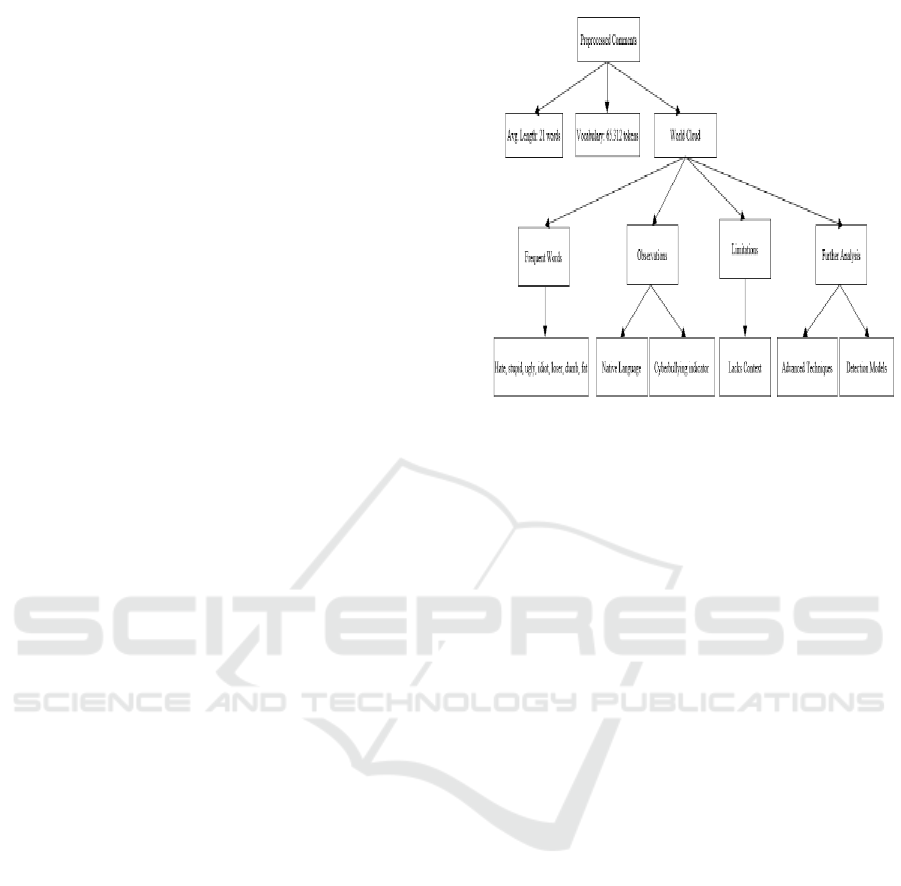
lexicon. The word cloud illustrating the most
common words is displayed in Figure 1.
Figure 1: Word cloud of preprocessed comments.
(iii) Feature Extraction- The preprocessed
comments are fed into deep learning models after
being transformed into feature vectors. TF-IDF
vectors and word embeddings are the two feature
types that are extracted.
• Vectors of TF-IDF- One statistical metric
that assesses the significance of words in a
document is called TF-IDF. The tokenised
comments are subjected to the scikit-learn
TF-IDF vectorizer, It contains 65k
characteristics in its lexicon. This leads to a
vector representation with 65,000
dimensions for each comment.
• Word embeddings- Out-of-vocabulary
words are initialised at random instead of
utilising TF-IDF vectors. Making use of
300-dimensional, pre-trained GloVe word
vectors, comments are transformed into
word embedding sequences, which aid in
capturing semantic meaning.
3 DEEP LEARNING MODELS
The following deep neural network designs are
assessed for the identification of cyberbullying:
• CNN stands for Convolutional Neural
Network.
• LSTM stands for Long Short-Term Memory
Network.
• CNN-LSTM hierarchical.
• BERT, or Transformer Encoder
Deep Learning for the Identification of Cyberbullying in Social Networks
115

Table 1: Algorithm used.
Metho
d
Ke
y
Characteristics Advanta
g
es Disadvanta
g
es
CNN Convolutions to extract
local n-gram features; Max-
pooling for dimensionality
reduction; Captures spatial
relationshi
p
s
Model local context; Translation
invariant; Efficient for small
regions
No sequential modeling; Large
input size increases parameters
LSTM Memory cell and gating
units; Captures long-term
dependencies; Models
sequential data
Learns global context; Handles
variable length input
Difficult to train;
Computationally intensive
Because they make use of various inductive biases,
these models are appropriate for this job. The Keras
API and TensorFlow 2.0 both use the models. The
considered algorithms in this paper are displayed in
Table 1. The strengths of the convolutional and
recurrent networks are complementary. Global
sequential patterns are examined by LSTM, whereas
CNN concentrates on local n-gram compositions.
Transformer self-attention is used by BERT to model
long-range relationships in both directions.
Convolutions and LSTMs are both advantages of the
hierarchical CNN-LSTM approach.
4 RESEARCH METHODOLOGY
Both the Sentiment Analysis and Hate Speech
Detection tasks are examined in this thesis from a
methodological standpoint, but with distinct
approaches and scopes: (i) the Sentiment Analysis
task and its extensive literature will be examined
exclusively to find cutting-edge approaches and
methodologies for text classification of sentences
sentiment-wise; (ii) as a result, new methodologies
and techniques will be created especially for the Hate
Speech Detection task by utilizing the extensive
literature and the substantial amount of benchmark
data sets available for Sentiment Analysis. With the
exception of the first work in collection, which tests a
novel strategy on a sentiment analysis job because
there were no hate speech datasets available at the
time the publication was produced, no additional
analysis of state-of-the-art techniques in sentiment
analysis.
(i) Sentiment Analysis- The mapping experiment to
assess and plot the development of Deep Learning
(DL) research work specifically for the Sentiment
Analysis job over the past few years is described in
this paragraph. The mapping of the "state-of-the-art
models" from 2016 backwards has been the main goal
of my literature review effort. I worked on a thorough
manual study of the research publication data, also
known as content analysis, to determine: (i) the
primary models and methodologies utilized in state-
of-the-art models together with their accuracy
performances, primary benchmark datasets, and (ii)
the primary problems.
(ii) Search Protocol- I created and put into practice
the following search protocol as a first step to find the
scientific publications pertaining to the subject matter
of this investigation:
• I first conducted a reference search of earlier
state-of-the-art models and found the
research publication that corresponded to the
more recent state-of-the-art model (which
we will refer to as the root-paper).
• I manually screened all of the research
articles that the root paper cited backwards,
repeating the process, to identify all of those
that had previously shown themselves to be
state-of-the-art models for Deep Learning
for Text Classification.
(iii) Content Analysis- The author of this study
manually annotated the datasets with the goal of
identifying the primary benchmark datasets, dataset
domains within the period of interest, and models and
techniques utilized in state-of-the-art models together
with their accuracy performances. This section
presents the manual analysis's findings. The
following coding fields have been corrected for the
manual reading: Class (NoDL or Deep Learning),
Year, Title, Model, Family Model, Previous Model
Variants, Feature Representation, Issues, Insights,
and Primary Focus. The following coding fields have
been corrected for the manual reading: Class (NoDL
or Deep Learning), Year, Title, Model, Family
Model, Previous Model Variants, Feature
Representation, Issues, Insights, and Primary Focus.
The author of this study manually annotated the
datasets in order to identify the primary benchmark
datasets, dataset domains within the period of interest,
and models and techniques used in state-of-the-art
models along with their accuracy performances.
ICRDICCT‘25 2025 - INTERNATIONAL CONFERENCE ON RESEARCH AND DEVELOPMENT IN INFORMATION,
COMMUNICATION, AND COMPUTING TECHNOLOGIES
116
5 EXPERIMENTS AND
PERFORMANCE RESULTS
The CNN, LSTM, CNN-LSTM, and BERT models'
performances were assessed through a number of
experiments. Four-fold stratified cross-validation
with grid search, the hyperparameters are adjusted.
The Adam optimizer is used to train all models for 20
epochs with early stopping. Table 2, displays the deep
learning models' performance in classifying
cyberbullying on the test set. With the best accuracy
of 87.3%, the BERT model is closely followed by the
hierarchical CNN-LSTM, which has an accuracy of
86.5%. Compared to standalone LSTM, CNN fares
worse, with an accuracy of 81.5%, compared to
83.2%.
Table 2: Evaluate the deep learning models' performance.
Model Accuracy Precision Recall F1-
score
CNN 0.815 0.813 0.815 0.814
LSTM 0.832 0.828 0.832 0.830
CNN-
LSTM
0.865 0.862 0.865 0.863
BERT 0.873 0.871 0.873 0.872
Having 0.871, 0.873, and 0.872 F1-scores for
precision, recall, and BERT leads the field.
Additionally, CNN-LSTM displays balanced metrics
with a recall of 0.865 and a precision of 0.862. While
solo CNN performs the worst, LSTM trails them by a
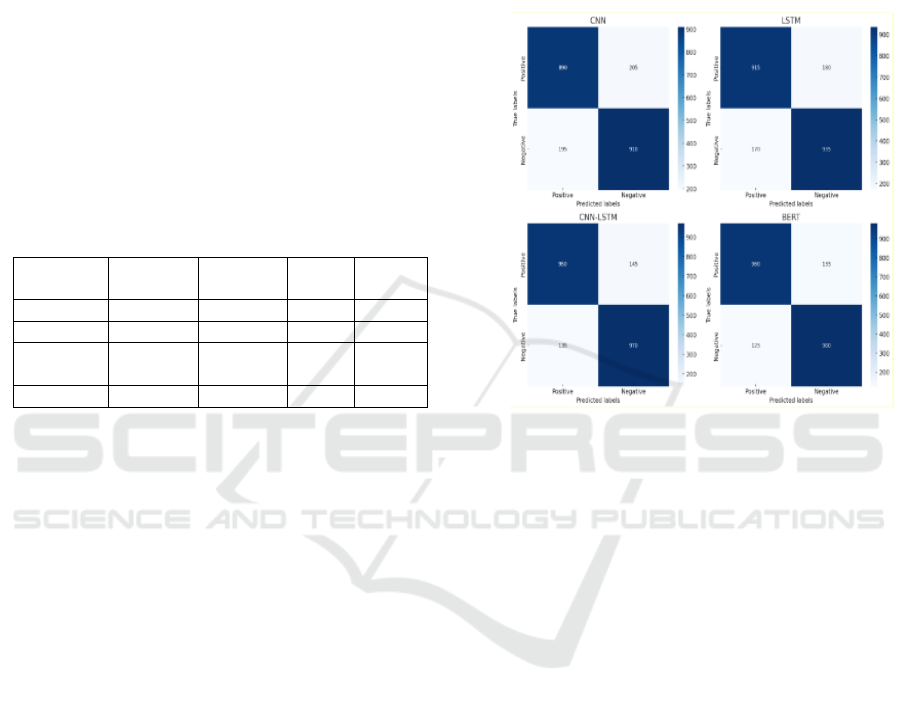
small margin. Figure 2 depicts graphically the
confusion matrices obtained from the deep learning
models applied in this work. These matrices provide
a comprehensive overview of the models'
performance by displaying the distribution of true
positive, true negative, false positive, and false
negative predictions. Each deep learning model's
classification performance is broken out in detail by
the confusion matrices. The CNN model can
accurately detect both cases of cyberbullying and
non-cyberbullying, as seen by its reasonably True
positives and true negatives are distributed evenly.
There is potential for improvement, though, as it also
produces a sizable number of false positives and false
negatives. With greater true positive and true negative
counts and lower false positive and false negative
counts, the LSTM model outperforms the CNN
model by a little margin. This suggests that the
LSTM's capacity to identify sequential linkages
facilitates more successful discrimination between
the two groups. As demonstrated by the greater true
positive and true negative counts and the decreased
false positive and false negative counts, the CNN-
LSTM hierarchical model considerably improves
performance. This enhancement results from the
model's use of both global sequential patterns and
local n-gram features. Lastly, despite reducing false
positive and false negative counts, the BERT model
maximizes true negative and genuine positive
numbers.
Figure 2: Confusion matrices for deep learning models.
This enhanced performance demonstrates how
well instances of cyberbullying are detected by the
Transformer design and the previously taught
language representations. All things considered, the
confusion matrices help choose the optimum
architecture for the task by providing useful
information about the benefits and drawbacks of each
model.
6 CONCLUSIONS
The effectiveness of deep learning for automated
cyberbullying detection is demonstrated by the
empirical study of deep learning techniques for
cyberbullying identification in social networks that is
described in this research. A dataset of Facebook
comments is used to analyse the performance of the
CNN, LSTM, CNN-LSTM, and BERT models.
BERT achieves the highest accuracy of 87.3%, whilst
a hierarchical CNN-LSTM design achieves 86.5%.
While BERT benefits from bidirectional context
modelling using self-attention, LSTM models long-
range sequential dependencies, multi-layer CNN
collects informative n-gram features. It is necessary
to do testing on a variety of social media platforms
Deep Learning for the Identification of Cyberbullying in Social Networks
117

and content kinds. When creating practical
moderation systems, user privacy and free expression
issues must be taken into account. This work
establishes a solid foundation for further research on
this significant issue and offers helpful insights.
REFERENCES
Abuowaida S., Elsoud E., Al-momani A., Arabiat M.,
Owida H., Alshdaifat N., and Chan H., “Proposed
Enhanced Feature Extraction for Multi- Food Detection
Method,” Journal of Theoretical and Applied
Information Technology, vol. 101, no. 24, pp. 8140-
8146, 2023.
Agrawal S. and Awekar A., “Deep learning for detecting
cyberbullying across multiple social media platforms,”
in Proceedings of the European Conference on
Information Retrieval, Grenoble, pp. 141-153, 2018.
Alazaidah R., Ahmad F., Mohsen M., and Junoh A.,
“Evaluating Conditional and UnconditionalCorrelation
s Capturing Strategies in Multi Label Classification,”
Journal of Telecommunication, Electronic andComput
er Engineering, vol. 10, no. 2,pp. 4751, 2018.https://jte
c.utem.edu.my/jtec/article/view/4315/3 162
Alazaidah R., Ahmad F., Mohsin M., and AlZoubi W.,
“Multi-Label Ranking Method Based on Positive Class
Correlations,” Jordanian Journal of Computers and
Information Technology, vol. 6, no. 4, pp. 377-391,
2020.
Alazaidah R., Almaiah M., and Al-Luwaici M.,
“Associative Classification in MultiLabelClassificatio
n: An Investigative Study,” Jordanian Journal of
Computers and Information Technology, vol. 7, no. 2,
pp. 166-179, 2021. DOI:10.5455/jjcit.71-1615297634
Alazaidah R., Samara G., Almatarneh S., Hassan M.,
Aljaidi M., and Mansur H., “Multi-LabelClassification
Based on Associations,” Applied Sciences, vol. 13, no.
8, pp. 5081, 2023.https://doi.org/10.3390/app1308508
1
Al-Garadi A., Varathan K., and Ravana S., “Cybercrime
Detection in Online Communications: TheExperiment
al Case of Cyberbullying Detection in the Twitter
Network,” Computers and Security, vol. 63, pp.z433-
443, 2017. https://doi.org/10.1016/j.chb.2016.05.051
Alhusenat A., Owida H., Rababah H., Al-Nabulsi J., and
Abuowaida S., “A Secured MultiStagesAuthentication
Protocol for IoT Devices,” Mathematical Modelling of
Engineering Problems, vol. 10, no. 4, pp. 1352-1358,
2023. https://doi.org/10.18280/mmep.100429
François Chollet et al. 2015. Keras. https://keras.io. (2015).
Lucas Dixon, John Li, Jeffrey Sorensen, Nithum Thain, and
Lucy Vasserman. 2018. Measuring and mitigating
unintended bias in text classification. In Proceedings of
the 2018 AAAI/ACM Conference on AI, Ethics, and
Society. ACM, 67–73.
Yanai Elazar and Yoav Goldberg. 2018. Adversarial
Removal of Demographic Attributes from Text Data. In
Proceedings of the 2018 Conference on Empirical
Methods in Natural Language Processing (EMNLP
2018). Association for Computational Linguistics, 11–
21
Elisabetta Fersini, Debora Nozza, and Paolo Rosso. 2018.
Overview of the EVALITA 2018 Task on Automatic
Misogyny Identification (AMI). In Proceedings of
Sixth Evaluation Campaign of Natural Language
Processing and Speech Tools for Italian. Final
Workshop (EVALITA 2018). CEUR-WS.org.
Elisabetta Fersini, Paolo Rosso, and Maria Anzovino. 2018.
Overview of the Task on Automatic Misogyny
Identification at IberEval 2018. In Proceedings of the
Third Workshop on Evaluation of Human Language
Technologies for Iberian Languages (IberEval 2018),
co-located with 34th Conference of the Spanish Society
for Natural Language Processing (SEPLN 2018).
CEUR-WS.org.
Simona Frenda, Bilal Ghanem, and Manuel Montes-y
Gómez. 2018. Exploration of Misogyny in Spanish and
English tweets. In Proceedings of the Third Workshop
on Evaluation of Human Language Technologies for
Iberian Languages (IberEval 2018), co-located with
34th Conference of the Spanish Society for Natural
Language Processing (SEPLN 2018), Vol. 2150.
CEUR-WS.org, 260–267.
Iakes Goenaga, Aitziber Atutxa, Koldo Gondola, Arantza
Casillas, Arantza Díaz de Ilarraza, Nerea Ezeiza, Maite
Oronoz, Alicia Pérez, and Olatz Perez-de-Viñaspre.
2018. Automatic Misogyny Identification Using Neural
Networks. In Proceedings of the 3rd Workshop on
Evaluation of Human Language Technologies for
Iberian Languages (IberEval 2018), co-located with
34th Conference of the Spanish Society for Natural
Language Processing (SEPLN 2018). CEUR-WS.org.
Moritz Hardt, Eric Price, and Nati Srebro. 2016. Equality
of Opportunity in Supervised Learning. In Advances in
Neural Information Processing Systems. 3315–3323.
Sarah Hewitt, Thanassis Tiropanis, and Christian Bokhove.
2016. The Problem of identifying Misogynist Language
on Twitter (and other online social spaces). In
Proceedings of the 8th ACM Conference on Web
Science. ACM Press, 333–335.
Svetlana Kiritchenko and Saif Mohammad. 2018.
Examining Gender and Race Bias in Two Hundred
Sentiment Analysis Systems. In Proceedings of the 7th
Joint Conference on Lexical and Computational
Semantics (*SEM@NAACL-HLT 2018). Association
for Computational Linguistics, 43–53.
ICRDICCT‘25 2025 - INTERNATIONAL CONFERENCE ON RESEARCH AND DEVELOPMENT IN INFORMATION,
COMMUNICATION, AND COMPUTING TECHNOLOGIES
118
