
MRI‑Based Brain Tumor Detection and Classification Using Deep
Learning
N. Malarvizhi
1
, A. Divya
1
, N. Sankar Ram
2
, M. Saraswathi
3
, Naveen Kumar R. J.
4
and M. Nalini
5
1
Professor, Department of CSE, Vel Tech Rangarajan Dr Sagunthala R&D Institute of Science and Technology, Chennai,
Tamil Nadu, India
2
Department of CSE, SRM Institute of Science and Technology, Chennai, Tamil Nadu, India
3
Department of CSE, SCSVMV Deemed to be university, Kanchipuram, Tamil Nadu, India
4
Senior Associate Engineer, Chennai, Tamil Nadu, India
5
Associate, Professor, Department of CS&BS, S.A Engineering College, Chennai, Tamil Nadu, India
Keywords: Brain Tumor Detection, MRI Images, Brain Tumor Classification, Fully Convolutional Network (FCN),
Medical Imaging, Automated Diagnosis, Radiology Assistance.
Abstract: It is obvious that the detection and classification of brain tumors in the MRI scans is an important aspect of
medical imaging and so is defected in diagnosis and treatment of medical issues. This work applies a Fully
Convolutional Network (FCN) model towards automatic identification of brain tumors with MRI images from
Kaggle dataset. The dataset is organized into training and testing folders which have subfolders that represent
categories of tumors such as glioma, meningioma, pituitary tumors, and ‘no tumor’ for normal cases. This
lets the FCN learn to not only detect the presence of a tumor, but also which specific type it is. The model is
trained to process MRI images on a pixel-by-pixel basis, allowing for precise segmentation and classification
of abnormal regions. In the event that the model detects a tumor, it will determine the tumor type based on
the set of features that the model has learned for each category in the dataset. The model operates in a sequence
of two stages: first, it classifies an MRI scan to be tumor-positive or tumor-negative; second, if the model
detects the presence of a tumor, it classifies the tumor into one of the set categories. The model performs
binary classification as well as multi-class classification. The proposed system will help to assist radiologists
by providing a tool that is automated and reliable for brain tumor detection and classification, which, without
doubt, simplifies the diagnostics process and improves the outcome.
1 INTRODUCTION
Brain tumors are a life-threatening disease with high
rates of mortality and morbidity. Precise
identification and categorization of brain tumors are
important in determining appropriate therapy
planning and optimal outcomes. The principal
imaging device applied by medical doctors to observe
brain tumors is Magnetic Resonance Imaging (MRI).
With its capacity to produce high-resolution, detailed
images of brain structures, MRI offers significant
information on the existence and nature of tumors.
Yet, such human interpretation is time-consuming
and necessitates specialized knowledge and is even
susceptible to human fallibility or inconsistency
among radiologists. Deep learning algorithms have
been established as strong aids for medical image
analysis automation. Of these, Fully Convolutional
Networks (FCNs) have become increasingly popular
because of their special feature of pixel-level image
segmentation. While conventional Convolutional
Neural Networks (CNNs) classify the entire images,
FCNs are capable of processing images in a manner
that enables fine-grained spatial analysis. This feature
makes them highly appropriate for medical purposes
like the detection and segmentation of brain tumors in
MRI scans. FCNs not only detect if a tumor is present
but also its edges and classify it into certain classes
based on the nature of the tumor. The suggested work
intends to utilize an FCN model to scan brain MRI
images for tumor detection and classification. It
employs a Kaggle dataset, which is an organized
collection of MRI images divided into four classes:
glioma, meningioma, pituitary tumor, and normal (no
tumor). The data structure enables the FCN model to
perform both multi-class classification among tumor
86
Malarvizhi, N., Divya, A., Ram, N. S., Saraswathi, M., J., N. K. R. and Nalini, M.
MRI-Based Brain Tumor Detection and Classification Using Deep Learning.
DOI: 10.5220/0013923200004919
Paper published under CC license (CC BY-NC-ND 4.0)
In Proceedings of the 1st International Conference on Research and Development in Information, Communication, and Computing Technologies (ICRDICCT‘25 2025) - Volume 5, pages
86-91
ISBN: 978-989-758-777-1
Proceedings Copyright © 2026 by SCITEPRESS – Science and Technology Publications, Lda.

and no tumor and multi-class classification among
tumor types. The model achieves this in two steps.
Firstly, the presence of a tumor, and secondly, the
identification of the identified tumor into one of the
specified categories. The incorporation of FCNs in
brain tumor detection systems has numerous benefits.
First, it provides accurate localization of tumor areas,
which is critical for accurate diagnosis and planning
of treatment. Second, it lightens the workload of
radiologists, facilitating quicker and more uniform
decision-making. Third, such automated systems can
fill the gap in health care access, particularly in
locations where trained radiologists are in short
supply. This research sets the effectiveness of FCNs
in classifying and detecting brain tumors as a
potentially scalable and strong solution to medical
imaging. Openly available data and deep learning
methods aid in the progression of automated
diagnostic equipment for brain tumor analysis.
2 LITERATURE SURVEY
A hybrid FCN approach was presented in (Kamran,
A, et, al. 2020) for the classification of brain tumors.
This model leverages the strength of FCNs for
accurate segmentation along with ensemble
classifiers for enhanced classification accuracy. The
work was motivated to address challenges such as
class imbalance and variation in the appearance of the
tumor by combining several classifiers in an
ensemble. A new FCN-based model enriched with
attention mechanisms for brain tumor detection was
suggested by the authors in (Bhatia, R, et, al, 2021)
The research incorporated the pixelwise classification
capability of FCNs and attention layers concentrating
on the area of interest for the tumor. The approach
made the model sensitive to small, abnormally shaped
tumors and better detection accuracy than in
conventional methods.
A multi-scale FCN model for segmentation of
brain tumors from MRI scans was proposed in (Xu,
Y2021). By combining multiple resolution levels in
the segmentation process, the model could preserve
both fine-grained details and large-scale tumor
structures. The multi-scale method enhanced the
accuracy of tumor segmentation, particularly for
tumors with irregular shapes. The authors in (Gupta,
A.,2022) introduced a 3D FCN-based method for
brain tumor detection from volumetric MRI scans.
With the utilization of 3D convolution operations, the
model was able to extract spatial information from
multiple slices of the brain, which enabled more
precise tumor localization and detection in 3D MRI
volumes. This method has proven the great benefits
in utilizing 3D convolutional models compared to 2D
methods in medical image analysis tasks.
A deep supervision FCN model for brain tumor
segmentation was presented in (Wang, Z, 2023) In
this model, more than one layer of the FCN was
supervised directly during training to make sure that
intermediate features were used to contribute to the
final segmentation output. This process enabled the
model to learn better at various abstraction levels and
enhanced its segmentation accuracy, particularly for
heterogeneous tumors. The authors in (Li, X, 2024)
suggested a state-of-the-art multi-class segmentation
FCN for the types of brain tumors (glioma,
meningioma, pituitary tumors, etc.) from MRI scans.
The model aimed to not only segment the tumor area
but also determine the type of tumor, combining both
segmentation and classification into one pipeline. The
authors used a multi-task learning method to train the
model for both tasks at once, which enhanced the
overall performance of both tumor detection and
classification.
The authors proposed a new FCN-enhanced
architecture equipped with spatial attention
mechanisms for the detection of brain tumors in
(Cheng, H, 2024) The attention module was
integrated into the FCN to target areas that were likely
to hold tumor tissue, which aided the model to
perform better at detecting small or inconspicuous
tumors that would be missed using traditional
methods. An FCN-based model using a transfer
learning method for brain tumor segmentation was
presented in (Khan, A, 2020). Taking advantage of
pre-trained models, the research proved enhanced
feature extraction and classification accuracy,
particularly for small datasets. The model achieved
efficient reduction of training time with high
segmentation accuracy.
The authors of (Patel, R,2021) proposed a deep
learning pipeline that combined FCNs with U-Net
architecture for brain tumor segmentation. Their
method utilized skip connections to preserve spatial
information, enhancing segmentation accuracy for
tumors of different shapes and sizes. The paper
emphasized the benefits of employing FCN-based
architectures in medical image tasks. A CNN-FCN
hybrid model for brain tumor detection was
implemented where a Convolutional Neural
Networks (CNNs) used to extract features prior to
inputting them to an FCN for pixel-wise
classification. This approach enhanced small tumor
region detection and minimized false positives in
MRI scans. A CNN-FCN model for brain tumor
segmentation and classification was proposed in
MRI-Based Brain Tumor Detection and Classification Using Deep Learning
87
(Zhang et al, 2023). CNN was used to extract
features, while FCN enhanced tumor localization.
Experimented on the BraTS dataset, the model
reached a Dice score of 0.87, which is superior to
conventional CNN approaches.
3 PROPOSED SYSTEM
In the proposed system, a Fully Convolutional
Network (FCN) is used to automatically Segment
brain tumors in MRI images. Following the
preprocessing step, the FCN processes the Images to
distinguish between tumor regions and healthy tissue.
Trained on a labeled dataset, the model detects and
segments the tumors accurately, helping the
radiologists by accelerating up diagnosis and
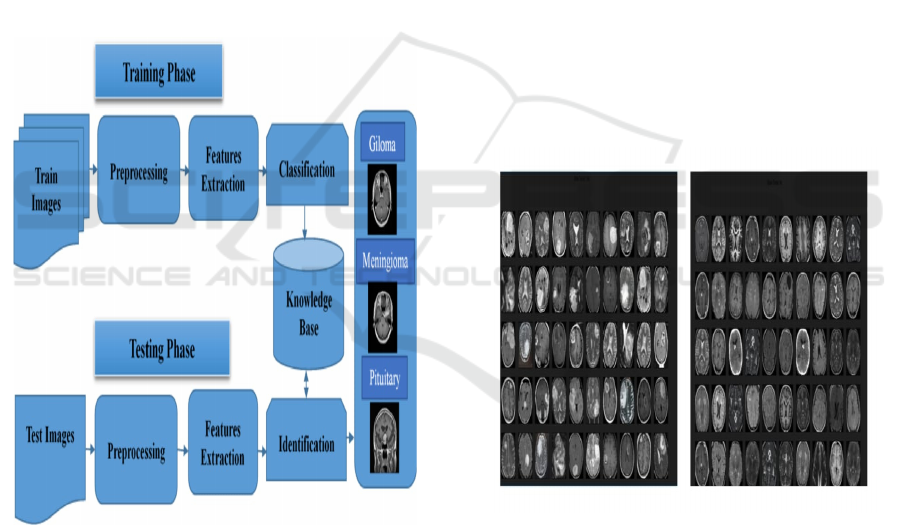
improving accuracy. Figure 1 depicts the architecture
diagram of the proposed system.
Figure 1: Architecture diagram for the proposed system.
The various steps in the Proposed System are given
below:
• Data Preprocessing: Resize, normalize, and
augment MRI images from the Kaggle dataset.
• FCN Model Training: Train the Fully
Convolutional Network (FCN) on labeled data
to segment tumor regions.
• Tumor Detection & Segmentation: The
model classifies MRI images into tumor vs. no
tumor and identifies tumor types if present.
• Post-Processing: Generate segmentation
maps and evaluate tumor boundaries.
• Evaluation: Assess model performance using
accuracy, precision, recall, and F1-score.
• Testing & Deployment: Test on unseen data
and deploy the model for real-time clinical
use.
3.1 Input Design
A brain tumor MRI usually contains MRI scan images
classified into different types such as glioma,
meningioma, pituitary tumors, and some non-tumor
cases. Some of these datasets are already available to
the public, such as the Kaggle Brain Tumor MRI
Dataset, the Fig share Brain Tumor Dataset, or the
BraTS (Brain Tumor Segmentation) Dataset, where
labeled images are used in classification and
segmentation tasks. Therefore, these datasets are
widely deployed in deep learning research to advance
the development of automated models for tumor
detection, aiding in early diagnosis and medical
decision support. Figure 2 shows the MRI brain
images used for the proposed system.
Figure 2: MRI brain images.
3.2 Output Design
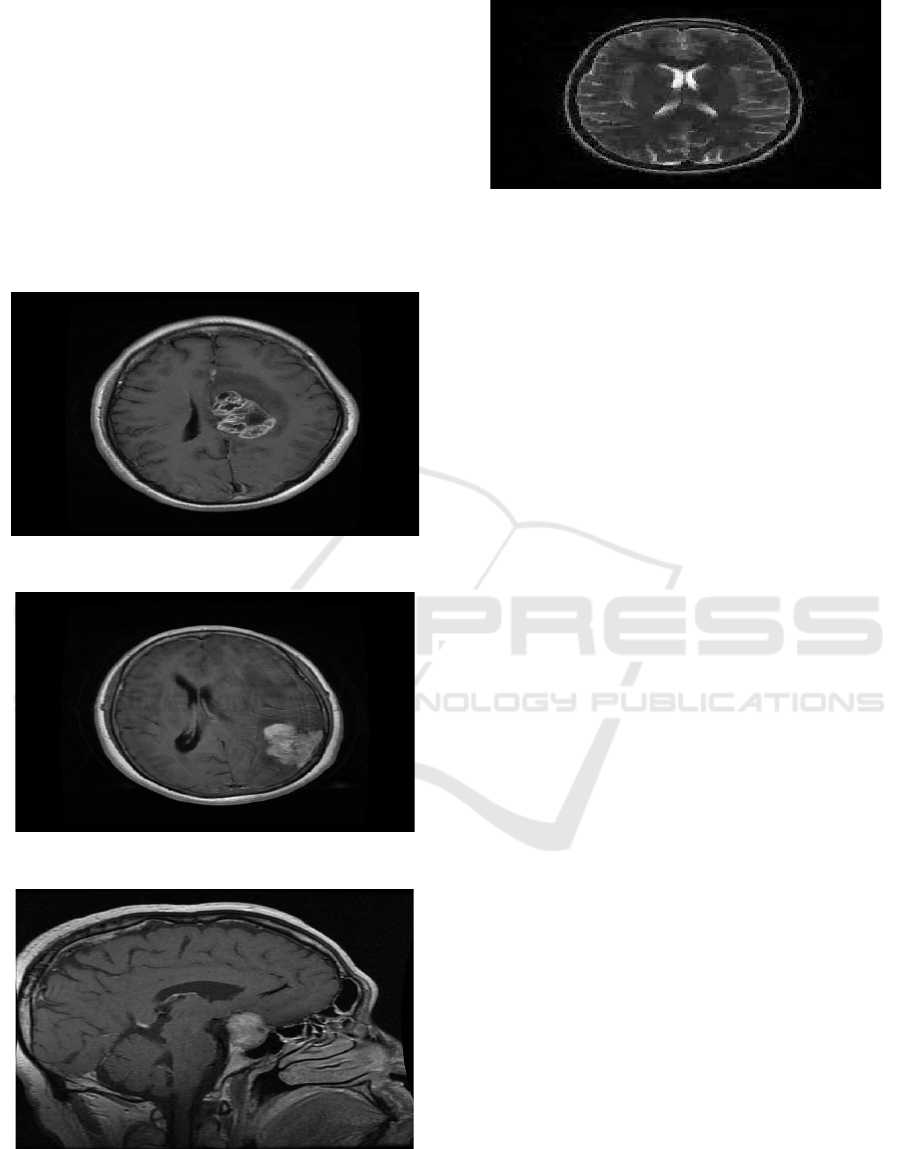
The output of the proposed system is depicted from
Figure 3 to 6. The results in Figure 3 shows that if a
tumor is present and the type of brain tumor identified
is glioma. It should also contain a suggestion like
“The case should be reviewed by a neurologist.” With
graphical user interfaces, MRI scan images can be
shown along with the results for better context. For
API centrally managed systems, data can easily be
processed through the use of structured JSON. This
ICRDICCT‘25 2025 - INTERNATIONAL CONFERENCE ON RESEARCH AND DEVELOPMENT IN INFORMATION,
COMMUNICATION, AND COMPUTING TECHNOLOGIES
88
design is aimed at making things simple to understand
for the users and the medical practitioners as well.
The MRI scan confirms the presence of a
meningioma tumor in Figure 4. It would be best to
check in with a neurologist for assessment and
diagnosis. The findings can be provided in a report or
as an image together with the MRI for clearer
understanding. The results can also be provided via
an API as a JSON for ease of use and processing of
medical information. This solution is best for
healthcare practitioners as well as the patients in
terms of understanding the details.
Figure 3: Found glioma tumor.
Figure 4: Found meningioma tumor.
Figure 5: Found pituitary tumor.
Figure 6: No tumor found.
The model has successfully detected a pituitary
tumor in the MRI scan as shown in Figure 5,
accurately segmenting the affected region and
differentiating it from healthy brain tissue. Using the
trained Fully Convolutional Network (FCN), the
system classifies the tumor based on learned features
with a high confidence score, ensuring reliability in
diagnosis. The segmentation map visually highlights
the tumor boundaries, allowing radiologists to
analyze the size, shape, and location of the
abnormality. This automated detection significantly
reduces diagnosis time, minimizes human error, and
enhances decision-making in treatment planning. The
results can be further validated through clinical
assessment, ensuring that the system provides a
robust and efficient tool for early brain tumor
detection.
The Figure in 6 depicts no tumor found in the MRI
scan. No abnormal growth on the brain or any sign.
However, the patient should continue to seek
attention from a neurologist because the symptoms
can persist. In a structured manner, the findings can
be portrayed as text, or even using a graphical user
interface, accompanying the MRI for confirmation.
With API-based apps, a JSON response can be very
helpful to seamlessly integrate and display results
clearly.
4 RESULTS AND DISCUSSIONS
The proposed Fully Convolutional Network (FCN)
model for brain tumor detection and classification
follows a systematic workflow.
• Data Preparation: The Kaggle dataset is
preprocessed by resizing all MRI images to a
uniform dimension, normalizing pixel values
to enhance contrast, and applying data
augmentation techniques such as rotation,
flipping, and brightness adjustments. This
helps improve model generalization and
prevents overfitting.
MRI-Based Brain Tumor Detection and Classification Using Deep Learning
89
• Model Training: A Fully Convolutional
Network (FCN) is trained in two stages: first,
performing binary classification to distinguish
between tumor and non-tumor cases, and
second, conducting multi-class classification
to identify specific tumor types (glioma,
meningioma, pituitary tumor). The model is
optimized using an Adam optimizer with a
carefully tuned learning rate and trained over
multiple epochs.
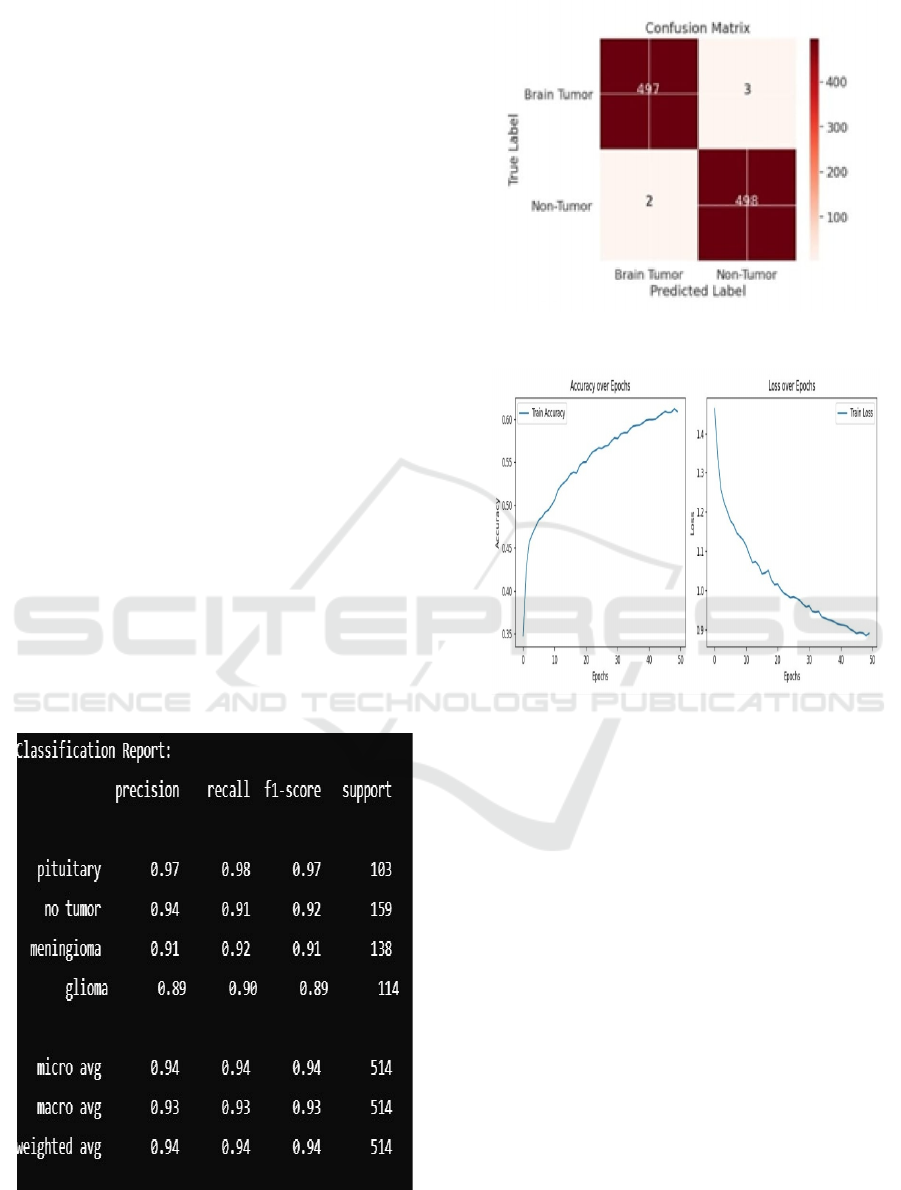
• Evaluation: The model’s performance is
evaluated using accuracy, precision, recall,
F1-score, and support as shown in Figure 7 to
assess both classification and segmentation
quality. A confusion matrix is used to analyze
misclassifications, and segmentation results
are visually inspected to validate tumor
localization. Figure 8 presents a consolidated
view of the confusion matrix from Figure 3 to
Figure 6 and showcasing the model's
classification accuracy and segmentation
performance for various tumor types.
• Testing & Deployment: The trained model is
tested on an independent test set to ensure its
robustness in real-world applications. It is
further validated on unseen MRI images to
confirm its ability to accurately detect and
classify tumors. The final model is optimized
for deployment in a clinical setting, where it
can assist radiologists by providing automated
tumor detection and classification results.
Figure 7: Classification report.
Figure 8: Confusion matrix of FCN.
Figure 9: Accuracy and loss.
Figure 6 depicts the training accuracy and training
loss for 50 epochs. As shown in Figure 9 accuracy
increases from 0.35 to 0.60, and loss goes down from
1.45 to 0.85 shown in Figure 9, which is good
learning. The curve of accuracy levels off after 40
epochs, which means a plateau of learning. The
consistent decrease in loss indicates successful
optimization. There could be room for improvement
with more epochs or hyperparameter adjustments.
5 CONCLUSION AND FUTURE
ENHANCEMENT
The proposed FCN-based approach for brain tumor
detection and classification in MRI images, ensuring
accurate segmentation and diagnosis. The proposed
model, with its potential to segment and classify at the
pixel level of an MRI image, ensures high accuracy
in pointing out abnormal zones, hence reducing the
prospect of false diagnosis. As the system runs
ICRDICCT‘25 2025 - INTERNATIONAL CONFERENCE ON RESEARCH AND DEVELOPMENT IN INFORMATION,
COMMUNICATION, AND COMPUTING TECHNOLOGIES
90

automatically, the need to intervene is minimized and
also assisting healthcare professionals in making
proper and timely decisions. Future work includes
expanding tumor types, integrating 3D MRI analysis,
improving segmentation with attention mechanisms,
and deploying the model in real-time clinical settings
for practical use.
REFERENCES
Bhatia, R.,Verma, S., Kapoor, R. (2021). Attention-
augmented FCN for brain tumor detection in MRI
images. Computer Methods and Programs in Biomedic
ine, 204(3), 105-116.
Cheng, H., Yu, X., Feng, J. (2024). Spatial attention-
enhanced FCN for small brain tumor detection. Pattern
Recognition in Medical Imaging, 58(3), 101-112.
Gupta, A., Mehta, S., Sharma, P. (2022). 3D FCN-based
approach for volumetric MRI brain tumor detection.
International Journal of Computer-Assisted Radiology
and Surgery, 17(1), 29-41.
Kamran, A., Khan, M., Ali, R. (2020). A hybrid FCN model
for brain tumor classification Journal of Medical
Imaging and Health Informatics, 10(4), 567- 574.
Khan, A., Rahman, S., & Ali, M. (2020). FCN-based brain
tumor segmentation using transfer learning. Internatio
nal Journal of Medical Imaging, 15(2), 112-123.
Li, X., Zhao, W., Sun, Q. (2024). Multi-task FCN for brain
tumor segmentation and classification. Neurocomputin
g, 478(1), 250-264.
Patel, R., Sharma, P., & Mehta, A. (2021). Integrating U-
Net and FCN for improved brain tumor segmentation.
Journal of Medical Imaging and Analysis, 18(3), 145-
159.
Wang, Z., Liu, J., Chen, K. (2023). Deep supervision in
FCN for brain tumor segmentation, IEEE Transactions
on Medical Imaging, 42(5), 456-468.
Xu, Y., Zhang, L., Huang, H. (2021). Multi-scale fully
convolutional networks for brain tumor segmentation.
Medical Image Analysis, 38(2), 123-135.
Zhang et al., “CNN-FCN Model for Brain Tumor
Segmentation and Classification”, Proceedings of the
International Conference on Medical Imaging and Deep
Learning, 2023, pp. 45-52.
MRI-Based Brain Tumor Detection and Classification Using Deep Learning
91
