Detecting Hate Speech in Tweets with Advanced Machine Learning
Techniques
J. David Sukeerthi Kumar
1
, Dudekula Moulabi
2
, Dudekula Hussainamma
2
, Battula Kavya
2
,
Boothuru Veena Nissie
2
and Ganne Rakshitha
2
1
Department of Computer Science & Design, Santhiram Engineering College, Nandyal‑518501, Andhra Pradesh, India
2
Department of Computer Science & Engineering, Santhiram Engineering College, Nandyal‑518501, Andhra Pradesh,
India
Keywords: XGBoost, BERT, RoBERTa, Hate Speech Identification, Natural Language Processing.
Abstract: Twitter is a social media platform that enables the swift dissemination of information. Twitter users have the
ability to broadcast brief messages called tweets. Tweets have news, opinions, and random thoughts. But they
also have discriminatory messages, such as hate speech, that can promote hatred and hurt people as well as
companies. Determining hate speech is key to maintaining a considerate and safe online community. The
project aims to enhance internet security by identifying hate speech in tweets through machine learning
techniques, specifically Natural Language Processing (NLP). Training of the model will be executed on a
tagged dataset. The tweets can be preprocessed by eliminating special characters and stop words before being
transformed into embeddings with the help of BERT/RoBERTa and XGBoost the proposed method
significantly improves detection accuracy while reducing false positives, as measured by F1-score, recall, and
precision.
1 INTRODUCTION
The fast development of social media sites such as
Twitter has changed communication, but it has also
enabled the propagation of harmful content, especially
hate speech. Generally speaking, hate speech is any
speech that spreads misleading information or
disinformation and disparages, ridicules, or threatens
people or groups because of their nationality, gender,
ethnicity, religion, or other protected characteristics.
Identifying hate speech is critical to making online
environments safer, but the conventional keyword-
based approach is not effective because hate speech is
complicated and dynamic. Hate speech detection
systems need to differentiate between hateful, offensive,
and neutral speech and comprehend sarcasm, intent, and
context. Conventional rule-based and machine learning-
based methods like Logistic Regression, SVM, and
Random Forest are less accurate when used with large
datasets.
The study explores using deep machine learning
techniques to identify hate speech on Twitter,
focusing on deep learning architectures, natural
language processing, and transformer architectures to
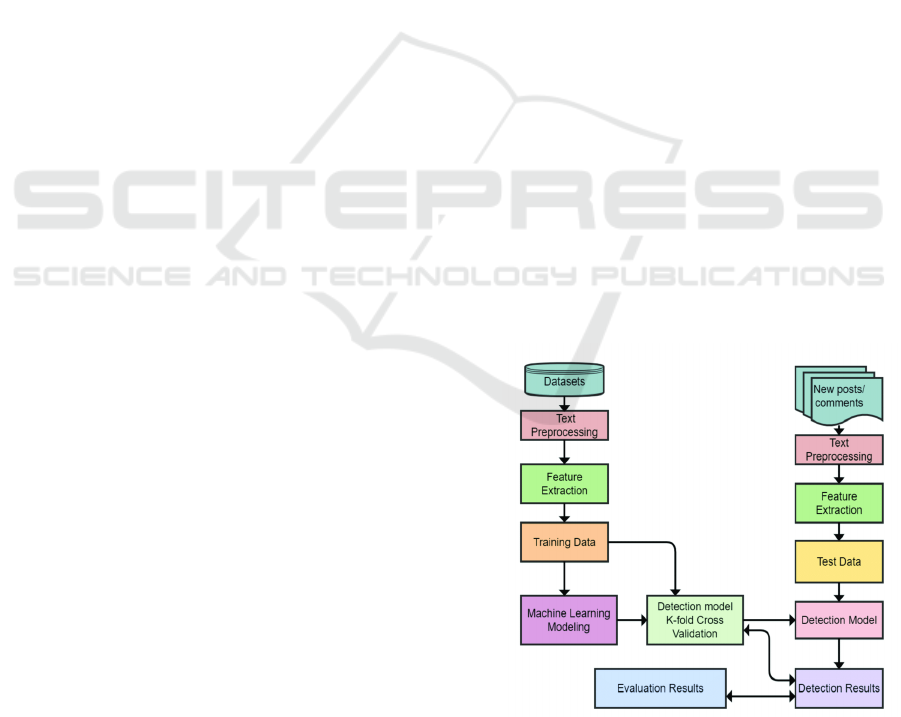
understand contextual meaning. Figure 1 show the
Hate Speech Detection Architecture.
Figure 1: Hate speech detection architecture.
Kumar, J. D. S., Moulabi, D., Hussainamma, D., Kavya, B., Nissie, B. V. and Rakshitha, G.
Detecting Hate Speech in Tweets with Advanced Machine Learning Techniques.
DOI: 10.5220/0013923100004919
Paper published under CC license (CC BY-NC-ND 4.0)
In Proceedings of the 1st International Conference on Research and Development in Information, Communication, and Computing Technologies (ICRDICCT‘25 2025) - Volume 5, pages
81-85
ISBN: 978-989-758-777-1
Proceedings Copyright © 2026 by SCITEPRESS – Science and Technology Publications, Lda.
81

2 PROBLEM STATEMENT
This paper presents a high-precision hate speech
detection system for Twitter, utilizing advanced
machine learning techniques. The system uses data
preprocessing, feature extraction, and contextual
embeddings from transformer-based models.
Performance is evaluated using precision, recall, and
F1-score metrics, with hyperparameter search and
ensemble learning enhancing performance.
3 LITERATURE REVIEW
Hate speech on social media, particularly Twitter, has
been identified as a significant issue causing
discrimination, cyberbullying, and disinformation in
society. Traditional machine learning methods like
Naïve Bayes (NB), Support Vector Machines (SVM),
Decision Trees (DT), and Random Forest (RF) were
used in early hate speech detection models.
Davidson et al. (2017) proposed a hate speech
corpus and utilized Logistic Regression and SVM for
the purpose of classification and attained competitive
outcomes. But classical models tend to face
contextual understanding and generalization
challenges, which renders them less efficient when it
comes to identifying implicit hate speech.Next,
Schmidt & Wiegand (2017)have surveyed hate
speech detection with NLP methods by examining
several feature engineering approaches (TF-IDF, n-
grams, bag-of-words) and classification models
(SVM, Naïve Bayes, Decision Trees). Fortuna &
Nunes (2018) conducted a comprehensive study on
hate speech detection in social media, highlighting
dataset biases as a significant challenge and
proposing fair classification mechanisms.
Researchers utilized deep learning techniques like
Convolutional Neural Networks (CNNs) and
Recurrent Neural Networks (RNNs) to overcome the
limitations of feature engineering.
While RNNs, specifically LSTM and GRU,
capture long-distance dependencies in sequential text,
CNNs find local structures in text. Badjatiya et al.
(2017) proposed an LSTM-based approach to hate
speech detection and reported improved results
compared with traditional methods. Yoon (2016)
examined CNN-based sentence classification and
demonstrated that CNNs are powerful at detecting
local patterns in text and thus useful for hate speech
detection. LSTMs can handle sequential relationships
and long-term dependencies more effectively than
CNNs. Deep learning models, however, often lack
interpretability and require large amounts of labeled
data.
Recent advancements in Natural Language
Processing (NLP) have led to the popularity of
transformer-based models like BERT, RoBERTa,
and ALBERT.After been pre-trained on sizable
datasets and refined on hate speech corpora, these
models use contextual embeddings to improve
classification accuracy. Mozafari et al. (2020) utilized
a transfer learning method using BERT to detect hate
speech and demonstrated that, unlike CNNs and
LSTMs, fine-tuning pre-trained transformers on hate
speech corpora enhances precision and recall. The
attention mechanism of transformers allows for end-
to-end reasoning over verbal hints, such as implicit
hate speech and sarcasm.
Hybrid approaches are methods that combine
multiple architectures to improve classification
accuracy. For instance, RoBERTa embeddings
integrated with XGBoost (RoBERTa+XGBoost) and
ALBERT integrated with BiLSTM
(ALBERT+BiLSTM) both employ contextual
embeddings and sequential modeling. Devlin et al.
utilized the Bidirectional Encoder Representations
from Transformers (BERT) model in bidirectional
text processing (2018) to acquire contextual word
representations. (Devlin et al. 2018). The method's
understanding of sarcasm, implied hate, and intricate
linguistic structures helped a great deal in increasing
the precision of hate speech classification. Raffel et
al. (2020) employed transformer models to explore
transfer learning and highlighted the need for pre-
training a model on large corpora and then fine-tuning
it on a particular hate speech dataset. The research
explained the challenges in scalability and
generalization issues in hate speech classification.
The accuracy of hate speech identification has
significantly increased as deep learning and
transformer-based models have supplanted
conventional machine learning techniques.
Addressing bias and contextual understanding
remains a primary research concern, notwithstanding
the potential of hybrid and ensemble techniques. It
will be necessary to combine ethical AI frameworks
with developments in natural language processing to
create more trustworthy hate speech detection
systems.
4 EXISTING RESEARCH
The existing hate speech detection system discuss
multiple techniques, including traditional classifiers,
deep learning architectures.
ICRDICCT‘25 2025 - INTERNATIONAL CONFERENCE ON RESEARCH AND DEVELOPMENT IN INFORMATION,
COMMUNICATION, AND COMPUTING TECHNOLOGIES
82

4.1 Traditional Machine Learning
Approaches
The existing approaches highlights the use of
supervised learning methods that rely on feature
engineering. The models used include:
• Support Vector Machines (SVM) – A widely
used classifier for text-based hate speech
detection.
• Naïve Bayes (NB) – A probabilistic model
effective for handling textual data.
• Logistic Regression (LR) – Applied for binary
classification tasks in hate speech detection.
• Random Forest (RF) – An ensemble learning
technique that improves accuracy by
aggregating multiple decision trees.
• Decision Trees (DT) – A rule-based method for
classification.
These methods generally rely on TF-IDF, n-grams,
and bag-of-words (BoW) for feature extraction.
While they offer decent performance, they struggle
with contextual understanding and fail to capture
implicit hate speech.
4.2 Deep Learning-Based Approaches
To improve accuracy, the existing reasearchers
discusses the application of deep learning models,
including:
Convolutional Neural Networks (CNNs) are
utilized for feature extraction from text
embeddings.
(RNNs) are used for classification. – Captures
sequential dependencies in tweets.
Long Short-Term Memory (LSTM) – An
advanced RNN variant that helps retain long-
term dependencies.
Gated Recurrent Units (GRUs) – A
computationally efficient alternative to LSTMs
with similar performance.
Models eliminate manual feature engineering and
capture sequential patterns, but struggle with sarcasm
and implicit hate speech.
4.3 Drawbacks in Existing System
• High False Positives & False Negatives – Most
models incorrectly label non-hateful content as
hate speech, resulting in high false positives.
• Bias in Training Data – Hate speech detection
models tend to be trained on biased data,
resulting in biased classifications across various
demographic groups.
• Difficulty in Detecting Implicit Hate Speech –
In contrast to explicit hate speech, implicit hate
is context-dependent, sarcastic, and
euphemistic, making it challenging for
conventional models to identify.
• Computational Complexity – Transformer-
based architectures such as BERT, RoBERTa,
and ALBERT demand large computing power,
thereby becoming hard to deploy for live hate
speech identification.
• Overfitting in Deep Learning Models – Deep
learning models like CNNs and RNNs tend to
overfit on training data, and thus become futile
for practical implementations.
• Scalability Problems – It requires highly
scalable and efficient models to handle millions
of tweets, posts, and comments in real-time,
which is an issue in current systems.
• High Computational Cost – Deep learning
models are computation intensive, which makes
real-time hate speech detection challenging on
low-power devices or on large social media
sites.
5 PROPOSED SYSTEM
The proposed system consists of the following key
components:
5.1 Data Collection & Pre-processing
• Collect tweets from publicly available datasets.
• Clean the data by removing URLs, hashtags,
special characters, and stopwords.
• Apply tokenization and word embeddings.
5.1 Feature Extraction & Embedding
• Utilize transformer-based models (e.g.,
RoBERTa, ALBERT) for contextual word
representations.
• Extract meaningful linguistic and semantic
features to improve classification performance.
5.2 Model Implementation & Training
• Implement multiple state-of-the-art models and
ensemble techniques for comparison.
• RoBERTa + XGBoost: Uses RoBERTa
embeddings with XGBoost for classification.
Detecting Hate Speech in Tweets with Advanced Machine Learning Techniques
83
• ALBERT + BiLSTM: ALBERT for feature
extraction, followed by a BiLSTM model for
sequence learning.
• Train models using labeled datasets with
appropriate loss functions.
5.3 Evaluation & Optimization
The comparison of models is based on metrics
such as accuracy, precision, recall, and F1-score.
Do hyperparameter tuning for improved
performance.
5.4 Advantages of Proposed System
• Improved Accuracy: The algorithm uses
sophisticated machine learning algorithms that
enhance the precision of hate speech detection
over standard approaches.
• Unification of Deep Learning: Implementation
of deep learning models enables the system to
learn contextual meaning in order to cut down
on false positives and false negatives.
• Strong Feature Extraction: Higher order NLP
principles assist in drawing strong features from
linguistic and contextual features of tweets to
enhance classification performance.
• Scalability: The system should be able to
process large amounts of tweets without
compromising performance, with consistent
accuracy at high levels of data.
• Reduced Bias: The system leverages diverse
datasets and algorithms to decrease bias in
detection, resulting in fair and accurate
classification.
• Far superior at identifying implicit hate speech
and sarcasm than other machine learning
models.
6 METHODOLOGY
• Data Collection: Collecting publicly available
hate speech datasets (e.g.Davidson dataset).
• Data Cleaning & preprocessing – Converting all
text to lowercase, removal of special characters,
symbols, stop words and URLs, handle class
imbalance using SMOTE (Synthetic Minority
Over-Sampling Technique).
• Feature Extraction: converting the textual data
into numerical representations pretrained
transformer models like RoBERTa and ALBERT.
• Model Selection & Training: Models like
RoBERTa , XGBoost, and ALBERT are used to
train the labelled dataset with optimization
techniques such as hyper parameter tuning.
• Evaluation & Performance metrics: The trained
models are assessed for their effectiveness in
detecting hate speech using metrics like accuracy,
precision, recall, and F1-score.
7 ARCHITECTURE
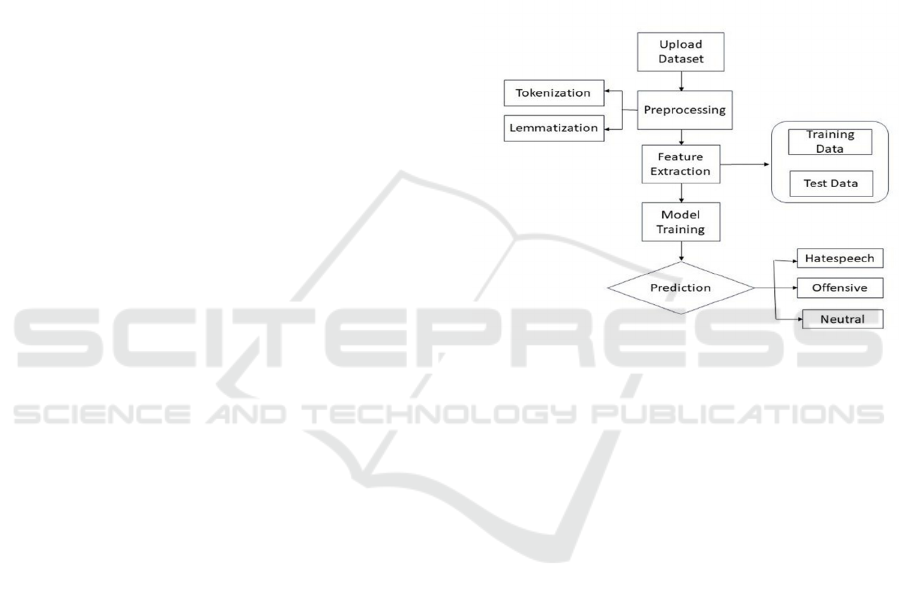
Figure 2: Design of the suggested system.
• Uploading the dataset: A publicly available
Davidson hate speech dataset is gathered and
uploaded in the software.
• Data Preprocessing: Preprocessing methods like
tokenization, lemmatization is performed on
tweets. Also, the data is preprocessed by
eliminating stop words, and special characters.
• Feature Extraction: 80% of data is assigned for
training from the uploaded dataset and 20% of
data is assigned for testing. Raw data is then
translated into numerical features.
• Model Training: To have high accuracy and
interpretability, train the system RoBERTa and
XGBoost models. Figure 2 show the Design of the
suggested system.
8 RESULT
• Three categories, including hate speech,
offensive speech, and neutral speech, will be used
by the proposed method to classify tweets.
• High Accuracy and Improved Model
Performance: Since we are using advanced
ICRDICCT‘25 2025 - INTERNATIONAL CONFERENCE ON RESEARCH AND DEVELOPMENT IN INFORMATION,
COMMUNICATION, AND COMPUTING TECHNOLOGIES
84
models like RoBERTa and XGBoost, the
proposed system is expected to outperform
traditional machine learning models.
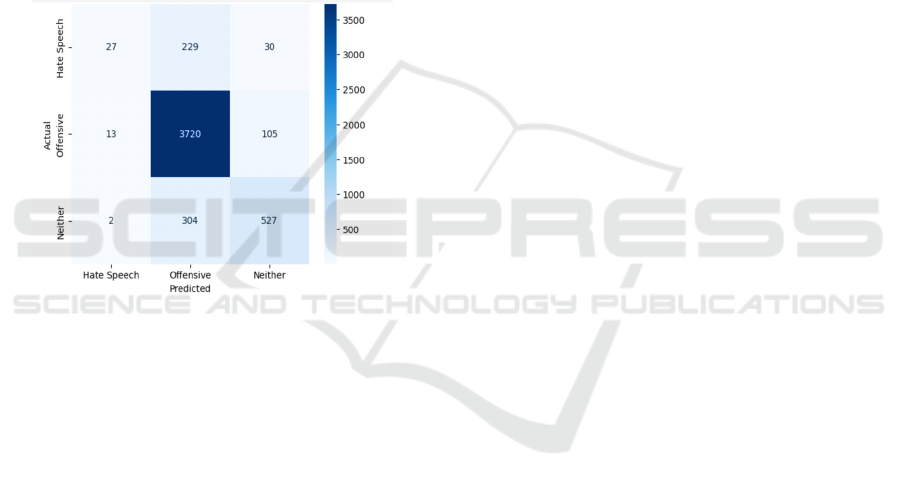
• Enhanced Contextual Understanding: A
notable decrease in false positives and false
negatives, so that offensive but not hateful
language is not incorrectly labelled as hate speech.
Figure 3 show the Confusion matrix.
• Make use of social context: Rather than
identifying single words in isolation, the model
will examine conversational context to distinguish
between hateful and non-hateful speech.
• Equitable datasets: Training datasets will be
designed in a way to prevent biases against any
particular demographic, political inclination, or
ethnicity.
Figure 3: Confusion matrix.
9 CONCLUSIONS
The proposed system for hate speech detection on
Twitter effectively combines advanced machine
learning and transformer-based models like
RoBERTa and XGBoost to achieve high accuracy and
contextual sensitivity. Unlike traditional models, it
significantly reduces false positives and false
negatives by understanding nuanced language,
sarcasm, and implicit hate. The system’s design also
emphasizes fairness by addressing dataset biases and
ensuring demographic neutrality. With its scalable
architecture and improved performance metrics, this
approach is well-suited for real-time applications.
Overall, it marks a step forward in building safer
online platforms through intelligent content
moderation.
REFERENCES
Badjatiya, P., Gupta, S., Gupta, M., & Varma, V. (2017).
“Deep Learning for Hate SpeechDetection in Tweets”.
WWW.
Davidson, T., Warmsley, D., Macy, M., & Weber, I. (2017).
“Automated Hate Speech Detection and the Problem of
Offensive Language”. ICWSM.
Davidson, T., Warmsley, D., Macy, M., & Weber, I. (2017).
“Hate Speech and Offensive Language Dataset”.
Kaggle.
Devlin, J., Chang, M.-W., Lee, K., & Toutanova, K. (2018).
“BERT: Pre-training ofDeep Bidirectional
Transformers for Language Understanding”. NAACL-
HLT.
Fortuna, P., & Nunes, S. (2018). “Hate Speech Detection in
Social Media: A Review”.ACM Computing Surveys,
51(6), 1-30.
Mozafari, M., Farahbakhsh, R., & Crespi, N. (2020). “A
BERT-Based Transfer LearningApproach for Hate
Speech Detection in Online Social Media”. ICMLA.
Raffel, C., Shazeer, N., Roberts, A., Lee, K., Narang, S.,
Matena, M., & Liu, P. J. (2020). “Exploring the Limits
of Transfer Learning with a Unified Text-to-Text
Transformer”. arXiv:1910.10683.
Schmidt, A., & Wiegand, M. (2017). “A Survey on Hate
Speech Detection Using Natural Language
Processing”.Proceedings of the 5th International
Workshop on Natural Language Processing for Social
Media (NLP4SocialMedia).
Yoon, K. (2016). “Convolutional Neural Networks for
Sentence Classification”. EMNLP.
Detecting Hate Speech in Tweets with Advanced Machine Learning Techniques
85
