
Parent and Student Insights Hub Using Chatbot
M. S. Radha Manga Mani, T. Pujitha, V. Hema Sri, U. Bhavana, Y. Srujitha and V. Swarupa
Department of Information Technology, SRKR Engineering College (A), Chinnamiram, Bhimavaram, Andhra Pradesh -
534204, India
{radha.renukesh, thatipujitha0910, vadlamudihemasri, bhavanauddarraju493, srujithayalamarthi, swarupavangalapudi}@
gmail.com
Keywords: the System Includes a Parent‑Student Insights Hub Combined with AI Technology, a Chatbot Feature, Face
Recognition Capabilities, Programming through Python Flask, OpenCV along with AWS Recognition,
Amazon S3, Dialog Flow, PostgreSQL, Academic Performance Tracking Features, Educational Data
Analytics Tools, Secure Login API, SMS Authentication Mechanisms, Deep Learning Functionality,
Real‑Time Insights Capabilities.
Abstract: The new system implements an AI-driven interface containing chatbot capabilities within the Parent and
Student Insights Hub to improve communication activities for schools (Colleges) and their parents and
students. Through its artificial intelligence bots, the system delivers instant secure notifications containing
complete educational data about each student including their academic activities combined with attendance
records and information regarding academic achievements along with changes to their curriculum. The
targeted student portal lets students check their academic information with the ability to create personal
academic targets. The platform leverages web technology to create a design that meets users' needs together
with secure authentication that works through facial recognition to enable parent entry. The system improves
academic outcomes through transparent features that drive development of students by facilitating
collaborative work between all participating organizations.
1 INTRODUCTION
Education institutions together with students and
parents must maintain efficient communication
systems because the digital age demands such
necessity. Educational institutions use increasing
digital solutions to handle academic data which
creates difficulties for students and parents in
accessing updated clear academic progress reports.
The conventional forms of communication fail to
deliver essential information which causes
knowledge deficits and lower student and parent
involvement especially among those with limited
ability to monitor academic development.
Colleges have the duty to keep students and their
guardians informed about academic activities and
show constant attention to these academic pursuits.
To achieve information exchange multiple
educational procedures, require concurrency which
produces both high costs and reduced productivity.
The communication system maintained by saladetric
produces distinct components while ensuring that
academic exchange remains active. The lack of
progress visibility for parents extends until grades
become public and students remain puzzled about
fulfilling their educational responsibilities
unsupervised.
We recommend developing the Parent and
Student Insights Hub Using Chatbot as an exclusive
digital platform which will boost communication
between educational institutions and students and
their parents. We have developed this platform to
establish a culture of engaged parental education by
giving instant secured access to essential academic
records and performance results and curriculum
updates. AI technology within chatbot architecture
allows parents to reach essential information
whenever needed while giving them simple ways to
contact the college through their messaging system.
The system creates personalized student views
that allow users to follow their academic
achievements as well as establish educational targets
and monitor lasting performance data.
Students will find all essential information
regarding grades with assignments and upcoming
events presented on the dashboard for complete
understanding of their commitments. Students can
74
Mani, M. S. R. M., Pujitha, T., Sri, V. H., Bhavana, U., Srujitha, Y. and Swarupa, V.
Parent and Student Insights Hub Using Chatbot.
DOI: 10.5220/0013923000004919
Paper published under CC license (CC BY-NC-ND 4.0)
In Proceedings of the 1st International Conference on Research and Development in Information, Communication, and Computing Technologies (ICRDICCT‘25 2025) - Volume 5, pages
74-80
ISBN: 978-989-758-777-1
Proceedings Copyright © 2026 by SCITEPRESS – Science and Technology Publications, Lda.
exercise better study decision-making through an
interface and interactive features that allows easy
navigation which promotes educational
responsibility.
Users benefit from top web technologies that
deliver this platform's convenient experience. The
system implements object-oriented defense
approaches which manage student identity
authentication using facial recognition technology in
combination with several user authentication
checkpoints to secure confidential data.
Through the Parent and Student Insights Hub
Using Chatbot system users obtain access to real-time
alerts that transmit academic test scores together with
college activities together with essential deadlines to
both parents and students. Through its digital
interface the platform creates a unified
communication system which raises parent
participation and supports student motivation and
boosts stakeholder interaction. The system seeks to
develop educational partnerships and deliver prompt
feedback combined with precise educational
messages beginning at the enrollment stage until
graduation. The platform unites educational resources
to establish a uniting support system for learners and
their associated members along with more effective
educational experiences. This system has set its
objective as becoming an essential school feature
while building communication tools that foster
continuing improvements of educational outcomes.
The platform uses technological advancement
alongside devoted information security together with
efficiency to evaluate future directions of academic
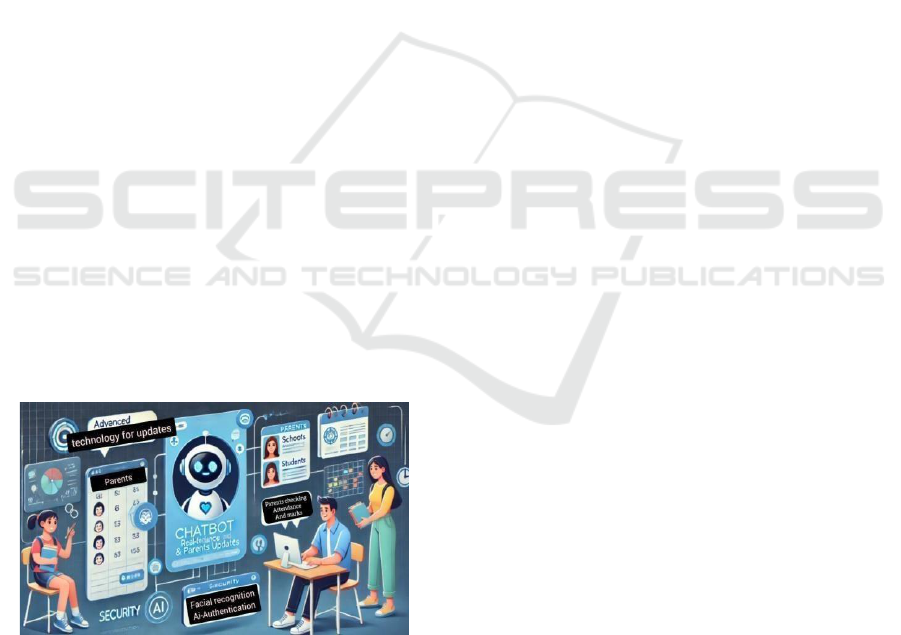
communication between parents and students. Figure
1 shows the overview of Hub.
Figure 1: An Overview of Hub.
2 LITERATURE REVIEW
Studies of educational system technologies have
established that HTML and CSS together with
JavaScript represent d e v e l o p e r s ' top
choices. The developers who build flexible user
interfaces required for student dashboard interactivity
rely on this method. -developers select the backend
functions require Flask (Python) as a development
tool due to its seamless integration with quick data
handling requirements. The Academic and student
data management sector depends on PostgreSQL
because this database offers exceptional reliability
and performance for structured information.
Information performance along with reliability levels
improve when operating with structured data.
The educational chatbots developed using
Dialogflow natural language processing enable users
to communicate easily through the system.
communication between members of the educational
ecosystem. AWS Rekognition typically serves secure
an authentication system based on facial recognition
allows users to log in while saving images as data in
Amazon S3 storage.
Securing the platform operations with maximum
efficiency characterizes the system enabled by
technology deployment. Educational platform user
interfaces work hand-in-hand with enhanced
processes of communication and data storage to
provide better user experiences.
Zhao, X., & Li, M. (2021). Through its face
recognition services AWS Rekognition enables safe
user authentication systems to verify identities of
registered users. Journal of Cloud Computing:
Advances, Systems, and Applications, 10(1), 45-58.
Li, Y., & Zhao, L. (2020). Performance
Optimization in PostgreSQL for Data Analytics.
Journal of Database Management, 31(3), 1-14.
Gupta, R., & Arora, P. (2021). Dialogflow works
as an educational tool to create intelligent chatbots
which enhance educational functions. Journal of
Educational Technology Systems, 50(2), 173-185.
Singh, N., & Sharma, R. (2020). Student
involvement can increase through the development of
Dialogflow chatbots that use conversational methods.
International Journal of Artificial Intelligence and
Education, 14(1), 45-60.
Roy, P., & Kumar, A. (2020). Building Interactive
Web Interfaces with HTML, CSS, and JavaScript.
International Journal of Web Development and
Design, 8(2), 80-95.
DeChant, C., et al. (2017). The real-time
dashboard development process becomes achievable
through integration of Flask and Chart.js
technological approaches. Phytopathology, 107(11),
1426– 1432. DeChant et al., 2017.
Parent and Student Insights Hub Using Chatbot
75

3 PROPOSED METHODOLOGY
The engineering framework within the student-parent
management platform’s proposed system depends on
modern web tools while integrating machine learning
alongside cloud services to deliver data security as
well as rapid information visualization. A responsive
interface results from the development of HTML
together with CSS and JavaScript. The Flask built
API operates with both high speed and exceptional
power on the system backend. The system provides
authentication for users while handling fetch requests
together with chatbot operations. Part of the system
contains a Dialogflow component which enables a
programmed chatbot to deliver academic progress
details about students to their parents. The system
secures login access through AWS Rekognition as its
implements facial recognition abilities that store
images on Amazon S3. Student academic information
along with records is stored within the PostgreSQL
database. The visualization of student attendance and
grades and placement reports happens immediately
through Chart.js. Simple expansion and low upkeep
requirements are features of the system because of its
modular design implementation.
3.1 Dataset Collection
When we were implementing the Dialogflow, we
trained it using several student queries collected from
different sample conversations and business
scenarios. The queries included attending class,
getting grades, and the curriculum among others. To
enhance the chatbot’s performance, we made sure to
include more variations of student-centered queries it
was able to respond to in real life.
We started with a database of parent images we
had photoshopped and assigned ID tags. Each of these
images had to be taken in different places and
different lighting to ensure the models were accurate
and robust. The model was also trained to ensure
correct parent identification during login which
ensured the models were boosted during training.
In order to finish the application testing, I combine
these data with that of other students in my class,
which numbers between sixty and seventy. The data
set was real and contained scholastic records such as
attendance, grades and courses relevant for the
purpose to test the performance and accuracy of the
student dashboard and other system functionalities.
3.2 Model Selection and Architecture
During development our team used different
technologies to create an organized platform which
maintained scalability potential.
The implementation of the chatbot employed
Dialogflow because it possessed full natural language
processing (NLP) functionality to process intents
accurately and efficiently. The system architecture
allowed intent generation for all types of requests sent
by the information attendance and placement
coordinators. To segment information better the
solution required specific entities for student names
and course codes. Through its webhook technology
Dialogflow enables user requests to reach Flask
which functions as the system backend component.
Flask application receives client requests for database
information retrieval to obtain needed responses from
PostgreSQL.
We chose AWS Rekognition to meet our
requirements since it offered accurate facial
processing and detection together with scalability.
The absence of a model-building feature is
unnecessary because this platform operates
effectively without it. Python and JavaScript serve as
the tools to extract face verification results from the
advanced computer vision models with powerful
APIs that operate in AWS Rekognition. Amazon S3
stores protected parent images through its secure lock
system for access control purposes. During login
AWS Rekognition runs its CompareFaces API on the
parent’s image that the system compares with stored
photographs. The system verifies parent identity
proceeding from a minimum 90% of similarity during
authentication access.
The micro web framework Flask defines by
Python now dominates backend implementations
because of its simplicity. Its minimalistic framework
exerts perfect functionality for systems between
small to medium range. Flask offers adaptable
features for creating APIs so users can experience
immediate communication between servers and
clients. Our business relies on Sequel databases
exclusively because of their reliable performance
speed. Postgres has left us perplexed for numerous
years. As a multi-dimensional database management
system, it demonstrates its capability to fulfill the
features of ACID together with the efficient indexing
system and ample storage capacity for complex
student and parent structure records.
The business operations become more reliable
because of this technology stack while also becoming
scalable and efficient so parents and students can log
in and access data securely through the effective
computerized information system. Figure 2 shows the
Hub architecture.
ICRDICCT‘25 2025 - INTERNATIONAL CONFERENCE ON RESEARCH AND DEVELOPMENT IN INFORMATION,
COMMUNICATION, AND COMPUTING TECHNOLOGIES
76
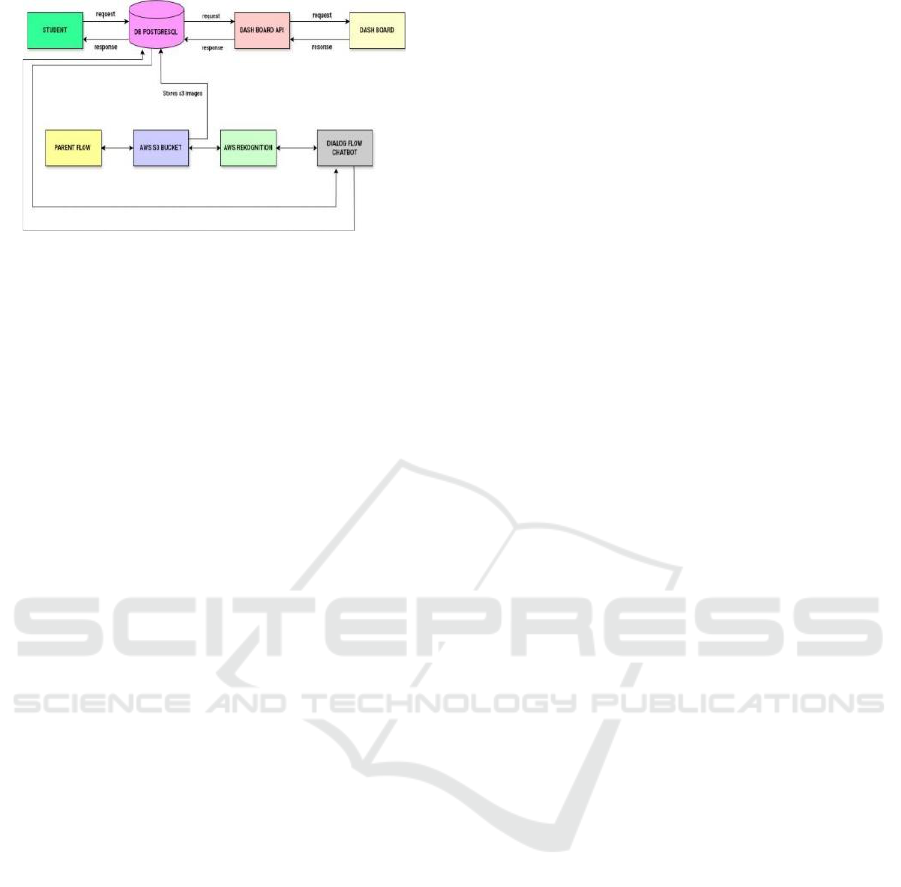
Figure 2: Hub Architecture.
3.3 Model Training and Evaluation
The created chatbot system contained a selection of
student queries commonly posed about attendance
information along with marks and placement
coordinator activities. All potential types of queries
required their own set of intents for coverage. The
model acquired numerous training phrases for each
intent to capture various methods of verbalization.
The designed intents included "Get_Attendance"
coupled with various queries for attendance
information while "Get_Marks" included distinct
ways to request grades.
The system created designated entities to process
student names together with course codes along with
department names during the information retrieval
process. Several model revisions and tests with
authentic operating queries helped to boost its
accuracy rates. The real-time PostgreSQL database
communicated with the Flask backend by means of a
webhook connection. The testing scenarios executed
separately to validate that suitable responses appeared
when using database information.
AWS Rekognition received selection for facial
recognition because it possesses pre-trained deep
learning models optimized for detecting and
matching faces. High-quality image acquisition of
parents included appropriate illumination selection
and multiple camera angles during data collection to
achieve a solid performance outcome. These images
were securely stored in Amazon S3. The pre-trained
model within AWS Rekognition allowed an exception
to explicit model training thus calibration activities
were conducted empirically to find proper face
matching threshold values.
The system requires face authentication results to
reach at least 90% accuracy level for reliable
verification.The testing process of comparing stored
images with new input images enabled better
performance in verifying faces. Continuous
performance evaluations functioned to preserve high
accuracy and defend against image quality variations
and lighting fluctuations together with angle
deviations.
They merged both the refined face recognition
component with the developed chatbot before
implementing them within the complete system.
Testing of the chatbot involved executing specific
scenarios to validate correct answers along with their
postgreSQL database origin. Various practical
situations including unexpected scenarios were
employed to verify how the chatbot handled multiple
kinds of user inquiries.
The testing involved multiple attempts of face
authentication to evaluate the performance of the face
matching algorithm in practical scenarios. Awe
Recongntion underwent precision testing of its face
matching algorithm through assessing input images
against stored images under various environmental
conditions during face matching operations. A test
was conducted on the chatbot alongside the face
recognition system based on particular evaluation
standards to verify their independent operation and
compliance with the system's requirements.
The research focused its assessment metrics
development on essential characteristics which define
both the chatbot and face recognition system. The
assessment of chatbot performance required
measuring if queries received the right intent
identification thus accuracy needed to be tracked. The
identification quality of the chatbot for student names
and course codes affected the functionality of entity
recognition.
The assessment of the face recognition system
also utilized accuracy along with precision and recall
and F1-score metrics. The construction of a confusion
matrix would enhance the comprehension of
classification results across multiple similarity
thresholds so users can optimize true positive against
false positive ratios. Sufficient testing sessions were
conducted to find the threshold value that best
reduced inappropriate facial match results.
The general system performance evaluation took
place after integration testing and preliminary testing
followed by feedback acquisition. The system testers
explored all features through their interaction with the
chatbot interface alongside performing face
recognition authentication. The gathered feedback
proved useful to identify areas for improvement
because it helped evaluate response speed and
usability and recognition precision.
The systems evolved according to received user
input. The Chatbot received additional query types
within its training data while the entity extraction
procedures became more specific for improved
results. A test was conducted to establish the capacity
Parent and Student Insights Hub Using Chatbot
77

of the face recognition application for working with
facial characteristics under various lighting
conditions.
The monitoring process continued to proactively
address system problems in order to maintain stability
and accuracy throughout time. The changing
behaviors of users were incorporated into both the use
and training databases of the chatbot as part of regular
performance maintenance checks supervised both
systems for system stability following changes in user
programs or system updates. Regular uploads of
updated queries and use cases related to the chatbot's
training data were necessary to fulfill the evolving
requirements of users.
4 IMPLEMENTATIONS
4.1 Client-Side Development
The application used an interface made from HTML,
CSS, and JavaScript to create an interactive design for
users. Although created for mobile platforms the
design works equally well and easily across all
systems thanks to its mobile-first development. The
system resizes itself automatically to accommodate
different screen sizes and it provides friendly access
mechanisms for users from all groups. Through the
system students view academic records including
grades and attendance while parents utilize the
chatbot for receiving immediate performance updates
about their children.
4.2 User Portal
Educational information about personal attendance
records and academic achievements together with
grades appear on the portal. Through the portal server
users obtain real time data which keeps them
continuously updated. Users experience easy access
through the portal because they can rapidly reach
their academic records and other related information.
4.3 Server
The Flask framework allows developers to create a
flexible system with its Python-based framework
because it provides an efficient approach for building
server specifications.
4.4 API Endpoints
The system allows students to access their account
through personalized credentials while parents
connect through a face recognition technology that
works on the portal to view student information.
PostgreSQL database availability can be accessed
through established endpoints that allow users to
retrieve attendance and performance records of
students. A dedicated endpoint system allows
Dialogflow webhook requests to receive
conversations from a chatbot that interacts with users.
4.5 Security Protocols
All passwords use encryption through the hash
protection algorithm resulting in the safeguarding of
user data. The system allows users to authenticate
their session after login thus enabling secure access to
maintain sessions that do not expose additional
accounts. Some supply endpoints utilize token-based
protection that enables the server to communicate
with these endpoints securely. The database employs
PostgreSQL as its storage system to provide a strong
and expandable relational database management
solution.
4.6 Schema Structure
The system contains one record for every user
including an encrypted password and stored username
and the specified role type selected between student
or parent. Academic Records Table serves as a
repository which contains extensive records about
student attendance data and academic grades
alongside various additional information. The
database groups student records in a specific format
to ensure expedient retrieval of information according
to user roles.
External Service Integrations
4.7 Dialog Flow
Through Dialogflow console users performed query
configuration by giving it the ability to process
student and parent inquiries.
Flask uses webhooks to connect its backend with
the chatbot which enables automatic question
responses for students. The information system
ensures users can pose questions which receive
immediate responses through its system.
AWS Services: The facial images of parents
receive protection through storage in S3 buckets. The
face recognition system enables picture retrieval
which supports its authentication mechanism.
The platform implements AWS Rekognition for
face recognition verification through its integration
with AWS SDK. Headshot comparisons between
ICRDICCT‘25 2025 - INTERNATIONAL CONFERENCE ON RESEARCH AND DEVELOPMENT IN INFORMATION,
COMMUNICATION, AND COMPUTING TECHNOLOGIES
78

parent images and S3-stored images serve as a user
authentication process which gives complete system
access authorization.
5 EXPERIMENTAL RESULTS
The main elements of the developed system consist of
Flask and PostgreSQL and AWS Rekognition along
with Dialogflow. The design structure permits
students as well as parents to join actively and employ
resources effectively. Users can monitor their entire
dashboard after authenticating with credentials which
contains academic updates including diplomas and
arts involvement reports along with academic
размещение details and curriculum outlines. The
entire content displays in a relayed presentation. The
information presentation improves due to the
combination of pie charts and diagrams among
visualization tools available for display. The
PostgreSQL database system retrieves protected
information from secured sources to present it
according to format specifications requested by users.
Through AWS Rekognition theFacing interface
allows parents to obtain attendance records and
academic performance scores and coordinator contact
information by using a messaging platform. The
operations of the chatbot run in real-time because it
uses Dialogflow to process queries instantly while
Flask supports simultaneous user interactions.
Face recognition integrated with reliable
software enables this feature to function properly as it
answers basic questions from users. The system
shows its limitations when users submit complex
inquiries. The chatbot maintained its operational
performance by consistently updating its system
functions since the start of the time period.
The project's secure database features allow students
and parents to use the scalable communication system
which provides instant response capabilities. The
platform requires two enhancements to its operations:
a larger database and better response functions and
facial recognition algorithms performance. Figure 3
and 4 shows the Sign in Page to the Hub and User
Validation.
5.1 Predicted Outputs
Figure 3: Sign in Page to the Hub.
Figure 5 shows above and figure 6 and 7 shows
below result analysis and chatbot.
Figure 4: User Validation.
Figure 5: User Dashboard.
Figure 6: Result Analysis.
Parent and Student Insights Hub Using Chatbot
79
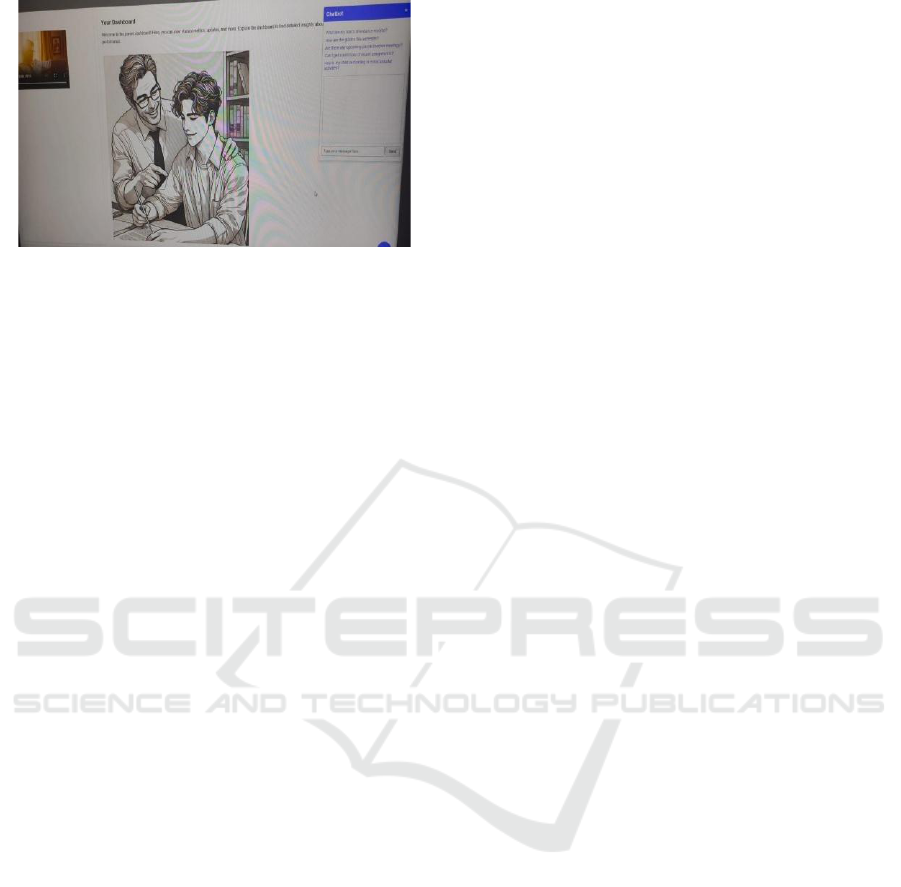
Figure 7: Chatbot.
6 CONCLUSIONS
The Bot enables phone’s parental controls and works
hand-in-hand with the central AI and academic
database personnel through facial recognition of the
parent and the chatbot. And for the utilization of the
system, the users are served with a Flask backend and
a Next.js and React frontend. The face authentication
is performed via AWS Rekognition while the bot
dialogues are processed by Dialogflow.
As such, the students and parents can see the
academic progress of their pupils. The objective of the
system is the enhancement of the database and the
improvement of the bot and the face recognition
features in the system’s future versions. This
unpresedented model improves the distribution and
management of academic record for all users
associated with students and educational institutions.
REFERENCES
DeChant, C., et al. (2017). Research consists of developing
a real-time dashboard which applies both Flask as
backend and Chart.js as frontend framework. Phytopat
hology, 107(11),14261432. The guide explains dashbo
ard development by showing an example which utilize
s Flask as backend and Chart.js as front-end libraries for
web application improvement.
Gupta, R., & Arora, P. (2021). Dialogflow Usage. Journal
of Educational Technology System, 50(2), 173-185.
The authors demonstrate Dialogflow usability for
educational robotics development to improve student
participation through speech-based learning.
Li, Y., & Zhao, L. (2020). Data Analytics Optimization
Strategies in PostgreSQL. Journal of Database Manag
ement, 31(3), 1–14. The article presents PostgreSQL
database modifications to enhance backend reader
queries and scale-managed analytics capabilities and
speed.
Roy, P., & Kumar, A. (2020). Building Web Interfaces
with HTML, CSS and JavaScript. International Journa
l of Web Development and Design, 8(2), 80-95. The
journal provides suggestions about responsive web
design that enhances user experience by using HTML
and CSS alongside Javascript for improved system ease
and satisfaction.
Singh, N., and Sharma, R. (2020). A conversational
student engagement platform uses Dialogflow technol
ogy for its development. International Journal of AI and
Education, 14(1), 45-60. This study develops a
Dialogflow-oriented conversational chatbot system that
boosts academic user interaction by offering immediate
relevant information regarding educational and
management issues.
Zhao, X., & Li, M. (2021). Universities leverage AWS
Rekognition Facial Detection as their main technology
for both authentication security and user identification
processes. Journal of Cloud Computing, 10(1), 45–58.
The research evaluates how AWS Reogntion operates
for face detection in secure authentication systems
particularly for user authentication operations and
security tasks.
ICRDICCT‘25 2025 - INTERNATIONAL CONFERENCE ON RESEARCH AND DEVELOPMENT IN INFORMATION,
COMMUNICATION, AND COMPUTING TECHNOLOGIES
80
