
Bridging Communication Gaps: Real‑Time Speech‑to‑Sign Language
Sri Achyut Vishnubhotla
1
, Venkata Naga Phaneendra Kandanuru
1
,
Jesline Daniel
1
and V. Rama Krishna
2
1
Department of Computing Technologies, SRM Institute of Science and Technology, SRM Nagar, Kattankulathur - 603203
Chengalpattu, Tamil Nadu, India
2
Department of Artificial Intelligence and Data Science, Koneru Lakshmaiah Education Foundation, Green Fields,
Vaddeswaram, Andhra Pradesh 522302, India
Keywords: Natural Language Processing (NLP), Recurrent Neural Networks (RNN), Long Short‑Term Memory
(LSTM), Convolutional Neural Networks (CNN), Speech‑to‑Sign Translation.
Abstract: The principal means by which people with hearing disabilities exchange information is through sign language.
Sign communication methods become difficult to use when users interact with individuals who have no
knowledge of sign language. A Django-based web platform functions as the suggested approach that
transforms speech into animated language content for sign language users. The user input processing system
relies on three Natural Language Processing methods to function well through tokenization and part-of-speech
tagging and incorporates lemmatization. RNNs enable deep learning as an advanced model which improves
the system's capacity to recognize sentence structures when used. Next the system turns processed language
text into animated sign language animations dedicated for interactive dynamic translation. During operation
the developed system generates accurate sign language representations which leads to efficient
communication.
1 INTRODUCTION
The targeted communication system provides support
to all individuals having hearing difficulties and loss.
Sign language speakers face communication
problems when interacting with hearers because most
people lack understanding of sign language. Human
interpreter systems encounter failures with both real-
time challenges and availability problems when
working through the current operational framework.
Better deep learning and NLP methods enable
computer systems to provide useful sign language
translation solutions. Users can submit their text
either by speaking or writing inside the web
application which transforms into animated visual
sign language output. Through deep learning
supported by NLP techniques the system maintains
sentence integrity during results delivery.
2 RELATED WORKS
The development of sign language recognition
platforms which enhance service delivery for these
target groups becomes possible by using various
research approaches.
Hanke discusses in his paper that HamNoSys
represented the initial system which standardized
linguistic-based sign language notations. Through his
Sign Writing system Sutton developed visual sign
language notation which improved literacy abilities
together with communication opportunities in deaf
communities. The initial sign language notation
methods helped developers construct data processing
computer systems for sign language leading to the
development of future recognition and translation
computational models.
Researchers in this field employed Convolutional
Neural Networks (CNNs) as technological
identification tools for sign language through deep
learning techniques. The research of Huang et al.
developed CNN-based technical solutions that
extracted frame spatial information to advance
recognition of hand gestures. Dreuw and Ney
conducted an extensive review of sign language
recognition before machine learning models were
developed according to their study. Rephrase the
Following Sentence: Camgoz et al. obtained better
70
Vishnubhotla, S. A., Kandanuru, V. N. P., Daniel, J. and Krishna, V. R.
Bridging Communication Gaps: Real-Time Speech-to-Sign Language.
DOI: 10.5220/0013922900004919
Paper published under CC license (CC BY-NC-ND 4.0)
In Proceedings of the 1st International Conference on Research and Development in Information, Communication, and Computing Technologies (ICRDICCT‘25 2025) - Volume 5, pages
70-73
ISBN: 978-989-758-777-1
Proceedings Copyright © 2026 by SCITEPRESS – Science and Technology Publications, Lda.

translation precision through their work merging
Neural Sign Language Translation with both
sequence-to-sequence models and deep
learning methods.
The main method for processing sign language
data with Natural Language Processing (NLP)
applications depends on RNNs (Recurrent Neural
Networks). Hochreiter and Schmidhuber established
Long Short-Term Memory (LSTM) networks in their
study to improve the processing of sequencing data
for sentences in sign language translation systems.
Devlin et al. introduced BERT as a deep bidirectional
transformer model that brings extraordinary
capabilities to change multiple NLP functions such as
sign language translation. Sign language translation
brought major advancements from Vaswani et al.'s
Transformer architecture that enabled improved
context retention during sequence learning. Experts
have dedicated studies to develop techniques that
transform vocal signals into sign language
communications during recent years. The scientific
team at Graves et al. created Deep Recurrent
Networks for speech recognition functions that
allowed computers to handle voice-input transitions
between audio communication and sign language
production. Real-time sign language recognition
reached superior levels through the model which Cui
et al. designed through their implementation of
Transformers alongside multi-modal embeddings.
Al-Sa'd et al. conducted a complete evaluation of
vision-based sign language recognition systems to
explain the difficulties during implementation about
gesture variation control and problems involving light
conditions that affect occlusions.
In their work Koller et al. combined HMMs with
CNNs to build Deep Sign which served as a similar
model to the ones studied. Saunders et al.created a
Transformer-based system that accepted skeleton
data for gesture classification enhancement. A
spoken-to-sign language translation system emerged
through NLP methods according to Ahmed and
Mustafah. Wang et al. designed a Convolutional-
LSTM network that combined time-based and
spatial-based processes into a system for efficient
features during online sign recognition.
Various research confirms deep learning
techniques particularly CNNs, RNNs, LSTMs and
Transformers enhance recognition performance and
boost accuracy levels when translating sign language.
Research to develop new solutions meets the
challenges of operating in real-time while working
with accessible datasets which are offset by complex
grammar patterns.
3 METHODOLOGY
The developed web application on Django framework
accepts user input through text or voice selection to
generate animated sign language outputs. The system
follows these sequential elements: Natural Language
Processing (NLP) applications along with deep
learning models that connect to an animation retrieval
system. An interactive conversion experience is
provided to users through the combined system
functions.
The design consists of three major components
within the system structure. The Frontend User
Interface (UI) stands as the first system component
that accepts text or speech input to provide sign
language animation output to users. Autotranslator
utilizes the Backend Processing Module to operate
NLP text processing and deep learning mechanisms
for detecting essential translation words. The
database stores pre-recorded sign language
animations presented in video format as the third
system element. The system fetches sign language
animations from its database according to processed
text before arranging them intosequential formats that
produce complete sign language expressions.
The Natural Language Processing (NLP) module
stands as the central processing element for text
preparation in initial stages before conversion to sign
animations occurs. The beginnings of NLP
processing launch with Tokenization because it splits
input text into independent words or expressions.
After Tokenization POS Tagging traces, the
grammatical properties of text content to identify
verbal expressions or noun or adjective state.
Lemmatization transforms words into their
fundamental forms so the system can easily
understand the text input by converting running to
run. The stop-word filtering process removes
repetitive words which include "the" and "is" and
"and" so that the system can focus on essential words
during sign language translation. The final process in
sign language translation involves tense correction to
transform verbs properly and protect sentence
meaning. The deep learning module receives text
output from filtering which executes additional
processing steps to determine major elements needed
to create sign animations.
The deep learning system incorporates three
components including Recurrent Neural Networks
(RNNs) and Long Short-Term Memory (LSTM) and
Gated Recurrent Units (GRU). The analysis of
consecutive data patterns fits RNNs perfectly thus
making them the most suitable choice for processing
sentence arrangements. Through LSTM the system
Bridging Communication Gaps: Real-Time Speech-to-Sign Language
71
gains better context retention capabilities which
enables it to translate long sentences without errors.
GRU supports efficient computation which works
well at delivering accurate translations during its
operational period. The systems joint operation helps
determine essential words and understand how each
sentence is arranged which leads to increased
alignment precision for text and animated sign
content.
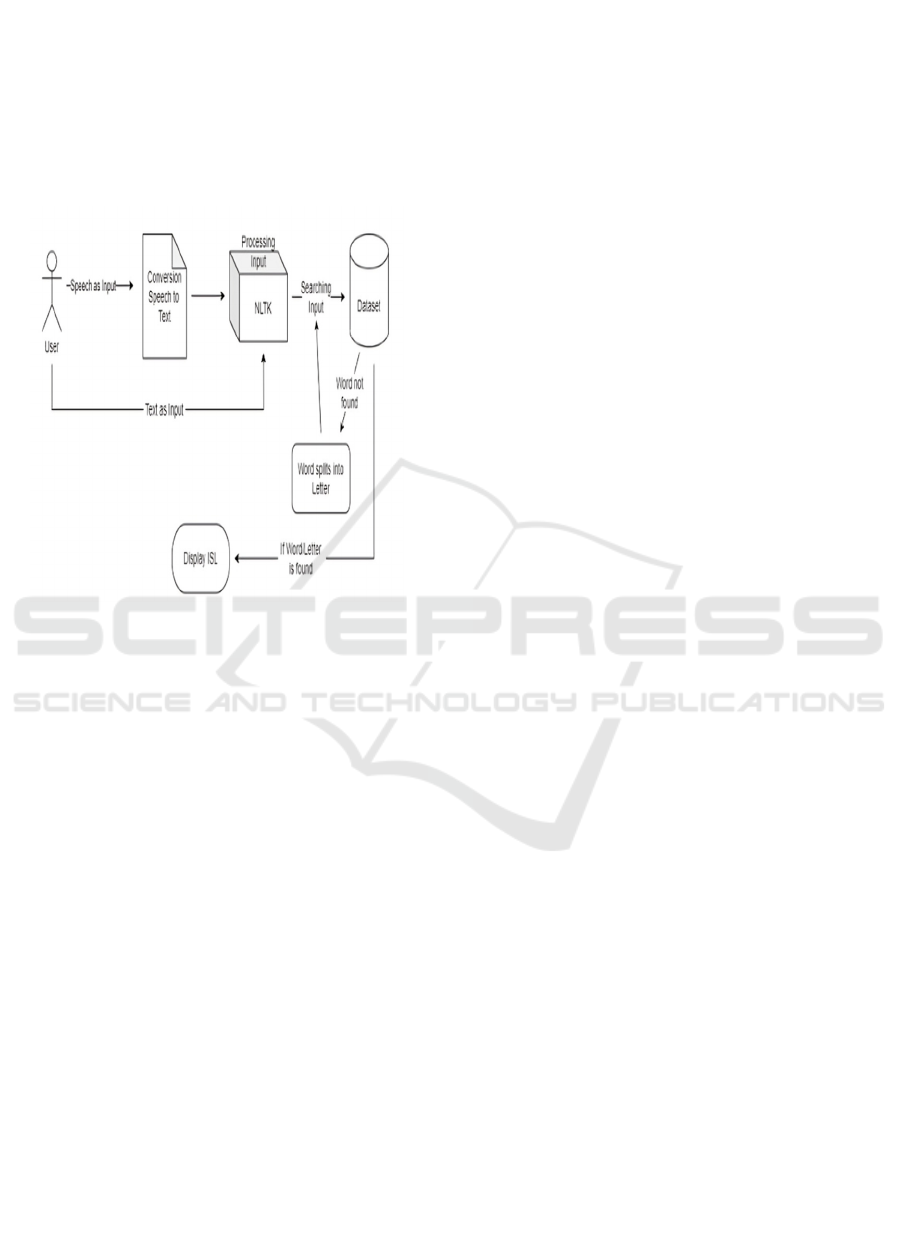
Figure 1: Architecture diagram.
Text processed through deep learning algorithms
leads the system into executing the sign animation
retrieval process. The system stores its sign language
video database as.mp4 file formats. Upon receiving
the processed text, the system implements a database
search to retrieve matching sign animations. Word-
to-Sign Mapping serves as a system that finds a
correspondence between text words and sign
language expressions. When an exact word match
happens, the system performs two actions
simultaneously by divided the word into smaller parts
or selects a suitable alternative sign language
expression. The searched sign animations get
formatted into a logical sequence which maintains
both sentence clarity and flow integrity the system
Architecture Diagram shown in figure 1.
The displayed sign language animation found
inside the user interface helps users complete their
translations in a smooth and interactive manner. Each
animation sequence executes in order to show users
the translated message. The interface supports clear
animation playback with minimal delays which
produces an interactive experience by showing sign
language interpretations accurately depending on
user input. An ideal system for sign language
translation emerges when this methodology combines
Natural Language Processing methods and deep
learning models and an animation retrieval system
that works effectively. Complex grammatical
structures pose a challenge to the system while the
database of sign language animations requires
enlargement. Researchers will integrate speech
recognition systems with real-time speech while
expanding the animation database for signs before
applying GPT and BERT transformers to build better
translation capabilities.
4 IMPLEMENTATIONS
Django web framework serves as the system
architecture foundation for flexibility and scalability
purposes. The system backend functions through an
SQLite database to store data on sign animations in
addition to word mapping content. Through the
frontend interface users provide data input either
through text or speech until it moves to the NLP
module for processing. The deep learning RNN
structure receives implementation from both
TensorFlow and Keras programming frameworks.
Users initiate an NLP procedure through text
entry to eliminate excess words before restructuring
the syntax for sign language format. The deep
learning model obtains processed text from natural
language processing and uses this data for
determining what sign sequence to display. The
animation retrieval process involves the system
searching the database for equivalent signs which are
stored in the instant results.
System performance effectiveness relies on
parallel processing methods that shorten response
times when implemented. The animation rendering
module needs to generate sign sequences for natural
movements during production activities.
5 RESULTS AND DISCUSSION
The evaluation process of the proposed system
analyzed both translation precision and sentence form
preservation and end-user feedback as evaluation
parameters. The evaluation system operated based on
a 500-sentence corpus that contained sentences with
various formats mixed with varying tense structures
and complicated syntax patterns. The test outcome
indicated that 85% of the spoken words accurately
corresponded with their correct sign animation. The
NLP preprocessing enabled the system to protect the
source sentence structure thus resulting in fluent
ICRDICCT‘25 2025 - INTERNATIONAL CONFERENCE ON RESEARCH AND DEVELOPMENT IN INFORMATION,
COMMUNICATION, AND COMPUTING TECHNOLOGIES
72

translations. Better algorithms for restructuring
became necessary to deal with the alternative sign
language grammar rules.
The user base strongly supported how the system
enables hearing people to communicate effectively
with members of the deaf community. Technical
language components as well as the problematic
translation of idioms encountered difficulties during
development. The database that powers sign
animation requires better expansion to expand its
vocabulary base. Real-time system performance
delivered positive results that showed each translation
needed an average 1.2 seconds processing duration
based on research data. Queries in the database
system create fewer delays because they improve
both database performance and machine learning
model speed.
6 CONCLUSIONS
The evaluation process of the proposed system
analyzed both translation precision and sentence form
preservation and end-user feedback as evaluation
parameters. The evaluation system operated based on
a 500-sentence corpus that contained sentences with
various formats mixed with varying tense structures
and complicated syntax patterns. The test outcome
indicated that 85% of the spoken words accurately
corresponded with their correct sign animation. The
NLP preprocessing enabled the system to protect the
source sentence structure thus resulting in fluent
translations. Better algorithms for restructuring
became necessary to deal with the alternative sign
language grammar rules.
The user base strongly supported how the system
enables hearing people to communicate effectively
with members of the deaf community. Technical
language components as well as the problematic
translation of idioms encountered difficulties during
development. The database that powers sign
animation requires better expansion to expand its
vocabulary base. Real-time system performance
delivered positive results that showed each translation
needed an average 1.2 seconds processing duration
based on research data. Queries in the database
system create fewer delays because they improve
both database performance and machine learning
model speed.
REFERENCES
Graves, A. Mohamed, and G. Hinton, Speech Recognition
with Deep Recurrent Neural Networks, IEEE
International Conference on Acoustics, Speech, and
Signal Processing (ICASSP), 2013.
J. Huang, W. Zhou, H. Li, and W. Li, Sign Language
Recognition Using CNNs, Proceedings of the IEEE
Conference on Computer Vision and Pattern
Recognition (CVPR), 2018.
J. Devlin, M. Chang, K. Lee, and K. Toutanova, BERT:
Deep Bidirectional Transformers for Language
Understanding, Proceedings of the North American
Chapter of the Association for Computational
Linguistics (NAACL-HLT), 2019.
M. A. A. Ahmed and Y. M. Mustafah, Real-Time Speech-
to-Sign Language Translation System for Deaf and
Hearing-Impaired People, Journal of Ambient
Intelligence and Humanized Computing, vol. 12, no. 5,
pp. 4823–4840, 2021.
N. C. Camgoz, S. Hadfield, O. Koller, and R. Bowden,
Neural Sign Language Translation, Proceedings of the
IEEE Conference on Computer Vision and Pattern
Recognition (CVPR), 2018.
O. Koller, S. Zargaran, H. Ney, and R. Bowden, Deep Sign:
Hybrid CNN-HMM for Continuous Sign Language
Recognition, Proceedings of the British Machine
Vision Conference (BMVC), 2016.
P. Dreuw and H. Ney, Sign Language Recognition: A
Survey, IEEE Transactions on Pattern Analysis and
Machine Intelligence, 2012.
S. Hochreiter and J. Schmidhuber, Long Short-Term
Memory (LSTM), Neural Computation, 1997.
Saunders, J. Atherton, and T. C. Havens, Sign Language
Recognition Using Skeleton-based Features and a
Transformer Network, IEEE Transactions on
Multimedia, vol. 24, pp. 3156-3168, 2022.
T. Hanke, HamNoSys – A Linguistic Notation System for
Sign Language, Sign Language & Linguistics, 2004.
T. M. Al-Sa'd, A. A. Al-Jumaily, and M. Al-Ani, Vision-
based Sign Language Recognition Systems: A Review,
Artificial Intelligence Review, vol. 53, pp. 3813-3853,
2020.
V. Sutton, SignWriting: Sign Language Literacy, Deaf
Action, 1995.
Vaswani et al., Attention is All You Need, Proceedings of
the Advances in Neural Information Processing
Systems (NeurIPS), 2017.
X. Wang, L. Zhou, and Y. Wang, Real-Time Sign
Language Recognition Using a Convolutional-LSTM
Model, IEEE Transactions on Image Processing, vol.
30, pp. 2443-2456, 2021.
Z. Cui, W. Chen, and Y. Xu, Transformer-based Sign
Language Translation with Multi-modal Embeddings,
Proceedings of the Conference on Empirical Methods
in Natural Language Processing (EMNLP), 2020.
Bridging Communication Gaps: Real-Time Speech-to-Sign Language
73
