
Predictive Analytics for Digital Transactions
Sasikala C., Anil Kumar Bandi, Ambica Cheluru, Aswartha Reddy Settipi,
Durga Bhavani Vanka and Tarun Kumar Reddy Peram
Department of Computer Science and Engineering, Srinivasa Ramanujan Institute of Technology (SRIT), Anantapur,
Andhra Pradesh, India
Keywords: Choice Trees, Irregular Woodlands, Angle Assistance, Protection Safeguarding Models, Models of
Straightforwardness Include Deep Neural Networks (DNN), Recurrent Neural Networks (RNN), Federated
Learning (FL), Financial Fraud Detection, Explainable Artificial Intelligence (XAI), AI Algorithms.
Abstract: In the domain of monetary misrepresentation location, accomplishing harmony among straightforwardness
and security is basic. Conventional methodologies frequently neglect to give both elevated degrees of
exactness and clear, justifiable clarifications for navigation, all while safeguarding delicate information. They
attempt to uncover the solutions that United Learning (FL) and Reasonable Computer-based Intelligence
(XAI) provide on these particular challenges. Financial institutions utilizing quantitative predictions must
deeply trust their models, and XAI provides models for them. However, Unified Learning considers the
construction of AI models to a collection of dispersed data sources where sensitive financial data is properly
siloed. In detail, this study looks at how different algorithms, which include Deep Neural Networks (DNN),
Recurrent Neural Networks (RNN), Decision Trees, Random Forests, and Support Vector Machines, are
utilized in fraud detection tasks and how these algorithms are integrated into the multi-task learning
framework. In addition, the study investigates fusion methods for models such as Stochastic Gradient Descent
(SGD) and its variants. This study investigates how financial institutions could enhance fraud detection
systems while ensuring transparency, confidentiality, and compliance with data protection laws by integrating
the best of both XAI and FL worlds.
1 INTRODUCTION
This article examines the combination of Explainable
AI (XAI) and Federated Learning (FL) with the goal
of increasing fraud detection capabilities within
financial institutions while enhancing transparency,
regulatory compliance, and data security. AI-enabled
fraud detection provides high accuracy, however, as
explained previously, there is a significant lack of
explain ability, which complicates matters within the
extremely controlled financial sector. To foster trust
and compliance with regulations like GDPR, XAI
ensures that decision-making by AI systems is
more explainable and transparent. On the other
hand, FL enables the development of AI models
on data held in silos, thereby preserving privacy and
minimizing the risk of security breaches. Established
financial institutions can now build effective systems
for accurate fraud detection without compromising
security, explain ability, or precision by integrating
XAI and FL. The models selected for the study
include decision trees, recurrent neural networks
(RNN), deep neural networks (DNN), and gradient
boosting models with a focus on the FL framework
for AI. The focus is also on optimization methods
such as stochastic gradient descent (SGD) to make
them more efficient. Lastly, the paper proposes a
framework for responsible use of AI in financial
fraud detection by achieving a balance of data
privacy, transparency, and overall system
performance.
2 THE ROLE OF THIS WEB
APPLICATION
The primary purpose of this study is to assess the
effectiveness of a novel combined approach using
Federated Learning (FL) and Explainable AI (XAI)
in payment fraud detection systems. There are
existing techniques for fraud detection and
prevention that work, but they tend to be centralized
56
C., S., Bandi, A. K., Cheluru, A., Settipi, A. R., Vanka, D. B. and Peram, T. K. R.
Predictive Analytics for Digital Transactions.
DOI: 10.5220/0013922500004919
Paper published under CC license (CC BY-NC-ND 4.0)
In Proceedings of the 1st International Conference on Research and Development in Information, Communication, and Computing Technologies (ICRDICCT‘25 2025) - Volume 5, pages
56-61
ISBN: 978-989-758-777-1
Proceedings Copyright © 2026 by SCITEPRESS – Science and Technology Publications, Lda.

and obfuscated, which can lead to challenges with
privacy and compliance laws. FL does allow for data
processing to be conducted in a more decentralized
manner, but XAI claims to provide trustable AI
conclusions. The focus of this research is on the
comparison of different AI models, including Deep
Learning Neural Networks (DNNs), Recurrent
Neural Networks (RNNs), Decision Trees, Random
Forest, and Gradient Boosting, which will all be
executed under FL framework. In order to improve
the performance of the models, additional parameters
such as Stochastic Gradient Descent (SGD) will also
be utilized. It is the objective of this work to also
illustrate an E2E framework for AI augmented
payment fraud detection featuring accuracy,
transparency, data privacy, and regulatory
compliance.
3 LITERATURE REVIEW
As scientists strive to enhance model simplicity,
security, and predictive accuracy, the combination of
Federated Learning (FL) and Explainable Artificial
Intelligence (XAI) has recently gained considerable
attention, especially in the realm of financial fraud
detection. Traditional AI methods have primarily
depended on centralized models for identifying
misrepresentation, where sensitive financial data is
stored and managed on centralized servers. However,
these methods face challenges related to regulatory
compliance and security, particularly with stringent
data protection laws like the GDPR. A promising
solution to these challenges is Federated Learning,
which facilitates the collaborative development of
models without sharing raw data among participants.
FL enables various financial institutions or
organizations to collaboratively build AI models
using their local datasets while keeping their most
sensitive information private, thus addressing
security concerns while leveraging extensive data
resources. Since the variety of value-based designs
employed by various organizations is essential in
spotting unusual activities, this widely recognized
learning paradigm is especially useful in detecting
financial extortion. Simultaneously, the test lies in
guaranteeing that such models are interpretable and
straightforward, as monetary (Balcıoğlu, Y. S)
foundations should give clarifications to their
mechanized choices, particularly when these choices
can have critical legitimate and monetary outcomes.
The requirement for interpretability in
misrepresentation location models has prompted a
developing interest in XAI. Conventional AI
calculations, especially profound learning models,
are frequently seen as "secret elements" because their
(Bodker A et al., 2022) dynamic cycles are not
effectively justifiable by people. This absence of
straightforwardness creates difficulties in managed
areas like money, where it isn't simply vital to make
exact expectations but additionally to give clear
defenses to those forecasts. ( Demertzis et al., 2022
XAI expects to resolve this issue by creating
procedures and models that permit leaders to
comprehend and believe the expectations made by
simulated intelligence frameworks. Different
procedures have been proposed to upgrade the
interpretability of mind- boggling models, for
example, highlight significance examination, nearby
clarification techniques like LIME (Neighborhood
Interpretable (Guo et al., 2024) Model rationalist
Clarifications), and SHAP (SHapley Added
substance Clarifications). These techniques offer a
method for making sense of individual expectations,
making it clearer why a specific exchange was hailed
as fake or not. By giving partners straightforward bits
of knowledge into the dynamic cycle, XAI not only
upgrades trust in computerized misrepresentation
identification frameworks (Hasan et al., 2024) yet in
addition helps meet administrative prerequisites in
regard to responsibility and decency in a computer-
based intelligence-driven direction. As far as
algorithmic commitments to misrepresentation
location, an extensive variety of AI models have been
investigated. Profound Brain Organizations (DNNs)
have been widely utilized because of their capacity to
catch complex examples and learn progressive
portrayals of information. These models (Koetsier et
al., 2022) have shown great outcomes in
distinguishing misrepresentation, especially in
conditions where the false way of behaving is
unobtrusive or advances over the long run.
Nonetheless, (Kollu et al., 2023) DNNs additionally
face difficulties connected with interpretability, as
they can be exceptionally perplexing and hard to
make sense of.
Repetitive Brain Organizations (RNNs),
especially Lengthy Transient Memory (LSTM)
organizations, have additionally been utilized in
misrepresentation (Lakhan etal., 2023) recognition
undertakings that include consecutive information,
like exchange chronicles. RNNs are successful in
demonstrating fleeting conditions, which is basic in
monetary extortion location, as deceitful exercises
frequently unfurl after some time and show
consecutive examples.
While RNNs offer benefits as far as transient
examination, they likewise experience the ill effects
Predictive Analytics for Digital Transactions
57
of interpretability issues, prompting a developing
interest in coordinating XAI procedures with RNN-
based models to offer more straightforward
misrepresentation discovery arrangements. Other
conventional AI procedures, for example, Choice
Trees, (Mothukuri et al., 2021) Arbitrary Woods, and
Angle Supporting techniques, have additionally been
generally utilized in misrepresentation locations.
Choice Trees are well known because of their
intrinsic interpretability; their treelike design
considers simple perceptions of choice ways. Be that
as it may, their exhibition can corrupt while taking
care of enormous, high-layered datasets, prompting
the utilization of group techniques like Irregular
Timberlands and Inclination (Raval et al., 2023)
Helping Machines (GBM). These techniques, while
further developing precision, present intricacy,
making them harder to decipher. In any case, there
have been propels in posthoc interpretability
techniques for troupe models, for example,
highlighting significance scores and proxy models,
which have helped address the compromise between
model exactness and logic. In addition, the utilization
of group models has been displayed to further
develop recognition (Sai et al., 2023) rates by joining
the qualities of different models and lessening the
gamble of overfitting.
4 IMPLEMENTATIONS
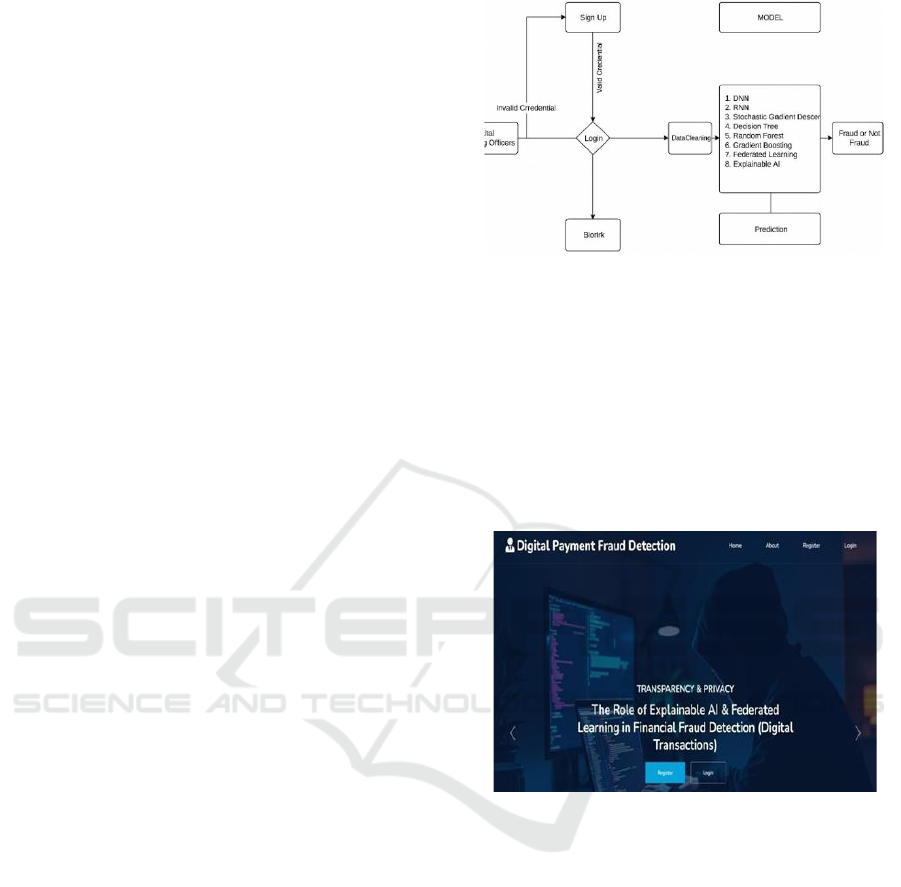
4.1 Flow Chart
A flowchart is a visual representation of the processes
occurring within a system or project. It illustrates the
various steps involved. The flowchart starts and
concludes at the terminal points, which are depicted
using oval shapes. Decision-making steps are
represented by diamond shapes. Rectangular boxes
indicate the processes that occur on the website.
Processes that are adjacent to each other are
sequential. Figure 1 Shows the Flow chart of
application.
4.2 Database Connectivity
To store and access data from the server we require a
database connection and we implanted below code
snippet below provide the connection. This code
creates a new mysqli object, specifying the database
server, username, password, and database name. The
connection is then verified, and an error message is
displayed if the connection fails.
Figure 1: Flow Chart of Application.
4.3 Fetching Data
To fetch data from the database we implemented the
following code snippet to get the data and load it in the
frontend pages. This query retrieves the user's data
from the users table, based on their unique user_id.
The resulting data is then processed and displayed
within the application. The shows Figure 2 Register
page.
Figure 2: Register Page.
4.4 Front end
The frontend of our web application was built using
HTML, CSS, JavaScript, and jQuery. HTML
provided the structural foundation, while CSS was
used for styling and layout. JavaScript and jQuery
were utilized for dynamic client-side functionality,
enhancing user interaction and experience. Our
frontend design aimed to provide an intuitive and
user- friendly interface, allowing users to seamlessly
navigate and utilize the application's features. The
Figure 3 shows Login Page.
ICRDICCT‘25 2025 - INTERNATIONAL CONFERENCE ON RESEARCH AND DEVELOPMENT IN INFORMATION,
COMMUNICATION, AND COMPUTING TECHNOLOGIES
58
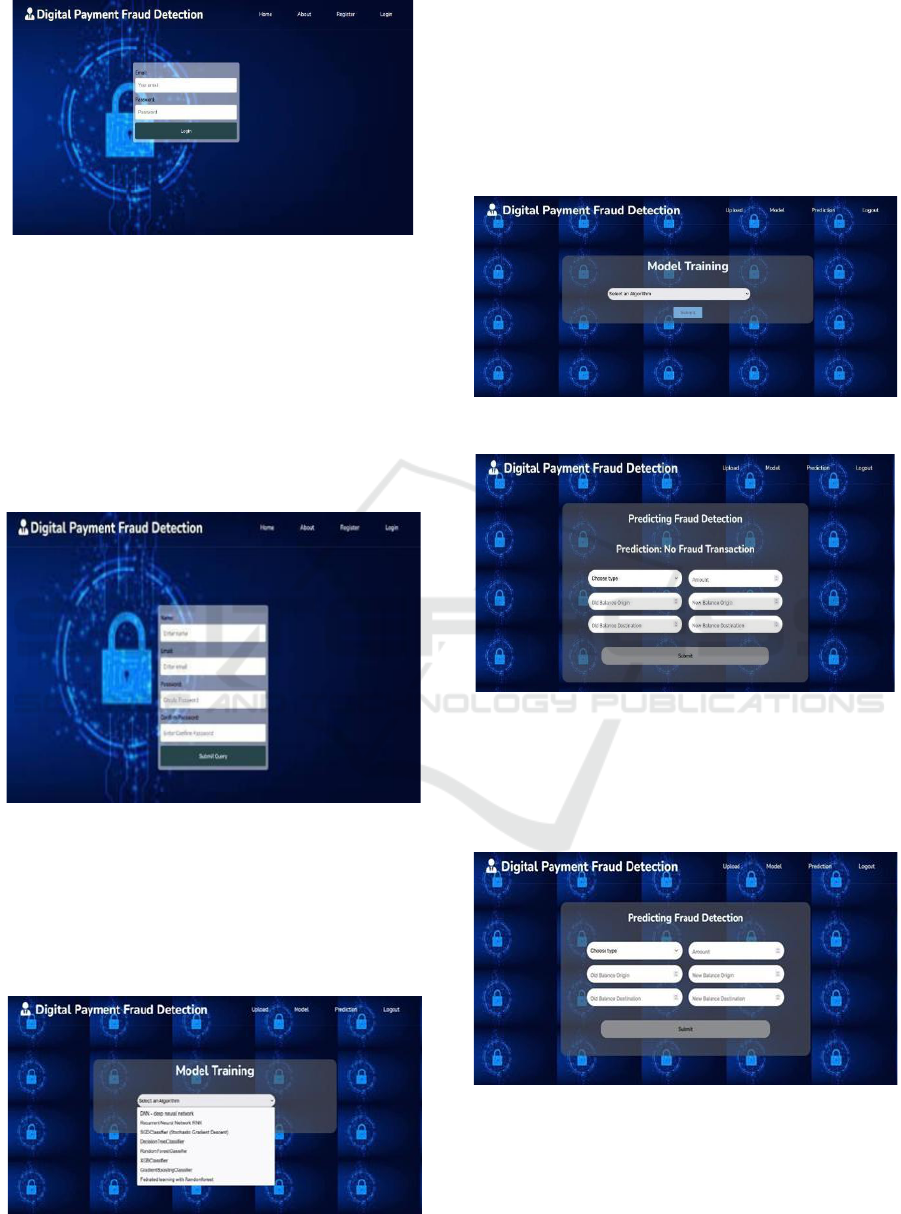
Figure 3: Login Page.
4.5 User Credentials Validation
This is an example code snippet of JavaScript used in
our application for front-end. This code snippet
verifies credentials and logs in the students and
faculty by sending a request to the database. It
verifies the user credentials with in the browser
before sending to the server for backend verification.
The shows Figure 4 Home page.
Figure 4: Home Page.
5 RESULTS
The interfaces of this progressive web application are
shown below Figure 5 and 6.
Figure 5: Model Training.
After selecting a certain algorithm, we calculate their
accuracies based on the result of the result of the
accuracies we choose which algorithm is best for
fraud detection. The process of choosing the
appropriate algorithm for fraud detection is illustrated
in Figure 6, while the final output of the system is
demonstrated on the prediction page shown in Figure
7.
Figure 6: Model Selection.
Figure 7: Prediction Page.
The below analytics shows Figure 8 and 9 the
performance of the web application. In case the given
values are legitimate then it shows the No fraud
transaction.
Figure 8: Result 1.
In case the given values aren’t legitimate then it shows
the fraud transaction.
Predictive Analytics for Digital Transactions
59

Figure 9: Result 2.
6 CONCLUSIONS
By ensuring data privacy through decentralized
model training without exposing individual data,
federated learning (FL) is enhanced by explainable
AI (XAI), which makes AI-driven decisions more
interpretable. This collaboration guarantees the
development of reliable, interpretable, and legally
compliant fraud detection systems. The study
illustrates that while deep learning models like deep
neural networks (DNNs) and recurrent neural
networks (RNNs) offer high precision, they often
lack transparency. In contrast, traditional models
such as decision trees and random forests provide
explain ability but may fall short in precision. By
integrating these models into a federated learning
framework, a hybrid approach can achieve a balance
of explain ability, precision, and data protection.
These advancements offer financial institutions a
roadmap for implementing effective and
regulatory-compliant fraud detection technologies,
adhering to standards like the CCPA and GDPR.
7 ACKNOWLEDGMENT
We extend our heartfelt thanks to Dr. C. Sasikala, an
assistant professor of computer science and engineering at
Srinivasa Ramanujan Institute of Technology, for his
invaluable guidance and support in making this research
a success.
REFERENCES
Ahmed, A. A., & Alabi, O. O. (2024). Secure and Scalable
Blockchain-Based Federated Learning for
Cryptocurrency Fraud Detection: A Systematic
Review. IEEE Access, 12, 102219–
102241.https://doi.org/10.1109/ACCESS.2024.342920
5
Ali, S., Li, Q., & Yousafzai, A. (2024). Blockchain and
federated learning-based intrusion detection
approaches for edge-enabled industrial IoT networks: a
survey. Ad Hoc Networks, 152, 103320.
https://doi.org/10.1016/J.ADHOC.2023.103320
Attanayaka, D. (2022). A novel anomaly detection
mechanism for Open radio access networks with Peer-
to- Peer Federated Learning. Laturi.Oulu.Fi.
https://oulurepo.oulu.fi/handle/10024/21293
Balcıoğlu, Y. S. (1 C.E.). Revolutionizing Risk
Management AI and ML Innovations in Financial
Stability and Fraud Detection.
Https://Services.IgiGlobal.Com/Resolvedoi/Resolve.A
spx?Doi=10.4018/979-8-3693-4382- Ch006,109–138.
https://doi.org/10.4018/979-8-3693-4382-1.CH006
Bodker, A., Connolly, P., Sing, O., Hutchins, B., Townsley,
M., & Drew, J. (2022). Card-not-present fraud: using
crime scripts to inform crime prevention initiatives.
Security Journal, 36(4), 1.
https://doi.org/10.1057/S41284-022-00359-W
Demertzis, K., Iliadis, L., Kikiras, P., & Pimenidis, E.
(2022). An explainable semi-personalized federated
learning model. Integrated Computer-Aided
Engineering, 29(4), 335–350.
https://doi.org/10.3233/ICA-220683
Guo, W., & Jiang, P. (2024). Weakly Supervised anomaly
detection with privacy preservation under a Bi- Level
Federated learning framework. Expert Systems with
Applications, 254, 124450.
https://doi.org/10.1016/J.ESWA.2024.124450
Hasan, M., Rahman, M. S., Janicke, H., & Sarker, I. H.
(2024). Detecting anomalies in blockchain transactions
using machine learning classifiers and explainability
analysis. Blockchain: Research and Applications, 5(3),
100207. https://doi.org/10.1016/J.BCRA.2024.100207
Koetsier, C., Fiosina, J., Gremmel, J. N., Müller, J. P.,
Woisetschläger, D. M., & Sester, M. (2022). Detection
of anomalous vehicle trajectories using federated
learning. ISPRS Open Journal of Photogrammetry and
Remote Sensing, 4, 100013.
https://doi.org/10.1016/J.OPHOTO.2022.100013
Kollu, V. N., Janarthanan, V., Karupusamy, M., &
Ramachandran, M. (2023). Cloud-Based Smart
Contract Analysis in FinTech Using IoT-Integrated
Federated Learning in Intrusion Detection. Data 2023,
Vol. 8, Page 83, 8(5), 83.
https://doi.org/10.3390/DATA8050083
Lakhan, A., Mohammed, M. A., Nedoma, J., Martinek, R.,
Tiwari, P., Vidyarthi, A., Alkhayyat, A., & Wang, W.
(2023). Federated-Learning Based Privacy
Preservation and Fraud-Enabled Blockchain IoMT
System for Healthcare. IEEE Journal of Biomedical and
Health Informatics, 27(2), 664–672.
https://doi.org/10.1109/JBHI.2022.3165945
Marry, P., Mounika, Y., Nanditha, S., Shiva, R., &
Saikishore, R. (2024). Federated Learning-Driven
Decentralized Intelligence for Explainable Anomaly
Detection in Industrial Operations. 2nd International
Conference on Sustainable Computing and Smart
ICRDICCT‘25 2025 - INTERNATIONAL CONFERENCE ON RESEARCH AND DEVELOPMENT IN INFORMATION,
COMMUNICATION, AND COMPUTING TECHNOLOGIES
60

Systems, ICSCSS 2024 - Proceedings, 874–880.
https://doi.org/10.1109/ICSCSS60660.2024.10625289
Mothukuri, V., Parizi, R. M., Pouriyeh, S., Huang, Y.,
Dehghantanha, A., & Srivastava, G. (2021). A
survey on security and privacy of federated learning.
Future Generation Computer Systems, 115, 619640.
https://doi.org/10.1016/J.FUTURE.2020.10.007
Raval, J., Bhattacharya, P., Jadav, N. K., Tanwar, S.,
Sharma, G., Bokoro, P. N., Elmorsy, M., Tolba, A., &
Raboaca, M. S. (2023). RaKShA: A Trusted
Explainable LSTM Model to Classify Fraud Patterns on
Credit Card Transactions. Mathematics 2023, Vol.
11, Page 1901, 11(8),1901. https://doi.org/10.3390/M
ATH11081901
Sai, C. V., Das, D., Elmitwally, N., Elezaj, O., & Islam, M.
B. (2023) Explainable Ai-Driven Financial Transaction
Fraud Detection Using Machine
Learning and Deep Neural Networks. https://doi.org/1
0.2139/SSRN.4439980
Predictive Analytics for Digital Transactions
61
