
Review on IoT‑Based Cattle Health Monitoring System Real‑Time
Detection and Alerting for Improved Farm Management
S. Salik Nihal, Santhosh Kumar C., F. Shafiq Mohammed and A. R. Kalaiarasi
Department of Electronics and Instrumentation Engineering, Saveetha Engineering College, Saveetha Nagar, Thandalam,
Chennai, Tamil Nadu, India
Keywords: Predictive Maintenance, Machine Failure Detection, Sensor Data Analytics, Machine Learning, Industrial
Automation, Real‑Time Data Processing, Fault Diagnosis, Proactive Maintenance.
Abstract: Automation and state-of-the-art technologies are significantly improving the productivity of farms. One of
the major areas of research in farm automation is the development of systems to monitor the health of cattle.
Wireless: Mobile and server networks are seamless enabling the monitoring system everywhere. The proposed
monitoring system consists of the following components: infrastructure, hardware, software, and
physiological instruments. Answer: Improving farm productivity largely has to do with keeping cattle healthy,
especially in large dairy farms, where regular health monitoring is much more difficult. This study has very
much significance for the dairy owners and local administration as well. The health monitoring system mainly
aims to track the health of individual cattle over time for early diagnosis and timely treatment of diseases.
Using sensor technology to measure temperature, heart rate and other important behavioral indicators, the
system takes your training through a series of sessions that optimize your performance. This information is
collected and sent to one central health care facility that reduces the need for constant health inspections,
saving money on long-term health care for animals. Smartphone implements also allow for real-time
monitoring of cattle vitals.
1 INTRODUCTION
Automation and technology are revolutionizing farm
productivity, increasingly via integration of high-
tech cattle wellbeing monitoring systems. Routine
health monitoring is a challenge particularly in large
dairy operations, which can be greatly facilitated by
the integration of mobile and wireless sensor
networks. This paper proposes a monitoring system
that combined with various components such as
Internet infrastructure, internet of things (IoT)
hardware and software as well as physiological
instruments measuring cattle health to enhance farm
productivity. However, the main goal is to realize
long-term health monitoring of individual animals,
which allows for timely sick diagnosis and treatment.
The system monitors key behavioral indicators like
temperature and heart rate using advanced sensor
technology. This data can be accessed at any time,
enabling healthcare personnel to monitor patients in
real time at a central health care center, thus
decreasing the number of manual inspections
performed over time and reducing long- term health
care costs. To best serve cattle well-being, dairy
owners, and local authorities, the system can provide
timely health information that can both optimize
practices and improve animal health across the board.
These innovations will help augment farm
automation to improve productivity while delivering
better animal care as needed.
2 EXISTING SYSTEM
Existing work in cattle monitoring system deals with
predicting the pre-disease of the cattle. In other cases,
the projects only deal with milking the cattle and
automated dairy farming. Farmers manually check
cattle for visible signs of illness or distress, which is
time consuming and may miss subtle symptoms.
Health data such as temperature and feeding patterns
are recorded manually, leading to potential
inaccuracies and delayed responses to health issues.
Nihal, S. S., C., S. K., Mohammed, F. S. and Kalaiarasi, A. R.
Review on IoT-Based Cattle Health Monitoring System Real-Time Detection and Alerting for Improved Farm Management.
DOI: 10.5220/0013922300004919
Paper published under CC license (CC BY-NC-ND 4.0)
In Proceedings of the 1st International Conference on Research and Development in Information, Communication, and Computing Technologies (ICRDICCT‘25 2025) - Volume 5, pages
45-50
ISBN: 978-989-758-777-1
Proceedings Copyright © 2026 by SCITEPRESS – Science and Technology Publications, Lda.
45
Visual Inspections: Farmers manually check cattle for
visible signs of illness or distress, which is time-
consuming and may miss subtle symptoms. Manual
Record Keeping: Health data such as temperature and
feeding patterns are recorded manually, leading to
potential inaccuracies and delayed responses to health
issues.
3 PROPOSED SYSTEM
Maintaining optimal health, particularly in dairy
farms, the system ensures better milk production,
improving farm yields. The automated system
reduces the need for manual health checks, cutting
labour costs, minimizing disruptions. Health data
collected over time provides valuable insights that can
b e analysed to optimize farm management practices,
improve animal welfare. The system is designed to
handle large herds, ensuring efficient management
and providing individual attention to each animal as
farms grow. Relying on sensor data instead of
subjective observations, the system ensures more
accurate, consistent, and reliable monitoring of
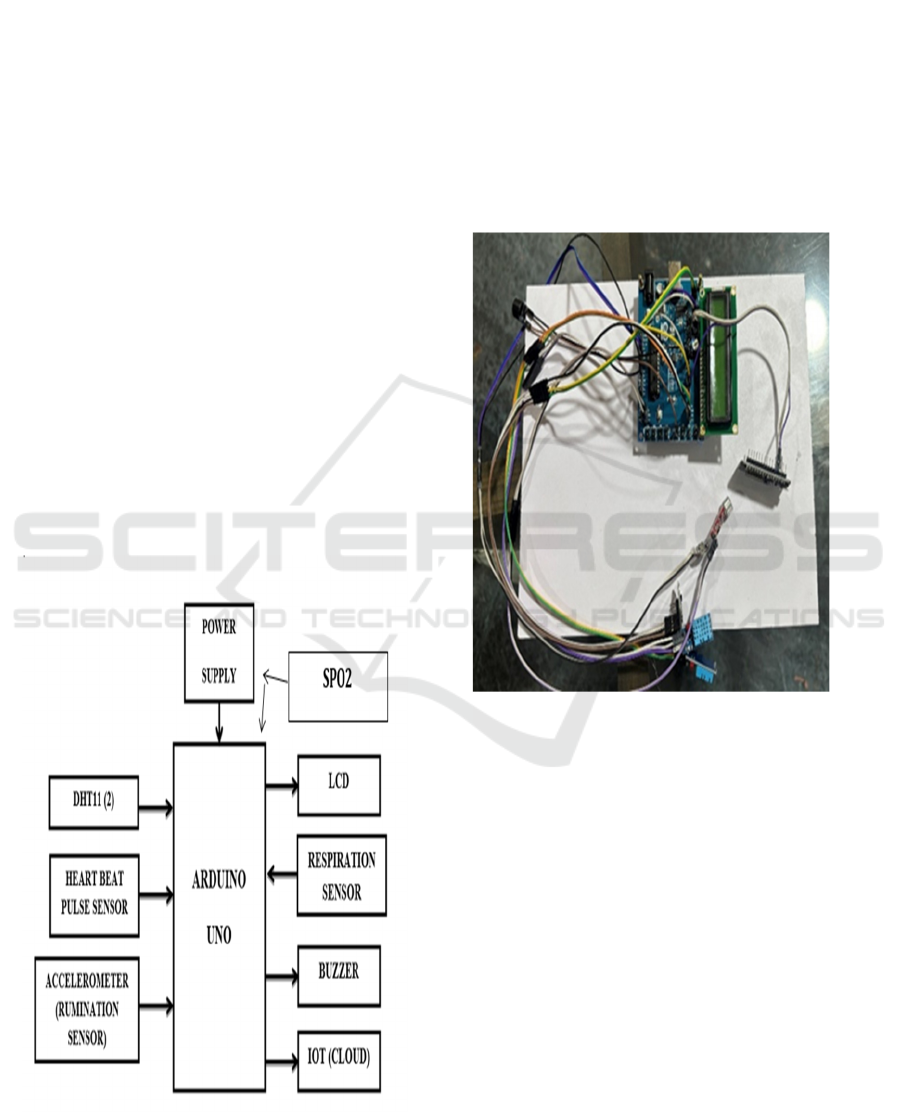
animal health. The figure 1 shows proposed system
block diagram.
Figure 1: Proposed system block diagram.
4 PROJECT
IMPLEMENTATIONS
Advancements in automation and technology are
revolutionizing farm productivity, particularly
through the development of sophisticated cattle
health monitoring systems. In large dairy operations,
routine health monitoring can be challenging, making
the integration of mobile and wireless sensor
networks highly beneficial.
Figure 2: Project implementation.
This proposed monitoring system combines
infrastructure, hardware, software, and physiological
instruments to enhance farm productivity by focusing
on the health of cattle. The core objective is to provide
continuous health tracking for individual animals,
enabling early diagnosis and swift treatment of
illnesses. The figure 2 shows Project implementation.
By utilizing advanced sensor technology, the system
monitors critical behavioural indicators such as
temperature and heart rate. This real-time data is
transmitted to a central healthcare facility, reducing
the need for frequent manual inspections and thereby
lowering long- term healthcare costs. The system’s
ability to provide timely health information not only
ICRDICCT‘25 2025 - INTERNATIONAL CONFERENCE ON RESEARCH AND DEVELOPMENT IN INFORMATION,
COMMUNICATION, AND COMPUTING TECHNOLOGIES
46
supports the well-being of the cattle but also benefits
dairy owners and regional authorities by optimizing
management practices and improving overall animal
health. Through these innovations, farm automation
is poised to enhance productivity while ensuring more
efficient and effective animal care.
4.1 Internet of Things
The Internet of Things (IoT) is a network of
interconnected physical devices embedded with
sensors, software, and other technologies that enable
them to collect, process, and exchange data over the
internet. This technology seamlessly bridges the
physical and digital worlds, revolutionizing various
aspects of daily life and industries. IoT devices range
from household gadgets like smart thermostats and
fitness trackers to sophisticated industrial equipment
and urban infrastructure. The primary goal of IoT is
to enhance efficiency, enable automation, and
provide data-driven insights for better decision-
making. The IoT ecosystem operates through a cycle
of sensing, communication, data processing, and
action. Sensors in devices capture data such as
temperature, motion, or location. This data is
transmitted through communication protocols like
Wi- Fi, Bluetooth, or cellular networks to centralized
or edge- based platforms for processing. Users
interact with the system through mobile applications
or dashboards, enabling informed decisions and
intelligent automation.
4.2 Cloud Computing
Cloud computing is a technology that allows
individuals and organizations to access computing
resources such as servers, storage, databases,
software, and networking over the inter- net, rather
than relying on local infrastructure. By utilizing cloud
services, users can store and process data remotely
and access applications without needing to install or
maintain them on local devices. This approach offers
significant benefits, including cost efficiency,
scalability, flexibility, and accessibility. Instead of
investing in expensive physical hardware, businesses
can leverage cloud providers’ resources on a pay-as-
you-go basis, scaling up or down as needed to match
demand. The three primary models of cloud
computing are Infrastructure as a Service (IaaS),
where users rent virtualized computing resources;
Platform as a Service (PaaS), which provides a
platform for developing and deploying applications
without managing underlying infrastructure; and
Software as a Service (SaaS), where users access fully
managed applications through the web, such as email
services or CRM systems. Cloud computing also
supports hybrid and multi-cloud strategies, allowing
organizations to mix public and private clouds to meet
specific security, performance, and compliance
needs.
5 HARDWARE
IMPLEMENTATIONS
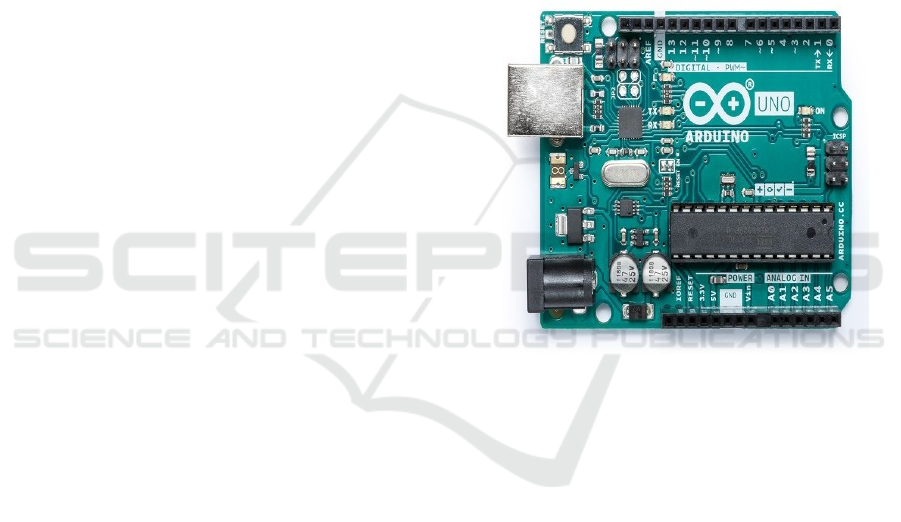
5.1 Arduino Uno
Figure 3: Arduino Uno.
The Arduino Uno is a widely used microcontroller
board based on the ATmega328P chip, making it one
of the most popular development platforms for
beginners and professionals in embedded systems. It
features 14 digital input/output (I/O) pins, out of
which 6 can be used as PWM outputs, allowing for
fine control over components like LEDs and motors.
Additionally, it includes 6 analog input pins, enabling
the board to read sensor data, potentiometers, and
other analog signals. Operating at a clock speed of 16
MHz, the board ensures smooth execution of
programs and accurate timing for various tasks. The
presence of a USB connection allows users to upload
code, communicate with a computer, and power the
board, making it convenient for both programming
and serial communication. The power jack supports
external power sources, such as an AC-to-DC adapter
or a battery, which is particularly useful for
standalone applications that do not rely on a computer
for power. The figure 3 shows Arduino Uno.
Review on IoT-Based Cattle Health Monitoring System Real-Time Detection and Alerting for Improved Farm Management
47
5.2 DHT11 Sensor
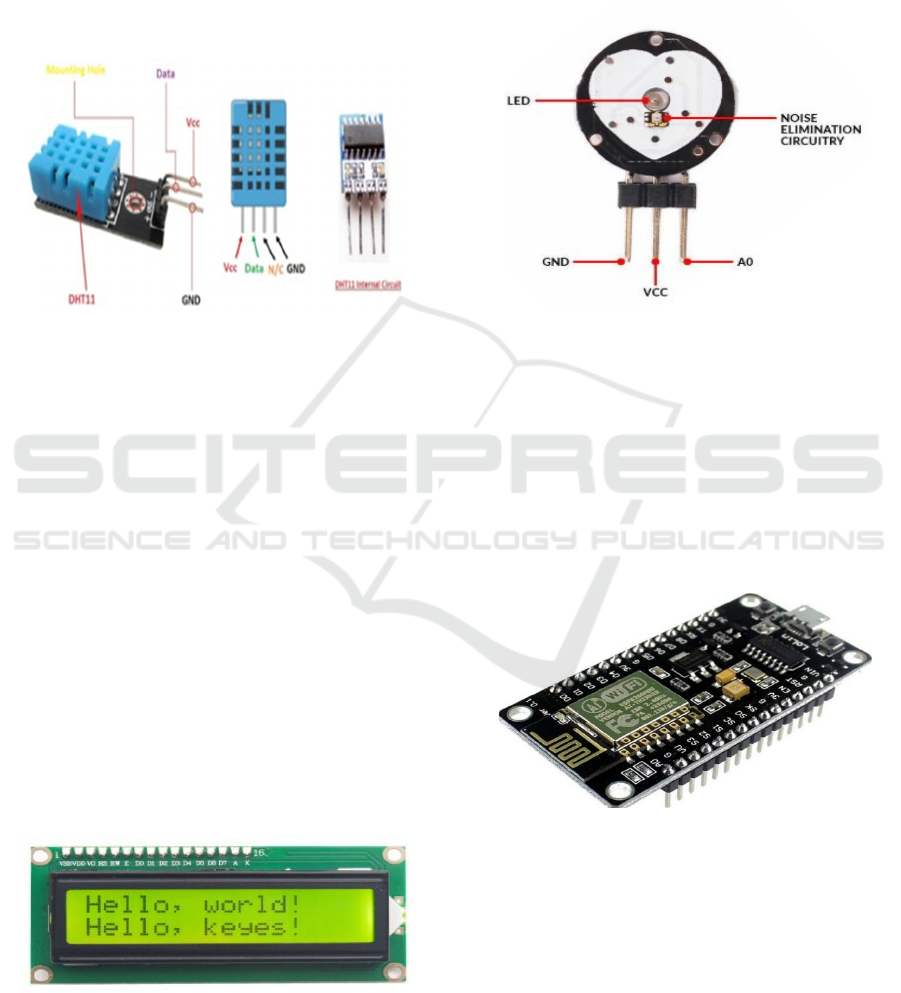
DHT11 Temperature and Humidity Sensor: The
DHT11 (Digital Humidity & Temperature sensor) is
a very low cost and commonly used digital sensor that
measures temperature and humidity in its surrounding
area. It functions within a temperature scale of 0◦C to
50◦C with an accuracy of 2◦C, and a humidity scale
of 20% to 80% with an accuracy of ±5%.
Figure 4: DHT11.
Using a digital output over a one-wire interface,
the sensor makes it a very easy pulg-and-play
functionality with any microcontrollers and IoT
systems. The figure 4 shows DHT11.
5.3 LCD Display
LCD means Liquid Crystal Display; LCD screen is an
electronic display module and find a wide range of
applications. The 16x2 (16 columns and 2 rows) LCD
display is one of the very basic modules and is widely
used in many devices and circuits. These modules
are more preferred than the seven segments and other
complimentary multi segment LEDs. And the reason
is that LCDs are cheap, are easily programmable,
have no restriction of showing special & even user
defined characters (as opposed to seven segments),
animations, etc. So, a 16x2 LCD refers to 16
characters per line and 2 such lines. The figure 5
shows LCD Display.
Figure 5: LCD Display.
5.4 Heartbeat Sensor
Heartbeat is detected using high intensity type LED
and LDR. The finger is placed in between LED and
LDR A photo diode or a photo transistor can be used
as sensors. Detection using transmitted or reflected
light can illuminate skin with visible (red).
Figure 6: Heartbeat sensor.
The minuscule difference in reflectivity and in
transmittance resulting from the changing blood
content of human tissue is nearly imperceptible.
Some noise sources can generate disturbance signals
whose amplitude is equal to or greater than the
amplitude of the pulse signal. The figure 6 shows
Heartbeat sensor.
5.5 ESP-12E Based NodeMCU
Figure 7: NodeMCU.
Ai-thinker Team Develop ESP-12E Wi-Fi
MODULE. module encapsulated with smaller
ESP8266 core processor ESP8266 is an industry-
leading ultra-low power 32 ADDC, integrated
MAC/BB/RF/PA/LNA and built-in antenna.
IEEE802 standard is supported by the module. When
it comes to Wireless Connectivity: 802.11 b/g/n
compliant, and full TCP/IP Protocol Stack. The add
ICRDICCT‘25 2025 - INTERNATIONAL CONFERENCE ON RESEARCH AND DEVELOPMENT IN INFORMATION,
COMMUNICATION, AND COMPUTING TECHNOLOGIES
48
mod- ules can be integrated into an existing device
network- ing, or implement a separate network
controller. ESP8266 is a high integration wireless
SOCs, designed for the space and power constrained
mobile platform designers. It has the best ability to
integrate Wi-Fi ability into other systems, or to act as
a stand-alone application, at the lowest cost, and
requiring the least amount of area. The figure 7 shows
NodeMCU.
6 RESULT
Real-time monitoring of health information aids in
the early detection of nasty diseases, enabling timely
action to prevent disease outbreaks, decrease health
concerns, and enhance cattle well-being and retention
[165]. Healthy cows are more productive, especially
in dairy farms, where milk production is directly
related to their health. Automated monitoring
systems keep the animals in optimum health and
promote yield and profit with minimal manual ‘health
checks’ required leading to a reduction in labour costs
and a minimisation of disruptions. Timely diagnosis
reduces treatment costs and minimizes losses from
untreated diseases. This not only ensures animal
welfare, but also allows farmers to provide timely
care by constantly tracking their vital signs,
temperature and heart rate. One further use case is the
collection of important health data that can be
studied over time to better inform farm management.
The larger the farms scale up, the more robotic
systems become important for smart herd
management and providing individual attention to
cows. The reliance on objective sensor data rather
than subjective observation minimizes human gaps
and results in more accurate, consistent monitoring.
Pathogen Management for Modern Dairy Farming:
Improving Efficiency and Prosperity in the Industry
This technology is vital to contemporary dairy
farming.
7 FUTURE SCOPE
There are multiple improvements in the cattle health
monitoring system, that can help in the system to
pursue its goals effectively. Utilising sophisticated
machine learning models and AI might allow the
system to identify potential health patient issues, prior
to their critical stage by studying historical
comparative datatics. The integration with other
sensors, including those for measuring blood glu-
cose concentration or rumination frequency, could
provide a more holistic health profile for cattle.
Upgrading with advanced analytics and data
visualization tools on the IoT cloud infrastructure
would enable a more in-depth analysis and decision
making process from detailed insights. Wireless
communica- tion technologies, such as LoRa WAN
or 5G, might also be implemented to enhance the
range and reliability of data transmission,
particularly across remote or large farm areas. Using
GPS-enabled wearable devices or smart collars
could also help with monitoring by providing geo-
tagged health data and tracking cattle movement.
Furthermore, creating automated feedback loops,
where environmental controls automatically kick in
based on sensor readings, can help ensure that the
cattle remain in ideal conditions. Integrating and
customizing health protocols using sensor data, in
collaboration with veterinary professionals, can be
better to treat patients. Such developments would not
just further enhance accuracy and efficiency of health
monitoring, but also promote animal welfare and
farm productivity, leading to smarter and more
responsive practices in the agriculture sector.
8 CONCLUSIONS
Overall, the cattle health monitoring system
incorporating an Arduino Uno and IoT connectivity
has the potential to revolutionize farm management,
especially in large-scale dairy farms. Combine the
capabilities of DHT11, pulse sensor, and
accelerometer, the system enables continuous
tracking of vital health indicators like body
temperature, heart rate, and rumination. Collecting
this data over time helps with identifying aggregated
results for any possible health issues, thus allowing
for a quick response without frequent physical
checks.
Figure 8: Output.
Review on IoT-Based Cattle Health Monitoring System Real-Time Detection and Alerting for Improved Farm Management
49

This gives the alerts to the farmer in the form of a
notification as well as in the form of a buzzer, which
helps him act fast enough to any abnormal situation.
By taking preventative actions, not only are the cattle
healthier but the farm is profitable with lower long-
term health costs. The project facilitates more
effective management practices by automating and
streamlining the health monitoring process, which
leads to better animal care resulting in enhanced
operational efficiency in dairy farming. The figure 8
shows Output.
REFERENCES
A. Fuentes, S. Yoon, J. Park, and D. S. Park, “Deep learning-
based hierarchical cattle behavior recognition with
spatio-temporal information,” Comput. Electron.
Agricult., vol. 177, Oct. 2020, Art. no. 105627.
Ande NagaSai Manikanta, Abdul Farid Baba, Devarakonda
Srivalli Vyshnavi, Dondapati Kiran Paul, and Siva Satya
Sreedhar P, "Cloud IoT Based Surveillance System for
Tracking and Monitoring of Domestic Animals," 2024
International Conference on Integrated Circuits and
Communication Systems (ICICACS), IEEE, DOI:
10.1109/ICICACS60521.2024.
Cho, B. H. (2021) "Analysis and Design of Cattle
Management System based on IoT", The Journal of the
Institute of Internet, Broadcasting and Communication,
Vol. 21, No. 2, pp. 125 130. ISSN 2289-0246. DOI
10.7236/JIIBC.2021.21.2.125.
D. Gowthami, K. Aakash, A. Mohammed Arsath and V.
Santhosh Kumar. "Smart Animal Health Monitoring
System using IoT," IRJET, vol. 05, May-2023.
Dineva, K. and Atanasova, T. (2021) "Design of scalable
IoT architecture based on AWS for smart livestock",
Animals, Vol. 11, No. 9. ISSN 2076-2615. DOI
10.3390/ani11092697.
El Moutaouakil, K., Jdi, H., Jabir, B. and Falih, N. (2023)
"Digital Farming: A Survey on IoT based Cattle
Monitoring Systems and Dashboards", AGRIS on-line
Papers in Economics and Informatics, Vol. 15, No. 2,
pp. 31-39. ISSN 1804-1930. DOI
10.7160/aol.2023.150203.
F. Napolitano, A. Bragaglio, E. Sabia, F. Serrapica, A.
Braghieri, and G. De Rosa, ‘‘The human animal
relationship in dairy animals,’’ J. Dairy Res., vol. 87, no.
S1, pp. 47–52, Aug. 2020.
Food and Agriculture Organization of the United Nations.
Accessed: Jan. 5, 2024. [Online]. Available:
https://www.fao.org/home/en/
H. Dohi, A. Yamada, S. Tsuda, T. Sumikawa, and S. Entsu,
‘‘Technical note: A pressure-sensitive sensor for
measuring the characteristics of standing mounts of
cattle,’’ J. Animal Sci., vol. 71, no. 2, pp. 369–372, Feb.
1993.
K. Wankhede, S.Pednekar, “Animal Tracking and Caring
using RFID and IOT “ 2018 IOSR Journal of Computer
Engineering (IOSR-JCE) e-ISSN: 2278-0661,p-ISSN:
2278-8727 PP 24-27.
Khatate. P, Savkar. A and Patil. C.Y (2018) "Wearable smart
health monitoring system for animals", 2018 2nd
International Conference on Trends in Electronics and
Informatics (ICOEI), IEEE, pp. 162-164). IEEE. DOI
10.1109/ICOEI.2018.8553844.
M Venkata Sai Prasad, A Sumalatha, K Sudha Rani, Ch
Meenakshi, M Nicy, and D Charan Babu, "Cloud-Based
IoT Solution for Enhanced Poultry Farm Management,"
2024 4th International Conference on Innovative
Practices in Technology and Management (ICIPTM),
IEEE, DOI: 10.1109/ICIPTM59628.2024.10563209
M. Crociati, L. Sylla, A. De Vincenzi, G. Stradaioli, and M.
Monaci, ‘‘How to predict parturition in cattle? A
literature review of automatic devices and technologies
for remote monitoring and calving prediction,’’
Animals, vol. 12, no. 3, p. 405, Feb. 2022.
P. Karn, P. Sitikhu, and N. Somai, ‘‘Automatic cattle
feeding system,’’ in Proc. 2nd Int. Conf. Eng. Technol.,
vol. 2, Dhapakhel, Nepal, Sep. 2019, pp. 138–142.
R. Girshick, ‘‘Fast R-CNN,’’ in Proc. IEEE Int. Conf.
Comput. Vis. (ICCV), Dec. 2015, pp. 1440–1448.
S. Paudyal, ‘‘Using rumination time to manage health and
reproduction in dairy cattle: A review,’’ Veterinary
Quart., vol. 41, no. 1, pp. 292 300, Jan. 2021.
Shabani. I, Biba. T and Çiço. B (2022) "Design of a Cattle-
Health Monitoring System Using Microservices and IoT
Devices", Computers, Vol. 11, No. 5, p. 79. ISSN 2073-
431X. DOI 10.3390/computers11050079.
T.-K. Dao, T.-L. Le, D. Harle, P. Murray, C. Tachtatzis, S.
Marshall, C. Michie, and I. Andonovic, ‘‘Automatic
cattle location tracking using image processing,’’ in
Proc. 23rd Eur. Signal Process. Conf. (EUSIPCO), Aug.
2015, pp. 2636–2640.
Unold, O., Nikodem, M., Piasecki, M., Szyc, K.,
Maciejewski, H., Bawiec, M. and Zdunek, M. (2020)
"IoT-Based Cow Health Monitoring System,
Computational Science – ICCS 2020: 20th International
Conference, Amsterdam, The Netherlands, June 3-5,
2020, Part V, pp. 344-356. DOI 10.1007/978-3-030-
50426-7_26.
Y. Qu, G. Sun, B. Zheng, and W. Liu, ‘Environment
monitoring system of dairy cattle farming based on multi
parameter fusion,’ Information, vol.12, no. 7, Jul. 2021,
Art. no. 273.
ICRDICCT‘25 2025 - INTERNATIONAL CONFERENCE ON RESEARCH AND DEVELOPMENT IN INFORMATION,
COMMUNICATION, AND COMPUTING TECHNOLOGIES
50
