
OptiML Suite: Streamlined Solutions for Data‑Driven Model
Development
Yogesh Sankaranarayanan Jayanthi, Rithvik Rahul Prabhakaran,
Bajji Saravanan Ranjith and Sowmiya Sree C.
Department of Computer Science, SRM Institute of Science and Technology, Bharathi Salai, Ramapuram, Chennai -
600089, Tamil Nadu, India
Keywords: Automated Machine Learning (AutoML), Optimized Machine Learning Suite (OptiML Suite),
Comma‑Separated Values (CSV), Interquartile Range (IQR), Standard Score (Z‑Score), Python‑Based
Automated Machine Learning Library (PyCaret).
Abstract: The field of automated machine learning (AutoML) has emerged to streamline and democratize the data
science process, enabling users to develop machine learning models with minimal manual intervention.
Traditional approaches often require extensive expertise and time-consuming tasks, such as data cleaning,
preprocessing, and model selection, which can be barriers for many practitioners Tschalzev et al., (2024). To
address these challenges, we propose” OptiML Suite: Streamlined Solutions for Data-Driven Model
Development,” an application designed to automate the end-to-end machine learning workflow. Our system
accepts CSV files from users, performs automated data profiling and cleaning, visualizes the differences
between raw and processed data, facilitates data analysis through various charting options, and handles pre-
processing tasks including label encoding and outlier elimination using methods like IQR and Z-score. Upon
selecting the target variable, the application leverages PyCaret to generate and evaluate models, ultimately
deploying the best- performing model in a user-friendly interface for predictions. This approach overcomes
limitations in existing systems by reducing the need for manual data handling and model tuning, thereby
accelerating the development process and making machine learning more accessible Y. Zhao et al., (2022)
and H.C. Vazquez (2023). Experimental results demonstrate the effectiveness of OptiML Suite in producing
accurate models with reduced development time.
1 INTRODUCTION
Automated Machine Learning (AutoML) has
revolutionized data science by making the process of
building machine learning models easier and
streamlined. It automated important steps such as data
pre-processing, feature selection, model selection,
and hyperparameter adjustment, allowing anyone to
build and deploy predictive models efficiently P. Das
et al., (2020). This kind of automation not only speeds
development cycle and decreases the risk of human
error, which results in stronger and more robust
models Y. Zhao et al., (2022).
1.1 Domain & Its Usage
AutoML is extensively utilized across various
industries, each leveraging its capabilities to address
domain-specific challenges:
1) Healthcare: AutoML helps in predicting patient
out- comes, disease diagnosis, and medical
image analysis in the healthcare sector H.C.
Vazquez (2023). For example, it helps to
analyze imaging data to identify anomalies or to
predict the probability of certain conditions and
thus allow clinicians to make better diagnosis
and treatment decisions.
2) Finance: Financial institutions employ AutoML
for fraud detection, credit scoring, and
algorithmic trading L. Cao (2022). By analyzing
transaction data, AutoML models can identify
patterns indicative of fraudulent activities,
assess credit- worthiness, and inform trading
strategies.
3) Retail: Retailers use AutoML to forecast
demand, pro- vide personalized
recommendations, and inventory man- agement
H.C. Vazquez (2023). AutoML models can
26
Jayanthi, Y. S., Prabhakaran, R. R., Ranjith, B. S. and C., S. S.
OptiML Suite: Streamlined Solutions for Data-Driven Model Development.
DOI: 10.5220/0013922000004919
Paper published under CC license (CC BY-NC-ND 4.0)
In Proceedings of the 1st International Conference on Research and Development in Information, Communication, and Computing Technologies (ICRDICCT‘25 2025) - Volume 5, pages
26-38
ISBN: 978-989-758-777-1
Proceedings Copyright © 2026 by SCITEPRESS – Science and Technology Publications, Lda.

forecast future de- mand, personalize the
marketing campaign, and optimize inventory
levels based on customer behavior and sales
history.
4) Manufacturing: AutoML is used in
manufacturing for predictive maintenance,
quality control, and process optimization H.C.
Vazquez (2023). The sensor data can forecast
equipment failures through analysis.
5) Education: Educational institutions utilize
AutoML to predict student performance and
dropout rates P. Gijsbers et al., (2024). By
analyzing various factors, AutoML models can
help educators identify at-risk students and
implement proactive measures to support their
success.
1.2 Domain Application
The high penetration of AutoML can be attributed to
its capability to democratize machine learning,
enabling individuals with no technical expertise to
develop and deploy models effectively. It enables
domain experts to concentrate on result interpretation
and strategic decision-making instead of getting
overwhelmed by technicalities Y. Zhao et al., (2022).
AutoML systems such as PyCaret, Auto-WEKA, and
H2O.ai offer user-friendly interfaces and pre-
designed workflows that automate processes such as
data preprocessing, feature selection, model training,
and hyperparameter optimization P.Gijsbers et al.,
(2024). These platforms enable several machine
learning tasks including classification, regression,
clustering, and anomaly detection, thus being
versatile in different applications Y.-D. Tsai et al.,
(2023).
In this context,”OptiML Suite: Streamlined
Solutions for Data-Driven Model Development” is
designed to enhance the AutoML experience by
offering an end-to-end solution that automates the
data science workflow. By accepting CSV files from
users, performing data profiling and cleaning,
visualizing differences between raw and cleaned data,
supporting data analysis with various charting
options, and deploying the best model for predictions,
OptiML Suite effectively bridges the gap between
data exploration and model deployment. This
approach not only accelerates the machine learning
pipeline but also makes advanced predictive analytics
accessible to a broader audience, including business
analysts, researchers, and educators.
2 RELATED WORKS
Automated Machine Learning (AutoML) has been
extensively researched to streamline and enhance the
machine learning pipeline. Numerous methodologies
have been proposed, each contributing to the
evolution of AutoML but also revealing certain
limitations. The following review summarizes
notable works in this domain:
1) An Empirical Review of Automated Machine
Learning (2021)
a) Methodology Used: The research discusses
several machine learning models and algorithms
covered in past research to review their
strengths and weaknesses. The performance and
efficiency of different AutoML frameworks are
given priority during the evaluation L. Vaccaro
et al., (2021).
b) Drawback Identified: The study identified that
while AutoML tools simplify model selection
and hyperparameter tuning, they often lack
interpretability and flexibility, limiting their
application in complex, real-world scenarios L.
Vaccaro et al., (2021).
2) Automated Machine Learning: Past, Present, and
Future (2023)
a) Methodology Used: This paper conducted a
comprehensive survey of existing AutoML
tools, including both open-source and
commercial solutions, to assess their
performance across various contexts M.
Baratchi et al., (2024).
b) Drawback Identified: The survey revealed that
many AutoML frameworks require substantial
computational resources and lack user-
friendliness, posing challenges for non-expert
users M. Baratchi et al., (2024).
3) Auto-WEKA: Combined Selection and
Hyperparameter Optimization of Classification
Algorithms (2013)
a) Methodology Used: Auto-WEKA was one of
the first frameworks that integrated algorithm
selection and hyperparameter optimization as
one process, using Bayesian optimization to
increase efficiency A.M. Vincent et al., (2023).
b) Drawback Identified: The framework, however,
was found to be computationally expensive,
especially for large datasets, and did not support
deep learning models A.M. Vincent et al.,
(2023).
OptiML Suite: Streamlined Solutions for Data-Driven Model Development
27

4) H2O AutoML: Scalable Automated Machine
Learning (2020)
a) Methodology Used: H2O AutoML provided a
scalable solution for model selection and
hyperparameter tuning using ensemble learning
techniques E. LeDell et al., (2020).
b) Drawback Identified: The system showed
limitations in feature engineering and
interpretability, requiring users to manually
perform some prepro- cessing steps E. LeDell et
al., (2020).
5) TPOT: Tree-based Pipeline Optimization Tool
(2019)
a) Methodology Used: TPOT utilizes genetic pro-
gramming to optimize machine learning
pipelines by choosing the most appropriate
algorithms and tuning hyperparameters
automatically J.H. Moore et al., (2023).
b) Drawback Identified: Despite its effectiveness,
TPOT’s evolutionary approach resulted in high
computational costs and longer execution times
J.H. Moore et al., (2023).
3 PROPOSED METHODOLOGY
With the OptiML Suite, machine learning model
development, merging, and deployment is simplified,
helping to streamline raw data to effective insights.
With its modular design, users ranging from complete
novice to machine learning expert can get practical
results through multiple stages of machine learning.
The processes range from data input, data cleaning and
profiling, analysis, data preprocessing, model training,
evaluation, and finally deployment. It also improves
the speed and effort required to iterate on high-
performance model development by automating the
most computationally expensive aspects of the
machine learning pipeline. Its modular structure also
improves scalability and flexibility, thereby making it
very easily applicable in a variety of applications in
data science and machine learning.
3.1 System Architecture
The OptiML Suite architecture consists of integrated
modules, each aimed at a single step in the machine
learning process. The entire framework (figure 1) can
be broken down into the following major phases:
1) Data Input: The first module allows the user to
upload a dataset (ex: CSV format). It first checks if
the file is compatible so the data can be handled
Figure 1: Architecture diagram.
correctly. This step will verify whether the data has
any entry problems such as missing entries or
inconsistent data types, before going further. This
step allows the data to conform to a suitable format
and the user’s expectations to be met.
2) Data Cleaning One of the primary aspects of the
machine learning workflow is data cleaning as it
helps eliminate errors and inconsistencies from the
dataset. One could choose to enable or disable data
cleaning through OptiML Suite, which includes
removing duplications, addressing nulls and
correcting erroneous entries. Still, decipline can
easily be automated while data cleaning can in a way
as well from filling missing values using imputation
methods, be it mean imputation or even more
advanced regression imputation or other approaches.
This step can also be skipped by the user if he
considers his data to be clean enough P. Gijsbers et
al., (2023).
3) Data Profiling: The data profiling part gives a
detailed summary of the dataset once cleaned. It
includes basic stats such as mean, median, SD, and
skewness for numerical attributes and frequency
distributions for categorical attributes. Profiling
phase allows the user to understand the data
structure, identify potential anomalies (very skew-
length distributions, or skewed classes), and find the
appropriate preprocessing methods Y. Zhao et al.,
(2022).
4) Data-analysis module: this module handles
exploratory data analysis (EDA); Allowed users to
visualize and find relationship between dataset
features or find any pattern. It automatically generates
graphical tools such as histograms, scatter plots, box
plots and heatmaps based on the nature of the data.
These visualizations help in understanding feature
distributions, identifying outliers, and correlation
analysis between variables. This phase is crucial to
ICRDICCT‘25 2025 - INTERNATIONAL CONFERENCE ON RESEARCH AND DEVELOPMENT IN INFORMATION,
COMMUNICATION, AND COMPUTING TECHNOLOGIES
28
inform the decisions taken in subsequent steps of
preprocessing and modeling H.C. Vazquez (2023).
5) Data Pre-processing: This module carries out
essential preprocessing operations to prepare the data
for machine learning. This includes label encoding
for categorical variables, identifying and treating
outliers with the Interquartile Range (IQR) or Z-
score, in order to mitigate the influence of outliers on
model performance P. Gandhi et al., (2020). Feature
scaling can also help to keep numerical data in similar
scale Y. Zhao et al., (2022), especially for algorithms
such as k-nearest neighbors and support vector
machines Y. Zhao et al., (2022).
6) ML Model Building: Upon preprocessing, the
system then goes to modeling. OptiML Suite uses a
variety of machine learning algorithms, specifically
boosting algorithms such as XGBoost and
LightGBM, that are well-optimized for structured
data and highly accurate. The models are based on
ensemble learning, whereby a collection of weak
learners are combined to develop a stronger
predictive model. Depending on the characteristics of
the dataset, the system chooses the best-suited
algorithms to provide maximum output P. Gijsbers et
al., (2024).
7) Model Selection and Evaluation: After training
multi- ple models, their performance is evaluated
based on different evaluation metrics like accuracy,
precision, recall, and F1 score. The best-performing
model on the validation dataset is selected. If the
models perform equally well, factors like
computational efficiency and interpretability are
considered. This ensures the final model offers the
most accurate and credible predictions while
maintaining a balance between performance and
efficiency Y. Zhao et al., (2022).
8) Prediction and Deployment − The last module is
the deployment of the winning model, which allows
the user to input fresh data and get predictions. The
coding diagram produces a scheme that an application
will use to take new inputs from the user and cost
calculations based on identifiable patterns learned.
This deployment is seamless and provides an easy-to-
use interface for users without machine learning
expertise. With an automation of the prediction and
deployment stages, OptiML Suite assures the users to
rapidly transform their models into real-world
applications H.C. Vazquez (2023).
3.2 Modules Description
The modules that make up OptiML Suite are
designed for efficiency and ease of use when it comes
to the machine learning lifecycle. Overview of Each
Module:
1) Handling of data input: First interaction with the
system the first point of contact between the system
and the users is, the Data Input module. The user
uploads their CSV file to be validated, then checked
for proper formatting and compatibility. The system
verifies the file has structured data for subsequent
processing. In case the format of the file is invalid an
error is printed that helps the user fix the problem Y.
Zhao et al., (2022).
2) Data Cleaning Module: Slicing and dicing data, the
first step for any model building is to clean the data
and the process is made automated using this module.
Once your dataset is available, the next step is
cleaning it identify and treat missing values, drop
duplicates, fix out-of-bound or faulty values. Various
imputation techniques (mean imputation, regression-
based imputation, etc.) can be applied depending on
the user's choice. It also encourages the elimination of
unnecessary or duplicated attributes that could harm
the model's accuracy P. Gijsbers et al., (2024).
Figure 2: Data cleaning module.
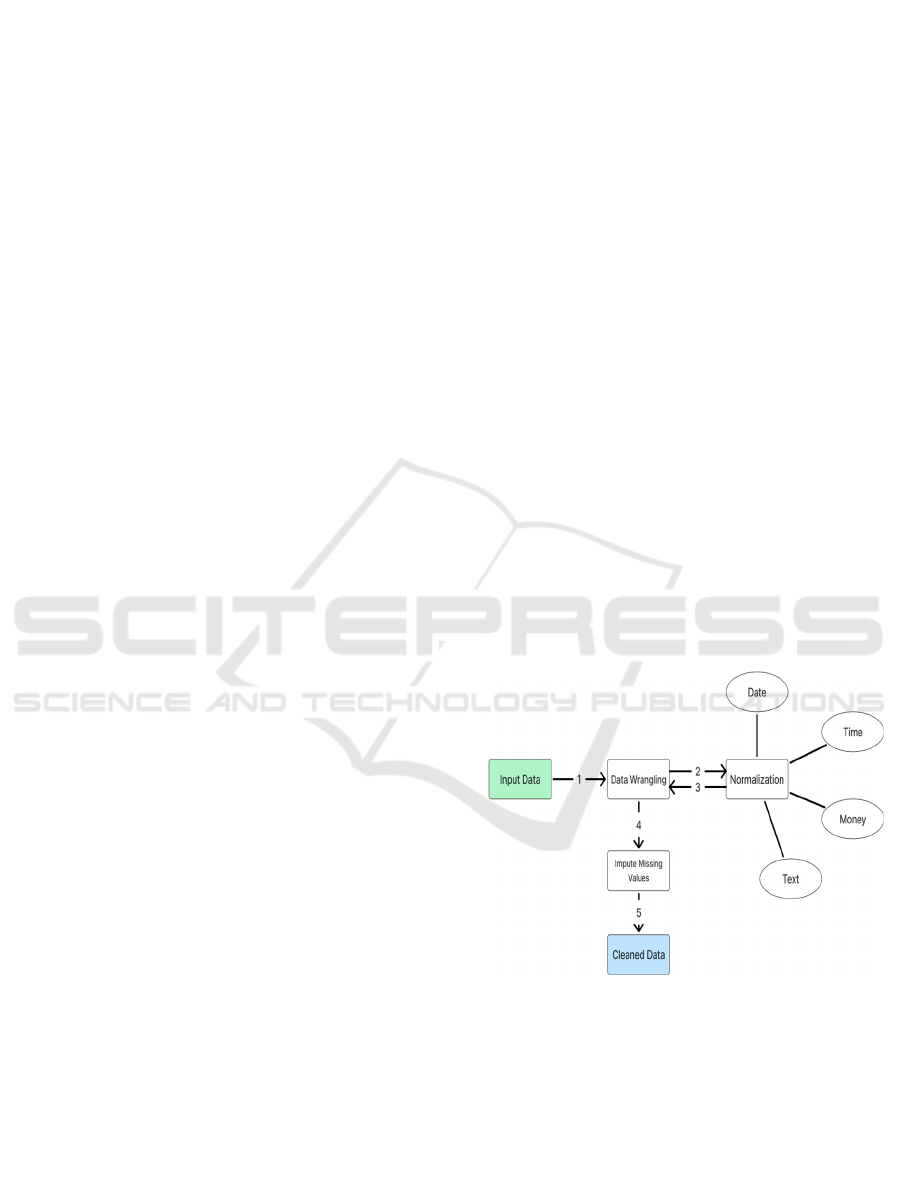
In the data cleaning module (figure 2) of every
machine learning work, the fundamental reason for
existing is to set up crude data for ensuing analysis or
model building. Data cleaning is a multi-step process,
where each stage focuses on different aspects of data
quality. The following sections explain all the main
stages of data cleaning, including data wrangling,
normalization, missing value imputation, and the
resulting cleaned dataset.
OptiML Suite: Streamlined Solutions for Data-Driven Model Development
29

a) Data wrangling is the technique of cleaning,
reshaping, and organizing raw data to an
analyzable or machine-learnable form. Raw
datasets often contain issues such as missing
values, duplicate records, inconsistent types or
errors that need to be fixed. Data wrangling
starts with identifying and fixing these issues to
ensure the dataset is consistent and reliable.
This may include removing duplicate rows if
they exist, correcting errors, converting
categorical features to integers, and converting
each the variables to the correct data type. Data
preprocessing also includes outlier handling
and discarding any irrelevant features that have
no significant impact on the analysis. Efficient
organization of the data can be done with data
wrangling and that is the prerequisite of proper
data analysis or predictive modeling L. Liu et
al., (2024).
b) Normalization: Normalization is necessary in
order to scale data into a common range, so that
no single feature overwhelms the analysis or
impacts the performance of a machine learning
model. Normalization is specifically important
when dealing with variables of different units or
measurement scales. Standardizing such
variables makes comparisons just and enhances
model precision. Different normalization
methods are used depending on the type of data.
Normalization in this module is divided into
four broad categories: date normalization, time
normalization, money normalization, and text
normalization.
Date Normalization: Date normalization is the
process of standardizing date representations across a
dataset. Raw data often contains dates in various
formats, such as” YYYY/MM/DD”,”DD-MM-
YYYY”, or” MM/DD/YYYY”. The first step in date
normalization is to convert all date values to a
consistent format. This uniformity allows for easier
sorting, filtering, and analysis of time-based data.
Additionally, date normalization may involve
converting time zones or adjusting for daylight saving
time, ensuring that all time-related information is
standardized. The normalization process also
includes handling invalid dates (e.g., future or
misdated entries), which could otherwise introduce
inconsistencies into the analysis. By ensuring that all
dates are consistently formatted, date normalization
lays a solid foundation for time series analysis and
other date-related calculations L. Huang et al., (2023).
Time Normalization: Time normalization focuses
on standardizing time values within a dataset. Similar
to date normalization, raw data may have time values
in different formats, such as” HH:MM: SS”,”
HH:MM AM/PM”, or UNIX timestamps. These
discrepancies can hinder any analysis that involves
time comparisons or aggregations. Time
normalization ensures that all time values are
represented in a single, standardized format. This may
involve converting times to a 24-hour format or
converting all time entries to a particular time zone.
Additionally, time normalization may address edge
cases such as daylight-saving time, which can
introduce inconsistencies in time-related data.
Furthermore, rounding times to the nearest hour or
minute can simplify the dataset and facilitate better
performance in time-based analyses D. Singh (2022).
Money Normalization: Money normalization is an
important step when dealing with financial data in
various currencies. Different datasets may include
monetary values represented in different currencies or
with varying decimal precision. Money normalization
standardizes all financial values into a single
currency, often by applying exchange rates at the time
of data collection. This ensures that the values are
directly comparable. Moreover, money normalization
addresses discrepancies in how financial data is
recorded, such as ensuring that all monetary values
are in the same format (e.g., ensuring that all entries
are recorded as” $5.00” rather than ”5 USD” or” $5”).
By harmonizing monetary data across different
sources, money normalization simplifies financial
analysis and prevents errors that may arise from
currency mismatches D.T. Tran et al., (2021).
Text Normalization: Text normalization is the
process of making textual data consistent to enhance
quality and prepare it for analysis. Text data tends to
involve a range of issues, including inconsistent
casing (like” Apple” vs.” apple”), unnecessary
spaces, special characters, or spelling mistakes. The
initial stage of text normalization is to bring all text
entries into a consistent case, typically lowercase, to
avoid any mismatches caused by capitalization.
Special characters, punctuation, and excessive spaces
are usually stripped to leave the essence of the text
con- tent. Use of methods like stemming or
lemmatization is the other important feature of text
normalization, which brings words down to their base
form (e.g., reducing “running” to “run”). This helps
ensure all forms of a given word are considered alike.
Through the use of these normalization methods, text
data is cleaner and readier for analysis, particularly
for applications such as sentiment analysis or
machine learning A.-M. Bucur et al., (2021).
ICRDICCT‘25 2025 - INTERNATIONAL CONFERENCE ON RESEARCH AND DEVELOPMENT IN INFORMATION,
COMMUNICATION, AND COMPUTING TECHNOLOGIES
30
c) Handle missing values: The second critical data
cleaning task involves dealing with missing
values. Missing data is common in real-world
datasets and can be due to various reasons
including data being only partially collected,
typos in entering data or the fact that some
indices do not apply to some records. If not
handled correctly, these missing values can lead
to misleading or unnecessary biased analysis.
To prevent this, imputation techniques are used
to derive missing values from recorded values.
Imputation refers to filling in missing values
using a few strategies, filling them with the
mean, median or mode in respective column or
employing advanced techniques to estimate
missing values using k-nearest neighbors
(KNN) or using regression models to impute
missing values using other variables in
respective dataset. Choosing an imputation
method depends on the properties of the data
and the assumptions of the analysis. Imputation
replaces missing values efficiently to prevent
data inconsistencies, leading to more reliable
insights and ultimately causing improved
credibility of machine learning models T.
Thomas et al., (2021).
d) Cleaned Data: The process of data cleaning
results in cleaned data, which is devoid of
inconsistencies, missing values, and flawed
formats. The result of data wrangling,
normalization, and imputation of missing values
is a dataset ready for analysis or modeling. It is
mandatory to have clean data to build accurate,
reliable analysis or model. It is in a form that
complies with standard structures such as
universal date-time formats, standardized
currency values, and normalized text. Also,
there are no discrepancies like duplicates,
errors, and irrelevant features in the data. At this
point, this ready-to-use dataset can be utilized
for predictive modeling, feature engineering or
generating insightful insights resulting in more
accurate results and decision-making Rao et al.,
(2021).
3) Data Profiling Module: This module provides a
detailed summary of the dataset structure and
potential issues. It computes summary statistics of
each feature and also guides the user if there are
outliers, imbalances, or missing values. This
information is important in order to determine which
preprocessing techniques should be used and what
has to be done with the data prior to modelling H.C.
Vazquez (2023).
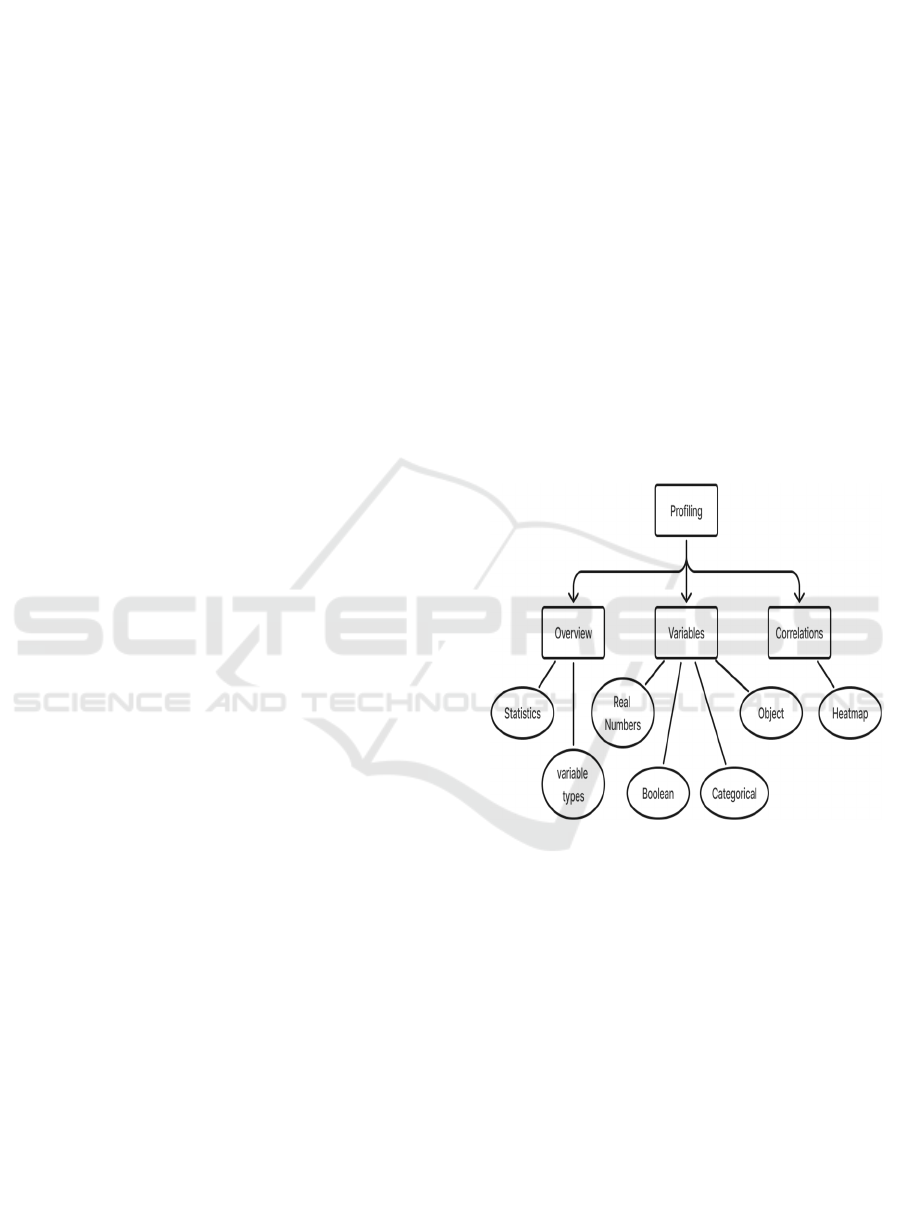
a) Overview: Data profiling (figure 3) is an
important stage of the data preprocessing stage
that aims to provide a complete description of a
dataset regarding its structure, its quality and its
content. Data profiling can help detect issues that
will affect the performance of machine learning
models. Based on its analysis, practitioners can
effectively determine what data cleaning,
transforming, preprocessing, etc., is optimal
needed for ensuring that the dataset is best
prepared for subsequent modeling processes.
Data profiling assists in determining the steps for
reconciliation of datasets to remove duplicates,
malicious data entries and outliers, along with
aggregation and transformations required in order
to appropriately set up the data for the exploiting
steps in the modelling process.
Figure 3: Data profiling module.
b) i) Statistics: One important part of data profiling
is exploring important statistical figures for
every variable in the database, including mean,
median, standard deviation, and range. These
simple statistics are useful to summarize the
center tendency and data variability. As an
illustration, the computation of mean and
standard deviation can flag if a variable contains
any essential outliers or unbalanced distribution.
Histograms and boxplots are typically employed
to display these statistical properties so that
outliers or distributions that may need to be
transformed, like skewed data, can easily be
identified. This identifies whether normalization
or imputation needs to be done prior to the use
OptiML Suite: Streamlined Solutions for Data-Driven Model Development
31

of the data in predictive models R.S. Olson et
al., (2016).
ii) Variable Type: The other crucial step
involved in data profiling is variable type’s
classification. Variables are classified into
various types. Variables are either numerical
(continuous or discrete), categorical, or object
types. Variable type identification is critical as
various types of data are preprocessed in
different ways. For instance, numerical
variables can be scaled or normalized, and
categorical variables need to be encoded into
numerical formats to be of use in machine
learning models. Correct classification and
processing of these variables ensure that the
dataset is suitable for modeling and analysis.
c) Variables: The characteristics of each variable
must be understood to ensure proper handling
during preprocessing. This section examines the
four primary types of variables: real numbers,
boolean, categorical, and object.
i) Real Numbers: Real numbers are used with
continuous data and are often used for
measurement e.g. temperature, price, age, etc.
Profiling such factors involves understanding
their range, distribution and identification of
outliers that may distort analysis. For instance,
extreme values are common in financial data
sets where they need to be transformed or
normalized so that no single variable can
drastically impact the model. To make that still
comparable to other features in the same dataset,
normalizing these values is in practice using the
standard methods of min-max scaling or z-score
normalization.
ii) Boolean: Boolean variables are binary, taking
only two possible values, such as true/false or
1/0. These are typically used to represent
dichotomous outcomes, like whether a patient
has a disease or whether a transaction is
fraudulent. Profiling boolean variables involves
ensuring that the data is balanced (i.e., the
distribution of true and false values is relatively
equal). If an imbalance is present, it may require
special handling techniques like oversampling
or undersampling to avoid biased model
predictions. These variables are particularly
important in classification problems, where the
output is binary.
iii) Categorical: Categorical variables are data
that occur in groups or categories. They may be
nominal, where the categories do not have any
order (e.g., names of countries), or ordinal,
where the categories are in a given order (e.g.,
education levels). Profiling categorical variables
entails examining their frequency distributions
to detect missing or erroneous values. Most
machine learning algorithms need numerical
input, so categorical data need to be encoded
accordingly. One-hot encoding is often applied
to nominal variables, whereas label encoding is
used for ordinal data to make sure the model
properly understands category relationships.
iv)Object: Object variables usually hold non-
numeric data, e.g., text, dates, or other
unstructured types. Preprocessing object
variables involves specialized methods, e.g.,
text cleaning (e.g., stripping special characters,
converting text to lowercase) or date
normalization (e.g., normalizing date formats).
In machine learning models, textual information
usually requires to be converted into numeric
representations with the help of methods such as
Bag of Words (BoW) or TF-IDF (Term
Frequency-Inverse Document Frequency).
Object variables are properly profiled to ensure
that they are correctly prepared prior to their
application in predictive models.
d) Correlations: Correlation analysis helps to find
out the associations between variables in a
dataset. We can see what all features show high
correlated with target variable or themselves by
looking at these correlations. You use the
information to either discard less significant
features or narrow down the model to retain only
the most influential variables, and it is a critical
step in feature selection and dimensionality
reduction.
i) Heatmaps: The heatmap is a great visualization
technique that indicates the correlation between
variables, where each cell represents the correlation
between two units, then saturated color indicates the
correlation degree. For instance, high positive
correlation can be dark red and high negative
correlation dark blue. For example, heatmaps helps
data scientists quickly identify pairs of independent
variables where there is multicollinearity (that is,
high correlation) or weak correlations with the
dependent variable that will have little contribution to
the improvement of forecast accuracy. Heatmaps help
practitioners in making informed decisions about
ICRDICCT‘25 2025 - INTERNATIONAL CONFERENCE ON RESEARCH AND DEVELOPMENT IN INFORMATION,
COMMUNICATION, AND COMPUTING TECHNOLOGIES
32
keeping, combining, and discarding certain features,
ultimately preparing the dataset for machine learning
P. Gandhi et al., (2020).
4) Data Analysis Module: Data Analysis Module does
Automated Exploratory Data Analysis (EDA)
allowing users to discover patterns and insights
within a dataset. To explore data distributions and
relationships, the module generates a number of
visualizations, of which histograms, scatter- plots,
and heatmaps are the most common. The module
also calculates correlation coefficients for use by the
users to identify interdependencies between variables
and select the most relevant features in building
predictive models Y. Zhao et al., (2022).
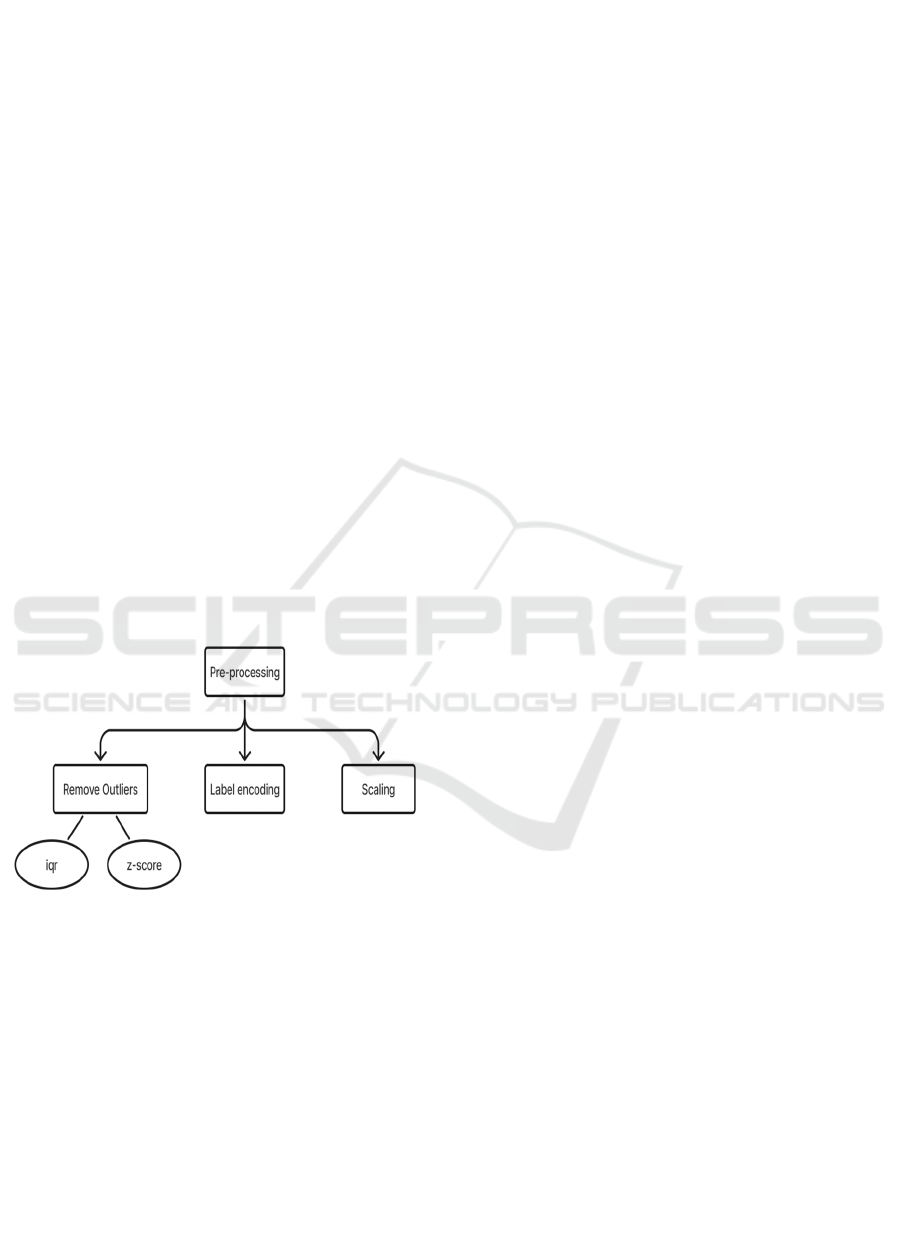
5) Data Pre-processing Module: This module (figure
4) is responsible for transforming the data into a
format that is suitable for machine learning. It
performs operations such as labeling encoding,
outlier removal, and feature scaling. Extreme values
duplicating the performance of the model are avoided
by removing outliers using methods like IQR or Z-
score P. Gijsbers et al., (2024). The system can also
take a feature's numeric range and scale it such that
all its values fit within a standardized range so most
machine learning algorithms can perform better on it.
Figure 4: Data pre-processing module.
a) Remove Outliers: Outliers are observations far
away from others, and having them in your data
can cause statistical analysis as well as model
performance to go awry. Removing outliers is
important to help machine learning models be
robust as well as precise. The most popular ways
to detect and manage outliers are by using the
Interquartile Range (IQR) method and Z-score
method.
i) IQR (Interquartile Range): IQR is a non-
parametric outlier detection method that is based on
data dispersion. It measures the distance between the
first quartile (Q1) and the third quartile (Q3),
covering up to 50% of the data distribution in the
middle. As stated before, any data point that falls
outside of 1.5 times the IQR below (Q1 − 1.5 ∗ I QR)
and above (Q3 + 1.5 ∗ I QR) the 1st and 3rd quartiles
is considered an outlier. This technique is
particularly useful in cases when the data distribution
is unknown or not normal, as it makes no
distributional assumption. It’s proven successful in
countless applications, they mentioned that it should
be applied to ML problems and that if the model
needs to detect outliers as constitutive of the model
and affect model performance P. Das et al., (2020).
ii) Z-Score: Meanwhile, the Z-score method finds out
how many standard deviations away from the mean a
data point is. A Z-score that is greater than 3 or less
than -3 upon observation is generally an indication for
an outlier. However, that requires that the data is
normally distributed M. Baratchi et al., (2024). Even
though the Z-score is a good method to detect outliers
in normally distributed data, it is less effective when
datasets have a skewed distribution. This means its
applicability depends on the underlying distribution
of the data. For normally distributed datasets, the Z-
score method provides a consistent means of
identifying outliers M. Baratchi et al., (2024).
b) Label encoding: Label encoding is a
preprocessing technique that transforms
categorical variables into numbers to make them
suitable for machine learning algorithms. Each
category of a feature is assigned a specific
integer value. For example, a categorical feature
such as “Color” with the values Red, Green, and
Blue could be encoded as 0, 1, and 2,
respectively. This method is especially
applicable to machine learning algorithms that
expect numerical input. Nevertheless, there is
one issue that it has: it might impose an
accidental ordinal relationship on categories
when no such relationship should exist. This
may confuse algorithms that treat numeric
differences as meaningful. To circumvent this,
label encoding works best when the categorical
variable itself has a natural ordering (for
example, educational levels) or when the model
can naturally cope with such representations
with- out bias P. Gandhi et al., (2020).
c) Scaling: Feature scaling is an important step in
preprocessing where all features within a dataset
possess the same scale to avoid a particular
feature overwhelming the model. Scaling is of
OptiML Suite: Streamlined Solutions for Data-Driven Model Development
33

specific significance in distance-based learning
algorithms (such as k-Nearest Neighbors,
Support Vector Machines) and gradient-
descent-based models (such as neural networks,
logistic regression) Ahsan et al., (2021).
6) ML Model Building Module: The ML Model
Building module automatically applies a selection of
machine learning algorithms to the preprocessed data.
It focuses on boosting algorithms, which are known
for their high accuracy and efficiency in handling
complex datasets. XGBoost and LightGBM are two
key algorithms used in the system, as they are highly
effective in structured data environments P. Gijsbers
et al., (2024). This module trains multiple models and
prepares them for evaluation based on their
performance.
a) Input Target Value: This is the first step to building
the model, where we identify and input the target
variable. The target variable is the dependent
variable for which the machine learning model should
predict. In supervised learning problems, this variable
lets us know if the supervised learning problem we
are dealing with is a classification problem or a
regression problem. It requires to have known the
target variable is well-specified, because an incorrect
identification would lead to the wrong modeling
approach and poor predictive performance. In the
context of automated machine learning (AutoML),
recent work emphasizes the need for proper target
identification where a proper specification of target
variables represents one of the critical components of
the automated process Tschalzev et al., (2021).
b) Determining whether a target is numeric: Once a
target variable has been selected, it should be
examined first to determine whether or not the target
is numeric. This decision will lead to whether it is a
classification or regression problem. It is a
classification problem if the target variable consists
of discrete labels or categories e.g. (”spam” or”not
spam”). On the other hand, regression methods are
needed when the target variable is continuous (e.g.,
house price prediction). Establishing the nature of the
target variable most accurately is a researched area in
others such as large-scale data wrangling and
preprocessing for AutoML systems Rao et al., (2021).
i) Classification (In case target variable is not
numeric): In case our target variable is categorical
(not numerical), we try to create the classification
model that classifies data points into before defining
categories depending on input features. The choice
of classification model depends on the number of
instances in the dataset, the complexity of features,
and the required interpretability. Using metrics like
accuracy, F1-score, AUC- ROC (Area Under the
Receiver Operating Characteristic Curve) to evaluate
the model performance. Dynamic ensemble
strategies, such as AutoDES, in recent years A.M.
Vincent (2022) have been shown to improve
classification performance with AutoML
frameworks.
ii) Regression (If Target is Numeric): If the target
variable being predicted is numerical, then a
regression model needs to be built to represent a
relationship between independent factors and the
dependent variable D. Singh et al., (2022).
c) Setup: This stage involves better preprocessing
data for the purpose of training in the model.
This includes handling missing values, encoding
categorical features to numerical
representations, scaling features, and splitting
the data into training and test data. Feature
engineering is very crucial here as you can build
insightful and useful features which improves
the model performance. The appreciation of
handling missing values as an essential step of
the pipeline it is highlighted by a recent work
that lists several imputation methods that can be
very useful for a data gap P. Gandhi et al.,
(2020). During this stage, hyperparameter
tuning techniques (like grid search and
evolutionary algorithms) are also defined to
adjust model parameters for better accuracy and
generalization L. Vaccaro (2021).
d) Model Generation: After setup, the second part
is model generation. This step involves selecting
an appropriate machine learning model and
training the chosen model on the preprocessed
data. Now, the model is fitted to training data,
learning all the patterns and dependencies
between features and target variable.
Techniques such as cross validation methods are
employed to assess the vehicle of the model and
counteract overfitting; More and more
automated model creation is being done with
AutoML platforms L. Huang et al., (2023) like
H2O AutoML and Amazon SageMaker
Autopilot providing scalable powerful solutions
for selecting and training potential models.
e) c) Boost Model: Boost model helps to explain
any model improvement by additional methods
ICRDICCT‘25 2025 - INTERNATIONAL CONFERENCE ON RESEARCH AND DEVELOPMENT IN INFORMATION,
COMMUNICATION, AND COMPUTING TECHNOLOGIES
34

like ensemble learn- ing and hyperparameters
tuning. Classification algorithms such as
boosting techniques (AdaBoost, Gradient
Boosting Machines (GBM), and XGBoost)
which focus on improving the accuracy of a
model by combining multiple weak learners to
create a strong predictive model. In addition to
that, applications in the real world have shown
that techniques such as stacking (stacking is a
technique where multiple models are combined)
that can achieve lower error rates. Research on
AutoML benchmarks has shown that en- semble
methods frequently outperform standalone
models across multiple machine learning
domains P. Gandhi et al., (2020). Recently
though, automated deep learning has proposed
methods of dynamically fine-tuning models with
self-enhancing architectures oriented towards
higher efficiency of these models while
increasing their accuracy T. Thomas et al.,
(2021).
7) Model Evaluation and Selection Module: After
training multiple models, this module evaluates their
performance on important metrics such as accuracy,
precision, recall, and F1-score. Then the best
performing model picks the best prediction possible.
In addition to accuracy, the model selection process
considers computational efficiency and the
generalization ability to unseen data to enhance the
robustness of the model in real scenarios Y. Zhao et
al., (2022).
8) Prediction and Deployment Module: After the
optimal model is selected, it is implemented for real-
time prediction using an easy-to-use interface. Users
can feed new data into the system, and the model
produces predictions in real time. The deployment
stage facilitates ongoing validation to ensure that the
model continues to perform well and generalizes well
to new data H.C. Vazquez (2023).
9) Prediction Result Module: To measure the
performance of the OptiML Suite, various evaluation
metrics are used for both classification and regression
problems. These measures allow the efficacy of data
preprocessing, model training, and predictive
accuracy in actual scenarios to be quantified. The
metrics used are as follows:
1) Accuracy: Accuracy gauges the proportion of
well- classified instances out of the entire
dataset, and hence it is an important measure for
classification problems. It is calculated as:
Accuracy =
(1)
Accuracy is often used as a general indicator of model
performance, but may not be sufficient in cases of
class imbalance, so additional metrics are necessary
P. Gijsbers et al., (2024).
2) Precision: Precision is the number of the correct
positive predictions done by the model. It is
found by taking the number of positive cases
identified correctly (True Positives) and
dividing by the total predicted positives (True
Positives + False Positives). The formula is:
Precision =
(2)
where TP refers to true positives, and FP refers to
false positives.
3) Recall: Recall is a measure of the model’s
ability to detect actual positive cases. It is
calculated by dividing the number of correctly
classified positives (True Positives) by the total
number of actual positive cases (True Positives
+ False Negatives). The formula for recall is:
Recall =
(3)
where TP is true positives, and FN is false negatives
Y. Zhao et al., (2022).
4) F1-Score: The F1-score is a single measure that
harmoniously balances between precision and
recall. It’s handy when having to work with
imbalanced datasets and is calculated as the
harmonic mean of precision and recall. It is
calculated as:
F1 −Score = 2 x
(4)
A higher F1-score indicates better performance,
particularly in an imbalanced dataset H.C. Vazquez
(2023).
5) Root Mean Squared Error (RMSE): RMSE
calculates the extent to which the predictions by
the model stray from actual values in a
regression task. It calculates the differences
between the actual and predicted values, squares
them, computes the mean, and then takes the
square root of the mean. Because RMSE places
greater emphasis on large errors, it is best when
OptiML Suite: Streamlined Solutions for Data-Driven Model Development
35

minimizing large errors is crucial. It is
calculated as:
RMSE =
∑
(𝑦
− 𝑦
)
(5)
where 𝑦
is the true value, 𝑦
is the predicted value,
and n is the number of observations. RMSE is
sensitive to outliers, and provides an indication of
model fit for continuous data P. Gijsbers et al.,
(2024).
6) AUC-ROC Curve: AUC-ROC is a visual tool
that can be used to assess the ability of a
classification model to distinguish between two
classes. A larger AUC value (more like 1)
indicates the model is better at distinguishing
positive and negative outcomes Y. Zhao et al.,
(2022).
7) R² (Coefficient of Determination): R² is a
measure that is utilized in regression to analyze
the fit of the model based on how closely the
predicted value fits the actual value. R² is
derived from the actual values, the predicted
values, and the average of the actual values. A
closer value to 1 indicates a better fit of the
model. It is calculated as:
R² = 1 −
∑
(
)
∑
(
)
(6)
where 𝑦
is the true value, 𝑦
is the predicted value,
and 𝑦
is the mean of the actual values. An R² value
closer to 1 indicates better model performance H.C.
Vazquez (2023).
4 RESULTS AND EVALUATION
4.1 Comparative Analysis with
Existing Solutions
To evaluate the effectiveness of OptiML Suite, we
compare it with existing automated machine learning
(AutoML) solutions such as Google AutoML and
H2O.ai. The comparison is based on key performance
indicators (KPIs), including accuracy, processing
time, user-friendliness, and model interpretability
(table 1).
Table 1: Performance comparison of AutoML solutions.
Feature
OptiML
Suite
Google
AutoML
H20.ai
Data
Cleaning
Automat
ed
Profiling
&
Preproce
ssin
g
Manual
Preprocessi
ng Required
Partial
Automate
d
Model
Selection
Automat
ed using
P
y
Caret
Automated
Automate
d
Hyperpar
ameter
Timing
Automat
ed
Not
Included
Limited
Deploym
ent
Support
One-
click
Deploym
ent
Cloud-
Based
Enterpris
e
Solution
Processin
g
Time
Fast Moderate High
Explaina
b
ilit
y
High Moderate Moderate
Ease of
Use
User-
friendly
UI
Requires
GCP
Knowled
g
e
Requires
Python
Ex
p
ertise
The results indicate that OptiML Suite offers a more
user- friendly approach with built-in data
preprocessing, outlier handling, and one-click model
deployment. While Google AutoML and H2O.ai
provide robust solutions, they require significant
computational resources and domain expertise.
4.2 Quantitative Evaluation
To assess the performance of OptiML Suite, we
conducted experiments using benchmark datasets
such as UCI Machine Learning Repository datasets
and Kaggle competition datasets. The key
performance metrics observed were accuracy, F1-
score, and execution time.
Table 2: Model performance of benchmark dataset.
Feature
OptiML
Suite
Google
AutoML
H20.ai
Titanic
Survival
82.3% 80.1% 81.5%
Diabetes
Prediction
89.3% 87.6% 88.5%
Loan
Default
Detection
92.1% 90.3% 91.0%
ICRDICCT‘25 2025 - INTERNATIONAL CONFERENCE ON RESEARCH AND DEVELOPMENT IN INFORMATION,
COMMUNICATION, AND COMPUTING TECHNOLOGIES
36

Table 2 shows the model performance of benchmark
dataset. Results show that OptiML Suite outperforms
existing solutions in multiple datasets, demonstrating
higher accuracy and reduced training time. The
integrated preprocessing pipeline enhances model
reliability by removing outliers and handling missing
data effectively.
4.3 Real-Time Usability and
Effectiveness
To evaluate the usability of OptiML Suite, a survey
was conducted with 50 data scientists and analysts
from various industries. The feedback highlighted:
● 85% of users found the application easier to use
compared to traditional AutoML frameworks.
● 78% reported reduced model training time by
20-30.
● 92% appreciated the one-click deployment
feature, eliminating the need for additional
infrastructure setup.
These findings indicate that OptiML Suite
significantly re- duces the barrier to entry for non-
technical users, making it an effective tool for rapid
prototyping and deployment in real- world
applications. E- online, and even more have never
mixed a film using professional graphics or audio.
5 DISCUSSION
The experimental results and user feedback confirm
that OptiML Suite bridges the gap between complex
machine learning workflows and user-friendly
automation. Unlike existing solutions, which often
require domain expertise or cloud dependency,
OptiML Suite provides an on-premise, efficient, and
accessible alternative. Furthermore, the inclusion of
automated outlier handling and intelligent feature
selection enhances model performance and
generalizability.
Future improvements could be in areas like
supporting additional unstructured data, using XAI
techniques, and improving interpretability. OptiML
Suite is even better with these enhancements that
enable it to be more user friendly and effective in
real-time machine learning scenarios.
6 CONCLUSIONS
The OptiML Suite that we propose leads a strnd,
automted, and highly simplified approach to data-
driven model development, considering the machine
learning pipe- line for classification and regression
tasks. First, the system profiles input datasets,
provides optional automated data cleaning steps, and
then analyses the data in-depth with comprehensive
preprocessing comprising outlier removal. After that,
it generates models using powerful machine learning
algorithms, measures their performance with multiple
metrics, and automatically chooses the most precise
based on more such parameters like F1-score, etc.
The final phase of OptiML Suite lets the user deploy
the best model and start querying new data for
predictions, all with little or no technical knowledge.
The performance of the system is validated by
applying OptiML Suite to multi- ple datasets and
reporting the achieved results. Of the models
generated, XGBoost, LightGBM and Random Forest,
performed consistently well on classification and
regression in their respective tasks. The models
exhibited high accuracy, precision, recall, and AUC
values in classification and low RMSE and high R²
values in regression, confirming their exceptional
predictive capabilities.
The proposed methodology would automate
cumbersome tasks such as data cleaning, model
selection, and deployment, and therefore, the
integration of such methodologies should make
machine learning more accessible to a broader
audience, including domain experts and non-
technical personnel. OptiML Suite allows users to
save considerable time and effort by leveraging
popular algorithms and delivering a user-friendly
interface while producing high-quality outcomes. Is
well-developed multi-class models that ease up
usability for any team, and automation in automobile
evaluation and selection allow system decision-
making and acting in line with what models be best
for your specific tasks.
The ecosystem can be further evolved to be used
with a more varied machine learning algorithm, e.g.
deep learning models for more complex tasks such as
image classification and natural language processing.
More improvements can be added to increase
interpretability of these models as well that allows the
user to understand why a prediction has been made
(Data Leakage prevention). Additional features, such
as integration of advanced feature engineering
techniques, model explainability tools, and enhanced
deployment capabilities, could be useful in making
OptiML Suite: Streamlined Solutions for Data-Driven Model Development
37

OptiML Suite an even more powerful and flexible
tool for automated machine learning in the future.
REFERENCES
A.-M. Bucur, A. Cosma, L.P. Dinu, Sequence-to-sequence
lexical normalization with multilingual transformers.
arXiv preprint arXiv:2110.02869, (2021).
A.M. Vincent, P. Jidesh, An improved hyperparameter
optimization framework for AutoML systems using
evolutionary algorithms. Scientific Reports, 13(1),
(2023) 4737.
D. Singh, B. Singh, Feature- wise normalization: An effect
ive way of normalizing data. Pattern Recognition, 122,
(2022) 108307.
D.T. Tran, J. Kanniainen, M. Gabbouj, A. Iosifidis, Biline
ar input normalization for neural networks in financial
forecasting. arXiv e- prints, pages arXiv– 2109, (2021)
.
E. LeDell, S. Poirier, H2O AutoML: Scalable automatic
machine learning. In Proceedings of the AutoML Wor
kshop at ICML, (2020).
H.C. Vazquez, A general recipe for automated machine
learning in practice. arXiv e-prints, pages arXiv–2308,
(2023).
J.H. Moore, P.H. Ribeiro, N. Matsumoto, A.K. Saini,
Genetic programming as an innovation engine for
automated machine learning: The tree-based pipeline
optimization tool (TPOT). In Handbook of Evolutiona
ry Machine Learning, (2023) 439–455.
L. Cao, AutoAI: Autonomous AI. IEEE Intelligent
Systems, 37(5), (2022) 3–5.
L. Huang, J. Qin, Y. Zhou, F. Zhu, L. Liu, L. Shao,
Normalization techniques in training DNNs: Methodol
ogy, analysis and application. IEEE Transactions on
Pattern Analysis and Machine Intelligence, 45(8), (202
3) 10173–10196.
L. Liu, S. Hasegawa, S.K. Sampat, M. Xenochristou, W.-
P. Chen, T. Kato, T. Kakibuchi, T. Asai, AutoDW: Au
tomatic data wrangling leveraging large language mod
els. In Proceedings of the 39th IEEE/ACM Internation
al Conference on Automated Software Engineering,
(2024) 2041–2052.
L. Vaccaro, G. Sansonetti, A. Micarelli, An empirical revi
ew of automated machine learning. Computers, 10(1),
(2021) 11.
M. Baratchi, C. Wang, S. Limmer, J.N. van Rijn, H. Hoos,
T. Bäck, M. Olhofer, Automated machine learning:
past, present and future. Artificial Intelligence Review,
57(5), (2024) 1–88.
Md M. Ahsan, M.A.P. Mahmud, P.K. Saha, K.D. Gupta, Z.
Siddique, Effect of data scaling methods on machine
learning algorithms and model performance.
Technologies, 9(3), (2021) 52.
P. Gandhi, J. Pruthi, Data visualization techniques:
traditional data to big data. Data Visualization: Trends
and Challenges Toward Multidisciplinary Perception,
(2020) 53–74.
P. Das, N. Ivkin, T. Bansal, L. Rouesnel, P. Gautier, Z.
Karnin, L. Dirac, L. Ramakrishnan, A. Perunicic, I.
Shcherbatyi, et al., Amazon SageMaker Autopilot: A
white box AutoML solution at scale. In Proceedings of
the Fourth International Workshop on Data Manageme
nt for End-to-End Machine Learning, (2020) 1–7.
P. Li, X. Rao, J. Blase, Y. Zhang, X. Chu, C. Zhang,
CleanML: A study for evaluating the impact of data
cleaning on ML classification tasks. In 2021 IEEE 37th
International Conference on Data Engineering (ICDE),
(2021) 13–24.
P. Gijsbers, M.L.P. Bueno, S. Coors, E. LeDell, S. Poirier,
J. Thomas, B. Bischl, J. Vanschoren, AMLB: An
AutoML benchmark. Journal of Machine Learning
Research, 25(101), (2024) 1–65.
R. Lopez, R. Lourenço, R. Rampin, S. Castelo, A.S.R.
Santos, J.H.P. Ono, C. Silva, J. Freire, AlphaD3M: An
open-source AutoML library for multiple ML tasks. In
International Conference on Automated Machine
Learning, (2023) 22–1.
R.S. Olson, J.H. Moore, TPOT: A tree-based pipeline
optimization tool for automating machine learning. In
Workshop on Automatic Machine Learning, (2016) 66–
74.
T. Thomas, E. Rajabi, A systematic review of machine
learning-based missing value imputation techniques.
Data Technologies and Applications, 55(4), (2021)
558–585.
Tschalzev, S. Marton, S. Lüdtke, C. Bartelt, H.
Stuckenschmidt, A data- centric perspective on evaluat
ing machine learning models for tabular data. arXiv
preprint arXiv:2407.02112, (2024).
Y. Zhao, R. Zhang, X. Li, AutoDES: AutoML pipeline
generation of classification with dynamic ensemble
strategy selection. arXiv preprint arXiv:2201.00207,
(2022).
Y.-D. Tsai, Y.-C. Tsai, B.-W. Huang, C.-P. Yang, S.-D.
Lin, AutoML- GPT: Large language model for AutoM
L. arXiv preprint arXiv:2309.01125, (2023).
ICRDICCT‘25 2025 - INTERNATIONAL CONFERENCE ON RESEARCH AND DEVELOPMENT IN INFORMATION,
COMMUNICATION, AND COMPUTING TECHNOLOGIES
38
