
Design of Hardware Accelerated Co‑Processor for Neural Inference
Computations
Kushagra Chauhan and R. Vidhyaand S. Nagadevi
Department of Computing Technologies, SRM Institute of Science and Technology, SRM Nagar, Kattankulathur, 603203,
Tamil Nadu, India
Keywords: ASIC, Neural Networks, Hardware Acceleration, Large Language Models, Energy Efficiency.
Abstract: The rapid growth in AI model complexity has increased demand for hardware capable of high- efficiency
inference with lower energy consumption. While GPUs have traditionally driven AI advancements, their
progress has plateaued with compute density improving by only 15% over four years. This work develops a
highly optimized ASIC accelerator specifically for LLaMA 3.1, implementing critical inference operations
through specialized computational units and memory hierarchy. The de sign achieves 100% efficiency in
matrix multiplication operations and 99.90% efficiency in attention computations, demonstrating significant
improvements over traditional GPU implementations. Results show sustained throughput of 256 operations
per cycle in matrix multiplication and 7.99 operations per cycle for attention mechanisms, with memory
bandwidth utilization of 1024GB/s. This research presents a sustainable solution for large-scale AI inference
deployment, addressing both computational efficiency and energy consumption challenges.
1 INTRODUCTION
The significant proliferation of AI technologies has
led to great demands for specialized hardware to
perform efficient and sustainable intensive model
inference. While GPUs form part of traditional
computing solutions and have widely played
significant roles in the advancement of AI capabilities,
they get used for general applications, leading to
suboptimal performance in AI applications. As model
sizes continue to balloon exponentially, energy and
computational requirements in data centers are
growing at an unprecedented pace (Y. LeCun et al.
2015).
By the end of 2024, Microsoft plans to deploy
approximately 1.8 million AI chips, primarily
NVIDIA H100 GPUs, resulting in a total power
consumption of around 1260MW for GPU processing
alone. When accounting for an additional 75% energy
overhead for cooling, networking, and other
supporting services, Microsoft’s AI infrastructure
will require 2205MWh. Similarly, Meta’s AI
infrastructure will consume around 420MW of power
for GPU computation and 735MWh in total with
overheads. The economics of scale of AI is moving
fast. The costs of training state-of-the-art models run
to billions of dollars, generating over $10 billion in
inference costs. At this scale, even an efficiency gain
of 1% would justify investments of $50-$100 million
in custom chip development. Performance of ASICs
has shown benefits of 10-100x over GPUs, as
demonstrated in Bitcoin mining applications (N. P.
Jouppi et al. 2017)
2 RELATED WORKS
The von Neumann bottleneck presents a
fundamental challenge in neural accelerators,
where bandwidth between processors and
memory becomes an overwhelming performance
barrier (D. Markovi´c et al., 2020). This
architectural limitation particularly affects neural
network accelerators where the volume and
frequency of data movement between memory
and processing units create significant
performance barriers.
Chen et al. 2016 introduced Eyeriss,
demonstrating significant energy efficiency
improvements through careful dataflow
optimization. Their spatial architecture achieved
1.4× to 2.5× better efficiency for AlexNet layers
Chauhan, K. and Nagadevi, R. V. S.
Design of Hardware Accelerated Co-Processor for Neural Inference Computations.
DOI: 10.5220/0013921700004919
Paper published under CC license (CC BY-NC-ND 4.0)
In Proceedings of the 1st International Conference on Research and Development in Information, Communication, and Computing Technologies (ICRDICCT‘25 2025) - Volume 5, pages 5-10
ISBN: 978-989-758-777-1
Proceedings Copyright © 2026 by SCITEPRESS – Science and Technology Publications, Lda.
5
and up to 3.7× fewer DRAM accesses compared
to contemporary solutions.
A significant milestone in neural network
acceleration came with Google’s Tensor
Processing Unit, analyzed in detail by Jouppi et
al. 2017. Their implementation validated the
crucial role of systolic arrays in neural network
acceleration, particularly for repeated matrix
multiplication operations common in inference
tasks. The TPU architecture demonstrated that
careful optimization of matrix operations and
weight reuse strategies could achieve up to 3.5
times better performance per watt compared to
contemporary GPU solutions.
The introduction of Transformer architecture
by Vaswani et al. revolutionized natural language
processing while presenting new challenges for
hardware acceleration. The attention mechanisms
require specialized computation patterns distinct
from traditional neural network operations,
introducing additional complexity in hardware
realization (S. Han et al. 2016).
3 SYSTEM ARCHITECTURE
Overall Architecture: The accelerator architecture
centers around a lightweight core that manages
control flow and coordinates specialized
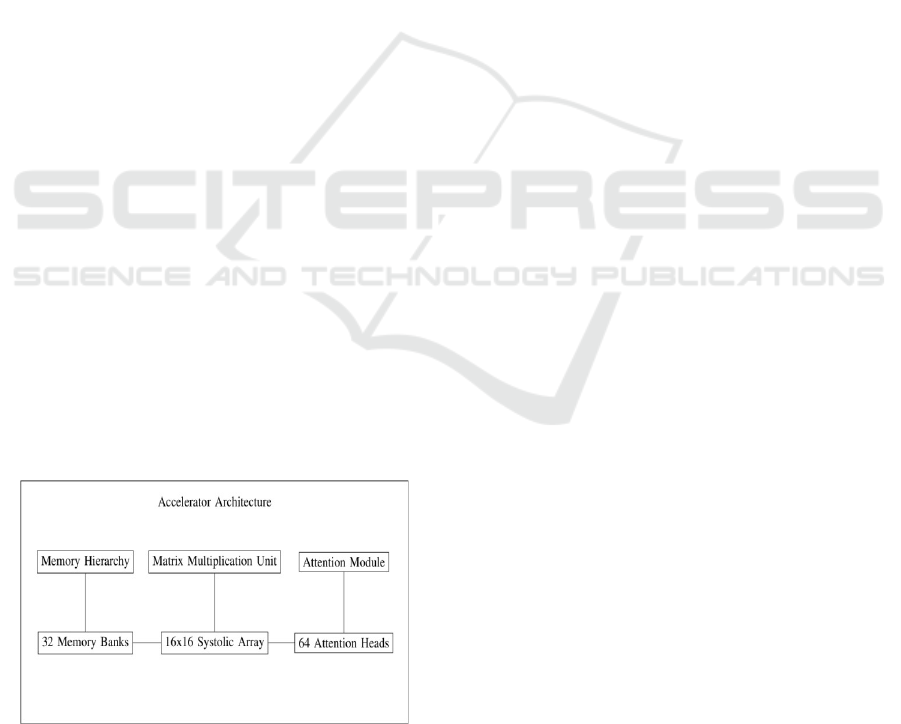
computational units. The system comprises three
primary components integrated through a
sophisticated FIFO-based communication system:
Sophisticated memory hierarchy with 32 independent
banks, High-throughput matrix multiplication unit
based on systolic arrays, Specialized attention module
supporting 64 parallel heads.
Figure 1 show the
High-level architecture of the proposed accelerator
showing major components and their
interconnections.
Figure 1: High-level architecture of the proposed
accelerator showing major components and their
interconnections.
Memory Hierarchy Implementation: The memory
subsystem implements a multi-bank architecture
comprising 32 independent memory banks, optimized
for the high bandwidth requirements of neural
network inference. The design includes:
Bank Organization: The bank organization features
32 independent memory banks that operate in
parallel, enabling efficient and simultaneous data
processing. Each bank is equipped with 64-byte cache
lines specifically optimized for matrix operations,
ensuring high performance in computational tasks
that rely heavily on such calculations. Additionally,
the system incorporates bank-level buffering, which
significantly reduces access latency by allowing
smoother and faster data retrieval. To further enhance
efficiency, advanced conflict resolution mechanisms
are integrated, minimizing delays and ensuring
seamless operation across the parallel banks.
Memory Controller: The memory controller is
designed with a sophisticated scheduling system that
ensures efficient management of data flow across the
memory banks. It employs a round-robin bank access
allocation strategy, which evenly distributes access to
the banks, promoting balanced performance and
preventing bottlenecks. To maintain precise timing
management, the controller includes latency counters
that track and optimize access delays, ensuring
smooth operation. Additionally, write-back policies
are tailored specifically for neural operations,
enhancing the system's ability to handle the demands
of neural network computations effectively.
Matrix Multiplication Unit: The matrix
multiplication unit implements a 16×16 systolic array
architecture designed for optimal throughput and
resource utilization.
Processing Element Design: Each processing
element is equipped with a two-stage pipeline
architecture, enabling efficient execution of
instructions by overlapping stages of processing for
improved throughput. It includes local accumulator
arrays, which provide fast, on-chip storage for
intermediate results, reducing the need for frequent
memory access. The processing elements also feature
input queues for data buffering, allowing smooth and
continuous data flow to prevent stalls during
operation. Additionally, the SIMD-compatible data
paths ensure that the system can perform parallel data
processing, making it well-suited for tasks that
benefit from single instruction, multiple data
operations.
Control Flow Management: The control system
implements a distributed control architecture,
ICRDICCT‘25 2025 - INTERNATIONAL CONFERENCE ON RESEARCH AND DEVELOPMENT IN INFORMATION,
COMMUNICATION, AND COMPUTING TECHNOLOGIES
6

allowing for decentralized management that enhances
scalability and reduces single-point failures across the
system. It incorporates lightweight synchronization
protocols, which streamline coordination between
components
while
minimizing
overhead,
ensuring
efficient
operation.
Advanced
pipeline
management is also a key feature, optimizing the flow
of instructions and data through the processing stages
for maximum throughput. Additionally, the system
includes performance monitoring capabilities,
enabling real-time tracking and analysis of
operational efficiency to support ongoing
optimization and troubleshooting.
Attention Module Implementation: The attention
module implements 64 parallel attention heads, each
capable of independent computation of attention
patterns.
Attention Head Architecture: Each attention head
contains dedicated Q/K/V computation units, which
are specialized for calculating the query, key, and
value components essential to attention mechanisms,
ensuring precise and efficient processing. These
heads also feature double-buffered computation units,
allowing seamless switching between buffers to
minimize downtime and enhance computational
continuity. An optimized softmax implementation is
included, tailored to accelerate the normalization
process critical for attention-based operations.
Furthermore, stream-aligned memory access patterns
are utilized, aligning data retrieval with processing
needs to maximize efficiency and reduce latency
during memory interactions.
Parallel Processing Management: The module
implements independent operation of attention heads,
enabling each head to function autonomously, which
enhances parallelism and overall system efficiency. It
incorporates sophisticated synchronization
mechanisms to coordinate activities across these
heads seamlessly, ensuring consistent and reliable
performance. Dynamic workload distribution is also a
key feature, allowing the module to adaptively
allocate tasks based on real-time processing demands,
optimizing resource utilization. Additionally,
advanced flow control is employed to manage data
movement effectively, preventing bottlenecks and
maintaining smooth operation throughout the
module's processes.
4 RESULTS AND
PERFORMANCE ANALYSIS
Test Environment: The performance evaluation was
conducted under rigorous test conditions to
thoroughly assess the system's capabilities. It utilized
a hidden size of 8192, reflecting a substantial capacity
for feature representation within the model. The
evaluation included 64 attention heads, allowing for
extensive parallel processing and attention coverage
across the data. A batch size of 32 was employed,
striking a balance between computational efficiency
and memory usage. Additionally, a sequence length
of 2048 was tested, simulating the system's ability to
handle long-range dependencies and large-scale input
data effectively.
Matrix Multiplication Performance: The matrix
multiplication unit achieved exceptional performance
metrics as shown in Table 1.
Table 1: Matrix multiplication unit performance.
Metric Value Status
Active Cycles 1010/1010 Optimal
Efficiency 100.00% Optimal
Operations 2,58,560 High
Throughput 256.00 ops/cycle Optimal
Bandwidth 1024 GB/s Optimal
Attention Mechanism Performance: The attention
module demonstrated impressive efficiency metrics
as shown in Table 2.
Table 2: Attention unit performance.
Metric Value Status
Active C
y
cles 1009/1010 Hi
g
h
Efficienc
y
99.90% Hi
g
h
O
p
erations 8,072 Normal
Throughput 7.99 ops/cycle Goo
d
System-Level Performance: The complete system
demonstrated several key performance characteristics
that highlight its robustness and efficiency. It
achieved sustained throughput across varying
workloads, ensuring consistent performance
regardless of task complexity or demand fluctuations.
The system exhibited minimal pipeline stalls,
reflecting a well-optimized design that keeps
processing stages active and reduces idle time.
Efficient memory bandwidth utilization was another
standout feature, maximizing data transfer rates while
minimizing waste, which is critical for high-
performance operations. Additionally, effective
thermal management ensured that the system
Design of Hardware Accelerated Co-Processor for Neural Inference Computations
7

maintained optimal operating temperatures,
enhancing reliability and longevity under intense
computational loads.
4.1 Detailed Evaluation Methodology
Testing Framework: The evaluation framework was
implemented in SystemC, utilizing a comprehensive
test bench designed to provide detailed and reliable
analysis of the system. It enables cycle-accurate
simulation of all components, ensuring precise
modeling of timing and behavior across the entire
architecture. Performance counter integration at
multiple levels allows for granular tracking of key
metrics, offering deep insights into system efficiency
and bottlenecks. The framework also supports
configurable workload generation, providing
flexibility to simulate a wide range of scenarios
tailored to specific testing needs. Additionally,
automated regression testing is incorporated,
streamlining the validation process and ensuring
consistent performance across updates or
modifications.
Workload Generation: Test vectors were generated
to align with LLaMA 3.1’s computational patterns,
ensuring the evaluation closely mirrored real-world
usage of the model. These included matrix sizes
matching the model’s dimensions, specifically
8192×8192, to replicate the scale of its matrix
operations accurately. Attention patterns were
derived from real inference scenarios, capturing the
system’s behavior under practical attention-based
workloads. Variable sequence lengths ranging from
128 to 2048 were tested, assessing the system’s
adaptability to both short and extended input
sequences. Additionally, different batch sizes—1, 8,
16, and 32 were incorporated, allowing the evaluation
to explore performance across a spectrum of
processing demands.
Performance Metrics: During the evaluation,
several critical metrics were collected to assess the
system's performance comprehensively.
Computational throughput, measured in operations
per cycle (ops/cycle), provided insight into the
system’s processing speed and efficiency. Memory
bandwidth utilization was tracked to evaluate how
effectively the system leveraged available memory
resources, a key factor in data-intensive tasks.
Pipeline stall statistics were gathered to analyze
interruptions in the processing flow, highlighting the
system’s ability to maintain continuous operation.
Additionally, power efficiency estimates were
calculated, offering a view into the system’s energy
consumption relative to its performance, an essential
consideration for scalability and sustainability.
4.2 SystemC Implementation Details
The accelerator was implemented using SystemC
2.3.3, enabling cycle-accurate modeling of
hardware behavior while maintaining high-level
C++ abstraction.
Processing Element Design: The Processing
Element serves as the fundamental computational
unit within the systolic array, featuring a meticulously
designed architecture to optimize performance. It
implements a two-stage pipeline that enhances
throughput by allowing overlapping execution of
operations, paired with local storage in the form of an
accumulator and an input queue for efficient data
management and flow control. The operation of the
Processing Element is governed by a structured
algorithm: it initializes with class members including
clock, reset, inputs a and b, and an output, alongside
internal states like the accumulator, a busy flag, and
the input queue. Upon initialization, the busy flag is
set to false, and the compute and input-handling
processes are registered to trigger on the clock’s
positive edge and input changes, respectively. The
compute procedure, central to its functionality, resets
the accumulator to zero and clears the busy state if a
reset signal is detected; otherwise, when the input
queue is not empty and the unit is not busy, it retrieves
data from the queue’s front, performs a multiply-
accumulate operation (accumulator ← accumulator +
data.a × data.b), removes the processed data from the
queue, and writes the updated accumulator value to
the output. This design ensures efficient, continuous
processing with robust control over data flow and
computational state.
Memory Bank Operation: The Memory Bank
controller is engineered to manage access patterns
and prefetch operations, ensuring optimal bandwidth
utilization across the system. It orchestrates the
interaction between the memory banks and the
processing units by intelligently scheduling data
retrieval and storage, minimizing latency and
maximizing throughput. Through sophisticated
prefetching, the controller anticipates data needs
based on access patterns, proactively loading relevant
data into buffers to reduce wait times and enhance
overall efficiency. This design enables the Memory
Bank to support high-performance operations,
particularly in data-intensive tasks, by maintaining a
steady and effective flow of information to and from
the memory banks.
ICRDICCT‘25 2025 - INTERNATIONAL CONFERENCE ON RESEARCH AND DEVELOPMENT IN INFORMATION,
COMMUNICATION, AND COMPUTING TECHNOLOGIES
8

Attention Head Implementation: The Attention
Head is designed to implement parallel processing of
attention computations, incorporating optimizations
for numerical stability to ensure both efficiency and
accuracy. It handles the core attention mechanism by
simultaneously computing query, key, and value
operations across dedicated units, leveraging
parallelism to accelerate processing speed. Numerical
stability optimizations are integrated into the design,
such as an enhanced softmax implementation, which
mitigates issues like overflow or underflow during
normalization, preserving the precision of attention
scores even under large-scale or extreme data
conditions. This combination of parallel execution
and stability-focused enhancements enables the
Attention Head to deliver robust and reliable
performance in attention-based workloads.
Performance Monitoring Implementation: The
Performance Monitoring System is designed to
provide a detailed assessment of system performance
through a structured set of metrics and procedures. It
tracks primary metrics such as cycles, active cycles,
stall cycles, and operations, while also calculating
derived metrics including throughput, efficiency, and
bandwidth. The Update Metrics procedure computes
these derived values: throughput is determined as
operations ÷ cycles, efficiency is calculated as (1 −
stall cycles ÷ cycles) × 100 to express the percentage
of productive time, and bandwidth is derived as bytes
transferred ÷ (cycles × CYCLE_TIME_NS) × 10⁻⁹,
resulting in a gigabytes-per-second (GB/s)
measurement. The GenerateReport procedure
enhances this analysis by calling Update Metrics and
logging a comprehensive performance report for the
specified module. This report includes key statistics:
total cycles, active cycles, stall cycles, operations,
throughput (in ops/cycle), efficiency (as a
percentage), and bandwidth (in GB/s). By
systematically logging these metrics, the system
ensures that performance data is both accurately
captured and easily accessible for optimization and
debugging purposes.
4.3 Implementation Path and Future
Development
Hardware Implementation Considerations: The
transition from SystemC simulation to hardware
implementation presents several challenges,
primarily in fabrication technology selection and
design adaptation. Fabrication choices range from
advanced nodes such as 3nm and 5nm from major
foundries to more mature nodes like 28nm and 45nm
for initial prototyping, with FPGA implementation
serving as a viable option for validation. Additionally,
adapting the design requires careful consideration of
scaling for available process nodes, power and
thermal management, physical design constraints,
and rigorous testing and validation requirements.
To further enhance hardware performance,
several improvements can be incorporated. These
include the integration of advanced memory
technologies, optimized implementations of attention
mechanisms, sophisticated power management
systems, and effective thermal optimization
techniques. These enhancements contribute to better
efficiency, performance, and scalability of the final
hardware implementation.
Software Stack Development: The software
infrastructure for the system requires a well-
structured development approach, starting with the
Driver Layer, which must ensure efficient data
transfer mechanisms, robust command execution
management, system monitoring capabilities, and
effective error handling with recovery mechanisms.
Additionally, Framework Integration is essential,
involving seamless interfaces with PyTorch and
TensorFlow, custom operator implementations,
workload-specific optimizations, and performance
monitoring tools. Looking ahead, future development
will prioritize comprehensive driver enhancements,
further optimizations for framework integration,
advanced performance monitoring, and improved
debugging and profiling capabilities to ensure a
highly efficient and scalable software stack.
5 CONCLUSIONS
This study illustrates the effective design and
modelling of a high-performance ASIC accelerator
for neural network inference. The implementation
demonstrates outstanding performance metrics, with
the matrix multiplication unit operating at full
efficiency at 256 operations per cycle and achieving
99.90% operational efficiency in the attention
module.
The research has accomplished several notable
accomplishments. The project encompasses the
creation of a comprehensive SystemC model for an AI
accelerator, allowing precise simulation and
validation. A highly efficient 32-bank memory
system has been developed to enhance data access
and processing performance. The research includes
the construction of a systolic array-based matrix
multiplication unit, improving computing efficiency
for AI tasks. Additionally, a parallel attention
Design of Hardware Accelerated Co-Processor for Neural Inference Computations
9

mechanism with 64 heads has been implemented,
enhancing the model's capacity to manage intricate
attention-based calculations.
This study significantly advances the domain of AI
hardware acceleration by investigating feasible
alternatives to GPU-based inference, providing
energy-efficient solutions designed for data centres,
and laying a solid framework for future ASIC
development. Furthermore, it tackles the von
Neumann bottleneck in neural computing, facilitating
the development of more efficient and scalable AI
processing systems.
This study presents several intriguing directions
for further investigation. A primary focus is the
incorporation of developing AI model designs, which
may significantly improve performance and
efficiency. Furthermore, investigating sophisticated
power optimization methods might result in more
energy-efficient applications. Enhanced memory
management techniques may enhance resource
consumption, allowing improved scalability and
accelerated calculations. Ultimately, optimizing
attention mechanism implementations may improve
model precision and processing efficiency, making
AI systems more effective and versatile in
handling intricate jobs. The tangible implementation
of AI accelerators signifies a vital advancement
toward enhanced and more accessible AI computing.
This study lays the groundwork for future
advancements, considering manufacturing limitations
and the methodical creation of software infrastructure
for effective neural network acceleration solutions.
REFERENCES
A. Vaswani et al., “Attention is all you need,” in Advances
in Neural Information Processing Systems, vol. 30,
2017, pp. 5998-6008.
D. Markovi´c et al., “Memory architectures for deep
learning hardware accelerators: A survey,” IEEE
Access, vol. 8, pp. 57566-57596, 2020.
H. Li et al., “An architecture-level analysis on deep learning
models for low-impact computations,” Artificial
Intelligence Review, vol. 56, pp. 1971-2010, 2023.
M. Horowitz, “Computing’s energy problem (and what we
can do about it),” in IEEE Int. Solid-State Circuits Conf.
Dig. Tech. Papers, 2014.
N. P. Jouppi et al., “In-datacenter performance analysis of
a tensor processing unit,” in Proc. 44th Annu. Int.
Symp. Comput. Archit. (ISCA), 2017.
S. Han, H. Mao, and W. J. Dally, “Deep compression:
Compressing deep neural networks with pruning,
trained quantization and Huffman coding,” in Int. Conf.
Learning Representations, 2016.
V. Sze, Y. Chen, T. Yang, and J. S. Emer, “Efficient
processing of deep neural networks: A tutorial and
survey,” Proc. IEEE, vol. 105, no. 12, pp. 2295-2329,
Dec. 2017.
W. J. Dally, “Hardware opportunities for machine
learning,” in Neural Information Processing Systems
(NIPS) Workshop, 2017.
Y. LeCun, Y. Bengio, and G. Hinton, “Deep learning,”
Nature, vol. 521, no. 7553, pp. 436- 444, 2015.
Y. Chen et al., “Eyeriss: A spatial architecture for energy-
efficient dataflow for convolutional neural networks,”
in Proc. ACM/IEEE 43rd Annu. Int. Symp. Comput.
Archit. (ISCA), 2016, pp. 367-379.
ICRDICCT‘25 2025 - INTERNATIONAL CONFERENCE ON RESEARCH AND DEVELOPMENT IN INFORMATION,
COMMUNICATION, AND COMPUTING TECHNOLOGIES
10
