
Smart Agriculture Monitoring and Nutrient Management System
with Disease Detection
Kavin S., Sathya T., Parimala Devi M., Kowsika K. S., Naga Arjun J. and Nithish Kumar S.
Department of Electronics and Communication Engineering, Velalar College of Engineering and Technology
Erode‑638012, Tamil Nadu, India
Keywords: Smart Agriculture, IoT, Disease Detection, Precision Farming, Automated Irrigation, Sustainable Farming.
Abstract: By utilizing the technology that exists now, the paper focuses on enhancing the efficiency of agriculture and
the agriculture system. Keywords: Agricultural resource management, Early disease detection, Crop
improvement, Soil nutrient management the research theme tackles pressing agricultural problems like
resource management, early disease identification and enhancing crop productivity. This system employs
technologies such as IoT, Machine Learning, and image processing to control vital farming parameters. Soil
moisture sensor, temperature and humidity sensor, disease detection camera module. These devices gather
real-time information, and the data is processed and visualized using a user-friendly mobile application. To
save water and keep the crop hydrated properly, automated irrigation is applied according to soil moisture
level. The findings demonstrate that the resources tend to be used in a better way, identification of crop
diseases occurs faster and the yield of crops has increased markedly. As a commercial product, it allows
agronomists and farmers to make data-driven decisions, minimizing human labor, preventing waste of
resources. Moving forward, the system will also involve the addition of more sensors to measure other soil
characteristics, a wider data set of disease detection capabilities, and predictive analytics to forecast yields.
The transformative nature of this work could lead to precision farming and sustainability, creating a much
more resilient agricultural ecosystem.
1 INTRODUCTION
As the world's population grows and resources
become scarcer, it becomes increasingly difficult to
farm in a sustainable manner and to appease the
environmentalists. Many complex challenges are not
met well with traditional farming techniques, leading
to inefficiency in water consumption, soil care, data
collection, crop monitoring etc. The adoption of this
technology aids in overcoming the limitations of
agriculture, enabling farmers to engage in precision
agriculture for optimum yield and sustainability. The
research generates a new way of helping to increase
the efficiency of farming through the real- time
monitoring and automated systems. The system uses
three main sensors which are soil pH sensor, soil
moisture sensor and ultrasonic sensor. The soil pH
sensor provides vital data regarding the soil's acid or
alkaline nature: Information required when selecting
crops in addition to favouring soil health. This is done
through a soil moisture sensor which is used to
monitor the moisture in the soil and irrigate as
needed. Ultrasonic sensor for detecting plant height,
giving information about the growth and health of the
crop (Evans, R.G. and Sadler, E.J (2008)).
This framework based on IoT technology can
execute real-time information collection and remote
desk monitoring through a mobile application. Data
have been bundled based on plant growth in order to
provide farmers easy access to soil pH, moisture
levels, etc. to make data-oriented decisions in
agriculture using the app (Parimala Devi,et.al., 2022)
The automated irrigation feature of this system
operates the pump to water only when the soil
moisture level is below a specific value, conserving
water.(Boopathi Raja,et.al., 2024) Not only does it
conserve water, but it also ensures that the crops are
adequately hydrated for their healthy growth. This
shows that technologies could change the old way of
planting crops (Othman, M.F., Shazali, K., 2012).
This allows for a streamlined approach to resource
management, less wastage, and greater levels of
production by targeting key metrics. It also provides
a decentralized, scalable, cost-effective system that
832
S., K., T., S., M., P. D., S., K. K., J., N. A. and S., N. K.
Smart Agriculture Monitoring and Nutrient Management System with Disease Detection.
DOI: 10.5220/0013921500004919
Paper published under CC license (CC BY-NC-ND 4.0)
In Proceedings of the 1st International Conference on Research and Development in Information, Communication, and Computing Technologies (ICRDICCT‘25 2025) - Volume 4, pages
832-839
ISBN: 978-989-758-777-1
Proceedings Copyright © 2026 by SCITEPRESS – Science and Technology Publications, Lda.
can be adapted to different farming environments.
This approach not only addresses current challenges
in agriculture but also paves the way for future
advancements in smart and sustainable agriculture
practices (Gutiérrez, J., et.al., 2023).
2 LITERATURE SURVEY
Sahasrabudhe M et.al (2023) proposed system
eliminates the need for traditional monitoring and
reduces the possibility of neglect-induced plant
deterioration or by offering an automated way to
guarantee optimal pH levels and soil moisture of the
plants (Sahasrabudhe, M., et.al., 2023). Montazeaud,
G et.al (2021) proposed technology saves a
tremendous deal of time. While maintaining better
accuracy compared to the manual method.
Applications, including crop, wild species, and model
organisms, its affordable price and small size make it
perfect. This encourages such implementations where
such resources are free and open access to all
(Montazeaud, G., et.al., 2021). Pavel, M et.al (2019)
developed a system using fourteen different color,
texture, and form features gathered by creating a gray
level support vector machine, and the co-occurrence
matrix at which is utilized to identify disease; the
system has an accuracy of 97.33% in classifying. As a
result, environmental parameter analysis and disease
classification help farmers efficiently track plant
growth for increased output. (Pavel, M.I., et.al., 2019).
Kashyap, B et.al (2021) suggested the studies on
different approaches, there is a trend in development
of inexpensive, user-friendly, portable sensing
systems. This will tend to effective crop and soil
management, which will advance agricultural
sustainability (Kashyap, B., et.al., 2021). Singh, G
et.al (2022) recommended process for producing
weekly WDI maps using easily accessible
measurements is presented in this study. By selecting
certain areas with greater water demand for the best
water distribution to support health of crop and,
eventually, maximum water-use productivity, these
demand helps in water resource management (Singh,
V., et.al., 2021). Sarkar, C et.al (2023) intended
performance of the algorithms is frequently assessed
using measures such as clarity, and F1 scores.
Researchers searching for efficient ML and DL-based
classifiers for leaf disease identification will find this
review helpful (Sarkar, C.,et.al., 2023).
3 AGRICULTURAL
MONITORING TECHNIQUES
& ACCURACY
IoT, sensors, and machine learning have all
contributed to advancements in agricultural
monitoring. Ultrasonic measurement had the
highest accuracy (97.33%), while leaf disease
detection was between 84% and 87%. Future
improvements will prioritize IoT and AI integration
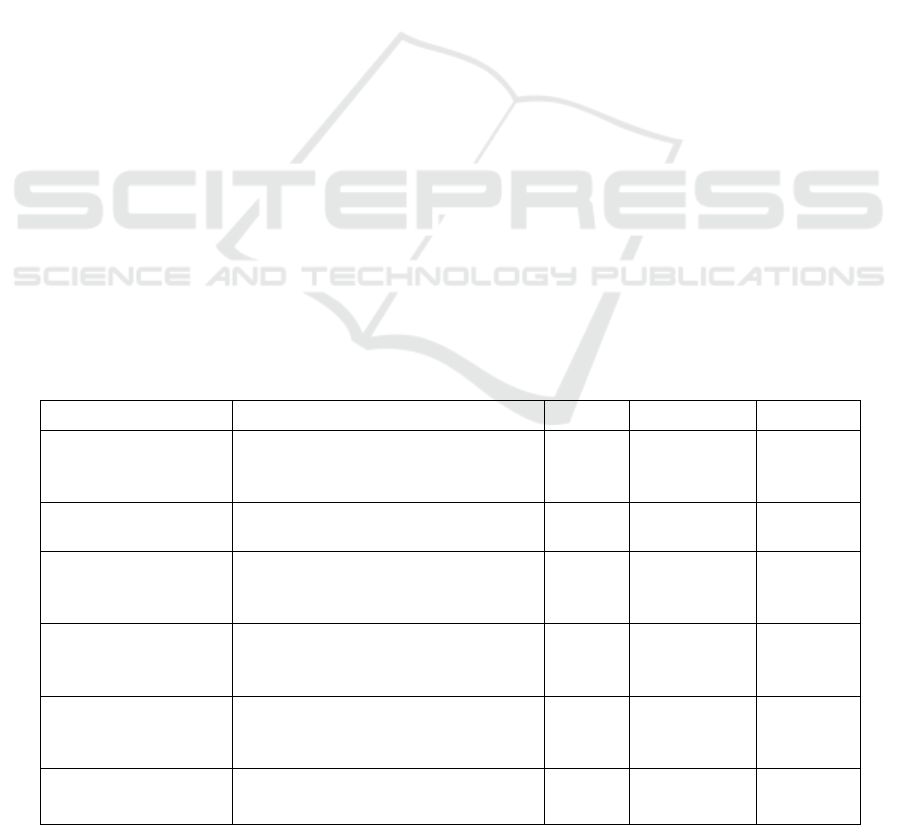
for precision farming. Table 1 shows the Smart
Agriculture Methods and Accuracy Overview (2017–
2023).
Table 1: Smart agriculture methods and accuracy overview (2017–2023).
Authors Methodology Year Data Type Accuracy
V Singh,et.al
Image Processing/Machine Learning
(Image segmentation and soft
computing for leaf diseases).
2017 Leaf images 84%
MI Pavel, et.al
IoT (Plant health monitoring with
image processing).
2019 Plant images 85%
B Kashyap, et.al
Sensing (Soil moisture and nutrient
monitoring in
agriculture).
021 Soil samples 88%
G Montazeaud, et.al
Embedded Systems (Low-
cost ultrasonic device for plant height
measurements).
2021
26 sorghum
genotypes
97.33%
S Raina, et.al
Image Processing
(Techniques for detecting plant leaf
diseases).
2021 Leaf images 86%
G Singh, et.al
Remote Sensing (Using soil moisture
data to identify water demand).
2022 Satellite images 89%
Smart Agriculture Monitoring and Nutrient Management System with Disease Detection
833

M Sahasrabudhe, et.al
Embedded Systems (Arduino Uno for
plant soil moisture
and pH sensing).
2023 Soil samples 90%
C Sarkar, et.al
Machine Learning (Leaf disease
detection using machine learning
and deep learning).
2023
Various leaf
images
87%
4 METHODOLOGY
The proposed system uses a structured methodology
to optimize farming practices by leveraging IoT and
sensor technology. The system is based on three
major sensors: soil pH, soil moisture, and ultrasonic.
The soil pH sensor measures the soil's acidity or
alkalinity. The information needed for crop growth.
Soil moisture sensor acts as a measure for the
moisture level present in the soil so that when the
moisture content is low enough, the irrigation is
triggered accordingly. The ultrasonic sensor
measures the height of the plant and serves a critical
measure of crop development and health. The system
heavily relies on the data collecting process. Each
sensor regularly gathers data and sends it to a
microcontrollerfor processing (Lee, W.-S.,
et.al.,2010).
The soil pH sensor shows a numerical value for
either acidity or alkalinity, the soil moisture sensor
measures whether the soil is wet or dry, and the
distance between the plant and ultrasonic sensor is
used to estimate plant height (Mowla, M.N.,et.al.,
2023). The processed data is then wirelessly
transferred to a mobile application through an IoT
module, enabling the real-time remote monitoring of
these conditions (Kirianaki, N.V.,et.al., 2002).
It also features an automatic irrigation system. A
simple, tiny water pump is operated by the
microcontroller when the microcontroller detects that
the soil moisture level falls below the pre-defined
threshold (Yin, H.,et.al., 2021).The pump
automatically shuts off when moisture levels are
optimal, saving water and surprising crops. The app
also offers real- time data, which helps farmers easily
monitor soil pH, moisture levels and plant height.
Notifications are also sent out when soil conditions or
irrigation triggers are not aligned, enabling fast-
action responses.
This guide walks through the extensive testing
and validation processes to ensure the system
remained accurate and reliable. To ensure that sensors
are functioning properly, sensor data are compared
against manual measurements, while the automatic
irrigation feature is tested for responsiveness and
efficiency. The system will be expanded in the future
with additional sensors for temperature, humidity or
nutrient levels that will be integrated and predictive
analytics that will estimate crop yields.
Thus, it allows the system to be capable of solving
contemporary agriculture problems and contributing
to sustainable agriculture (Yin, H.,et.al., 2021).
The Soil Moisture Index (SMI) is calculated to
determine the soil's water content and guide irrigation
decisions. The equation used is:
(Poyen, F.B.,et.al., 2020)
SMI=
× 100 (1)
Where V
moist
is the current moisture reading, V
dry
is
the voltage for dry soil, and V
wet
is the voltage
for
wet soil. When the SMI falls below a certain
threshold, the irrigation system is activated. The
condition for triggering irrigation is given by:
I
=
1,if SMI<SMIthreshold
0,if SMI≥SMIthreshold
(2)
In addition, the plant height is measured using an
ultrasonic sensor. The height of the plant is
determined by the formula:
H
plant
=H
sensor
- D
measured
(3
)
Where H
sensor
is the fixed height of the sensor from
the ground, and D
measured
is the distance between
the sensor and the plant. The soil pH is also an
important parameter to assess the soil’s suitability for
crop growth. The pH status is categorized as acidic,
neutral, or alkaline based on the following:
pH
=
Acidic,if pH<6.5
Neutral,if 6.5≤pH≤7.5
Alkaline,if pH>7.5
(4)
Finally, the Water Consumption Efficiency (WCE) is
calculated to evaluate how effectively water is being
used in irrigation:
WCE=
× 100 (5)
ICRDICCT‘25 2025 - INTERNATIONAL CONFERENCE ON RESEARCH AND DEVELOPMENT IN INFORMATION,
COMMUNICATION, AND COMPUTING TECHNOLOGIES
834
Where W
used
is the amount of water used for
irrigation, and W
available
is the total available water.
These equations form the foundation for automating
the monitoring and management of key agricultural
parameters, ensuring efficient use of resources and
improving crop health.
4.1 Implementation
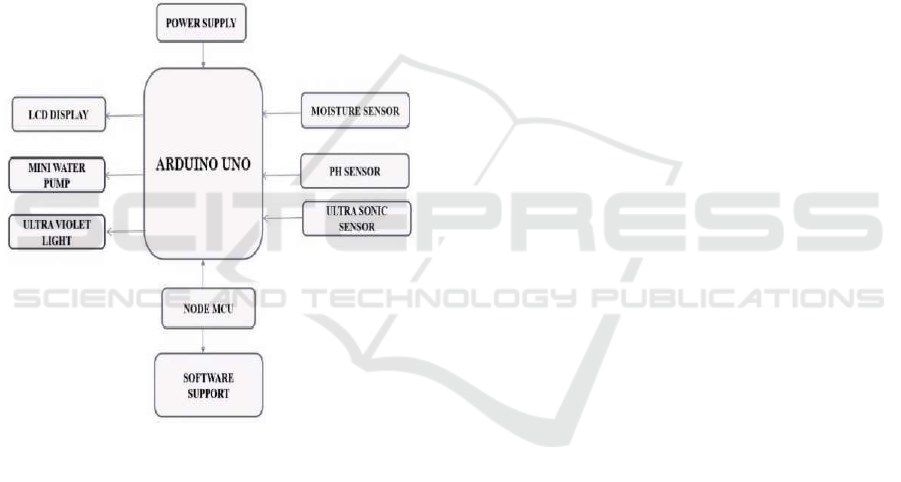
The Figure 1 displays a smart agriculture system built
on Arduino Uno that includes moisture, pH, and
ultrasonic sensors for monitoring. A tiny water pump,
UV light, and LCD monitor automate irrigation and
data visualization, while NodeMCU provides
wireless control with software support for precision
farming.
Figure 1: Block diagram of smart agriculture system.
Microcontrollers: The Arduino Uno is a
microcontroller board built upon the ATmega328P
that is commonly used for electronics programs,
automation, and IoT applications. It runs at 5V and
has 14 digital I/O pins (6 PWM), 6 analog inputs, and
UART, SPI, and I2C connectivity. It features 32 KB
Flash memory, 2 KB SRAM, and 1 KB EEPROM,
and operates at 16 MHz. The board is programmed
with the Arduino IDE using (Kondaveeti, H.K., et.al.,
2021) USB Type-B connector and can be driven by
USB, an adapter (7- 12V), or a battery. Its open-
source nature and compatibility with numerous
sensors make it suitable for both novice and advanced
users of embedded systems, robotics, and smart
agriculture. One open-source, inexpensive IoT
platform is the NodeMCU ESP8266. It was first
created by the Chinese business Espress if Systems
and is now widely used by developers and enthusiasts
working on IoT applications (Kondaveeti, H.K.,et.al.,
2021). The ESP8266 Wi-Fi microchip, a potent,
standalone SoC (System on Chip) that can manage
networking features and run user-defined programs in
a variety of programming languages, is the
foundation of the platform (Xia, W.,et.al., 2014).
Sensors:
Soil moisture sensors detect water content
in soil, an important statistic for agriculture and the
environment (Parimala Devi, M.,et.al., 2020). These
sensors aid in optimizing irrigation, conserving water,
increasing plant development, and monitoring
environmental conditions. Soil moisture sensors are
of three types: capacitive, resistive, and tensiometric,
each with its own set of characteristics and
specifications (Leib, B.G.,et.al., 2003). A pH meter
sensor consists of two electrodes: a sensitive
electrode made of special glass and a reference
electrode. The electrode detects hydrogen ion
activity in a solution, which is then used to calculate
pH based on the voltage difference between the pH
electrode and the reference electrode (Vonau, W.,
et.al.,2006).
Ultrasonic sensors are extensively employed in
many different fields, including agriculture, where
they perform a number of tasks such object detection,
level monitoring, and distance measurement
(Boopathi Raja, et.al., 2022). The basic idea behind
these sensors is to send out ultrasonic waves and time
how it extended takes for an echo to return from an
object. (Abbasi, A.Z.,et.al., 2014)The speed of sound
in the atmosphere and the time delay are then used to
determine the object's distance(Colaço, A.F.,et.al.,
2018).
Mini Water Pump: The system uses brushless mini
DC water pump that uses DC 4.5V to 24V to power a
brushless motor. The impeller rotates as a result of the
brushless motor's spin, raising the liquid's pressure
and creating the illusion of liquid transfer. For small-
scale water movement applications, a micro water
pump is a lightweight, portable pump. Due to their
versatility, these pumps are used in a variety of
settings, such as homes, farms, and factories. They
are perfect for applications with limited space and no
need for large flow rates because of their compact
size. A miniature submersible water pump uses both
an impeller and a motor to pump water. The impeller
pumps water at high speeds (Zheng, X.,et.al., 2014).
Water travels through the eye, the impeller's center,
along the outside portion of the blades (Takacs, G.,
2017).
Smart Agriculture Monitoring and Nutrient Management System with Disease Detection
835

Ultraviolet Light: UV light, particularly UV-A
(315-400 nm) and low levels of UV-B (280-315 nm),
can enhance plant growth and photosynthesis. It
promotes chlorophyll production, improves nutrient
absorption, and stimulates the development of
flavonoids and antioxidants, all of which help plants
withstand environmental stress. Controlled UV light
exposure can also help to strengthen stems, improve
leaf health, and increase crop output (Nawkar, G.M.,
et.al.,2013). Furthermore, UV radiation promotes
disease resistance by activating protective responses
in plants, making them more resistant to pests and
diseases (Paradiso, R.,et.al., 2022).
4.2 Software Support
The purpose of this webpage is to use crop leaves to
identify illnesses. HTML and CSS were used in the
development of this webpage, which shows the extent
of disease propagation and integrates a trained AI
model to detect the disease. The type of illness in that
crop is displayed if a farmer uses any camera linked
to this webpage to scan the leaf of the damaged crop.
Farmers can use their web browsers to access the
Sprout website. Farmers are able to scan the crop's
afflicted leaf (van Bruggen, A.H.,et.al., 2016). This
website provides information about the disease so that
farmers can take preventative actions including
applying fertilizer and other materials in advance of
the disease's occurrence.
5 WORKING OF AGRICULTURE
MONITORING SYSTEM
The pH sensor in the soil ascertains the in order to
safely reduce the voltage from a higher source level
(230V/240V) to a lower level (12V) appropriate for
powering the Arduino Uno and other low-voltage
devices, a step-down transformer is utilized in this
work. Since every component in this system operates
on a DC supply, an AC voltage transformer is
converted to a DC voltage using a rectifier. The
Arduino Uno board is the circuit's brain. Soil’s acidity
or alkalinity, according to the ATmega328P
microcontroller, the Arduino Uno is a well-known
open-source microcontroller board. It has 32 KB of
flash memory, 2 KB of SRAM, and 1 KB of
EEPROM and runs at a clock speed of 16 MHz. The
board has fourteen digitals. Six analog input pins (A0
to A5) and I/O pins (0 to 13) enable flexible interface
with sensors and actuators. PWM output is supported
by six of the digital pins for controlling devices, such
as LEDs and motors. The Arduino Uno has internal
5V voltage regulator, an external power source (7–
12V), or USB. The Arduino IDE, which supports a
C/C++-based language and provides a wealth of
libraries and examples, is used for programming. It is
perfect for educational and recreational works
because of its open-source nature, which promotes
customization and community involvement (Nvs,
B.,et.al., 2020).
A Node MCU ESP8266 12E was used to give
microcontroller-based plan Wi-Fi connectivity. Its
foundation is the ESP8266 microcontroller, a highly
integrated Wi-Fi chip capable of offering a
comprehensive Wi-Fi solution. In addition to
controlling the water pumps and RED light, it can
show the PH level, soil moisture content, and plant
height. An ultrasonic sensor expels a 40 kHz pulse
that travels through the atmosphere and returns to the
sensor if a plant is present. It is possible to determine
the height by computing the travel time and the speed
of sound. Since they provide real-time information on
the soil's water content, soil moisture sensors are
essential to smart agriculture. By monitoring and
controlling irrigation more effectively, these sensors
assist formers in providing the best possible growing
environment for crops.
6 RESULTS
The board's electrical circuit includes a power supply
unit, Arduino UNO board, Node MCU board, soil
moisture sensor (figure 2), pH meter sensor (figure 4),
ultrasonic sensor (figure 3), tiny water pump, and
LCD display. The soil moisture sensor monitors soil
moisture content, whether wet or dry. If the soil is dry,
the LCD display alerts the user to activate the tiny
water pump until the moisture level increases. The
soil pH meter analyzes the acidity and alkalinity of
the soil. The device uses an LCD monitor to show soil
pH levels. Farmers can boost soil pH if it is below "7"
by adding calcium and/or magnesium- containing
components, such as Examples include limestone,
baking soda, eggshells, and wood ashes.
ICRDICCT‘25 2025 - INTERNATIONAL CONFERENCE ON RESEARCH AND DEVELOPMENT IN INFORMATION,
COMMUNICATION, AND COMPUTING TECHNOLOGIES
836
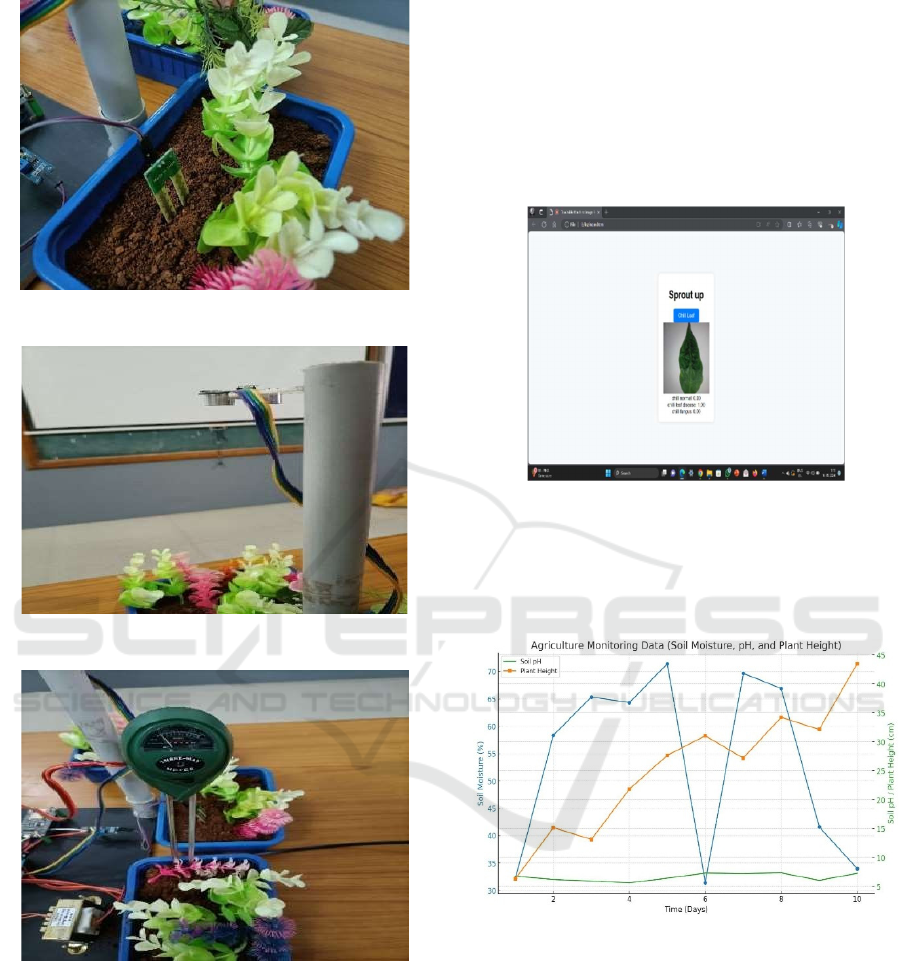
Figure 2: Soil moisture sensor.
Figure 3: Ultrasonic sensor.
Figure 4: pH meter sensor.
Farmers can use elemental sulfur, aluminum sulfate,
or sulfuric acid to raise pH levels above "7". The
ultrasonic sensor is used in agriculture to measure
crop height. Crop height should be checked often to
monitor growth and defend against weeds, resulting
in increased yield. It is a website for detecting
agricultural diseases using the leaves. This webpage
uses HTML and CSS to depict illness spread levels
and integrates a trained AI model for disease
identification. Scanning infected crop leaves with a
camera attached to this webpage identifies the disease
type. Farmers can utilize the software support on
their internet browser. Farmers can scan the afflicted
leaves of specific crops. This website provides
disease information, allowing farmers to take
proactive steps such as fertilizer use and other
preventative materials. Software support is shown in
figure 5.
Figure 5: Software support.
6.1 Sensor Output (Soil Moisture, pH,
and Plant Height)
Figure 6: Trends in Soil Moisture, Ph, and Plant Growth: a
10-Day Agricultural Monitoring Study.
The graph in figure 6 tracks three key factors that
impact soil health and plant growth over the course of
a 10- day agricultural monitoring study: soil pH, plant
height, and soil moisture. With plant height
increasing slowly, soil pH being relatively constant
during the observation period, and soil moisture
varying considerably, the results show dynamic
tendencies. Over the course of the 10-day period, the
blue line, which represents soil moisture (%), varies
greatly, exhibiting abrupt declines and strong
increases that reflect changes in water availability.
Smart Agriculture Monitoring and Nutrient Management System with Disease Detection
837

• Dynamics of soil moisture: On day one, the soil
moisture percentage is around 30%, but by day
two, it has sharply increased to about 60%,
indicating the start of irrigation or rainfall. This
rising tendency persists, peaking at over 70% on
day six, followed by a sharp decline to around
0%. After this dip, soil moisture rapidly recovers
and varies further, declining noticeably after day
8. These discrepancies point to the necessity of
better irrigation techniques to sustain steady soil
moisture levels.
• Growth in the plant height: In contrast to soil
moisture, plant height increases steadily over
the course of ten days. It grows steadily, with
only little variations, from about 30 cm on day
1 to a height of about 45 cm on day 10. This
suggests that the plant is thriving in spite of
changes in soil moisture, which could be the
result of an adaptable root system or lingering
soil moisture.
• pH stability of soil: Soil pH varies only slightly
and remains fairly stable. It starts at about 6.5
and fluctuates a bit through the course of the
10-day period. Soil pH does not change with
the change of soil moisture or plant growth as
the soil pH measured in the observed conditions
showed a steady state. This would indicate that
the soil is buffered well or that there were no
external inputs such as fertilizers and soil
amendments throughout the course of the study.
7 CONCLUSIONS
The Smart Agriculture Monitoring and Disease
Detection System is a significant breakthrough in
modern agriculture that helps address several critical
aspects, including the management of resources and
maintenance of plant health, as well as
environmental sustainability. Combined with IoT
sensors for monitoring soil moisture, pH levels, and
plant development, this technology offers farmers a
complete automated solution. With the real-time
monitoring and control system of Blynk app, Farmers
can take data-driven decisions and improve the
efficiency and productivity of their Farming
techniques. This technique, in addition to minimizing
the use of dangerous pesticides, inspires better crops
and improves the farming ecology; by allowing for
early disease detection, it creates an efficient use of
resources especially the water needed for irrigation.
Its scalability and versatility make it appropriate for a
variety of farming contexts, from small-scale
agriculture to major farming enterprises, making it a
new versatile instrument for the future of agriculture.
Innovations such as this provide a pathway to
efficient and sustainable farming practices as the
world seeks to feed a larger population without
harming the environment. A Smart Agriculture
Monitoring and Disease Detection System, which
represents a move toward a future in which nature and
technology can coexist harmoniously to promote
food security and safeguard the planet's resources for
future generations. Its strength can be enhanced by
impending technologies which can use complex
sensors, ML models among other tech components.
This will also advance the precision and efficiency of
farming methods, creating more opportunities for
environmental conservation, crop production
improvement, and sustainability
REFERENCES
Abbasi, A.Z., Islam, N., Shaikh, Z.A.: A review of wireless
sensors and networks' applications in agriculture.
Computer Standards & Interfaces 36, 263-270 (2014)
Boopathi Raja, G., Parimala Devi, M., Deepa, R., Sathya,
T., Nithya, S.: Portable IoT Smart Devices in
Healthcare and Remote Health Monitoring. Internet of
Things in Bioelectronics: Emerging Technologies and
Applications 125-143 (2024)
Colaço, A.F., Molin, J.P., Rosell-Polo, J.R., Escolà, A.:
Application of light detection and ranging and
ultrasonic sensors to high-throughput phenotyping and
precision horticulture: current status and challenges.
Horticulture research 5, (2018)
Escobar-Bravo, R., Nederpel, C., Naranjo, S., Kim, H.K.,
Rodríguez-López, M.J., Chen, G., Glauser, G., Leiss,
K.A., Klinkhamer, P.G.: Ultraviolet radiation
modulates both constitutive and inducible plant
defenses against thrips but is dose and plant genotype
dependent. Journal of Pest Science 94, 69-81 (2021)
Evans, R.G., Sadler, E.J.: Methods and technologies to
improve efficiency of water use. Water resources
research 44, (2008)
Gutiérrez, J., Villa-Medina, J.F., Nieto-Garibay, A., Porta-
Gándara, M.Á.: Automated irrigation system using a
wireless sensor network and GPRS module. IEEE
transactions on instrumentation and measurement 63,
166-176 (2013)
Kashyap, B., Kumar, R.: Sensing methodologies in
agriculture for soil moisture and nutrient monitoring.
IEEE Access 9, 14095-14121 (2021)
Kirianaki, N.V., Yurish, S.Y., Shpak, N.O., Deynega, V.P.:
Data acquisition and signal processing for smart
sensors. Wiley Chichester, England: (2002)
Kondaveeti, H.K., Kumaravelu, N.K., Vanambathina, S.D.,
Mathe, S.E., Vappangi, S.: A systematic literature
review on prototyping with Arduino: Applications,
challenges, advantages, and limitations. Computer
Science Review 40, 100364 (2021)
ICRDICCT‘25 2025 - INTERNATIONAL CONFERENCE ON RESEARCH AND DEVELOPMENT IN INFORMATION,
COMMUNICATION, AND COMPUTING TECHNOLOGIES
838

Lee, W.-S., Alchanatis, V., Yang, C., Hirafuji, M., Moshou,
D., Li, C.: Sensing technologies for precision specialty
crop production. Computers and electronics in
agriculture 74, 2-33 (2010)
Leib, B.G., Jabro, J.D., Matthews, G.R.: Field evaluation
and performance comparison of soil moisture sensors.
Soil Science 168, 396-408 (2003)
Montazeaud, G., Langrume, C., Moinard, S., Goby, C.,
Ducanchez, A., Tisseyre, B., Brunel, G.: Development
of a low cost open-source ultrasonic device for plant
height measurements. Smart Agricultural Technology
1, 100022 (2021)
Mowla, M.N., Mowla, N., Shah, A.S., Rabie, K.M.,
Shongwe, T.: Internet of Things and wireless sensor
networks for smart agriculture applications: A survey.
IEEE Access 11, 145813-145852 (2023)
Nawkar, G.M., Maibam, P., Park, J.H., Sahi, V.P., Lee,
S.Y., Kang, C.H.: UV-induced cell death in plants.
International journal of molecular sciences 14, 1608-
1628 (2013)
Nvs, B., Saranya, P.: Water pollutants monitoring based on
Internet of Things. Inorganic Pollutants in Water, pp.
371-397. Elsevier (2020)
Othman, M.F., Shazali, K.: Wireless sensor network
applications: A study in environment monitoring
system. Procedia Engineering 41, 1204-1210 (2012)
Paradiso, R., Proietti, S.: Light-quality manipulation to
control plant growth and photomorphogenesis in
greenhouse horticulture: The state of the art and the
opportunities of modern LED systems. Journal of Plant
Growth Regulation 41, 742-780 (2022)
Parimala Devi, M., Raja, G.B., Gowrishankar, V., Sathya,
T.: IoMT-based smart diagnostic/therapeutic kit for
pandemic patients. Internet of Medical Things for
Smart Healthcare: Covid-19 Pandemic 141-165 (2020)
Parimala Devi, M., Choudhry, M.D., Nithiavathy, R.,
Boopathi Raja, G., Sathya, T.: Blockchain Based Edge
Information Systems Frameworks for Industrial IoT: A
Novel Approach. Blockchain Applications in the Smart
Era, pp. 19-39. Springer (2022)
Pavel, M.I., Kamruzzaman, S.M., Hasan, S.S., Sabuj, S.R.:
An IoT based plant health monitoring system
implementing image processing. In: 2019 IEEE 4th
international conference on computer and
communication systems (ICCCS), pp. 299-303. IEEE,
(Year)
Poyen, F.B., Ghosh, A., Kundu, P., Hazra, S., Sengupta, N.:
Prototype model design of automatic irrigation
controller. IEEE Transactions on Instrumentation and
Measurement 70, 1-17 (2020)
Raihan Haidar Arkan, D.N.S.S., SKom, M.: Leaf Disease
Detection Web Design using Django Framework for
CNN Models.
Sahasrabudhe, M., Sayyed, J., Shanmugasundar, K.,
Daryapurkar, R., Mehendale, N.: Design and
Implementation of an Arduino Uno-Based Plant Soil
Moisture and pH Sensing Monitoring System.
Available at SSRN 4505176 (2023)
Sarkar, C., Gupta, D., Gupta, U., Hazarika, B.B.: Leaf
disease detection using machine learning and deep
learning: Review and challenges. Applied Soft
Computing 145, 110534 (2023)
Singh, V., Misra, A.K.: Detection of plant leaf diseases
using image segmentation and soft computing
techniques. Information processing in Agriculture 4,
41-49 (2017)
Takacs, G.: Electrical submersible pumps manual: design,
operations, and maintenance. Gulf professional
publishing (2017)
van Bruggen, A.H., Gamliel, A., Finckh, M.R.: Plant
disease management in organic farming systems. Pest
Management Science 72, 30-44 (2016)
Vonau, W., Guth, U.: pH monitoring: a review. Journal of
Solid State Electrochemistry 10, 746-752 (2006)
Xia, W., Wen, Y., Foh, C.H., Niyato, D., Xie, H.: A survey
on software-defined networking. IEEE
Communications Surveys & Tutorials 17, 27-51 (2014)
Yin, H., Cao, Y., Marelli, B., Zeng, X., Mason, A.J., Cao,
C.: Soil sensors and plant wearables for smart and
precision agriculture. Advanced Materials 33, 2007764
(2021)
Zheng, X., Liu, C., Yan, Y., Wang, Q.: A review of
thermoelectrics research–Recent developments and
potentials for sustainable and renewable energy
applications. Renewable and Sustainable Energy
Reviews 32, 486-503 (2014)
Smart Agriculture Monitoring and Nutrient Management System with Disease Detection
839
