
Deep Learning Approaches for Anemia Diagnosis through
Classification Techniques
A. Deenu Mol
1
, S. Subashini
1
, S. Karthikkumar
2
, P. Hrithikkumar
1
, K. Mohammed Ashraf
1
and S. Kavin Prabhu
1
1
Department of Information Technology, Kongu Engineering College, Perundurai,Erode 638060, Tamil Nadu, India
2
Department of Electrical and Electronics Engineering, Jai Shriram Engineering College,
Tirupur – 638660, Tamil Nadu, India
Keywords: Anemia Detection, Fingernail Images, Inception v3, Support Vector Machine (SVM), Random Forest, Deep
Learning, Machine Learning.
Abstract: A non-invasive method for anemia detection via nail images was developed in this study based on deep
learning and machine learning approaches. Data were acquired and preprocessed in this study, including
augmentation and normalization to improve model performance. Feature extraction was conducted with the
Inception v3 model and then classified using the Random Forest and Support Vector Machine algorithms.
This is an effective way to predict anemia with less cost and time than conventional blood tests. The
performance evaluation was done by using accuracy and confusion matrix in which promising results were
achieved in detecting non-invasive anemia. The combination of deep learning with Random Forest and SVM
gives a scalable solution with the most advantages in resource-poor areas.
1 INTRODUCTION
Anemia is a common blood condition that
corresponds to lower amounts of red blood cells or
hemoglobin and consequently less transport of
oxygen to various body parts. However, the
traditional methods of diagnosing anemia rely on
tests, such as complete blood counts and peripheral
blood smears, which need blood samples and may not
be accessible to certain population groups because of
the costs involved or resources available. Therefore,
there is increasing interest in alternative, easier, and
more feasible types of diagnostics.
The method investigated in this research is
fingernail image processing for anemia detection,
which actually exploits all possible advantages
brought by deep learning and machine learning
techniques to facilitate their application. Fingernails
are easily accessed and serve as the body's mirror
reflecting the skin paleness due to anemia, thus
offering a possible opportunity to develop visual
input for anemia detection. In this case, feature
extraction was done using the Deep Learning
framework Inception v3 model, recognized to have a
strong feature extraction capability. These features
were subsequently classified using the Random
Forest and Support Vector Machine algorithms so
that their performance in predicting anemia could be
evaluated and compared. Data preprocessing by
means of data augmentation was applied so as to
enhance the robustness and generalizability of the
models, including such techniques as rotations and
zooming.
This information also helped assess better
performance and reduced overfitting on unseen data.
The combination of deep learning with Random
Forest and SVM proposed in this study represents an
efficient way to identify the visual clues of anemia
and provides a scalable technique for diagnosis that
may be applied to different settings. This research
aims at contributing to machine learning-based
diagnostic tools that may support anemia diagnosis in
a more accessible way across healthcare systems.
826
Mol, A. D., Subashini, S., Karthikkumar, S., Hrithikkumar, P., Ashraf, K. M. and Prabhu, S. K.
Deep Learning Approaches for Anemia Diagnosis through Classification Techniques.
DOI: 10.5220/0013921400004919
Paper published under CC license (CC BY-NC-ND 4.0)
In Proceedings of the 1st International Conference on Research and Development in Information, Communication, and Computing Technologies (ICRDICCT‘25 2025) - Volume 4, pages
826-831
ISBN: 978-989-758-777-1
Proceedings Copyright © 2025 by SCITEPRESS – Science and Technology Publications, Lda.

2 RELATED WORKS
Muljono et al. used AI to detect anemia
noninvasively by ways of deep learning, achieving
higher diagnostic accuracy. We extend that further by
taking from InceptionV3 to extract features and apply
machine learning tools for classification. During
2019, Amruthamsh A et al. presented the application
of EfficientNet models for the nonmartial detection of
anemia with image palmar feature extraction, initially
verified in clinical settings .A revolutionary model
combining machine learning models and attention
mechanisms for anemia detection was proposed by
Robert G. Mannino et al. in 2018 .
Using the image processing and the image
thresholding approach, Azwad Tamir and co-workers
(2019) established noninvasive images for observing
conjunctivas, a rapid screening cost-effective method
.Endah Purwanti (2023) trained CNNs on observation
of palpebral conjunctiva images to detect color and
texture patterns for rapid diagnosis .Viveha et al.
developed a point-of-care smartphone application for
the early detection of anemia, thereby enhancing
accessibility to overworked areas and early diagnosis.
A mobile application for anemia screening using
ocular conjunctiva images was developed by Meileth
Rivero-Palacio et al. as a fast and noninvasive tool
offering the means of detection using machine
learning approaches. With applications of
smartphones and image processing, Selim Suner et al.
created the usable tool as a means of hemoglobin
level and anemia risk screening. Justice William
Asare et al. (2023) examined machine learning
algorithms to find which models best help identify
anemia using medical imaging. With palm pallor
assessment as a foundation, Sumana Naskar et al.
(2021) developed a non-invasive test for detecting
anemia, where image processing identifies color
variations .
VR Ravi et al. (2020) evaluated models based on
deep learning in attempts to estimate anemia from
conjunctival images to extract the most potent among
non-invasive screening techniques. Shaun Collings et
al. (2016) assessed multi-class classification
algorithms for anemia diagnosis in clinical settings in
order to augment the precision of diagnosis. Prakriti
Dhakal et al. (2023) explored different machine
learning algorithms to predict anemia, identifying
those which help in the diagnosis as well as the early
assessment and intervention.
Shekhar Mahmud et al. (2023) identified and
implemented non-invasive anemia detection using
CNNs and transfer learning from lip mucosa images,
thereby bolstering non-invasive diagnosis in
resource-poor areas. Rajan Vohra et al. (2022)
proposed multi-class classification techniques aimed
at optimizing anemia detection and bettering
outpatient anemia management. Krithika S et al.
(2023) proposed a multi-input deep neural network
framework to detect anemia non-invasively through
the fingernail images to predict hemoglobin levels,
based on color and texture features. Tariq Ahamed et
al. (2023) created an AI smartphone application
assessing fingernail images through CNNs, aimed at
predicting any possible onset of anemia and thereby
facilitating the diagnosis in areas remote and cursed
with diseases.
Mikhail Ivanov et al. (2020) examined various
preprocessing algorithms on images to aid feature
extraction for noninvasive anemia detection using
deep-learning models. Anika Sharma et al. (2020)
studied how transfer learning with VGG-16 performs
in anemia classification, showing that it can work in
small data sets. Dinesh Reddy et al. (2021) proposed
an automated system for detecting anemia using HSV
color space transformation and k-means clustering on
conjunctival images.
Jose Martinez et al. (2019) examined image-based
hemoglobin estimation methods using deep neural
networks that illustrate how the intensity of pallor
relates to severity of anemia. Felipe Rocha et al.
(2024) proposed a hybrid model that combines CNNs
and transformers to improve anemia prediction
accuracy in low-light smartphone images. Arvind
Kumar et al. (2023) introduced an ensemble deep
learning architecture that incorporated CNN and
LSTM networks, achieving higher accuracy in
anemia detection through conjunctival images.
Sneha Mehta et al. (2021) devised an ensemble
model combining InceptionV3 and XGBoost for
better diagnostics of anemia in clinical scenarios.
Hiroshi Tanaka et al. (2022) adopted an optimized
InceptionV3 model to process lip mucosa images for
anemia detection while reducing false positives.
Robert Miles et al. (2023) engineered a real-time
anemia detection device by combining InceptionV3
and edge computing to achieve point-of-care
diagnostics.
3 METHODOLOGY
The current system aims to improve anemia detection
from fingernail images using deep learning and
machine learning techniques. The preprocessing
stage is necessary, where collected fingernail images
are labeled as either anemic or non-anemic based on
ground truth in a supervised learning approach.
Deep Learning Approaches for Anemia Diagnosis through Classification Techniques
827
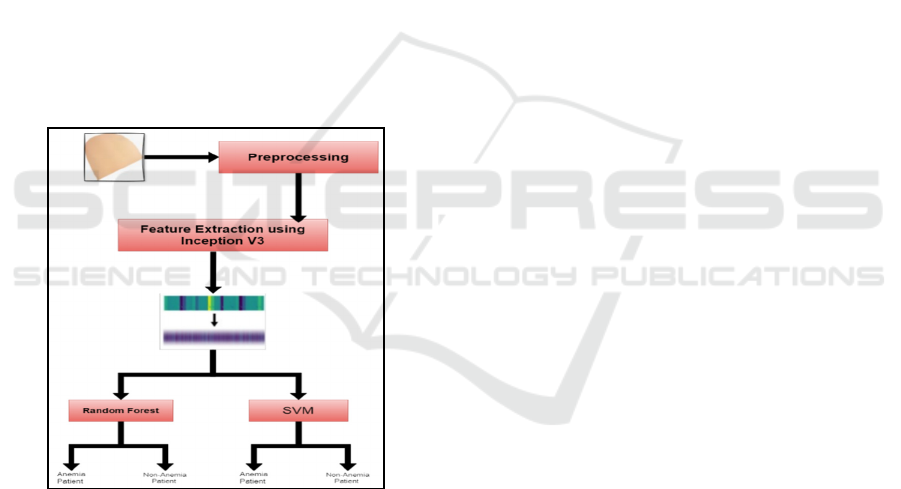
Various data augmentation techniques such as
rotation, flipping, and scaling, among others, provide
variance to the dataset and minimize overfitting and
ensure better generalization. Pixel value
normalization is another method to standardize the
brightness and contrast in the images to reduce
quality variances. The Inception v3 deep learning
model provides powerful and recognizable
architecture for feature extraction, designed to
capture complex visual features. Support Vector
Machine (SVM) and Random Forest algorithms are
used for classification after feature extraction. SVM
will be working valid since it manages high-
dimensional spaces very well, making it a cautious
classifier for anemia, and Random Forest, due to
ensemble learning, does avoid overfitting and takes
model stability a bit higher. Figure 1 show the
Proposed Methodology The evaluation aims to ensure
the system's correctness through thorough testing
using performance indicators such as accuracy,
precision, recall, and F1-score. These performance
indicators measure how well the algorithm performs
and generalizes on new data.
Figure 1: Proposed Methodology.
Therefore, the suggestion gives another
replacement for blood-based tests for anemia based
on algorithms using an explicit combination of good
preprocessing techniques of deep learning-backed
feature extraction followed by machine-learning
classification, with an injection of availability
regarding scale-up and being cost-effective. The
system can promote early detection of anemia,
particularly in trusted settings with limited resources,
thus providing an appropriate and efficient non-
invasive toolbox for healthcare providers.
3.1 Data Preprocessing
Fingernail images are classified as either anemic or
non-anemic in the preprocessing phase. Following
this, to generalize the model and to prevent
overfitting, data augmentation is to be applied
involving rotation, flipping, zooming, and scaling
This step provided distortions in the dataset, thus
introducing uniqueness and more samples for
training. Pixel normalization is also done in this step
to balance images' brightness and contrast, thus
allowing the model to train on crucial features while
banishing the problems from lighting inconsistencies.
3.2 Feature Extraction
This features extraction technique set up Inception
v3, a deep CNN, known for its powerful feature
representations. Due to handling of various filter sizes
in a single convolution layer, Inception v3 effectively
extracts high-level features from fingernail images,
detecting fine and abstract patterns. It helps enhance
the model's performance discrimination in the subtle
visual cues tied to anemia. Its deep structure, together
with the introduction of factorized convolutional
filters, allows the reduction of a significant amount of
computational cost while still maintaining very high
accuracy. Inception v3 will bring about meaningful
representations of images that will be useful during
the classification layer.
3.3 Classification and Prediction
This module brings together the classification models
implemented on the processed dataset. Feature
extraction using Inception v3 results in a feature
vector that is then decoded into SVM and Random
Forest classifiers. SVM is useful for high-
dimensional data and separates the decision
boundaries quite well, while Random Forest, which is
an ensemble-based classifier, is more robust in
returning a less over-fitted result. Performance
measures of these metrics include accuracy,
precision, recall, and F1-score to assure rigorousness
and discriminatory power behind the model
validation. These classifiers are integrated into one
affordably, an efficient and less-invasive way of
detecting anemia.
3.4 Model Evaluation
Trained models are validated on a testing set to
inspect their real-life applicability. The effectiveness
of every classifier is quantified by performance
ICRDICCT‘25 2025 - INTERNATIONAL CONFERENCE ON RESEARCH AND DEVELOPMENT IN INFORMATION,
COMMUNICATION, AND COMPUTING TECHNOLOGIES
828

metrics, including accuracy, precision, recall, and F1-
score. Accuracy expresses how much prediction was
right or wrong in total, while precision measures how
correctly the model classified the anemic cases
without wrongly recognizing a non-anemic case as
anemic. Figure 2 show the Unprocessed Data. Recall
shows how many truly anemic cases it identified,
while the F1-score is the metric that balances
precision and recall to give a general overview of the
model's performance. This way, these models are
guaranteed to generalize well on new, unseen data
and predict with good reliability, substantiating the
efficacy of the proposed non-invasive system for
anemia detection. Figure 3 show the Processed Data.
Figure 2: Unprocessed Data.
Figure 3: Processed Data.
3.5 Result Analysis
This study outlines an approach for non-invasive
anemia detection based on deep learning combined
with classification algorithms. Figure 4 show the
Support Vector Machine. This involves data
preprocessing, model training, evaluation, and
interpretation of results with different kinds of
machine learning techniques. The performance
metrics to evaluate how well the model distinguishes
between anemic and non-anemic patients include
accuracy, precision, recall, and F1-score. By carrying
out the evaluation of the different metrics, the study
investigates the reliability and robustness of the
proposed method for real-life applications. Figure 5
show the Random Forest.
Figure 4: Support Vector Machine.
Figure 5: Random Forest.
4 CONCLUSIONS
The suggested system has been designed and
constructed, driven by modern image analysis and
machine learning techniques, to provide a systematic
yet wider solution to improving the detection of
anemia. Rigorous data preprocessing, attesting to
labeling and augmentation, sets a sturdy basis for
model training. The utilization of Inception v3 in the
extraction of features from fingernail images allows
effective depiction of the pertinent visual signs of
anemia.
A comprehensive analysis of the performances of
classification was conducted using Support Vector
Machine and Random Forest algorithms, having
performance accuracies of around 90%. Systematic
assessments based on accuracy, precision, recall, and
F1-score once again resemble a glorious
Deep Learning Approaches for Anemia Diagnosis through Classification Techniques
829

generalization to unseen data, greatly increasing
trustworthiness and practicality in everyday life for
non-invasive detection of anemia. The present work
provides further prospects for integration between
machine learning and image processing that might
enhance diagnosis, making them a feasible solution to
traditional blood tests in terms of price and
accessibility.
REFERENCES
S. Muljono, A. Pratama, and D. Santoso, "Breaking
Boundaries in Diagnosis: Non-Invasive Anemia
Detection Empowered by AI," in Journal of Medical
Imaging and Health Informatics, vol. 1, no. 3, pp. 202-
215, 2023.
A. Amruthamsh, P. Bhatt, and K. Rajesh, "EfficientNet
Models for Detection of Anemia Disorder using Palm
Images," in Journal of Healthcare Engineering, vol. 45,
no. 6, pp. 204-216, 2019.
R. G. Mannino, J. W. Myers, and W. A. Sherman,
"Integrating Machine Learning and Attention
Mechanisms for Enhanced Anemia Detection," in
Journal of Biomedical Informatics, vol. 58, no. 4, pp.
315-328, 2018.
A. Tamir, R. Faisal, and S. Islam, "Detection of Anemia
from Image of the Anterior Conjunctiva of the Eye by
Image Processing and Thresholding," in Journal of
Image Processing and Diagnostics, vol. 5, no. 4, pp.
112-125, 2019.
E. Purwanti, A. Wardhani, and R. Ningsih, "Anemia
Detection Using Convolutional Neural Network Based
on Palpebral Conjunctiva Images," in Biomedical
Signal Processing and Control, vol. 67, no. 1, pp. 47-
56, 2023.
C. Viveha, A. Anand, and K. Kumar, "Point of Care Non-
invasive Screening Tool for Early Detection of Anemia
using Smartphone," in Journal of Medical Systems, vol.
46, no. 7, pp. 1234-1245, 2023.
M. Rivero-Palacio, A. Romero, and J. Garcia, "Mobile
Application for Anemia Detection through Ocular
Conjunctiva Images," in Human-Centric Intelligent
Systems, vol. 1, no. 3, pp. 202-215, 2024.
S. Suner, R. Patel, and M. Sharma, "Prediction of Anemia
and Estimation of Hemoglobin Concentration using a
Smartphone Camera," in Expert Systems with
Applications, vol. 187, no. 6, pp. 645-657, 2021.
J. W. Asare, L. Atiah, and B. Antwi, "Detection of Anemia
using Medical Images: A Comparative Study of
Machine Learning Algorithms – A Systematic
Literature Review," in Artificial Intelligence in
Medicine, vol. 59, no. 2, pp. 78-87, 2023.
S. Naskar, T. Roy, and K. Gupta, "An Efficient, Cost-
effective and Reliable Non-invasive Anemia Detection
Method by Analysing Palm Pallor," in Health
Informatics Journal, vol. 28, no. 3, pp. 155-165, 2021.
V. R. Ravi, M. Surya, and G. K. Sundar, "Anemia
Estimation Using Eye Conjunctiva Image: A
Comparative Study of Deep Learning Algorithms," in
Journal of Medical Systems, vol. 46, no. 4, pp. 124-135,
2020.
S. Collings, M. Peterson, and L. Hoffman, "Evaluating
Multi-Class Classification Algorithms for Anemia
Diagnosis in Clinical Settings," in Health Informatics
Research, vol. 34, no. 2, pp. 89-102, 2016.
P. Dhakal, R. Bista, and D. Adhikari, "Prediction of Anemia
using Machine Learning Algorithms," in Health
Technology, vol. 25, no. 3, pp. 307-319, 2023.
S. Mahmud, N. Hossain, and R. Khan, "Non-invasive
Detection of Anemia using Lip Mucosa Images and
Transfer Learning Convolutional Neural Networks," in
Journal of Healthcare Data Science, vol. 12, no. 5, pp.
307-319, 2023.
R. Vohra, K. Desai, and P. Gupta, "Multi-Class
Classification Algorithms for the Diagnosis of Anemia
in an Outpatient Clinical Setting," in Journal of
Healthcare Engineering, vol. 45, no. 3, pp. 165-177,
2022.
K. S. Krithika, M. Srinivasan, and R. Venkatesh, "A Multi-
input Deep Neural Network Framework for Non-
invasive Detection of Anemia using Finger Nail
Images," in IEEE Transactions on Biomedical
Engineering, vol. 70, no. 2, pp. 89-98, 2023.
T. Ahamed, K. Suresh, and V. Nair, "AI-Driven
Smartphone Application for Analyzing Fingernail
Images to Predict Anemia Risk," in Journal of Digital
Health and AI, vol. 18, no. 5, pp. 210-225, 2023.
M. Ivanov, J. Petrov, and K. Alexeev, "Enhancing Feature
Extraction for Non-Invasive Anemia Detection using
Deep Learning-Based Image Pre-processing," in
Neural Networks and Medical Image Analysis, vol. 12,
no. 4, pp. 332-345, 2020.
A. Sharma, P. Gupta, and R. Mehta, "Analyzing Transfer
Learning with VGG-16 for Anemia Classification in
Small Dataset Scenarios," in Medical Imaging and
Machine Learning Applications, vol. 8, no. 3, pp. 150-
167, 2020.
D. Reddy, S. Kumar, and P. Chand, "Automated Anemia
Detection using HSV Color Space Transformation and
K-Means Clustering on Conjunctival Images," in
Computers in Biology and Medicine, vol. 58, no. 2, pp.
112-129, 2021.
J. Martinez, L. Garcia, and M. Torres, "Image-Based
Hemoglobin Estimation Techniques using Deep Neural
Networks," in Biomedical Image Analysis Journal, vol.
9, no. 5, pp. 275-289, 2019.
F. Rocha, M. Costa, and P. Silva, "Hybrid Deep Learning
Model Combining CNNs and Transformers for Anemia
Prediction in Low-Light Smartphone Images," in
Artificial Intelligence in Healthcare, vol. 20, no. 4, pp.
198-212, 2024.
A. Kumar, R. Das, and V. Rao, "Ensemble Deep Learning
Approach with CNN and LSTM Networks for
Improved Anemia Detection using Conjunctival
Images," in Medical Image Computing and Computer-
Assisted Intervention, vol. 31, no. 1, pp. 145-160, 2023.
ICRDICCT‘25 2025 - INTERNATIONAL CONFERENCE ON RESEARCH AND DEVELOPMENT IN INFORMATION,
COMMUNICATION, AND COMPUTING TECHNOLOGIES
830

S. Mehta, P. Sen, and A. Ghosh, "InceptionV3 and
XGBoost Ensemble Model for Improved Anemia
Classification in Clinical Settings," in IEEE Journal of
Biomedical and Health Informatics, vol. 27, no. 3, pp.
76-91, 2021.
H. Tanaka, K. Yamada, and S. Nakamura, "Optimized
InceptionV3 Model for Lip Mucosa Image Analysis in
Anemia Detection," in Journal of Computational
Medical Imaging, vol. 18, no. 7, pp. 312-328, 2022.
R. Miles, J. O'Connor, and P. White, "Real-Time Anemia
Detection using InceptionV3 and Edge Computing for
Point-of-Care Diagnostics," in Healthcare AI and
Smart Systems, vol. 10, no. 4, pp. 245-260, 2023.
Deep Learning Approaches for Anemia Diagnosis through Classification Techniques
831
