
Advanced Text Steganography Using Variational Autoencoders and
Greedy Sampling
Tarush Chintala, Ritesh Mishra and Shobana J.
Department of Data Science and Business Systems, SRM Institute of Science and Technology, Kattankulathur, Tamil Nadu,
India
Keywords: Text Steganography, BERT, Variational Auto‑Encoder, Text Generation, Steganographic Techniques, Data
Concealment, Generative Text Modification, Stealth Communication, LSTM, Grammatical Integrity,
Semantic Coherence.
Abstract: Text steganography applies language use as a cover for the covert communication by embedding secret
messages within apparently ordinary text. Our proposal involves a new strategy for performing text
steganography utilizing a VAE along with a transformer-based model for encoding and decoding secret
messages. This approach uses BERT-based encoder to learn latent representations of cover texts, allowing for
embedding hidden information in such a way that the text could be linguistically coherent and fluent. A greedy
algorithm is used for embedding messages into token sequences and developing techniques for the robust
extraction of messages. To generalize to different domains of text, the model is trained on diverse datasets
including social media posts and news articles. Experimental results show that the approach presented yields
very high embedding capacity with minimal distortion and can thus provide a reliable and scalable solution
to secure text-based steganography. Further validation of the system is done by encoding and decoding text
messages and then measuring the model in terms of accuracy and text quality compared to baseline
approaches.
1 INTRODUCTION
1.1 Background
The increasing prevalence of digital communication
has manifested a deep need for secure and private
means of exchanging data. Encryption will be sure to
maintain the secrecy of information but essentially
advertises the fact that something confidential exists,
drawing unwanted attention to it. A more covert
approach is steganography, as it conceals the very
existence of a message inside an innocuous carrier.
Text steganography is very attractive because the
medium itself is ubiquitous, but it faces unique
difficulties, for instance, as regards cover text fluency
and intelligibility while carrying enough embedding
capacity.
Recent developments in the area of natural
language processing, especially with transformer-
based models such as BERT (Bidirectional Encoder
Representations from Transformers), open up further
avenues to overcome the said challenges. Using pre-
trained models for languages, a latent representation
could be developed which would encapsulate the
semantic complexity in textual content so that hidden
information may be embedded in a more efficient
manner. The current project introduces a text
steganography framework based on a combination of
a Variational Autoencoder (VAE) and BERT-based
encoder for embedding secret messages within cover
texts.
1.2 Objectives
The primary objectives of this study are:
● To design a model that encodes secret information
into natural language with minimal distortion,
ensuring the linguistic coherence and naturalness
of the cover text.
● To implement an embedding and decoding
algorithm that optimizes both accuracy and
embedding capacity using a greedy approach.
● To evaluate the model’s generalizability across
different text domains, including social media
posts and news articles, for robustness and
scalability.
Chintala, T., Mishra, R. and J., S.
Advanced Text Steganography Using Variational Autoencoders and Greedy Sampling.
DOI: 10.5220/0013921200004919
Paper published under CC license (CC BY-NC-ND 4.0)
In Proceedings of the 1st International Conference on Research and Development in Information, Communication, and Computing Technologies (ICRDICCT‘25 2025) - Volume 4, pages
811-817
ISBN: 978-989-758-777-1
Proceedings Copyright © 2026 by SCITEPRESS – Science and Technology Publications, Lda.
811

1.3 Scope of the Study
The scope of this study encompasses the development
and evaluation of a deep learning-based text
steganography framework. The model is trained on
diverse datasets to enhance its applicability to various
text sources, such as social media content and formal
news articles. The focus is on embedding capacity,
message extraction accuracy, and the preservation of
text quality. While the current implementation
emphasizes natural language texts in English, the
techniques can be extended to other languages and
steganographic scenarios. This study does not cover
visual or audio steganography, nor does it address
attacks on the steganographic system, which are left
for future research.
Experimental evaluations demonstrate the
model's ability to embed and decode hidden messages
with high accuracy and minimal impact on text
fluency, outperforming traditional methods in
embedding capacity and extraction reliability. The
proposed framework showcases the potential of
advanced NLP techniques for secure and scalable
text-based steganography.
2 LITERATURE REVIEW
2.1 Generative Text Steganography
Based on LSTM Network and
Attention Mechanism with
Keywords
This paper presents LSTM networks with an attention
mechanism for generative text steganography. The
attention mechanism now has its center focus on
keywords in order to improve the quality of the text.
As a result, the steganographic text is of better
quality that gives a better semantic coherence
compared to others. Also, it offers better resistance to
steganalysis, in which information that needs to be
kept secret is covered more organically.
The approach based on LSTM structures is
however quite computationally intensive and may
still show subtle statistical differences detectable with
steganalysis tools.
2.2 TS-RNN: Text Steganalysis
Based on Recurrent Neural
Networks
This paper proposes a steganalysis method based on
RNN to uncover hidden information that is embedded
into steganographic texts. It catches anomalies of
conditional probability distributions that arise when
confidential data is embedded. The approach utilizes
bidirectional RNNs to capture the correlation of
words in order to improve the capability of detection.
The model was achieving high detection accuracy
and was able to estimate the amount of hidden
information. Because RNNs permit effective
modeling of sequential text data, this model would be
very applicable for detecting subtle anomalies in
generated text.
2.3 Linguistic Generative
Steganography with Enhanced
Cognitive-Imperceptibility
This research looks into cognitive imperceptibility in
text steganography by merging the perception,
statistics, and cognition frameworks using Encoder-
Decoder models. The goal is to generate
steganographic text that sounds natural and follows
the human cognitive expectations. In doing so, it
ensures semantic regulation throughout the
generation process to reach equilibrium with it
The method increases the imperceptibility
because it includes cognitive factors that help
minimize the possibilities of detection for the text
under cover. It offers a more comprehensive
framework because it envelops the perceptual,
statistical, and cognitive aspects into text
steganography.
2.4 Near-imperceptible Neural
Linguistic Steganography via
Self-Adjusting Arithmetic
Coding
The study introduces a method that utilizes self-
adjusting arithmetic coding for encoding, which
enhances the statistical imperceptibility of the hidden
information compared to traditional methods
The proposed method shows remarkable better
performance compared to the best existing methods
by large margins, achieving improvements of 15.3%
in bits per word and 38.9% in KL metrics over
multiple corpora of texts.
2.5 An Approach for Text
Steganography Based on
Markov Chains
This proposed technique seeks to generate texts that
are very close to the original language's structural
ICRDICCT‘25 2025 - INTERNATIONAL CONFERENCE ON RESEARCH AND DEVELOPMENT IN INFORMATION,
COMMUNICATION, AND COMPUTING TECHNOLOGIES
812
characteristics through Markov models, minimizing
the possibilities of being detected. This technique
allows the encryption process to conserve text
fluency.
The implementation called MarkovTextStego,
supports both unigrams and bigrams as states, and is
also extendable to n-grams. This adaptability greatly
enhances the ability of the model to support different
sorts of text.
2.6 Frustratingly Easy Edit-based
Linguistic Steganography with a
Masked Language Model
The paper proposes a new approach to applying
linguistic steganography using a masked language
model (MLM), in which Alice agrees with Bob on
masking and encoding strategies. Alice hid some of
the tokens in a cover text and employed MLM to
produce a vocabulary distribution for each masked
token, and she selects high-probability sub words that
represent a secret message in bits form for creating a
stego text that she sends to Bob, who decrypts the
secret message by reversing.
Results indicate that edit-based lacks payload
capacity compared with generation-based models, but
pays a controlled trade-off in security/payload
capacity terms; it's also more resistant against
automatic detection. Finally, human evaluators gave
it slightly worse ratings regarding naturalness and
understandability compared with other models. In any
case, this study shows the applicability of using
MLMs for secure communication, which produces
understandable, grammatically correct stego texts.
2.7 Adversarial Watermarking
Transformer: Towards Tracing
Text Provenance with Data
Hiding
The Adversarial Watermarking Transformer (AWT)
develops an elaborate way in which binary messages
are actually watermarked into text without altering its
comprehensible sense. It works with an encoder
decoder transformer model that learns to tweak input
sentences slightly to preserve the actual input from
profound change. The model gets good bit accuracy
for the messages and retains its text utility despite
detarring denoising. The identified performance
metrics show that the proposed AWT approach
achieves a reasonably good trade-off between utility
and verification confidence to warrant continued
development and experimentation as a solution to
trace back the origin of syntactically generated text
while preserving its semantic content.
3 PROPOSED METHOD
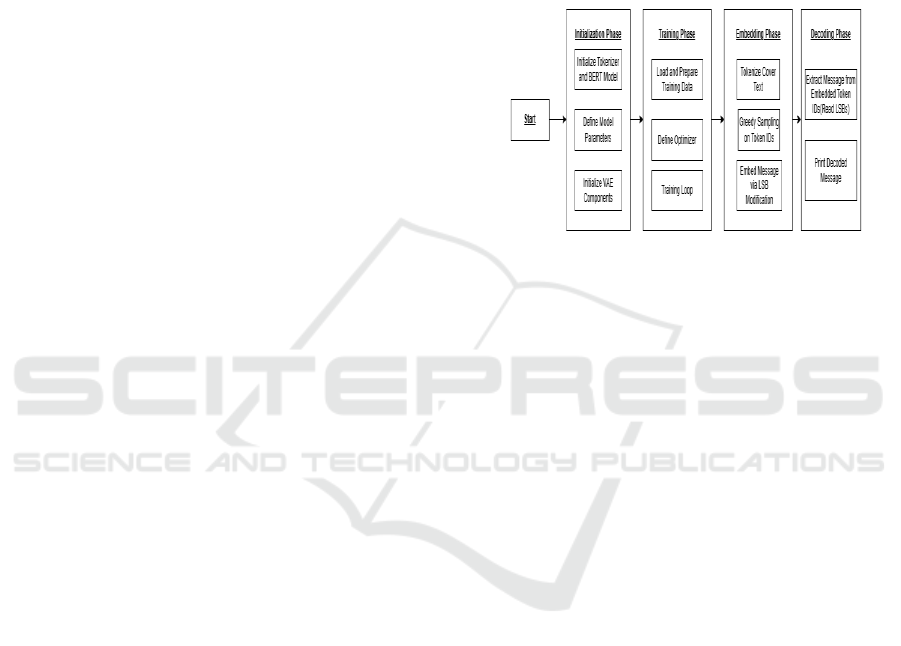
The proposed scheme for the text steganography
framework can be outlined into several key stages,
which reflect the structure and logic of the code as
well. Figure 1 illustrates the proposed system.
Figure 1: Proposed Workflow.
3.1 Data Preparation
The initial phase of the code involves the acquisition
and preprocessing of textual data derived from
multiple sources, including social media content (e.g.,
Twitter), news articles, and film critiques. This
procedure is executed by the Text Dataset Loader
class, which effectively cleans the text to eliminate
extraneous elements and readies it for the training
process. Then comes the tokenization of the dataset
with the help of a tokenizer, just like one seen within
the BERT model, turning the textual data to be fed
into the model to the relevant tokens.
3.2 Architectural Framework
The approach integrates covert messages within
natural language texts by employing a Variational
Autoencoder combined with a BERT-based encoder.
The VAE is made of two models: the encoder and
decoder:
The encoder utilizes a BERT model to transform
input text into a latent representation containing
semantic information in a reduced-dimensional
space.
The latent representation can be defined as a
vector that encompasses both the original cover text
and the concealed message, facilitating alterations for
the purpose of embedding covert information.
Advanced Text Steganography Using Variational Autoencoders and Greedy Sampling
813

The decoder reconstructs the input text using the
latent representation. In this way, the output text is
linguistically coherent and looks most natural.
3.3 Message Embedding
A greedy embedding algorithm is used that changes
token sequences in order to encode the secret message
within the latent space. The strategy works by
adjusting the latent representation in a way that does
not change the overall meaning or fluency of the
cover text much while embedding the message bits.
The algorithm translates the hidden message into
changes of tokens that are along the lines of natural
language changing, thereby ensuring minimal
distortion in the underlying text.
3.4 Training the Model
The VAE model is trained with the prepared datasets
that learn meaningful latent representations, capable
of encoding and decoding text correctly.
Through training, the loss function is designed to
improve at once the fidelity of the reconstructed cover
text and the potential capacity of introducing the
hidden message. This requires a delicate balance
between minimizing the reconstruction loss that
preserves text quality and maximizing the
information capacity of the latent space.
3.5 Message Decoding
After this embedding procedure, the embedded
message within the text could then be fed to the model
to decode the secret information.
The decoding procedure involves converting the
latent representation back to the original secret
message bits, and thus recovering the information
which is embedded in the token sequences.
3.6 Testing
The performance of the model is scored on three
primary evaluation metrics:
● Perplexity: Perplexity serves as a widely utilized
metric within the realms of language modeling and
various generative models for assessing the accuracy
with which a model forecasts a sequence of text.
Typically, a reduced perplexity score signifies that
the model demonstrates enhanced capabilities in
predicting the next word in the sequence, implying an
improved comprehension of the fundamental
structure of the text.
Mathematically, for a sequence of tokens w
1
,w
2
,..,w
n
,
the perplexity is defined as:
Perplexity =
Here:
● P is the probability that the model assigns to the
token w
i
, given the preceding tokens.
● n is the total number of tokens in the sequence.
● Encoded Bits per Second: Ebps is a measure of
the amount of information in bits that can be encoded
and therefore hidden inside a given medium, such as
text, images, or audio, within a time unit-per-second.
A greater Ebps indicates a higher amount of
information for encoding or concealment within a
unit of time, thus representing a metric of efficiency
and capacity of an encoding system.
To calculate Ebps, you need:
● Total bits encoded (B): The total number of bits
of hidden information embedded within the generated
text or medium.
● Encoding time (T): The time taken to encode
those bits into the medium.
Then, the formula for Ebps is:
● Total Encoding Time: Total encoding time is the
duration it takes to embed a predetermined amount of
hidden information into a cover medium, which can
be text, images, or sound, using a steganographic
model. It provides a time estimate that is essential for
understanding how much an encoding protocol will
efficiently accomplish especially in the context of
real-time or near-real-time data transfer applications,
such as clandestine communication or secure
messaging. Total encoding time is typically measured
by timing the process of embedding information into
the cover medium. This is often done by:
1. Starting a timer at the beginning of the
encoding process.
2. Stopping the timer once the entire payload
(hidden data) has been embedded.
3. Measuring the elapsed time, which represents
the total encoding time.
4 IMPLEMENTATIONS
Our method involves using a BERT-based
Variational Autoencoder (VAE) as shown in figure 2
combined with an encoding framework for
steganographic messages to produce coherent text
while securely embedding binary information within
the generated sequences.
ICRDICCT‘25 2025 - INTERNATIONAL CONFERENCE ON RESEARCH AND DEVELOPMENT IN INFORMATION,
COMMUNICATION, AND COMPUTING TECHNOLOGIES
814

Figure 2: Sequence diagram of model workflow.
The encoder employs a pre-trained BERT model,
specifically bert-base-uncased, to produce high-
dimensional, contextually rich embeddings which are
the result of text sequences as inputs. These
embeddings are subsequently passed through
multiple fully connected layers in order to compute
the mean and log variance
parameters of a
Gaussian that defines the latent space. This sampling
technique allows for backpropagation through the
stochastic layer, thereby ensuring that z is always
differentiable during training.
The decoder uses a LSTM network to reconstruct
the input sequence by successively sampling tokens
from z. Finally, the LSTM outputs are passed through
a linear layer so that they become token probabilities
for enabling sampling methods or greedy decoding
over text.
Using the reparameterization trick, the latent
variable z is sampled as
N(0,I)
The training utilizes a combined loss function
with reconstruction loss, such as maximizing the
similarity of the input and generated text sequences,
while adding to this Kullback-Leibler divergence in
order to force the latent space into behaving like a
standard Gaussian distribution. This combination
ensures that the VAE produces diverse and
semantically coherent text outputs.
A steganographic encoding function integrates
binary messages into the produced text through
alterations to the least significant bits (LSB) of
chosen token identifiers. The sequence resulting from
this process retains semantic coherence while
embedding the information in a covert manner. A
decoding function decrypts these transformed tokens
to retrieve the original binary message, thereby
validating the correctness of the message.
Text generation and message embedding process:
During inference, the VAE generates text sequence
through sampling of latent space. It integrates the
binary message into such a way through this sequence
that the output becomes indistinguishable from the
typical VAE-generated text but contains a hidden
message. The methodology really integrates
variational text generation with an innovative
steganographic embedding technique and exemplifies
such effectiveness in situations requiring secure
communication of messages through natural
language text.
5 OUTPUT
Figure 3: Demonstration of the model.
5.1 Original Token IDs
The given cover text is tokenized using the BERT
tokenizer, which converts the input text into a
sequence of token IDs. In this case, the Original
Token IDs are as shown in figure 3.
[30400,30400,18725,18725, 18725,,18725][30400,
30400, 18725, 18725, 18725, \dots,
18725][30400,30400,18725,18725,18725,…,18725]
This represents the initial representation of the
cover text before embedding the secret message.
5.2 Embedded Token IDs
After encoding the secret message, the token
sequence is modified to conceal the binary
information of the hidden message. The Embedded
Token IDs are as shown in figure 3:
[30400,30401,18725,18724,18725,…,18725]
Here, slight perturbations in token values indicate
that the model has embedded the binary-encoded
Advanced Text Steganography Using Variational Autoencoders and Greedy Sampling
815

secret message within the token sequence while
preserving semantic coherence.
5.3 Embedded Text Representation
When converted back into text, the Embedded Text
consists of a sequence of words, including a mix of
meaningful and potentially out-of-vocabulary tokens
such as as shown in figure 3:
{"##朝木 intercontinentaltility inter
continentaltilitytilitytilitytility intercontinental ..."}
This text representation maintains linguistic
coherence while embedding the hidden message.
5.4 Encoding Details
Encoded Token IDs as shown in figure 3: The
resulting token sequence after encoding.
Number of Embedded Tokens: 29 tokens were
modified to embed the secret message.
Key Size: 16 bits, corresponding to the binary
representation of the secret message.
5.5 Decoding and Recovery
The Decoded Secret Message is extracted by
reversing the embedding process and converting the
binary data back into text. The output confirms
successful recovery as shown in figure 3:
"Original Secret Message: hi"
"Decoded Secret Message: hi"
This confirms the model's ability to reliably encode
and decode secret messages within natural language
text while preserving readability and structure.
6 EVALUATION
We will evaluate the effectiveness of our Variational
Auto-Encoder steganography method through several
metrics, including:
Perplexity: The perplexity of the model trained
came out to be 566.02. as shown in figure 4.
Encoded bits per second: The encoded bits per
second for our method came out to be 16.74
bits/second.
Total Encoding Time: The total encoding time
came out to be 0.4780 seconds.
7 RESULTS AND DISCUSSION
Initial experiments reveal that our method of using
VAE Stega actually does embed secret information
and retains readability in addition to grammatical
accuracy. The capacity for steganography without a
loss to the text naturalness through latent encoding in
the VAE as well as use of contextual generation by
using the BERT tokenizer facilitates the overall
embedding of a hidden piece of information naturally.
The dual benefits allow the model smooth integration
of this hidden information leading to high encoding
efficiency alongside perceived quality in the output
texts.
Comparing our results to previous works in the same
field:
Figure 4: Perplexity Comparison between proposed model
and existing systems.
8 CONCLUSIONS
This work presents a new idea of text steganography
using VAE Stega, taking latent space encoding
through VAE and context-aware generation through
BERT tokenizer. Our results show that this
framework effectively balances the embedding
capability for information with high readability and
grammatical accuracy to decrease the risks of
detection without sacrifice on the fluency of the
natural text flow. Subsequent studies will focus on
improving the latent encoding procedures while
considering semantic coherence to make text
steganography methods more robust and practical.
REFERENCES
Abdallah, A., & Osman, M. (2020). A Survey on Deep
Learning Techniques for Privacy and Security in Text
ICRDICCT‘25 2025 - INTERNATIONAL CONFERENCE ON RESEARCH AND DEVELOPMENT IN INFORMATION,
COMMUNICATION, AND COMPUTING TECHNOLOGIES
816

Generation. Journal of Information Security and
Applications, 52, 102484.
Abdelnabi, S., & Fritz, M. (2009). Adversarial
Watermarking Transformer: Towards Tracing Text
Provenance with Data Hiding. CISPA Helmholtz
Center for Information Security.
Brown, T., Mann, B., & Ryder, N. (2020). Language
Models are Few-Shot Learners. arXiv preprint
arXiv:2005.14165.
Chen, X., Yu, Z., Wang, J., & Zhang, X. (2023). Generative
Text Steganography with Large Language Model.
arXiv.
Dai, Z., Yang, Z., Yang, Y., Carbonell, J., Le, Q., &
Salakhutdinov, R. (2019). Transformer-XL: Attentive
language models beyond a fixed-length context. In
Proceedings of the 57th Annual Meeting of the
Association for Computational Linguistics (pp. 2978–
2988). Association for Computational Linguistics.
Feng, C., Xu, Y., & Chen, W. (2020). Optimizing Text
Steganography for High Capacity and Low
Detectability. Applied Intelligence, 50(2), 507–518.
Gu, J., Liu, Q., & Cho, K. (2018). DialogWAE: Learning
Turn-Level Variational Latent Actions for
Conversations. In Proceedings of the 57th Annual
Meeting of the Association for Computational
Linguistics (pp. 1233–1242). Association for
Computational Linguistics.
Jinyang Ding, Kejiang Chen, Yaofei Wang, Na Zhao,
Weiming Zhang, and Nenghai Yu. 2023.Discop:
Provably Secure Steganography in Practice Based on
“Distribution Copies”. In 2023 IEEE Symposium on
Security and Privacy (SP). IEEE Computer Society,
2238–2255.
Kang, H. X., Wu, H. Z., & Zhang, X. P. (2020). Generative
Text Steganography Based on LSTM Network and
Attention Mechanism with Keywords
Li, L. J., Huang, L. S., & Zhao, X. X. (2008). A Statistical
Attack on a Kind of Word-Shift Text Steganography
Liu, S., Zhang, S., & Chen, Y. (2021). Hierarchical Text
Embedding for Robust Steganography in the Latent
Space. IEEE Access, 9, 1784–1796.
Luo, X., & Chen, X. (2019). Latent Space Manipulation for
Enhanced Text Steganography Using Variational
Autoencoders. Pattern Recognition Letters, 128, 311–
319.
Moraldo, H. H. (2014). An Approach for Text
Steganography Based on Markov Chains
Shen, S., Tan, H., Zhang, Y., Feng, J., & Zhou, M. (2017).
Style Transfer from Non-Parallel Text by Cross-
Alignment. In Advances in Neural Information
Processing Systems (Vol. 30, pp. 6830–6841). Curran
Associates, Inc.
Siyu Zhang, Zhongliang Yang, Jinshuai Yang, and
Yongfeng Huang. 2021.Provably Secure Generative
Linguistic Steganography. In Findings of the
Association for Computational Linguistics: ACL-
IJCNLP 2021. 3046–3055.
Ueoka, H., Murawaki, Y., & Kurohashi, S. (2021).
Frustratingly easy edit-based linguistic steganography
with a masked language model. arXiv:2104.09833v1.
Wu, H., Kang, H., & Yang, H. (2021). Neural Text
Steganography Based on Adversarial Training. IEEE
Transactions on Neural Networks and Learning
Systems, 32(1), 127–138.
Yang, Z., Wang, K., Li, J., & Huang, Y. (2019). TS-RNN:
Text Steganalysis Based on Recurrent Neural
Networks. IEEE Signal Processing Letters, 26(4), 627-
631.
Yang, Z., Xiang, L., Zhang, S., Sun, X., & Huang, Y.
(2021). Linguistic generative steganography with
enhanced cognitive-imperceptibility. IEEE Signal
Processing Letters, 28(4), 409-413.
Zachary Ziegler, Yuntian Deng, and Alexander M Rush.
2019.Neural Linguistic Steganography. Proceedings of
the 2019 Conference on Empirical Methods in Natural
Language Processing and the 9th International Joint
Conference on Natural Language Processing (EMNLP-
IJCNLP). 1210–1215.
Zhang, Z., Zhao, Y., & Liu, Y. (2022). An Efficient RNN-
Based Steganalysis Model for Detecting Text
Steganography. Journal of Information Security and
Applications, 63, 103111.
Ziegler, Z. M., Deng, Y., & Rush, A. M. (2019). Neural
Linguistic Steganography
Advanced Text Steganography Using Variational Autoencoders and Greedy Sampling
817
