
A Machine Learning‑Driven Crisis Management System: Real‑Time
Incident Reporting and Response Optimization
A. R. Dhedeep Reddy, Shamil Saidu Mohamed, Hareni M., Harini C. J. and Gayathri R.
Department of Computer Science and Engineering, Amrita School of Computing, Amrita Vishwa Vidyapeetam, Bengaluru,
Amrita Nagar, Choodasandra, Junnasandra, Bengaluru, Karnataka, India
Keywords: Crisis Management, Machine Learning, CNN, Incident Reporting, Emergency Response, MongoDB Atlas,
next.js, Admin Dashboard, Crisis Classification, Real‑Time Communication.
Abstract: The Crisis Management System seeks to improve the coordination of emergency management through real-
time incident reporting and the categorization of crises. The two major end users of the system are the normal
users who have the privileges to submit reports and undergo crisis management training, and the admins who
review the reports, give follow- up on current crises, and coordinate with the responders. At the center of the
system is a Convolutional Neural Network that may be employed for accurate predictions in the type of crisis
at hand and, in its essence, hurries decision-making processes. The platform will be best complemented with
modern machine learning techniques and cutting-edge web technologies to optimize crisis management and,
by default, increase response times and coordination. It is fully developed using Next.js, with MongoDB Atlas
for data storage security.
1 INTRODUCTION
Whether it be a natural disaster, a security threat, or
an accident, at the time of every emergency, crisis
management plays a very important role. Traditional
systems for handling crises come with serious
limitations in handling and a number of other issues.
Issues like delayed reporting, methods of outdated
communication, and slow responses may worsen the
case. For example, an absolute reliance on phone calls
and site reports results in repetition of information at
the top, thus creating bottlenecks leading to a snail’s
pace reaction by the authorities and lousy
coordination at critical junctures. Lack of a common
platform on the training which is to be imparted,
incident reporting, and monitoring of performances
results in less preparedness of the responders and
administrators in handling the crisis effectively.
For today’s emergencies, our approach needs to be
wiser and responsive—so that it maintains the speed
of real-time data, enables clear communication, and
quickly moves toward informed decisions. That’s
where the new Crisis Management System comes in:
it streamlines reporting, amplifies coordination in
crisis, and adds insight via machine learning for better
resource allocation and fast responses. There are two
major types of users for this system: the regular users
and the admins. This would provide ease for regular
users in creating their profiles, submitting incident
reports, and accessing useful resources such as
detailed guides on how to respond in various
emergencies and quizzes to help them test and
improve their skills in crisis management. Feedback
from such quizzes helps the users to assess their
knowledge and become more confident to handle any
response when called upon.
The admins serve as the bridge between the users
and the authorities. They receive the reports, review
them, and pass on the critical information to the right
responders. In return, they avail data of the incidents
to the admins, who develop a log of the crisis with its
status and continued communication with the user for
better timely and coordinated response.
Equally impressive is the application of a machine
learning model—a Convolutional Neural Network, or
CNN—that automatically analyzes incident
descriptions to predict the type of crisis. Quick
classification of a crisis cuts down time taken for
situational understanding and therefore yields better
response accuracy.
Information about users, incident reports, and
quiz results is safely stored in MongoDB Atlas for
scalability and reliability of the system. The system’s
804
Reddy, A. R. D., Mohamed, S. S., M., H., J., H. C. and R., G.
A Machine Learning-Driven Crisis Management System: Real-Time Incident Reporting and Response Optimization.
DOI: 10.5220/0013921000004919
Paper published under CC license (CC BY-NC-ND 4.0)
In Proceedings of the 1st International Conference on Research and Development in Information, Communication, and Computing Technologies (ICRDICCT‘25 2025) - Volume 4, pages
804-810
ISBN: 978-989-758-777-1
Proceedings Copyright © 2025 by SCITEPRESS – Science and Technology Publications, Lda.

frontend is designed using Next.js to ensure a
seamless, dynamic user experience when taking up
training courses, submitting reports, or getting in
contact with an admin.
In all, this new Crisis Management System takes
the cumbersome, inefficient processes of traditional
systems and replaces them with a streamlined, real-
time platform for re- porting, crisis classification,
training, and communication. The system predicts
crises with the help of machine learning and classifies
them, while its ground on recent web technologies
makes life much easier for one and all. Indeed, both
users and admins are likely to respond to any
emergency more speedily, effectively, and safely.
These tools enable the unexpected to be far better
dealt with by society, because crisis responses are
much quicker and more accurate at all levels.
2 RELATED WORKS
Wodak, Ruth., In the context of the COVID-19
pandemic, governments worldwide have utilized
various methods to legitimize and communicate their
restrictive measures. Based on comparative
discourse-historical analysis of Austria, Germany,
France, Hungary, and Sweden during the lockdown
from March to May 2020, four main frames can be
identified: religious, dialogic, trust-building, and war-
oriented. These framing strategies thus serve a double
function: addressing public fears while legitimizing
specific actions, such as border closures and
renationalization within the EU. Such measures
underlined the importance of biopolitics,
emphasizing the priorities of common health in a
global crisis.
Lai, Ivan Ka Wai, and Jose Weng Chou Wong.,
2021, The Macau hospitality industry also responded
dynamically to the pandemic. In one study on
strategies adopted by hotels in early 2020, six critical
practice categories were identified: pricing,
marketing, maintenance, human resources,
government assistance, and epidemic prevention. In
the initial phase, epidemic prevention was the top
priority, with selective pricing and maintenance
strategies. As the pandemic developed, emphasis
shifted toward deferred maintenance and furloughs,
showing adaptability in crisis management
approaches.
Gu¨ndog˘an, Mete, and Murat Ata. 2021, Fair
distribution of resources is a major concern in any
crisis situation, especially when the resources are not
sufficient. A resource management model was
proposed that can monitor individual consumption
and needs in real time by leveraging technological
tools for ethical and data-driven decision- making.
While voluntary compliance is ideal, transparent and
fair resource allocation mechanisms are critical in
coercive scenarios. This model, developed using
the ’Structured System Analysis and Design Method,’
serves as a practical framework for ensuring fairness
and efficiency.
Grissa, et al., 2023, Organizations are able to
show flexibility in any given situation and thus
exercise effective crisis management. The
introduction of the OSminer algorithm brought out
relationships such as power, control, and coordination
among actors in organizational structures that evolve
in crises. Application of this algorithm to a flood
crisis in southwest France revealed a network
comprising 24 actors. However, this is powerful, and
limitations in robustness and adaptability suggest that
there is still room for refinement with regard to
organizational analysis tools.
Dai, et al, 2020, The problems involved in
environmental crises require a systematic research
framework due to their intricacies. In analyzing the
literature using NoteExpress and Ucinet, there is
evidence that climate change forms one of the central
issues in research regarding environmental crisis
management. Some of the important identified
research topics are environmental crisis types,
governance strategies, technology applications, and
micro-governance. Therefore, it helps give the
direction for the future by identifying the
categorization based on management practices, uses
of technology, and theoretical approaches so far used.
Munawar, et al, 2020., Effective crisis
management must address both the psycho- logical
and material aspects of crises. Governmental
communication strategies in the time of the pandemic
have illustrated how framing of policies can be used
to reduce fear without losing trust. Similarly,
technological solutions, such as real-time monitoring
of resource use, ensure equity and transparency,
paving the way for resilient and ethical crisis
management systems.
Anju Paul, et al, 2015, Collaborative strategies are
crucial in reinforcing crisis response frameworks. As
identified, the OSminer algorithm establishes that the
analysis and optimization of stakeholder interaction
strengthen organizational structures toward adapt-
ability. When utilized with environmental crisis
management strategies, such tools bridge immediate
crisis response with long-term sustainability goals,
allowing societies to build up resilience against future
challenges.
A Machine Learning-Driven Crisis Management System: Real-Time Incident Reporting and Response Optimization
805
In pandemic management, considerable emphasis
has been placed on how trust and leadership have
fundamental roles in crisis communication. Leaders
acting as the ’faces of crisis management’ utilize
rhetoric to align the sentiments of the public by
framing government action as an enactment of
collective solidarity, a moral obligation, or national
resilience. These communication strategies were very
useful in maintaining compliance by the public with
health measures and mitigating fear, according to
discourses of EU member states during the COVID-
19 pandemic. Anju Paul., et al, 2015, The
metaphor ’fighting a war’ was generally used to unite
citizens under one cause and also as a way to reinforce
the perceived legitimacy of far- reaching policy
measures, including lockdowns and movement
restrictions. Ramasamy, V., et al., Beyond crisis
communication, technological advancements also
shifted the resource allocation model. Real-time data
analytics and AI are increasingly being used to
forecast demand and improve the distribution of
resources during emergencies. Vimala, S., et al, 2013,
For instance, embedding AI-based decision-support
systems into traditional frameworks of resource
management has shown improvements in both equity
and efficiency, especially in urban areas characterized
by high demand volatility. Mukherjee and D. Saha,
However, such systems also raise ethical concerns
about surveillance and data privacy, emphasizing the
need for trans- parent governance mechanisms.
Sandhya Harikumar, et al., 2013 While the
pandemic severely dampened the hospitality sector,
certain lessons in resilience through different
adaptive strategies can also be garnered. Case studies
indicate that diversification of revenue streams,
adopting stringent safety protocols, and embracing
digital marketing enabled hotels to weather the crisis
more successfully. For example, the move to
contactless technologies, such as mobile check-ins
and automated cleaning systems, resolved safety
concerns and further enhanced customer trust and
satisfaction. These innovations highlight how
technology has been instrumental in transforming
crisis management practices across industries.
3 METHODOLOGY
The proposed system for Crisis Management
incorporates a comprehensive multi-component
architecture that offers efficient handling of various
crisis-related activities, including incident reporting,
crisis prediction, training modules, and real-time chat
functionalities. This methodology outlines the step-
by-step implementation and integration in the system,
by making use of modern web technologies, machine
learning, and cloud-based database systems.
3.1 Incident Management
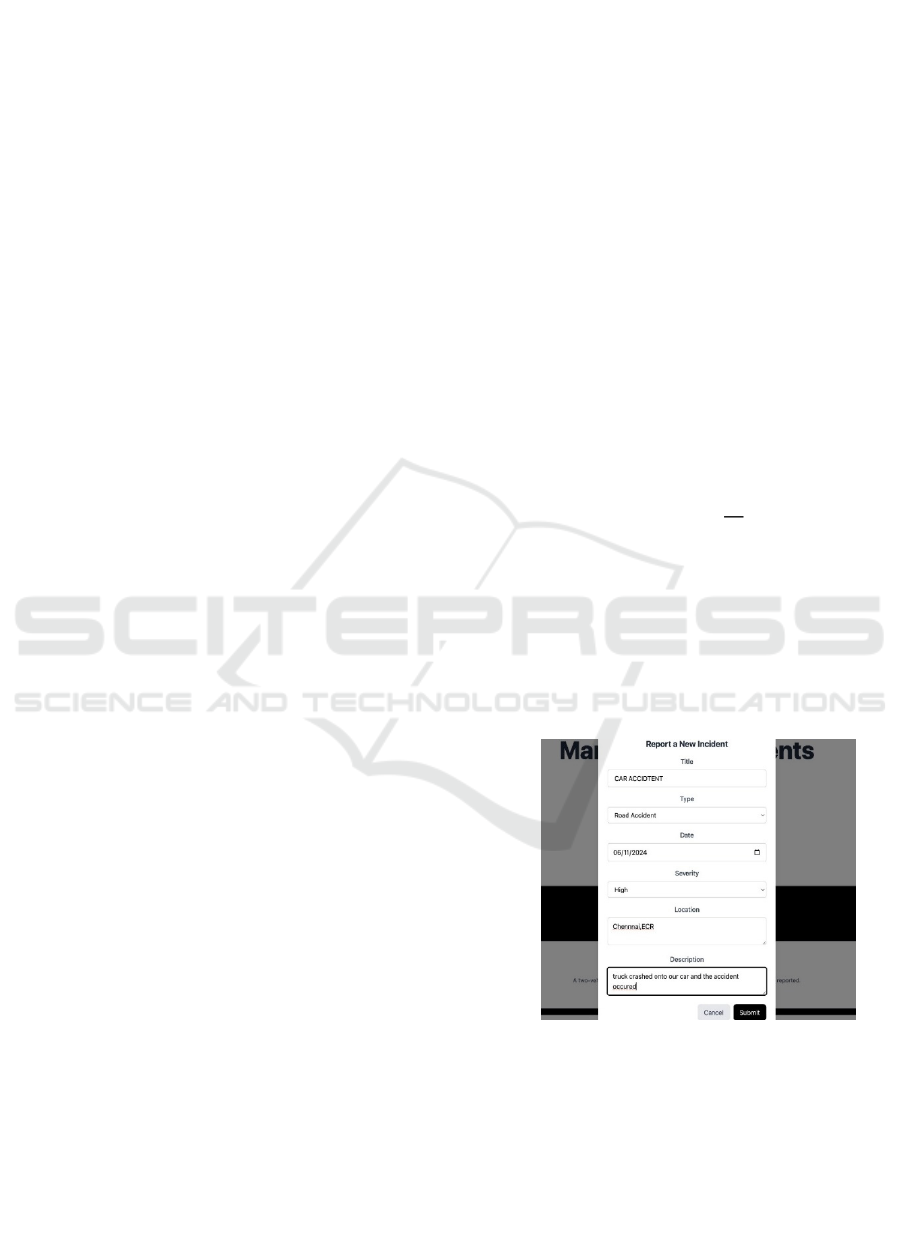
The system allows the user to report crises efficiently
through its user-friendly web interface. The incident
management steps are as follows:
3.1.1 Incident Reporting
Next.js has a nicely designed frontend, through which
users can submit detailed reports regarding crises,
including title and description of the incident,
criticality level, location, and whether optional files
are attached or not.
3.1.2 Incident Data Storage
Each incident will be persisted in the MongoDB
database via Prisma ORM. Key fields in this database
schema will include incident id, user ID, type,
severity level, description, and status.
3.1.3 Real-time Updates
Admins can view the submitted incidents through
their dashboard, which categorizes incidents based on
their status: Not Viewed, Viewed, and Action Taken.
Figure 1 shows the incident report.
Figure 1: Incident report.
3.2 Crisis Prediction Model
The system utilizes a CNN-based machine learning
model designed to categorize crisis incidents into
different classes. The process follows these steps:
ICRDICCT‘25 2025 - INTERNATIONAL CONFERENCE ON RESEARCH AND DEVELOPMENT IN INFORMATION,
COMMUNICATION, AND COMPUTING TECHNOLOGIES
806
3.2.1 Preparing the Dataset
The datasets are preprocessed and tokenized, with
each crisis type being mapped to an integer value,
such as:
• Infrastructure and Utilities Damage
• Volunteering for Rescue Efforts and Donation
Ef- forts
• Medical and Humanitarian Needs
• Affected Individuals
• Other Relevant Details
• Not Relevant
3.2.2 Word2Vec Embeddings
Pre-trained Word2Vec embed- dings are used to
convert the text into vector representations.
3.2.3 Data Preprocessing
Incident descriptions are tokenized, padded to a
length of 100, and the labels are transformed into
categorical formats.
3.2.4 Model Architecture
The architecture of the CNN model includes:
• An embedding layer with frozen Word2Vec
weights
• A 1D convolutional layer with 128 filters
and a kernel size of 5
• Global max-pooling, a dense layer with
128 units, and dropout
• An output layer with a SoftMax activation
function for multi-class classification
3.2.5 Model Training
The model is trained using categorical cross-
entropy loss and the Adam optimizer, for 10
epochs with a batch size of 32. The best-
performing model is saved using Model
Checkpoint.
3.3 Training and Quiz Modules
The system provides a training module with crisis-
specific pages and quizzes to enhance
preparedness. This methodology will include:
• Training Topics: There is crisis-specific
training mate- rial that might be included,
such as Road Accidents or Cyberattacks.
It is presented as pages of an interactive
nature with illustrations.
• Quiz Framework: Current Training on
any particular topic presents a specially
prepared quiz regarding user testing.
Questions, Options, and Answers will
dynamically be fetched from the
database.
• Quiz Result Analysis: It performs the
analysis and provides the statistics of the
user regarding his quizzes through
charts; for example, pie charts for correct
vs. wrong answers and bar charts for
topic-wise performance. These are
implemented using Recharts.
• Leaderboard: A leaderboard showing
the performance against their peers can
act as a motivator to learn continuously.
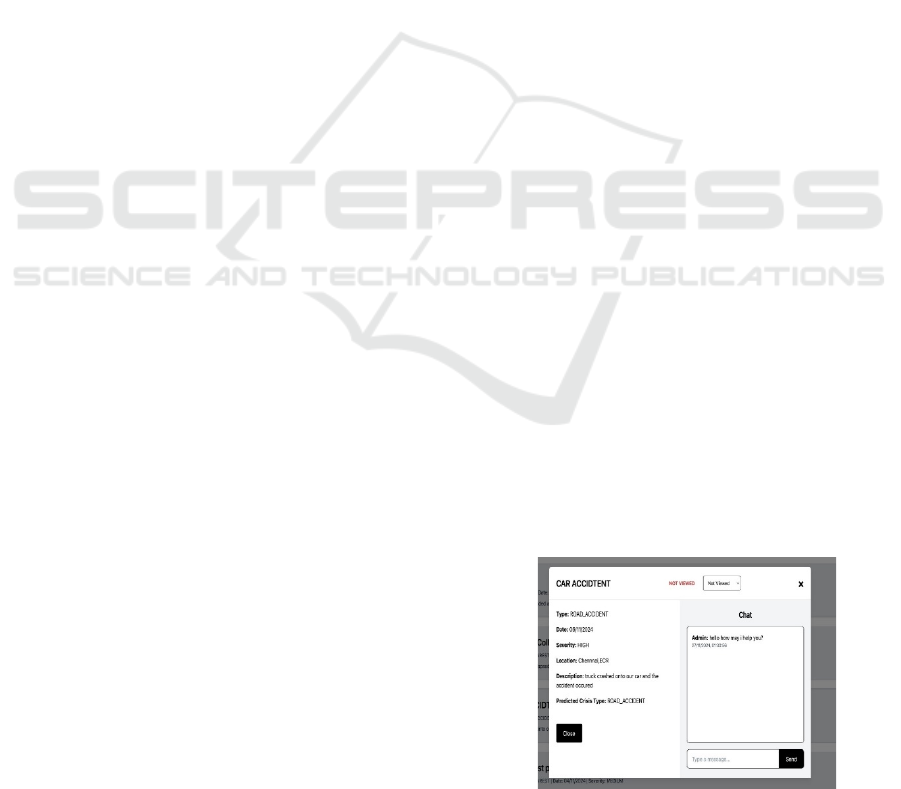
3.4 Real-Time Chat Capability
Apart from all mentioned, the system will include
an embedded chat module where users could
engage in discussions with admins. Figure 2
shows the chat interface. The methodology
includes:
• Integration with Chat: It allows users
and admins to send messages regarding
incidents. Messages are stored in the
ChatMessage table of the database,
including sender ID, message, and
timestamp.
• UI/UX Designing: The user interface is
clean and intuitive, enabling users to
view chat history and send messages in
real time.
• Polling Mechanism: The frontend uses
polling every 5 seconds to fetch the latest
chat messages, ensuring real- time
communication without overloading the
server.
Figure 2: Chat interface.
A Machine Learning-Driven Crisis Management System: Real-Time Incident Reporting and Response Optimization
807
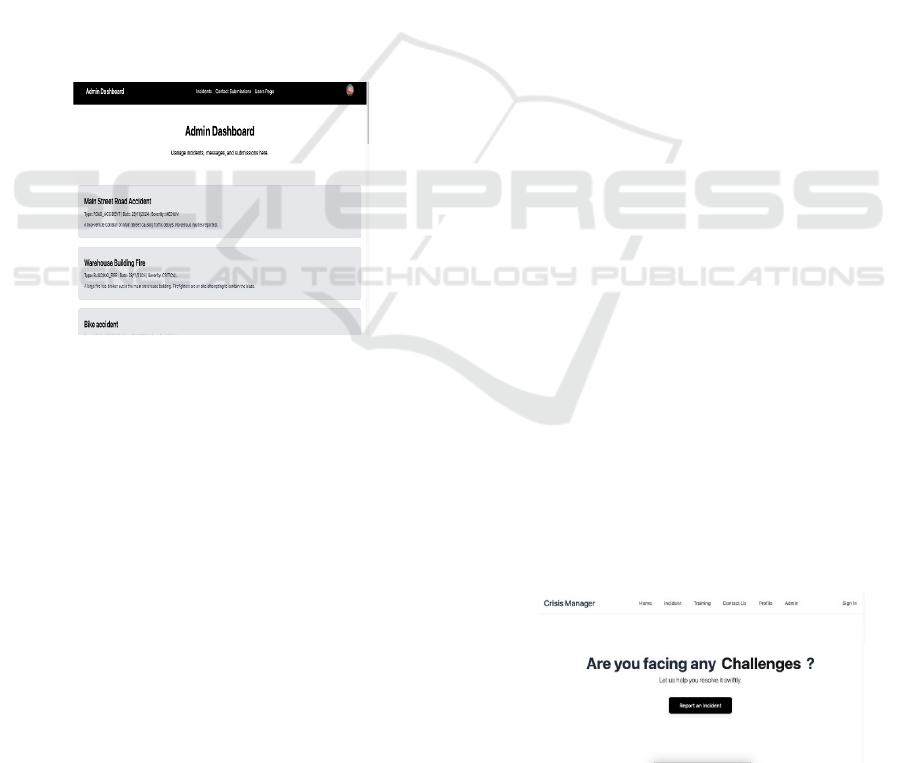
3.5 Admin Dashboard
Figure 3 shows the admin dashboard serves as the
control panel for managing all system features and
includes the following:
• Incident Overview: Incidents are displayed
as cate- gorized tabs with visual indicators
on each incident’s status, such as a color-
coded badge. Admins can mark the status of
an incident (e.g., Not Viewed, Viewed,
Action Taken) and leave comments via chat.
• Contact Submissions: Users can submit
queries or feedback through the” Contact Us”
form, and admins can view these
submissions on a dedicated dashboard page.
• Prediction Monitoring: The admin
dashboard displays crisis predictions for
maximum transparency in crisis
categorization. If a prediction is unavailable,
admins can manually trigger the prediction
script.
Figure 3: Admin dashboard.
3.6 User Authentication and
Authorization
The system uses Clerk for user authentication and
role- based authorization to securely grant access to
resources. The methodology includes:
• User Roles: The platform supports two
types of users: Users and Admins. Each
role has specific privileges, such as
incident reporting for users and incident
management for admins.
• Authentication Integration: Clerk’s
API is used both on the frontend and
backend, enabling seamless login and
secure API calls using user-specific
tokens.
• Role Verification: API endpoints
verify user roles to prevent
unauthorized access.
3.7 Database Design
Our database schema, implemented with Prisma and
Mon- goDB, follows these basic design principles:
• Incident Table: Stores all reported
incidents with fields for type, severity,
description, and status.
• Prediction Table: Stores crisis
predictions associated with each
incident.
• ChatMessage Table: Logs all chat
messages exchanged between users and
admins.
• QuizStat Table: Tracks quiz
performance statistics, including total
attempts, correct answers, and wrong
answers.
3.8 UI/UX Design Principles
The frontend stack involves Next.js, Tailwind CSS,
with authentication handled by Clerk. Figure 4 shows
the homepages. This makes sure that the user
interface is modern and responsive. Key design
principles include the following:
• Consistency: Uniform design elements,
such as color schemes (white
backgrounds with black/gray text),
animations, and spacing, ensure a
polished look.
• Accessibility: High contrast text,
proper labeling, and keyboard
navigation make it accessible for all
types of users.
• Responsive Design: The platform
adapts seamlessly to various screen
sizes, from desktops to mobile devices.
Figure 4: Homepage.
ICRDICCT‘25 2025 - INTERNATIONAL CONFERENCE ON RESEARCH AND DEVELOPMENT IN INFORMATION,
COMMUNICATION, AND COMPUTING TECHNOLOGIES
808

The application is deployed on AWS, which has
the following setup:
• Frontend Hosting: Next.js app
• Backend APIs: The Next.js APIs
• Database Hosting: MongoDB Atlas for
secure, scalable, and cloud-based
database management hosted on Vercel.
4 RESULTS AND EVALUATION
This project integrates incident reporting, crisis
prediction, training, and real-time communication
into the crisis management system. Users will report
incidents via a Next.js frontend; data is maintained on
a real-time-updating MongoDB for admins.
Predictions for efficient decision-making are
provided as incidents get categorized into their
respective classes by a CNN-based machine learning
model. A training module comprising interactive
content and quizzes is there for better preparedness; a
leaderboard will keep up the motivation among the
users.
Figure 5: Recent incidents.
Figure 5 displays the list of incidents that is
reported in recent times. This would enable real-time
chat display to users and admins who are going to
communicate regarding incidents. Incident status,
predictions, and feedback on the admin dashboard
will also show up. Use Clerk for implementing secure
user authentication and support of role-based
authorization within this. The ORM data storage shall
be used within this application, maintaining data for
incidents, pre- diction models, and messages in a chat.
It is cloud-deployed, and continuous scalability can
be maintained with the help of CI/CD pipelines.
5 DISCUSSION
The proposed Crisis Management System presents a
well-structured framework that integrates incident
reporting, crisis classification, real-time
communication, and training modules to improve
emergency response efficiency. The use of a
Convolutional Neural Network (CNN) for crisis
classification is a notable strength, as it facilitates
quick and automated identification of crisis types
based on incident descriptions. The incorporation of
Next.js for frontend development ensures a seamless
user experience, while MongoDB Atlas enhances
scalability and security in data management.
Additionally, the integration of Clerk for
authentication strengthens role-based access control,
ensuring secure interactions within the system.
However, while the system demonstrates
significant improvements over traditional crisis
management approaches, certain aspects can be
enhanced for greater effectiveness. Firstly, the CNN
model relies on text-based crisis descriptions, which
may lead to misclassification due to ambiguities in
reporting. Incorporating multimodal inputs, such as
image and video analysis using deep learning
techniques, could improve classification accuracy.
Secondly, the system lacks an automated decision-
support mechanism that suggests optimal response
strategies based on crisis severity and available
resources. Implementing reinforcement learning
models or optimization algorithms could further
enhance decision-making. Additionally, while real-
time chat enables direct communication, introducing
a chatbot powered by natural language processing
(NLP) could assist users in submitting well-structured
reports and provide instant guidance. Lastly, the
training module, while interactive, could be expanded
with scenario-based simulations using gamification
techniques to better engage users and improve crisis
preparedness.
Overall, the Crisis Management System offers a
promising solution for improving emergency
response efficiency, but further enhancements in
crisis classification, decision support, and user
engagement could significantly refine its impact and
usability.
6 CONCLUSIONS
This holistic crisis management and incident response
framework provides a focused approach to crisis
management and minimizing risks. The framework
ensures timely detection of incidents, accurate
assessment, and rapid resolution of incidents through
the integration of advanced technology, effective
communication channels, and optimized processes. It
emphasizes proactive planning, real-time
A Machine Learning-Driven Crisis Management System: Real-Time Incident Reporting and Response Optimization
809

collaboration, and post-incident evaluation for
continuous improvement in readiness and resilience.
This strategy gives businesses the ability to reduce
interruptions, safeguard assets, and guarantee the
security and welfare of all parties involved in a crisis.
REFERENCES
A. Mukherjee and D. Saha, “An optimal file allocation
policy in a networked database management system”,
Int’l journal of Network Management, vol. 4, no 4, Dec
’94, p 218-23, USA.
Anju Paul, E V Sunitha, Distortion less watermarking of
relational databases based on circular histogram
modulation, IEEE International Conference on Circuit,
Power and Computing Technologies, 2015.
Anju Paul, Sunitha EV, “Watermarking of Relational
Databases using Video”, International Journal of
Science, Engineering and Technology Research
(IJSETR),2015.
Dai, Shengli, Xin Duan, and Wei Zhang.” Knowledge map
of en- vironmental crisis management based on
keywords network and co- word analysis, 2005–2018.”
Journal of Cleaner Production 262 (2020): 121168.
Grissa, Dhouha, Eric Andonoff, and Chihab Hanachi.”
Discovering and evaluating organizational knowledge
from textual data: Application to crisis management.”
Data Knowledge Engineering 148 (2023): 102237.
Gu¨ndog˘an, Mete, and Murat Ata.” Resource management
in crisis situations.” Avrupa Bilim ve Teknoloji Dergisi
27 (2021): 935-941.
Lai, Ivan Ka Wai, and Jose Weng Chou Wong. ”
Comparing crisis management practices in the hotel
industry between initial and pandemic stages of
COVID-19.” International Journal of Contemporary
Hospitality Management 32.10 (2020): 3135-3156.
Munawar, Hafiz Suliman, et al.” Big data and its
applications in smart real estate and the disaster
management life cycle: A systematic analysis.” Big
Data and Cognitive Computing 4.2 (2020)
Ramasamy, V., Nadarajan, R., Thilaga, M., Nirmala, P. “A
Novel Approach for Detection and Elimination of
Automorphic Graphs in Graph Databases,”
International Journal of Open Problems in Computer
Science and Mathematics, Vol. 3(1), pp. 56-72.
Sandhya Harikumar, Haripriya, H., and Kaimal, M. R.,
“Implementation of projected clustering based on SQL
queries and UDFs in relational databases”, in Intelligent
Computational Systems (RAICS), 2013 IEEE Recent
Advances in, Trivandrum, 2013.
Vimala, S., Nehemiah, H. K., Bhuvaneswaran, R. S.,
Saranya, G. (2013). Design Methodology for Relational
Databases: Issues Related to Ternary Relationships in
Entity-relationship Model and Higher Normal Forms.
International Journal of Database Management
Systems, 5(3), 15.
Wodak, Ruth.” Crisis communication and crisis
management during COVID-19.” Global Discourse
11.3 (2021): 329-353.
ICRDICCT‘25 2025 - INTERNATIONAL CONFERENCE ON RESEARCH AND DEVELOPMENT IN INFORMATION,
COMMUNICATION, AND COMPUTING TECHNOLOGIES
810
